(Gold- und Silberschmiede)Biblio.com

19 040 résultats
réf. 5f2408Verschiedene Auflagen und Verlage 1968-2000. Insgesamt ca. 2600 S. mit Abbildungen verschiedene Einbände teils quart teils geringe Gebrauchsspuren. - sonst gute Exemplare / Enthalten: Schönes altes Silber. Keysers Handbuch für Sammler und Liebhaber; Manfred Meinz / Der Eisenkunstguß; Eva Schmidt / Gold aus dem Alten Peru. Die Königsgräber von Sipán; Kunst- und Ausstellungshalle der Bundesrepublik Deutschland 15. Dezember 2000 bis 29. April 2001 / Maritimes Silber im Industriezeitalter. Glanzlichter im Alltag der Schiffahrt; Detlev Ellmers / Das Ratssilber der Stadt Köln; Werner Schäfke / Antiquitäten: Gold & Silber; Herausgegeben von Albrecht Bangert / Barocke Silberplastik in Südwestdeutschland; Mane Hering-Mitgau / Hanauer und Kasseler Silber; Ina Schneider und Ekkehard Schmidberger / Silber; Richard Came / Der grosse Goldkelch Bischof Gerhards. Geschichte Frömmigkeit und Kunst um 1400; Michael Wolfson Der Hildesheimer Dom. Studien und Quellen Band 1 / Der Schatz aus Troja. Schliemann und der Mythos des Priamons-Goldes; Wladimir P. Tolstikow und Michail J. Trejster / Von Anbeginn. Vier Jahrtausende Heiliges Land im modernsten Museum der Welt; Karl Katz u.a. / Goldhelm Schwert und Silberschätze. Reichtümer aus 6000 Jahren Rumänischer Vergangenheit; Herausgeber: Stadt Frankfurt am Main - unknown
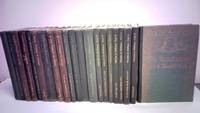
réf. 1g12153Gerhard Stalling Oldenburg/Berlin 1924-1930. Zusammen ca. 5100 S. mit Kartenbeilagen Bildern Textskizzen Anlagen sowie Abb. original Halbleder- und Halbleineneinbände einige Bibliotheksstempel/ 1 Rücken mit Lederausriß. - Enthalten: Bände 5 8 10 11 13-15 17 19 22-27 29 31-36 - unknown
réf. 4c5177The Office London 1848. IV 280 S. mit vielen Holzstichen original Leinen-Verlagseinband quart bestoßen/Name auf Vorsatz und Titel/Einband fleckig/Block gelockert/teils gering fleckig. - sonst gutes Exemplar / innen sauber komplett / good condition / Text englisch - unknown
1579réf. B6621A Lyon: Par Barthelemy Vincent M.D. LXXIX. 1579. . A near fine example reinforcement on margin of leaf B4. Plates are clean and crisp. Binding: Full embossed cotemporary pigskin with central medallion; spine expertly rebacked saving the original with six 6 raised bands gilt lettered title on Morocco label on two; all edges sprinkled red. Notes: Text in Middle French. Second French edition after its first of 1578; first Lyon French edition with commentaries to illustrations by Beroald de Verville. "In 1578 after the death of Besson c. 1572 the Theater of Mathematical and Mechanical Instruments was published in Geneva a work in which we note an evolution in turning techniques with the appearance of the first mandrels and first fixed glasses. Other Geneva editions will follow in French Latin Italian German and finally Spanish until 1602. in rue de la Harpe opposite Saint-Cosme presented twenty-one models of machines eleven of which were executed from the plates of Jacques Besson. … The work belongs to … a genre consisting of presenting series of engravings of instruments and machines often newly invented. These printed writings are used by the inventors in order to protect their invention and to guarantee their right in an irrefutable way. These printed ‘machine’ books appeared in France at the end of the 16th century when the formation of the intermediate class of technicians crystallized grouped together today under the name of engineers. These engineers first appeared in Italy in the 15th century then in Germany and finally in France. … Besson's book which is unanimously considered to be the first true "machine theatre" marks a break with its passage to print. There are sixty figures in all each occupying a full page. Each engraving is accompanied by a legend indicating the manner of construction and its function. … Besson presents four major series of machines: machines for raising water mills cranes and winches. He often suggests ways to multiply the force in order to be able to replace two or three workers with one." “When King Charles IX of France made a royal visit to Orléans in 1569 Besson presented to the King a draft of his new treatise what was to become the Theatrum Instrumentorum. and returned with him to Paris as "master of the King's Engines". Charles gave Besson exclusive rights to his designs in that same year. While employed by the court Besson also created an ingenious screw-cutting lathe that was semi-automatic in that the operator only needed to pull and release a cord. … Besson's Theatrum Instrumentorum Theater of Machines was completed and published in 1571 or 1572. It was a unique work; previously works on engineering and technology such as Valturio's De re militari 1472 Biringuccio's Pirotechnia 1540 and Agricola's De re metallica 1556 had had only limited descriptions of new inventions or recounted inventions of the past without much detail. In contrast Besson's work was a collection of his own new inventions with detailed illustrations of each engraved by Jacques Androuet du Cerceau to his specifications. Some of his designs suggested important improvements to lathes and the waterwheel. The Latin captions to the highly detailed drawings were sparse however which would seem to indicate that the text was probably produced in a hurry. Even the title page does not give the name of the printer or the date of publication. The rush in publishing the book may have been due to the crackdown on French Protestants that culminated in the St. Bartholomew's Day Massacre of 1572. … Although Besson was favoured by King Charles IX he feared the increasing anti-Protestant sentiment in France and emigrated to England shortly after the St. Bartholomew's Day Massacre of 1572 where he died in 1573. … The Theatrum Instrumentorum had proved so popular that a second edition appeared in 1578 with more detailed descriptions of the instruments and machines by François Béroalde de Verville. The copper plates from the original edition were reused except for four which were replaced by new engravings produced by René Boyvin.” Size: Folio 342x238mm. Illustration: Illustrated allegorical wood engraved title; large ornamental and floral woodcut initials head- and tailpieces; moreover sixty 60 insert wood engraved plates depicting mathematical and mechanical instruments and inventions. Provenance: Upper pasted endpaper with a bookplate black ink manuscript ownership note dated 1588. Pages: Ll: bl. 20 60 ill bl.; collation: bl. illustrated title A2-E4 engraved plates numbered 1-60; bl. Category: Book Early Printed 1500; Book Plate Books General; Book Science & Technology; Par Barthelemy Vincent, M.D. LXXIX. hardcover
réf. DADAX1496453026New unknown
réf. DADAX1496452992New unknown
réf. A9781927338896Paperback / softback. New. paperback
réf. DADAX1665907959New unknown
2024réf. x-1032838175Routledge 2024. Paperback. New. 5th edition. 614 pages. 9.68x6.87x1.22 inches. Routledge paperback
réf. DADAX1399712896New unknown
réf. B9781501368394Paperback / softback. New. What happens when fashionable forms of unserious speech prove to be contagious when they adulterate and weaken communicative spheres that rely on honesty trust and sincerity Demonstrating how the tension between irony and avowal constitutes a central conflict in Fontane’s works this book argues that his best-known society novels play out a struggle between the incompatible demands of these two modes of speaking. Read in this light the novels identify an irreconcilable discrepancy between word and deed as both the root of emotional discord and the proximate cause of historical and political upheaval. Given the alarm since 2016 over unreliability falsehood and indifference to truth it is now easier to perceive in Fontane’s novels a profound concern about language that is not sincere and not meant to be taken literally. For Fontane irony exemplifies a discrepancy between language and meaning a loosening of the ethical bond between words and the things to which they refer. His novels investigate the extent to which human relationships can continue to function in the face of pervasive irony and the erosion of language’s credibility. Although Fontane is widely regarded as an ironic writer Tucker’s analyses reveal a critical distance between his works and the prospect of irony as a dominant idiom. Revisiting Fontane’s novels in a post-truth age brings the conflict between irony and avowal into sharper relief and makes legible the stakes and contours of our own post-truth condition. paperback
réf. 003297Boston: n.p. Massachusetts Historical Society 1926. Soft cover. Very Good. Octavo. 10pp. Read before the Massachusetts Historical Society January 14 1926. Printed paper wrappers. This article was also printed in Volume 59 of the Proceedings of the Massachusetts Historical Society October 1925 - June 1926 pp. 148-155. Although there are no ownership inscriptions this item came from a large collection of bibliographical items belonging to Lawrence Wroth along with items from A.N.L. Munby and Thomas Streeter's collections. 0 Boston: n.p. [Massachusetts Historical Society], 1926. paperback
réf. 003298Stamford: The Overbrook Press 1966. Soft cover. Very Good. Octavo. ii 4 ivpp. First separate edition and first in book form published as the Altschul's holiday greeting for the year. Pictorial stiff wrappers. Very good copy. Although there are no ownership inscriptions this item came from a large collection of bibliographical items belonging to Lawrence Wroth along with items from A.N.L. Munby and Thomas Streeter's collections. 0 Stamford: The Overbrook Press, 1966, paperback
réf. 28760567-nnew. unknown
réf. 28760567like new. unknown
réf. 003310New York: The New York Public Library 1928. Hardcover. Very Good. Octavo. 25 ipp. Reprinted from the Bulletin of the New York Public Library of January 1928. Publisher's original printed wrappers within library boards. With plates. Although there are no ownership inscriptions this item came from a large collection of bibliographical items belonging to Lawrence Wroth along with items from A.N.L. Munby and Thomas Streeter's collections. Presentation from Lathrop C. Harper the celebrated New York book dealer to Henrietta C. Bartlett the Shakespeare scholar and bibliographer who in turn had gifted it to Yale University. With her gift bookplate to Yale University and their 'Discard' stamp over the bookplate. A fabulous copy associated with many of the luminaries of the twentieth-century American book world. 0 New York: The New York Public Library, 1928. hardcover
réf. 0197529380-9-1Oxford University Press; 5th edition July 21 2020. New. The item is brand new never used or read. It's in perfect condition and may include supplements and/or access codes or come shrink-wrapped. Oxford University Press; 5th edition (July 21, 2020) unknown
2023réf. 1-1538724618Twelve 2023. Hardcover. New. 1st edition. 257 pages. 9.25x6.25x1.00 inches. Twelve hardcover
1771réf. 40109Paris: Bluet . Avec Approbation & Privilege du Roi 1771. Quarto. Modern quarter mid-tan tree calf with marbled boards spine in gilt-ruled compartments with titling gilt ribbon marker patterned endpapers. 1f. recto half-title verso blank 1f. recto title with publisher's decorative device verso blank v-viii "L'Editeur" 362 pp. 1f. recto "Approbation" and "Privilege" verso blank. With exceptionally attractive decorative woodcut tailpieces some signed "Huault" or "H" and numerous typeset musical examples throughout. Uniform light browning. Le Duc overpaste to Bluet imprint to title as in other copies: "Chez Le Duc au Magasin de Musique et d'Instruments . Rue neuve des petits Champs No. 1286 vis à vis la Trésorerie Près la Rue Vivienne." A very good wide-margined copy overall with a preface by Diderot. First Edition. Cortot p. 18. Gregory-Bartlett p. 28. Hirsch I 56. Wolffheim I 497. RISM Écrits p. 132. Bemetzrieder was a noted French theorist and teacher. "His first work Leçons de clavecin et principes d'harmonie was a tremendously successful dialogue-form treatise which was edited and endorsed by Diderot. He continued publishing pedagogical works in French until he left Paris in 1781 moving to London where he taught music and expanded re-edited and translated his earlier works. He also wrote on music education mathematics philosophy and ethics." Cynthia M. Gessele and Jean Gribenski in Grove Music Online. Bluet ... Avec Approbation, & Privilege du Roi unknown
réf. 003385Cambridge Massachussetts: John Wilson and Son 1899. Soft cover. Good. Octavo. 70pp. Original wrappers loose and torn. In a protective envelope. Wroth's or Streeter's copy. Although there are no ownership inscriptions this item came from a large collection of bibliographical items belonging to Lawrence Wroth along with items from A.N.L. Munby and Thomas Streeter's collections. Ex-library copy. 0 Cambridge, Massachussetts: John Wilson and Son, 1899. paperback
réf. 29520581like new. unknown
réf. 29520581-nnew. unknown
1566réf. B6630Bononiae /Bologna: Alexandri or Alexander or Alessandro Benatii or Benatius or Benacci publisher c. 1566. . Edition: First Commandino edition. Binding: 17th century mottled calf; spine raised with six 6 bands compartments gilt gilt lettered title on two; all edges speckled red. Notes: First edition by Commandino. David Clement judges this edition of the first four books bound with the two books of Sereni on cones and cylinders to be extremely rare. Also footnote 32 states: in Bibliotheca Uilenbroukiana P.I. p. 55. Catal. duarum Bibliothecaruin Dom. N. B. & D. L. Hagae - Com. ap. Beauregard 1747. in 8vo. p. 9 Vogt Libror. rarior. p. 40. describes this Commandin edition surpassing that of Jean-Baptiste Memmius which was printed in Venice in 1537. It quotes Fabricius’ statement in the Bibliotheca Graeca about Memmius or Memus not having understood the subject at hand translated from a basically wanting manuscript with manifold thereby rendering his version weak. It also mentions that this didn’t mean Commandin’s was fault-free remaring the Greek manuscript he had drawn on was filled with failts. Concerning Apollonius’s work Koudela states” Interest in ancient Greek knowledge increased gradually in the fifteenth and sixteenth centuries especially in Italy the leading country of Europe's culture and science of the time. Latin translations of Greek works on conic sections and other curves - Apollonius and Pappus in particular - appeared in several editions. Although some original works were also published in the sixteenth century no significant progress in the study of conic sections had been made until the work of Kepler. His contribution influenced the further development of projective geometry and can be regarded as the transition from ancient to modern geometry. The spread of Greek knowledge in the Renaissance The invention of conic sections is attributed to Menaechmus 4th cent. BC a member of Plato's Academy at Athens. Various species of conic sections were obtained by truncating an acute-angled right-angled and obtuse-angled cone by a plane perpendicular to the generator of the cone. Conic sections were also investigated by Aristaeus the Elder 4th cent. BC and by Euclid c. 325 - c. 265 BC. Their works on this subject are now lost. The works of Archimedes 287 - 212 BC contain some important results concerning the properties of conic sections especially parabolas. The greatest ancient writer on conic sections was Apollonius of Perga c. 262 - c. 190 BC. His famous work Conics consisted of eight books and contained 487 propositions. Apollonius introduced the terms ellipse parabola and hyperbola and showed that various sections of the cone can be obtained by varying the inclination of the intersecting plane. Among other ancient authors dealing with conic sections we should mention Pappus of Alexandria c. 290 - c. 350 AD the last of great Greek geometers. His main work known as Collection is valuable - among other things - because it provides an account and comments on the results obtained by his predecessors. Pappus introduced the notion of the focus and the directrix of a hyperbola Kline 1990 p. 128 . Apollonius’ work influenced the greatest scholars of the modern era such as Descartes and Newton. The Latin translation of the first four books of Apollonius by Gianbattista Memo appeared in Venice in 1537. The present edition of Apollonius’ Conics of the sixteenth century is based on the translation and important new edits by Federico Commandino 1506-1575 who published “classical Greek mathematical texts under the auspices of the Duke of Urbino.” Horblit: “The most influential early edition of this highly important text entirely superceding Memmo’s version of 1537”. Other sources state that in total the Conics consist of 387 not 487 propositions published in seven books with the eighth book remaining unconfirmed. References: Adams A-1310; Brunet I 347; David Clement Bibliothèque curieuse historique et critique: A-Aqvino 1750 p.415/6; Dibner 101; Honeyman 118; Horblit 4; Koudela L.: Curves in the History of Mathematics: The Late Renaissance 2005; Norman 57; Riccardi I/1 361 51; Commandino; Sotheran I 124. Work II: Conicorum lib. V VI VII with Archimedis Assumptorum liber. Pergaeus Apollonius c. 262-c. 190 B.C. author; Archimedes c. 287-c. 212 B.C author; Abu'l Fath of Isphahan or Bundari al-Fath ibn Ali c. 1190 - c. 1245 author; Borelli Giovanni Alfonso c. 1608-1679 editor; Abraham Ecchellensis 1605-1664 translator: APOLLONII PERGAEI// CONICORVM LIB. V.VI.VII. // PARAPHRASTE // ABALPHATO ASPHAHANENSI // Nunc primum editi. // ADDITVS IN CALCE. // ARCHIMEDIS ASSVMPTORVM LIBER // EX CODICIBVS ARABICIS M.SS. // SERENISIMI // MAGNI DVCIS ETRVRIAE //ABRAHAMVS ECCHELLENSIS MARONITA // In Alma Vrbe Linguar. Orient. Professor Latinos reddidit. // IO: ALFONSVS BORELLVS // In Pisana Academia Matheseos Professor curam in Geometricis versioni // contulit & notas vberiores in vniversum opus adiecit. // AD SERENISSIMVM // COSMVM III. // ETRVRIAE PRINCIPEM. // FLORENTIAE // Ex Typographia Iosephi Cocchini ad insigne Stellae MDCLXI. // SVPERIORVM PERMISSV. Two parts in one.Text in Latin. First edition. / Editio princeps Florentiae / Florence: ex Typographia Iosephi Cocchini publisher; c. 1661. Folio 294x199mm. Illustrated with a red and black ink title decorative head- tail pieces and woodcut initials of varying sizes at openings a large number of mathematical in-text woodcut illustrations mainly diagrams throughout again of varying sizes; wide margined paper. Pagination: 36 415 bl. Collation: Ll: bl. half title red and black ink title 3-6 1-4 with index A1-Z4 Aa1-Zz4 Aaa1-Fff4 with errata bl. Very beautiful and rare work edited by Alfonso Borelli is the first edition of books V VI and VII of the Conicorum of Apollonius. Concerning Apollonius Koudela states” Interest in ancient Greek knowledge increased gradually in the fifteenth and sixteenth centuries especially in Italy the leading country of Europe's culture and science of the time. Latin translations of Greek works on conic sections and other curves - Apollonius and Pappus in particular - appeared in several editions. Although some original works were also published in the sixteenth century no significant progress in the study of conic sections had been made until the work of Kepler. His contribution influenced the further development of projective geometry and can be regarded as the transition from ancient to modern geometry. The spread of Greek knowledge in the Renaissance The invention of conic sections is attributed to Menaechmus 4th cent. BC a member of Plato's Academy at Athens. Various species of conic sections were obtained by truncating an acute-angled right-angled and obtuse-angled cone by a plane perpendicular to the generator of the cone. Conic sections were also investigated by Aristaeus the Elder 4th cent. BC and by Euclid c. 325 - c. 265 BC. Their works on this subject are now lost. The works of Archimedes 287 - 212 BC contain some important results concerning the properties of conic sections especially parabolas. The greatest ancient writer on conic sections was Apollonius of Perga c. 262 - c. 190 BC. His famous work Conics consisted of eight books and contained 487 propositions. Apollonius introduced the terms ellipse parabola and hyperbola and showed that various sections of the cone can be obtained by varying the inclination of the intersecting plane. Among other ancient authors dealing with conic sections we should mention Pappus of Alexandria c. 290 - c. 350 AD the last of great Greek geometers. His main work known as Collection is valuable - among other things - because it provides an account and comments on the results obtained by his predecessors. Pappus introduced the notion of the focus and the directrix of a hyperbola Kline 1990 p. 128. While Koudela mentions 487 propositions in total for eight books comprising the Conics other sources mention 387 published in seven books only with an eighth book announced but its publication unconfirmed/ elusive. Apollonius’ work influenced the work of great scholars such as Descartes and Newton. A Latin translation of Conicorum’s first four books appeared in Venice in 1537 and it was not until 1661 for the present work - Conicorum’s books V to VII - to be published; the present work constitutes the most innovative or original part of the work of Apollonius. Translated from the Arabic manuscript of Abu'l Fath of Isphahan c. 1190 - c. 1245 purchased by the Medici’s during the first half of the 17th century the text of had survived only in the Arabic language. Norman states: “This was a valuable addition to the mathematical knowledge of the time for whereas Books I-IV of the Conics dealt with information already known to Apollonius’s predecessors Books V-VII were largely original. Book V discusses normals to conics and contains Apollonius’s proof for the construction of the evolute curve; Book VI treats congruent and similar conics and segments of conics; Book VII is concerned with propositions about inequalities between various functions of conjugate diameters”. Cajori states: “The fifth book reveals better than any other the giant intellect of its author. Difficult questions of maxima and minima of which few examples are found in earlier works are here treated most exhaustively. The subject investigated is to find the longest and shortest lines that can be drawn from a given point to a conic. Here are also found the germs of the subject of evolutes and centres of osculation.” Cajori A history of mathematics 40; Brunet I: 347; D.B.I. XII 546; De Vitry 29; DSB I 191re: Apollonius & II 308 re Borelli ; III 364. Honeyman 119; Koudela L.: Curves in the History of Mathematics: The Late Renaissance 2005; Norman 58; Riccardi I /1 158 Borelli. Size: Folio 294x199mm. Illustration: Text in Latin. Illustrated with numerous decorative historiated woodcut initials of varying sizes at openings; hundreds of in-text illustrations mainly diagrams of varying sizes. Volume: Two parts in one. Pages: Pagination: Bl. 4 114 2 36 bl. Collation: Ll:1-6 1 -4 with index A1-Z4 a1-f2; 2 a1-i4. Category: Book Europe Italy; Book Science & Technology; Alexandri or Alexander or Alessandro Benatii or Benatius or Benacci, publisher unknown
réf. DADAX0133723127New unknown
2020réf. __1703144457Independently published 2020. Paperback. New. 135 pages. Spanish language. 9.00x6.00x0.34 inches. Independently published paperback