1967réf. 61660Seattle WA: The Shorey Book Store 815 Third Ave. Neelans Litho 1967. Atlas folio. 14.5 x 21.5 in. 36 pp. With lithographed photos text woodcut illustrations throughout including 1 double-page panoramic birds-eye. Lithographed softcovers front cover art w/ gold-tinted embellishments of The Largest Gold Nugget discovered by George W. Carmack from No. 8 El Dorado map on back cover execured by Warren C. Wilkins of the gold stikes in the Yukon chipping edgewear some scuffing closed tear neatly repaired rebacked still VG- copy from the library of Gary Kurutz. First Shorey Book’s edition of this famed Klondike gold rush promotional magazine originally published in Dawson N.W.T. & San Francisco CA which was projected to be published quarterly however Moore and his partners Charles Meadows & Wilkins were later sued in Nov. 1898 and appear to have been driven out of business in the Yukon. The impossibly scarce original publication issued April 1st 1898 touted all of the major gold strikes heretofore made in the Alaska-Yukon Territories the potential for land development nicely illustrated with photographs and copies were embellished with gold ink arching over mushers and gold miners. The last copy to appear at auction was in 1969 in the famed Streeter sale 3586 and the copy used to create this fine lithographed reproduction was oend by Dorothy Pattinson of Fairbanks AK who at the time had loaned it to the Pullen Alaska Museum’s Klondike Exhibit at the Seattle Center Food Circus balcony on the grounds of the 1962 Seattle World’s Fair. Worldcat locates 9 copies of the Shorey facsimile U of Victoria WI Historical Soc. BLM Kenai Peninsula U of AK CWU EWU Western U of Alberta; The legal case documents spelling the demise of Messers. Moore Meadows & Wilkins are held by the Huntington Library HM 27914; Not in Kurutz Klondike & Alaska Gold Rushes. The Shorey Book Store, 815 Third Ave., Neelans Litho, paperback
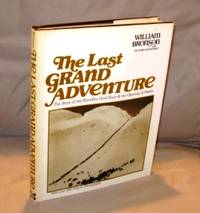
1977réf. 25923New York:: McGraw-Hill 1977. First Printing of the First US Edition. A Fine tight copy in a Fine unclipped dust jacket. Alaska! The Yukon! The Klondike! This volume documents the whole glorious story of the great gold hunt in the last decade of the 19th century with more than 500 rare photographs. Authors Bronson and Reinhardt document the complete story of the monumental gold discovery in Alaska beginning with the gold-laden schooner Excelsior in San Francisco the summer of 1897 to the wind down of the stampede in 1899. Fully illustrated with more than 500 black and white photographs of the era. McGraw-Hill, unknown
1898réf. 63466Vancouver & Victoria B.C.: Province Publishing Company Ltd. 1898. Folio. 10 x 14 in. 2 63 3 pp. With photo illustrations throughout in colour and black & white plan of Vancouver on last leaf. Textured purple-coloured softcovers decorative silver lettering stamped on front cover yapp fore-edges minor sunning to front cover minor creasing curling front cover edgewear still a VG- copy. First edition of this exceedingly scarce and lavishly illustrated guidebook promoting Vancouver & Victoria B.C. as the primary outfitting stations for the Klondike Gold Rush. Photos depict the military contingent departing to police and restore order in the gold country and even features an interview with F.M. Rattenbury advocating the coastal route to the Klondike via the Chilkoot and White Passes. Many of the photographs depict miners on the trail the Canadian customs house at Chilkoot Pass and Dawson City. Worldcat locates 5 copies Yale UBC Toronto Bancroft Canadian Centre for Architecture; See: Kurutz Klondike & Alaska Gold Rushes A Descriptive Bibliography 480. Province Publishing Company, Ltd., paperback
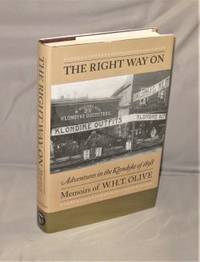
1999réf. 26762Langley:: Timberholme Books 1999. First Printing of the First Canadian Edition. A Fine tight copy in a Fine dust jacket . W.H.T. Olive's memoir is his record of the year he spent as manager of the boats for the Bennett Lake & Klondyke Navigation Company in the Yukon Gold Rush of 1898. In the untamed North where travellers had only one thing on their minds Gold! Olive's day-to-day life was nothing but extraordinary. He acted as onboard diplomat for both seasoned prospectors and greenhorns shot the White Horse Rapids and in addition to passengers and their provisions was responsible for two all-important kinds of shipment: mail and liquor. His adventures included rescuing damsels in distress guiding his employer the architect Frank Rattenbury through a disastrous mosquito-infested expedition and defending his strongbox at gunpoint from thieves. Sam Steele of the North West Mounted Police William Ogilvie first commissioner of the Yukon Machine-gun Joe Boyle and the notorious gangster Soapy Smith all make an appearance here. Olive's account of his adventures is complemented by his fond remembrance of the sourdoughs on the trail he met during this short but intense period in history. Timberholme Books, unknown
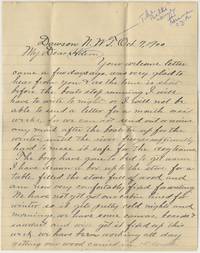
1900réf. List3888Dawson North West Territory sic Yukon Territory 1900. A long 1900 letter from Frank S. Bell in Dawson written shortly before navigation closed for the winter. Bell explains that if he does not write at once he may not be able to send another letter for quite a while: "as the time is short before the boats stop running I will have to write tonight or I will not be able to send a letter for a month or six weeks for we can not send out or receive any mail after the boats tie up for the winter until the river freezes sufficiently hard to make it safe for the dog teams." Bell writes from an unfinished cabin; he and his companions had spent the day carrying in fifteen cords of wood and still needed to prepare the cabin for winter: "The boys have gone to bed to get warm. I have drawn a box up to the stove for a table filled the stove full of wood and am now very comfortably fixed for writing. We have not yet got our cabin lined for winter so it gets pretty cold nights and mornings." He gives a good account of Dawson under Canadian police regulation. Sunday labor required a permit public houses were closed gambling was allowed only if conducted fairly and "sure thing games" were not permitted: "It is against the law here to work on Sunday without getting a permit & if the police catch you at it they take you in the police regulations are very strict almost too much so sometimes but then it makes Dawson a pretty orderly place to all outside appearances. All gambling must be done on the square no sure thing games are permitted." Bell notes that Dawson where "Saloons & all public houses are closed on Sunday" is a "much more orderly town than it would be if it were on the American side." The letter also anticipates further gold rushes in Alaska likely the Fairbanks rush as Bell mentions activity in "Tanana country": "I think there will be a stampede into the Tanana country this winter & next spring; prospectors have been in there this summer and staked some claims but there was no way to get provision in there until the snow comes when they can sled it in with dogs . We may go down in the spring if we make money enough this winter for a grub stake." Bell is also unusually reflective about the psychology of the Klondike. He calls this his "last chase" but immediately admits the pull of the country: "There is a fascination about this Klondike country. People that leave here & go outside only remain away a short time before they want to get back. There is always that ripple of excitement & any day may bring tidings of another rich discovery somewhere. Everyone is here for the one purpose to get rich quick." He closes with practical comments on Dawson travel hospitals trained nurses and his hope to make enough money to enter business in Seattle. A good Dawson letter from the late Klondike period with content on winter travel and mail cabin life Canadian police regulation gambling Sunday laws theaters hospitals Seattle and Skagway travel and coming gold rushes. . unknown books
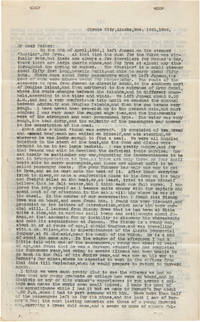
1718réf. 43100Circle City Alaska and on a steamer between Juneau and Seattle. Nov. 10 1896; Feb. 17 1897. Typed Letters from a Miner in Alaska During the Klondike Gold Rush A very interesting pair of typed letters from a young man in Alaska during the Klondike Gold Rush. The anonymous author wrote these two letters to his parents describing his journey overland and by water to the Birch Creek mining district his experiences mining for gold and his decision to go into business as a merchant. The letters are written in a detailed style that indicates an educated author. They include three manuscript sketches showing the routes traversed in Alaska and provide a great deal of information about the writer's experiences in the Klondike. These letters are typed but they were likely originally handwritten by the author who later typed them and included his manuscripts maps and sketch in order to send them to his family when he arrived in Seattle or San Francisco. The letter dated Nov. 10 begins with a description of the writer's boat journey from Juneau to Dyea actually before the discovery of gold around Dyea was widely announced which was a popular disembarkation point for the Chilkoot Trail to Dawson City a center of the gold rush. He arrived at Dyea on April 23 and notes that "dinner at the Dyea post was the last square meal I have had up to the present date November 10." After dinner he loaded his equipment on horses for the journey inland: "My outfit consisted of about 1000 lbs. of provisions guns amunition sic tools for boat building a whip-saw jack-plane cross-cut saw hand saw rip saw hatchet hammer draw knife brace and bits square etc. and clothing blankets tent sheet-iron stone and in fact I think I had about every thing that ever went down the Yukon. Altogether my outfit weighed about 1302 pounds which is much more than is usually taken into the interior." The author spent the next several days transporting his provisions between Dyea and Lake Linderman and he includes in his letter a sketch of the route from Dyea through the valley to the lake noting several camps along the way as well as a sketch of his sled. The second letter dated Feb. 17 1897 was written on board the steamer Al Ki between Juneau and Seattle. He continues the narrative of his trip inland explaining that he arrived at Lake Linderman on May 14. A month later on June 14 the author and a partner their canoe loaded with provisions departed for Circle City which they reached on June 29. There they stored most of their provisions and headed for the mines in the Birch Creek region. Mining was at its height in the middle of the summer but rather than seek out a claim on their own the author and his companion Jim Wishard decided to work for other miners earning some $10 a day. He describes working at mining from 7 p.m. until 6 a.m. the long days making the task of working at night possible. In August the author bought a claim in the Harrison Creek region but decided to forego mining in favor of establishing himself as a merchant: "From what I could see the miners are poorly supplied with food by the two companies and there is always a great demand for luxuries; that is something out of the ordinary and even the necessaries of life. I made up my mind last summer that I could do as well bringing in some food - in other words being something of a merchant - as in any other way to start and having a good knowledge of the country and keeping my eyes open I would undoubtedly have many good chances for speculation. It is a conceded fact that one cannot lose money taking in such an outfit. Everything brings in an average profit of 400 per cent. over the original cost and whatever any one has to sell in the 'grub' line is in demand." The author then describes his construction of a small cabin in Circle City and his decision soon afterward to leave Alaska for the winter. He describes the trip to Dyea undertaken in January and the hardships of winter overland travel in Alaska. Included are some very practical tips: "In crossing water when it is thirty or forty degrees below zero one should dip his moccasins into the water very quickly taking them out before the moccasin is wet through. They will then freeze in a mass on your feet and will serve the same purpose as rubber boots. You can then walk right through water though I would not advise any one to tempt Providence too much." The letter concludes with a description of a recently discovered gold strike called "Bonanza" not far from the Forty Mile camp. The author describes the high hopes around the strike and includes a manuscript map of the region indicating the location of a claim in which he himself has invested. He hopes that his mine will bring him some wealth but reiterates his belief that the way to wealth in the Yukon Gold Rush is by supplying miners with goods and that he is on his way to Seattle and San Francisco to buy provisions to resell. The Beinecke Library holds what appear to be typed drafts of these same letters with somewhat more typographical errors and less polished maps which they attribute to the merchant Cameron C. Burns. We locate no other copies of these letters nor any published version of the text. A detailed and ephemeral first-hand account of an early Alaska gold-seeker. Stapled at upper edge. Three horizontal folds. Near fine. hardcover books
1897réf. 61925Victoria B.C.: R.E. Gosnell Agent General 39 Victoria St. 1897. 8vo. 500 7 pp. plus 26 pp. publisher’s illustrated advertisements. Over 50 photo plates 4 maps 2 large folding recto & verso text illustrations. Red pebbled publisher’s cloth black lettering & decorated border front cover gilt & black lettering on spine minor edgewear rubbing ownership stamps & writing on title still VG copy from the library of former California State Librarian Gary Kurutz. First edition thus of this expanded edition of Gosnell’s 1860-1931 noted British Columbia Year Book and was originally self-published by first British Columbia Legislative Librarian and the first Provincial Archivist. Unlike the initial print run for this publication which consisted of only 216 pages this Year Book in reaction to the Klondike Gold Rush excitement expanded with a section on “The Canadian Yukon” with notes drawn from William Ogilvie article by H. Bratnober additional maps and even includes a section on the “Routes into Klondyke.” Also featured are numerous printed photos documenting stampeders on their way into the golden rivers and streams of the North. See: Kurutz Klondike & Alaska Gold Rushes A Descriptive Bibliography 211c. R.E. Gosnell, Agent General, 39, Victoria St., hardcover
1930réf. 62088Toronto: The Hunter-Rose Co. Ltd. 1930. 8vo. 6 359 1 pp. Frontisp. map numerous photo plates. Green publisher’s cloth black lettering slight shelfwear slight foxing & dustsoiling fore-edges w/ d.j. plain brown paper w/ banner title in red & black across upper fore-edge & spine printer’s imprint at foot of spine slight shelfwear NF/NF copy. First edition of this fascinating account by one of the original Klondike sourdoughs who went with a party of 10 in 1898 providing detailed accounts of the early miners those lost in avalanches on the Chilkoot Trail the amount of supplies needed and more. Robertson recounts his life before the Klondike as a champion bicycle racer along with describing hockey matches and skiing competitions in Dawson in 1898 and 1899. This work was compiled according to the author to “attract capitalists to the Yukon Territory.” Scarce in original dustjacket. Kurutz Klondike & Alaska Gold Rushes A Descriptive Bibliography 498. The Hunter-Rose Co., Ltd., hardcover
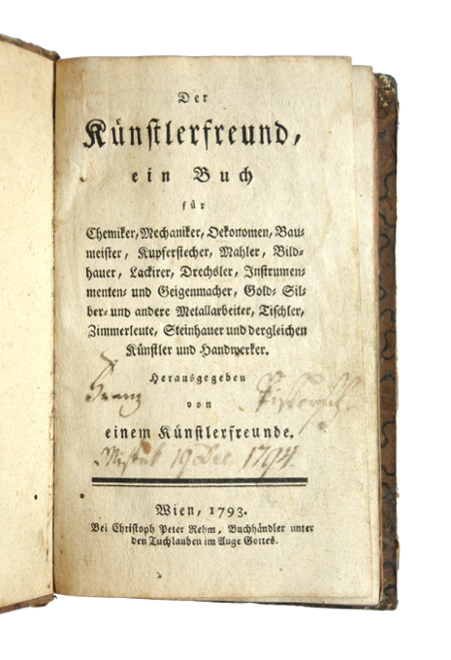
1793réf. 48619Wien, Christoph Peter Rehm, 1793. 8°. 140 S., 6 Bll., Ppbd. d. Zt. m. goldgepr. Rückenschild.
1977réf. LFA-126738406Revue mensuelle de combat et de réflexion : 48 pages, format 150 x 210 mm, illustrée, brochée, bon état
1994réf. LFA-126746680N° 5 (Avril 1994) : revue de 66 pages, format 215 x 285 mm, illustrée, brochée couverture couleurs, bon état
1996réf. LFA-126746693N° 18 (Février 1997) : revue de 66 pages, format 215 x 285 mm, illustrée, brochée couverture couleurs, bon état
1997réf. LFA-126746736N° 33 (Décembre 1997-Janvier 1998) : revue de 66 pages, format 215 x 285 mm, illustrée, brochée couverture couleurs, bon état
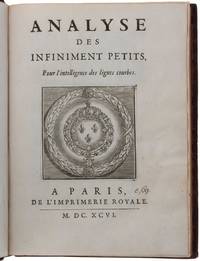
1700réf. 2848Paris: L'imprimerie Royale; Jean Boudot 1700. First edition. First editions. L'Hôpital's treatise on differential calculus was based on lessons he received from Johann Bernoulli and it was under the influence of Malebranche that some years later appeared the first work on the integral calculus by Louis Carré. Hardcover. THE FIRST BOOKS ON DIFFERENTIAL AND INTEGRAL CALCULUS. A fine sammelband comprising the first editions of the first books on the differential and integral calculus respectively. "In France it was through the Oratorian circle of Nicolas Malebranche that Johann Bernoulli introduced in 1691 the Leibnizian calculus. His lessons to the Marquis de l'Hôpital led to the draft of the first treatise of differential calculus 1696 and it was under the influence of Malebranche that some years later appeared the first works on the integral calculus by Louis Carré in 1700 and Charles René Reyneau in 1708. The spread and acceptance of the Leibnizian calculus was transferred in this way to the wide public" Landmark Writings p. 56. "The importance of L'Hospital's work lay in its dissemination throughout Europe of the concepts and early development of the calculus whose cause L'Hospital advanced as well through his many contacts; these included Christiaan Huygens who is reputed to have learned the calculus from L'Hospital" DSB. Bernoulli's lectures also covered integral calculus but L'Hospital dropped plans to write a continuation to his Analyse des infiniment petits dealing with this subject "in deference to Leibniz who had let him know that he had similar intentions" ibid. Leibniz never wrote such a text however and Bernoulli's lectures on integral calculus remained unpublished until they appeared in his Opera 1742. The task of completing L'Hospital's book was instead taken up by Carré a pupil of Malebranche and assistant to Pierre Varignon from whom he probably learnt calculus. "Following the classical custom his Analyse des infiniment petits starts with a set of definitions and axioms . The difference differential is defined as the infinitely small portion by which a variable quantity increases or decreases continuously. Of the two axioms the first postulates that quantities which differ only by infinitely small amounts may be substituted for one another while the second states that a curve may be thought of as a polygonal line with an infinite number of infinitely small sides such that the angle between adjacent lines determines the curvature of the curve. Following the axioms the basic rules of the differential calculus are given and exemplified. The second chapter applies these rules to the determination of the tangent to a curve in a given point . The third chapter deals with maximum-minimum problems and includes examples drawn from mechanics and geography. Next comes a treatment of points of inflection and cusps. This involves the introduction of higher-order differentials each supposed infinitely small compared to its predecessor. Later chapters deal with evolutes and with caustics. L'Hospital's rule is given in chapter 9" ibid. The tenth and final chapter of the Analyse discusses the methods of Descartes and Johann Hudde. The companion work by Carré is "the first treatise on the integral calculus in any language which is here applied to the determination of the area of superficies surfaces and solids and their centres of gravity problems of percussion oscillation etc." Sotheran. On this last topic the determination of the centres of oscillation of solids Carré made a significant error. This was known to Bernoulli but not publicized at the time and so was propagated into several later calculus texts such as Charles Hayes' Treatise on Fluxions 1704 and Edmund Stone's The Method of Fluxions both Direct and Inverse 1730. Both works are rare on the market: ABPC/RBH list four copies of L'Hospital's book since the Norman copy which realised $6325 in 1998; and only two copies of Carré's work in the last half century. "Differential and integral calculus are generally considered to have their origins in the works of Newton and Leibniz in the late 17th century although the roots of the subject reach far back into that century and arguably even into antiquity. Leibniz first described his new calculus in a cryptic article more than a decade before the publication of the Analyse. For all practical purposes Leibniz' early papers were not understood until Jakob Bernoulli and his younger brother Johann began studying them in about 1687 and making discoveries of their own using his techniques. "Bernard de Fontenelle became the secretary of the Académie des Sciences in Paris in 1697 and wrote the eulogy of l'Hôpital for the academy's journal. He said that in 1696 'the Geometry of the Infinitely small was still nothing but a kind of Mystery and so to speak a Cabalistic Science shared among five or six people. They often gave their Solutions in the Journals without revealing the Method that produced them and even when one could discover it it was only a few feeble rays of this Science that had escaped and the clouds immediately closed again.' Later on Montucla went one step further and listed the only people that he believed understood Leibniz' calculus before 1696: Leibniz himself Jakob and Johann Bernoulli Pierre Varignon and l'Hôpital. L'Hôpital's Analyse changed all of this and for much of the 18th century his book served aspiring French mathematicians as their first introduction to the new calculus. "For all that the Analyse was a popular and successful introduction to the differential calculus it's remarkable that there is no account of the integral calculus in the book. In his Preface l'Hôpital explained why: 'In all of this there is only the first part of Mr. Leibniz' calculus . The other part which we call integral calculus consists in going back from these infinitely small quantities to the magnitudes or the wholes of which they are the differences that is to say in finding their sums. I had also intended to present this. However Mr. Leibniz having written me that he is working on a Treatise titled De Scientiâ infiniti I took care not to deprive the public of such a beautiful Work' p. iii. Unfortunately Leibniz never completed this book On the Science of the Infinite. "The Analyse consists of ten chapters which l'Hôpital called 'sections.' We consider it to have three parts. The first part an introduction to the differential calculus consists of the first four chapters: In which we give the Rules of this calculus. Use of the differential calculus for finding the Tangents of all kinds of curved lines. Use of the differential calculus for finding the greatest and the least ordinates to which are reduced questions De maximis & minimis. Use of the differential calculus for finding inflection points and cusps. "Taken together these chapters provide a thorough introduction to the differential calculus in about 70 pages. The next five chapters are devoted to what can only be described as an advanced text on differential geometry motivated in part by what were then cutting-edge research problems in optics and other fields" Bradley et al. pp. v-vi. These subsequent chapters no longer mirror the structure of Bernoulli's lectures. Chapter 5 the longest in the Analyse deals with evolutes and involutes including the cycloid and various spirals. Chapters 6-8 are on envelopes of lines and curves i.e. curves that are tangent to every member of a family of lines or curves - this includes the study of caustics in geometrical optics. Chapter 9 contains "the solution of various problems that depend upon the previous Methods;" the first of these is the celebrated rule that we now call L'Hôpital's Rule which was first discovered by Bernoulli. In his final chapter of the Analyse l'Hôpital demonstrates how all of the methods of Descartes and Hudde may be easily derived and justified using Leibniz's differential calculus. Born into a noble family L'Hospital 1661-1704 abandoned a military career due to poor eyesight to pursue his interest in mathematics. "Some time around 1690 L'Hôpital joined Nicolas Malebranche's circle which was engaged among other things in the study of higher mathematics. It was there in November 1691 that he met the 24-year-old Johann Bernoulli who was visiting Paris and had been invited by Malebranche to present his construction of the catenary at the salon . Bernoulli told Pierre Rémond de Montmort that upon meeting the Marquis he soon found him to be a good enough mathematician with regard to ordinary mathematics but that he knew nothing of the differential calculus other than its name and had not even heard of the integral calculus. L'Hôpital had apparently mastered Fermat's method of finding maxima and minima and told Bernoulli that he had used it to invent a rule for determining the radius of curvature for arbitrary curves. The method was unwieldy and actually could only be used at local extrema of algebraic curves. Bernoulli showed him the formula for the radius of curvature that he had developed with his brother Jakob which employed second-order differentials. Apparently this so impressed the Marquis that he visited Bernoulli the very next day and engaged him as his tutor in the differential and integral calculus. "Bernoulli tutored the Marquis in his Paris apartment four times a week from late 1691 through the end of July 1692 . In the summer of 1692 Bernoulli accompanied the Marquis to his estate in Oucques near the French city of Blois where he continued giving him tutorials until some time in October . Bernoulli kept copies of his lessons to the Marquis throughout his long and productive career. The first part on the differential calculus was incorporated by l'Hôpital into the first four chapters of the Analyse. Bernoulli himself published the much larger second part concerning the integral calculus in his collected works. Titled Lectiones mathematicae de methodo integralium this treatise bears the subtitle 'written for the use of the Illustrious Marquis de l'Hôpital while the author spent time in Paris in the years 1691 & 1692' . Because Bernoulli chose not to publish this part it was impossible in the 18th century to say how closely l'Hôpital's textbook coincided with Bernoulli's lessons. A comparison finally became possible when Paul Schafheitlin discovered a manuscript copy of the full set of lessons on both the differential and integral calculus in the library of the University of Basel in 1921 . Because the latter part was a near-perfect match to what Bernoulli had published in 1741 he could be quite certain that the first part was essentially the same set of lessons l'Hôpital had used when composing the Analyse . "Since the appearance of the Lectiones various authors have characterized the Analyse as having essentially been written by Bernoulli. Indeed Bernoulli himself in an angry letter to Varignon of February 26 1707 said that 'to speak frankly Mr. de l'Hôpital had no other part in the production of this book than to have translated into French the material that I gave him for the most part in Latin.' The truth is much more nuanced. The superstructure of l'Hôpital's first four chapters is certainly due to Bernoulli and many of the details are essentially the same in both texts. However l'Hôpital added much in both quantity and quality. For one thing Bernoulli's Lectiones occupied 37 manuscript pages compared to 70 typeset pages for the first four chapters of the Analyse but the Marquis added much more than mere verbiage to Bernoulli's lesson. He was a very talented pedagogue. He organized his material very well extracting general propositions where Bernoulli gave examples and explained matters clearly and in some detail. Furthermore he frequently included many illustrative examples gradually increasing in difficulty generally providing an appropriate level of detail but always leaving some things for readers to work out for themselves" Bradley pp. vii-xi. The last six chapters were not taken directly from Bernoulli's lectures although l'Hôpital has drawn on material provided to him in Bernoulli's letters or in his lessons on the integral calculus. Louis Carré's 1663-1711 father a prosperous farmer wanted him to become a priest but after having spent three years studying theology in Paris he refused to take holy orders and his father cut off all financial support for his son. Carré managed to avoid poverty by becoming an amanuensis to Malebranche. The group Malebranche had assembled at the Oratory in Paris included Varignon and l'Hôpital among others. Carré spent seven years with Malebranche after which he became a private tutor in Paris specializing in the teaching of women then barred from a university education many of whom were nuns.At this stage Carré seems to have been interested mainly in philosophy and did not take much interest in current mathematical research. However on 4 February 1699 Varignon admitted him as one of his élèves in the Academy of Sciences. This stimulated Carré's interest in mathematics and he began working on his Methode pour Ia mesure des surfaces . The work is divided into four Sections: On the measure i.e. area of surfaces. On the dimension i.e. volume of solids.3 On centres of gravity. On centres of percussion and oscillation. The centre of percussion is the point on a solid body attached to a pivot where a perpendicular impact will produce no reactive shock at the pivot. The same point is called the centre of oscillation for the body suspended from the pivot as a pendulum meaning that a simple pendulum with all its mass concentrated at that point will have the same period of oscillation. The formula for the centre of oscillation originally derived by Huygens in his Horologium oscillatorium 1673 requires certain integrations to be performed. Carré made an error in calculating the integral for the moment of inertia of a cone suspended from its vertex a mistake that led to an incorrect expression for the centre of oscillation of the cone. Lenore Feigenbaum explains that the story of Carré's mistake and the subsequent propagation of his error in eighteenth-century calculus textbooks "is instructive in several regards: first in showing how some of the methods of the calculus were interpreted and absorbed during the early 18th century; second in shedding light on the nature of the textbook industry of the time; and finally in providing us with a modicum of historical sympathy when we find our own students making the same kind of mistakes." Between 1701 and 1705 Carré published over a dozen papers on a variety of mathematical and physical subjects which led to him being admitted to the Academy of Sciences as an Associate Mechanician on 15 February 1702 and being promoted to Pensioner on 18 August 1706. This provided him with an income which allowed him to devote himself entirely to his academic studies during the final five years of his life. At age 46 he suffered an attack of dyspepsia from which he died in 1711. I. Babson Supplement p.30; Honeyman 2006 & 2007; Norman 1345; Sotheran First Supplement 1411; not in Macclesfield. II. Macclesfield 481; Poggendorff I 383-384; Sotheran I 704. Bradley Petrilli & Sandifer. L'Hôpital's Analyse des infiniments petits. An Annotated Translation with Source Material by Johann Bernoulli 2015. Grattan-Guinness ed. Landmark writings in Western mathematics 1640-1940 2005. Two works bound in one volume 4to 251 x 186 mm pp. xviii 181 3 with 11 folding engraved plates; pp. xii 115 1 blank and 4 folding engraved plates. Old signature cut from first title and expertly repaired. Contemporary French calf spine gilt with red lettering-piece. Fine copies. / Hardcover. L'imprimerie Royale; Jean Boudot unknown
réf. #[61708]Title page to the third volume of works by Bacquet Jean 15.-1597 with large oval printer's device of Abel Langelier or L'Angelier 1553-1610 representing a shepherd kneeling in front of a fire and an angel coming from the sky. On the frame: 'SACRUM PINGUE DABO NEC MACRUM SACRIFICABO'. It might hint to Abel one of the sons of Adam and Eve as the first name of the publisher is Abel. Allegorical figures populate the outer frame. Monogrammed in a shield beneath the representation. l Letterpress and wood engraving on laid paper; total: 352 x 215 mm; despite a light pink shadow on the top left margin in good condition mounted on cardboard decorated with a line frame in black ink. unknown
réf. 69-8513Late 19th or Early 20th Century Photographer. 6.25 x 10.5 cm. Very Good. Light foxing. [Late 19th or Early 20th Century Photographer] unknown
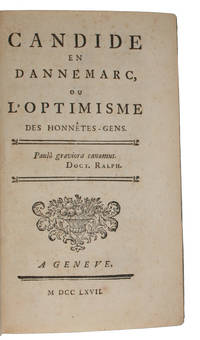
1767réf. 45831Geneve 1767. Original blue cardboard binding with contemporary handwritten paper title-label to spine. Pencil-numbering to inside of boards. A very nice and clean copy. Woodcut vignette to title-page. With the ex-libris of the notes Danish book collector K.F. Plesner to inside of front board. Rare first edition of this interesting anonymously written continuation of Voltaire's Candide which wraps up the adventures of the hero. "Turning his back on both Voltarian satire and scepticism the novelist proposes a moralistic fable - the focal point of which is a rehabilitation of Leibniz's Theory of Optimism. The main body of the novel tells the story of Candide and his new wife the noble Zénoïde in their sumptuous Copenhagen townhouse. Before achieving this happy state however the couple endures various trials and tribulations reminiscent of the newly minted gothic genre. "Candide au Dannemarc" also features a satirical portrait of Jean-Jacques Rousseau." Éduard M. Langille from the introduction to the new edition of "Candide au Dannemarc" edited by him. Voltaire's "Candide" had inspired a sequel that appeared in 1760 which is attributed to Charles-Claude-Florent de Campigneulles but which might be by Henri-Joseph du Laurens. The present work is a direct continuation of that sequel although it ignores the happy ending of the previous work but evidently from the preface it is not written by the same author. It has still not been determined who the actual author is.The part on Rousseau pp. 148-167 in the present work has become quite famous portraying him satirically as trying to make a living in Copenhagen from copying music while plotting to escape to America. The novel ends with Candide leaving Denmark to be the Danish ambassador in Russia.A secoond edition appeared in 1769. paperback
1813réf. 13538Philadelphia: Jane Aitken / "For the Author 1813. First Edition. Hardcover. Good-. Octavo 2 volumes bound together. A DEFECTIVE copy lacking the title page and possibly other blank prelims in volume I with the first text page being the first leaf of the Preface. Collation: iii-v 7-90 blank 1-142 blank. Bound in contemporary full sheep with a black morocco spine label bearing the lone word "Thought." Though defective an otherwise good copy moderately foxed at extremities with mild wear to corners and spine ends; sound. Inked ownership signature of P. Keyes Esq to the first leaf of the Preface. Law was a British-born lawyer who settled in the young United States where he married into George Washington's family and became a significant real estate developer in the early years of the capital city. The two texts are sometimes attributed to Law's partner George Watterston but they are attributed by American Imprints and the LOC to Law. The printer of volume I and possibly volume II was Jane Aitken one of the few women in the printing trade in early 19th century America. She is best known for publishing Charles Thomson's massive English translation of the Septuagint the first published in the western hemisphere. Scarce in commerce. American Imprints 20531; 28918. Jane Aitken / "For the Author hardcover
Madrid, Espasa Calpe, 1972 ("Clásicos Castellanos"). 4to.; 253 pp., 1 h. Cubiertas originales.
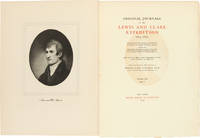
1904réf. 52627New York: Dodd Mead & Company 1904-1905. One of 200 Sets on Large Paper One of 200 large paper sets on Van Gelder paper with the atlas supplied from the reprint edition done by Argosy-Antiquarian Press. "The most elaborate work on this expedition" - Howes. A cornerstone of modern historical research printing for the first time many major primary documents which did not appear in the Biddle edition including the Floyd and Whitehouse journals and material from the Clark-Voorihis papers along with facsimile manuscripts maps portraits and other illustrative matter. Also valuable is Victor Paltsits' bibliography of the Lewis and Clark expedition in the first volume. "This edition is notable for its thorough Introduction covering the history of the expedition and earlier exploration and a detailed account of the original journals and their various editions.In its maps and numerous illustrations the Thwaites edition is an outstanding source of visual materials relating to the expedition" - LITERATURE OF THE LEWIS AND CLARK EXPEDITION. Quarto. Original gilt green cloth. Octavo atlas maps laid in a red cloth drop-front box. Cloth somewhat worn particularly at spine ends. Ex-library bookplates with withdrawal stamps on front pastedowns shelf labels on spines reference stamps across top edges. Some occasional offsetting from plates but generally clean internally. A good set. Text volumes untrimmed. HOWES L320 "c." LITERATURE OF THE LEWIS AND CLARK EXPEDITION 5d.1. WAGNER-CAMP 13:7 note. TWENEY WASHINGTON 76. REESE BEST OF THE WEST 233 note. hardcover
1904réf. 52627New York: Dodd Mead & Company 1904-1905. One of 200 Sets on Large Paper One of 200 large paper sets on Van Gelder paper with the atlas supplied from the reprint edition done by Argosy-Antiquarian Press. "The most elaborate work on this expedition" - Howes. A cornerstone of modern historical research printing for the first time many major primary documents which did not appear in the Biddle edition including the Floyd and Whitehouse journals and material from the Clark-Voorihis papers along with facsimile manuscripts maps portraits and other illustrative matter. Also valuable is Victor Paltsits' bibliography of the Lewis and Clark expedition in the first volume. "This edition is notable for its thorough Introduction covering the history of the expedition and earlier exploration and a detailed account of the original journals and their various editions.In its maps and numerous illustrations the Thwaites edition is an outstanding source of visual materials relating to the expedition" - LITERATURE OF THE LEWIS AND CLARK EXPEDITION. Quarto. Original gilt green cloth. Octavo atlas maps laid in a red cloth drop-front box. Cloth somewhat worn particularly at spine ends. Ex-library bookplates with withdrawal stamps on front pastedowns shelf labels on spines reference stamps across top edges. Some occasional offsetting from plates but generally clean internally. A good set. Text volumes untrimmed. HOWES L320 "c." LITERATURE OF THE LEWIS AND CLARK EXPEDITION 5d.1. WAGNER-CAMP 13:7 note. TWENEY WASHINGTON 76. REESE BEST OF THE WEST 233 note. hardcover books
Valencia, Editorial Castalia, 1954 ("Floresta. Joyas Poéticas Españolas"). 8vo.; LVI pp., 138 hojas, 5 hs. Cubiertas originales. Pérdida de un tercio de la lomera.
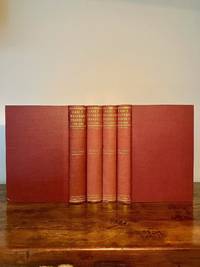
1905réf. 13153Cleveland OH: Arthur H. Clark Company 1905. First Thus. Hardcover. Fine. 8vo. Pp. 321; 356; 291; 308. Folding map. Maroon cloth spine lettered in gilt. Small chip to gutter of front board of Vol. 3 else a clean bright set. Reprinted from Volumes XIV XV XVI & XVII of Thwaites's Early Western Travels: 1748-1846. Arthur H. Clark Company hardcover
1920réf. 61861On a lake in northern New England 1920. Photographs. Small snapshots 3 x 4 1/2 inches nice images. The vintage outboard motor being used is especially interesting. Very good. 8871. unknown books
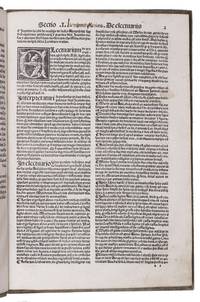
1513réf. L85CQLCOIXI5Colophon: Venice: Gregorio de Gregori 1513. Early 20th-century vellum possibly incorporating older materials sewn on 3 recessed supports red spine label. Folio 30.5 x 21 cm. With 13 woodcut decorated initials 6 series plus 8 repeats 4-line typographic Lombardic initials. Set in rotunda gothic types in 2 columns with a preliminary note in roman type. With contemporary pen decorations in brown ink added to about half of the initials and occasional similar pen decorations in the margins an occasional manuscript paragraph mark some rubrications in brown ink and some initials coloured with a transparent ochre wash. Seventh known copy of an early edition of an important treatise on pharmacology and medical botany by Giovanni Giacomo Manlio di Bosco fl. 1490-post 1500 first published in Venice 1490 or Pavia 1494 Sordano records an edition by Octavius Scotus in 1490 but the ISTC records no edition by him until 1496. It is a commentary on ancient Arabic and Greek pharmacological works especially the Arabic treatises of Yuhanna Ibn Masawayh ca. 777-857 a Nestorian Christian physician from Assyria who taught at the academy in Gundeshapur Iran and was personal physician to four caliphs. It gives instructions for preparing numerous medicines indicating the quantities of the ingredients simples each derived from a single plant and describing each ingredient. The present edition includes Manlios preliminary note addressed to Bernardinus Niger included in the 1494 1496 and 1499 editions but omitted in many later editions.The title page indicates that the book also contains Lumen apothecariorum a work by Quirico de Augustis de Tortona of Milan fl. 1486-1497 first published in 1492. But it is not present here or in any of the other seven copies we have traced. The two works were combined in the Venice editions of 1504 ca. 1502/05 and 1506. De Gregori apparently followed one of these editions but did not include the second work. Hieronymus Surianus fl. 1458 d. 1522 edited the first two.With contemporary and later marginal manuscript notes. With the text area of B2.7 somewhat browned an occasional small and unobtrusive stain and a few small worm holes in the last few leaves but generally in very good condition. Some of the manuscript notes have been shaved. The binding is slightly dirty and the boards slightly bowed but the binding is still good. A rare early edition of an important work of pharmacology.l Durling 2938; EDIT 16 29621 1 copy; ICCU 29621 same copy; KVK & WorldCat 5 copies; Emiliano Sordano Il Luminare maius di Manlio del Bosco thesis University of Torino 2010 p. 41; USTC 840112 2 copies; cf. Adams M370 1506 ed.; BMC STC Italian p. 410 1504 and other eds.; Schelenz Geschichte der Pharmazie p. 414 1529 ed.; Wellcome 4017 1628 Lyon ed.; not in Garrison & Morton; Honeyman; Norman Lib. Gregorio de Gregori, hardcover