[California Gold Rush]. Fitch, OH O HBiblio.com
17 610 résultats
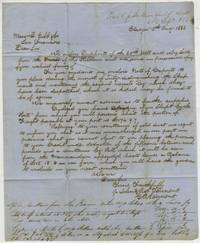
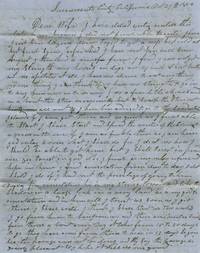
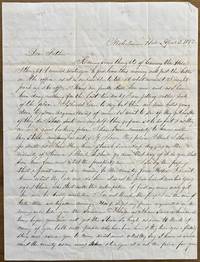
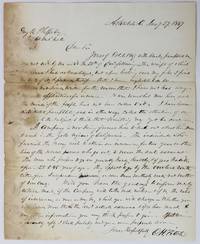
1849réf. 2389Ashtabula Oh: January 29 1849. About very good. 1pp. on a bifolium. Previously folded. Light dampstaining and short closed tears along gutter somewhat affecting first few lines of text but not overall sense. An interesting letter from O.H. Field an aspirational field representative of the Connecticut Mutual Life Insurance Company in Ashtabula Ohio to the company secretary George R. Phelps inquiring about a policy for a group of men headed to the Gold Rush in California in January 1849. Connecticut Mutual was founded in Hartford three years prior to the composition of this letter in 1846. Fitch's missive begins with a report on his efforts to drum up interest in life insurance in his area with pamphlets and other materials sent to him by Phelps: "Yours of Oct 1 1849 with blanks pamphlets &c was not received by me until the 25th of Dec. following. I have not had any definitive applications for insurance. It was somewhat new here and the minds of the people had not been called to it. I have however distributed pamphlets and in other ways called the attention of our citizens to the subject. I think that something yet might be done. The letter goes on to describe a potential policy for a group soon leaving for the Gold Rush and requests a favorable rate in order to stimulate interest in policies from additional parties: "A company is now being formed to head out about ten men to work in the gold regions of California. The individuals who furnish the money wish to obtain an insurance for two years on the lives of the several persons who go out to secure the amount advanced. The men who propose to go are generally hardy healthy & of good habits & from 25 to 45 years of age. They expect to go by the overland route either from Independence Missouri or some more southerly route not south of Vera Cruz. Will you have the goodness to inform me by return mail if the company will take such risks -- & if so the rates of insurance as near as may be which you will charge -- whether you will insure more than the amt. actually advanced & if so how much & any other information you may think proper to give. If I receive a favorably sic reply I shall probably send you more proposals soon." A neat letter concerning the preparations and considerations necessary for a journey to California in the early days of the Gold Rush and the role and rise of early American insurance companies in the planning of such lengthy and dangerous overland travel. January 29 unknown
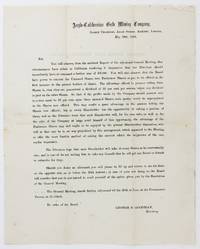
1855réf. 5250London: May 19 1855. About very good. 2pp. on a bifolium. Previously folded. Light wear along top edge; short closed tear at right margin. Scattered faint foxing. With original mailing envelope. This two-page printed circular dated May 19th 1855 from the Anglo-California Gold Mining Company in London offers to convert "unissued shares" of company stock into "preference shares." The first page of the circular reads in part: "You will observe from the enclosed report not present of the adjourned General Meeting that circumstances have arisen in California rendering it imperative that the Director should immediately have at his command a further sum of £6600. You will also observe that the Board have power to convert the unissued shares into preference shares at par to be offered in the first instance to the present holders of shares. The advantage offered to persons taking those Shares is that they are guaranteed a dividend of 25 per cent per annum before any dividend is paid on the other Shares." The second leaf of the bifolium prints a blank form for recipients to purchase said preferred shares. During the first years of the California gold rush approximately 120 companies formed in Great Britain to offer mining shares in the booming goldfields to the public. Many saw these companies as an opportunity to invest in the boom without facing the expense or the danger of traveling to California. Most however ended in failure and investors collectively lost almost £2 million at the time. The Anglo-California Gold Mining Company formed by Luke Williams in March 1849 was one of the first and largest of these British ventures and it sold thousands of ten shilling shares to the public. Williams sent a former Royal Navy Captain Henry Vere Huntley to the Calaveras River in early 1850 to start the operation. When he failed Williams arranged a deal with Fremont's Quartz Rock Mariposa Gold Company to crush and refine their ore and the ore of smaller ventures. To that end the company sent two steam-powered crushing mills to California and when those proved useless to the task the company failed. May 19 unknown
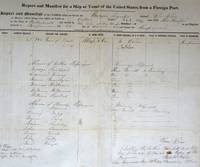
1850réf. List2418Callao: Alsop and Company 1850. Folded ship manifest measuring 15 ¼ x 12 ½ inches. Fine condition with slight normal wear. A very scarce Gold Rush period shipping manifest for the Barque Equator captained by William Weir listing the passengers and cargo for a voyage to San Francisco in December of 1850 with notations showing the vessel’s arrival in San Francisco in May of 1851. Alsop & Co. was the work of Joseph Alsop the grandson of Continental Congress delegate John Alsop and his friend Henry Chauncey. Originally from Middletown Connecticut the pair established Alsop & Co. in New York City in 1824 and would eventually play a large role in the gold trade in California and trade extensively in South and Central America. Chauncey Alsop and others were among the partners in the trans-Panamanian railway that helped transform trans-continental trade in 1850. One of Alsop & Co.’s treasure boxes was aboard the S.S. Central America when it sank in 1857 carrying gold to the Eastern United States from Panama. The shipping manifest offered here lists the primary cargo as 195 tons of coal and also lists the names of fourteen passengers on the voyage. Imported coal - from Callao in this case - was essential to heat houses and run furnaces at factories including assay offices before the development of a local coal industry in California. We find only two instances of Gold Rush-era ship manifests - which were usually thrown away - surfacing in the trade or auction records this one and one other which sold for $3600 at PBA Galleries in 2014. Alsop and Company unknown
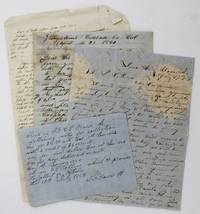
1860réf. 4301Eldorado & Iowa Hill 1860. Good. Four manuscript documents including three letters totaling six pages. Old folds moderate toning minor edge wear a few tears a small hole in one letter. A neat group of four manuscript letters and documents all related to the mining activities of L.D. Davis of Georgia over a four-year period during the latter years of the California Gold Rush. Davis appears to be a lawyer living somewhere back east and may have been an investor in California mines or managing the financials for some mining concern from afar. The documents include an 1856 promissory note regarding "noted for collection" a long undated letter likely from California to Davis detailing amounts of gold taken from an unspecified mine and the mine's ownership situation and two letters overtly datelined from California -- the first from Iowa Hill in 1859 and the second from Georgetown in El Dorado County in 1860. Each document presents a unique set of concerns for Davis. Notable details of the three letters are as follows: 1 Autograph Letter Signed from A.J. Huff to Mr. L.D. Davis. Iowa Hill Ca. April 17 1859 2pp. The text reads in part "I have been very very sick for the last three weeks but am at this time improving.the disease is caused by the exposure of this last winter having worked continually in the rain and snow preparing my claim for the season. Times are very hard in this country now everyone has to work hard and is in big luck if he makes a decent living. A great many are making money very fast but in comparison not one in ten to the number than used several years back to make money or in other words the chances are about one in ten when they were one in fifty two and three in this country. If a man can get a good claim he can make more clear money out of it than he could then owing to the fact that everything is cheaper and experience has taught the People of California a great deal in respect to saving the gold and expediting the work. I think I have a very good claim which will last for a long time three or four years. It has been very expensive opening it but that is pretty well all over with now." 2 Autograph Letter Signed from J.D. Arranaut to L.D. Davis. Georgetown Eldorado County Ca. April 28 1860 2pp. Here a colleague of Davis's in California seems to be struggling and writes thanking Davis for a loan. The text reads in part with spelling normalized: "I was glad to hear from you and to.learn that you would comply with my request by letting my wife have $25 worth of corn for her use and please find enclosed a bank draft. I take it as a great favor as I am far from home. Let me know how my wife is getting along and if she stands in need of anything." 3 Autograph Letter Signed from J.H. Worley to L.D. Davis Esq. N.p. n.d. 1p. The letter concerns percentage ownership in an unspecified mine and opens with a four-line listing of the "amt. of gold taken from mine 513.51.1 while under my control." The author then writes in part: "The rent and expenses were take out of the above account and after the gold was sold one half after paying expenses. I know you are too well positioned in law to know that I dare not have settled with any other person unless I had been so instructed according to law. When Mr. Findley returned from Burke County he stated to me that one half the mine was for Mr Adams and myself and the other was for himself and his friends but did not say who they were. unknown
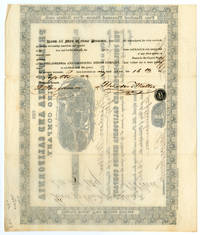
1618réf. 51617Philadelphia. Sept. 16 1852. Invest in California Gold Mines! A certificate for stock in the Philadelphia and California Mining Company completed on Sept. 16 1852 granting one Theodore Walter fifty shares in the venture and signed by the Secretary L. Alter and the President Pearson Serrill. The central woodcut depicts a mining scene representing the company's California operations. The Philadelphia and California Mining Company was founded in the same year on the basis of a land lease from John Fremont in the area of the Mariposa River. A rare piece of mining ephemera: OCLC records only one other example of a stock certificate from this company held by the California Historical Society. Previously folded with small chip at edge of a fold line. Printed form completed in manuscript by several hands. With a woodcut mining vignette. Near fine. OCLC 828929436. unknown
1959réf. 62286Denver CO: Fred A. Rosenstock The Old West Publishing Co. 1959. 4to. 221 1 pp. Title in red & black frontisp. 3 folding maps 1 large chart of travel folded in rear pocket. Brick-red publisher’s cloth illustration vignette printed on front cover gilt lettering on spine partially uncut & unopened w/ d.j. slight scuffing upper right corner minor chipping dustsoiling couple closed tears & creasing NF/G copy. First edition of this exceptional effort by Morgan to present the Overland diary of Pritchard along with two previously unpublished maps of the 1849 gold rush miners by J. Goldsborough Bruff and the exceptional and immense chart tracing the emigration of no less than 162 diarists across the South Pass route to California demarcating 80 important points along the trail. Fred A. Rosenstock, The Old West Publishing Co., hardcover
1959réf. 62285Denver CO: Fred A. Rosenstock The Old West Publishing Co. 1959. 4to. 221 1 pp. Title in red & black frontisp. 3 folding maps 1 large chart of travel folded in rear pocket. Brick-red publisher’s cloth illustration vignette printed on front cover gilt lettering on spine partially uncut & unopened w/ d.j. slight scuffing upper right corner F/NF copy. First edition of this exceptional effort by Morgan to present the Overland diary of Pritchard along with two previously unpublished maps of the 1849 gold rush miners by J. Goldsborough Bruff and the exceptional and immense chart tracing the emigration of no less than 162 diarists across the South Pass route to California demarcating 80 important points along the trail. Fred A. Rosenstock, The Old West Publishing Co., hardcover
1902réf. 61749Unadilla NY: Sold by the Vestry of St. Matthew’s Church Press of Geroge D. Raitt 1902. 8vo. xv 1 323 pp. plus 3 pp. publisher’s ads for Halsey’s “The Old New York Frontier.” Frontisp. plates 1 folding map. Red publisher’s linen gilt device front cover gilt lettering on spine minor soiling head of spine edgewear rubbing still VG- copy from the library of former California State Librarian Gary Kurutz. First edition one of 650 copies printed and then distributed by St. Matthew’s Church of this uncommon work where the second half of the book consists primarily of Dr. Halsey’s experiences as a member of a 49er Gold Rush “Company” and featuring his diary. Inspired by Horace Greeley’s Tribune trumpeting the California gold discovery Dr. Halsey and several friends after catching a Broadway production of “California and the Gold Diggings” organized pooled their money and set out for Panama. While waiting to sail from Panama City he notes a cargo of 200 gold ingots each weight 150 lbs. enroute from California. After arriving in San Francisco June 4 1849 the group experience the wild gambling dens hyper-inflation and head for Sacramento and the diggings at Big Bar on the Middle Fork of the American River. Even though Halsey tries to break off from the Company and speculate in real estate and set up a medical practice the company refuse to release him and they actually succeed in pulling 20-36 ounces a day from their diggings. After making back their investment and a little more he decides the area is over-saturated with doctors and returns to Unadilla NY. See: Kurutz California Gold Rush 308. Sold by the Vestry of St. Matthew’s Church, [Press of Geroge D. Raitt], unknown
1850réf. List1929California 1850. With thirteen letters most multi-page written from Monterey in 1850 a 7 pp facsimile transcription of a 1834 Mexican land grant on cloth measuring 11 x 14 inches and and eleven page document on paper in Spanish relating to a Monterey land grant transcribing an 1841 document. Letters heavily worn with some loss at margins but mostly legible land grant in good to very good condition transcribed document in Spanish in fair condition with water damage to margins. Fair. An interesting archive of 1850s-era material relating to the life and career of the surveyor Edward Williams which recently surfaced in the central mother lode region. The group includes his personal letters from the California Gold Rush as well as well two interesting documents form his work for the Surveyor General J.W. Mandeville in 1858 where he transcribed two Mexican land grants. Lt. Edward Williams was a member of Company E New York Volunteers under Capt. Nelson Taylor. He came to California around 1847 and found employment as a deputy surveyor later working for the Office of the Surveyor General of the Unites States for California. In 1858 Surveyor General J.W. Mandeville commissioned a report on Mexican-era California Land Grants. Mandeville had Williams copy the original documents exactly - inclusive of an ink copy on linen that is an "exact tracing" of the original documents starting with 1834 up through about 1840. These "copies" were submitted to the Surveyor General in 1858 for use in the report. Williams continued the title work by copying other documents from about 1841 though this time not as a tracing but hand copied on the usual blue paper of the 1850s. The documents illustrate the length officials went to while they investigated Mexican Land Grant titles to California properties in the 1850s. The process was difficult and involved two distinctly separate cultures and legal systems that clearly conflicted. The Mexican Government granted rights for these large land parcels in California to various people but clearly stated they could not sell parts of the property. The wording was used many times in litigation of the period in both defense of the land grants and in opposition to how the land grants were handled. The issues were actually quite simple in that the Mexican legal standards for land grants was far different from those in the United States and the two differing forms of written land ownership and use clashed. These documents reflect a parcel of land granted to Francisco Mesa at "Corral de Tierra" a large parcel in Monterrey County California. Mesa had requested land for "his personal use and that of his family." In the Grant the title papers reflect "while the land is under Francisco's possession it cannot be divided mortgaged or a levy placed on it nor handed down." These original documents help illustrate the complex story of Mexican Land Grants in California. Also included are thirteen letters from Ed aka "Ned" to various family members primarily his mother and sister Alice and vice versa. About half are from Ed the other half are written to him. The dates of the letters are; 1850: February 10th April 15th April 16th April 28th June 10th July 30th October 11th and November 17th and 1851: September 9th. One undated letter with heavy loss is written from Panama. The letters are generally readable but the condition far from perfect with water stains throughout and chips abundant along edges and significant textual loss. The letters are generally at least two pages sometimes four or more inclusive of writing in the crossed line custom to save paper. Most are datelined at Monterrey where he discusses the people the customs setting and more. Despite the condition flaws there is much to be gleaned from his correspondence. In his April 15 1850 letter . he describes his trip to San Juan Bautista from Monterrey in detail while he was on his way to San Francisco. Williams writes of his great pleasure on tasting cooked beef by the Indians that he found was the best he ever tasted as they camped on the way to San Jose with the ultimate goal Mission Dolores in San Francisco: “this the beef they put on the embers of the fire and broiled it - I never tasted anything like it before so tender so juicy…” One of his first notes on San Francisco: "There are regular streets filled with all kinds of sorts of stores… The shipping covers the water as far as you can see. And those nearest the shore are converted into store houses the rigging being taken down and the and holes cut in the sides for doors.The best houses in town are occupied by gamblers . a large saloon filled with tables on which are played all kinds of games of chance - at some of the tables are displayed immense amounts of coin and gold in lumps worth from 1 to 5000 dollars which some poor infatuated fool of a miner has at some time lost to them." In his letter of April 16th he discusses both his difficulties with women in California and his lack of fitting in back east: “The Spanish Girls are very nice and all that sort of thing but the trouble is to find one that is educated. I can’t bear an uneducated wom an and I think I shall have to come to N.Y. and bring one out here… I know one or two in N.Y. but I don’t believe they would have such an uncouth specimen of an ‘hombre’ as me…” In his next letter he describes Carmel in detail. He states: “I haven’t been to the mines nor have I any inclination to go” though he intends to settle in California permanently. In his next letter he discusses the people he’s met and how he detests the anglophone community there: “How do I like the People Those of Spanish whom I call my friends I love with all my soul - there is not much society except among them… the Eng. and Am. population I detest from the bottom of my heart. This may sound strange but you will know the por que when you arrive.” He then praises the climate and scenery of Monterey. One letter written from Panama which has unfortunately sustained heavy losses at margins offers some details of the trip on the Chagres River. The replies to Williams from his family offer details on life in New York and are similarly compromised in condition but overall there is enough to glean from the group to provide a detailed example of family correspondence from the period. Overall a very interesting and unusual archive of a young professional who moved to California during the Gold Rush period and rejected the Anglophone mining community with particular interest to historians of Monterey and of the systems of land grants that shaped Mexican and American land policy in the nineteenth century. unknown books
1850réf. List2418Callao: Alsop and Company 1850. Folded ship manifest measuring 15 ¼ x 12 ½ inches. Fine condition with slight normal wear. A very scarce Gold Rush period shipping manifest for the Barque Equator captained by William Weir listing the passengers and cargo for a voyage to San Francisco in December of 1850 with notations showing the vessel’s arrival in San Francisco in May of 1851. Alsop & Co. was the work of Joseph Alsop the grandson of Continental Congress delegate John Alsop and his friend Henry Chauncey. Originally from Middletown Connecticut the pair established Alsop & Co. in New York City in 1824 and would eventually play a large role in the gold trade in California and trade extensively in South and Central America. Chauncey Alsop and others were among the partners in the trans-Panamanian railway that helped transform trans-continental trade in 1850. One of Alsop & Co.’s treasure boxes was aboard the S.S. Central America when it sank in 1857 carrying gold to the Eastern United States from Panama. The shipping manifest offered here lists the primary cargo as 195 tons of coal and also lists the names of fourteen passengers on the voyage. Imported coal - from Callao in this case - was essential to heat houses and run furnaces at factories including assay offices before the development of a local coal industry in California. We find only two instances of Gold Rush-era ship manifests - which were usually thrown away - surfacing in the trade or auction records this one and one other which sold for $3600 at PBA Galleries in 2014. Alsop and Company unknown books
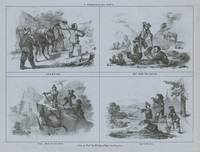
1850réf. List1315Britton and Rey 1850. Single sheet measuring 8 ¼ x 10 ¾ inches on blue wove paper. Small chip to corner not affecting image some older tape repairs verso at margins else fine very good plus overall and quite attractive. Very Good. A series of four illustrations telling the story of a mining party that heads out with a pack mule only to fail to find gold and lose their mule before returning to a new prospect with their clothes in shambles. This is entry 209 in Baird’s California’s Pictorial Letter Sheets in which he sets the publication date as being prior to 1855. The series possibly illustrates scenes from a song. A particularly fine example on the classic blue wove paper of the period. unknown books
1853réf. BK0069Glasgow Scotland 1853. Autograph letter signed for John & Robert Tennent by G. R. Tennent to D. Gibb & Co. San Francisco. Received by the steamer Winfield Scott September 20 1853. 1 p. 8 ½ x 10 ½ inches. Light wear; very good. A Gold Rush commercial letter documenting the movement and valuation of California gold within the transatlantic financial system. Writing from Glasgow to the San Francisco firm of D. Gibb & Co. John & Robert Tennent acknowledge a remittance of gold dust valued at $5092 and explain why the transaction produced a poorer return than a conventional bill of exchange. The specie had been sold in London for £1001 12s. 6d. The firm then added sixty days' interest and deducted marine insurance in order to compare the net proceeds with the value of a draft. Their calculation left a balance of £15 18s. 6d. in their favor which they instructed the California merchants to include in their next remittance: "Referring to your remittance of gold dust we regret to inform you that as it was unauthorized on our part we presume that you cannot object to our placing the proceeds to your Credit under deduction of the difference between such proceeds and a remittance by Bill." The letter also records £174 9s. 7d. in freight payable at San Francisco on goods shipped aboard the Kate and refers to an enclosed summary of exports sent to California during the month of July. A concise but useful account of the practical economics of Gold Rush remittances showing the comparison between specie and bills of exchange together with the costs of interest insurance freight and transatlantic shipment. . unknown books
1851réf. BK0070Owsley's Bar Yuba River California 1851. 2 pp. 7 ½ x 9 ½ inches. Folded for mailing and postmarked San Francisco February 1 with red-orange circular datestamp and matching "40" rate handstamp. Minor wear with small pale spot to address panel. A Gold Rush letter from Thomas J. Dabline at Owsley's Bar on the Yuba River giving a detailed report on a dispersed community of Maine emigrants in the California diggings. Dabline names roughly a dozen acquaintances recording their locations occupations and in several cases their financial success while also describing the effects of an exceptionally dry winter on mining along the Yuba. Dabline begins by noting that he has continued mining "with about the same results" and then describes the winter season which had brought remarkably little rain. The shortage of water had begun to interfere directly with mining in the dry ravines: "The very small quantity of rain which has fallen has operated unfavorably for those who are engaged in mining in the dry ravines and hundreds who have been throwing out dirt for washing have been obliged to leave it for want of water. But should it continue as it has it will be very favorable for an early season up the mountains." He compares the weather to a pleasant October in Maine with occasional frost and thin ice and remarks on the relative health of the surrounding mining population estimating only six or eight deaths during the season among roughly 1500 to 2000 miners living within several miles. The strongest portion of the letter is Dabline's account of what he calls "the other Maine boys" who were dispersed across the northern California diggings: "I cannot tell you much about the other Maine boys. They are scattered about the country in the various diggings. I have learned that F. McLeod has gone home with about 3000 dollars and Mr. Sholl with 5000 or 6000 dollars. Fitch Demey is over on the American River in the Express business. Mr. Vinton & Upton are down on the McCormic or dry Creek. Mr. Carpenter with the two Johnsons of Waterville are over on the Feather River. Mr. G. is I believe at Sacramento City. The Trumbulls are up about Nevada City and Dr. Anderson was sometime back down at the little village of Nicholas which is about 55 miles above Sacramento." The passage offers a compact picture of a Maine migration network after its arrival in California with members spread among the Yuba American and Feather River regions Nevada City Sacramento and other settlements. Dabline records both the mobility of the group and their varying outcomes including men who had already returned home with several thousand dollars and another who had entered the express business rather than mining. He closes by mentioning current excitement over reports of a rich new discovery at Gold Bluff though adding that "very little credit is given to the tale here." A useful firsthand account of the social geography of the Gold Rush documenting a community of Maine emigrants across the mining regions while remaining connected through news of one another's whereabouts and fortunes. . unknown books
1851réf. List3716Panama City Panama 1851. Single three-page letter measuring appx. 8 x 10 inches. Stampless cover marked "STEAMSHIP" and circled rate marking "40. Folded with some small tears and fading at folds some stains with tear at seal overall bright and legible; excellent. A letter from Henry Francis Douglass 1826-1897 while on his way to the California gold mines sent to his wife Lydia Lillibridge 1828-1904 in Voluntown Connecticut. The letter is highlighted by Douglass' description of Panama City including a brutal execution that he witnessed there: "of all the wickedest places that I ever saw this is the worst there is robery evry day most and murders I keep myself clost nights last night there was a lady on the other side of the street robed of her watch worth $100 and seventy dollars I saw while seting on the piaser piazza to the house. about fifteen minets ago two black men were brout out of the prison by the soldiers dresed in white acompaned by a cathalic prest led up to the stakes the preist sat down on a stool the murders kneeled down to prests throde the cloaks over ther heads and whispered to parden there sins then they was each one tied to the stake while forteen native soldier shot them one strugld but they shot him over again such site I never saw before but it was two good for them they was two of the five that murderd the ten on shagres Chagres river men women and chrilden". The murder for which the men were executed had occurred around the end of February 1851. Eleven people Americans and Europeans transiting the Isthmus were killed: six men three women and two children. Contemporaneous newspaper reporting described the murderers as "Carthagenians negroes and half-breed Indians who hate the whites."1 The gold rush in California had caused a massive influx of people and money to Panama and with it an increase in crime and racial tension. Douglass had arrived in Chagres and traveled to Gorgona which Douglass renders "gorgoney" via the Chagres River then overland to Panama City the typical route before the construction of railroads or the canal. Chagres is "the most sunken place that I ever saw all kinds of bisness carred on that anyon could think of" and the route is "very Dangers at this time" "very wet" and plagued by lice disease and seasickness. However he reports encountering "a lot just returning from the mines with good nuse" and felt "in couraged to go on". Douglass mined in California for two years before returning to his family.2 Of interest to historians of Panama in the California Gold Rush and of social conditions there especially crime and punishment before the construction of the railroads and canal. 1 "Murders on the Isthmus" The Brandon Post April 3 1851 2. 2 Charles Henry James Douglas A collection of family records with biographical sketches and other memoranda of various families and individuals bearing the name Douglas or allied to families of that name E.L. Freeman & Co. 1879. books
1850réf. BK0017Sacramento City California 1850. Autograph letter signed "Sam'l Locke" to his wife in Belfast Maine. 6 pp. Stampless folded letter with clear circular "SACRAMENTO CITY / CAL." postmark and "40" rate handstamp; manuscript notation recording receipt in Maine on December 19 1850. Light soiling; very good. A bleak California Gold Rush letter written during the 1850 Sacramento cholera epidemic by Samuel Locke a Maine emigrant suffering from prolonged fever and unable to regain his strength. Surrounded by sickness failed mining ventures violent crime and men too poor or ill to return home Locke plans to seek recovery in the Sandwich Islands while relying upon his religious faith for consolation. Locke had been ill since August and was now so weak that ordinary work exhausted him: "My limbs or legs are very weak short breath and no appetite at all. I have no desire to eat anything not one thing I can think of. I have no strength to go into any business or to do any. I do a few little chores round or about the store occasionally but to sweep the store it beats me all out . O how I long to get out of this place. Can't get any strength don't know as I can anywhere but I long to try." Friends advised him to spend the winter in the Sandwich Islands. He expected to travel first to San Francisco and then make the fifteen- to twenty-day passage to Hawaii though he feared that continued illness might leave him unable either to support himself there or return to Maine. He states that he will "trust in providence yes trust in God who I feel is my only refuge". Locke gives a grim account of California's climate and the spread of cholera through Sacramento claiming that the climate in California prevented the sick from recovering their strength as the "air is very light & bad middle of the day very hot and nights very cool." The previous week's report had stated forty dead but "nothing near all the cases were reported" with Locke himself knowing of several unreported cases personally. A local blacksmith died overnight after his companions borrowed Locke's syringe and "We can hardly see a healthy looking individual in the streets." The letter also records the uncertain fortunes of men from Locke's home region scattered through the mines. William Beckett and his partners had spent the summer constructing a mining dam had struck gold on the first day and then immediately "the dam was washed away so they lost all their summer's labor." Other acquaintances had moved to Kelsey's Bar the southern mines or Oregon or were preparing to return east by way of Panama. Some remained convinced that California would reward perseverance while others had "seen enough" after accomplishing nothing. Locke regarded success as largely accidental: "Thousands are here and in the mines who want to get home and cannot-not able to do seamen's duty and no money to pay but they have got to stay in the mines and do the best they can. Some it is true have been lucky. It is all luck. If they happen to hit a good place they do well." News that cholera had entered the mining districts increased his alarm. Locke feared especially for men living in tents as the rainy season approached with poor food and little protection from exposure. Sacramento itself was marked by nightly violence: "There are murders or robberies about every night. One man killed in front of our house a few nights ago. We heard him holler and heard the blows. Next morning he died. His head was dreadfully mangled." Locke closes with an emotional message to his wife and children. His health finances and prospects all appeared uncertain and he repeatedly asked his family and church to pray for him: "Tell the dear Children to be good and if they never see me again when I am gone they will have the satisfaction . of knowing they acted as thy Father requested . Pray for me ask the Church to pray for me indeed I know I have your prayers and you have mine often." A particularly bleak account of the human cost of the California Gold Rush documenting epidemic disease physical collapse failed mining schemes violent crime religious faith and the predicament of emigrants unable to escape California after their health and resources were exhausted. . unknown books
1853réf. BK0072Volcano California 1853. Autograph letter signed "S. W. Leonard" to his uncle Joseph Winslow in Mansfield Massachusetts. 2 pp. 7 ½ x 9 ¾ inches. Folded letter with clear circular "VOLCANO / CAL." postmark and matching "10" rate handstamp. Light aging; very good. A Gold Rush letter from a miner who after traveling hundreds of miles through California believed he had finally found a promising claim and a community in which he could remain. Writing from Volcano in the middle mines of Calaveras County S. W. Leonard reports modest but steady earnings on Sutter Creek describes the speculative hopes of his six-man company and contrasts the settlement's families and Sunday meetings with the more transient camps he had left behind. Leonard and William Draper had spent the previous week working a claim about a mile from Volcano making "from five to eleven dollars a day a piece working about nine hours a day." The returns were respectable rather than spectacular but Leonard's hopes centered on another claim held by members of the company. Local reports told of a French miner who had taken as much as one hundred dollars from a single load there the previous year. The men had not yet reached the promising layer but were "in hopes it will provide as good as reported." The company consisted of Leonard William and James Draper Comey and Davis of Pawtucket and Clark of New York. They were paying seven dollars per week for board. Leonard expected to remain in California for years and believed that if his health held his prospects were "flattering." His optimism rested not only on the claims but on Volcano itself. After months of continual movement through the diggings he considered it "the best place that I have seen yet" since "I left Peoria" and hoped that he would never "be obliged to take another tramp of this kind." Volcano had already begun to take on the character of a permanent settlement; Leonard counted approximately forty families mostly from the western states and noted that religious meetings were held every Sunday: "There is no place of resort here for evil purposes and what people are here are steady working men." He closes without dramatic news but with the guarded confidence typical of the Gold Rush: a workable claim an untested prospect tolerable living costs and the hope that he had at last reached the end of his wandering. A representative letter from the California diggings recording the modest daily economics of mining and one emigrant's search for both a profitable claim and a stable community. . unknown books
1849réf. BK0018Ferrisburgh Vermont 1849. Autograph letter signed "Anne R. M." to her husband Lloyd Minturn in San Francisco "Upper California." 8 pp.; approximately 1700 words. With stampless cover bearing a black "NEW-YORK / 40" datestamp of January 17 and manuscript routing "per Cherokee. Significant edge wear and central vertical crease; text generally clear and complete. An intimate Christmas letter from Anna Robinson Minturn of Ferrisburgh Vermont to her husband Lloyd then engaged in the hotel and real estate business at Pueblo San José during the California Gold Rush. Writing on the anniversary of his departure Anna describes the four-month-old son Lloyd had never seen questions whether California's speculative "mania" could last and repeatedly urges him to return home. Lloyd Minturn had traveled to California in January 1849 with David Lion Gardiner and other eastern emigrants. By November Gardiner reported that Minturn was "at Pueblo San Jose keeping a hotel and speculating in real estate."1 Anna's references to Lloyd's hotel and stables their rental and the uncertain recovery of his investment relate directly to his California business. He later appears in San Francisco as a member of the Committee of Vigilance of 1851 with his place of business on California Street and his residence at the Mansion House.2 Anna begins writing late on Christmas day imagining a future holiday spent with Lloyd "by thy quiet fire-side in Vermont-with thy wife and darling child with thee." Returning to the letter three days later she reflects on the year since his departure: "Oh how much I think about thee as the anniversary of thy departure comes round . When I think of thee my dearest ask then what a weary dreary time it seems . Our little darling improves so rapidly is so very lovely that I can hardly bear to have thee away." News that another California emigrant Dr. Stone had returned safely made Lloyd's absence still more painful. Although she understood that "the object of thy pilgrimage" at last appeared attainable Anna wondered why the management of his property could not be entrusted to an agent asking why "Mr. Ruckle" cannot "receive the rents & pay the former owner and send thee thy portion of the profits." However she immediately checks her own advice with an observation on marriage and gender: "You men know so much more how these things work than we so that it is rather labor wasted to advise much and I do hate to see a woman trying to rule her husband-don't thee" Anna feared that Lloyd might remain away sacrificing his domestic life only to lose the anticipated reward. Her skepticism extends to the Gold Rush itself: "I do hope though that the man who has taken your property will be able to pay you-that would be so bad to stay away so long-sacrificing so much & lose thy reward entirely-don't thee suppose this mania in California will end much as the land speculation did here seems to me it must. I hope thee won't get drawn in." Much of the letter is devoted to their infant son whose birth Lloyd may initially have learned of from another returning emigrant because of the "shamefully neglected" Pacific mails. At four months the boy weighed eighteen and one-quarter pounds and had "cheeks as hard as little apples." Anna encloses a lock of his hair explaining that she had kissed it before sending it. The contrast between California and the Vermont household runs throughout the letter. Anna describes the snow distant mountains sleighing baked apples and buckwheat cakes while Lloyd remains in a place known to her mainly through contradictory reports and unreliable correspondence. She cites Bayard Taylor's account of portions of California as suitable wheat country while noting that other observers claimed wheat could not be grown there at all remarking on the "contradictory accounts about California" that make it hard to "tell what to believe." Her anxiety was heightened by reports of cholera progressing toward California. She closes by asking Lloyd to protect his health and praying that he might be restored to her "in sound health both body & soul." Anna was a daughter of Rowland Thomas and Rachel Robinson of Rokeby the prominent Ferrisburgh Quaker family whose home later became known for its role in the Underground Railroad. Other letters from Anna to Lloyd during his California absence survive at the Bancroft Library and the Smithsonian.3 Overall a substantial and affecting account of the Gold Rush from the perspective of a wife left behind. 1 David Lion Gardner Letter to Juliana McLachlan Gardiner November 30 1849 David Gardiner Letters BANC MSS 2006/127 box 1.The Bancroft Library University of California Berkeley. 2 Anna Robinson Minturn Letters to Lloyd Minturn 1849-1851 Warshaw Collection of Business Americana Subject Categories: Steamboats box 1 folder 6 J-L Archives Center National Museum of American History Smithsonian Institution Washington DC. 3 Anna R. Minturn "Anna R. Minturn to Mr. Lloyd Minturn Ferrisburgh December 2 1849" California Gold Rush Letters BANC MSS C-B 547 box 5 The Bancroft Library University of California Berkeley. . unknown books
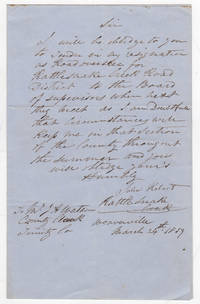
1859réf. 44772Weaverville CA 1859. Very good minor creasing along edges and folds minor soiling contents clean. 1 pp. Bifolium. 5 x 8 inches. March 24th 1859. Gold Rush era letter from John Hobart to Trinity County Clerk J.A.Watson resigning from his post in Weaverville California . "I will be obliged to you to tender in my resignation as Road overseer for Rattlesnake Creek Road District to the Board of Supervisors when next they meet as I am doubtfull that circumstance will keep me in that section of the County throughout the summer." Weaverville California founded in 1850 was a Gold Rush town and once had a population of nearly 2500 Chinese goldminers. In 1855 the Weaverville Trinity Times called attention " the large and rapidly increasing number of Chinese among us.crowding themselves into every vacant spot they can find." unknown books
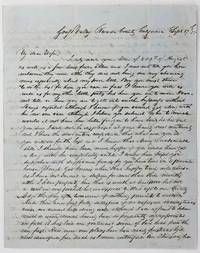
1855réf. 4791Grass Valley Ca: September 17 1855. Very good. 4pp. on a folded folio sheet. Old fold lines minor wear. An intimate letter from a gold seeker in Nevada County California. Theodore Shaw writes to his wife about mixed luck in California a terrible fire his concern for their children and his great anxiety about the future. He writes in part: "I have property here that is worth at least $1000 but not a cent in my pocket but we expect to start up to our quartz ledge the day after tomorrow if nothing prevents to errect a mill up there. And now our plans have been nearly frustrated by a most dreadful fire such as I never witnessed. On Thursday last about 11 o'clock p.m. an alarm of fire was heard and by about half past 12 some 350 stores dwellings and buildings were consumed with a large portion of their contents our hotel included. . The entire business part of the town is in ruins.we have been sleeping under an old shed in the suburbs. This fire has injured us in this way several who had taken stock in our company have lost their means still we intend going on in a smaller way. We had formed a company with a Capital Stock of $50000 divided into 50 shares of $1000 each. Do you know Lydia I have more anxiety about your health than anything else as I know you work hard; only think what would happen to our dear children if anything serious should happen to your health and I away here in California. September 17 unknown books
1852réf. 4789Mokilomni Hill Ca: April 3 1852. Very good. 2pp. plus integral address leaf. Quarto on a folded folio sheet. Old fold lines minor wear. In a highly legible script. An interesting letter from a disillusioned fortune-seeker in Calaveras County advising his father not to come west as all the easy pickings are gone. He writes "Times are pretty dull here now and as I have been doing nothing for the last two weeks I am getting rather sick of the place. I should leave today but there are some holes going down by some acquaintance of mine & I want to see if they get anything. If they do I shall sink one myself they go from 50 to 60 feet & as they are in a good looking place I have some curiosity to know whether they strike anything or not. If I leave this place I think I shall go south as I hear they have struck some deep diggings in the vicinity of Sonora & think I shall go down that way. I see by the papers that a great many are coming to the country from Boston. I do not know what they all will do here it is not the place here it was two years ago & those who start with the anticipation of finding money easily got here will be badly mistaken. April 3 unknown books
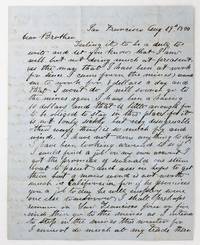
1850réf. 6357San Francisco: August 29 1850. Very good. 3pp. on a folded folio sheet. Old folds some light wear and soiling. Letter from a disillusioned painter living in San Francisco to his family back home in New Bedford Massachusetts. Currently in San Francisco proper Allen finds the town quite disagreeable with fog and wind and very little work. He writes that he isn't working at present because his employer will only pay him $8 a day which "won't do." He says "I will sooner go to the mines again. I have been a haveing 10 dollars and that is little enough for to be obliged to stay in this place for it is not only sickly but very disagreeable other ways." He's had little success in his job hunt with a glut of painters in town. "I have been looking around to see if I could find a job on my own account. I got the promise of several & one steamboat to paint and am in hopes of getting them but a man's word is not worth much in California for if he promises you a job today he will employ some one else tomorrow." He notes that he will go back to the mines in the winter: "Men enjoy much better health in the mines than do in this place as a general thing but mining is rather uncertain though I am determined to give it a good try this winter and then quit the country that is to say this section of it." He complains about a lack of correspondence and closes with a statement about the terrible plague of fleas he is currently suffering. A candid and grim look at life in San Francisco in 1850. August 29 unknown books
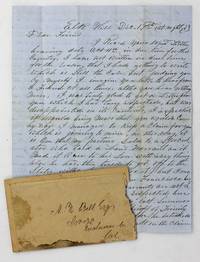
1853réf. 4788Elk Hill Ca: December 17 1853. Very good. 3pp. on a folded folio sheet. Old folds light wear and soiling. With original mailing envelope. An informative letter sent from a miner in Gold Rush-era California to a friend in Tuolumne County primarily concerning a mining claim but also providing many interesting local details. The author writes "I managed to keep a claim for you which is joining to mine in this way it is one that my partner sold to a speculator who laid a land warrant on it." He discusses the process of the land warrants and how he made the man title the claim properly in San Francisco. "This claim was jumped last summer by W.H. Dixon first sheriff of Trinity City who died the day before he intended to occupy the house he built on the claim. He shot himself accidentally and never spoke." The author immediately stepped in and nabbed it for his friend but it was short-lived. "The claim is cheap at $2000 as soon as I made it known that I should not administer it was jumped by 3 in one day before 9 o'clock. So much for your not coming as I told you I could not keep them off any longer and you would not come if I had." He further mentions that he is digging potatoes which he deems the finest in the world discusses issues with the crop and further talks about new arrivals in the area. December 17 unknown books
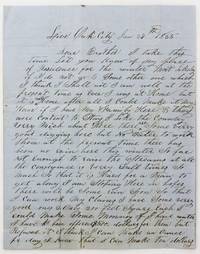
1855réf. 5504Live Oak City Ca: January 27 1855. Still very good. 4pp. on a bifolium. Previously folded with manuscript docketing on lower half of second leaf verso. Minor wear along old folds with a couple of short separations. Minor soiling and dampstaining somewhat heavier to addressed area. A detailed mid-1850s California Gold Rush letter from Elias Hunt Jr. to his brother in the tiny of Poolville New York southeast of Hamilton. Hunt was camped in Live Oak north of Yuba City when he wrote this letter home on January 27th 1855. He tells his brother that he has good claims but that a lack of rain has not allowed him to work them: "It is hard for a man to get along. I am stopping here in hopes there will be some rain soon so that I can work my claims. I have some very good ones 2 only 200 feet square each. I could make some money if I had water. I have been offered $500 dollars for them but I refused it -- I think I can make an ounce per day; I know that I can make ten dollars for I have done that before." There is talk of irrigating the area but Hunt is not sure that it will be finished before he wants to return east: "There is a ditch coming in here to suply sic the place with water but it will not be completed until Spring some time in April & I should like to come home in June. I shall stay until there is water in the ditch then I can wash a part of my claims & sell the rest to a good advantage for they are situated immediately on the line of the ditch." Continuing upon his plans to return he writes: "I have had a very good offer to come home across the plains by a man in Sacramento. He is from Utica; his name is Hamilton. He is going to cross with four hundred Spanish horses or mares. He has offered me good money to come with him as I have been over to Carson Valley this last season. It will take some sixty days to do it if I should get through with my claims by the time time that he gets ready to start. I think I shall come with him if the Indians are not to hosstille sic. They were very bad this last season; they got possession of one of Uncle Sam's forts." Hunt continues writing about local hunting prospects and family in New York before delivering a Crockett-esque farewell -- "Please give my respects to all may inquire for me & let the rest go to Hell for all that I care." A good letter from one of the less trafficked areas of the California Gold Rush. January 27 unknown books
1860réf. 4301Eldorado & Iowa Hill 1860. Good. Four manuscript documents including three letters totaling six pages. Old folds moderate toning minor edge wear a few tears a small hole in one letter. A neat group of four manuscript letters and documents all related to the mining activities of L.D. Davis of Georgia over a four-year period during the latter years of the California Gold Rush. Davis appears to be a lawyer living somewhere back east and may have been an investor in California mines or managing the financials for some mining concern from afar. The documents include an 1856 promissory note regarding "noted for collection" a long undated letter likely from California to Davis detailing amounts of gold taken from an unspecified mine and the mine's ownership situation and two letters overtly datelined from California -- the first from Iowa Hill in 1859 and the second from Georgetown in El Dorado County in 1860. Each document presents a unique set of concerns for Davis. Notable details of the three letters are as follows: 1 Autograph Letter Signed from A.J. Huff to Mr. L.D. Davis. Iowa Hill Ca. April 17 1859 2pp. The text reads in part "I have been very very sick for the last three weeks but am at this time improving.the disease is caused by the exposure of this last winter having worked continually in the rain and snow preparing my claim for the season. Times are very hard in this country now everyone has to work hard and is in big luck if he makes a decent living. A great many are making money very fast but in comparison not one in ten to the number than used several years back to make money or in other words the chances are about one in ten when they were one in fifty two and three in this country. If a man can get a good claim he can make more clear money out of it than he could then owing to the fact that everything is cheaper and experience has taught the People of California a great deal in respect to saving the gold and expediting the work. I think I have a very good claim which will last for a long time three or four years. It has been very expensive opening it but that is pretty well all over with now." 2 Autograph Letter Signed from J.D. Arranaut to L.D. Davis. Georgetown Eldorado County Ca. April 28 1860 2pp. Here a colleague of Davis's in California seems to be struggling and writes thanking Davis for a loan. The text reads in part with spelling normalized: "I was glad to hear from you and to.learn that you would comply with my request by letting my wife have $25 worth of corn for her use and please find enclosed a bank draft. I take it as a great favor as I am far from home. Let me know how my wife is getting along and if she stands in need of anything." 3 Autograph Letter Signed from J.H. Worley to L.D. Davis Esq. N.p. n.d. 1p. The letter concerns percentage ownership in an unspecified mine and opens with a four-line listing of the "amt. of gold taken from mine 513.51.1 while under my control." The author then writes in part: "The rent and expenses were take out of the above account and after the gold was sold one half after paying expenses. I know you are too well positioned in law to know that I dare not have settled with any other person unless I had been so instructed according to law. When Mr. Findley returned from Burke County he stated to me that one half the mine was for Mr Adams and myself and the other was for himself and his friends but did not say who they were. unknown books
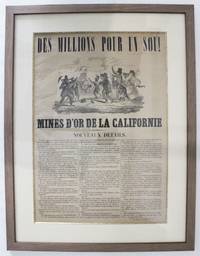
1849réf. 5043Paris: Typ. Schneider Rue d'Erfurth 1 1849. Very good. Broadside approximately 18 x 13 inches. Matted and framed. A pair of short closed tears repaired at lower edge. Even toning and light creasing. Contemporary manuscript annotation under caption title. A wonderful illustrated faux news broadside published in Paris as gold fever coursed through Europe in 1849. The headline promises "nouveaux détails" of the gold mines in California but the text is in fact a humorous description and light-hearted admonishment of the multitudes thoughtlessly giving up their livelihoods for the hardscrabble life of a gold digger in the California wilderness. The first section runs through a litany of types who are abandoning their lives for adventure and advises them not to consider the difficulties of the journey: "En route pour les mines d'or de la Californie! Partez! Il n'est pas néccessaire que vous preniez de lourds baggages : une cassette et une bonne pioche vous suffriont. Ne vous laissez pas décourager par la peur d'une navigation de cinq mois. elle sera peut-être périlleuse. mais le résultat est si consolant : de l'or!. toujours de l'or!. Qu'importent la colique et les fièvres doublées d'un mal de mer brutal. de l'or!. toujours de l'or!. Qu'importe d'être noir ou jaune en mourant du moment qu'on se repose dans un linceul d'or pour l'éternité! Partez!" The remainder of the text somewhat sardonically describes life in California and warns prospective travelers not long for the comforts of home but rather to concentrate on their sought-after riches: "Par example ne vous attendez pas à jouir de toutes les douceurs de la vie. Vous n'y trouverez ni biftecks au beurre d'anchois ni dinde truffées; car les aliments y sont rares. Mais les racines y sont en grande abondance. Vous vivrez un peu à la manière des anachorètes pour un temps. seulement vous déterrerez de l'or. ce qu'ils ne faisaient pas que l'on sache." The illustration which occupies approximately the top third of the broadside depicts men and women from all walks of life carrying pickaxes on their shoulders and racing for a ship about to depart. The image carries the printed signature of "B. Netter;" a contemporary manuscript note under the caption identifies the publication date as February 17 1849. The Bibliothèque Nationale de France estimates that as many as 40000 French men and women made their way to California between 1848 and 1856. The present broadside is an excellent document of California gold fever in France and the pervasive interest in gold rush news in Europe during the mid-19th century. Rare we locate just four copies at Berkeley UCSD California Historical Society and the BNF. Typ. Schneider, Rue d'Erfurth, 1 unknown books