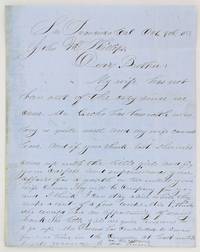
1852réf. 2473San Francisco: October 4 1852. Very good. 2pp. with integral address leaf. Old folds mild staining and soiling three-inch closed tear to address leaf. An interesting letter documenting the family side of the California Gold Rush in which a San Francisco man writes to his brother offering to send his wife and daughters to Placerville as helpers. Interestingly at first Phillips addresses the letter to his brother in Ohio then scratches it out and writes in "Cal;" this most likely indicates the Phillipses hailed from Ohio and trekked to California along with scores of others in hopes of untold riches in the California gold fields. In his letter Phillips writes that his wife who has long been in San Francisco looking after a sick friend can now leave as he is better "And if you think best she will come up with the little girls and fix your carpets and superintend your affairs for a month or two untill your wife comes." The formerly sick friend Mr. Gardner could also accompany them apparently as "He is coming up to P. and he wants you to give him work for a short time. Mr. G. is a good sailsman sic having been in the dry goods business." While not overtly concerned with gold mining the correspondence is nevertheless interesting for providing details on family routines during the Gold Rush era when numerous families uprooted their lives and moved not only to places like San Francisco and Placerville but between such locations during the years of speculation. A nice example of history from below particularly notable for its domestic implications during the time of the great California Gold Rush. October 4 unknown books
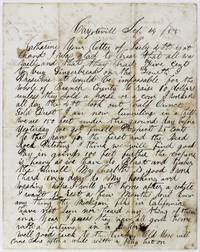
1855réf. 3206Coyoteville: September 12 1855. Very good. 2pp. plus integral blank. Original mailing folds moderate toning staining and ink spotting but still easily readable. Bottom fourth of integral blank excised. An informative Gold Rush letter about mining in the long-vanished ghost town of Coyoteville which was an extraordinarily rich gold area for a couple of years in the early 1850s. A noted tunneling method nicknamed "coyoteing" was developed in the town and subsequently inspired the name of the town. In the present letter Moses Pine writes to "Catherine" in Branch County Michigan and signs his name simply as "Mose Esq" at the conclusion. The author informs Catherine presumably his wife or sister of his activities some of the economic realities and some of the practical details of prospecting for gold in California. Presuming that "it would be impossible for the whole of Branch County to raise $10 unless they sell a horse" Pine comments that he had ginger bread on the Fourth of July after working all day and yielding a "half Ounce Gold Dust." He then provides a detailed description of his mining: "I am now tunneling in a hill. We are 150 feet under the ground. Day before yesterday we got small respect 25 cents to the pan for the first and the bed rock pitching. I think we will find good pay in the going 100 feet further the expense is heavy as we have to blast and timber the tunnel." Pine also talks of his health and that "I work hard every day do my cooking and baking." He then expresses his hope to get back to Michigan to "rest a few months" but knows nothing of other Michigan folks in California: "Have not seen nor heard anything of them in a year. I guess they have all gone home with a fortune in a horn. Well good luck to the lucky. Old Mose will come home after a while with a pretty hat on." A nicely-detailed letter from an unusual and obscure Gold Rush location. September 12 unknown books
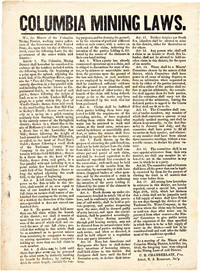
1853réf. 46036Columbia Ca.: Gazette Print 1853. The Laws of the Diggings A rare broadside printing of the laws of the Columbia Mining District in California in 1853 created and enforced by the miners for their own self-government. The seventeen articles all deal with regulations for mining and claims. The first nine set out rules for making and operating claims. The next three address foreign ownership of claims. Article 10: "None but Americans and Europeans who have or shall declare their intentions of becoming citizens shall hold claims in this district." Article 11: "Neither Asiatics nor South Sea Islanders shall be allowed to mine in this district either for themselves or for others." Article 12 sets out a punishment for any miner who sells a claim to an Asian or a Polynesian. The final five articles set out rules for enforcing the laws including the creation of a Miners Committee and a system of binding arbitration. According to the text the laws were adopted "at a meeting of the Miners of the Columbia Mining District held Oct. 1st 1853." and the laws are signed in print by "C.H. Chamberlain Pres." and "R.A. Robinson Sec'y." "The item is of basic importance.as an example of how the California miners - or men beyond the reach of government anywhere else in our States and Territories for that matter - banded together and enacted and enforced codes of law for their own protection" - Eberstadt. The COLUMBIA GAZETTE which printed this broadside was according to Kemble the second newspaper to operate in Columbia starting operations in the fall of 1852. The first newspaper in the area the COLUMBIA STAR apparently printed only two or three issues in October-November of 1851 before the printing press was destroyed by vandals. Greenwood locates only three copies at the California Historical Society and the Bancroft Library and the Streeter copy which was sold at the Clifford sale in 1994. Rocq lists a copy at the Huntington Library. OCLC adds copies at Yale Library of Congress University of California at San Diego Stanford and DeGolyer Library at Southern Methodist University. A rare and interesting example of the search for order in the tumult of the gold rush. The Streeter copy sold to Howell for $550 in 1968. It later reappeared in the sale of California collector Henry Clifford in 1994. Broadside 10¾ x 8 inches. Printed in three columns. A bit of light foxing mostly in margins. Near fine. In a folding cloth clamshell case spine gilt. GREENWOOD 381. ROCQ 15427. EBERSTADT 131:105. STREETER SALE 2735. CLIFFORD SALE 26. OCLC 29876358. hardcover books
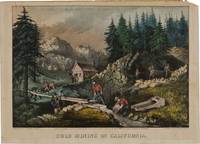
1871réf. 67574New York: Currier & Ives 1871. Attractive Gold Rush Print by Currier & Ives A fine handcolored lithograph by Currier & Ives depicting placer miners in California during the Gold Rush. In the foreground two men are shown shoveling sediment into a Long Tom capped with a sluice box while another man scoops up the remainder and deposits it into a rocker box. Behind them another trio work hard rock with pickaxes and a high-pressure hose. A small mining camp can be seen in the distance with a group of redwood stumps as evidence of their construction activities. Number eleven in the New Best 50 Currier & Ives prints. Not in Peters. Light tanning and soiling small chip to upper right corner. Very good. Matted. CONNINGHAM 2412. CURRIER & IVES CATALOGUE RAISONNÉ 2622. unknown books
1849réf. 49949New York. January 29 1849. Life Insurance for a Forty-Niner Who Went West with John Woodhouse Audubon An intriguing note regarding life insurance for a forty-niner traveling to California in 1849 with Henry Webb and John Woodhouse Audubon. The note reads: "Langdon H. Havens wants a life insurance permit for California to go over the Overland Route in company with persons bearing dispatches from our Government in a Company of 100 or more. He wants to leave for Washington immediately." Perhaps the twenty-six-year-old Haven sometimes spelled Havens originally intended to join a safe government-sponsored expedition from Washington but he was in fact among the 100 Forty-Niners who embarked on a famously ill-fated overland expedition led by Army Colonel Henry Webb with John Woodhouse Audubon son of the famous ornithologist as his second in command which left New York on February 8. The company proceeded by ship train stagecoach and riverboat to New Orleans and from there by steamer across the Gulf of Mexico to the mouth of the Rio Grande where they arrived on March 13 - an odd overland route dictated by Webb a veteran of the Mexican-American War. There disaster struck. A dozen men died of cholera the company's money was stolen and leadership conflict led Webb to leave the company with a dozen followers. Some of the remaining stalwarts including Haven followed Audubon onward trekking for seven months through Mexico and Arizona the survivors finally reaching San Diego in November. Some then took a boat to San Francisco; others continued overland to the gold fields. As meticulously recorded by Audubon a naturalist and painter in his own right the entire venture has gone down in history as "one of the most poorly-planned" Forty-Niner expeditions "on record." Haven though nearly dying en route was one of the fortunate few who "made it to California." An appealing note dated in the famous year of the California Gold Rush that eerily anticipates the dangers inherent in overland travel in America in the 19th century. Mailing folds slight edge discoloration else fine. unknown books
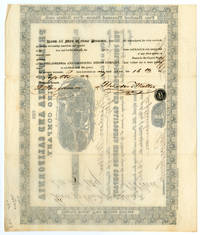
1618réf. 51617Philadelphia. Sept. 16 1852. Invest in California Gold Mines! A certificate for stock in the Philadelphia and California Mining Company completed on Sept. 16 1852 granting one Theodore Walter fifty shares in the venture and signed by the Secretary L. Alter and the President Pearson Serrill. The central woodcut depicts a mining scene representing the company's California operations. The Philadelphia and California Mining Company was founded in the same year on the basis of a land lease from John Fremont in the area of the Mariposa River. A rare piece of mining ephemera: OCLC records only one other example of a stock certificate from this company held by the California Historical Society. Previously folded with small chip at edge of a fold line. Printed form completed in manuscript by several hands. With a woodcut mining vignette. Near fine. OCLC 828929436. unknown books
1850réf. 68036Northumberland NY and Tuolumne County CA. 1850–1857. New Yorker in the "Land of Gold" A scattered but intriguing collection of manuscripts related to New York native Isaac Vanderwerker or Vanderwarker who made for the California gold mines in 1850 and remained out west until at least 1857. This group consists primarily of letters written to Isaac by his brother at home in Northumberland inquiring after Isaac's activities in the gold fields and commenting on matters at home though it also contains a detailed letter from Isaac himself a letter from his ill-fated sister Joann and two letters written by business partners in California. The earliest letter here written by Isaac's brother who signs only with initials is dated October 7 1850 shortly after Isaac arrived in California. Isaac was apparently one of many gold-seekers who elected to take a slow sailing ship from Panama rather than wait on the heavily delayed steamships though he weathered the journey better than most. Isaac's brother also notes several acquaintances who "have returned without making their fortune" and still more who are leaving regularly for the mines including a "Justus" who "made a vendue and sold his personal property" in order to fund the journey. Everyone in town it seems either wants to head to California or has an excuse not to. "I hope you will be one of the lucky ones and get well paid for all your toil sufferings and anxieties" he writes to his brother. "We have most of the California news every month. I saw in the last paper an account of the riot and burning of Sacramento City it spoke of some large lumps of gold being taken out weighing from one to forty pounds at Carsons new diggings on the Stanislaw another instance where a man took out four thousand dollars in two days at Murphy diggings but these cases are something extra John L. Cramer is at the Northern Mines on the Yuba…." The Vanderwerkers were early settlers of upstate New York and appear to have done well for themselves – Isaac and his brother are involved in several substantial properties and much of their correspondence relates to the management of their farms. The next letter in the group comes from the following summer written by Isaac's sister Joann. Joann discusses more details of the family's properties and notes that her health is poor enough that she is not sure to see the end of the week. Regardless news of California remains at front of mind: "There is a story in circulation that Aron Bliss Jaines Brother in law has stoll 15 thousand dollars at San Francisco and the owner has followed him here and there a going to take him back and hang him. John Cramer is on the yube never his Father said he guest by his writing he was not doing very well." From here we skip two years to October 16 1853 when Isaac's brother writes to tell him that large numbers are still heading for California. Joann has been holding on the last two years and "Old Frank" who used to work with them before moving to Canada would like to know if Isaac has work for him in California. He also goes on to discuss a bit of contentious New York politics: "We shall have five state tickets this fall viz whig Barnburner or soft hunker Adamantine or hard Temperance & abolition. The whigs no dout will carry the Election. The Barnburners had quite a majority in the State Convention….the Canal board are Barnburners & they are making a clean sweep of the hunkers." The letters continue over the next few years regarding more transcontinental legal matters real estate dealings Joann's eventual death in 1855 and the usual litany of deaths and marriages at home. The most content rich letter in the group is the only one written by Isaac himself sent to New York from Tuolumne County on May 18 1857. As Isaac describes his life in the west he also reveals himself to be a talented writer: "Dear Brother I will again endeavour to correspond with you by a few rude caught characters on paper which may put you in mind that you have a Brother Still in the land of gold…." He sends some gold home not present describes a chance meeting with the aforementioned John Cramer remarks on the high cost of goods in the mines and recent fires in San Francisco and Stockton. Business isn't cheap in the "land of gold" and he claims he "can do as much business in the States for 10 Dollars as I can Here for one Hundred." With that in mind he adds a postscript stating that he has sold out his plot and mining apparatus for $1500 and will try to go into business burning lime or supplying bricks and lumber in Benicia. He describes the new town and the rapid pace of development in California: "Benicia is situated about thirty miles up the Bay from San Francisco and about Six miles from the present Capital of the state named Vallejo. About three months ago the first building was erected which is a Hotel about two weeks ago they commenced building there is now about twenty small houses up and one three story Hotel. The government officers reside at Vallejo after the 10 of this month. I had an introduction to the governor at Vallejo last week he is a clever sort of man but not Dignified hardly fit for the Station…." Isaac's brother responds to this letter a few months later curious about his sibling's new business ventures. He also comments that "by what I can learn of the character of the Mexicans and Indians I should hate to travel alone without being well armed. I see by our papers that Lynch Law is that that governs all the mines I saw an account of a man being hung at San Francisco by Mr. Lynch at short notice." Unsurprisingly more and more are returning home by 1857 including a man named Wells " come in the same steamer your letter did he was sick but made out to keep up till he got home and died less than a week after he was not very successful in California." A heartfelt letter from a friend about the health of Isaac's mother also present seems to have convinced him and Isaac returned home for a visit to New York in the latter part of 1857. A September 3rd letter from his business partner John W. Kelly sent from Sawmill Flatt is addressed to Isaac in Saratoga and discusses business dealings in California. It would appear Isaac never pulled completely out of mining as the letter regards efforts to secure mortgage payments for Isaac's "ditch." The final letter in this collection is dated December 17 1857 and is addressed to Isaac from the offices of A.C. Goodrich in Columbia California. Goodrich describes a large flume his company has built 180 miles long and twelve feet wide by three feet deep "exclusive of the artificial embankment or five hundred ton stream capacity this day and night as we have reservoirs in abundance to hold the night & Sunday water. Would give 1000 ton streams which sold at the precent price viz $4.00 per day would pay ten per cent on a Capital of $1000.000. This would give a large basis for waste and reduction in price and still leave room for handsome profits on our Capital stock of $450000. The present cost of the work we can only approximate to but it is not far from 100000$." They hope that Isaac can become their agent and help them find investors. An interesting group of letters sent between brothers in California and New York during the Gold Rush stretching across seven long years of separation. Old folds occasional light tanning and staining. Very good. unknown books
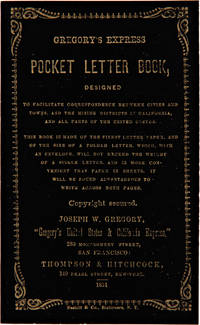
1851réf. 58179San Francisco: Thompson & Hitchcock 1851. Lovely Unused California Gold Rush Letter Book A lovely example of an unused Gold Rush letter book intended to advertise Joseph Gregory's California and New York Express Line as a convenient way for gold seekers in California to communicate with friends and family back home. Gregory's California Express according to the wrapper is "one of the oldest established in the business dispatch messengers BY EVERY STEAMER leaving New-York and San Francisco in charge of Letters Parcels Packages Gold Dust and valuables for distribution throughout the United States and California." Also according to Gregory's text "this book is made of the finest letter paper and of the size of a folded letter which with an envelope will not exceed the weight of a single letter and is more convenient than paper in sheets." The inside rear wrapper prints two testimonials from the PANAMA STAR praising the express line's speed and volume. Gregory also published a pamphlet titled GREGORY'S GUIDE FOR CALIFORNIA TRAVELLERS; VIA THE ISTHMUS OF PANAMA 1850 primarily to promote his business. A scarce and well-preserved piece of Gold Rush ephemera here with the original unused envelope. 24mo. Original dark purple wrappers printed in gilt. Very minor wear to wrapper edges. Near fine with the original unused plain paper envelope. unknown books
réf. 10514Paris Banque de France s.d. Un volume in-12 dos collé, couverture jaune illustrée, 185 pages, illustrations en couleurs. Bon état.
1911réf. 009679Hambourg [Paris] A fond de cale 1911 In-12 Demi-reliure
Sevilla, Sociedad de Bibliófilos Andaluces, 1868. 8o.; IX pp., 27 pp., 1 h. Edición limitada de 300 ejemplares. Cubiertas en papel.
Madrid, 1947 ("Cuadernos de Ínsula, 1). 4to.; 229 pp. Cubiertas originales.
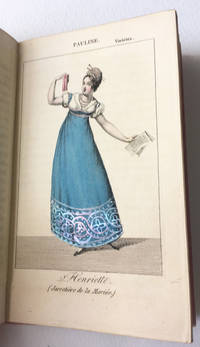
1818réf. Flo136Very rare complete set of all 8 volumes of this review of French theatre in the years 1818-1824. All eight years of publication complete with 8 handcolored engraved title pages and over 90 finely handcolored engraved portraits of actors actresses opera singers ballet dancers and comedians in costumes of their famous roles. "Very interesting almanac attributed to Charles Malo or Francois-Adolphe Loeve-Weimars giving a summary of Parisian and provincial theaters reviews on the plays and their performers notes on debuts repertoires etc." Grand-Carteret Les almanachs français Includes portraits of sopranos Mme. Gavaudan and Angelica Catalini tenors Jean-Blaise Martin and Simon Cheard ballet dancers Emilie Bigottini Genevieve Gosselin Antoine Paul and Mlle. Clotilde child actress Leontine Fay actors Francois-Joseph Talma and Charles-Gabriel Potier and many more. Odd volumes turn up occasionally but it is very rare to find the complete set of this intriguing anecdotal overview of Parisian theatre from the first quarter of the 19th century. Condition: All volumes in their pastel card slipcases paper bindings holding some spots of foxing to a few plates but overall very good with tissue guards. Complete with all engravings and calendars at end. Charles Malo 1790-1871 was a French author editor and translator whose books included a series of gift books for women illustrated by Pancrace Bessa almanacs city guides battlefield guides etc. Louis Janet paperback
réf. 98101501Canton 1860-80's Cheungqua. A group of 7 pith or Tongcao color paintings usual minimal issues mostly clean & solid sold "as is" as a collection with the typical chips & a few fox spots else very good clean examples. A RARE GROUP ! . . . . A SUITE OF 7 FINE CHINESE COLOR PITH PAINTINGS . . . SHOWING BEAUTIFULLY DRESSED CHINESE WOMEN . . . PLAYING MUSICAL INSTRUMENTS . . . EXECUTED IN STUNNING & BRILLIANT COLORS . . . AKA: CHINESE EXPORT WATERCOLOURS . A group of typical "trade paintings" executed by Chinese native artists for foreign traders visiting Canton or Macao during the early to mid-19th century. . A SUPERB SUITE OF FABULOUS COLOR PITH PAINTINGS: A stunningly beautiful group of hand-painted color pith paintings depicting a woman playing a musical instrument. . "GOLDEN LOTUS" or "LOTUS FEET" BOUND FEET Chanzu: This like most illustrations of the period show the women with bound feet. Chanzu bound feet was an erotic obsession and fetish in ancient China. The erotic ramifications are outlined in the references below. . The paintings illustrate Chinese women in a domestic scene with furniture playing musical instruments. Subjects are: . a. Yue1in Ruan Moon Guitar Moon Zither 4 stringed . b. Yanqin Chinese Dulcimer . c. Sanxian three-stringed Chinese lute . d. Drumming on the back of a Chinese ceramic bowl . e. Dizi Chinese bamboo flute . f. Huqin Chinese violin . g. Tong Luo Chinese Brass Gong . DESCRIPTION OF THE PAINTING ART WORK AND CONDITION: . Each painting is in brilliant vivid and stunning colors. Each is skillfully painted with a fine hand delicate fine-point brush with great detail incredible reality texture and appeal. . As usual the set paintings were tipped to a contemporary backing period Each painting is backed with a contemporary stiff paper or a more current back card. . Items "a" & "b" are matted see cover.jpg & title.jpg photos posted to our website. . Each painting is approximately 21 x 34 cm. most have a blue silk ribbon border partial border or border lacking chipped and the like on has restorations on the verso in the margin only. . Each painting has some chips parts missing on the edges or with small holes here and there 'e' by and large the images are complete but some may have usual and often typical age-related cracks or splits a touch of fox spots on "c." . Suitable for framing & display. Please review photographs posted to our website for details. . "RICE PAPER" PAINTINGS: Several authors refer to this name rather than the proper name "Pith" paper paintings also can be called "Tung Tsao." . THE CANTON ARTIST OR 'SCHOOL' OF CHEUNG QUA: Cheung Qua was an export watercolor painter in Canton. He and followers of his school produced various single and albums of these paintings which were sold from his studio. . Often his in-house artists began painting on their own thus replicating the techniques subjects and essence of their masters. Because these paintings were rarely signed the one and only identification ever found was occasionally on the album cover or spine with the studio name. . Often these paintings were sold in various shops in Macao the main resting and gathering place of foreigners during part of the year. . REFERENCE: . CLUNAS Craig.: CHINESE EXPORT WATERCOLOURS. This entire book is devoted to Pith or Rice paper paintings. For musical instruments see color plates on pp.50-53 especially plates on pp.66-67 plates 39 & 40 are particularly similar to our examples that is to say by the same or an artist who was in the same house of Cheungqua or that school. CHU Arthur. et al.: ORIENTAL ANTIQUES AND COLLECTIBLES: A GUIDE pp.62-66. THE CHINESE PITH PAINTING COLLECTION AT THE NATIONAL LIBRARY OF AUSTRALIA: An Annotated Guide. Crossman Carl L. The decorative arts of the China trade : paintings furnishings and exotic curiosities. LEVY Howard S.: CHINESE FOOT BINDING: The History of a Curious Erotic Custom. . --. THE LOTUS LOVERS: The Complete History of the Curious Erotic Custom of Foot binding in China. JACKSON Beverly.: SPLENDID SLIPPERS: A THOUSAND YEARS OF AN EROTIC TRADITION. . . unknown
réf. 38044201Canton 1860-80's Cheungqua. A single pith or Tongcao color painting usual minimal issues clean & solid example brilliantly vivid colors rarely found in such clean & fine condition. A RARE EXAMPLE ! . . . . FINE CHINESE COLOR PITH PAINTINGS . . . SHOWING BEAUTIFULLY DRESSED CHINESE IMPERIAL COURT LADY . . . EXECUTED IN STUNNING & BRILLIANT COLORS . . . AKA: CHINESE EXPORT WATERCOLOURS . A stunning Chinese Imperial Court. She wears a golden-embroidered outer dress with elaborate collar sleeves and hem. She wears pink silk-embroidered pants and her "lotus" bound feet are on a wooden stool. She sits on a Ming dynasty style Huahuali wood chair with a fan in her right hand and silk-embroidered accessory in her left. Adjacent to her is a matching Ming table with three ripe 'You' fruits pommel. . This is a typical studio trade painting" executed by Chinese native artists hand-painted color pith painting for foreign traders visiting Canton or Macao during the early to mid-19th century. . "GOLDEN LOTUS" or "LOTUS FEET" BOUND FEET Chanzu: This like most illustrations of the period show the woman with bound feet peeking out below her pant cuff. Chanzu bound feet was an erotic obsession and fetish in ancient China. The erotic ramifications are outlined in the references below. . DESCRIPTION OF THE PAINTING ART WORK AND CONDITION: . This painting is in brilliant vivid and stunning colors. Skillfully painted with a fine hand delicate fine-point brush with great detail incredible reality texture and appeal. . As usual this paintings was tipped to a contemporary stiff backing paper card. . This painting is approximately 19.5 x 27.5 cm. . There are a few old mends on the verso the image is not impacted it remains quite solid and very stable. By and large a far and above average excellent example. Suitable for framing and display. . Please review the photograph posted to our website for details. . "RICE PAPER" PAINTINGS: Several authors refer to this name rather than the proper name "Pith" paper paintings also can be called "Tung Tsao." . THE CANTON ARTIST OR 'SCHOOL' OF CHEUNG QUA: Cheung Qua was an export watercolor painter in Canton. He and followers of his school produced various single and albums of these paintings which were sold from his studio. . Often his in-house artists began painting on their own thus replicating the techniques subjects and essence of their masters. Because these paintings were rarely signed the one and only identification ever found was occasionally on the album cover or spine with the studio name. . Often these paintings were sold in various shops in Macao the main resting and gathering place of foreigners during part of the year. . REFERENCE: . CLUNAS Craig.: CHINESE EXPORT WATERCOLOURS. This entire book is devoted to Pith or Rice paper paintings. For musical instruments see color plates on pp.50-53 especially plates on pp.66-67 plates 39 & 40 are particularly similar to our examples that is to say by the same or an artist who was in the same house of Cheungqua or that school. CHU Arthur. et al.: ORIENTAL ANTIQUES AND COLLECTIBLES: A GUIDE pp.62-66. THE CHINESE PITH PAINTING COLLECTION AT THE NATIONAL LIBRARY OF AUSTRALIA: An Annotated Guide. Crossman Carl L. The decorative arts of the China trade : paintings furnishings and exotic curiosities. LEVY Howard S.: CHINESE FOOT BINDING: The History of a Curious Erotic Custom. . --. THE LOTUS LOVERS: The Complete History of the Curious Erotic Custom of Foot binding in China. JACKSON Beverly.: SPLENDID SLIPPERS: A THOUSAND YEARS OF AN EROTIC TRADITION. . . unknown
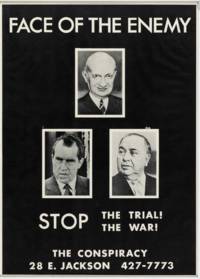
1969réf. List911Chicago 1969. 21 1/4 x 29 1/4 inches. Some light toning and edgewear near fine condition overall. The first example of this poster we have encountered which shows Judge Julius Hoffman Chicago Mayor Richard Daley and President Richard Nixon. We find no other records and can only assume it was produced in the same era as the previous offering as it bears the same address of 28 E. Jackson. unknown
1969réf. List911Chicago 1969. 21 1/4 x 29 1/4 inches. Some light toning and edgewear near fine condition overall. The first example of this poster we have encountered which shows Judge Julius Hoffman Chicago Mayor Richard Daley and President Richard Nixon. We find no other records and can only assume it was produced in the same era as the previous offering as it bears the same address of 28 E. Jackson. unknown books
1742réf. 23231Paris 1742. 12mo. Briasson Contemporary gold-tooled polished calf sewn on 5 supports with the corresponding raised bands on the spine a red morocco title label on the spine lettered in gold the gilt coat of arms of Louis-Hilaire du Bouchet comte de Sourches in the centre of both boards gold-tooled board edges red edges marbled endpapers. With an engraved frontispiece portrait of Thamas Kouli-Kan an engraved folding map 26.4 x 22.5 cm several decorated woodcut initials and woodcut head- and tailpieces. 4 455 6 pp. First edition of this life of the Persian ruler Nader Shah 1688-1747 founder of the Afsharid dynasty. Published anonymously the work has been attributed to Jean-Antoine Du Cerceau 1670-1730 and Abbé André de Claustre dates unknown. The biography is arranged chronologically with the years indicated in the margins. Illustrated with a large portrait and a folding map of Persia and the Mughal territories the work also contains a wealth of information on the geography and history of the Persian Empire.Nader Shah was a member of the Afshar tribe. He entered the service of Tahmasp the son of Shah Sultan Husayn. Nadir took the name Tahmasp Kuli Khan Tahmasp's slave. He warred against the Turks successfully and when the shah turned victory to disaster by a conciliatory peace Nadir in 1732 deposed him. Tahmasp's infant son Abbas III was placed on the throne with Nadir as regent. In 1736 Nadir deposed Abbas and he himself became shah thus ending the rule of the Safavid dynasty. In 1747 during a campaign against rebellious Kurds Nadir Shah was assassinated by officers of his own guard. Although the dynasty he founded the Afshar dynasty 1736-49 was short-lived Nadir is generally regarded as one of the greatest of all rulers of Persia. The present copy comes from the library of Louis-Hilaire du Bouchet called the Comte de Sourches 1716-1788 Seigneur de la Ronce and d' Hilaire-Ursule de Thiersault captain of the dragons at the regiment of the Languedoc lieutenant-général and knight of Saint-Louis.From the library of Louis-Hilaire du Bouchet 1716-1788. The edges of the boards are slightly scuffed the spine shows traces of use the title label is partly detached but still present. The leaves are lightly browned. Otherwise in good condition.l Atabey 257; De Backer & Sommervogel II col. 977; Cioranescu 19736; cf. Diba Collection p. 83 later ed.; for the coat of arms: Olivier Man. Rel. Arm. pl. 580. hardcover
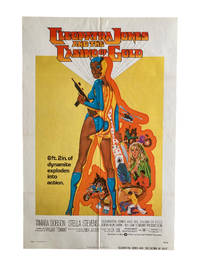
1975réf. 004250Warner Bros. 1975. Single sided printed poster approximately 690mm x 1040mm in size. Slightly creased from old folds with some light abrasion to image along those folds and a couple of Japanese tissue repairs to reverse but generally quite bright and clean. Directed by Chuck Bail and starring Tamara Dobson wearing some fantastic outfits. First Edition. Unbound. Good. US One Sheet. Poster. Warner Bros. Paperback
1991Catalogue de l'exposition présentée en 1991 aux Musées royaux d'art et d'histoire de Bruxelles: 166 pièces - objets en or, mais aussi en bois, bronze, terre cuite, cuir, tissu - avec notices, commentaires, dessins et photos couleurs, avec textes en alternance sur les civilisations des différents peuples, de la civilisation de Maïkop (3è millénaire avant J.-C.) à celle des Sarmates (IIè siècle avant J.-C.- IIè siècle après J.-C.); préface, introduction et texte sur l' "Histoire de la civilisation des Scythes de la région du nord de la mer Noire" de Boris PIOTROVSKY, directeur du Musée de l'Ermitage; morceaux choisis d'HERODOTE à propos des Scythes in fine; cartes; bibliographie. Français
réf. 20080Bruxelles, Musées royaux d'art et d'histoire / Crédit communal, 1991 1 volume 25 x 29,7cm Broché sous couverture noire illustrée couleurs. 263p.; cartes et nombreuses illustrations in texte, vignettes et pleines pages, en noir et en couleurs. Bon état.
1994Catalogue de l'exposition présentée en 1994 à l'Arsenal de Metz par le Conseil général de la Moselle sur le travail, l'utilisation et la mythologie de l'or, symbole divin, des civilisations précolombiennes du Pérou, de l'Equateur et de la Colombie; sous la direction de Daniel LEVINE, du département Amérique du Musée de l'Homme; cartes, nombreuses photos couleurs, croquis techniques en noir; bibliographie. Exemplaire bien complet de sa jaquette. Français
réf. 20112[s.l, Metz], Editions Serpenoise, [d.l. 1994] 1 volume 23,8 x 30cm Cartonnage éditeur sous jaquette illustrée couleurs. 132p., 2 feuillets; cartes et nombreuses illustrations in texte, vignettes et pleines pages, la plupart en couleurs. Très bon état.
réf. 201317122Paris, Editions alsatia , 1946 ; in-8, 176 pp., br. Page non coupé.
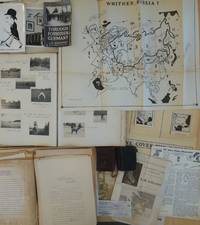
1950réf. List2425Europe and California 1950. Includes two small diaries from 1901 and 1917 with sporadic entries a large photo album measuring 14 x 11 with appx. 400 small photographs from 1906-1909 attached to album pages most measuring 3 x 2 as well as a few larger format images laid in. With 100 plus pages of typed pages including retained correspondence story ideas and various other manuscripts. With eleven maps produced for his “Of Men and Maps” series including five copies of a large map entitled “Whither Russia” in varied states and in large sizes up to 30 by 36 inches and a handful of small ephemeral pieces. Generally near fine condition with the exception of the album which is missing its rear board and has some pages loose and torn. Very Good. J.M. de Beaufort a war correspondent for the London Daily Telegraph and New York American during World War I recounted his wartime adventures in the 1917 book "Behind the German Veil: A Record of a Journalistic War Pilgrimage." Originally arriving in Chicago in 1909 he married a steel magnate's daughter and pursued a career in show business. However by 1912 he had gone through a divorce and transitioned to newspaper work earning the moniker of the "Dude Reporter." Originally born in the Netherlands as Jacques Albert Uilenbroek he was thought to be a deserter. He spent the latter part of his life in the United States apparently jailed in San Francisco for a stint in the 1920s and eventually settled in Los Angeles. Offered here is an interesting smattering of material from the life of the mysterious De Beaufort which bookends his most unusual career and life with a large visual photographic record of his life in Europe as a young man and over a hundred pages of manuscript material from late in his life with a highlight being several maps in draft form for an apparently unpublished project called “Of Men and Maps.” As a group the material shows the work of an ex-con artist and war correspondent trying to regain his form while living in Los Angeles. He was still writing as a “Special Correspondent” at this point though the title seems to have been fully honorary. Also included are two small pocket journals with sporadic notations from his life in Europe in 1900 and in 1917. In its entirety the group gives an interesting visual and manuscript record of a literary fraudulent and imaginative transatlantic life and intellect. The cartographic highlight of the group is several iterations of a large map called “Whither Russia” in varied forms which show an interesting interpretation of the sphere of influence of the USSR and its growth from 1939 to 1946. Also included are two drafts of a map of Operation Market-Garden in the Netherlands in 1944 an unidentifed tactical map of a military battlefield a map called “Middle East Jackpot” showing the division of territory between the Allied and Axis powers a map called “Dawn’s Early Light some reproduced small format maps from the De Beaufort’s and a small map called “Gifts from Yalta.” De Beaufort was working on these maps for a column called “Of Men Maps and Memories” that was published in the East Los Angeles Tribune. He also sent the columns out in newsletter form from his address at 1635 N. Ogden Drive in Los Angeles. The collection of manuscripts drafts and retained correspondence tackle a range of subjects perhaps most interestingly those detailing De Beaufort’s creative process - drafts of stories lists of ideas for stories and letters. His over the top style is on display in a lot of the writings some of which are of unknown origin and purpose. The documents contain correspondence between De Beaufort and Edwin Pauley the oil man and presidential advisor. In one untitled essay he asks himself the question “What has been your most thrilling experience” and his reply is “ Silly questions. Who or at least what newspaperman of some 25 turbulent years standing - and falling - could answer such a question. A reporter’s life has a thousand thrills. There was that rainy day in Marcy 1915 in the fortress of Loetzen when I stood face to face with Hindenburg. Hm yes that was quite a thrill…” De Beaufort was entrenched in the Los Angeles journalistic scene at this point and the documents show the degree to which he relied on his former glories to attempt various career revitalizations endeavors. The album of photographs from 1906-1909 over 400 in total give a visual record of the young Uilenbroek’s life in Europe. The star of the collection is his bulldog Bob who travels throughout Europe with him and eventually comes to America by 1907. Mary who we presume to be his future wife is featured heavily in the images. It is unclear whether he was working at this point the images show affluent young people and their dog in varied cities and are purely of a personal nature. Other photographs laid in are relics from his war correspondent period. The loose photographs and ephemera are a mix of portraits from different periods from his life including two pictures of Sydney Turing Barlow Lawson one signed by his widow. The journals are sporadically filled and hard to decipher though one legible passage says “drinking all day.” Overall the group gives evidence of this intriguing life and is the only extant group of material relating to Beaufort to our knowledge with the exception of a single journal from his time in Belgium during WWI that was sold at Bonhams and is still available in the trade as of this writing. unknown