TOLLEN (not TORREN), Gerrit van der, author & MOTOKI Masahide (or Shōei or Shōzaemon) 本木正栄, transBiblio.com
17 709 résultats
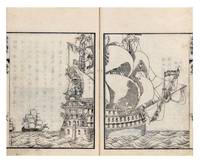
réf. 10340Many fine woodcuts throughout. Four parts & appendices in five vols. 8vo orig. semi-stiff wrappers a little frayed old stitching orig. title slips on covers. Tokyo: Yamasakiya Seishichi 山崎屋清七 et al. 1852. First printed edition of this artillery manual from the bakumatsu period. In the early 19th century Japan came under increased pressure from Western nations that wanted access to Japanese ports. “The Shogunate government issued the Order to Drive Away Foreign Ships in 1825 and commanded that foreign ships appearing along the coast of Japan be fired upon so the domains along the coast began building gun batteries and installing cannons. This is when the gun batteries and emplacements were built at Odaiba in Edo Bay and at Uraga Nakaminato Tahara Maiko Dannoura Uwajima Kagoshima and elsewhere. Dutch coastal artillery books were referred to when building these gun batteries” NDL Japan-Netherlands Exchange in the Edo Period online. Our book was published in this historical context. The book had already been translated by Motoki Masahide 1767-1822 who had left it unpublished at his death manuscript copies exist. Nunokawa Tsūboku 布å·é€šç’ž who edited Motoki’s translation and brought it to print in his Preface referenced the order that the domains build coastal defenses as one justification for publication. Motoki had studied not only Dutch but also French Russian and English. He published an English-language primer in 1811 and an English-Japanese dictionary in 1814. The Dutch original from which the book was translated was titled Het Nieuwe Licht Der Bosschieterye 1699 and was written by Gerrit van der Tollen fl. 1721-23 who worked for the Dutch East India Company. Our book is richly illustrated with a series of fine single- and double-page woodcuts of many kinds of cannons and mortars cannonballs and Western warships along with diagrams of problems in ballistics. Sections include illustrations and explanations of the structure and dimensions of cannons the measurement of gunpowder and lists of Dutch terms translated into Japanese. Some sections are written in a question-and-answer format “Which countries produce cannons Is there a difference in the making of light and heavy cannonballs”. The book begins with a history of artillery a topic that is treated further in the appendices which were not written by Motoki. The appendices treat the history of artillery both in Europe and in China. Note that Google Books presents the copy at the Bavarian State Library as being published in 1825 but the digitized title page says Kaei mizunoene which corresponds to 1852 and is the same date as seen in our book. Very fine set. ⧠Motoki: Christopher Joby The Dutch Language in Japan 1600-1900 Leiden & Boston: 2021 pp. 74 121 186 191 196-97 276 285 & 320. unknown
réf. 10340Many fine woodcuts throughout. Four parts & appendices in five vols. 8vo orig. semi-stiff wrappers a little frayed old stitching orig. title slips on covers. Tokyo: Yamasakiya Seishichi 山崎屋清七 et al. 1852. First printed edition of this artillery manual from the bakumatsu period. In the early 19th century Japan came under increased pressure from Western nations that wanted access to Japanese ports. “The Shogunate government issued the Order to Drive Away Foreign Ships in 1825 and commanded that foreign ships appearing along the coast of Japan be fired upon so the domains along the coast began building gun batteries and installing cannons. This is when the gun batteries and emplacements were built at Odaiba in Edo Bay and at Uraga Nakaminato Tahara Maiko Dannoura Uwajima Kagoshima and elsewhere. Dutch coastal artillery books were referred to when building these gun batteries” NDL Japan-Netherlands Exchange in the Edo Period online. Our book was published in this historical context. The book had already been translated by Motoki Masahide 1767-1822 who had left it unpublished at his death manuscript copies exist. Nunokawa Tsūboku 布å·é€šç’ž who edited Motoki’s translation and brought it to print in his Preface referenced the order that the domains build coastal defenses as one justification for publication. Motoki had studied not only Dutch but also French Russian and English. He published an English-language primer in 1811 and an English-Japanese dictionary in 1814. The Dutch original from which the book was translated was titled Het Nieuwe Licht Der Bosschieterye 1699 and was written by Gerrit van der Tollen fl. 1721-23 who worked for the Dutch East India Company. Our book is richly illustrated with a series of fine single- and double-page woodcuts of many kinds of cannons and mortars cannonballs and Western warships along with diagrams of problems in ballistics. Sections include illustrations and explanations of the structure and dimensions of cannons the measurement of gunpowder and lists of Dutch terms translated into Japanese. Some sections are written in a question-and-answer format “Which countries produce cannons Is there a difference in the making of light and heavy cannonballs”. The book begins with a history of artillery a topic that is treated further in the appendices which were not written by Motoki. The appendices treat the history of artillery both in Europe and in China. Note that Google Books presents the copy at the Bavarian State Library as being published in 1825 but the digitized title page says Kaei mizunoene which corresponds to 1852 and is the same date as seen in our book. Very fine set. ⧠Motoki: Christopher Joby The Dutch Language in Japan 1600-1900 Leiden & Boston: 2021 pp. 74 121 186 191 196-97 276 285 & 320. unknown books
réf. 11598Eight double-page & 24 full-page woodcuts. .5 32; 36 folding leaves. 8vo orig. semi-stiff wrappers now mottled title-slips new stitching. Japan: 1867; Preface dated 1865 & Postscripts dated 1861 & 1866. First edition. The tragic story of Hayashi Shihei æž—åå¹³ 1738-93 and his efforts to prepare Japan for changing times is well known. A Japanese scholar and a specialist in military affairs he travelled to Nagasaki in 1777 where he was greatly impressed by the size and strength of the Dutch ships. While there he learned of Russian intentions to advance south from Siberia into Asia. This prompted him to go to the northernmost island of Hokkaido to study the situation. As a result of this journey he became alarmed at the weakness of Japan's coastal defenses and ignorance of the outside world. In 1787 Hayashi began to privately issue in a series of 16 volumes only 38 sets were produced his famous and controversial Kaikoku heidan which recommended stronger military forces and a maritime defense capability. His series is a remarkable example of a study on modern strategy introducing the military sciences of the West to Japan. Hayashi describes the powerful weaponry of the Western powers and openly criticizes the shogunate for its ignorance of the rest of the world and reliance upon an isolationist policy while neglecting maritime defenses. Kaikoku heidan caused a sensation and was banned by the government in 1792 on the grounds that national security matters were being discussed without official consent. Almost all copies and the woodblocks were confiscated. Hayashi was placed under house arrest in 1792 and died the following year. In his final years he used the pen name "Rokumusai" meaning "Six Losses" enumerated as: "no parents no wife no children no woodblocks no money and no desire to die." The present work by his nephew Michiyuki who had studied under the military theorists Oikawa Kanzaemon åŠå·å‹˜å·¦è¡›é–€ and Hishita JūzŠ日下å蔵 is both an homage to his uncle and an addendum on the modern role of horses and cavalry in warfare as practiced in the West. Michiyuki believed that the traditional Japanese methods of using horses in battle were no longer relevant and that the samurai must be trained in the methods practiced by the cavalries of Western countries. The book is richly illustrated. In the first volume are fine woodcuts of training patterns designed to improve the horses' agility. Also shown are a series of horses' eyes and teeth each revealing the character of the animal and its suitability in warfare. Acupuncture points on legs of horses are also shown. The woodcuts in the second volume depict modernized saddles stirrups bridles and horseshoes. Fine set and very scarce. Preserved in a chitsu. unknown
réf. 11598Eight double-page & 24 full-page woodcuts. .5 32; 36 folding leaves. 8vo orig. semi-stiff wrappers now mottled title-slips new stitching. Japan: 1867; Preface dated 1865 & Postscripts dated 1861 & 1866. First edition. The tragic story of Hayashi Shihei æž—åå¹³ 1738-93 and his efforts to prepare Japan for changing times is well known. A Japanese scholar and a specialist in military affairs he travelled to Nagasaki in 1777 where he was greatly impressed by the size and strength of the Dutch ships. While there he learned of Russian intentions to advance south from Siberia into Asia. This prompted him to go to the northernmost island of Hokkaido to study the situation. As a result of this journey he became alarmed at the weakness of Japan's coastal defenses and ignorance of the outside world. In 1787 Hayashi began to privately issue in a series of 16 volumes only 38 sets were produced his famous and controversial Kaikoku heidan which recommended stronger military forces and a maritime defense capability. His series is a remarkable example of a study on modern strategy introducing the military sciences of the West to Japan. Hayashi describes the powerful weaponry of the Western powers and openly criticizes the shogunate for its ignorance of the rest of the world and reliance upon an isolationist policy while neglecting maritime defenses. Kaikoku heidan caused a sensation and was banned by the government in 1792 on the grounds that national security matters were being discussed without official consent. Almost all copies and the woodblocks were confiscated. Hayashi was placed under house arrest in 1792 and died the following year. In his final years he used the pen name "Rokumusai" meaning "Six Losses" enumerated as: "no parents no wife no children no woodblocks no money and no desire to die." The present work by his nephew Michiyuki who had studied under the military theorists Oikawa Kanzaemon åŠå·å‹˜å·¦è¡›é–€ and Hishita JūzŠ日下å蔵 is both an homage to his uncle and an addendum on the modern role of horses and cavalry in warfare as practiced in the West. Michiyuki believed that the traditional Japanese methods of using horses in battle were no longer relevant and that the samurai must be trained in the methods practiced by the cavalries of Western countries. The book is richly illustrated. In the first volume are fine woodcuts of training patterns designed to improve the horses' agility. Also shown are a series of horses' eyes and teeth each revealing the character of the animal and its suitability in warfare. Acupuncture points on legs of horses are also shown. The woodcuts in the second volume depict modernized saddles stirrups bridles and horseshoes. Fine set and very scarce. Preserved in a chitsu. unknown books
réf. 56445Leipzig: Arkstee und Merkus 1749. A copper engraved view on laid paper uncoloured from Volume 5 of Schwabe's Allgemeine Historie der Reisen 1747 - 1774. Image size is 25cm x 17cm. Text in German. Verso blank. At upper right: "No. 43.". At lower right: "F. de Bakker fecit 1749." and "T.V.F.". Original vertical folds clean very nice condition. This view possibly by Bellin engraved by de Bakker appeared earlier in Prevost's Histoire Generale des Voyages. An image of the Imperial Audience Hall at Beijing China. The scrollwork cartouche contains a numbered key to locations in the image. This image is based on the one by Jean Nieuhof published in his 1665 work: L'Ambassade de la Compagnie Orientale des Provinces Unies vers L'Empereur de la Chine . "Le dedans du Palais Imperial 'T KEYSERS HOF van binnen" - pg. 215. Leipzig: Arkstee und Merkus, 1749. unknown
1985Ril. carton., cm 28x23, pp 200, 31 tavv a colori e 242 ill. b/n.
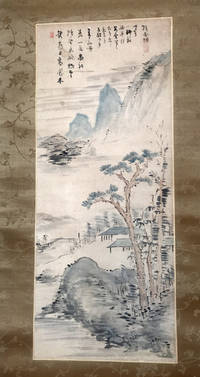
réf. 90223Rai KyÅhei 頼京平 aka ShunsÅ or Manshiro artist. Kakemono 掛ã‘物 - Hanging Scroll Landscape. N.p. n.d. Landscape painting of a mountain scene with pine trees. Hanging scroll kakemono 掛ã‘物 beautifully mounted on brocade with black wooden jiku handles. Image size 44.7x18.4cm with 49.5cm silk fabric at top 26.5cm at bottom and borders of approx 5-5.5cm on either side. Rai KyÅhei 頼京平 c.1756-1834 was an influential Confucian scholar and the uncle of the famous kanshi poet Rai SanyÅ. Sanyo was known for TÅjun KagetsuchÅ å旬花月帖 Journal of Flowers in 100 Days/ A Few Brief Moments Describing Moon and Flowers a collaborative work of poetry with floral and landscape paintings created after a three month walking tour through central Japan with his nephew and mother in the 1820s. The three poets and their entourage were influenced by the lyrical scenes of nature observed in Kyoto and Nara during their travels. This scroll is likely inspired by that period of travel and reflection in nature. Slight foxing on the image. Encased in a wooden scroll box 40.7 x 6.4cm with artist’s name brushed on label laid down on end of box. unknown
réf. 90223Rai KyÅhei 頼京平 aka ShunsÅ or Manshiro artist. Kakemono 掛ã‘物 - Hanging Scroll Landscape. N.p. n.d. Landscape painting of a mountain scene with pine trees. Hanging scroll kakemono 掛ã‘物 beautifully mounted on brocade with black wooden jiku handles. Image size 44.7x18.4cm with 49.5cm silk fabric at top 26.5cm at bottom and borders of approx 5-5.5cm on either side. Rai KyÅhei 頼京平 c.1756-1834 was an influential Confucian scholar and the uncle of the famous kanshi poet Rai SanyÅ. Sanyo was known for TÅjun KagetsuchÅ å旬花月帖 Journal of Flowers in 100 Days/ A Few Brief Moments Describing Moon and Flowers a collaborative work of poetry with floral and landscape paintings created after a three month walking tour through central Japan with his nephew and mother in the 1820s. The three poets and their entourage were influenced by the lyrical scenes of nature observed in Kyoto and Nara during their travels. This scroll is likely inspired by that period of travel and reflection in nature. Slight foxing on the image. Encased in a wooden scroll box 40.7 x 6.4cm with artist’s name brushed on label laid down on end of box. unknown books
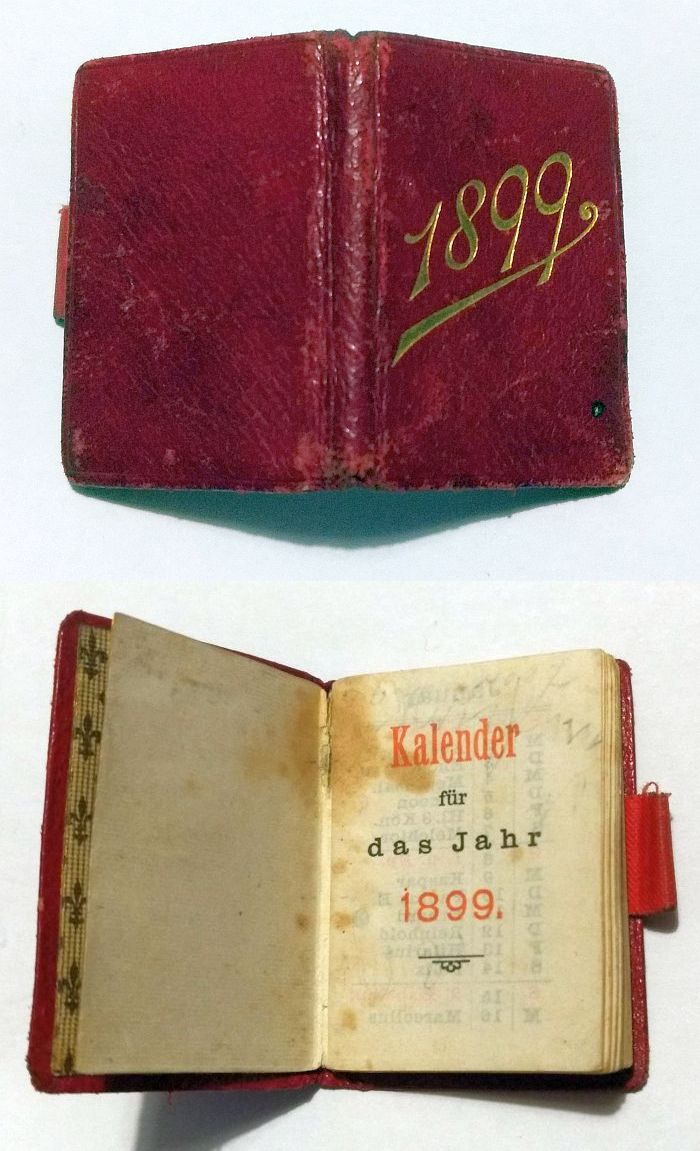
1898réf. 5094446Ohne Ort und Verlag (1898). 30 Seiten. Hinterer fliegender Vorsatz als weitere Textseite bedruckt. Antiqua-Druck in rot und schwarz. 46 x 34 mm. Roter flexibler Lederband mit goldgeprägter Jahreszahl auf dem Vorderdeckel, Leinenschlaufe an der Vorderkante des Hinterdeckels für den Miniaturbleistift, Goldschnitt und Buntpapiervorsätzen.
1972(Codice BM/0661) In 4º (31 cm) 56 pp. Il nobilissimo ordine della Giarrettiera, orologi da caminetto, il servizio da viaggio per toilette della principessa imperiale Olga di Russia, mobili liguri, bolli a secco di Francesco Sforza, il museo di Doccia, botanica di Disertori, cavalli e cavalieri nelle monete. Molte foto a colori e in nero. Brossura editoriale a colori, ottimo. ~~~ SPEDIZIONE IN ITALIA SEMPRE TRACCIATA
1971(Codice BM/0656) In 4º (31 cm) 80 pp. Orologi notturni, pittori genovesi nel 600/700, ceramiche orvietane del XII e XIV secolo, argenti dell'ottocento, insegne e ordini cavallereschi, reliquiari perottiani del museo di Sassoferrato, tappeti orientali, peltri, monete della seconda rivolta giudaica, sedia italiana, Camillo Boccaccino, ecc. Moltissime foto a colori e in nero. Brossura editoriale a colori, ottimo. ~~~ SPEDIZIONE IN ITALIA SEMPRE TRACCIATA
1971(Codice BM/0652) In 4º (31 cm) 80 pp. Un servizio da viaggio per Pietro Rotari, lampadari in cristallo e vetro barocchi e del '700, orologi, carte araldiche del '600, ceramica del Cerreto, peltri, bastoni, Andrea Solario ecc. Moltissime foto a colori e in nero. Brossura editoriale a colori, ottimo. ~~~ SPEDIZIONE IN ITALIA SEMPRE TRACCIATA
2010réf. 36127München, Goldmann Verlag, 1991, 2010. 413, 749 Seiten , 18 cm, kartoniert
1859réf. 3063798Ludwigsburg: Druck und Verlag von Ferd. Riehm 1859. VIII, 496 Seiten. Gr. 8° (23 x 15,5 cm). Privater Leinenband mit goldgeprägtem Titel. [Hardcover / fest gebunden].
1943réf. 2507029Kansas: Potter 1943. Soft cover. Very Good. 7 original glossy b/w photographs 3 1/2" x 5 3/4" - one slightly smaller of a circa 1934 jack rabbit roundup and general massacre in Western Kansas. At this time there was a general infestation of the pests that destroyed crops far and wide. Men gathered together and "drove" the rabbits into corners and clubbed them to death. News documentary film is available showing scenes. Five of these seven photos identify "Potter" as the photographer. "Noll" is identified on one and one is unidentified. The name "L. Durr" is written on the back of several. On the back of one in ink is written "I didn't send you any of these before. What do you think of the stupid rabbits A copy was in a Sun edition of the star." On the back of each photo is a band of residue from removal from a scrap or photobook. The images are very good and have a narrow white border. This are not RPPCs. Very scarce original photo. Potter unknown
24 x 16,5 cm. 72 Seiten. Kartoniert (sehr gut). *In Künzelsau wirkten von 1580 bis 1896 über 30 Zinngießer. Ihre Ware war weitverbreitet und erfuhren hoher Wertschätzung. Bücher de
Hardcover, 862 pages, ENG / GER, 130 x 105 x 100 mm, NEW, illustrated, with 5 ribbon markers. ISBN 9783939130208. the very early works of Karl Fritsch ; published in honour of the Françoise van den Bosch Award 2006, which has been awarded to the eminent goldsmith Karl Fritsch
Leipzig, Verlag Julius Kittls Nachf, 1935. 4to.; 686 pp., 1 h., 16 láminas, un mapa plegado y un árbol genealógico, aparte. Encuadernación original en tela estampada.
1970réf. 3319DBJosef Stocker, Dietikon. 1970–1972. Folio. Übersichtsblatt der 18 Einzelblätter, 22 Bl., 3 Schriftblätter und 18 Einzelblätter. Orginalbroschurdecken und Halbleinenmappe. Bibliophile Drucke von Josef Stocker.
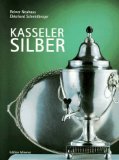
Softcover, 351pp., 21x28cm., ills. in col. and b/w., very good copy. ISBN 393235320x.
1998réf. 29689BBEurasburg:, Ed. Minerva, 1998. 4°. 351 S., mehr als 200 meist farbigen Abbildungen, Bibliographie, broschiert (sehr gut erhalten)
1998réf. 52657Eurasburg : Ed. Minerva 1998. 351 S. : zahlr. Ill. ; 28 cm kart., Softcover/Paperback
23,5 x 21,5 cm. 103 Seiten. Kartoniert (wie neu). ISBN 9783923319084 Bücher de
1919réf. 14087Pforzheim, Firma Arnold Biber, 1919. 1. Auflage mit sehr vielen Abbildungen. ill. OKt., 75 S., 4° [2 Warenabbildungen]