H Gold RogersBiblio.com

17 168 résultats
réf. 0483144703.Ghardcover. Good. Access codes and supplements are not guaranteed with used items. May be an ex-library book. hardcover
réf. 1333259743.Gpaperback. Good. Access codes and supplements are not guaranteed with used items. May be an ex-library book. paperback
réf. 23685547like new. unknown
réf. 1491756438.Ghardcover. Good. Access codes and supplements are not guaranteed with used items. May be an ex-library book. hardcover
réf. 1491756411.Gpaperback. Good. Access codes and supplements are not guaranteed with used items. May be an ex-library book. paperback
2022réf. BIBSD0166897722022. Full Leather Bound. NEW. Size: 14.60 x 22.86 cms A Unique Premium Leather-Bound book for elite readers/collectors of old rare books. An Original Leather is being used for binding this book with Golden Leaf Printing and designing on Spine front and Back of the book with edge gilding. WE HAVE MULTIPLE OPTIONS IN COLOR OF LEATHER RED GREEN BLUE MAGENTA TAN PURPLE DEEP BROWN BLACK AND WITH DIFFERENT COLOR LABELS. YOU MAY CHOOSE ANY COLOR OF YOUR CHOICE AND MAIL US. This service is chargeable. Original edition was published in 1854 and this unique edition is Reprinted in 2022 with the help of original edition. Black & white printing on high quality natural shade paper with sewing binding for longer life professionally processed without changing its contents. As these are old books we processed each page manually on computer and make them readable. We give our best to give you the best book but in some cases we have to adjust few pages which are blur or missing or black spots. If it is multi volume set then it is only single volume. We hope that you understand these issues in these old treasure. This is an important book for the readers who want to know more about our old treasure. Our dedicated team is trying to bring these rare books back to the shelves. We are also giving service of printing the hard-to-find books which are not listed in our store. Hope you will like it and give your comments and suggestions. Lang: - English Pages 214. Product Disclaimer: Please be aware that because leather is a natural material slight discoloration or change in texture may be visible. FOLIO EDITION Size 12x19 Inches IS ALSO AVAILABLE ON REQUEST. hardcover
1857réf. ZB530517NY: Published for the Author 1857. Price HAS BEEN REDUCED by 10% until Monday Nov. 2 weekend sale item 12mo 70 2 errata with verso blank; red embossed cloth binding rubbed at extremities with stain on front cover; most of the text devoted to the author's experiences in Italy during the 1840s. - If you are reading this this item is actually physically in our stock and ready for shipment once ordered. We are not bookjackers. Buyer is responsible for any additional duties taxes or fees required by recipient's country. Photos available upon request. NY: Published for the Author hardcover
réf. 1347308776.Ghardcover. Good. Access codes and supplements are not guaranteed with used items. May be an ex-library book. hardcover
2026réf. LRB4000190Paris: Editions Recreasoft 2026 Language: English. Approximately 542 pages. English : Print-on-demand reprint. Original edition : 1798. A substantial collection of the letters and correspondence of Henry St. John Viscount Bolingbroke covering both public and private communications from the period of his service as Secretary of State to Queen Anne. An important source for the study of early eighteenth-century British politics diplomacy and political thought with additional editorial value for readers interested in Bolingbroke's life and influence. Book images are non-contractual. Editions Recreasoft. Softcover. New. Editions Recreasoft paperback
2026réf. LRB25022999Paris: Editions Recreasoft 2026 Language: English. Approximately 646 pages. Volume 2 of a multi-volume work. English : Print-on-demand reprint. Original edition : 1798. This volume presents a comprehensive collection of the letters and correspondence of Viscount Bolingbroke covering both his public and private communications during his tenure as Secretary of State to Queen Anne. The work includes state papers explanatory notes and translations of foreign letters providing valuable insights into the political and personal life of one of the most influential figures of the early 18th century. Book images are non-contractual. Editions Recreasoft. Softcover. New. Editions Recreasoft paperback
2026réf. LRB46040901Paris: Editions Recreasoft 2026 Language: English. Approximately 630 pages. Volume 3 of a multi-volume work. English: Print-on-demand reprint. Original edition : 1798. Text in English. This edition presents the letters and correspondence of Henry St. John Viscount Bolingbroke during his tenure as Secretary of State to Queen Anne. The collection includes both public and private communications offering insights into the political and personal life of one of the most influential figures of the early 18th century. The work provides a valuable resource for historians and scholars of British political history as well as for those interested in the correspondence of key historical figures. Book images are non-contractual. Editions Recreasoft. Softcover. New. Editions Recreasoft paperback
2026réf. LRB46040899Paris: Editions Recreasoft 2026 Language: English. Approximately 646 pages. Volume 2 of a multi-volume work. English: Print-on-demand reprint. Original edition : 1798. Text in English. This edition presents a comprehensive collection of the correspondence of Henry St. John Viscount Bolingbroke during his tenure as Secretary of State to Queen Anne. The letters provide valuable insights into the political and personal life of one of the most influential figures of the early 18th century. The volume includes both public and private correspondence offering a multifaceted view of Bolingbroke's role in British politics and his relationships with key contemporaries. Book images are non-contractual. Editions Recreasoft. Softcover. New. Editions Recreasoft paperback
1997Thierry Guglielmo Lettera d'oro. , Mondadori 1997, Libro in condizioni medicori, presenrta pagine interne leggermente ingiallite come la copertina Mediocre (Poor) . Copertina flessibile 156 9788804427957
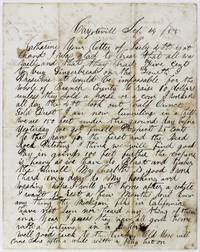
1855réf. 3206Coyoteville: September 12 1855. Very good. 2pp. plus integral blank. Original mailing folds moderate toning staining and ink spotting but still easily readable. Bottom fourth of integral blank excised. An informative Gold Rush letter about mining in the long-vanished ghost town of Coyoteville which was an extraordinarily rich gold area for a couple of years in the early 1850s. A noted tunneling method nicknamed "coyoteing" was developed in the town and subsequently inspired the name of the town. In the present letter Moses Pine writes to "Catherine" in Branch County Michigan and signs his name simply as "Mose Esq" at the conclusion. The author informs Catherine presumably his wife or sister of his activities some of the economic realities and some of the practical details of prospecting for gold in California. Presuming that "it would be impossible for the whole of Branch County to raise $10 unless they sell a horse" Pine comments that he had ginger bread on the Fourth of July after working all day and yielding a "half Ounce Gold Dust." He then provides a detailed description of his mining: "I am now tunneling in a hill. We are 150 feet under the ground. Day before yesterday we got small respect 25 cents to the pan for the first and the bed rock pitching. I think we will find good pay in the going 100 feet further the expense is heavy as we have to blast and timber the tunnel." Pine also talks of his health and that "I work hard every day do my cooking and baking." He then expresses his hope to get back to Michigan to "rest a few months" but knows nothing of other Michigan folks in California: "Have not seen nor heard anything of them in a year. I guess they have all gone home with a fortune in a horn. Well good luck to the lucky. Old Mose will come home after a while with a pretty hat on." A nicely-detailed letter from an unusual and obscure Gold Rush location. September 12 unknown books
1855réf. 3206Coyoteville: September 12 1855. Very good. 2pp. plus integral blank. Original mailing folds moderate toning staining and ink spotting but still easily readable. Bottom fourth of integral blank excised. An informative Gold Rush letter about mining in the long-vanished ghost town of Coyoteville which was an extraordinarily rich gold area for a couple of years in the early 1850s. A noted tunneling method nicknamed "coyoteing" was developed in the town and subsequently inspired the name of the town. In the present letter Moses Pine writes to "Catherine" in Branch County Michigan and signs his name simply as "Mose Esq" at the conclusion. The author informs Catherine presumably his wife or sister of his activities some of the economic realities and some of the practical details of prospecting for gold in California. Presuming that "it would be impossible for the whole of Branch County to raise $10 unless they sell a horse" Pine comments that he had ginger bread on the Fourth of July after working all day and yielding a "half Ounce Gold Dust." He then provides a detailed description of his mining: "I am now tunneling in a hill. We are 150 feet under the ground. Day before yesterday we got small respect 25 cents to the pan for the first and the bed rock pitching. I think we will find good pay in the going 100 feet further the expense is heavy as we have to blast and timber the tunnel." Pine also talks of his health and that "I work hard every day do my cooking and baking." He then expresses his hope to get back to Michigan to "rest a few months" but knows nothing of other Michigan folks in California: "Have not seen nor heard anything of them in a year. I guess they have all gone home with a fortune in a horn. Well good luck to the lucky. Old Mose will come home after a while with a pretty hat on." A nicely-detailed letter from an unusual and obscure Gold Rush location. September 12 unknown
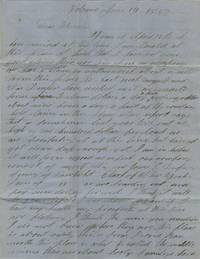
1853réf. BK0072Volcano California 1853. Autograph letter signed "S. W. Leonard" to his uncle Joseph Winslow in Mansfield Massachusetts. 2 pp. 7 ½ x 9 ¾ inches. Folded letter with clear circular "VOLCANO / CAL." postmark and matching "10" rate handstamp. Light aging; very good. A Gold Rush letter from a miner who after traveling hundreds of miles through California believed he had finally found a promising claim and a community in which he could remain. Writing from Volcano in the middle mines of Calaveras County S. W. Leonard reports modest but steady earnings on Sutter Creek describes the speculative hopes of his six-man company and contrasts the settlement's families and Sunday meetings with the more transient camps he had left behind. Leonard and William Draper had spent the previous week working a claim about a mile from Volcano making "from five to eleven dollars a day a piece working about nine hours a day." The returns were respectable rather than spectacular but Leonard's hopes centered on another claim held by members of the company. Local reports told of a French miner who had taken as much as one hundred dollars from a single load there the previous year. The men had not yet reached the promising layer but were "in hopes it will provide as good as reported." The company consisted of Leonard William and James Draper Comey and Davis of Pawtucket and Clark of New York. They were paying seven dollars per week for board. Leonard expected to remain in California for years and believed that if his health held his prospects were "flattering." His optimism rested not only on the claims but on Volcano itself. After months of continual movement through the diggings he considered it "the best place that I have seen yet" since "I left Peoria" and hoped that he would never "be obliged to take another tramp of this kind." Volcano had already begun to take on the character of a permanent settlement; Leonard counted approximately forty families mostly from the western states and noted that religious meetings were held every Sunday: "There is no place of resort here for evil purposes and what people are here are steady working men." He closes without dramatic news but with the guarded confidence typical of the Gold Rush: a workable claim an untested prospect tolerable living costs and the hope that he had at last reached the end of his wandering. A representative letter from the California diggings recording the modest daily economics of mining and one emigrant's search for both a profitable claim and a stable community. . unknown books
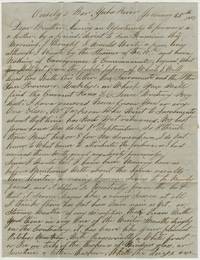
1851réf. BK0070Owsley's Bar Yuba River California 1851. 2 pp. 7 ½ x 9 ½ inches. Folded for mailing and postmarked San Francisco February 1 with red-orange circular datestamp and matching "40" rate handstamp. Minor wear with small pale spot to address panel. A Gold Rush letter from Thomas J. Dabline at Owsley's Bar on the Yuba River giving a detailed report on a dispersed community of Maine emigrants in the California diggings. Dabline names roughly a dozen acquaintances recording their locations occupations and in several cases their financial success while also describing the effects of an exceptionally dry winter on mining along the Yuba. Dabline begins by noting that he has continued mining "with about the same results" and then describes the winter season which had brought remarkably little rain. The shortage of water had begun to interfere directly with mining in the dry ravines: "The very small quantity of rain which has fallen has operated unfavorably for those who are engaged in mining in the dry ravines and hundreds who have been throwing out dirt for washing have been obliged to leave it for want of water. But should it continue as it has it will be very favorable for an early season up the mountains." He compares the weather to a pleasant October in Maine with occasional frost and thin ice and remarks on the relative health of the surrounding mining population estimating only six or eight deaths during the season among roughly 1500 to 2000 miners living within several miles. The strongest portion of the letter is Dabline's account of what he calls "the other Maine boys" who were dispersed across the northern California diggings: "I cannot tell you much about the other Maine boys. They are scattered about the country in the various diggings. I have learned that F. McLeod has gone home with about 3000 dollars and Mr. Sholl with 5000 or 6000 dollars. Fitch Demey is over on the American River in the Express business. Mr. Vinton & Upton are down on the McCormic or dry Creek. Mr. Carpenter with the two Johnsons of Waterville are over on the Feather River. Mr. G. is I believe at Sacramento City. The Trumbulls are up about Nevada City and Dr. Anderson was sometime back down at the little village of Nicholas which is about 55 miles above Sacramento." The passage offers a compact picture of a Maine migration network after its arrival in California with members spread among the Yuba American and Feather River regions Nevada City Sacramento and other settlements. Dabline records both the mobility of the group and their varying outcomes including men who had already returned home with several thousand dollars and another who had entered the express business rather than mining. He closes by mentioning current excitement over reports of a rich new discovery at Gold Bluff though adding that "very little credit is given to the tale here." A useful firsthand account of the social geography of the Gold Rush documenting a community of Maine emigrants across the mining regions while remaining connected through news of one another's whereabouts and fortunes. . unknown books
1851réf. BK0070Owsley's Bar Yuba River California 1851. 2 pp. 7 ½ x 9 ½ inches. Folded for mailing and postmarked San Francisco February 1 with red-orange circular datestamp and matching "40" rate handstamp. Minor wear with small pale spot to address panel. A Gold Rush letter from Thomas J. Dabline at Owsley's Bar on the Yuba River giving a detailed report on a dispersed community of Maine emigrants in the California diggings. Dabline names roughly a dozen acquaintances recording their locations occupations and in several cases their financial success while also describing the effects of an exceptionally dry winter on mining along the Yuba. Dabline begins by noting that he has continued mining "with about the same results" and then describes the winter season which had brought remarkably little rain. The shortage of water had begun to interfere directly with mining in the dry ravines: "The very small quantity of rain which has fallen has operated unfavorably for those who are engaged in mining in the dry ravines and hundreds who have been throwing out dirt for washing have been obliged to leave it for want of water. But should it continue as it has it will be very favorable for an early season up the mountains." He compares the weather to a pleasant October in Maine with occasional frost and thin ice and remarks on the relative health of the surrounding mining population estimating only six or eight deaths during the season among roughly 1500 to 2000 miners living within several miles. The strongest portion of the letter is Dabline's account of what he calls "the other Maine boys" who were dispersed across the northern California diggings: "I cannot tell you much about the other Maine boys. They are scattered about the country in the various diggings. I have learned that F. McLeod has gone home with about 3000 dollars and Mr. Sholl with 5000 or 6000 dollars. Fitch Demey is over on the American River in the Express business. Mr. Vinton & Upton are down on the McCormic or dry Creek. Mr. Carpenter with the two Johnsons of Waterville are over on the Feather River. Mr. G. is I believe at Sacramento City. The Trumbulls are up about Nevada City and Dr. Anderson was sometime back down at the little village of Nicholas which is about 55 miles above Sacramento." The passage offers a compact picture of a Maine migration network after its arrival in California with members spread among the Yuba American and Feather River regions Nevada City Sacramento and other settlements. Dabline records both the mobility of the group and their varying outcomes including men who had already returned home with several thousand dollars and another who had entered the express business rather than mining. He closes by mentioning current excitement over reports of a rich new discovery at Gold Bluff though adding that "very little credit is given to the tale here." A useful firsthand account of the social geography of the Gold Rush documenting a community of Maine emigrants across the mining regions while remaining connected through news of one another's whereabouts and fortunes. . unknown
1853réf. BK0072Volcano California 1853. Autograph letter signed "S. W. Leonard" to his uncle Joseph Winslow in Mansfield Massachusetts. 2 pp. 7 ½ x 9 ¾ inches. Folded letter with clear circular "VOLCANO / CAL." postmark and matching "10" rate handstamp. Light aging; very good. A Gold Rush letter from a miner who after traveling hundreds of miles through California believed he had finally found a promising claim and a community in which he could remain. Writing from Volcano in the middle mines of Calaveras County S. W. Leonard reports modest but steady earnings on Sutter Creek describes the speculative hopes of his six-man company and contrasts the settlement's families and Sunday meetings with the more transient camps he had left behind. Leonard and William Draper had spent the previous week working a claim about a mile from Volcano making "from five to eleven dollars a day a piece working about nine hours a day." The returns were respectable rather than spectacular but Leonard's hopes centered on another claim held by members of the company. Local reports told of a French miner who had taken as much as one hundred dollars from a single load there the previous year. The men had not yet reached the promising layer but were "in hopes it will provide as good as reported." The company consisted of Leonard William and James Draper Comey and Davis of Pawtucket and Clark of New York. They were paying seven dollars per week for board. Leonard expected to remain in California for years and believed that if his health held his prospects were "flattering." His optimism rested not only on the claims but on Volcano itself. After months of continual movement through the diggings he considered it "the best place that I have seen yet" since "I left Peoria" and hoped that he would never "be obliged to take another tramp of this kind." Volcano had already begun to take on the character of a permanent settlement; Leonard counted approximately forty families mostly from the western states and noted that religious meetings were held every Sunday: "There is no place of resort here for evil purposes and what people are here are steady working men." He closes without dramatic news but with the guarded confidence typical of the Gold Rush: a workable claim an untested prospect tolerable living costs and the hope that he had at last reached the end of his wandering. A representative letter from the California diggings recording the modest daily economics of mining and one emigrant's search for both a profitable claim and a stable community. . unknown
2007réf. Q-0696234300Meredith Books 2007-03-06. Hardcover. New. In shrink wrap. Looks like an interesting title! Meredith Books hardcover
1997réf. Q-0688140394William Morrow & Co 1997-01-01. Hardcover. New. In shrink wrap. Looks like an interesting title! William Morrow & Co hardcover
2019réf. 500186203Hatier 2019 420 pages 12 6x17 4x2 4cm. 2019. Broché. 420 pages.
2003réf. 18615GALLIMARD 2003 192 pages collection Témoins. 15x1 8x21 4cm. 2003. Broché. 192 pages.
1860réf. 241931860 Firenze : Le Monnier, 1860,in12 reliure demi basane,XII, 308p.,bon état,qques rousseurs,rare édition.
1902réf. RO40130603Librairie Hachette et Cie, Paris. 1902. In-8. Cartonnage d'éditeurs. Etat d'usage, Coins frottés, Mors fendus, Intérieur acceptable. 255 pages. Illustré de nombreuses gravures en noir et blanc dans le texte. Tranche dorée.. . . . Classification Dewey : 840.08-XIX ème siècle