17.709 Ergebnisse
Madrid, 2005. 4to., 192 pp. Enc. original.
Madrid, por Cano, 1798-1799. Tres tomos en 12vo.; XLVIII pp., 251 pp. y cinco láminas + 316 pp. y cuatro láminas + 303 pp. y 5 láminas. Rastros antiguos de humedad en primeras y últimas páginas del tomo II. Encuadernación uniforme de época en piel, con tejuelos.
Madrid, Imprenta y Librería de Gaspar y Roig, Editores, 1851. Folio; 179 pp. Con 38 ilustraciones entre el texto. Impresión a doble columna. Encuadernación en media piel, de época.
Madrid, Artes Gráficas Municipales, 1954. 4to. mayor; XI pp., 1035 pp., 1 h. y una lámina con la reproducción de la portada de la edición príncipe. Encuadernación original en tela estampada. Manchas de tinta en el plano posterior.
Barcelona, Librería de J. Oliveres y Gavarro, 1839. 4to.; 2 hs., 254 pp., 2 hs. y una lámina de Amills. Encuadernación de época en piel, con tejuelos.
Madrid, Razón y Fé, s.a. (hacia 1930). 4to. menor; 185 pp., 1 h. Cubiertas originales.
Barcelona, Talleres de la Sociedad Alianza de Artes Gráficas, 1975. 4to. mayor; 90 pp. Edición limitada y numerada de 200 ejemplares. Impresión en papel de hilo. Cubiertas originales.
Madrid, Luis Navarro, Editor, 1882 (Biblioteca de los Americanistas). 4to. mayor; LVI pp., 475 pp., 1 h. Edición limitada y numerada de 500 ejemplares, impresos en papel de hilo. Ejemplar intonso. Cubiertas originales.
Barcelona, Instituto Gallach, 1936. Folio; 616 pp. Con numerosas ilustraciones fotográficas entre el texto, mapas y 10 láminas en color. Encuadernación original en tela estampada.
Barcelona, Herederos de Juan Gili, 1909. 4to. menor; 557 pp., con 104 ilustraciones entre el texto. - Encuadernación en media tela.
Madrid, CIAP, 1931. 4to.; 337 pp., y una lámina fotográfica. Cubiertas originales. Contiene un extenso capítulo sobre las expediciones precolombinas y defiende la tesis del nacimiento de Colón en Pontevedra.
Zaragoza, por Pasqual Bueno, 1696. 4to.; 12 hs., XVI pp., 494 pp., de 496, faltando la última página. de Tabla. Pequeño agujero en la página 481/482, faltando dos palabras. Primera edición en español. Encuadernación en pergamino de la época.
Lyon: En Leon de Francia, por Antonio Briasson, Mercader de Libros, 1712. 4to. menor; retrato a toda plana realizado por Leclec, portada, 626 pp., 11 hs. Encuadernación en pergamino de la época.
Madrid, en la Imprenta de Don Pedro Joseph Alonso y Padilla, 1751. 4to.; 12 hs., 279 pp., 4 hs. Encuadernación de la época en piel, ligeramente fatigada en plano superior.
1916Best.-Nr. BOOKS0059952 volumes. 867 pages; 826 pages. Octavo 8 3/4" x 6 1/2" bound in quarter blue cloth with gilt lettering to spine over marbled boards. Edited by Jeranimo Becker. Second edition. Pedro de Aguado was a Spanish Franciscan friar who spent around 15 years in the New Kingdom of Granada preaching to the Indians. During this time he collected source material for a history of the region and began a manuscript Recopilacion historial which he completed in Spain between 1576 and 1583 but was unable to publish. The manuscript was used by other historians but was not published until the twentieth century. De Aguado's date of birth is uncertain. He is believed by Juan Friede to have been baptized in Valdemoro on 26 January 1513 whilst Guillermo Morón argues for 16 February 1538. Arriving in the New World in 1560 or 1561 in Cartagena his movements are uncertain until his arrival in Bogota in 1571 although it is likely he soon left Cartagena to minister to the Muisca people. By around 1564 he was a pastor to the Muisca at Cogua and he was able to build two churches there. Cogua was considered the first Indian town in New Granada where all the Indians were converted to Christianity an achievement of Aguado's recognized by King Philip II. In 1571 de Aguado moved to Bogota and became a "minister provincial" of the local Franciscan Province. In 1575 de Aguado was sent by the Province on a mission to Spain to answer charges that the local monks were greedy and abusive. He was not able to leave Spain to return to Bogota¡ until 1583. During this time he developed a manuscript on the history of the region Recopilacion historial begun during his "idle hours" in Bogota¡ It is likely that Part I on Santa Marta and the New Kingdom of Granada was written in Bogota and Part II on Venezuela and Cartagena in Spain. De Aguado tried unsuccessfully to secure publication over a number of years. A series of bureaucratic hurdles around censorship were complicated by a change in the rules invalidating the royal license to print which de Aguado obtained in 1581 while a second license in 1582 was complicated by a new requirement to have the printed copy checked against the original manuscript signed off by the king's secretary. Financial difficulties also played a role but a definitive reason for publication failing to materialize is not known. A planned Part III appears to have been abandoned possibly in frustration at the difficulties with publication with the witness statements that would have been the source material left in Spain on his return to Bogota in 1583. Dates for de Aguado's death are even less certain than those for his birth; dates vary from 1589 1595 to 1608. After his death his work was used directly and indirectly by other authors notably by Fray Pedro de Simon who appears to have had access to a copy of Part II of the manuscript which de Aguado took with him on his return to Bogota The manuscript de Aguado left in Spain was obtained in the late eighteenth century by the historian Juan Bautista Munoz; his collection became part of the University of Valencia on his death and was transferred to the Real Academia de la Historia after the university was partly destroyed in 1812 during a French siege of Valencia. There the manuscript was discovered in 1845 by Joaquin Acosta and it was consulted by some historians in the latter part of the nineteenth century. However it was not published until 1906 Part I Historia de Santa Marta y Nuevo Reino de Granada and 1913 Part II Historia de Venezuela. Condition: Shelf wear with some rubbing to extremities spine gilt dulled else a very good copy. Real Academia de la Historia 1916-17 Madrid hardcover
Madrid, Real Academia de la Historia, 1897 ["Memorial Histórico Español". Tomo XXXV]. 4to.; 584 pp. Encuadernación en pasta española, con tejuelo. Lomera ligeramente rozada.
Madrid, Real Academia de la Historia, 1899-1900 ["Memorial Histórico Español". Tomo XL]. 4to.; 354 pp., 1 h. Con 240 reproducciones de autógrafos de personajes que intervinieron en las Comunidades, en láminas fuera de texto, 12 láminas con retratos, fotografías y reproducciones de documentos, dos croquis y un mapa, todos ellos plegados. Encuadernación en pasta española, con tejuelo. Lomera ligeramente rozada.
Granada, 1999. 4to.; XCVII-343 pp. Cubiertas originales.
Barcelona, Imprenta de Oliva, 1835. 8vo.; 2 hs., 317 pp. Taladros de polilla en algunas páginas, afectando ocasionalmente letras. Encuadernación de época en media piel.
Barcelona, Imprenta de Oliva, 1835. 8vo.; 2 hs., 324 pp., 1 h. Encuadernación de época en media piel.
Barcelona, Imprenta de Oliva, 1836. 8vo.; 2 hs., 226 pp. Taladros de polilla en algunas páginas, afectando ocasionalmente letras. Ejemplar fatigado. Encuadernación de época en media piel.
Barcelona, Imprenta de Oliva, 1836. 8vo.; 2 hs., 226 pp. Taladros de polilla en algunas páginas, afectando ocasionalmente letras. Encuadernación de época en media piel.
Barcelona, Imprenta de Oliva, 1836. 8vo.; 2 hs., 335 pp. Encuadernación de época en media piel. Lomera con pérdidas.
Barcelona, Imprenta de Oliva, 1836. 8vo.; 2 hs., 349 pp. Taladros de polilla en algunas páginas, afectando ocasionalmente letras. Encuadernación de época en media piel.
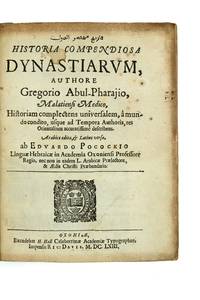
1663Best.-Nr. 4120Oxford: H.Hall. Impensis Ric: Davis 1663. First edition thus in the Arabic edition and Latin translation by Edward Pococke. 4to. 203x155mm. pp. 12 368 90 66 5bl 565 2. The final part 565 2 in Arabic paginates from the rear of the book. The two blanks are present. Three parts in one volume i.e. the Latin translation the Supplementum and the Arabic edition each with its own title page. Bound in twentieth century brown full calf by Sangorski and Sutcliffe lettered in gilt to spine. Contemporary manuscript title to fore-edge. Some light fading to the spine slight toning to edges of first and last leaves and a small hole to foot of the final leaf not affecting the text but overall in very good condition throughout. Front pastedown has the bookplate of the Middle East scholar R.M.Burrell. His important library of books on the Middle East was sold by Sotheby's in 1999 this was lot 319. On 17th October 1630 Edward Pococke 1604-1691 arrived in Aleppo as Chaplain of the Levant Company. While there he deepened his study of the languages and culture of the region and began to collect Arabic manuscripts. In 1636 Pococke returned to England at the request of Archbishop Laud who had recently established a Chair of Arabic at Oxford and wanted Pococke to be the first holder of it. One of the manuscripts brought back by Pococke was the al-Mukhtasar fî'l-Duwal 'History of the Dynasties' of Abu'l-Faraj Bar Hebraeus 1226-1286. The lack of material in England on Islamic history and geography meant that Pococke felt unable to prepare his edition and translation and so he secured a sabbatical from Oxford and sailed for Constantinople where he spent the next three years collecting manuscripts. He returned to England shortly before the outbreak of the Civil War and it was only in 1650 that he published extracts from the "History" in his Specimen historiae Arabum which included other material culled from his now extensive collection of manuscripts. Pococke was a Royalist and the years of the Protectorate were hard: he almost lost his professorship and his priestly living. At the Restoration he returned to Oxford and began work on the complete Historia Compendiosa Dynastiarum. Finally in 1663 almost thirty years after Pococke had returned from Aleppo with the manuscript of al-Mukhtasar fî'l-Duwal his far-reaching Historia which opened up Arab history to Western was published and "remained the standard edition until the twentieth century" ODNB. Oxford: H.Hall. Impensis Ric: Davis.