17.560 Ergebnisse
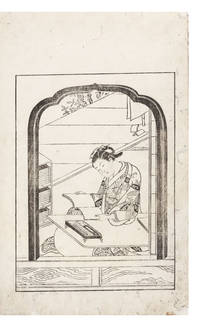
Best.-Nr. 6330Edited by Yusuishi Tanaka. Woodcut frontis. & eight fine double-page woodcut illus. 21; 18 folding leaves. Two vols. Large 8vo orig. blue wrappers wrappers rather worn & rubbed orig. block-printed title labels on upper covers rubbed new stitching. Osaka Edo & Kyoto: 1749. First edition of this beautifully illustrated book; the fine woodcuts are by Sukenobu Nishikawa 1671-1750 or -51 or -54 who “counts among the foremost masters of so-called ukiyo-e primitive prints. His subject matter like that of his contemporaries revolved around images of women walking. These images are stylised lending the rhythmic movement of the sumptuous robes an almost sculptural effect. Nishikawa also did many book illustrations…Nishikawa founded a whole school and according to his family archives Harunobu 1725-1770 was a follower of his.”–Oxford Art Online. This work is concerned with the education of women in its widest sense combining knowledge with taste. Four types of girls’ “play” are described and illustrated; each providing instruction in behavior and ethics. The fine woodcut frontispiece depicts a young woman reading a book surrounded symbols of knowledge and refinement: bookshelves and brushes for calligraphy. Her clothes and hairstyle are appropriate. The first volume is concerned with dolls hina. In Japan dolls are not for play but have high spiritual value which offer girls preparation for adulthood and marriage. For the Japanese dolls are living creatures possessing heart and soul from which girls can learn discipline obedience and control. Nakanishi 1634-1709 was a scholar and writer on Shintoism and the present text was edited and posthumously published by Yusuishi Tanaka who has contributed a preface. The theme of the text is instructional and written for girls and young women: there are many references to texts essential for proper behavior and ethics. Nakanishi draws on the Nihon Shoki the oldest chronicle of Japan; Man’yoshu the eighth-century anthology of Japanese poetry; the Tale of Genji; and Makura no Soshi the famous Pillow Book. There are four fine double-page woodcut illustrations in the first volume. The first illustration depicts an upper-class woman sending her dolls away in a boat thereby sending her suffering away. The second illustration depicts the hinamatsuri doll festival with dolls arranged on shelves. The following illustration depicts a young woman facing her suitor her dowry behind her all are objects of knowledge and culture: a calligraphy set fine papers in a box picture scrolls books etc. The final illustration in this volume depicts an offering made to the sky referencing tanabata the star festival. According to legend the Milky Way separates two lovers; they are allowed to meet only once a year on the seventh day of the seventh lunar month of the lunisolar calendar. The second volume is concerned with kai-awase the Japanese shell-matching game. Again there are four fine double-page illustrations each filled with deep meaning. Matching the shells symbolizes the unity of partners in a marriage. There are many references to the Tale of Genji and Lady Murasaki; scenes from this novel were often used to illustrate the shells. One of the illustrations depicts the traditional card game called uta-garuta being played by several women. A very good set and rare. Some carefully repaired worming mostly confined to the margins. The lower outer corners of many leaves are “thumbed.” ⧠Brown Block Printing & Book Illustrations in Japan p. 131. unknown books
Best.-Nr. 6330Edited by Yusuishi Tanaka. Woodcut frontis. & eight fine double-page woodcut illus. 21; 18 folding leaves. Two vols. Large 8vo orig. blue wrappers wrappers rather worn & rubbed orig. block-printed title labels on upper covers rubbed new stitching. Osaka Edo & Kyoto: 1749. First edition of this beautifully illustrated book; the fine woodcuts are by Sukenobu Nishikawa 1671-1750 or -51 or -54 who “counts among the foremost masters of so-called ukiyo-e primitive prints. His subject matter like that of his contemporaries revolved around images of women walking. These images are stylised lending the rhythmic movement of the sumptuous robes an almost sculptural effect. Nishikawa also did many book illustrations…Nishikawa founded a whole school and according to his family archives Harunobu 1725-1770 was a follower of his.”–Oxford Art Online. This work is concerned with the education of women in its widest sense combining knowledge with taste. Four types of girls’ “play” are described and illustrated; each providing instruction in behavior and ethics. The fine woodcut frontispiece depicts a young woman reading a book surrounded symbols of knowledge and refinement: bookshelves and brushes for calligraphy. Her clothes and hairstyle are appropriate. The first volume is concerned with dolls hina. In Japan dolls are not for play but have high spiritual value which offer girls preparation for adulthood and marriage. For the Japanese dolls are living creatures possessing heart and soul from which girls can learn discipline obedience and control. Nakanishi 1634-1709 was a scholar and writer on Shintoism and the present text was edited and posthumously published by Yusuishi Tanaka who has contributed a preface. The theme of the text is instructional and written for girls and young women: there are many references to texts essential for proper behavior and ethics. Nakanishi draws on the Nihon Shoki the oldest chronicle of Japan; Man’yoshu the eighth-century anthology of Japanese poetry; the Tale of Genji; and Makura no Soshi the famous Pillow Book. There are four fine double-page woodcut illustrations in the first volume. The first illustration depicts an upper-class woman sending her dolls away in a boat thereby sending her suffering away. The second illustration depicts the hinamatsuri doll festival with dolls arranged on shelves. The following illustration depicts a young woman facing her suitor her dowry behind her all are objects of knowledge and culture: a calligraphy set fine papers in a box picture scrolls books etc. The final illustration in this volume depicts an offering made to the sky referencing tanabata the star festival. According to legend the Milky Way separates two lovers; they are allowed to meet only once a year on the seventh day of the seventh lunar month of the lunisolar calendar. The second volume is concerned with kai-awase the Japanese shell-matching game. Again there are four fine double-page illustrations each filled with deep meaning. Matching the shells symbolizes the unity of partners in a marriage. There are many references to the Tale of Genji and Lady Murasaki; scenes from this novel were often used to illustrate the shells. One of the illustrations depicts the traditional card game called uta-garuta being played by several women. A very good set and rare. Some carefully repaired worming mostly confined to the margins. The lower outer corners of many leaves are “thumbed.” ⧠Brown Block Printing & Book Illustrations in Japan p. 131. unknown
1835Very Good Arabic Original full brown morocco with traditional flap. Traditional shemses (mytical sun) embossing on boards. Large roy. 8vo. (25 x 17 cm). In Arabic. [9], 562 p. Hegira 1251 = Gregorian 1835. "A supercommentary to Ibrâhîm ibn Muh?ammad al-H?alabî (1549-)'s shorter commentary (entitled Ghunyat al-mustamlî) on Sadîd al-Dîn al-Kâshgharî (13th century)'s treatise on Muhammadan ceremonial law entitled Munyat al-musallî.". Extremely rare. Brockelmann: History of the Arabic Written Tradition Supplement, Vol. 1: Islamic literature in Arabic, Vol. 2: Post-Classical period.; 52. Sadid al-Din Al-Kashgari, seventh century., pp. 682.; Not printed copy in OCLC for Bulaq Edition, for digital register, OCLC 945200709.
2013Best.-Nr. Q-0547992653New Harvest 2013-04-16. Hardcover. New. In shrink wrap. Looks like an interesting title! New Harvest hardcover
1876Best.-Nr. 61903Wien, Hof- und Staatsdruckerei, 1876. 8°. VI, 105 (1), XVI S., Lwd. d. Zt.
Madrid, 2000. 4to.; 239 pp. Ilustraciones. Cubiertas originales.
88 Seiten. 27 x 21 cm. Kartoniert (sehr gut). Bücher en
2021Best.-Nr. BN310131Nova Md 2021. 2021. Softcover. Highland Rebels Highland Rebels Alessia Gold Nova Md paperback
8vo. pp. vii, 214. profusely illus. in b/w including, some maps. pictorial boards. Very good condition. ISBN 9781901663259.
Best.-Nr. 48876, Edinburgh, NMS Publishing, 1999, 8vo. pp. vii, 214. profusely illus. in b/w including, some maps. pictorial boards. Very good condition. ISBN 9781901663259.
1987Best.-Nr. 021110San Francisco CA U.S.A.: RE/Search S.F. 1987. First hardcover edition thus. Photo Illustrated contains two novels and a play in three-acts of High Priest of California. "Wild Wives" was first published as a Beacon Paperback 1956; " High Priest of California" was published as a Royal Giant paperback in 1953. Fine in dust jacket lightly sunned at spine as usual. 1 of 250 copies this being #161 SIGNED & NUMBERED by Willeford. . Signed by Author. First Edition. Hardcover. Fine/Near Fine. Book. RE/Search S.F.
1986Best.-Nr. 1213773PN. New. 1986. Reprint Edition. Soft Cover. Date is copyright date; this is a later reprint edition . PN paperback
1982Ex-library book with usual stickers, stamps, etc. Binding is solid and text is clean. 221 pages, large format volume of approx. 40 articles by individual authors on the subject. Sections include Mineral Exploration Strategies, Geological Methods of Exploration in Tropical Rain forests, Ceochemical Techniques, Geophysical Techniques, Remote Sensing Techniques, Environmental Considerations & Case Histories. Graphs, charts, B&W photos, maps, tables, line drawings.
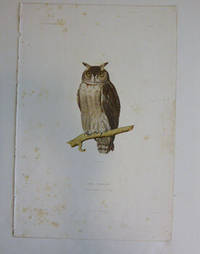
Best.-Nr. 51-7421Paris: Arthus Bertrand 1845-1851. Color engraving. 48.5 x 32.5cm. Light foxing.As published in "Voyage en Abyssinie exécuté pendant les années 1839 1840 1841 1842 1843 " éditée à Paris chez Arthus Bertrand. Text by Théophile Charlemagne Lefebvre 1811-1860 and others. Planche. 4. Otus cineraceus is a historical scientific name previously used to classify a subspecies of small owl in North and Central Amer Paris: Arthus Bertrand, 1845-1851. unknown
Best.-Nr. 1330343913.Gpaperback. Good. Access codes and supplements are not guaranteed with used items. May be an ex-library book. paperback
softcover, geillustreerde kartonomslag, 240 x 300mm., 341pages ., zeer uitgebreid geillustreerd in kleur en z/w. ISBN 9066250240. Tweetalig editie , avec sommaire en francais. 16 september - 10 december 2000. In goede staat
1716Best.-Nr. 1469Haarlem: Weduwe van Hermanus van Hulkenroy 1716. Early 19th-century marbled boards with a paper title label on the spine. 4to. With an etched frontispiece an etching of a mermaid on the title 2 folding etchings 2 full-page etchings and 21 etchings in the text all after Adriaen van Ostade. Further with musical annotation to all songs. First edition of a rare Dutch songbook with songs for farmer's festivals all with musical annotation. The work has been beautifully illustrated with etchings after the famous Dutch painter of country life Adriaen van Ostade 1610-1685. The fine etchings newly made and in reverse present an exemplary survey of Van Ostade's work showing busts of peasants women on their way to the market carrying baskets farmers smoking merry parties dancing in front of the farm a knife-grinder a schoolmaster etc. Together they give a lively impression of country life.The work was published anonymously but has been attributed to either Jan van Gijsen 1668-1722 or Aäron van Hulkenroy 1687-1733. Van Gijsen was a popular author who wrote a large number of occasional poems. His collected works were published at Amsterdam in three volumes in 1707-1711 but the present selection was probably published only once partly with the address of the Widow of Van Hulkenroy and partly with the address of J. van Egmont who had also published the collected works. Aäron van Hulkenroy was the son of publisher Hermanus van Hulkenroy and took over the publishing company after both his parents had passed. He was also a poet who wrote various poetry collections which were always published by his mother or later himself. The present work has been attributed to him because the very first poem on the verso of the half title is signed with his initials.The boards and spine are rubbed with some loss of material at the lower outer corner of the front board. The leaves and plates are somewhat foxed a small tear in the margin of first folding plate has been repaired on the back. Otherwise in good condition.l Goovaerts 1011; Cat. Muziekhist. Museum Scheurleer II p. 92; Scheepers I 284 "Hoogst zeldzaam"; Scheurleer Liedboeken 199 lists both 1716-issues; STCN 154032301; cf. Hollstein XV pp. 1-70 for the etchings; NNBW 8 col. 648 Gijsen and NNBW 4 col. 790 Hulkenroy; not in Arents Tobacco. Weduwe van Hermanus van Hulkenroy, hardcover
1810Best.-Nr. 12097Haarlem, Joh. Enschede en Zoonen, 1810. 12° (15-18,5 cm). 184 num Bll., 412, 491 SS. Samteinband der Zeit mit Ganzkopfgoldschnitt und Schließen aus Echtgold
Gebonden in half linnen, 280 + 360mm, 46pp.+ 34 illustraties volpagina Het goud- en zilverwerk in het Nederlandsch museum voor geschiedenis en kunst te Amsterdam met tekst door A. Pit directeur van het museum. Rijkgevuld met 34 illustraties.
Best.-Nr. 8163, Brussel, Koninklijke Musea voor Kunst en Geschiedenis, 1991., softcover originele geillustreerde uitgeversomslag in kleur, 25x29,5cm, 263pp, geillustreerd in kleur en z/w. in goede staat. ISBN 905066086x.
Best.-Nr. 1527676633.Gpaperback. Good. Access codes and supplements are not guaranteed with used items. May be an ex-library book. paperback
Würzburg, Schmitt & Meyer, 1971. 4to.; 259-XV pp., mimeografiadas. Cubiertas originales.
Cáceres, 2003. 4to. mayor; 270 pp. Cubiertas originales.
Best.-Nr. 1330831675.Gpaperback. Good. Access codes and supplements are not guaranteed with used items. May be an ex-library book. paperback
Madrid, Real Academia de la Historia, 1970. 4to. mayor; 98 pp. Cubiertas originales.