188 resultados
1983102 pages including index. Includes directions for selecting, buying and using beading materials; Guidelines for either buying or making your own beadwork loom; An examination of Indian beadwork designs, their development, significance and uses. Step-by-step instructions for all of the variations of beading techniques used in both look and applique work. Directions for beading round objects, rosettes and necklaces. approximately 200 illustrations, examples and photos of beaded articles from 1835 to present. Average wear. Some soiling and staining. Binding intact. Good working copy. Book
1949Features include: Sunken Treasure - In 1799 the British frigate Lutine sand off the Dutch coast and in 1933 a new method of salvage was attempted; A Burmese Houdini; Tiger's Teeth - An English Adventure; The Major's Panther - Amateur big-game hunters get lucky; #20,000 - the eventful life of a banker; On the Trail in Wonderland - Travels through Navajo Indian country; Three Queer Mysteries from Malaya; Our Trip to the Buffalo Country - An Australian Journey; Looking Down the Devil's Throat - A trip to Iguassu Falls in Brazil; The Naga Head-Hunters of Assam; Where Water Burns - An Alberta Story; Passed with Honours - by Lieut.-Col. M.C.A. Henniker. Illustrated in black and white. Somewhat above average wear. Openings at each spine end. One inch tear to fore-edge of back cover. Magazine
1946ref. 2082702114609001Yoshida shobo 1946. Soft Cover. Fine. Number of books: 1 Yoshida shobo paperback
1978ref. 2090502113717869Not Available 1978. Soft Cover. Fine. The book is in fine condition. Not Available paperback
1939ref. 25313Doubleday Doran & Co NY 1939. HBDJ 1939. First Edition as stated on the copyright page. 1st Printing Dates Match on Title & Copyright pg VG-/VG- AS-IS DJ light rub wear Scuff tiny chips Extremities Spine DJ small chip Top But NOT Affecting Authors Name Back DJ light Fox edges Bright Green cloth Titled & Decorated RedMaroon on spine cvr Slight Lean to Book Interior nice tight clean light FOX Wea The U.S. Edition was issued before the British Edition for this title. . First Edition. Hard Cover. Doubleday Doran & Co NY hardcover
1936ref. 28780REILLY & LEE Chicago 1936. HARDBACK NO DJ 1936 First Edition; GOOD /No Jacket; . INTERIOR PGS FOXED. 5 1/2 X 7 3/4. The blue cloth boards have black letters on the front and spine CVR & FOX. LITE STAINS BACK CVRThe spine has been sun fadded and the back has several spots on it. The previous owner signed the inside of the book. The pages have truned brown from the ageing process. 186 PGS. 1st Edition. Hardcover. Good/No Jacket. REILLY & LEE Chicago hardcover
1979A clean, unmarked book with a tight binding. 90 pages. 8 1/2"w x 8 1/2"h. Many b&w photos. Previous owner's name inside.
ref. 45478698-nnew. unknown
ref. B9781016289573Hardback. New. hardcover
1895ref. 30283SMALL HARDBACK NODustjacket Date Published: 1895 ON COPYRIGHT PG. 1st edition THUS VG/VG AS-IS NOJACKET SMALL GoldGILT red & BRown CRUSHED LEVANT LEATHER CVR SUPER EXTRA HAND FINISHED EDGES SEWN WITH SILK GILT TOPSHardback: Very Good. Binding firm. Beautiful Art Nouveau cover. Wear to cover sunning of spine. Interior clean and unmarked. No library markings in book. Dust Jacket: NO DJ issued. 4 1/4" by 6 1/4" 258pg. ads. Henry Altemus PHILADELPHIA hardcover
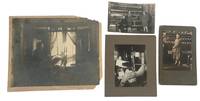
1900ref. 238851900. Women textile workers photo archive depicting Jacquard weaving and related mechanized textile production c. 1900 documenting an industrial technology directly connected to the development of programmable computation. Two photographs show women at Jacquard looms where large harness assemblies permit the selective control of warp threads required for figured weaving. The Jacquard system used sequences of punched cards to determine which warp cords were raised during successive passes storing instructions outside the loom mechanism. Charles Babbage adopted the punched card principle for his Analytical Engine in 1836 and Ada Lovelace in her 1843 Notes on the Analytical Engine compared its manipulation of mathematical operations to the Jacquard loom's weaving of figured patterns. Photo archive 4 silver gelatin photographs mounted on cardstock c.1900-1930. Two photographs show women seated at Jacquard looms enclosed by tall wooden frames supporting dense arrays of harness cords descending toward the warp; the punched card chains themselves are not visible in these views. A third shows a woman standing beside a monumental warp creel filled with scores of individually wound yarn packages each feeding thread through a corresponding guide. The fourth shows two women attending a broad industrial textile machine identified with Bruno Knobloch who patented a thread feeding device for flat warp knitting machines and a Jacquard device for warp knitting machinery. The four photographs document distinct pieces of equipment with women operating supplying and monitoring each machine. Textile manufacturing employed more women than any other industrial sector in Europe and the United States during this period and the Jacquard loom in particular was operated predominantly by women in both domestic workshops and factory settings. Jacquard demonstrated his punched card controlled loom in 1801. The women pictured here worked inside the industrial system Lovelace pointed to: textile production organized around the controlled selection of threads repeatable sequences of mechanical operations and machinery capable of translating predetermined instructions into complex physical patterns. Light fading and tonal variation with scattered surface and mount wear; overall in good condition. unknown
1900ref. 238851900. Women textile workers photo archive depicting Jacquard weaving and related mechanized textile production c. 1900 documenting an industrial technology directly connected to the development of programmable computation. Two photographs show women at Jacquard looms where large harness assemblies permit the selective control of warp threads required for figured weaving. The Jacquard system used sequences of punched cards to determine which warp cords were raised during successive passes storing instructions outside the loom mechanism. Charles Babbage adopted the punched card principle for his Analytical Engine in 1836 and Ada Lovelace in her 1843 Notes on the Analytical Engine compared its manipulation of mathematical operations to the Jacquard loom's weaving of figured patterns. Photo archive 4 silver gelatin photographs mounted on cardstock c.1900-1930. Two photographs show women seated at Jacquard looms enclosed by tall wooden frames supporting dense arrays of harness cords descending toward the warp; the punched card chains themselves are not visible in these views. A third shows a woman standing beside a monumental warp creel filled with scores of individually wound yarn packages each feeding thread through a corresponding guide. The fourth shows two women attending a broad industrial textile machine identified with Bruno Knobloch who patented a thread feeding device for flat warp knitting machines and a Jacquard device for warp knitting machinery. The four photographs document distinct pieces of equipment with women operating supplying and monitoring each machine. Textile manufacturing employed more women than any other industrial sector in Europe and the United States during this period and the Jacquard loom in particular was operated predominantly by women in both domestic workshops and factory settings. Jacquard demonstrated his punched card controlled loom in 1801. The women pictured here worked inside the industrial system Lovelace pointed to: textile production organized around the controlled selection of threads repeatable sequences of mechanical operations and machinery capable of translating predetermined instructions into complex physical patterns. Light fading and tonal variation with scattered surface and mount wear; overall in good condition. unknown books
1981ref. 2082702114611283Regular 2400 Yen Ordinance Publishing 1981. Soft Cover. Fine. The book is in fine condition. Regular 2,400 Yen Ordinance Publishing paperback