130 résultats
réf. 1527828441.Gpaperback. Good. Access codes and supplements are not guaranteed with used items. May be an ex-library book. paperback
1982280 pages. Index. Excellent black and white photographic plates. Reviews the dramatic history of coal mining and coal miners on Vancouver Island. Average wear. Unmarked. Binding intact. Please note: Front free endpaper removed. A sound working copy. Book
1995379 pages. Footnotes. Index. Glossary. Footnotes. Maps. Reproductions of many black and white archival photos. Signed and inscribed by author upon half-title page. Chapters include: Before Gold, Discovery on Pine Creek, The Trails to Atlin Creek, 1899 - The Boom Year, Bureaucrats and Bunglers - The Role of Government; The Placer Creeks, The Japanese Incident, Quest for a Mother Lode, The Political Scene, Commerce and Industry, Keeping the Peace, Men of God and Their Churches, Care of the Sick, Fire Fighting, Mining Camp Schools, Gold Camp Society, They Lived Off the Land, Some Women of Atlin, Tourism. Clean and unmarked with light wear. A sound copy. Book
1915réf. 36550Colorado 1915. 5-1/2" x 8-3/4". Printed form on pink paper completed in ink manuscript two holes punched at top. Very Good. Ernest George Ahl age 19 born in Sweden and residing at 214 No. 4 St. Victor lists his occupation as trammer and claims eleven months' experience at Stratton's Independence Mine. He recites that he has never been a member of the Western Federation of Miners or a member of any labor organization. He states that he is "in sympathy with the objects and purposes of the Miners' Protective Association. . . and will abide by and observe the Constitution and By-Laws as may be prescribed by its Executive Committee." He signs the document. On the verso are additional notes regarding his application. The Stratton Independence Mine & Mill was located in the Cripple Creek Mining District in Victor Colorado on the south slope of Battle Mountain. Named after Winfield Scott Stratton who discovered the mine on July 4 1891 it was site of the first major strike in the Cripple Creek/Victor area. The disputes led to the formation of the Western Federation of Miners in 1893. Tensions between management and workers escalated into the Colorado Labor Wars of 1903. The Miners' Protective Association formed in Virginia City in May 1863 opposed pending wage cuts and created a benefit fund for sick and injured miners and their families. By 1912 it had established an office in Cripple Creek which was made up of both employers and employees. Mining American Volume 65 1912 p.197. Ernest George Ahl was born in Malmere Shana Sweden on June 28 1896 and died in San Diego California on June 21 1923. Not much is known about him; Swedish emigration records show him leaving for New York on June 11 1914. His Declaration of Naturalization occurred March 1917 at San Diego California; he registered for the World War I draft on June 8 1917 and listed his employer at the time as Portland Gold Mining Company; he is listed in the Roster of Men and Women Who Served in The World War From Colorado 1917-1918 Teller County as a private in the Infantry. unknown books
1915réf. 36550Colorado 1915. 5-1/2" x 8-3/4". Printed form on pink paper completed in ink manuscript two holes punched at top. Very Good. Ernest George Ahl age 19 born in Sweden and residing at 214 No. 4 St. Victor lists his occupation as trammer and claims eleven months' experience at Stratton's Independence Mine. He recites that he has never been a member of the Western Federation of Miners or a member of any labor organization. He states that he is "in sympathy with the objects and purposes of the Miners' Protective Association. . . and will abide by and observe the Constitution and By-Laws as may be prescribed by its Executive Committee." He signs the document. On the verso are additional notes regarding his application. The Stratton Independence Mine & Mill was located in the Cripple Creek Mining District in Victor Colorado on the south slope of Battle Mountain. Named after Winfield Scott Stratton who discovered the mine on July 4 1891 it was site of the first major strike in the Cripple Creek/Victor area. The disputes led to the formation of the Western Federation of Miners in 1893. Tensions between management and workers escalated into the Colorado Labor Wars of 1903. The Miners' Protective Association formed in Virginia City in May 1863 opposed pending wage cuts and created a benefit fund for sick and injured miners and their families. By 1912 it had established an office in Cripple Creek which was made up of both employers and employees. Mining American Volume 65 1912 p.197. Ernest George Ahl was born in Malmere Shana Sweden on June 28 1896 and died in San Diego California on June 21 1923. Not much is known about him; Swedish emigration records show him leaving for New York on June 11 1914. His Declaration of Naturalization occurred March 1917 at San Diego California; he registered for the World War I draft on June 8 1917 and listed his employer at the time as Portland Gold Mining Company; he is listed in the Roster of Men and Women Who Served in The World War From Colorado 1917-1918 Teller County as a private in the Infantry. unknown
1912réf. 027323Cripple Creek CO: Miners' Protective Association 1912. Paper Back. Very Good. 8vo - over 7¾" - 9¾" tall. Applications. date-stamped & signed applications. Miners' Protective Association was a Company run origanization which required all applicants to forswear any connection to the Western Federation of Miners & to not organize in the future. This was in response to the Colorado mine strike of 1903-04. Applicants last names only: 1912 - Easton. 1913 - KeeganJr; Bennallack; Gipson; Burtis; Miller; Winston; Collins; Tompkins; Weir; Mason. 1914 - Gilmore; O'Brien; ThomasNicolas; ThomasRoy. 1915 - Chapman. 1916 - Lartaigue; Sauer; Vahldick; Cowperthwaite; Bush; Keller; Burnett; Wheeler; Green; Williams; Mulligan; Miller; Shriversincludes Western Union telegram. $85ea. Miners' Protective Association unknown
1981Book shows considerable shelf wear to oblong covers. Binding is solid and square, text/interior is clean and free of marking of any kind. 119 pages with a great many full page b&w photos: dead soldiers, miners, mines, landscapes, seascapes, rock formations, waterfalls, lakes, mountains in Arizona, Nevada, Idaho, Utah, Wyoming, Grand Canyon, etc.
1890réf. 185951890. Albumen photograph 19th century depicting African American men working in a quarry or mining environment with direct relevance to the study of labor organization race relations and industrial development in the post-emancipation United States. The image shows a large group of Black laborers positioned among rock formations several holding tools such as hammers and shovels indicating active participation in extractive work. Interspersed within the scene are white men women and children including a prominently placed well-dressed man at the center suggesting supervisory or ownership roles and reflecting the racial hierarchy characteristic of labor systems in this period. The composition captures both the physical conditions of industrial labor and the social structure of mixed-race work environments that emerged in the decades following the Civil War. Albumen photograph measuring approximately 8 x 6 inches mounted on cardstock. The scene includes two small shacks and a buckwagon in the background situating the group within a temporary or semi-permanent industrial site. The arrangement of figures tools and built elements provides visual context for quarry or mining operations and the organization of labor at such sites. Mount with soiling and wear including small tears; photograph with minor surface abrasions but image remains clear; overall very good condition. A detailed visual record of African American labor in a nineteenth-century industrial setting documenting both work practices and social dynamics. unknown books
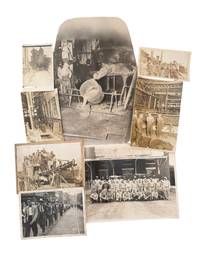
1900réf. 235961900. African American coal mining photo archive depicting Black industrial labor from the turn of the century through the postwar era documenting the changing conditions of mine work while revealing the continuity of Black employment in one of America's most dangerous industries. Spanning approximately fifty years from an early albumen photograph made around the turn of the century to silver gelatin photographs of the 1940s and 1950s the group records successive generations of miners whose labor fueled the nation's railroads steel production and wartime industries. By 1900 more than 180000 African Americans worked in mining and related extractive industries particularly across Appalachia and the industrial Midwest where operators frequently recruited Black labor during strikes while maintaining segregated workforces and company towns. Photo archive of 10 photographs including one large albumen print and nine silver gelatin photographs ranging from approximately 3 x 5 to 9 x 14 inches United States circa 1900s through the 1950s. The photographs show Black miners posed beside coal cars loaded with freshly mined coal; mixed Black and white work crews standing before steam powered mining equipment; African American workers operating within large industrial preparation plants beneath towering conveyors and ore bins; foundry and furnace interiors where molten metal is poured from massive ladles; miners gathered for formal group portraits outside industrial buildings; and workers posing beside hoists rail equipment and mechanical machinery. One of the largest photographs records a substantial interracial work crew surrounding a coal car marked with capacity information while another documents a line of African American workers walking through a commercial district following their shift preserving the contrast between industrial labor and urban life. Later photographs depict Black workers operating heavy electrical or mechanical equipment and standing inside modernized industrial facilities illustrating the technological transformation of mining and processing across the first half of the twentieth century. Coal mining became one of the largest employers of African American industrial labor following Reconstruction as southern and Appalachian operators recruited Black workers into mines expanding to meet the demands of railroads steel mills and urban growth. During both World Wars Black miners became indispensable to national coal production even while remaining concentrated in the most dangerous occupations and frequently excluded from skilled positions promotion and union representation until the growing influence of the United Mine Workers and the broader civil rights movement began to erode formal segregation after the Second World War. The chronological span of this archive distinguishes it from single period mining groups by tracing the persistence of Black industrial labor from the era of mule drawn coal cars and steam powered extraction to mechanized postwar production. Light surface wear scattered creasing and occasional edge chipping; the large albumen print shows moderate age toning. Overall in very good condition. A concentrated visual record of African American labor sustaining the American coal industry across five decades of industrial and social change. unknown books
1890réf. 185951890. Albumen photograph 19th century depicting African American men working in a quarry or mining environment with direct relevance to the study of labor organization race relations and industrial development in the post-emancipation United States. The image shows a large group of Black laborers positioned among rock formations several holding tools such as hammers and shovels indicating active participation in extractive work. Interspersed within the scene are white men women and children including a prominently placed well-dressed man at the center suggesting supervisory or ownership roles and reflecting the racial hierarchy characteristic of labor systems in this period. The composition captures both the physical conditions of industrial labor and the social structure of mixed-race work environments that emerged in the decades following the Civil War. Albumen photograph measuring approximately 8 x 6 inches mounted on cardstock. The scene includes two small shacks and a buckwagon in the background situating the group within a temporary or semi-permanent industrial site. The arrangement of figures tools and built elements provides visual context for quarry or mining operations and the organization of labor at such sites. Mount with soiling and wear including small tears; photograph with minor surface abrasions but image remains clear; overall very good condition. A detailed visual record of African American labor in a nineteenth-century industrial setting documenting both work practices and social dynamics. unknown
1900réf. 235961900. African American coal mining photo archive depicting Black industrial labor from the turn of the century through the postwar era documenting the changing conditions of mine work while revealing the continuity of Black employment in one of America's most dangerous industries. Spanning approximately fifty years from an early albumen photograph made around the turn of the century to silver gelatin photographs of the 1940s and 1950s the group records successive generations of miners whose labor fueled the nation's railroads steel production and wartime industries. By 1900 more than 180000 African Americans worked in mining and related extractive industries particularly across Appalachia and the industrial Midwest where operators frequently recruited Black labor during strikes while maintaining segregated workforces and company towns. Photo archive of 10 photographs including one large albumen print and nine silver gelatin photographs ranging from approximately 3 x 5 to 9 x 14 inches United States circa 1900s through the 1950s. The photographs show Black miners posed beside coal cars loaded with freshly mined coal; mixed Black and white work crews standing before steam powered mining equipment; African American workers operating within large industrial preparation plants beneath towering conveyors and ore bins; foundry and furnace interiors where molten metal is poured from massive ladles; miners gathered for formal group portraits outside industrial buildings; and workers posing beside hoists rail equipment and mechanical machinery. One of the largest photographs records a substantial interracial work crew surrounding a coal car marked with capacity information while another documents a line of African American workers walking through a commercial district following their shift preserving the contrast between industrial labor and urban life. Later photographs depict Black workers operating heavy electrical or mechanical equipment and standing inside modernized industrial facilities illustrating the technological transformation of mining and processing across the first half of the twentieth century. Coal mining became one of the largest employers of African American industrial labor following Reconstruction as southern and Appalachian operators recruited Black workers into mines expanding to meet the demands of railroads steel mills and urban growth. During both World Wars Black miners became indispensable to national coal production even while remaining concentrated in the most dangerous occupations and frequently excluded from skilled positions promotion and union representation until the growing influence of the United Mine Workers and the broader civil rights movement began to erode formal segregation after the Second World War. The chronological span of this archive distinguishes it from single period mining groups by tracing the persistence of Black industrial labor from the era of mule drawn coal cars and steam powered extraction to mechanized postwar production. Light surface wear scattered creasing and occasional edge chipping; the large albumen print shows moderate age toning. Overall in very good condition. A concentrated visual record of African American labor sustaining the American coal industry across five decades of industrial and social change. unknown
2001No marks or inscriptions. A lovely clean crisp very tight copy with bright unmarked boards and no bumping to corners. Dust jacket not price clipped or marked or torn with slight creasing to edges and minor traces of handling. 160pp. Easington District was the last area of Durham's huge coalfield to be exploited. This book tells the story of the heroic struggle by the people of Easington District with tragic disasters, defeats and triumphs in their mining industry from the mid-nineteenth century to the early twentieth century. Illustrated by a stunning collection of drawings and photographs, some in colour. A very scarce book.
1974Covers show light wear only. Book is otherwise in excellent condition. Binding is solid and square, , text/interior is clean and free of marking of any kind. Black and white illustrations, often full page. 182 pages. "Frances Benjamin Johnston was a prominent studio photographer and photojournalist at the turn of the twentieth century. She presented three bodies of work at the Paris Exposition Universelle in 1900: a collection of photographs by American women, a series of photographs of students in the Washington, D.C., school system, and a series of photographs of students from the Hampton Normal and Agricultural Institute. These exhibits all promoted the nationalistic agenda of progress at the Paris Exposition, illustrating American advancement in art, education, and society." ; "Johnston was a significant-and arresting-figure in early twentieth-century photography.Johnston produced a good deal of the usual society portraiture of the time-including a nude photograph of a debutante that prompted the girl's outraged father to file a lawsuit-but she was also an important photodocumentarian. Students of African American history can reexamine life at Hampton Institute (now Hampton University) or Tuskegee using hundreds of photographs made by Johnston at the turn of the last century.through Johnston's work we can see Admiral Dewey on the deck of the USS Olympia, the Roosevelt children playing with their pet pony at the White House, and the gardens of Edith Wharton's famous villa near Paris. Johnston's major project on early vernacular architecture of the American South preserves scores of buildings that no longer exist except on her film." ; photos of the famous include Thordore ROosevelt, Susan B Anthony, Mark Twain, William McKinley, Joel Chandler Harris, Admiral Dewey, Booker T. Washington, Jacob Riis, Alexander Graham Bell, Jane E Clark, Andrew Carnegie, George Washington Carver, John Phillip Sousa, Helen Hay, John Milton Hay, General LEonard Ward, Julia Marlowe, Richard Hovey, Margaret James, Phoebe Apperson Hearst, Albert Beveridge, Edith Wharton, DIfford Pinchot, Jane Cowl, and Ryan Tillman
1984réf. Q-0835605833Theosophical Pub House 1984-04-01. Paperback. New. In shrink wrap. Looks like an interesting title! Theosophical Pub House paperback
1999Book shows very light wear to covers only. Binding is solid and square, covers have sharp corners, exterior shows no other blemishes, text/interior is clean and free of marking of any kind. 402 pages in oversize format with b&w photos throughout. Very detailed study of the area and surounding region, heavily footnoted with chapters on Fur trappers, Explorers and scientist, Prospectors and miners, Homestading, the Frontier community, Cattle ranchers, Reclamation and irrigation, Dude wranglers, Tourists, Park of the Matterhorns, Grand Teton National park
19558vo., First Edition, free endpapers very lightly browned; blue cloth, backstrip lettered in black, a near fine copy in unclipped dustwrapper. Classic novel set aginst the rise of Communism in the Yorkshire mining industry. VERY SCARCE IN THIS CONDITION.
1984145 pages. Index. Footnotes. Reference list. Supplemental 1984 price guide laid-in. "Contains nearly 450 illustrations covering every type of candlestick brand-name model, plain to fancy blacksmith models, folding and mechanical models. Also included are many wonderful underground photos from the turn of the century showing mine candlesticks in actual use. Includes a discussion of history, collecting pointers, and guides to cleaning and recognition." - from photocopy of publisher's book list laid-in. Wilson's superbly detailed diagrams exquisitely present these artifacts in their original form. Average wear. Binding intact. Unmarked. A sound copy of this magnificent reference. Book
réf. DADAX0548833540New unknown
réf. DADAX0548979987New unknown
1994réf. mon00002178221994-01-01. Paperback. Good. in x in x in. Clean copy sound binding. paperback
réf. DADAX0195067258New unknown
réf. DADAX0271029048New unknown
réf. SONG1572334959Used: Good unknown
réf. DADAX0252080548New unknown
réf. DADAX025203628XNew unknown