704 risultati
1916rif. 56549Washington D.C. & Juneau A.T.: Superintendent of Documents U.S. Surveyor General’s Office 1916. Oblong Atlas Folio. 24 x 19 in. 14 colour maps 1 large folding 17.25 x 41.5 in. Printed softcovers stapled and paper reinforcement at gutter margin some minor toning & soiling to fore-edges edgewear to spine minor scuffing and a couple removed label ghosting still VG- bright copy. First edition of this remarkably scarce plat map atlas for the Matanuska coal fields and township sites surveyed by Walker & McDaniel during their surveys following those on the Kenai Peninsula. By 1912 with the act establishing Alaska as a U.S. Territory and in 1914 the authorization to construct an Alaska Railroad there became an increased need and demand for coal. The Matanuska mines located about 45 miles northeast of Anchorage first began production in 1916 and would stay in continuous production through both World War I and World War II and well into the 20th Century re-opening again in the 21st Century. Not only do these maps show available government lease sites for coal mines but also available Township sites for homesteaders as required by the original Homestead Acts of 1866 and the 1916 Act for Alaska requiring surveys and resurveys to accurately determine boundaries of unsold railroad lands and identify their boundaries. Worldcat locates 2 copies Anchorage Museum & Univ. of Calgary; See: Catalogue of the Public Documents of the Sixty-Fourth Congress Index Vol. 13 1922 p. 74; C. Albert White A History of the Rectangular Survey System 1983 p. 189. Superintendent of Documents, U.S. Surveyor General’s Office, paperback
1904rif. 47570Baltimore MD: Manufacturers’ Record Publishing Co. June 23 1904. Folio. 508-518 4 519-528 pp. w/ 60 pp. of illustrated advertisements. Numerous maps illustrations tables. Illustrated brick-red softcovers illustrated ads on back cover stapled as issued minor edgewear creasing slight chipping still a VG- copy. First edition of this scarce trade magazine focused on coal mining in the southern United States. Of particular interest is the special supplement on coal mining in the Elkhorn Region of Kentucky along the upper waters of the Big Sandy in Pike County. Manufacturers’ Record Publishing Co., paperback
1905rif. 47571Chicago IL: The Mining World Company May 6 1905. Folio. 463-488 pp. 24 59-84 pp. of illustrated advertisements. Numerous photo text illustrations tables 1 large map. Illustrated gold-coloured softcovers some creasing minor chipping & very small closed tears to spine some minor creasing to corners still VG- copy. First edition of this scarce trade magazine focused on U.S. and world coal mining especially with sections on Mexico & Australia as well. Of particular interest is the large section of mining reports from Arizona Colorado Idaho Illinois Kansas Lake Superior Montana Oregon Washington -- Republic Gold Mines British Columbia and more. The Mining World Company, paperback
rif. RGW22847With 4 Share certificates for the Llynvi Coal & Iron Company Ltd dated 1871 to Mary Cavan creased on one corner 1885 correspondence and endorsements about the debentures. The principal sums were repaid in 1885. In 1884 it would appear the debentures were worth £41860. The works were started in 1798. This particular company was formed in 1872. It would appear Mary Cavan held nearly one third of the shares in The Llynvi Coal and Iron Company in 1871. Her husband Colonel Cavan had died in 1870. The Cavan family had a long history of investing in the South Wales iron industry. James Cavan had invested in the Llynvi Iron Works in 1845 and before that in the Cambrian Iron and Spelter Company.In 1886 the companyÕs ironworks at Maesteg ceased to work. Possibly the paying back of the debentures was a contributing factor to the closure. unknown
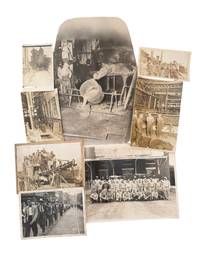
1900rif. 235961900. African American coal mining photo archive depicting Black industrial labor from the turn of the century through the postwar era documenting the changing conditions of mine work while revealing the continuity of Black employment in one of America's most dangerous industries. Spanning approximately fifty years from an early albumen photograph made around the turn of the century to silver gelatin photographs of the 1940s and 1950s the group records successive generations of miners whose labor fueled the nation's railroads steel production and wartime industries. By 1900 more than 180000 African Americans worked in mining and related extractive industries particularly across Appalachia and the industrial Midwest where operators frequently recruited Black labor during strikes while maintaining segregated workforces and company towns. Photo archive of 10 photographs including one large albumen print and nine silver gelatin photographs ranging from approximately 3 x 5 to 9 x 14 inches United States circa 1900s through the 1950s. The photographs show Black miners posed beside coal cars loaded with freshly mined coal; mixed Black and white work crews standing before steam powered mining equipment; African American workers operating within large industrial preparation plants beneath towering conveyors and ore bins; foundry and furnace interiors where molten metal is poured from massive ladles; miners gathered for formal group portraits outside industrial buildings; and workers posing beside hoists rail equipment and mechanical machinery. One of the largest photographs records a substantial interracial work crew surrounding a coal car marked with capacity information while another documents a line of African American workers walking through a commercial district following their shift preserving the contrast between industrial labor and urban life. Later photographs depict Black workers operating heavy electrical or mechanical equipment and standing inside modernized industrial facilities illustrating the technological transformation of mining and processing across the first half of the twentieth century. Coal mining became one of the largest employers of African American industrial labor following Reconstruction as southern and Appalachian operators recruited Black workers into mines expanding to meet the demands of railroads steel mills and urban growth. During both World Wars Black miners became indispensable to national coal production even while remaining concentrated in the most dangerous occupations and frequently excluded from skilled positions promotion and union representation until the growing influence of the United Mine Workers and the broader civil rights movement began to erode formal segregation after the Second World War. The chronological span of this archive distinguishes it from single period mining groups by tracing the persistence of Black industrial labor from the era of mule drawn coal cars and steam powered extraction to mechanized postwar production. Light surface wear scattered creasing and occasional edge chipping; the large albumen print shows moderate age toning. Overall in very good condition. A concentrated visual record of African American labor sustaining the American coal industry across five decades of industrial and social change. unknown
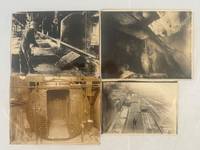
1920rif. 224531920. Appalachian Coal Mining Operations; Photo Archive of Five Original Gelatin Silver Photographs ca. 1910s-1920s. Five gelatin silver prints measuring betweenand 8" x 9" to 5" x 7" Striking vernacular archive documenting early 20th-century industrial coal mining practices through four large-format photographs capturing both above- and below-ground operations. One image depicts a smelter or foundry worker tending molten material in a heavy industrial setting possibly related to coke production-a critical process in transforming coal into fuel for steelmaking. The worker wears a protective leather apron gloves and a helmet with face shield using a long paddle to manipulate the material. Industrial piping and steel platforms surround the workspace and a massive crucible or furnace stands nearby. Another photograph captures a dramatic underground mining scene. Two Black miners in heavy coats and headlamps drill upward into the cavern ceiling using a compressed-air jackleg drill. The low uneven rock walls exposed support timbers and scattered equipment emphasize the confined and hazardous conditions of subsurface labor. Coal dust visibly clings to their garments hinting at prolonged exposure to harsh particulate-laden environments common in deep mining shafts. One image centers on a large cylindrical steel structure-likely a pressure chamber or industrial boiler associated with coal-fired power or steam generation. The riveted iron shell and complex pipe fittings suggest this is part of an early steam engine or autoclave. Tools such as a coal shovel and rake lean nearby alongside a coal scuttle reinforcing the manual labor involved in operating and maintaining this machinery. Another photograph presents an expansive view of a coal rail yard in winter. A lone worker walks atop a line of boxcars amid snow-covered tracks while coal smoke rises from the buildings along the rail lines. The archive offer a vivid and textural record of early 20th-century coal mining labor and its related technologies. At this time coal mining was one of the deadliest occupations in the United States; between 1900 and 1930 tens of thousands of miners died in accidents or from occupational illnesses such as black lung disease. Light edge wear and surface handling; one image with silvering and faint creases. Well-preserved examples of early 20th-century industrial photography documenting coal mining infrastructure labor and technology during a critical era of American energy and industrial history. Minor edge wear and light creasing; one image with mild silvering; overall very good. unknown
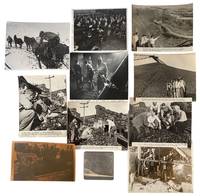
1943rif. 213381943. Anthracite coal mining photographs circa 1930s to 1950s document the daily labor conditions environmental hazards and union activity within Pennsylvania's coal industry and provide direct visual evidence of industrial work in one of the most significant energy sectors in the United States. Created during a period when anthracite coal production remained central to regional economies and national energy supply these images record both above ground and subterranean labor processes as well as the collective organization of workers responding to unsafe conditions and economic pressures. The archive supports research into labor history industrial practices occupational health and union movements in mid twentieth century America. Eleven silver gelatin photographs ranging approximately from 4 x 6 inches to 8 x 10 inches some with typed captions attached depicting mining activity and related scenes in Pennsylvania's anthracite region. Images include miners traversing severe winter conditions while guiding donkeys hauling coal carts through heavy snow; workers shoveling coal in enclosed dimly lit environments with airborne dust visible in the light captioned "Coal shoveling brigade or how I spent my summer vacation"; and inspection scenes in which workers examine coal samples prior to distribution. Additional photographs show large scale coal piles dwarfing individual laborers emphasizing production scale. One press photograph dated January 15 1943 documents a mass meeting in Hazleton Pennsylvania where union leader Andrew Yevchak addresses striking miners with caption noting that 17000 workers were ordered to return to work following the gathering. Produced during a period marked by ongoing labor disputes mechanization and heightened awareness of occupational hazards such as coal dust inhalation these photographs capture both the physical demands of mining and the organizational structures that shaped worker response. The inclusion of the 1943 Hazleton meeting situates the archive within broader wartime labor tensions when coal production was critical to the war effort and strikes carried national implications. Together the images provide a grounded record of industrial labor environmental exposure and collective action within the anthracite coal industry preserving visual documentation of work that was both economically essential and physically hazardous. Minor edge wear and light creasing to a few prints with strong image clarity overall; condition very good. unknown
2009rif. DADAX3838107608Sudwestdeutscher Verlag Fur Hochschulschriften AG 2009-06-04. paperback. New. 5.91x0.29x8.66. Buy with confidence. Excellent Customer Service & Return policy. Sudwestdeutscher Verlag Fur Hochschulschriften AG paperback
rif. 36436various publishers n.d. Good/No Jackets. Cloth-covered Solander box Approximately 20 offprints. (various publishers) hardcover
rif. A9781344784849Hardback. New. hardcover
1925rif. 009741Fairmont West Virginia: Fairmont Printing Co. 1925. Full title from front wrapper reads: Agreement. Memorandum agreement between the Consolidation Coal Company and its employees in West Virginia Division. The local organization of employees at each operation take the name and number of the mine and is know as "space in text Miners' Association No. space." Original green printed wrappers. 40 pp. Unrecorded on OCLC/WorldCat. First Edition. Soft Bound. Fine. Fairmont Printing Co.
1940rif. ABE-1662601201260The Wartime Prices & Trade Board Ottawa 1940 A beautiful little piece of wartime propaganda illustrating how to save coal to benefit the war effort. No copies in any major libraries and so a supremely scarce item. Near fine in condition with some light staining from staple oxidization as well as from another source on the rear. Lithographed colours remain wonderfully bright sharp and unhindered by staple spotting. 16 pages including covers comprised of a single stapled signature. 1st Edition. Soft cover. Near Fine. The Wartime Prices & Trade Board, Ottawa paperback
1950rif. c2951bLondon: James Upton Ltd. G: in good condition without dust jacket as issued. Cover marked. Wear to spine end. Binding staples rusted. 1950. First Edition. Illustrated card cover. 150mm x 210mm 6" x 8". 23pp. . James Upton Ltd unknown
1986rif. 19320Biosedra Cardiologie 1986. Très bon état coins et coiffes légèrement usés ensemble trés propre. in4 a l'italienne. 1986. Reliure editeur cartonnée. 107 pages. l'enregistrement holter normal et pathologique Biosedra Cardiologie unknown
rif. 1120119685.Gpaperback. Good. Access codes and supplements are not guaranteed with used items. May be an ex-library book. paperback
rif. 45426968-nnew. unknown
rif. 61188LEHIGH COAL AND NAVIGATION COMPANY. Report of the Board of Managers of the Lehigh Coal and Navigation Company to the Stockholders. January 9 1843. Phila.: Printed by William S. Young 1843. 1st ed. 30 pp. Orig. printed wrappers. Very light scattered foxing else a very good copy. The report details expenses due to the great flood of January 1841 which necessitated repairs to be made from the mouth of the Lehigh to Mauch Chunk Pennsylvania with more work on the upper section of the river still to be done. Scarce Worldcat locates only six copies. unknown
1827rif. 451361827. NORTH AMERICAN COAL COMPANY. A Brief Sketch of the Property Belonging to the North American Coal Company with Some General Remarks on the Subject of Coal and Coal Mines. N.Y.: Printed by Willam sic Davis Jun. 1827. 14pp. 2 folding maps. Orig. blank wraps. Sewn as issued. Some chipping and soiling to untrimmed edges wrapper split along spine. Overall very good. American Imprints 1827 No. 30069. The North American Coal Company mined property in near Pottsville in Schuykill County about 100 miles northwest of Philadelphia. The maps show the property the locations of mines and existing and proposed canals. unknown
rif. 9264170480.Gpaperback. Good. Access codes and supplements are not guaranteed with used items. May be an ex-library book. paperback
1839rif. 26058Pennsylvania 1839. Manuscript broadside 11" x 22". Two drawings at head of report followed by detailed descriptions of each drawing: boundaries chutes directions of veins projected coal output etc. Old horizontal folds some splits along fold edges a few small chips. Drafted on paper which bears the watermark of "John C. Clark Phila" the oldest legal stationers in the United States founded in 1817 and the 9th oldest continuously operating business in Philadelphia according to its current website. The Peach Mountain mines were situated near Pottsville in the county of Schuylkill Pennsylvania. Peach Mountain was one of several mines in the area which produced red ash anthracite. According to this offering the mine bordered the Delaware Coal Company which was responsible for working it. "Mr. Read thinks that the above coal can be delivered on the bank at $1. per ton. He would contract at that note after the tunnel was driven. The driving of the tunnel would effect a saving of 10c per ton on all the coal lying above the level of the present tunnel. The said 10c per ton are now paid for loading and running to and unloading into the chute of 79 feet whence it is again loaded into drift waggons on the deep level. It would take a year to drive the tunnel at a total cost of about $2500. unknown
1881rif. 12219Philadelphia 1881. Original printed wrappers institutional stamp binder holes in blank inner margin bound into modern plain wrappers. 12pp folding map frontis of the Indianapolis Decatur and Springfield Railway; folding color section showing "position of Coal Seams and Bore Holes" and area proposed to be purchased for the Company. Institutional stamps Good. The prospectus demonstrates the substantial markets existing along the rail line and the good prospects for opening mines. FIRST EDITION. Not in NUC Eberstadt Decker. unknown
rif. ria9780309110228_inpHardback. New. New Book; Fast Shipping from UK; Not signed; Not First Edition; States that it is important that the United States extract its coal resources efficiently safely and in an environmentally responsible manner. This book focuses on the research and development needs and priorities in the areas of coal hardcover
rif. 55903Harrisburg: Lane S. Hart 1881. . Black cloth spine designed and lettered in gilt. Marbled page edges. Engraved pictorial title page and six folding maps and plates. Upper front cover a bit marked some wear and a white mark on the spine a clean very good copy in general. Small name stamp on end paper and title page. The final 180 pages and the folding plates all relate to coal mining in Pennsylvania. Plates illustrate coke ovens a coal washing machine and a columnar section from a shaft; the others are detailed maps of coal mines. Harrisburg: Lane S. Hart, 1881. hardcover
rif. 1528005376.Gpaperback. Good. Access codes and supplements are not guaranteed with used items. May be an ex-library book. paperback
1982rif. 060679NP: Peabody Coal Company 1982. First Edition . Hardcover. Very Good/No Dust Jacket. A Very Good copy in blue hard covers lettered in gold of this tall-format volume. Three large folding maps complete thus are in the map pocket at the rear: two referencing reclamation projects and one titled "1982 Vegetation Study Areas". Light cover wear clean/unmarked within and not ex-library. Peabody Coal Company hardcover