[FASHION]ABAA
69 résultats
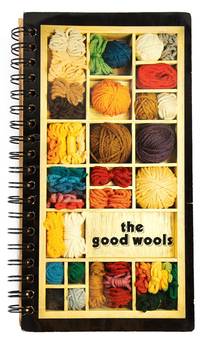
1977réf. 1004235New York: The Wool Bureau 1977. Original trend report on American knitwear for fall 1977 featuring fashion sketches on every page each captioned with the name of the manufacturer the wool content and the retail price. Featured designers of these ready-to-wear styles include Donna Karan for Anne Klein Gloria Vanderbilt and Kay Unger. Also represented are the mass-market "sport" lines of Givenchy and Pierre Cardin. The Good Wools was issued by The Wool Bureau the American branch of the International Wool Secretariat. The IWS shaped global fashion trends for decades through forecasting reports like this one and through the International Woolmark Prize which launched the careers of designers Yves Saint Laurent and Karl Lagerfeld. In 1997 the IWS would rebrand as The Woolmark Company keeping their iconic logo the stylized skein of yarn used throughout The Good Wools to signify 100% wool content. Provenance: Ellen Robinson uncredited designer of the tweed separates created for a New Division of Alex Colman page 81. A near-fine copy. Spiral-bound volume measuring 10 x 5.25 inches: 8 170. Original color photographic wrappers. Text printed on tan paper with brown card chapter dividers line drawings on every page. The Wool Bureau unknown books
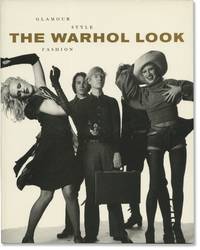
1997réf. 166527Boston: Bulfinch Press 1997. First Edition. Softcover. First Edition. Illustrated with 650 color 405 halftone and 150 duotone illustrations. Published in conjunction with a traveling exhibition which opened on November 8 1997 at the Whitney in New York and closed at the Andy Warhol Museum in spring of 1999. Near Fine in perfect-bound wrappers. Bulfinch Press unknown books
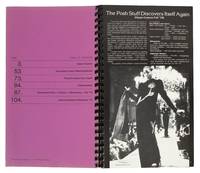
1978réf. 1003704Westport Connecticut: Here & There 1978. September 1978 issue of Here & There Francine Horn's groundbreaking fashion trend report focusing on haute couture Japanese fashion and resort wear: "The posh stuff is back in line for Fall '78." Forecasting a year in advance the pages reveal trendsetting European designs for Fall 1979 alongside their American counterparts with lively editorial commentary. The opening chapters celebrate the return of haute couture and its translation to ready-to-wear led by St. Laurent and Givenchy and inspired by Hollywood glamour Chesterfield overcoats and vintage cocktail looks. The coverage of American resort wear highlights the role of the fashion illustrator in forecasting. Because those collections were presented in private showrooms that prohibited photography Here & There charged their "much overworked illustrator Mr. Frank Spina with the prodigious task of capturing with his 'rapacious rapidograph' the highlights of these resort collections" which included designs by Bill Blass Norma Kamali Perry Ellis and Willie Smith. Both a major trade publication and a savvy ad for Francine Horn's fashion trend consultancy Here & There was an industry must-read a success due in part to her husband David Charles Horn's candid photography and provocative editorials. Like most fashion forecasting reports from the 1970s this number of Here & There is scarce in commerce and in institutional holdings. A very good example featuring original patterns and twenty original mounted textile swatches. Single volume measuring 14 x 8 inches: 123 1. Original coil-bound stiff black wrappers lettered in white. First leaf printed on magenta paper; black-and-white photographs and line drawings throughout text; twenty tipped-in fabric swatches. Light shelfwear corners bumped lower wrapper creased. Here & There unknown books
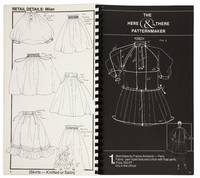
1978réf. 1003703Westport Connecticut: Here & There 1978. June 1978 issue of Here & There Francine Horn's groundbreaking fashion trend report advising American retailers on the upcoming European fall collections. The only photo story in the issue "The London Collections Fall '78" is also the largest. A statistical analysis of the new styles purchased by three hundred French retail stores at the Port de Versailles exhibition breaks down the data by clothing item number of interested stores and percentage of retailers' projected budgets an unusual feature in forecasting reports. The "Retail Details" section highlights oversized silhouettes by Agnes B. and Thierry Mugler in Paris early Laura Ashley and Elle coordinates in London and separates by Max Mara and Kenzo in Milan. Both a major trade publication and a savvy ad for Francine Horn's fashion trend consultancy Here & There was an industry must-read a success due in part to her husband David Charles Horn's candid photography and provocative editorials. Like most fashion forecasting reports from the 1970s this number of Here & There is scarce in commerce and in institutional holdings. A very good example. Single volume measuring 14 x 8 inches: 94. Original coil-bound stiff black wrappers lettered in white. First leaf printed on orange paper black-and-white photographs and line drawings throughout text. Light shelfwear top right corner of upper wrapper clipped. Here & There unknown books
1974réf. 1003720Paris and New York: International Wool Fashion Office; The Wool Bureau 1974. Ephemeral 1974 trend report on Parisian knitwear for American designers and showrooms issued by the International Wool Fashion Office in Paris and The Wool Bureau in New York. Editor Skippy Stone declares: "Fall 1974. . . Total from top to toe. Paris is everything that is at once avant romantic feminine and grand . . . blending the classic and peasant into a new season of big new clothes." Top runway models of the day among them Jerry Hall pose in voluminous layered knits designed by the likes of Kenzo Issey Miyake Sonia Rykiel and Karl Lagerfeld for Chloë. The International Wool Secretariat IWS the entity behind the IWFO and The Wool Bureau was the natural fiber mills' response to DuPont's introduction of nylon in the 1930s a major disruptor in the fashion industry. The IWS shaped global fashion trends for decades through forecasting reports like this one and the International Woolmark Prize which launched the careers of young designers Yves Saint Laurent and Karl Lagerfeld. In 1997 the IWS would rebrand as The Woolmark Company keeping their iconic logo the stylized skein of yarn sprinkled throughout this report. Text in English and French. An uncommon survival. Side-stapled volume measuring 12 x 9 inches: 80. Original photographic wrappers black-and-white photographs throughout text. Light foxing and edgewear; evidence of label removal to upper wrapper. International Wool Fashion Office; The Wool Bureau unknown books
1990réf. 160300N.p.: N.p. 1990. Vintage jumbo oversize UK record store poster promoting Depeche Mode's 1990 release "Violator." Considered by many to the the most sophisticated and sublime of all their releases Depeche Mode's seventh studio album "Violator" propelled the English electronic New Wave band to international stardom. Preceded by the release of two smash hit singles "Personal Jesus" and "Enjoy the Silence" the triple platinum "Violator" achieved the band's greatest critical and commercial success and lists 167 on Rolling Stone's 2020 list of the 500 greatest albums of all time. 40 x 60 inches folded as issued. Some light rubbing on the outer creases else Near Fine. N.p. unknown books
1989réf. 159713San Francisco: Club Oasis 1989. Original "Majestically Modern" poster announcing an "XQ" fashion show and performance art by "Christi On's Hot Foote Dancers" Thursday August 17 1989 hosted by Live 105 KITS disc jockey "Big" Rick Stewart with DJ Mark Hamilton also a disc jockey with Live 105 KITS. The popular San Francisco LGBTQ nightclub Club Oasis first opened in 1982. Following its decline in the early 2000s the club was bought by actor writer musician director producer and choreographer D'Archy Drollinger who reopened the club as an internationally acclaimed drag show nightclub/cabaret in 2015. D'Arcy was appointed as the San Francisco Drag Laureate in 2023 the first Drag Laureate ever in the world. 11 x 17 inches on pink paper. Near Fine with some light edgewear. Club Oasis unknown books
1999réf. 159683San Francisco: Zip Zap Hair Salon Circa 19990. Original hand colored and annotated flyer advertising Zip Zap hair salon San Francisco circa 1990. San Francisco's Zip Zap Hair Salon opened on 245 Fillmore Street in 1986 and is still in operation today. 8.5 x 11 inches Xerographic duplication colored and annotated with oil pastel. Very Good plus with several small pinholes. Zip Zap Hair Salon unknown books
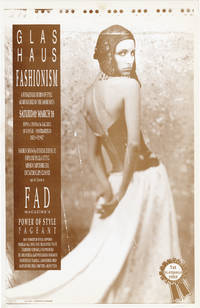
1989réf. 159727San Francisco: N.p. 1989. Vintage "Glas Haus Fashionism: A Totalitarianform of Style Administered by the Fashionists" poster for a fashion show produced by Glas Haus and Fad Magazine held at San Francisco's Galleria Design Center at 101 Kansas Street Saturday March 18 1989. Glas House was a short-lived 1980s arts magazine published in San Francisco as well as a legendary series of avant-garde art parties and dance events spearheaded by Joegh Bullock and held throughout the San Francisco area throughout the 1980s. Fad Magazine not to be confused with the British magazine first published in 2009 was a short-lived arts and fashion magazine published in San Francisco in the mid 1980s. 11 x 17 on glossy paper. Very Good plus with light edgewear some faint creasing at the extremities and a small pinhole at the top center. N.p. unknown books
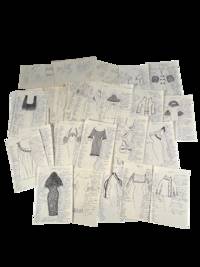
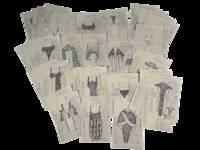
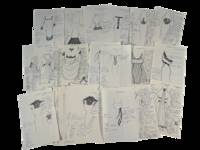
1950réf. 218281950. Fashion design archive likely 1950s to 1960s documenting women's garment design during the mid-century through original working sketches that preserve both style development and the practical language of dressmaking. The archive is strongest as evidence of how women's fashion was conceived on paper before production with repeated attention to silhouette trim fabric and construction. Dresses blouses coats and eveningwear appear throughout placing the material within the visual world of postwar American fashion as it moved from structured elegance toward sharper and more decorative later mid-century forms. Archive of over 100 original hand-drawn fashion sketches on individual sheets measuring approximately 6.5 x 9 inches. The drawings are executed in ink and depict a wide range of women's clothing including fitted dresses capes blouses coats and formal designs with careful attention to drape proportion neckline sleeve treatment and surface embellishment. Many sheets are accompanied by dense handwritten notes in the margins or on the reverse recording measurements fabric suggestions and pattern or construction instructions. The combination of illustration and notation gives the sheets the character of working designs rather than purely display drawings and suggests use in dressmaking training or client planning. The archive belongs to the history of women's fashion not only as a record of finished styles but as evidence of the design process itself preserving the intermediate stage between idea and garment. Such working sketches show how fashion circulated through manual skill technical knowledge and close attention to fabric and form in the decades before design became fully digitized. Light general wear from use; overall very good. A substantial mid-century design archive that preserves the visual and technical vocabulary of women's fashion making across more than one hundred original sketches. unknown books
1950réf. 218261950. Fashion design archive. 1950s-1960s. This group documents mid-century women's fashion design practice through a sustained body of original sketches and working notes showing how garments were conceived annotated and prepared for construction during a period of stylistic transition in American dress. The material provides direct evidence of design thinking at the level of silhouette fabric selection and pattern planning including repeated attention to cocktail wear outer garments and formal dress. It captures the movement from structured postwar styles toward more experimental and decorative approaches associated with later mid-century fashion with particular emphasis on the technical and aesthetic decisions made by a designer or dressmaker. Archive of over 100 original hand-drawn fashion sketches on individual sheets measuring approximately 6.5 x 9 inches executed in ink with extensive handwritten annotations on rectos versos and margins. The drawings depict a range of women's garments including dresses blouses coats and evening wear with recurring titles such as "cocktail dress" "cocktail cape" and "dress." The figures are rendered with attention to line proportion and textile texture often emphasizing drape fitted bodices and surface embellishment. Annotations provide detailed construction guidance including measurements fabric types and pattern instructions. One design for a strappy dress specifies "Pattern: leopard or zebra fur attached.fabric velveteen.color red -- orange -- black." indicating experimentation with bold materials and color combinations. The consistent pairing of image and instruction suggests use as a working portfolio either for client presentation dressmaking production or formal training. Mid-century fashion in the United States expanded through department stores home sewing and professional dressmaking with designers and students producing working sketches that translated style into reproducible garments. The presence of detailed technical notes alongside finished illustrations places this archive within that production process linking aesthetic design to practical construction. Light wear from handling; overall very good. A concentrated record of mid-century women's fashion design practice preserving both the visual language and technical methods used to create garments during a period of evolving style. unknown books
1950réf. 218271950. Fashion illustration archive circa 1950s-1960s documenting women's garment design and construction practices in the mid-twentieth century. The archive reflects shifting silhouettes and decorative approaches associated with mid-century fashion including structured postwar forms and emerging streamlined influences. Archive comprises over 100 original fashion illustrations each executed in ink on sheets measuring approximately 6.5 x 9 inches. The drawings depict a range of garments including cocktail dresses coats suits blouses and eveningwear with attention to silhouette drapery and surface embellishment. Many sheets include handwritten annotations in cursive along margins and versos detailing construction elements such as measurements fabric choices and stylistic variations. Examples include labeled designs such as "cocktail dress" "coat" and "suit" with notes specifying features like "turtle neck - bare cut out - colors - gold" and "square low neckline with studded pearls. colors - purple - gold." The annotations suggest iterative design thinking with references to materials color palettes and structural adjustments indicating use as a working portfolio rather than presentation-only sketches. This archive provides detailed evidence of mid-century fashion design practices at the level of individual garment planning bridging artistic representation and technical instruction. The combination of visual sketches and written notes demonstrates how designers translated aesthetic concepts into wearable forms contributing to the study of dressmaking textile use and women's fashion history during a period of stylistic transition. The volume and consistency of the material suggest sustained use potentially within a professional or training context. Light wear and minor handling marks; overall very good condition. A substantial working archive illustrating mid-twentieth-century women's fashion design and construction methods. unknown books
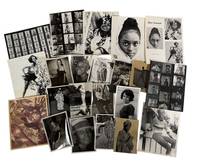
1950réf. 211751950. Archive of fashion photography documenting African American women's participation in commercial and editorial modeling from the 1950s through the 1980s a period in which the American fashion and advertising industries remained overwhelmingly centered on white beauty standards and limited Black representation in print media. Working in Cultural / Representational Mode the material illustrates changing presentations of Black femininity glamour and natural beauty across several decades of American fashion culture. The photographs provide visual evidence of evolving aesthetic conventions surrounding race cosmetics hairstyles leisure and commercial image-making during the postwar and Civil Rights eras. Particularly notable are several 1970s images depicting Black models with natural hairstyles and minimal cosmetic styling reflecting broader cultural shifts associated with Black pride movements and changing representations of African American identity in fashion and advertising imagery. Collection comprises 23 silver gelatin photographs and one color photograph produced by several professional photographers between the 1950s and 1980s. Images include editorial fashion shoots casting and publicity photographs scanned negatives and studio portraiture featuring predominantly Black women alongside several white models photographed by the same studios. Two 1970s editorial images depict a lean Black model with closely cropped natural hair posed in a leopard-print wrap. Four photographs focus specifically on Black women including close-up portraits emphasizing natural presentation and informal styling. One younger woman appears without visible makeup wearing a bandana and t-shirt while another is photographed in a straw hat with hoop earrings and patterned sash. Additional photographs include a Black model posed in a bikini atop the rim of a classical fountain featuring Aphrodite imagery. Four professional photographs and one casting card depict singer and actress Sylvia Vanderbeilt in commercial studio poses. Several scanned negatives portray a Black female model in multiple outfits and poses characteristic of 1970s fashion photography including one sequence featuring both the model and a young Black girl during apparent test shoots. The latest material consists of scanned negative strips from an apparent 1980s fashion session featuring a Black model with a sleek bob hairstyle modeling padded blazers and contemporary commercial attire. Other photographs depict white women in evening gowns fur wraps and casual mid-century fashions including two images by photographer Lee Brian showing the same model posed in mid-length evening gowns amid neoclassical architectural settings one with an elaborate mink shawl. Several photographs bear photographer or studio stamps on the verso including L.W. Ward of Cedar Rapids Iowa and Lee Brian of Palm Beach Florida. The archive traces substantial shifts in fashion photography and racial representation across three decades of American commercial imagery from heavily stylized mid-century glamour photography to the more natural aesthetics associated with 1970s fashion editorials and Black cultural self-presentation. The inclusion of both editorial and test photography offers insight into the production practices of commercial modeling studios as well as the visual conventions used in presenting Black women to advertising and fashion audiences during a period of gradual but uneven industry integration. Minor wear and light handling marks throughout; photographs otherwise remain in very good condition overall. A visually strong grouping documenting African American representation within postwar American fashion photography and commercial image culture. unknown books
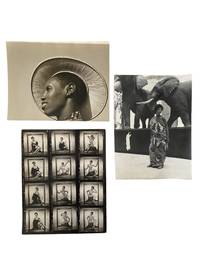
1950réf. 206231950. Archive of three black and white silver gelatin photographs of black models dating from the 1950s-70s. Photographs measure approx. 8" x 10". This archive includes a press photo from 1974 showing model Beverly Bradshaw posed in front of a museum display of elephants wearing a traditional Nigerian Ibo wrapped dress designed by Angie Ihejirika. Article on verso from the Chicago Sun Times details Mrs. Ihejirika's demonstration of the art of African wrapping at the Field Museum of Natural History. Photo has a bald patch on left side not affecting subject matter. Also included is a print of twelve Kodak film cells showing actress and model Nancy Westbrook in a series of poses sitting within a large picture frame. Seven images show Westbrook in a bikini and five wearing only a fur stole. These photographs date to the early 1950s and least one the third down on the left appeared in Jet Magazine with a short profile of Ms. Westbrook in 1953. Another photograph undated shows a black model in profile from the neck up smiling in a sun hat tilted away from camera to frame her head with a halo-like effect. Modeling in fashion and print has historically been dominated by white women reflecting a bias in beauty standards in the United States. These images show black women claiming space in the often exclusionary fashion world of the mid-late 20th century. Overall very good condition. Three images of black fashion models in the US 1950s-70s. unknown books
1940réf. 196571940. African American Black Models in Commercial Print: Philadelphia Studio Fashion Photoshoot 1930s-1940s Archive of 4 Original Vintage Photographs. Each black and white silver gelatin photograph measures 3.5" x 4.5". All photographs were captured at Condax Studio in Philadelphia. Condax Studios was associated with the Models' Guild of Philadelphia which served as a "central resource of information for commercial photographers connecting them with professional models for television fashion and convention work". All photographs capture a black woman striking various poses in two contrasting outfits. In two photographs she poses in a black dress and heels glamorous jewelry and a rose. Her eyes are slightly covered by a black birdcage veil. In the remaining two photographs she sports a posh blazer and skirt set glamorous jewelry heels and an umbrella. Until the middle of the 1940s consumer advertising completely ignored the black consumer and virulent racial segregation in the United States meant that Black people's needs were not being satisfied. Thus traditional advertisers were reluctant to associate the image of a black person with their products. At this point in time they perceived it may lead to a loss in sales by the way Black people were viewed in society. These photographs capture an early instance of a Black print model in an era where there was little representation. Two photographs are minority wrinkled not affecting image quality. This photo archive is expressive and in very good condition overall. unknown books
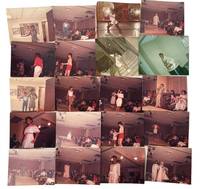
1984réf. 197351984. Photographic archive 1984 documenting African American participation in fashion runway culture during a period of expanding visibility for Black models within commercial and public-facing fashion events. The images center on runway presentation styling and performance with emphasis on clothing posture and audience reception. The material supports research into Black representation in fashion the aesthetics of 1980s design and the intersection of race visibility and consumer culture within the fashion industry. Archive of 20 original color photographs dated July 1984. Prints measure approximately 4 x 4.5 inches to 5 x 6 inches. The photographs depict multiple runway scenes featuring Black models in varied outfits including bright casual wear dresses athletic ensembles and business-influenced styles. Specific images include a model wearing a pink lace floral dress with ribbon detailing and white heels figures in coordinated athletic-inspired outfits with bold color accents and a model in a white dress trimmed with pink ruffles and pearl-like ornamentation. One image shows a male model in white flared overalls and sandals. Additional photographs capture audience members of mixed racial identities seated along the runway as well as backstage moments in which models pose against a wall displaying portraits of other figures associated with the production or company. Several prints bear date stamps reading "7/84" on the verso. Produced during a decade marked by gradual shifts in fashion industry representation these photographs provide visual evidence of Black models occupying central roles in runway presentation while engaging with broader stylistic trends of the period. The inclusion of both runway and backstage scenes allows for study of performance preparation and audience interaction within fashion environments. Light handling wear and minor surface marks; overall very good condition. A cohesive visual record of 1980s runway culture with emphasis on African American representation. unknown books
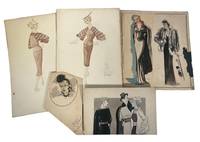
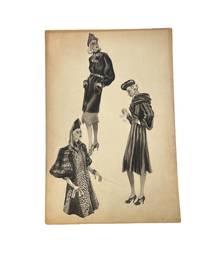
1920réf. 199741920. Vernacular fashion illustration archive circa 1920s-1950s documents the evolution of women's dress and stylistic ideals across early and mid-twentieth-century design with emphasis on silhouette material and aspirational presentation. The drawings capture shifts from the elongated androgynous forms associated with 1920s and 1930s fashion to the structured tailoring and fitted garments of the postwar period. Elements such as exaggerated shoulders cinched waists and coordinated ensembles situate the works within broader developments in women's fashion including the influence of tailored suits and formal eveningwear. The illustrations also record accessory culture including gloves hats and jewelry positioning dress within a larger system of social signaling and presentation tied to class gender norms and modern consumer identity. United States and possibly Europe circa 1920s-1950s. Archive of six original gouache and pencil fashion illustrations on hard mat boards and one on thick watercolor paper each measuring approximately 10 x 7 to 10 x 15 inches. Several works bear artist signatures or initials including examples signed "Virginia" and "G. Wichner." Two dated compositions from April 11 1954 depict coordinated ensembles including a rose-toned set with a pencil skirt and structured blazer rendered with detailed attention to tailoring and fabric accents. Other illustrations include multi-figure studies of women in draped garments with belted waists a single-figure composition in a long gown with fur coat and elongated cigarette holder and portrait studies featuring headpieces veils and bold cosmetic styling. Use of shading color variation and line work emphasizes fabric texture garment movement and body form. Produced during a period of significant transformation in women's fashion these illustrations align with the development of modern fashion media including editorial illustration design sketching and commercial garment production. The visual emphasis on proportion tailoring and accessorization reflects the increasing codification of fashion as both industry and cultural expression in the twentieth century. As original works the drawings provide insight into the processes of design visualization and stylistic interpretation supporting research into fashion history gender presentation and visual culture. Light handling wear to mounts and sheets; overall very good condition. unknown books
1951réf. 200661951. Fashion Women's fashion design sketches dated 1951 document the rapid transformation of female dress following the end of wartime rationing and the international adoption of Christian Dior's "New Look" silhouette. These drawings show designers experimenting with narrow waists structured bustlines wide skirts and dramatic outerwear styles that defined postwar femininity and reshaped global fashion culture in the late 1940s and early 1950s. Such instructional sketches provide visual evidence of how couture aesthetics circulated through design schools and professional training environments during a moment when fashion industries in Europe and the United States were rebuilding after World War II. Archive of fifteen original women's fashion design sketches executed on nine illustration boards measuring approximately 11 x 14 inches. Drawings are rendered in pencil ink watercolor and collage techniques and depict coats dresses trench coats and daywear ensembles characteristic of early 1950s style. Several boards include multiple designs including sheath dresses with high necklines and plunging backs bell sleeved coats trimmed with fur and children's pinafore dresses worn over blouses. One design shows a woman wearing a flight jacket cravat and pleated trousers recalling mid century women adopting traditionally masculine tailoring. One board bears the signature "Reindel" on the verso. Designs prominently feature hourglass silhouettes associated with Dior's New Look including cinched waists sloped shoulders and flared skirts. Other garments incorporate menswear inspired coats and tailored outerwear reflecting the hybridization of wartime practicality and postwar luxury. Boards show light foxing and minor handling marks. Very good condition. A visual teaching archive illustrating postwar fashion design practice during the early Cold War era. unknown books
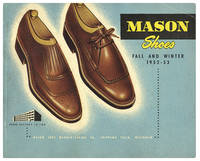
1952réf. 41618Chippewa Falls WI: Mason Shoe Manufacturing Co 1952. First Edition. Very good . An illustrated wholesale catalog of leather mens and ladies footwear and outerwear from the Mason Shoe Manufacturing Company of Chippewa Falls WI. Generously illustrated in color throughout with detailed product descriptions and model numbers that correspond to the original price list in front. Of note is a four page spread of men's leather coats including "The Racer" a classic motorcycle-culture jacket with multiple zippers straps and buttons. Wraps. Oblong 4to. Color illustrated wraps. Mild handling wear. Faint creasing to wraps. Overall sound clean. 112pp. Mason Shoe Manufacturing Co unknown books
1788réf. 42077London: Fores 1788. Framed and glazed. Fores unknown books
1848réf. 229448Paris 1848. First editions. Engraved fashion plates 677 of which are hand-colored. Many entitled "Modes de Paris". 16 vols. 4to. Bound in marbled boards with paper spine labels. First editions. Engraved fashion plates 677 of which are hand-colored. Many entitled "Modes de Paris". 16 vols. 4to. Periodical issued bi-weekly then weekly. Volumes for 1832-1836 have 24 issues 1837 has 26 and 1838-1848 have 52 issues each. unknown books
1932réf. 25922Paris: Au Printemps 1932. 1 vols. Image 11-1/2 x 8 inches matted to 17-1/2 x 14 inches. 1 vols. Image 11-1/2 x 8 inches matted to 17-1/2 x 14 inches. Reynaldo Luza 1893-1978 pre-eminent fashion artist was born in Lima Peru. He began training as an architect at the University of Louvain Belgium but returned to Peru at the outbreak of World War I where he changed his studies from architecture to art. In 1918 he came to the United States where he earned his living by contributing drawings to several fashion publications principally VOGUE HARPERS BAZAAR and VANITY FAIR. In 1921 he joined HARPERS BAZAAR as the principal fashion artist a position he was to hold for 27 years. He divided his time between New York Paris and London working closely with all of the leading fashion designers of the times--Poiret Patou Lelong Paquin Douillet Doucet Cheruit Worth Drecoll Callot Soeurs Redfern Martial et Amand Premet Reboux Chanel Vionnet Molyneaux Schiaparelli Hartnell Steibel and Balenciaga among others. In 1940 Luza made New York his principal base where over the next few years he continued his activities at Harpers as well as creating fabric and furniture designs and the costumes for the movie "The Bridge of San Luis Rey". Among other distinctions he received several honorary appointments from the government of Peru including that of Artistic Director of the Paris Exposition of 1938 and the New York World's Fair of 1939-40; he also did the interior design of the new Lima airport. In 1950 Luza returned to Peru where he began a second career as a portrait painter exhibiting his work over the next few years in Paris New York and Washington D.C. Au Printemps unknown books
1913réf. 218820London: Sampson Low Marston & Company Ldt 1913. First edition. 155 colored plates several in black and white which are printed on both sides. 1 vols. 4to. Green morocco-backed boards. Very good. First edition. 155 colored plates several in black and white which are printed on both sides. 1 vols. 4to. An excellent survey of French and English mode of dress between 1786 and 1912. Colas 2426; Hiler & Hiller p. 722 placing date as 1912 Sampson Low, Marston & Company Ldt unknown books
1985réf. 81353San Francisco: Last Gasp 1985. First Edition. Quarto. 26cm. Publisher's glossy card illustrated wraps. 92pp. Clean and bright very light wear a near fine copy. Internally clean. A very clean and pretty copy of a half-serious half-tongue in cheek run down of San Francisco subcultures of the early 1980's their peculiarities history and linguistic peculiarities. From Shboom to Miss Thing via Cholo slang and mockery of the Mallbeat. A snowglobe of the SF youth culture of days gone. 81353. Last Gasp unknown books
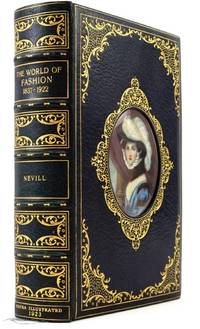
1923réf. ST20131London: Methuen & Co 1923. 218 x 138 mm. 8 1/2 x 5 1/2". vii 1 280 pp. ELEGANT DARK BLUE MOROCCO GILT BY BAYNTUN stamp-signed on front turn-in covers with gilt fillet frame stippled volute cornerpieces UPPER COVER WITH LOVELY MINIATURE PORTRAIT of a fashionable lady the painting under glass and surrounded by a gilt-tooled frame raised bands spine compartments with volute frame gilt lettering gilt-framed turn-ins ecru moiré silk endleaves all edges gilt. WITH 21 PLATES OF FASHIONABLE PEOPLE five of these called for one color and 16 EXTRA-ILLUSTRATED seven of these in color one double-page and nine in black & white all with tissue guards. Spine gently sunned to navy blue just a hint of rubbing to joints but still quite a fine copy--clean and fresh internally and with almost no signs of use inside or out. This handsomely illustrated look at the London social scene during the Victorian and Edwardian eras and after the Great War comes in a suitably chic binding by the last Victorian bindery still in family hands. Author Ralph Nevill 1865-1933 was a denizen of the world he writes about being the son of one of the leading hostesses of the day Lady Dorothy Walpole Nevill 1826-1913; DNB notes that "family tradition" held that Ralph's father was her close friend Benjamin Disraeli Lord Beaconsfield. Nevill has a wide array of insider anecdotes to share about country house life the pleasures of London society and prominent politicians and journalists. He makes it clear that the Victorian era was preferable to the 20th century and nothing is more drab that the post-war world. The illustrations feature portraits of prominent men landscapes of stately homes and scenes from the balls operas and royal occasions that made up the London Season. The very pretty binding is in the Cosway style made popular by bookseller Henry Sotheran and the Riviere bindery characterized by a miniature painting set under glass on the covers or doublures. Our binding was done by the venerable English firm founded in Bath by George Bayntun in 1894. Among the great English workshops of the Edwardian "golden age" of lavish bindings Bayntun has the distinction of being the only one located outside London's West End to be sought after by bibliophiles. Bayntun was a worthy rival to the likes of Sangorski & Sutcliffe and Riviere & Son the latter being subsumed by Bayntun in 1939. Bayntun of Bath continues to create fine hand bindings for bibliophiles. Unusually the miniature painting in our binding is signed by the artist but we were unable to decipher the signature and the Bayntun bindery did not have any information about the painter's identity. Methuen & Co unknown books