[SUIKAN: AN ILLUSTRATED MANUSCRIPT SCROLL OF JAPANESE CEREMONIAL COSTUMES AND ACCESSORIES].Biblio.com
2 628 résultats
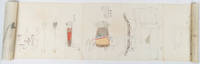
1902réf. 221072Japan. Meiji 35 1902. Delicate manuscript scroll on washi finely painted in colour and black and white 28 x 475cm. A little occaisonal browning. Very good. Dating from March 1902 this beautifully illustrated scroll extends to almost 500cm depicting ceremonial costumes in fine delicate lines and subtle colours. The garments generally known as suikan 水干 date from the Heian period 794–1192. Detailed notes accompany the illustrations describing sizes cuts folds textiles and colours while further drawings show some of the textile weaves. Ceremonial accessories including a bow arrows and hats are also illustrated in colour. The scroll was copied from a manuscript whose source is not recorded. . unknown
1888réf. 145681888. Collection of 3 chromolithographic prints from The Illustrated History of Costume : period styles and accessories by Albert Racinet published by Firmin Didot & Cie in Paris in 1888. Titled: PERSIA - PERSE- PERSIEN. 7 ½" x 8 ¾". These lithographs beautifully depict Persian costumes and interior décor from Iran. In the first lithograph we can see 10 men and one woman dressed in the various traditional Qajar attires of Iran. The second lithograph shows the beautiful interior décor including very intercate and vibrant Persian rugs elaborately scrolled door and window frames of a Kajar residence. The third lithograph captures five musicians playing various instruments and four women dancers. In very good condition. unknown
1864réf. 145861864. Two original antique steel costume engravings of a Persian Iran Royal Officer and Noble woman printed in 1864. Overall size: 9" x 12.5." The plate illustrations are brightly colored and intricately detailed characterization of the traditional costumes of a Persian Royal Officer and Noble woman. In the engraving of the Royal Officer titled "Khatchadour D'hohannes: Officier du Prince Royal de Perse" his attire entails a vibrant green coat with gold trimmings which covers a gold-colored ensemble with a purple sash that stores his dagger. In the engraving of the Persian Woman titled "Dame Persane" she is depicted in traditional costume as imagined by Europeans in the 1800's. The woman is shown leaning against a banister wearing an embroidered white satin gown with a pink silk and fur trimmed coat and a feathered headdress. General age related toning. Overall both prints are in very good condition. unknown
1748réf. 143711748. Mallet Allain Manesson. "Arabes" 1748 presents two male figures identified as Arabs through the conventions of European geographical and costume illustration derived from Mallet's Description de l'Univers. Mallet's original work first published in Paris in 1683 combined maps city views portraits and images of dress with accounts of the customs religions and governments attributed to different nations; its second volume treated Asia. The engraving records the visual vocabulary through which Arab clothing and appearance were presented to European readers within this encyclopedic geographical tradition. Mallet Allain Manesson. "Arabes." 1748. Engraving. Overall page 10" x 7.25"; image 5.5" x 7.5". Beneath a decorative banner lettered "Arabes" two standing men wear contrasting garments against a mountainous landscape. One wears a buttoned tunic overcoat pointed shoes and a large turban; he holds a decorative cane while resting his other hand at his belt. The second wears a decorated collared tunic beneath an overcoat pointed shoes and a tall head covering from which a long length of fabric descends. The paired figures allow differences in headwear garment ornament and accessories to be compared within a single composition. The plate derives from an illustrated geographical work conceived by Mallet a French military engineer and mathematics teacher whose Description de l'Univers organized contemporary geographical knowledge alongside images of the "divers habillemens" of different peoples. The "Arabes" composition therefore records an eighteenth-century European printed conception of Arab dress rather than serving as direct ethnographic documentation of a specific Arab population or locality. Overall very good condition. The combination of costume detail and explicit ethnic captioning documents how Arab peoples were visually categorized for European audiences in early modern geographical publishing. unknown
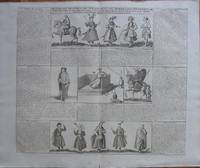
1720réf. 143601720. Atlas historique engraving of Persian costume and customs 1720 records an early eighteenth-century European presentation of dress military equipment horsemanship and tobacco use in Persia during the late Safavid period. Rather than presenting a single landscape or event the plate assembles male and female costume hairstyles turbans footwear weapons armor horses and smoking implements into a comparative visual survey. Its attention to cavalry equipment and what the accompanying description calls the "militia and their weapons" and the "offensive and defensive" equipment worn by soldiers at war documents the categories through which European geographical publications described Persian society and military culture. Atlas historique. Description of Persia and Persian costumes. 1720. Sheet size 51 x 43 cm. The engraving contains numerous individual figures and objects arranged for comparison including four men in different Persian costumes women in period dress examples of female hairstyles turbans and shoes and representations of tobacco smoking and pipes including a hookah. Military subjects include armor weapons cavalry horses an elaborate bow and equestrian equipment. The combination of human figures with separately illustrated articles of clothing arms and personal equipment allows individual elements of Persian dress and material culture to be examined across the sheet. Published in 1720 the engraving dates to the final years of Safavid rule when European atlases and geographical compilations increasingly combined maps with images and written accounts of the peoples clothing military practices and customs of regions beyond Europe. Here Persian men and women cavalry weapons tobacco consumption and dress are organized as subjects of geographical and ethnographic description providing evidence of how Persia was visually classified for an early eighteenth-century European audience. The detailed renderings of costume armor weapons horses hairstyles and smoking implements also preserve period representations of material culture associated with Safavid Persia. Very good condition. unknown
1960réf. 31312S.l. París s.a. ca. 1960.- Son 22 fotografías sueltas y numeradas seguidas relativas a la moda de hombres y mujeres en Francia en el siglo XVII; 8º menor apaisado 13 x 18 cm.; Revelado en blanco y negro brillo.- Cada fotografía vale 3 euros pero se venden como colección conjunta al precio indicado a pie de ficha. MODAS ALTA COSTURA BELLEZA Y COSMÉTICA Libro en español Sin editorial paperback
réf. 42306London: Cecil Palmer n.d. . Deluxe edition no. 75 of 250 copies signed by author and artist 4to. pp.46 pictorial hardcover decorative gilt uncut 10 colour plates; toning to endpapers occasional foxing throughout more pronounced foxing to edges of text block light rubbing and toning to extremities of paper covered boards overall still a very good copy of this scarce volume in a fair unclipped dust-jacket lightly worm with creasing and closed tears to extremities light toning and a few marks. London: Cecil Palmer, n.d. hardcover
réf. 70448The Netherlands not published ca. 1920. Five original water-colours of 23.5 x 17.5 cm mounted on sheets of 29.0 x 23.5 cm; including three double-sized oblong width 45 cm. In later blind wrapper. = A nice suite of watercolours showing Dutch Amsterdam citizens in their Sunday's suits and dresses. The source of these drawings is unknown. Slight age-toning a few spots but generally in a goood condition. A unique item. unknown
réf. 71-6817Paris: Costume Parisien 1826. Hand-colored engraving. 22 x 13.5 cm sheet. Very Good light foxing minor surface soiling colors faded.Provenance: ancienne galerie Vandevoorde 22 rue Vignon Paris. Paris: Costume Parisien, 1826. unknown
1993réf. 25288ELos Angeles: Butterfield & Butterfield 1993 & 1994. First Editions. Lavishly illustrated catalogues with many black & white and color photographs. This set of presents costumes and memorabilia from such diverse films as Gone With The Wind Planet of the Apes Big Orson Welles’ crown from Macbeth Bruce Lee costumes and promotional material George Hamilton’s costume pieces from Zorro The Gay Blade a photograph collection of Sarah Bernhardt Elvis Presley’s costumes and signed photograph Tyrone Powers’ suit from The Razor’s Edge Billy Crystal’s vest from City Slickers dresses from The Sound of Music scripts from Star Trek and much more. Part I is 79 pages plus index Part II is 178 pages and has the prices realized sheet laid in and Part III is 167 pages plus an index. All copies are fine in glossy printed wrappers. Butterfield & Butterfield unknown
réf. Erik Näslund, chief curaNot in perfect condition. unknown
réf. Rangström, LenaIn Pristine Condition. unknown
réf. Edh, Börje; PhotographsIn Pristine Condition. unknown
réf. Reimerson, Anna KarinIn Pristine Condition. unknown
réf. Ellen AndersenIn Pristine Condition. unknown
réf. Nicklasson, Hasnis Eva; DIn Pristine Condition. unknown
réf. Christie, Inger LiseIn Pristine Condition. unknown
réf. Scheel, Ellen WigaardIn Pristine Condition. unknown
réf. 0364566582.Gpaperback. Good. Access codes and supplements are not guaranteed with used items. May be an ex-library book. paperback
réf. 1334565384.Gpaperback. Good. Access codes and supplements are not guaranteed with used items. May be an ex-library book. paperback
1900réf. 40351Weissenburg im Elsas: Druck u. Verlag v. C. Burckardt's Nachf 1900. A very good copy light toning colors vibrant. 1 sheet. Chromolithograph. 33.5 x 43 cm 13 1/4 x 17 inches. Template for the construction of a Japanese infantry cap on thin cardboard. Many such military related items were printed during the German Imperial period. C. Burckhardt Nachfolger was a successor firm to Imagerie Wentzel and one of the largest producers of paper lithographic items. Druck u. Verlag v. C. Burckardt's Nachf unknown
1971réf. KOS01205155Shueisha 1971. Soft Cover. Fine. KOS01205155 Shueisha paperback
réf. KOS02200792TBD 1996. Soft Cover. Fine. KOS02200792 TBD paperback
1991réf. KOS02202106Unknown Valley 1991. Soft Cover. Fine. KOS02202106 Unknown Valley paperback
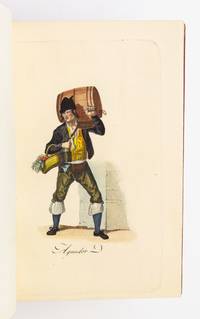
1832réf. ST19313Madrid: Real Calcografía 1832-36. 240 x 160 mm. 9 1/2 x 6 1/4". ELEGANT MODERN RED MOROCCO VERY HANDSOMELY GILT in the style of the period BY ANTOLIN PALOMINO OLALLA hand-signed on front turn-in with swirling cornerpieces and central lozenge raised bands spine panels gilt gilt turn-ins all edges gilt in slightly worn red marbled paper slipcase. With engraved title page and 112 ENGRAVED PLATES by Juan Carrafa after drawings by Jose Ribelles y Helip and ALL WITH CONTEMPORARY HAND COLORING. Colas 646; Lipperheide 1224. Edges of some leaves with faint stains and thumb soiling of no consequence but the finely colored plates beautifully preserved and THE SPARKLING BINDING IN FLAWLESS CONDITION. This is a beautifully bound work filled with exquisitely hand-colored plates depicting early 19th century Spanish costumes. Neither Lipperheide nor Colas identifiy the artist but the San Fernando Royal Academy of Fine Arts in Madrid attributes the images here to the Spanish painter and draughtsman José Ribelles y Helip and identifies the engraver as Juan Carrafa. The plates were originally published by the Royal Academy in 1825 in 14 parts with eight plates per part and the present edition was produced around 1832-36 based on the dates found in the descriptive labels incorporated into two of the plates. The illustrations depict men and women in regional dress from across Spain as well as particular "types" including shepherds fishermen merchants musicians dancers bullfighters smugglers sailors and more. The superb hand coloring enlivens each illustration with vibrant colors and careful attention to shading patterns and accessories. Antolin Palomino Olalla 1909-95 was one of the great Spanish binders of the 20th century. A versatile and meticulous artist teacher and craftsman Palomino Olalla opened his Madrid workshop in 1942 and became especially renowned for his hand-gilding mosaic bindings and marbled paper techniques. He seems to have specialized in binding antiquarian books and attracted important institutional clients as well as discerning bibliophiles such as Bartolomé March Servera. The gilding on the present work is especially elegant and applied with laser precision adding another dimension of pleasure to an already appealing work. The book is uncommonly seen for sale at Anglo-American auctions. Real Calcografía unknown