409 résultats
1955réf. 155308Hangzhou.: 中國杭州都錦生絲織廠制. Dujin Silk Factory. No date. circa1955. Handcoloured silk jacquard panorama of the West Lake in Hangzhou. Measures 27.5 x 120cm. Lightly frayed at ends a very good copy. Silk jacquard weavings such as these were very popular in China from the mid to late 20th century as tourist souvenirs. It appears likely that this particular example was woven in the 1950s as traditional Chinese characters have been used and the Dujin Silk Factory where it was made changed its name to Dongfang Hongsi in 1966. The Dujin Silk Factory was well known in Hangzhou and beyond. It was originally established in 1922 and entered public-private joint management in the 1950s. Unfortunately it now no longer exists. . 中國杭州都錦生絲織廠制. [Dujin Silk Factory] unknown
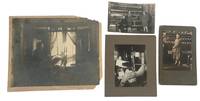
1900réf. 238851900. Women textile workers photo archive depicting Jacquard weaving and related mechanized textile production c. 1900 documenting an industrial technology directly connected to the development of programmable computation. Two photographs show women at Jacquard looms where large harness assemblies permit the selective control of warp threads required for figured weaving. The Jacquard system used sequences of punched cards to determine which warp cords were raised during successive passes storing instructions outside the loom mechanism. Charles Babbage adopted the punched card principle for his Analytical Engine in 1836 and Ada Lovelace in her 1843 Notes on the Analytical Engine compared its manipulation of mathematical operations to the Jacquard loom's weaving of figured patterns. Photo archive 4 silver gelatin photographs mounted on cardstock c.1900-1930. Two photographs show women seated at Jacquard looms enclosed by tall wooden frames supporting dense arrays of harness cords descending toward the warp; the punched card chains themselves are not visible in these views. A third shows a woman standing beside a monumental warp creel filled with scores of individually wound yarn packages each feeding thread through a corresponding guide. The fourth shows two women attending a broad industrial textile machine identified with Bruno Knobloch who patented a thread feeding device for flat warp knitting machines and a Jacquard device for warp knitting machinery. The four photographs document distinct pieces of equipment with women operating supplying and monitoring each machine. Textile manufacturing employed more women than any other industrial sector in Europe and the United States during this period and the Jacquard loom in particular was operated predominantly by women in both domestic workshops and factory settings. Jacquard demonstrated his punched card controlled loom in 1801. The women pictured here worked inside the industrial system Lovelace pointed to: textile production organized around the controlled selection of threads repeatable sequences of mechanical operations and machinery capable of translating predetermined instructions into complex physical patterns. Light fading and tonal variation with scattered surface and mount wear; overall in good condition. unknown
1900réf. 238851900. Women textile workers photo archive depicting Jacquard weaving and related mechanized textile production c. 1900 documenting an industrial technology directly connected to the development of programmable computation. Two photographs show women at Jacquard looms where large harness assemblies permit the selective control of warp threads required for figured weaving. The Jacquard system used sequences of punched cards to determine which warp cords were raised during successive passes storing instructions outside the loom mechanism. Charles Babbage adopted the punched card principle for his Analytical Engine in 1836 and Ada Lovelace in her 1843 Notes on the Analytical Engine compared its manipulation of mathematical operations to the Jacquard loom's weaving of figured patterns. Photo archive 4 silver gelatin photographs mounted on cardstock c.1900-1930. Two photographs show women seated at Jacquard looms enclosed by tall wooden frames supporting dense arrays of harness cords descending toward the warp; the punched card chains themselves are not visible in these views. A third shows a woman standing beside a monumental warp creel filled with scores of individually wound yarn packages each feeding thread through a corresponding guide. The fourth shows two women attending a broad industrial textile machine identified with Bruno Knobloch who patented a thread feeding device for flat warp knitting machines and a Jacquard device for warp knitting machinery. The four photographs document distinct pieces of equipment with women operating supplying and monitoring each machine. Textile manufacturing employed more women than any other industrial sector in Europe and the United States during this period and the Jacquard loom in particular was operated predominantly by women in both domestic workshops and factory settings. Jacquard demonstrated his punched card controlled loom in 1801. The women pictured here worked inside the industrial system Lovelace pointed to: textile production organized around the controlled selection of threads repeatable sequences of mechanical operations and machinery capable of translating predetermined instructions into complex physical patterns. Light fading and tonal variation with scattered surface and mount wear; overall in good condition. unknown books
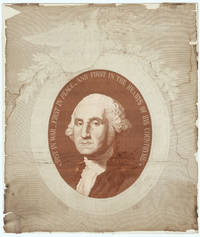
1856réf. 5672BFIRST "COMPUTER" PORTRAIT OF AMERICA'S FIRST PRESIDENT Lyon Joseph Marie Jacquard 1856. Silk machine-woven textile 49.8 x 42.2 cm. Mounted on old board. Edge wear some marginal tears and losses edge toning from mounting tape some damp staining and wrinkling. This said a remarkable survival. Rare silk textile portrait of George Washington 1732-99 woven on the earliest programmable loom – the Jacquard Loom – which influenced the development of other programmable punch-card-driven machines that in turn would lead to the early versions of IBM's digital compiler. The present work thus may plausibly be considered the first 'computer' portrait of the first President of the United States. The textile carries the monogram 'JR' and is dated 1856 from Lyon the birthplace and home of Joseph Marie Jacquard 1752-1834 who invented his revolutionary device in 1804 to aid in the production of complex patterns of damask matelassé and brocade. Based on Gilbert Stuart's 1755-1828 iconic portrait this two-color textile is inscribed with the famed line 'First in War First in Peace and First in the Hearts of his Countrymen' which is taken from Washington's eulogy delivered by Henry "Light Horse Harry" Lee 1756-1818 a major general in the Continental Army a member of the Continental Congress governor of Virginia father of the famous Civil War general Robert E. Lee and a close friend of Washington. Now rare the textile was apparently well known to American audiences for decades after its initial production: A certain R. H. Thurston for example in his 1880 inaugural address as president of the American Society of Mechanical Engineers invoked history's greatest engineers including "Jacquard who perfected the pattern-loom which to-day weaves with equal facility the portrait of him who was 'first in war first in peace and first in the hearts of his countrymen' and the most beautiful and ingenious combinations of form and color of which decorative art is so wonderfully prolific" Thurston p. 9. Provenance: Skinner Fine Books and Manuscripts 1 June 2013 lot 19. J. Essinger Jacquard's Web: How a Hand-Loom Led to the Birth of the Information Age; R. H. Thurston "The President's Inaugural Address" Transactions of the American Society of Mechanical Engineers vol. 1 1880 pp. 1-16. Joseph Marie Jacquard
1856réf. 5672BFIRST "COMPUTER" PORTRAIT OF AMERICA'S FIRST PRESIDENT Lyon Joseph Marie Jacquard 1856. Silk machine-woven textile 49.8 x 42.2 cm. Mounted on old board. Edge wear some marginal tears and losses edge toning from mounting tape some damp staining and wrinkling. This said a remarkable survival. Rare silk textile portrait of George Washington 1732-99 woven on the earliest programmable loom – the Jacquard Loom – which influenced the development of other programmable punch-card-driven machines that in turn would lead to the early versions of IBM's digital compiler. The present work thus may plausibly be considered the first 'computer' portrait of the first President of the United States. The textile carries the monogram 'JR' and is dated 1856 from Lyon the birthplace and home of Joseph Marie Jacquard 1752-1834 who invented his revolutionary device in 1804 to aid in the production of complex patterns of damask matelassé and brocade. Based on Gilbert Stuart's 1755-1828 iconic portrait this two-color textile is inscribed with the famed line 'First in War First in Peace and First in the Hearts of his Countrymen' which is taken from Washington's eulogy delivered by Henry "Light Horse Harry" Lee 1756-1818 a major general in the Continental Army a member of the Continental Congress governor of Virginia father of the famous Civil War general Robert E. Lee and a close friend of Washington. Now rare the textile was apparently well known to American audiences for decades after its initial production: A certain R. H. Thurston for example in his 1880 inaugural address as president of the American Society of Mechanical Engineers invoked history's greatest engineers including "Jacquard who perfected the pattern-loom which to-day weaves with equal facility the portrait of him who was 'first in war first in peace and first in the hearts of his countrymen' and the most beautiful and ingenious combinations of form and color of which decorative art is so wonderfully prolific" Thurston p. 9. Provenance: Skinner Fine Books and Manuscripts 1 June 2013 lot 19. J. Essinger Jacquard's Web: How a Hand-Loom Led to the Birth of the Information Age; R. H. Thurston "The President's Inaugural Address" Transactions of the American Society of Mechanical Engineers vol. 1 1880 pp. 1-16. Joseph Marie Jacquard books
1889réf. E00911889. Titelblatt von J. Berjon in Tinte signiert / titre signé en encre par Berjon. 11 Lagen starkes Papier mit Kordelbindung. Lederband der Zeit mit goldgeprägtem Deckel- u. Rückentitel. Zustand 1.
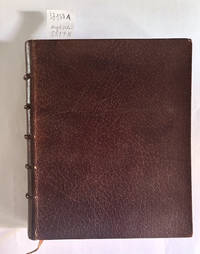
1886réf. 8517BB1886. Lyon A. Roux 1886 "achevé . le VIII Sept. l'an de N.S. 1887". Small 8vo. 1 w. Bl. 25 beidseitig gewebte Bll. 1 w. Bl. Mit 3 ganzseit. Ill. Frontispiz mit leergelassenem Wappen zahlreichen Initialen u. durchgehenden floralen bzw. figürlichen Bordüren nach mittelalterlichen illuminierten Stundenbüchern. Text and illustrations entirely woven on a Jacquard machine with black and silver silk. Precious contemporary morocco leather in Jansenist-style 5 raised bands board edges with double gilt fillet top and bottom edge gilt doublures with burgundy moiré silk endpapers and inside boards with gilt tooled borders dentelles floral motifs and fillets. Binding signed J. Kaufmann and Ch. Meunier. Front board slightly concave. Dampstains throughout mostly on the bottom margins and only spreading on the first and last one or two leaves on the first few pages also affecting the top outer corners. All leaves with neat edges and free of any fraying. Overall in good condition. Extremely rare with only about 50 flawlessly woven copies. Vicaire V 342. - P. Marais "Note sur un livre de prières en tissue de soie" in: Bulletin du Bibliophile 1889 S. 163-166. - A. Laillier Une merveille artistique: notice sur un livre de prières tissé en soie" in: Bulletin de la Société industrielle de Rouen 1er janvier 1890 S. 267-270. - Michael Laird in The World from Here. Treasures of the Great Libraries of Los Angeles edited by C. Burlingham & B. Whiteman 2001 63. "Despite the fact that this rare volume is not a printed book it is of singular interest in that it was completely woven with silver and black silk thread. It also represents an extremely early book production involving automation and programming. The book was manufactured on silk looms that were programmed using the punched-card system developed by Joseph-Marie Jacquard 1752-1834. Several hundred thousand cards were required to program this curious magnum opus the actual figure is not known but estimates range from 106000 to 500000. After fifty failed attempts it took two years to weave approximately sixty copies. It will be observed that the weave in the present volume is almost microscopic it is exactly four hundred weft threads for every 2.5 centimeters approximately one inch. The movement of the machine was limited to one tenth of a millimeter the result being an extremely precise piece of bookmaking which on account of the material used truly gleams. It is noteworthy that Jacquard's looms only slightly modified are still in use today producing some of the world's finest fabric for furniture. The punched instructional cards utilized by Jacquard's weaving machinery served as the primary inspiration for the famous 'Analytical Engine' conceived by Charles Babbage 1791-1871". - A highlight of Jacquard production from Lyon the capital of silk and hometown of Joseph Marie Jacquard and possibly the only successful attempt at weaving a complete book with legible text. After weaving the silk leaves were folded and mounted on cardboard to give them the necessary strength. Each copy of the book was individually bound when sold but many copies remained in stock for years. - Lillian Randall noted that the "illuminations" of this particular prayer book came from a late 19th-century monograph the "Imitation de Jésus-Christ" Paris: Gruel et Engelmann which included reproductions of various illuminated manuscripts from the 14th to 16th century. The illuminations were chosen by R. P. J. Hervier who was also responsible for the overall design of the volume. A copy of the book was exhibited in the Lyon Pavilion at the Universal Exhibition in 1889 where its maker J. A. Henry won the Grand Prix. - With its small format the iconography and the general aesthetic featuring tendrils fillets miniatures and initials this work was clearly modelled on medieval books of hours. Just as a medieval manuscript was often tailored to the commissioner by inserting his coat of arms into a composition or by mentioning a saint to whom he was particularly devoted to this book of hours has a coat of arms in the frontispiece whose field remains empty to possibly embroider the coat of arms the name and the motto of the recipient. In our copy the field was left blank. hardcover
1886réf. 8517BBLyon, A. Roux, 1886 ("achevé ... le VIII Sept. l'an de N.S. 1887"). Small 8vo. 1 w. Bl., 25 beidseitig gewebte Bll., 1 w. Bl. Mit 3 ganzseit. Ill., Frontispiz mit leergelassenem Wappen, zahlreichen Initialen u. durchgehenden floralen bzw. figürlichen Bordüren nach mittelalterlichen illuminierten Stundenbüchern. Text and illustrations entirely woven on a Jacquard machine with black and silver silk. Precious contemporary morocco leather in Jansenist-style, 5 raised bands, board edges with double gilt fillet, top and bottom edge gilt, doublures with burgundy moiré silk endpapers and inside boards with gilt tooled borders (dentelles, floral motifs and fillets). Binding signed J. Kaufmann and Ch. Meunier. Front board slightly concave. Dampstains throughout, mostly on the bottom margins and only spreading on the first and last one or two leaves, on the first few pages also affecting the top outer corners. All leaves with neat edges and free of any fraying.
1886réf. 37158ABLyon, A. Roux, 1886 ("achevé ... le VIII Sept. l'an de N.S. 1887"). Kl.-8°. 1 w. Bl., 25 beidseitig gewebte Bll., 1 w. Bl. Mit 3 ganzseit. Ill., Frontispiz mit leergelassenem Wappen, zahlreichen Initialen u. durchgehenden floralen bzw. figürlichen Bordüren nach mittelalterlichen illuminierten Stundenbüchern. Text und Illustrationen vollständig mit Jacquard-Technik in Schwarz auf silbergrauer Seide gewebt. Wertvoller, dunkelbrauner Maroquin-Meistereinband d. Zt. auf 5 Bünden, mit doppelten Goldfileten auf den Kanten, Kopf- u. Fußgoldschnitt, Dublüre in burgunderroten Moiré-Seidenvorsätzen mit floralen Goldbordüren, - Prägungen à la Dentelle und -Filetierung der Innendeckel. Signiert J. Kauffmann (vorderer Innendeckel) u. Ch. Meunier (Rückdeckel). Einband an wenigen, kleinen Stellen sehr leicht berieben. Frontdeckel leicht konkav gewölbt. Durchgehende Feuchtigkeitsspuren vor allem am Fußssteg, zu Beginn und am Schluss etwas ausgedehnter, auf den ersten Seiten auch an der oberen Außenecke. Alle Seit