359 risultati
1999rif. BN555752Pyc Livres 1999. 1999. Hardcover. Installations frigorifiques tome 1 : Eléments de Installations frigorifiques tome 1 : Eléments de Pierre-Jean Rapin et Patrick Jacquard Pyc Livres hardcover
1996rif. BN580362Pyc Livres 1996. 1996. Hardcover. Installations frigorifiques tome 2 Installations frigorifiques tome 2 Pierre-Jean Rapin et Patrick Jacquard Pyc Livres hardcover
2003rif. BN580321Dunod - L'Usine 2003. 2003. Softcover. Formulaire du froid Formulaire du froid Pierre Rapin et Patrick Jacquard Dunod - L'Usine paperback
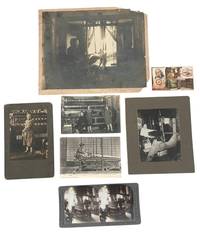
1880rif. 240511880. Photograph archive documenting women textile workers at handlooms and factory machinery alongside the Jacquard loom an important precursor to modern computing. Jacquard's punched-card mechanism inspired Charles Babbage's proposed Analytical Engine whose operations Ada Lovelace likened to weaving in 1843. Jacquard system established a method of controlling machinery through encoded instructions a principle subsequently adopted in early computer design. The archive documents the connection between women's industrial history with the technological foundations of modern computing. Textile manufacturing was also among the earliest major industrial employers of women. Photo archive of four silver gelatin photographs one 1914 Keystone View Company stereoview one real photo postcard and one color advertising card various sizes ranging from 4 x 2 inches to 7.5 x 10 inches circa 1880s-1920s. A large photograph mounted on card stock shows a woman operating a wooden loom beside a curtained window; another depicts a seated weaver at a substantial timber-framed loom. Other photographs show a young worker before ranks of yarn bobbins and three women beside industrial textile machinery. The stereoview depicts a Jacquard loom weaving brocade in South Manchester Connecticut its punched-card apparatus visible overhead. The postcard depicts Japanese weaving while an 1881-copyright trade card portrays Jacquard and his invention. One photograph bears a handwritten Cyrillic inscription dated February 25 1928. Scattered fading spotting abrasions and mount wear particularly to the largest print which shows chipped card stock. Overall good. unknown
rif. 9788426712103New. unknown
2011rif. x-3642708390Springer-Verlag 2011. Paperback. New. 476 pages. 9.60x6.70x1.00 inches. Springer-Verlag paperback
2012rif. x-3642884172Springer 2012. Paperback. New. reprint edition. 592 pages. 9.25x6.10x1.34 inches. Springer paperback
rif. SONG3540063293Springer 0000-00-00. First Edition. hardcover. Used: Good. 0.00x0.00x0.00. Buy with confidence. Excellent Customer Service & Return policy. Springer hardcover
1839rif. 461741839. Jacquard Joseph Marie 1752-1834. Portrait in silk of Joseph-Marie Jacquard after an original oil portrait by Claude Bonnefond manufactured by Didier Petit et Cie; woven by Michel-Marie Carquillat 1803-1884 in Lyon France 1839. The image including caption and Carquillat's name taking credit for the weaving is 55 x 34 cm.; the full piece of silk including blank margins is 85 x 66 cm. The visible portion of the image in the frame is 72 x 54.5 cm. and the frame measures 104 x 84 cm. Minor wear from folding barely visible in the image but with the image in clear unfaded and fresh condition. The weaving was professionally treated by a textile conservator whose conservator's report and images of before and after are available. Minor flaws visible in the large outer margins of the silk not affecting the image. In a large and attractive archival frame. This famous image of which only a very few examples are known was woven by machine using 24000 Jacquard cards each of which had over 1000 hole positions. The process of mis en carte or converting the image details to punched cards for the Jacquard mechanism for this exceptionally large and detailed image would have taken several workers many months as the woven image convincingly portrays superfine elements such as a translucent curtain over glass window panes. Once all the "programming" was completed the process of weaving the image with its 24000 punched cards would have taken more than eight hours assuming that the weaver was working at the usual Jacquard loom speed of about forty-eight picks per minute or about 2800 per hour. More than once this woven image was mistaken for an engraved image. The image was produced only to order most likely in a small number of examples. Recorded examples are those at the Metropolitan Museum of Art the Science Museum London The Art Institute of Chicago and the Computer History Museum Mountain View California Musée de Tissus Lyons. The image is the subject of the book by James Essinger entitled Jacquard's Web: How a Hand Loom Led to the Birth of the Information Age 2004. To Charles Babbage the incredible sophistication of the information processing involved in the mis en carte-what we call programming-of this exceptionally elaborate and beautiful image confirmed the potential of using punched cards for the inputting programming and outputting and storage of information in his design and conception of the first general-purpose programmable computer--the Analytical Engine. The highly aesthetic result also confirmed to Babbage that machines were capable of amazingly complex and subtle processes-processes which might eventually emulate the subtlety of the human mind. "In June 1836 Babbage opted for punched cards to control the machine the Analytical Engine. The principle was openly borrowed from the Jacquard loom which used a string of punched cards to automatically control the pattern of a weave. In the loom rods were linked to wire hooks each of which could lift one of the longitudinal threads strung between the frame. The rods were gathered in a rectangular bundle and the cards were pressed one at a time against the rod ends. If a hole coincided with a rod the rod passed through the card and no action was taken. If no hole was present then the card pressed back the rod to activate a hook which lifted the associated thread allowing the shuttle which carried the cross-thread to pass underneath. The cards were strung together with wire ribbon or tape hinges and fan-folded into large stacks to form long sequences. The looms were often massive and the loom operator sat inside the frame sequencing through the cards one at a time by means of a foot pedal or hand lever. The arrangement of holes on the cards determined the pattern of the weave. "As well as patterned textiles for ordinary use the technique was used to produce elaborate and complex images as exhibition pieces. One well-known piece was a shaded portrait of Jacquard seated at table with a small model of his loom. The portrait was woven in fine silk by a firm in Lyon using a Jacquard punched-card loom. The image took 24000 cards to produce and each card had over 1000 hole positions. Babbage was much taken with the portrait which is so fine that it is difficult to tell with the naked eye that it is woven rather than engraved. He hung his own copy of the prized portrait in his drawing room and used it to explain his use of the punched cards in his Engine. The delicate shading crafted shadows and fine resolution of the Jacquard portrait challenged existing notions that machines were incapable of subtlety. Gradations of shading were surely a matter of artistic taste rather than the province of machinery and the portrait blurred the clear lines between industrial production and the arts. Just as the completed section of the Difference Engine played its role in reconciling science and religion through Babbage's theory of miracles the portrait played its part in inviting acceptance for the products of industry in a culture in which aesthetics was regarded as the rightful domain of manual craft and art" Swade The Cogwheel Brain. Charles Babbage and the Quest to Build the First Computer 2000 107-8. . unknown
rif. 489711-6Springer. Used - Good. Former library copy. Pages intact with minimal writing/highlighting. The binding may be loose and creased. Dust jackets/supplements are not included. Includes library markings. Stock photo provided. Product includes identifying sticker. Better World Books: Buy Books. Do Good. Springer unknown
rif. 3543920-6Duke University Press. Used - Good. Former library copy. Pages intact with minimal writing/highlighting. The binding may be loose and creased. Dust jackets/supplements are not included. Includes library markings. Stock photo provided. Product includes identifying sticker. Better World Books: Buy Books. Do Good. Duke University Press unknown
rif. 100135518Albin Michel / Plon / Fayard. Bon état de l'ensemble couvertures défraîchies intérieurs propres quelques rousseur ou ternissures sur les tranches. in8. Sans date. Broché. 10 volumes. 510 pages. 10 livres sur le moyen-orient géopolitique: Guerre du Golfe : le dossier secret salinger Le Rêve brisé : Histoire de l'échec du processus de paix au Proche-Orient 1995-2002 enderlin La guerre des Bush : Les secrets inavouables d'un conflit laurent eric Au nom d'Oussama Ben Laden. jacquard roland L'infiltree anonyme Visage Vole - Avoir Vingt Ans a Kaboul latifa Génération Intifada Bucaille Que veulent les arabes fereydoun hoveyda Génocide en Irak : La Campagne d'Anfal contre les Kurdes middle east watch Un printemps arabe Benoist-Méchin History Middle East - General History/Middle East - General General and world history Histoire générale et thématique Histoire internationale Middle Eastern history Palestine Proche et Moyen-Orient HISTOIRE History Human rights watch-Middle East Irak Iraq Albin Michel / Plon / Fayard unknown
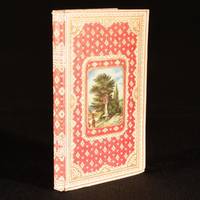
1880rif. 960F6Rouen: Megard 1880 . Hardback. Very Good. 8.5" by 5.5". Not Stated. L. Jacquard's very scarce juvenile novel set in Saint-Domingue beautifully bound in the publisher's decorative cartonnage binding. In the original French.L. Jacquard's very scarce novel.From the 'Bibliothèque Morale de la Jeunesse' series from Rouen based publisher Megard. This was a collection of works of literature and history aimed at younger readers beautifully bound in distinctive and highly decorative cartonnage bindings in order to attract the young.This series was part of a broader movement in nineteenth-century France to provide children with literature that combined moral instruction with engaging storytelling.Illustrated with a frontispiece.Jacquard's moralising children's novel is set on Saint-Domingue the French colony that now occupies the western portion of the island now called Haiti. It was established in 1659 and remained a French colony until Haiti gained independence in 1804 marking the end of the Haitian Revolution. In the publisher's original decorative cartonnage binding decorated in gilt and pink and with colour illustrated pictorial inlay to centre of front board. Externally bright. A touch of fading to back strip with bump to back strip tail. Front hinge strained but firmly held. Frontispiece detached and loosely inserted. Internally binding lightly strained throughout. Pages lightly age toned with spotting throughout. Very Good Megard hardcover
1995rif. 140946Paris: Chez l'auteur 1995. Broché. Etat satisfaisant. in-8. 110 pp. Couverture jaunissante frottée en coins et coiffes. Chez l'auteur unknown
rif. 201695like new. unknown
rif. 201695-nnew. unknown
2014rif. H-819-793Dunod 2014. Paperback. Very Good. Former library book. Edition 2014. Ammareal gives back up to 15% of this item's net price to charity organizations. Dunod paperback
2005rif. SONG2234058066STOCK 2005-09-14. STOCK. paperback. Used: Good. 5.31x0.51x8.46. Buy with confidence. Excellent Customer Service & Return policy. STOCK paperback
2011rif. DADAX3642708390Springer 2011-11-17. Softcover reprint of the original 1st ed. 1985. paperback. New. 6.69x1.08x9.61. Buy with confidence. Excellent Customer Service & Return policy. Springer paperback
1985rif. 4853Springer 1985. Proceedings of NATO Advanced Research Workshop Montpellier. V.g. /No jacket. Hard covers no dust jacket Little used. xvii 452 pp. Springer hardcover
1886rif. 8517BB1886. Lyon A. Roux 1886 "achevé . le VIII Sept. l'an de N.S. 1887". Small 8vo. 1 w. Bl. 25 beidseitig gewebte Bll. 1 w. Bl. Mit 3 ganzseit. Ill. Frontispiz mit leergelassenem Wappen zahlreichen Initialen u. durchgehenden floralen bzw. figürlichen Bordüren nach mittelalterlichen illuminierten Stundenbüchern. Text and illustrations entirely woven on a Jacquard machine with black and silver silk. Precious contemporary morocco leather in Jansenist-style 5 raised bands board edges with double gilt fillet top and bottom edge gilt doublures with burgundy moiré silk endpapers and inside boards with gilt tooled borders dentelles floral motifs and fillets. Binding signed J. Kaufmann and Ch. Meunier. Front board slightly concave. Dampstains throughout mostly on the bottom margins and only spreading on the first and last one or two leaves on the first few pages also affecting the top outer corners. All leaves with neat edges and free of any fraying. Overall in good condition. Extremely rare with only about 50 flawlessly woven copies. Vicaire V 342. - P. Marais "Note sur un livre de prières en tissue de soie" in: Bulletin du Bibliophile 1889 S. 163-166. - A. Laillier Une merveille artistique: notice sur un livre de prières tissé en soie" in: Bulletin de la Société industrielle de Rouen 1er janvier 1890 S. 267-270. - Michael Laird in The World from Here. Treasures of the Great Libraries of Los Angeles edited by C. Burlingham & B. Whiteman 2001 63. "Despite the fact that this rare volume is not a printed book it is of singular interest in that it was completely woven with silver and black silk thread. It also represents an extremely early book production involving automation and programming. The book was manufactured on silk looms that were programmed using the punched-card system developed by Joseph-Marie Jacquard 1752-1834. Several hundred thousand cards were required to program this curious magnum opus the actual figure is not known but estimates range from 106000 to 500000. After fifty failed attempts it took two years to weave approximately sixty copies. It will be observed that the weave in the present volume is almost microscopic it is exactly four hundred weft threads for every 2.5 centimeters approximately one inch. The movement of the machine was limited to one tenth of a millimeter the result being an extremely precise piece of bookmaking which on account of the material used truly gleams. It is noteworthy that Jacquard's looms only slightly modified are still in use today producing some of the world's finest fabric for furniture. The punched instructional cards utilized by Jacquard's weaving machinery served as the primary inspiration for the famous 'Analytical Engine' conceived by Charles Babbage 1791-1871". - A highlight of Jacquard production from Lyon the capital of silk and hometown of Joseph Marie Jacquard and possibly the only successful attempt at weaving a complete book with legible text. After weaving the silk leaves were folded and mounted on cardboard to give them the necessary strength. Each copy of the book was individually bound when sold but many copies remained in stock for years. - Lillian Randall noted that the "illuminations" of this particular prayer book came from a late 19th-century monograph the "Imitation de Jésus-Christ" Paris: Gruel et Engelmann which included reproductions of various illuminated manuscripts from the 14th to 16th century. The illuminations were chosen by R. P. J. Hervier who was also responsible for the overall design of the volume. A copy of the book was exhibited in the Lyon Pavilion at the Universal Exhibition in 1889 where its maker J. A. Henry won the Grand Prix. - With its small format the iconography and the general aesthetic featuring tendrils fillets miniatures and initials this work was clearly modelled on medieval books of hours. Just as a medieval manuscript was often tailored to the commissioner by inserting his coat of arms into a composition or by mentioning a saint to whom he was particularly devoted to this book of hours has a coat of arms in the frontispiece whose field remains empty to possibly embroider the coat of arms the name and the motto of the recipient. In our copy the field was left blank. hardcover
rif. 3540063293.Ghardcover. Good. Access codes and supplements are not guaranteed with used items. May be an ex-library book. hardcover
rif. 53440Eds de l'Aire In-8 21 cm 175pp. Nb-0239-230 unknown
rif. A9780822329770Hardback. New. Presents a dramatic portrait of the wanted terrorist and his extensive brotherhood. This title details how bin Laden became an international emblem of fundamentalist pan-Islamic anti-US fervour and the leader of a brotherhood so passionate that devotees who have never met him will act autonomously in his name. hardcover
rif. ria9783642884177_inpPaperback. New. New Book; Fast Shipping from UK; Not signed; Not First Edition; It is part of the ideology of science that it is an international enterprise carried out by a community that knows no barriers of nation or culture. But the reality is somewhat different. Despite the best intentions of scientists to fo paperback