10 924 résultats
réf. SLIVCN-9782849757253FAGE EDITIONS
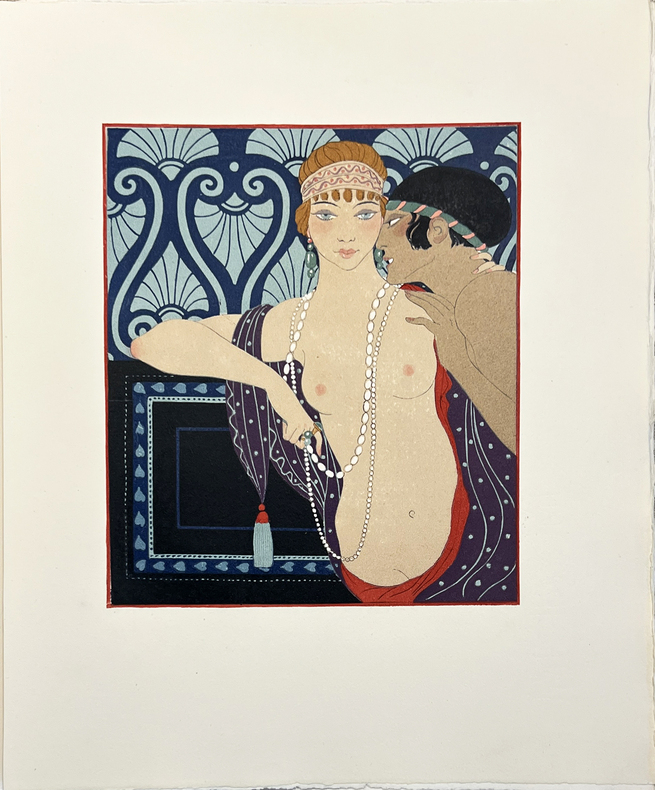
1922réf. 21896CORRARD 1922 1 Estampe originale en couleurs pour Les Chansons de Bilitis, gravée sur bois par François-Louis SCHMIED. Paris, Pierre Corrard éditions, 1922, 19.5 x 16.7 cm (format à vue), 33.2 x 26.5 cm (format de la feuille).
1954réf. 13444Paris, les Bibliophiles de l'Amérique latine, 1954. En feuilles, couvertures illustrées, sous chemise et étui crème.
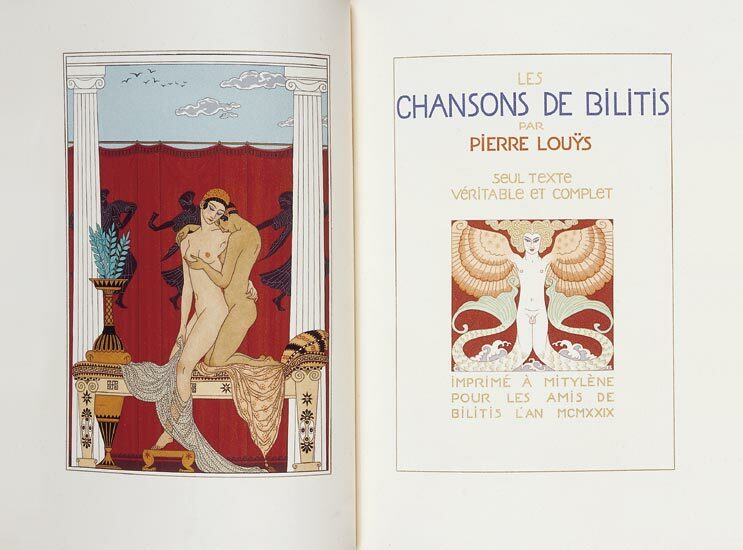
1929réf. 1850Imprimé à Mitylène pour les amis de Bilitis [Paris: P. Bouchet], 1929. Volume petit in-4 (24,5 x 19,5 mm) relié en plein maroquin mosaïqué, doublé et décoré, étui. - 62 COMPOSITIONS GRAVÉES SUR BOIS EN COULEURS DE GEORGE BARBIER dont un frontispice et 6 à pleine page, 24 sujets à mi-page et de nombreuses lettrines et culs-de-lampe. - PREMIÈRE ÉDITION INTÉGRALE de ces 22 chansons, publiée pour le compte de Louis Barthou, Jacques André et Georges Miguet. Réalisé en 1929, période où le talent de l'artiste était alors à son apogée, ce livre est l'une des productions les plus importantes des années trente. - LE LIVRE LE PLUS RARE DE GEORGE BARBIER TIRÉ SEULEMENT À 25 EXEMPLAIRES. Un des 20 sur papier vélin filigrané au titre de l'ouvrage, celui-ci, non numéroté mais d'une prestigieuse provenance, est augmenté d' UNE SUITE COMPLÈTE DU TRAIT EN BRUN/ROUGE SUR JAPON. La suite tirée à 5 ou 6 ex. comprend également l' illustration des couvertures et une planche inédite. La reliure à décor d'attributs érotiques a été commanditée à Charles Septier par le bibliophile Beauvillain. Avec son ex-libris gravé : "Et BEAUVILLAIN ? / toujours il vous aime". SUPERBE EXEMPLAIRE RELIÉ EN PLEIN MAROQUIN DOUBLÉ MOSAÏQUÉ DE L'ÉPOQUE. - Références : Carteret Illustrés IV, 251 ; Dutel II, 1183 ; Pia Enfer 201-203. - Notes : Les Chansons de Bilitis sont l’œuvre la plus célèbre de Pierre Louÿs (1870-1925) qui s'est ici amusé à monter une petite mystification, faisant croire qu'il s'agissait d'un véritable document historique retrouvé, les œuvres d'une contemporaine de Sappho, dont il ne nous reste que quelques bribes de poèmes… Il n'a pas même négligé de citer de vrais ouvrages savants issus de l'industrieuse université allemande, d'inventer des découvertes archéologiques, et de multiplier les évidences pour donner du corps à son invention. Elle a eu le bonheur d'attraper quelques érudits enthousiastes, professeurs d'université offrant leurs services pour améliorer la traduction ! Bilitis est même devenu un nom commun, comme Sapho. "Je voulais entendre Le rire de Sappho Et la voix de Sa lyre Ce qui me parvint fut Le marmonnement moustachu Des grammairiens Des ptérodactyles grecs Et des dodos victoriens". Il s'agit en fait d'un pastiche, mélangeant bribes saphiques, épigrammes de l'Anthologie Grecque, et de tout ce que peuvent offrir Alciphron (Lettres de pêcheurs, de paysans, de parasites et d'hétaïres), La Pastorale de Daphnis et Chloé de Longus, Lucien et tous les romans grecs... Au final, on a plus d'une centaine de poèmes suggestifs et ingénieux, fruit de la malicieuse imagination et de l'art imitatif de l'auteur. Ce n'est pas mal du tout, mais quand même: c'était bien trop beau pour être vrai ! L'introduction : Vie de Bilitis, est excellente, et remplit parfaitement son office… "Bilitis naquit au commencement du sixième siècle avant notre ère, dans un village de montagnes situé sur les bords du Mélas, vers l’orient de la Pamphylie. Ce pays est grave et triste, assombri par des forêts profondes, dominé par la masse énorme du Taurus ; des sources pétrifiantes sortent de la roche ; de grands lacs salés séjournent sur les hauteurs, et les vallées sont pleines de silence. Elle était fille d’un Grec et d’une Phénicienne. Elle semble n’avoir pas connu son père, car il n’est mêlé nulle part aux souvenirs de son enfance. Peut-être même était-il mort avant qu’elle ne vînt au monde. Autrement on s’expliquerait mal comment elle porte un nom phénicien que sa mère seule lui put donner. Sur cette terre presque déserte, elle vivait d’une vie tranquille avec sa mère et ses sœurs. D’autres jeunes filles, qui furent ses amies, habitaient non loin de là. Sur les pentes boisées du Taurus, des bergers paissaient leurs troupeaux. Le matin, dès le chant du coq, elle se levait, allait à l’étable, menait boire les animaux et s’occupait de traire leur lait. Dans la journée, s’il pleuvait, elle restait au gynécée et filait sa quenouille de laine. Si le temps était beau, elle courait dans les champs et faisait avec ses compagnes mille jeux dont elle nous parle. Bilitis avait à l’égard des Nymphes une piété très ardente. Les sacrifices qu’elle offrait, presque toujours étaient pour leur fontaine. Souvent même elle leur parlait, mais il semble bien qu’elle ne les a jamais vues, tant elle rapporte avec vénération les souvenirs d’un vieillard qui autrefois les avait surprises. La fin de son existence pastorale fut attristée par un amour sur lequel nous savons peu de chose bien qu’elle en parle longuement. Elle cessa de le chanter dès qu’il devint malheureux. Devenue mère d’un enfant qu’elle abandonna, Bilitis quitta la Pamphylie, d’une façon assez mystérieuse, et ne revit jamais le lieu de sa naissance. Nous la retrouvons ensuite à Mytilène où elle était venue par la route de mer en longeant les belles côtes d’Asie. Elle avait à peine seize ans, selon les conjectures de M. Heim qui établit avec vraisemblance quelques dates dans la vie de Bilitis, d’après un vers qui fait allusion à la mort de Pittakos. Lesbos était alors le centre du monde…" - ENGLISH DESCRIPTION : Pierre Loüys- George Barbier : LES CHANSONS DE BILITIS. Seul texte véritable et complet. Imprimé à Mitylène pour les amis de Bilitis, 1929. Small 4to. (246 x 192 mm). pp. (iv), 56, (i), (i). Wood-engraved colour frontispiece, printed title in various colours with colour wood-engraved vignette and Louÿs test in three sections ('Bucoliques en Pamphylie', 'Elegies à Lesbos' and 'Epigrammes dans lIle de Chypre') illustrated with 60 wood-engraved illustrations by Pierre Bouchet after George Barbier, 54 in colour, seven full-page, 24 decorating the text, the remainder culs-de-lampes or vignettes, final leaf with justification and achevé d'imprimer; three-line initials in colour against gilt background throughout as well as numerous head- and tail-pieces and initial letters, verse numbering in gilt in Roman numerals, text in capitals ruled throughout and two additional wood-engravings for the wrappers; this copy with the additional suite printed in outline in bistre on Japon including the cover illustrations and a "planche refusée" in black. Our copy is not numbered but comes from a important collector and provenance with ex-libris. Full contemporary emerald crushed morocco by Charles Septier with his signature gilt, front and rear boards ruled in gilt to surround a decorative border of inlaid jade morocco with gilt Greek key pat-tern around curvilinear jade morocco surround with gilt roll tool for a central vignette with argent disc supported by lamp tools, banded spine in five compartments with gilt titles and elaborate decorative tooling, doublures of tan morocco with gilt surrounding an inner border of red and black inlaid morocco, central inlaid circular medallions illustrating vignettes from the book in colour morocco, gilt floral, foliate, phallic and vulvic tools at corners, patterned silk guards, marbled endpapers, board edges ruled in gilt, original wrappers with gilt illustration and backstrips preserved, a.e.g., matching morocco-edged wool-lined marbled board slipcase. The binding was commissioned by Beauvillain as he had commissioned other bindings from Septier and that his ex libris is bound in as a full sheet rather than pasted on one of the pages. Provenance: leaf with engraved ex-libris of Robert Beauvillain by Jouas bound in with the text: "Et BEAUVILLAIN ? / toujours il vous aime". - BARBIER'S RAREST BOOK, Les Chansons de Bilitis, bound by Septier and with the very rare additional suite. From the edition limited to 25 copies on vélin d'Arches only, this copy also with the very rare suite printed in outline in bistre on Japon of which very few copies were printed. Also with an extra unpublished full page print in bistre bound in the suite. The rarest and most recherché and erotic work by George Barbier. The magnificent binding by Septier features phallic and vulvic tools to the doublures and a central circular vignette to each: that for the front doublure is after the illustration for the second poem Je me suis dévêtue pour monter a un arbre ... ); that for the rear is after the twenty-third (D'abord je n'ai pas répon-du ... ). First published in Paris in 1894, this purports to be translations of poems by a woman named Bilitis, a contemporary and ac-quaintance of Sappho. This caused a sensation, not only because finding an intact cache of poems from a completely unknown Greek poet circa 600 B.C. would be a miracle, but because of its open and sensitive exploration of lesbian eroticism. Actually Bilitis never existed. The poems were a clever forgery by Pierre Louÿs -- the "translator"; to lend weight, he had even included a bibliogra-phy with bogus supporting works. Louÿs actually did have a good command of the classics, and he salted Bilitis with a number of quotations from real poets, including Sappho, to make it even more convincing. (J. B. Hare). They [Barbier's Les Chansons de Bilitis and Aphrodite] are celebrations of the ancient gods and their freedom from taboo. Bar-bier's illustrations reveal this world in full flower ... When reality and imagination fused, not only was it possible to travel freely wherever you liked, it was also possible to encounter ancient gods and fairies. Art Deco mixed old and new in previous unseen ways ... In his glass, Barbier mixed an uncanny cocktail of neoclassic and modern. (Hiroshi Unno) [Carteret Illustrés IV, 251; Dutel 1183; not in Unno].
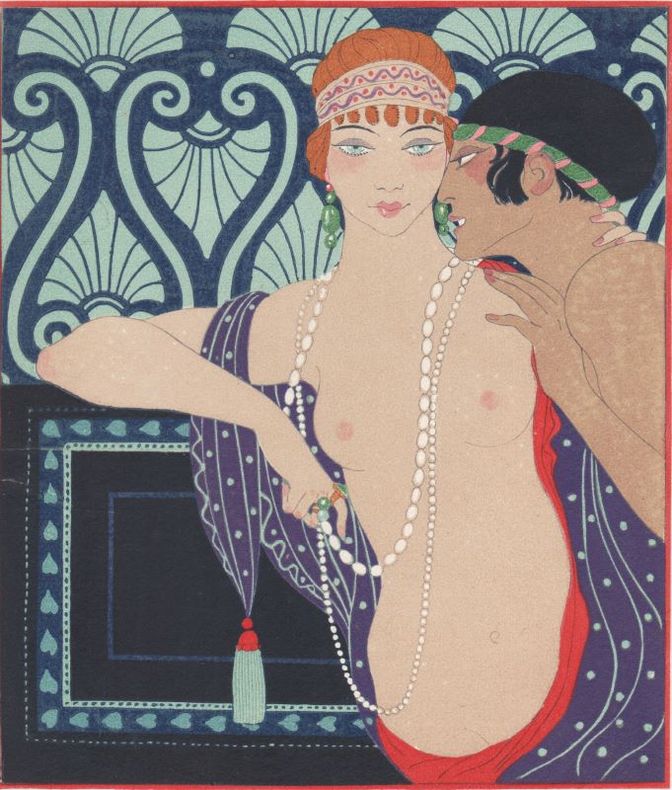
1922réf. 3930Collection Pierre Corrard, Paris 1922. Un volume in-4 en feuilles sous coffret décoré imitant la peau de serpent dorée, incrustée au premier plat, la médaille de Bilitis réalisée pour l'occasion par le sculpteur art-déco, Albert POMMIER. Première édition illustrée par GEORGE BARBIER et gravée sur bois par F.L. SCHMIED. 44 superbes illustrations couleurs dont la couverture, 13 en hors-texte et 8 à pleine page, 21 dans le texte ainsi que de nombreux ornements. L'un des 125 ex. numérotés sur Arches, seul tirage, signé par G.Barbier. Il est joint à cet exemplaire trois maquettes originales d'essai de la couverture avec ajouts et découpes par Barbier. - ENGLISH DESCRIPTION: P. Loüys. LES CHANSONS DE BILITIS. Taduit du grec. Illustrations de G. Barbier gravées sur bois par F.L. Schmied (1922) .Collection Pierre Corrard, Paris 1922. A quarto volume (33 x 26 cm) issued in loose sheets within a shellcase featuring a gold snakeskin-effect finish; the front cover is inset with the "Bilitis" medallion created for the occasion by Art Deco sculptor Albert Pommier. First edition, illustrated by George Barbier and featuring wood engravings by F.L. Schmied.- 44 superb illustrations, including the cover, 13 plates and 8 full-page images, 21 in-texte, as well as numerous decorative elements. One of 125 copies numbered on Arches paper, signed by G. Barbier. Included with this copy are three original cover mock-ups featuring additions and cut-outs by Barbier. A perfectly preserved copy housed in a highly elegant custom-made presentation box. Additional photographs available upon request.
1873réf. 10295Paris, Germer-Baillère, 1873. In-8 de [4]-III-657 pages, demi-maroquin vert, dos à 4 nerfs orné de fleurons, roulettes, filets, encadrements et titre dorés, plats de percaline décorés à froid, tranches dorées, gardes moirées blanches. Reliure à peine frottée, rousseurs.
1876réf. 71633Edition traduite sur la troisième édition anglaise par Ed. Barbier. Suivie d'une conférence sur les troglodytes de la Vézère Par M. P. Broca. Avec 256 figures intercalées dans le texte, 1 vol. in-8 reliure éditeur pleine percaline brune, toutes tranches dorées, Librairie Germer Baillière, Paris, 1876, VI-639 pp. Rappel du titre complet L'Homme Préhistorique. Étudié d'après les monuments retrouvés dans les différentes parties du monde suivi d'une description comparée des moeurs des sauvages modernes Par Sir John Lubbock M. P., Vice-président de la Société royale, Vice-président de l'Association britannique pour l'avancement des sciences, Président de l'Institut anthropologique.
réf. 1012Description du livre: 1 vol, 1945, br.+feuillets+emboitage, 17x26, 87 pages, Ed. ARCHAT POEMES ILLUSTRATIONS DANS LE TEXTE BON ETAT
2010réf. 30119567Florence : Giunti 2010 . Softcover . Fine /No Jacket . 26.5 x 22.5cms 157pp colour illusts. Exhibition catalogue. Peggy Guggenheim Collection. Giunti paperback
2010réf. 22580Milano: Mondadori Electa/Macro 2010. cloth hard cover in dust jacket. minute and few bits of wear to dj negligible impact. no other flaws or wear. clean. no writing or markings. no bumps or chips. strong binding.; parallel text italian-english.; 209pp. illustrated throughout in color a few in b/w. interview with gormley. essay. catalogue. reference section. drawings of the british artist known for sculpture. First Edition. Hard Cover. Near Fine Plus/Near Fine. 4to - over 9¾" - 12" tall. Exhibition Catalogue. Mondadori Electa/Macro Hardcover
réf. 35870023-nnew. unknown
réf. ria9788899534950_inpHardcover. New. New Book; Fast Shipping from UK; Not signed; Not First Edition; Tornabuoni art returns to the origins of sculptor Arnaldo Pomodoro's work 1926 Morciano di Romagna specifically to the years 1956-1965 a pivotal period of the artist's production. His creations initially derived from the goldsmith hardcover
2012réf. 30119574Venice : Marsilio 2012 . Softcover . Very Good /No Jacket . 29.0 x 24.0cms 385pp b/w & colour illusts. Exhibition catalogue. Capogrossi is recognized as belonging to an elite group of major Italian Post War Artists. Marsilio paperback
2019réf. 029413Marsilio Editori Venezia 2019. Book. Near Fine. Wrappers. 368 pages with 150 illustrations in color. Paperback. Texts in Italian. Minor wear to the paper corners and edges. Else the binding is tight the spine uncreased the interior clean and free of markings. Curated by Luca Massimo Barbero. Published on the occasion of the exhibition from the Palazzo Reale Milan 25 September 2019 - 19 January 2020. Marsilio Editori, Venezia Paperback
réf. Z1-K-019-02289Mondadori Electa. Used - Good. Ships from UK in 48 hours or less usually same day. Your purchase helps support Sri Lankan Children's Charity 'The Rainbow Centre'. Ex-library so some stamps and wear but in good overall condition. 100% money back guarantee. We are a world class secondhand bookstore based in Hertfordshire United Kingdom and specialize in high quality textbooks across an enormous variety of subjects. We aim to provide a vast range of textbooks rare and collectible books at a great price. Our donations to The Rainbow Centre have helped provide an education and a safe haven to hundreds of children who live in appalling conditions. We provide a 100% money back guarantee and are dedicated to providing our customers with the highest standards of service in the bookselling industry. Mondadori Electa unknown
réf. BN391490Liu Ruowang Paintings and Sculptures 2007-2017 Liu Ruowang Paintings and Sculptures 2007-2017 Luca Massimo Barbero unknown
2006réf. 30119512Venice : Peggy Guggenheim Collection 2006 . Hardcover . Fine /No Jacket . 27.5 x 23.0cms 224pp colour illusts. Exhibition catalogue. Peggy Guggenheim Collection hardcover
2018réf. 022342Fondazione Palazzo Strozzi Florence 2018. Book. Fine Condition. Wrappers. 299 pages. Paperback exhibition catalogue bound in stiff illustrated French fold covers. Text in Italian. Tight binding minimal shelfwear to the edges uncreased spine and clean unmarked interior. Explosively illustrated with artworks by a range of artists from Enrico Baj Alberto Burri Piero Manzoni Lucio Fontana and many more. Published on the occasion of the exhibition held from March 16-July 22 2018. Fondazione Palazzo Strozzi, Florence Paperback
2018réf. 022387Fondazione Palazzo Strozzi Florence 2018. Book. New. Wrappers. 299 pages. Paperback exhibition catalogue bound in stiff illustrated French fold covers. Still in shrink-wrap. Text in Italian. Illustrated wraps. zTight binding minimal shelfwear to the edges uncreased spine and clean unmarked interior. Explosively illustrated with artworks by a range of artists from Enrico Baj Alberto Burri Piero Manzoni Lucio Fontana and many more. Published on the occasion of the exhibition held from March 16-July 22 2018. Fondazione Palazzo Strozzi, Florence Paperback
réf. 57791, , 2018 Hardcover, 224 pages, 30 x 24 cm, iLLUSTRATIONS; 150, TEXT in Italian, English, Chinese. ISBN 9788836641031.
2015réf. 0222802015 Forma Edizioni Hardcover As New
1984réf. 173506New York: Time-Life Books 1984. First Edition Thus; First Printing. Hardcover. Near Fine in boards. Gilded text block edges.; 8vo 8" - 9" tall; 474 pages. Time-Life Books hardcover
1922réf. 8553Volume 2 of the Apres le Guerre collection assembled by Dorbin-Aire. Marbled endpapers. Lacking spine paper see image and general wear to edges and corners of boards; plates themselves all fine. Artists included are: Georges Barbier Benito Robert Bonfils Bernard Boutet de Monvel Pierre Brissaud Jean-Gabriel Domergue Drian Iacovleff Chas Laborde Llano-Florez Georges Lepape Charles Martin Andre Marty Pierre Mourgue Simeon Zenker Zyg-Brunner and others. Gazette's focus was on fashion lifestyle and beauty on a more elite level than that of Harper's Bazaar and Vogue. Part of their difference was publishing around 10 full page fashion illustrations per issue in the pochoir technique. This collection of 100 plates comes from the 1920-1922 issues. Plates are not trimmed c. 8 x 9.7 inches; 20.2 x 24.6 cm & are individually hinged. Dorbon-Aine hardcover
1982réf. SBBIH-R74SZZKJLINJImprint unknown 1982. paperback. Good. Our good condition books are generally good for reading but not for gifting or collecting. They could have imperfections such as creasing fanning inscriptions margin notes yellowing staining on edge or cover or pages bumps scuffs etc etc sometimes multiple of these. It's a wide category that encompasses anything that isn't almost-new down to anything that is slightly better than poor. We would NOT recommend gifting Good books - these should be considered reading copies. Our books are dispatched from a Yorkshire former cotton mill. We list via barcode/ISBN so please note that the images are stock images and may not be the exact copy you receive furthermore the details about edition and year might not be accurate as many publishers reuse the same ISBN for multiple editions and as we simply scan a barcode or enter an ISBN we do not check the validity of the edition data when listing. If you're looking for an exact edition please don't order at least not without checking with us first although we don't always have time to check. We aim to dispatch prompty the service used will depend on order value and book size. We can ship to most countries see our shipping policies. Payment is via Abe only. Imprint unknown paperback
réf. B9781019353974Hardback. New. hardcover