4205 resultados
1930ref. 63176New York: Funk and Wagnalls 1930. Second printing. Octavo. Cloth hardcover titled in gilt on spine and front cover; blue-green top-stain; xvi5215pp; illus. Tight square Near Fine copy lacking the dustwrapper. A guide to stylish domesticity for the new upwardly-mobile American woman a follow-up to her epochal Etiquette: the Blue Book of Social Usage 1927 and one of those tragic Depression-era publishing mis-fires - written at the apex of the Roaring Twenties published in the immediate aftermath of the Wall Street crash. A particularly bright and attractive copy sadly lacking the dustwrapper. Funk and Wagnalls unknown books
1871ref. 24106Philadelphia: Henry Carey Baird 1871. First American Edition. Publisher's black embossed cloth. Front free endpapers excised; cover spotted; some pages with pencil notes. 8vo xvi 13 - 173 1 - blank xii Masury's Fine Colors 24 Catalogue of Practical and Scientific Books pp. An extensive manual of coach decoration and color application. Henry Carey Baird hardcover books
ref. 006203Wien: Rikola Verlag. First Edition. Hardcover. Very Good. 12 by 8 cm. 253 14 pp. A number of brown and white plates of eighteenth century scenes. Condition: light soiling on paper pastedown of cover. Rikola Verlag hardcover books
1740ref. 2420Augsburg: Johann Jacob Haid & son 1740. Six tall narrow folio-sized engravings with etching platemarks 400 x 207 mm. sheets 435 x 277 mm. deckle edges unsigned but by Jacop Wangner after Watteau numbered 1-6 in the plate at lower right imprint at lower right I. Haid et filius excudit A. V. Augustae Vindelicorum. Upper edges archivally tipped to mats. Fine. A perfectly preserved suite of six large rococo engravings reproducing Watteau's paintings for a folding screen intended to be cut out by ladies for use in furniture decoration. Watteau's influence on 18th-century decorative arts throughout Europe by way of the many engravings after his work published by Gersaint has long been recognized but the use of the engravings as actual sheets to be cut up and applied to household objects has garnered little attention until recently. The vogue for decoupage probably first appeared in the late seventeenth century and by the 1720s the hobby of cutting out colored prints for application to various household objects and pieces of furniture was all the rage in France Germany and beyond. The process which remained a favorite pastime throughout the eighteenth century was known as la découpure in French as Ausschneidekunst in German and as lacca contrafatta or lacca povera in Italian although "the latter term appears to be a true misnomer considering the amount of minute work involved" Kisluk-Grosheide p. 83. It consisted of neatly cutting out hand-colored engraved or woodcut motifs or figures applying them to a textile or sometimes cardboard ground and varnishing them. These creations were applied to furniture as well as to "screens folding screens wall hangings ceilings the tops of coaches and sedan chairs" loc. cit. affording a passable imitation of Asian lacquer. The craze which created a goldmine for certain print publishers reached the point that bibliophiles and collectors were warned to keep a vigilant eye on their most precious books prints and paintings lest eager young ladies attack them with scissors. In 1728 six engravings after Watteau's paintings for a folding screen were commissioned by the art collector Jean de Julienne as part of a vast program of reproductions of Watteau's painted oeuvre. They were engraved by Louis Crépy fils and published by the Paris marchand-mercier art dealer and print publisher Edmé-François Gersaint. An announcement of their upcoming publication in the November 1727 Mercure de France explicitly described them and two other Crépy-Watteau engravings as "marvelously appropriate for decoupages with which ladies these days make such pretty furniture" Crépy grave actuellement six morceaux en hauteur . d'après un Paravant peint par Watau dont les compositions sont très-galantes. De pareils sujets peints sur des fonds blancs conviennent à merveille aux découpures dont les Dames font aujourd'hui de si jolis meubles Mercure de France 1 Novembre 1727 p. 2492 digitized on Gallica. Indeed the publisher himself highlighted this usage in his own note in a later issue of the Mercure cited by Glorieux p. 212: pointing out that all of the decorative motifs in the Watteau engravings were "most useful for painters fan-makers sculptors goldsmiths tapestry-weavers embroiderers etc." he added that "all these ornaments can be perfectly used in decoupage" tous ces ornements réussissent parfaitement en découpure. These and other rococo engravings were quickly taken up by German publishers especially in Augsburg Metken p. 102. This paravent folding screen suite was one of the first of the Watteau engravings to be copied in Germany. The present very close reverse copies of Crépy's six plates appeared in Augsburg only a few months after their publication in June 1728 in Paris: engraved by Jacob Wangner or Wagner ca. 1703-1781 they were published by the heirs of Jeremias Wolff in 1729. This set is an otherwise unrecorded reissue of the Wangner copperplates. A lavishly decoupage-decorated secretary in the collections of the Metropolitan Museum of Art includes cutouts that were almost certainly from these Augsburg plates as they are from "reverse copies of the prints by Crépy" Kisluk-Grosheide p. 88 noting other examples of Augsburg copies of Watteau prints used on the same secretary. Her assertion that "it has not been shown that these engravings were actually used for this purpose" p. 84 is only applicable to the French plates. Indeed other examples of lacca povera objects described in her article point to the German production of copies of French rococo prints as the main source for decoupage at this time on pieces produced throughout Europe including in Italy and in France itself. The general title appears at the foot of the first plate. Each engraving presents a central figure or scene set within a frame of delicate rococo arabesques and ornaments. Three show the Comédie italienne figures of Pierrot Harlequin and Colombine a woman playing the lute on a rug-bedecked stage a pair of allegorical figures flanking an awning above and at bottom the smiling visage of a Commedia dell'Arte character of the opposite sex. The remaining pastoral scenes of courtship or douceur de vie are set within naturalistic elements two with streams flowing over a dripping shell-shaped basin or ledge under which a ghostly face can be dimly discerned. Watteau's designs were based on earlier designs by Claude III Audran decorative painter for Louis XIV at Versailles and Fontainebleau to whom Watteau had apprenticed. "After joining forces with ornamentalist Claude III Audran about 1708 he Watteau began inserting figures in Comédie-Italienne costumes into Audran's trademark arabesques" Judy Sund "Watteau's Pierrots Why so Sad" The Art Bulletin vol. 98 no. 3 2016 p. 325 reproducing the Pierrot panel from the present series. OCLC locates a single copy of the Wolff issue at the Bibliothèque nationale de France reproduced in Gallica. In the present issue of which I locate no other copies the engraver's signatures were removed. On the Wolff issue cf. W. Augustyn "Augsburger Buchillustration im 18. Jahrhundert" in Augsburger Buchdruck und Verlagswesen von den Anfangen bis zur Gegegenwart 1997 p. 820 citing E. Isphording Gottfried Bernhard Göz 1708-1774 1997 pp. 35 ff.; Thieme Becker 35:150. On the Crépy engravings cf. Guilmard Maitres ornemanistes p.145; Dacier & Vauflart Jean de Julienne et les graveurs de Watteau au XVIII. siècle 159-163; E. de Goncourt Catalogue Raisonné de l'Oeuvre . d'Antoine Watteau 1875 p. 224 nos. 309-314; G. Glorieux À l'enseigne de Gersaint: Edme-François Gersaint marchand d'art sur le Pont Notre Dame Paris 2002 pp. 189-192; Mark Millard Collection: French Books no. 170.35 5 of the 6 plates. On the use of these engravings for decoupage see: D. O. Kisluk-Grosheide "'Cutting up Berchems Watteaus and Audrans': A Lacca Povera Secretary at The Metropolitan Museum of Art" Metropolitan Museum Journal 31 1996 pp. 81-97; and S. Metken Geschnittenes Papier Munich 1978 pp. 101-2 & 113. Johann Jacob Haid & son unknown books
1964ref. 013371London: Hutchinson 1964. 1st Edition. Hardcover. VG/Very Good. First title of Beckwith's first Hebridean omnibus autobiographically based on her life on the Isle of Skye. 14th impression 1964 after the first 1959. Clean text and endpapers in unclipped dustjacket moderately worn about edges. Hutchinson hardcover books
1964ref. 013372London: Hutchinson 1964. 1st Edition. Hardcover. Near Fine -/Very Good. Third title of Beckwith's first Hebridean omnibus autobiographically based on her life on the Isle of Skye. Uncommon first printing. Clean text and endpapers in unclipped dustjacket moderately worn about edges. Hutchinson hardcover books
ref. 5i6671Internationale Zeitschrift für Industrie und Handel aller Einrichtungsbranchen Köln 1958 664 Seiten Leinen mit goldgeprägtem Titel quart. - Dreisprachig: Deutsch / Englisch / Französisch unknown
1929ref. 039396Los Angeles: Jake Zeitlin 1929. 1st Edition 1st Printing. Soft cover. Fine/Near Fine. One Of 500 Copies Printed By The Mayers Company Published By Jake Zeitlin. Black Card Wrappers With Black Dj With Printed White Cover Label. This Example With The Bookplate Of Merle Armitage Signed By Him. In A Specially Made Folding Case Red Cloth Red Morocco Spine With Armitage's Name Title And Date In Gilt. Book Very Clean Spine Split At Ends. Jake Zeitlin paperback
1929ref. 028522Los Angeles: Jake Zeitlin 1929. 1st Edition 1st Printing. Soft cover. Fine/Near Fine. One Of 500 Copies Printed By The Mayers Company. Black Card Wrappers With Black Dj With Printed White Cover Label. This Example Inscribed By Armitage For His Friend And Illustrator Of Many Of Armitage's Books Pasquale Giovanni Napolitano About Whom Armitage Later Wrote A 1935 Book "Badly Written Its Meaning Still Holds. Inscribed To Napolitano / Merle Armitage". Book Is Fine Dj Clean But With A Few Minor Edge Tears And Nicks. A Controversial Address Rare When Signed Or Inscribed. Jake Zeitlin paperback
1990ref. 173961Italy: c. 1990. An attractive Italian wooden ribbon pattern wall decoration. Wood finished in gold leaf; 13 x 41 cm Very good condition. unknown
ref. SONG0810966905Brand: Harry N Abrams 2000-01-01. 1st English-language Ed. hardcover. Used: Good. 9.75x1.25x12.00. Buy with confidence. Excellent Customer Service & Return policy. Brand: Harry N Abrams hardcover
1930ref. 63176New York: Funk and Wagnalls 1930. Second printing. Octavo. Cloth hardcover titled in gilt on spine and front cover; blue-green top-stain; xvi5215pp; illus. Tight square Near Fine copy lacking the dustwrapper. A guide to stylish domesticity for the new upwardly-mobile American woman a follow-up to her epochal Etiquette: the Blue Book of Social Usage 1927 and one of those tragic Depression-era publishing mis-fires - written at the apex of the Roaring Twenties published in the immediate aftermath of the Wall Street crash. A particularly bright and attractive copy sadly lacking the dustwrapper. Funk and Wagnalls unknown
ref. 500476469Sans date. Très bon état unknown
ref. BN604865Paredes Geniales: Tecnicas de Dise~no y Decoracion Paperback Paredes Geniales: Tecnicas de Dise~no y Decoracion Paperback Paredes Geniales: Tecnicas de Dise~no y Decoracion Paperback paperback
ref. DADAX0313223408New unknown
ref. DADAX0517577011New unknown
ref. DADAX1436935830New unknown
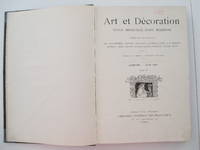
1899ref. 11386AB1899. 12 volumes. Paris Levy 1899 - 1913. 29 : 215 cm. Richly illustated with many partly coloured plates. Original half-cloth. Important French arts periodical on modern art and architecture with many partly half tone plates on architecture decorative arts painting graphic design sculpture furniture textiles gardens etc. The present volumes covering mainly the art nouveau period. The illustrationas are by Walter Crane Eugene Grasset Alphonse Mucha William Nicholson Auguste Rodin Theo van Rysselkberghe Carlos Schwabe M.P. Verneuil. Present are the following volumes: V. Janvier-Juin 1899 - VII. Janvier-Juin 1900 - VIII. Juillet-Décembre 1900 - IX. Janvier-Juin 1901 XIII. Janvier-Juin 1903 - XVII. Janvier-Juin 1905 missing page 59/60 and 173-176 - XX. Juillet-Decembre 1906 missing pages 141-172 - XXV. Janvier-Juin 1909 - XXVI. Juillet-Décembre 1909 missing page 1/2 and 37-69 - XXVIII. Juillet-Décembre 1910 missing page 115-120 and 143/144 - XXXII. Juillet-Décembre 1912 missing page 17-20 - XXXIII. Janvier-Juin 1913 missing page 177/178. - Also some pages and plates are missing it is still an extensive overview of the arts movements in Europe and overseas containing articles and illustrations of the most important artists of that time. - Binding a bit rubbed some pages in two volumes with menor tears otherwise a good copy. hardcover
1933ref. 054125John Henry Nash 1928 1933 1933. 1st Edition . Hardcover. Fine. 238 155 Pp. Matching Full Vellum 5 Bands Very Thick Boards Top Edge Gilt Gilt Rules Very Heavy Paper Each #25 Of 1000 Copies. George Hearst Book With Compliments Slip From William Randolph Hearst; Phoebe Apperson Hearst Slip With Errata Slip. Both In Custom Slipcase With Two Compartments. Very Near Fine No Marks No Warping To Covers. Per Wikipedia George Hearst September 3 1820 - February 28 1891 Was An American Businessman Miner And Politician. After Growing Up On A Small Farm In Missouri He Founded Many Mining Operations And Is Particularly Known For Developing And Expanding The Homestake Mine In The Late 1870S In The Black Hills Of South Dakota. In 1879 He Listed It On The New York Stock Exchange And Went On To Other Pursuits. The Mine Operated Continuously Producing Gold Until 2001. His Company Grew To Be The Largest Private Mining Firm In The United States And Had Huge Investments In Mexico And Peru Mines. Hearst Acquired The Reputation Of Being The Most Expert Prospector And Judge Of Mining Property On The Pacific Coast. He Contributed To The Development Of The Modern Processes Of Quartz And OtherVague Kinds Of Mining. George Hearst Acquired The San Francisco Examiner Newspaper As A Sign Of Loyalty To His Friends By Accepting It As Payment For A Gambling Debt Owed To Him. He Primarily Used The Examiner To Promote The Interests Of The Democratic Party And To Laud The Party's Initiatives Especially When They Were Under Public Attack. After Settling In San Francisco In The Early 1860S Hearst Became A Politician First Representing San Francisco In The State Legislature For One Term. He Also Maintained Mining Interests Through His Company. Hearst Was Appointed As A United States Senator In 1886 To Fill A Vacancy And Was Elected As A Democrat Later That Year On His Own Account. He Served In The Senate From 1887 To His Death In 1891. His Only Child From His Late Marriage At Age 40 Was His Son William Randolph Hearst Who Became Internationally Known As A Newspaperman And Publisher And Was A Primary Inspiration For Orson Welles' 1941 Film Citizen Kane. As Quoted In The Book On His Vote In The Senate "If People Can't Afford To Buy Butter Let Them Buy Oleomargarine". His Lifelong Focus On The Physical Basis Of Money Silver And Gold Rather Than The Manufacture Of Useful Items And His Lifelong Concern With Politicking Made Him One Of The Most Successful Admired And Richest Americans And Financed The Career Of His Son William Randolph Hearst Producer Of The Worthless Imperialist And Sometimes Successfully War-Mongering New York Journalism Of His Son Who Is Also Not Known To Have Ever Produced Anything Original And Of Value. John Henry Nash 1928, 1933 hardcover
ref. 108688Paris Calavas 190. Tavola cromolitografica cm 265 x 36 unknown
ref. 108672Paris Calavas 19. Tavola cromolitografica cm 265 x 36. Immagine a due colonne unknown
ref. 108695Paris Calavas 190. Tavola cromolitografica cm 265 x 36 unknown
ref. 108683Paris Calavas 190. Tavola cromolitografica cm 265 x 36 unknown
ref. 108715Paris Calavas 190. Tavola cromolitografica cm 265 x 36 unknown
ref. 108697Paris Calavas 190. Tavola cromolitografica cm 265 x 36 unknown