3 892 résultats
1838réf. 53499Paris, Hangard-Maugé 1838 4 tomes en 3 volumes. In-4 28,5 x 22 cm. Reliures demi-chagrin vert foncé, dos à nerfs ornés de filets dorés, caissons ornés de 3 cadres dorés, guirlande en contreplats, tranches dorées. 4- 344 - 280 pp. - 15 pp.- 158 & 164 planches en en chromolithographie. Quelques usures et frottements. Quelques planches déliées et effrangées. Accroc d’hum. au second plat du second volume de planche, affectant les 6 dernières planches et les 2 ff. de table.
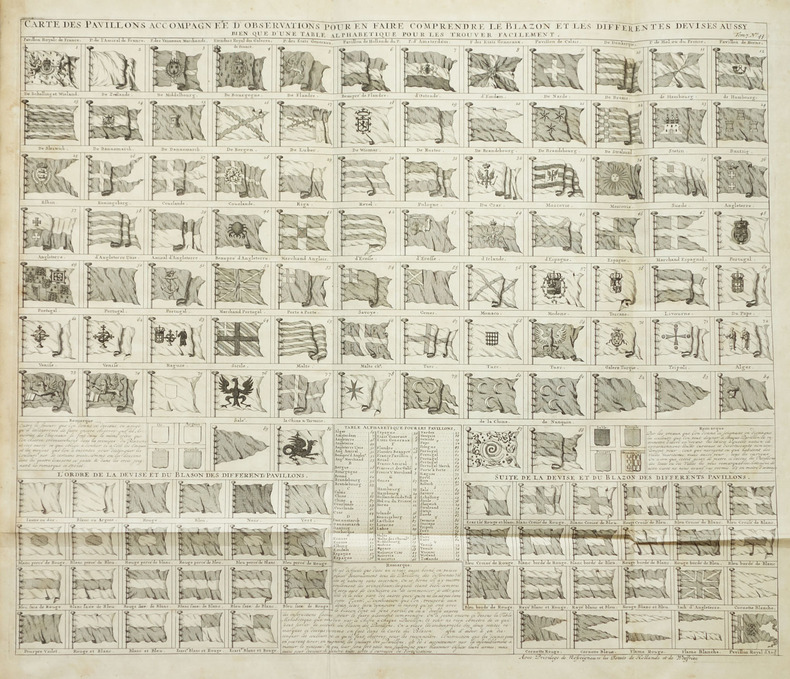
1720réf. LBW-2016Amsterdam, circa 1720. 490 x 585 mm.
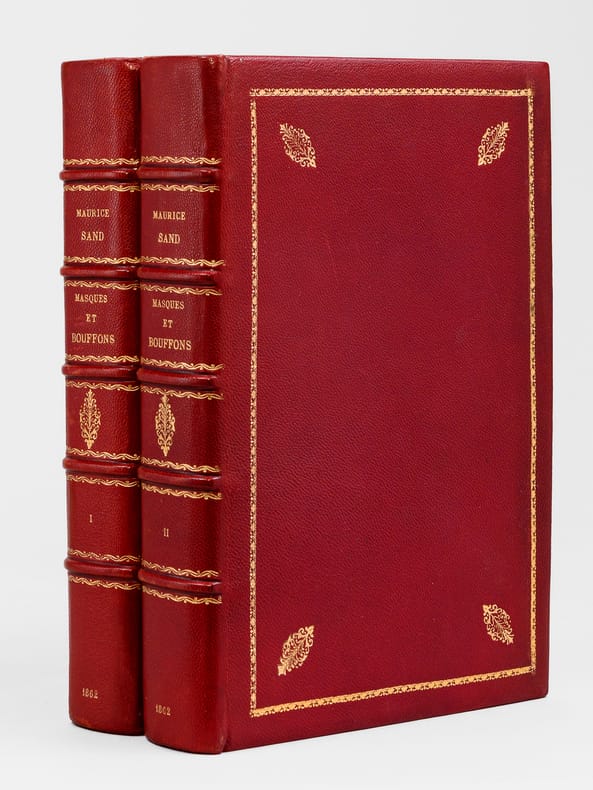
1862réf. 71056Texte et dessins par Maurice Sand, Gravures par A. Manceau, Préface par George Sand, 2 vol. grand in-8 reliure postérieure plein chagrin bordeaux, dos à 5 nerfs orné, tête dorée, filetd dorés d'encadrement en plats et fers dorés en écoinçons, couvertures conservées, A. Lévy Fils, Libraire-Éditeur, Paris, 1862, VIII-356 pp. ; 2 ff., 384 pp. avec 50 planches en couleurs hors texte
1788Manuscrit d'époque, 40 ff. format in-4 br., 1788 : Inventaire des Meubles & Effets, Titres et Papiers dépendant de la succession de dame Marie-Anne Jaunay, Veuve du sieur René-Martin Chesneau, Marchand orfèvre à Angers, fait à la requête de ses enfants commencé le 18 9bre et fini le 3 Xbre 1788 ; La maison est située 1174 rue Baudrière à Angers ; le fils et héritier Louis-Julien Chesneau étant alors "actuellement en Amérique pour un voyage", les scellés ont été apposés sur les meubles, effets, titres et papiers, dont "beaucoup de marchandises d'orfèvrerie et bijoux qu'il est intéressant de vendre actuellement pendant le tems de la foire qui se tiens en cette" d'où l'urgence d'un inventaire complet. L'inventaire est réalisé notamment en présence de Sieur Philippe Didier, "marchand orfèvre en cette ville, garde en charge de la communauté des orfèvres de cette dite ville, y demeurant, Ruë Bourgeoise, paroisse St Maurice", afin d'établir l'estimation des marchandises. Suivent plusieurs pages d'inventaire décrivant l'orfèvrerie et sa valeur, meubles après meubles, tiroirs apès tiroirs. On y trouve cuillères, tasses, gobelets (par exemple : "vingt un goblets unis, cinq autres ciselés, pesant ensemble neuf marcs, cinq onces, quatre gros, estimés à raison de cinquante six livres quatre sols le marc y compris le controlle cinq cents quarante quatre livres huit sols neuf deniers"), tabatières, "porte-huilliers à plateaux", caffetière, custode, cure-oreille, "sallières", bougeoirs, ciboires, encensoir, burettes, vieilles paires de boucles, flambeaux avec leurs bobèches, moutardier, boucles à chappes d'argent, vielles pierreries, argenterie à refondre, boucles de batellier à chappes d'argent, boutons de manche et de col, boucles de ceintures, crochets de corps, boucles d'homme ou de femme,, alliances, paires de "mirza d'or", épingles de Batellier, 245 filets dor (pour plus de 1900 livres), "pieds d'étaux d'or", croix à relique d'or, croix à la jeannette, bagues, croix d'or massives, lingots d'argent (44 marcs 4 once quatre gros d'argent en lingot, de 11 deniers dix grains, estimés à raison de 52 livres le marc, 2317 livres et 5 sols), "Brulis blanc", "Brulis doré", "un Boëtier dans lequel il y a huit rosettes et trois Bagues a sept Pierres etc... Le montant total des marchandises dont la vente est autorisée (dans le respect des règles successorales) s'élève à 26766 livres, 10 sols set 11 deniers. A la suite on peut lire l'inventaire complet de la maison : chandeliers, rôtissoir, et "poëllons", bahuts, chaudron, mobilier de toilette, "lit à l'ange", les armoires et leur contenu (par exemple "une armoire de Bois d'acajou, fermant à deux-Battants, garnie de ses serrures et clef ; sur l'ouverture de laquelle est apposé le second scellé [... ]" contenant "une Robbe et un juppon de satin brodé, une autre robbe et un juppon du ras de St Maur, une autre robbe et un juppon de siamoise, une autre robbe et un juppon de taffetas rayé, une autre robbe et un juppon couleur Gorge de pigeon aussi rayé, une autre robbe et un juppon de Taffetas couleur serin"). On note l'intervention de la domestique qui expose que lui appartient le mobilier de sa chambre. L'estimation de tous les meubles meublants et effets mobiliers présents dans la maison et la boutique sont estimés à 4699 livres et 14 sols. Suit l'estimation de biens dépendants de la même succession, meubles garnissant les biens situés au lieu de la Rive, paroisse de Pruniers (Maison, grenier, bûcher, cour, grange au pressoir, cellier, boulangerie, etc..) pour un total de 1268 livres et 19 sols, puis l'ensemble des biens, créances et quittances recouvrées par la suite, pour un montant de 2872 livres et 10 sols, également 1216 livres de quittances provenant de débiteurs insolvables, 1045 livres de créances à recouvrer, 545 livres de "dettes actives douteuses", 4216 livres de passif. L'inventaire se conclut sur un récapitulatif global, le montant de la succession mobilière s'élevant à 34931 livres, 16 sols et 1 denier Remarquable inventaire réalisé à Angers en 1788, chez la veuve d'un orfèvre ! Ce très beau document historique détaille et valorise l'intégralité du stock d'orfèvrerie, mais également tous les biens meubles de ladite veuve (mouill. angulaire et un très petit grignotage marginal, bon état par ailleurs). Français
1788réf. 59873Manuscrit d'époque, 40 ff. format in-4 br., 1788 : Inventaire des Meubles & Effets, Titres et Papiers dépendant de la succession de dame Marie-Anne Jaunay, Veuve du sieur René-Martin Chesneau, Marchand orfèvre à Angers, fait à la requête de ses enfants commencé le 18 9bre et fini le 3 Xbre 1788 ; La maison est située 1174 rue Baudrière à Angers ; le fils et héritier Louis-Julien Chesneau étant alors "actuellement en Amérique pour un voyage", les scellés ont été apposés sur les meubles, effets, titres et papiers, dont "beaucoup de marchandises d'orfèvrerie et bijoux qu'il est intéressant de vendre actuellement pendant le tems de la foire qui se tiens en cette" d'où l'urgence d'un inventaire complet. L'inventaire est réalisé notamment en présence de Sieur Philippe Didier, "marchand orfèvre en cette ville, garde en charge de la communauté des orfèvres de cette dite ville, y demeurant, Ruë Bourgeoise, paroisse St Maurice", afin d'établir l'estimation des marchandises. Suivent plusieurs pages d'inventaire décrivant l'orfèvrerie et sa valeur, meubles après meubles, tiroirs apès tiroirs. On y trouve cuillères, tasses, gobelets (par exemple : "vingt un goblets unis, cinq autres ciselés, pesant ensemble neuf marcs, cinq onces, quatre gros, estimés à raison de cinquante six livres quatre sols le marc y compris le controlle cinq cents quarante quatre livres huit sols neuf deniers"), tabatières, "porte-huilliers à plateaux", caffetière, custode, cure-oreille, "sallières", bougeoirs, ciboires, encensoir, burettes, vieilles paires de boucles, flambeaux avec leurs bobèches, moutardier, boucles à chappes d'argent, vielles pierreries, argenterie à refondre, boucles de batellier à chappes d'argent, boutons de manche et de col, boucles de ceintures, crochets de corps, boucles d'homme ou de femme,, alliances, paires de "mirza d'or", épingles de Batellier, 245 filets dor (pour plus de 1900 livres), "pieds d'étaux d'or", croix à relique d'or, croix à la jeannette, bagues, croix d'or massives, lingots d'argent (44 marcs 4 once quatre gros d'argent en lingot, de 11 deniers dix grains, estimés à raison de 52 livres le marc, 2317 livres et 5 sols), "Brulis blanc", "Brulis doré", "un Boëtier dans lequel il y a huit rosettes et trois Bagues a sept Pierres etc... Le montant total des marchandises dont la vente est autorisée (dans le respect des règles successorales) s'élève à 26766 livres, 10 sols set 11 deniers. A la suite on peut lire l'inventaire complet de la maison : chandeliers, rôtissoir, et "poëllons", bahuts, chaudron, mobilier de toilette, "lit à l'ange", les armoires et leur contenu (par exemple "une armoire de Bois d'acajou, fermant à deux-Battants, garnie de ses serrures et clef ; sur l'ouverture de laquelle est apposé le second scellé [... ]" contenant "une Robbe et un juppon de satin brodé, une autre robbe et un juppon du ras de St Maur, une autre robbe et un juppon de siamoise, une autre robbe et un juppon de taffetas rayé, une autre robbe et un juppon couleur Gorge de pigeon aussi rayé, une autre robbe et un juppon de Taffetas couleur serin"). On note l'intervention de la domestique qui expose que lui appartient le mobilier de sa chambre. L'estimation de tous les meubles meublants et effets mobiliers présents dans la maison et la boutique sont estimés à 4699 livres et 14 sols.Suit l'estimation de biens dépendants de la même succession, meubles garnissant les biens situés au lieu de la Rive, paroisse de Pruniers (Maison, grenier, bûcher, cour, grange au pressoir, cellier, boulangerie, etc..) pour un total de 1268 livres et 19 sols, puis l'ensemble des biens, créances et quittances recouvrées par la suite, pour un montant de 2872 livres et 10 sols, également 1216 livres de quittances provenant de débiteurs insolvables, 1045 livres de créances à recouvrer, 545 livres de "dettes actives douteuses", 4216 livres de passif.L'inventaire se conclut sur un récapitulatif global, le montant de la succession mobilière s'élevant à 34931 livres, 16 sols et 1 denier
1875réf. PHO-2295Liverpool et Londres, Henry Sotheran & Co, 1875, 2 volumes folio (40,5x30,5cm), 5ff.- LXXI pp., 61 pp., 12 pl. ; II : 51 pl. avec feuillets explicatifs, suivies de 4 pl. de marques et monogrammes, ouvrage entièrement montés sur onglets. Relié demi chagrin et coins, dos à nerfs avec titre, auteur et tomaison, tête dorée, très légers frottements, très légères rousseurs. Bel exemplaire
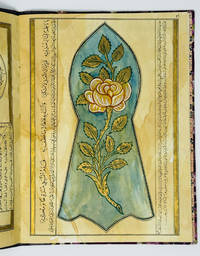
réf. FRE11623 pp.: genealogical diagrams ornamental headpiece devotional diagrams and a full-page representation of the Prophet’s sandal. 25.1 × 21.8 cm 9⅞ × 8â… in. Mid-twentieth-century cloth binding with patterned endpapers. Pale water stains throughout the text block; scattered marginal repairs and small losses occasionally affecting the decorative frames. The edition came out in monochrome variant our version includes the hand-colored parts. An extensively hand-decorated Ottoman lithograph edition combining calligraphic genealogies with gold ornament and a striking floral representation of the Prophet’s sandal. The lithographed text and diagrams are embellished by hand in gold green red black blue and white. Broad gilt borders frame the pages while gold highlights the trunks of genealogical trees and selected calligraphic elements. The opening headpiece combines red flowers and green foliage on a gold ground blue ornamental compartments and a pointed central finial; blue and red floral sprays extend above it into the upper margin. The most elaborate illustration occupies page 21: the outline of the Prophet’s sandal encloses a large flowering rose against a pale blue ground. Its branching stem and serrated leaves are heightened in gold with green and black outlines and veins; red contours and opaque white strokes define the overlapping petals around a gold centre. Combining two devotional emblems—the sandal and the rose—the composition evokes the Prophet through objects and floral imagery. The genealogies themselves form a sequence of calligraphic designs. Names and explanatory passages spread from central trunks into branching leaf-like clusters turning family relationships into visual compositions. Other pages arrange devotional texts within circles intersecting lines and geometric compartments. The contents extend beyond ancestry to the Prophet’s relatives wives and descendants attendants and scribes weapons utensils and mounts together with a chronology and protective prayers. A matching lithographed edition is described in Hasan Fahri Tan’s study of the text and recorded at Istanbul’s Atatürk Library shelfmark B-509. Reference: Hasan Fahri Tan “Süleyman Nahîfî’nin Ravzatü’s-Safâ fî Sîreti’l-Mustafâ Adlı Eserinin İncelenmesi” Din ve Bilim 5/2 2022 pp. 342–360 especially pp. 347 and 359. hardcover
1867réf. 115196London, Day and Son, Limited 1867 In-folio 34,5 x 23 cm. Reliure de l’époque demi-chagrin vert-émeraude à coins, dos à nerfs, 15 pp. de texte, description des planches, 100 planches en chromolithographie à pleine hors texte dont le frontispice [manque planches 80 & 87]. infimes rousseurs marginales, planches d’une grande fraîcheur. Ouvrage d’une certaine rareté.
réf. 175265Paris, Au Bureau de l'Administration, 1842-1847 5 vol. in-4, demi-chagrin violine, dos à nerfs orné (rel. de l'époque). Qqs rousseurs, petits frottements aux coiffes. Ex-libris Commissaire de l'Air Stiot. Bon exemplaire.
réf. 23510Paris, chez l'auteur, 1835. In-4 oblong, 56 pl. (dos refait, petits frottements, petites rousseurs notamment en début et fin de volume, petite déchirure marginale sans atteinte une gravure).
1899réf. 11386AB1899. 12 volumes. Paris Levy 1899 - 1913. 29 : 215 cm. Richly illustated with many partly coloured plates. Original half-cloth. Important French arts periodical on modern art and architecture with many partly half tone plates on architecture decorative arts painting graphic design sculpture furniture textiles gardens etc. The present volumes covering mainly the art nouveau period. The illustrationas are by Walter Crane Eugene Grasset Alphonse Mucha William Nicholson Auguste Rodin Theo van Rysselkberghe Carlos Schwabe M.P. Verneuil. Present are the following volumes: V. Janvier-Juin 1899 - VII. Janvier-Juin 1900 - VIII. Juillet-Décembre 1900 - IX. Janvier-Juin 1901 XIII. Janvier-Juin 1903 - XVII. Janvier-Juin 1905 missing page 59/60 and 173-176 - XX. Juillet-Decembre 1906 missing pages 141-172 - XXV. Janvier-Juin 1909 - XXVI. Juillet-Décembre 1909 missing page 1/2 and 37-69 - XXVIII. Juillet-Décembre 1910 missing page 115-120 and 143/144 - XXXII. Juillet-Décembre 1912 missing page 17-20 - XXXIII. Janvier-Juin 1913 missing page 177/178. - Also some pages and plates are missing it is still an extensive overview of the arts movements in Europe and overseas containing articles and illustrations of the most important artists of that time. - Binding a bit rubbed some pages in two volumes with menor tears otherwise a good copy. hardcover
1783réf. 663836 vol. in-4 reliure de l'époque plein veau marbré, dos à 5 nerfs doré orné, filet doré en coupes, toutes tranches marbrées, Chez Panckoucke, A Paris, chez Plomteux, A Liège, 1783-1787, Tome I : 1783, 3 ff., 158 planches simples et 69 doubles (total équivalent à 296 planches), de Aiguillier & Aiguillier-Bonnetier à Cuivre coulé en table & trifilerie ; Tome II : 1783, 4 ff., 196 planches simples et 53 doubles (total équivalent à 302 planches), de Diamantaire Lapidaire Metteur en Oeuvre à Horlogerie ; Tome III : 1784, 4 ff., 232 planches simples et 34 doubles (total équivalent à 300 planches), de Horlogerie à Monnoyage ; Tome IV : 1785, 2 ff., 210 planches simples et 47 doubles (total équivalent à 304 planches), de Mosaïque à Tourneurs et Tours ; Tome V : 1787, 2 ff., 160 planches simples, 91 doubles, 13 triples, une quadruple, avec une planche du grand Vaisseau de 84 Canons (total équivalent à 385 planches), de Tourneurs et Tours à Marine ; Tome VI : 1786, 2 ff., 202 planches simples et 88 doubles (en fait 198 simples et 92 doubles, les planches des métiers à draps sont 4 planches doubles et non simples, comme annoncé, total équivalent à 378 planches) de Bonneterie à Toilerie, Velours de Coton
1856réf. 115211London, Day and Son, Limited, Lithographers to the Queen 1856 4 volumes. In-folio 34 x 23 cm. Reliures demi-chagrin vert-émeraude à coins, dos à nerfs encadrés de petits fers dorés, 157 pp. en pagination continue, figures dans le texte, 100 planches en chromolithographie à pleine page hors texte, bibliographies.
1910réf. 207381910 Huile sur toile signée en bas à droite, (1900), 78 x 78 cm.
1740réf. 2420Augsburg: Johann Jacob Haid & son 1740. Six tall narrow folio-sized engravings with etching platemarks 400 x 207 mm. sheets 435 x 277 mm. deckle edges unsigned but by Jacop Wangner after Watteau numbered 1-6 in the plate at lower right imprint at lower right I. Haid et filius excudit A. V. Augustae Vindelicorum. Upper edges archivally tipped to mats. Fine. A perfectly preserved suite of six large rococo engravings reproducing Watteau's paintings for a folding screen intended to be cut out by ladies for use in furniture decoration. Watteau's influence on 18th-century decorative arts throughout Europe by way of the many engravings after his work published by Gersaint has long been recognized but the use of the engravings as actual sheets to be cut up and applied to household objects has garnered little attention until recently. The vogue for decoupage probably first appeared in the late seventeenth century and by the 1720s the hobby of cutting out colored prints for application to various household objects and pieces of furniture was all the rage in France Germany and beyond. The process which remained a favorite pastime throughout the eighteenth century was known as la découpure in French as Ausschneidekunst in German and as lacca contrafatta or lacca povera in Italian although "the latter term appears to be a true misnomer considering the amount of minute work involved" Kisluk-Grosheide p. 83. It consisted of neatly cutting out hand-colored engraved or woodcut motifs or figures applying them to a textile or sometimes cardboard ground and varnishing them. These creations were applied to furniture as well as to "screens folding screens wall hangings ceilings the tops of coaches and sedan chairs" loc. cit. affording a passable imitation of Asian lacquer. The craze which created a goldmine for certain print publishers reached the point that bibliophiles and collectors were warned to keep a vigilant eye on their most precious books prints and paintings lest eager young ladies attack them with scissors. In 1728 six engravings after Watteau's paintings for a folding screen were commissioned by the art collector Jean de Julienne as part of a vast program of reproductions of Watteau's painted oeuvre. They were engraved by Louis Crépy fils and published by the Paris marchand-mercier art dealer and print publisher Edmé-François Gersaint. An announcement of their upcoming publication in the November 1727 Mercure de France explicitly described them and two other Crépy-Watteau engravings as "marvelously appropriate for decoupages with which ladies these days make such pretty furniture" Crépy grave actuellement six morceaux en hauteur . d'après un Paravant peint par Watau dont les compositions sont très-galantes. De pareils sujets peints sur des fonds blancs conviennent à merveille aux découpures dont les Dames font aujourd'hui de si jolis meubles Mercure de France 1 Novembre 1727 p. 2492 digitized on Gallica. Indeed the publisher himself highlighted this usage in his own note in a later issue of the Mercure cited by Glorieux p. 212: pointing out that all of the decorative motifs in the Watteau engravings were "most useful for painters fan-makers sculptors goldsmiths tapestry-weavers embroiderers etc." he added that "all these ornaments can be perfectly used in decoupage" tous ces ornements réussissent parfaitement en découpure. These and other rococo engravings were quickly taken up by German publishers especially in Augsburg Metken p. 102. This paravent folding screen suite was one of the first of the Watteau engravings to be copied in Germany. The present very close reverse copies of Crépy's six plates appeared in Augsburg only a few months after their publication in June 1728 in Paris: engraved by Jacob Wangner or Wagner ca. 1703-1781 they were published by the heirs of Jeremias Wolff in 1729. This set is an otherwise unrecorded reissue of the Wangner copperplates. A lavishly decoupage-decorated secretary in the collections of the Metropolitan Museum of Art includes cutouts that were almost certainly from these Augsburg plates as they are from "reverse copies of the prints by Crépy" Kisluk-Grosheide p. 88 noting other examples of Augsburg copies of Watteau prints used on the same secretary. Her assertion that "it has not been shown that these engravings were actually used for this purpose" p. 84 is only applicable to the French plates. Indeed other examples of lacca povera objects described in her article point to the German production of copies of French rococo prints as the main source for decoupage at this time on pieces produced throughout Europe including in Italy and in France itself. The general title appears at the foot of the first plate. Each engraving presents a central figure or scene set within a frame of delicate rococo arabesques and ornaments. Three show the Comédie italienne figures of Pierrot Harlequin and Colombine a woman playing the lute on a rug-bedecked stage a pair of allegorical figures flanking an awning above and at bottom the smiling visage of a Commedia dell'Arte character of the opposite sex. The remaining pastoral scenes of courtship or douceur de vie are set within naturalistic elements two with streams flowing over a dripping shell-shaped basin or ledge under which a ghostly face can be dimly discerned. Watteau's designs were based on earlier designs by Claude III Audran decorative painter for Louis XIV at Versailles and Fontainebleau to whom Watteau had apprenticed. "After joining forces with ornamentalist Claude III Audran about 1708 he Watteau began inserting figures in Comédie-Italienne costumes into Audran's trademark arabesques" Judy Sund "Watteau's Pierrots Why so Sad" The Art Bulletin vol. 98 no. 3 2016 p. 325 reproducing the Pierrot panel from the present series. OCLC locates a single copy of the Wolff issue at the Bibliothèque nationale de France reproduced in Gallica. In the present issue of which I locate no other copies the engraver's signatures were removed. On the Wolff issue cf. W. Augustyn "Augsburger Buchillustration im 18. Jahrhundert" in Augsburger Buchdruck und Verlagswesen von den Anfangen bis zur Gegegenwart 1997 p. 820 citing E. Isphording Gottfried Bernhard Göz 1708-1774 1997 pp. 35 ff.; Thieme Becker 35:150. On the Crépy engravings cf. Guilmard Maitres ornemanistes p.145; Dacier & Vauflart Jean de Julienne et les graveurs de Watteau au XVIII. siècle 159-163; E. de Goncourt Catalogue Raisonné de l'Oeuvre . d'Antoine Watteau 1875 p. 224 nos. 309-314; G. Glorieux À l'enseigne de Gersaint: Edme-François Gersaint marchand d'art sur le Pont Notre Dame Paris 2002 pp. 189-192; Mark Millard Collection: French Books no. 170.35 5 of the 6 plates. On the use of these engravings for decoupage see: D. O. Kisluk-Grosheide "'Cutting up Berchems Watteaus and Audrans': A Lacca Povera Secretary at The Metropolitan Museum of Art" Metropolitan Museum Journal 31 1996 pp. 81-97; and S. Metken Geschnittenes Papier Munich 1978 pp. 101-2 & 113. Johann Jacob Haid & son unknown
1740réf. 2420Augsburg: Johann Jacob Haid & son 1740. Six tall narrow folio-sized engravings with etching platemarks 400 x 207 mm. sheets 435 x 277 mm. deckle edges unsigned but by Jacop Wangner after Watteau numbered 1-6 in the plate at lower right imprint at lower right I. Haid et filius excudit A. V. Augustae Vindelicorum. Upper edges archivally tipped to mats. Fine. A perfectly preserved suite of six large rococo engravings reproducing Watteau's paintings for a folding screen intended to be cut out by ladies for use in furniture decoration. Watteau's influence on 18th-century decorative arts throughout Europe by way of the many engravings after his work published by Gersaint has long been recognized but the use of the engravings as actual sheets to be cut up and applied to household objects has garnered little attention until recently. The vogue for decoupage probably first appeared in the late seventeenth century and by the 1720s the hobby of cutting out colored prints for application to various household objects and pieces of furniture was all the rage in France Germany and beyond. The process which remained a favorite pastime throughout the eighteenth century was known as la découpure in French as Ausschneidekunst in German and as lacca contrafatta or lacca povera in Italian although "the latter term appears to be a true misnomer considering the amount of minute work involved" Kisluk-Grosheide p. 83. It consisted of neatly cutting out hand-colored engraved or woodcut motifs or figures applying them to a textile or sometimes cardboard ground and varnishing them. These creations were applied to furniture as well as to "screens folding screens wall hangings ceilings the tops of coaches and sedan chairs" loc. cit. affording a passable imitation of Asian lacquer. The craze which created a goldmine for certain print publishers reached the point that bibliophiles and collectors were warned to keep a vigilant eye on their most precious books prints and paintings lest eager young ladies attack them with scissors. In 1728 six engravings after Watteau's paintings for a folding screen were commissioned by the art collector Jean de Julienne as part of a vast program of reproductions of Watteau's painted oeuvre. They were engraved by Louis Crépy fils and published by the Paris marchand-mercier art dealer and print publisher Edmé-François Gersaint. An announcement of their upcoming publication in the November 1727 Mercure de France explicitly described them and two other Crépy-Watteau engravings as "marvelously appropriate for decoupages with which ladies these days make such pretty furniture" Crépy grave actuellement six morceaux en hauteur . d'après un Paravant peint par Watau dont les compositions sont très-galantes. De pareils sujets peints sur des fonds blancs conviennent à merveille aux découpures dont les Dames font aujourd'hui de si jolis meubles Mercure de France 1 Novembre 1727 p. 2492 digitized on Gallica. Indeed the publisher himself highlighted this usage in his own note in a later issue of the Mercure cited by Glorieux p. 212: pointing out that all of the decorative motifs in the Watteau engravings were "most useful for painters fan-makers sculptors goldsmiths tapestry-weavers embroiderers etc." he added that "all these ornaments can be perfectly used in decoupage" tous ces ornements réussissent parfaitement en découpure. These and other rococo engravings were quickly taken up by German publishers especially in Augsburg Metken p. 102. This paravent folding screen suite was one of the first of the Watteau engravings to be copied in Germany. The present very close reverse copies of Crépy's six plates appeared in Augsburg only a few months after their publication in June 1728 in Paris: engraved by Jacob Wangner or Wagner ca. 1703-1781 they were published by the heirs of Jeremias Wolff in 1729. This set is an otherwise unrecorded reissue of the Wangner copperplates. A lavishly decoupage-decorated secretary in the collections of the Metropolitan Museum of Art includes cutouts that were almost certainly from these Augsburg plates as they are from "reverse copies of the prints by Crépy" Kisluk-Grosheide p. 88 noting other examples of Augsburg copies of Watteau prints used on the same secretary. Her assertion that "it has not been shown that these engravings were actually used for this purpose" p. 84 is only applicable to the French plates. Indeed other examples of lacca povera objects described in her article point to the German production of copies of French rococo prints as the main source for decoupage at this time on pieces produced throughout Europe including in Italy and in France itself. The general title appears at the foot of the first plate. Each engraving presents a central figure or scene set within a frame of delicate rococo arabesques and ornaments. Three show the Comédie italienne figures of Pierrot Harlequin and Colombine a woman playing the lute on a rug-bedecked stage a pair of allegorical figures flanking an awning above and at bottom the smiling visage of a Commedia dell'Arte character of the opposite sex. The remaining pastoral scenes of courtship or douceur de vie are set within naturalistic elements two with streams flowing over a dripping shell-shaped basin or ledge under which a ghostly face can be dimly discerned. Watteau's designs were based on earlier designs by Claude III Audran decorative painter for Louis XIV at Versailles and Fontainebleau to whom Watteau had apprenticed. "After joining forces with ornamentalist Claude III Audran about 1708 he Watteau began inserting figures in Comédie-Italienne costumes into Audran's trademark arabesques" Judy Sund "Watteau's Pierrots Why so Sad" The Art Bulletin vol. 98 no. 3 2016 p. 325 reproducing the Pierrot panel from the present series. OCLC locates a single copy of the Wolff issue at the Bibliothèque nationale de France reproduced in Gallica. In the present issue of which I locate no other copies the engraver's signatures were removed. On the Wolff issue cf. W. Augustyn "Augsburger Buchillustration im 18. Jahrhundert" in Augsburger Buchdruck und Verlagswesen von den Anfangen bis zur Gegegenwart 1997 p. 820 citing E. Isphording Gottfried Bernhard Göz 1708-1774 1997 pp. 35 ff.; Thieme Becker 35:150. On the Crépy engravings cf. Guilmard Maitres ornemanistes p.145; Dacier & Vauflart Jean de Julienne et les graveurs de Watteau au XVIII. siècle 159-163; E. de Goncourt Catalogue Raisonné de l'Oeuvre . d'Antoine Watteau 1875 p. 224 nos. 309-314; G. Glorieux À l'enseigne de Gersaint: Edme-François Gersaint marchand d'art sur le Pont Notre Dame Paris 2002 pp. 189-192; Mark Millard Collection: French Books no. 170.35 5 of the 6 plates. On the use of these engravings for decoupage see: D. O. Kisluk-Grosheide "'Cutting up Berchems Watteaus and Audrans': A Lacca Povera Secretary at The Metropolitan Museum of Art" Metropolitan Museum Journal 31 1996 pp. 81-97; and S. Metken Geschnittenes Papier Munich 1978 pp. 101-2 & 113. Johann Jacob Haid & son unknown books
réf. 6708P., Librairie Centrale des Beaux-Arts, (1897-1933). Ensemble de 39 volumes