8 065 résultats
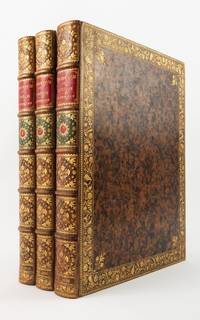
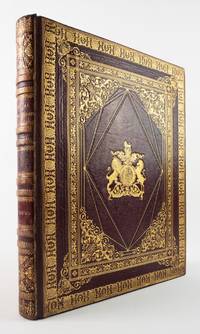
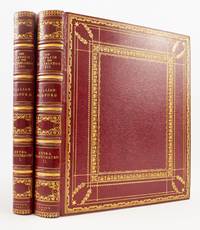
1817réf. ST19508aLondon: Henry Colburn 1817. FIRST EDITION. 322 x 274 mm. 12 3/4 x 10 3/4". One volume extended to two. SUMPTUOUS CRIMSON STRAIGHT-GRAIN MOROCCO GILT BY MORRELL stamp-signed on front turn-ins covers with wide frame decorated with Neoclassical ornaments raised bands spine compartments framed by volutes and flowers gilt lettering gilt-framed turn-ins scarlet watered silk endleaves leather hinges top edges gilt. WITH 30 HAND-COLORED PLATES as called for including a double-page view of the Battle of Waterloo a folding battle plan for Ligny and a folding map of the route from Brussels to Paris the last two expertly repaired and backed in linen and EXTRA-ILLUSTRATED WITH 66 PLATES eight of these hand-colored most portraits of military leaders. With "Portraits of General Officers" used as the frontispiece as in Abbey in place of the seldom-seen plate "Waterloo in Memory of Shaw of the Life Guards" that appears in some copies but is not on the list of plates. With an ALS dated Dublin Castle 1st Oct 1819 signed by Lord Whitworth. Front flyleaves with engraved armorial bookplate of Frederick S. Peck. Abbey "Life" 372; Tooley 336; Cohn "Cruikshank" 556. ◆Joints edges and corners with visible but not serious wear one plate with neatly repaired marginal tear just touching edge of image occasional mild foxing additional trivial imperfections otherwise fine--clean and fresh internally with richly colored plates in a lustrous binding bright with gilt. This is a very attractively illustrated celebration of Wellington's victorious campaign against Napoleon offered here in a special copy enhanced by additional plates many depicting principal actors in the conflict and a stately Neoclassical binding. Famed illustrator George Cruikshank drew the frontispiece depicting the seven general officers for the British side along with the ebullient illustrated title depicting victory the double-page plate of the fateful Battle of Waterloo and the ignominious "Flight of Bonaparte." The plates contributed by James Rouse mostly depict the countryside and villages in the area where fighting was taking place. Journalist and novelist William Mudford 1782-1848 wrote the text with assistance from primary sources among these the Duke of Wellington himself to whom the work is dedicated. Mudford was the editor of the "Courier" an evening journal with a conservative stance on politics. His prose is described as "vigorous" by the "Dictionary of Literary Biography" which also notes his flair for creating atmosphere. These gifts were brought to bear on the present account rendering this historic campaign in vivid terms. The manuscript letter inserted into the second volume was written by Lord Charles Whitworth 1752-1825 Lord Lieutenant of Ireland at the time of writing. He had been the British Ambassador to France when Napoleon was first consul and had gained much respect for the determination and dignity with which he had handled the mercurial Bonaparte's tirades against his country. Here he recommends to an unknown recipient the person who had conducted financial affairs for him in France. The present bindings are the work of the London bindery of W. T. Morrell established about 1861 as successor to the firm begun by Francis Bedford who in turn had taken over the famous bindery of Charles Lewis. Prideaux in her "Modern Bookbindings" says that Morrell at that time had a very large business that supplied "all the booksellers with bindings designed by his men" which were "remarkable for their variety and merit." The scion of an old and prosperous New England family former owner Frederick Stanhope Peck 1868-1947 was an avid collector of books and manuscripts amassing a collection of more than 8000 titles. When his library went to auction in 1944 it was noted for its fine bindings and excellent condition. Henry Colburn unknown
1817réf. ST19508aLondon: Henry Colburn 1817. FIRST EDITION. 322 x 274 mm. 12 3/4 x 10 3/4". One volume extended to two. SUMPTUOUS CRIMSON STRAIGHT-GRAIN MOROCCO GILT BY MORRELL stamp-signed on front turn-ins covers with wide frame decorated with Neoclassical ornaments raised bands spine compartments framed by volutes and flowers gilt lettering gilt-framed turn-ins scarlet watered silk endleaves leather hinges top edges gilt. WITH 30 HAND-COLORED PLATES as called for including a double-page view of the Battle of Waterloo a folding battle plan for Ligny and a folding map of the route from Brussels to Paris the last two expertly repaired and backed in linen and EXTRA-ILLUSTRATED WITH 66 PLATES eight of these hand-colored most portraits of military leaders. With "Portraits of General Officers" used as the frontispiece as in Abbey in place of the seldom-seen plate "Waterloo in Memory of Shaw of the Life Guards" that appears in some copies but is not on the list of plates. With an ALS dated Dublin Castle 1st Oct 1819 signed by Lord Whitworth. Front flyleaves with engraved armorial bookplate of Frederick S. Peck. Abbey "Life" 372; Tooley 336; Cohn "Cruikshank" 556. ◆Joints edges and corners with visible but not serious wear one plate with neatly repaired marginal tear just touching edge of image occasional mild foxing additional trivial imperfections otherwise fine--clean and fresh internally with richly colored plates in a lustrous binding bright with gilt. This is a very attractively illustrated celebration of Wellington's victorious campaign against Napoleon offered here in a special copy enhanced by additional plates many depicting principal actors in the conflict and a stately Neoclassical binding. Famed illustrator George Cruikshank drew the frontispiece depicting the seven general officers for the British side along with the ebullient illustrated title depicting victory the double-page plate of the fateful Battle of Waterloo and the ignominious "Flight of Bonaparte." The plates contributed by James Rouse mostly depict the countryside and villages in the area where fighting was taking place. Journalist and novelist William Mudford 1782-1848 wrote the text with assistance from primary sources among these the Duke of Wellington himself to whom the work is dedicated. Mudford was the editor of the "Courier" an evening journal with a conservative stance on politics. His prose is described as "vigorous" by the "Dictionary of Literary Biography" which also notes his flair for creating atmosphere. These gifts were brought to bear on the present account rendering this historic campaign in vivid terms. The manuscript letter inserted into the second volume was written by Lord Charles Whitworth 1752-1825 Lord Lieutenant of Ireland at the time of writing. He had been the British Ambassador to France when Napoleon was first consul and had gained much respect for the determination and dignity with which he had handled the mercurial Bonaparte's tirades against his country. Here he recommends to an unknown recipient the person who had conducted financial affairs for him in France. The present bindings are the work of the London bindery of W. T. Morrell established about 1861 as successor to the firm begun by Francis Bedford who in turn had taken over the famous bindery of Charles Lewis. Prideaux in her "Modern Bookbindings" says that Morrell at that time had a very large business that supplied "all the booksellers with bindings designed by his men" which were "remarkable for their variety and merit." The scion of an old and prosperous New England family former owner Frederick Stanhope Peck 1868-1947 was an avid collector of books and manuscripts amassing a collection of more than 8000 titles. When his library went to auction in 1944 it was noted for its fine bindings and excellent condition. Henry Colburn unknown books
1806réf. ST20974London: R. Ackermann 1808-10 paper watermarked 1806 and 1807. FIRST EDITION. 340 x 280 mm. 13 1/2 x 11". Three volumes. VERY HANDSOME MOTTLED CALF HEAVILY AND ELEGANTLY GILT BY RIVIERE & SON stamp-signed on verso of front free endpaper covers with lovely floral roll frame oblique floral sprays at corners raised bands spines richly gilt in compartments with central floral spray within a lozenge of small tools flower duo at corners one red morocco label one green morocco label with volume number on onlaid red morocco medallion enclosed by a gilt sunburst turn-ins with gilt floral roll marbled endpapers all edges gilt rear joint of volume III neatly repaired small recent repairs to joints elsewhere. Woodcut title pages 104 COLORED AQUATINT PLATES after Rowlandson and Pugin. Faintly embossed library stamp of "H_____ Library Collection" presumably private to title pages. A Large Paper Copy. Abbey Scenery 212; Tooley 7. Joints and extremities slightly rubbed but the bindings still splendid despite their signs of use and looking magnificent on the shelf. Offsetting from plates onto facing page as usual with this book about a fourth of the plates with significant transfer another fourth with none or almost none the remaining half with something in between but the plates with lovely rich coloring and with no offsetting of the text onto plate images and the text printed within spacious margins very fresh and unsoiled. Deemed by Abbey "a colour-plate book of great importance" Ackermann's pictorial tour of London is offered here in elegant bindings by an important English workshop. According to Tooley this is "one of the great colour-plate books" that "should form the corner stone of any collection of books on this subject. The plates by Rowlandson and Pugin present an unrivalled picture of London in early 19th century" and are consequently "of historic value as many of the buildings no longer exist." DNB calls "Microcosm" "an acknowledged masterpiece" the success of which led to Ackermann's volumes on Westminster Abbey and the colleges at Oxford Cambridge and Winchester a series considered "among the most beautiful illustrated books of the first half of the nineteenth century." Artist Thomas Rowlandson 1756-1827 is remembered for his caricatures and humorous illustrations but he made his name illustrating the travel books with views he would later satirize in his "Doctor Syntax" volumes. According to DNB publisher Rudolph Ackermann "kept Rowlandson in almost continuous employment producing drawings for the fine colour-plate books for which his firm the Repository of Arts at 101 Strand became famous. . . . Augustus Pugin was brought in to draw the architecture" for the present work while Rowlandson supplied the figures. Our binder Riviere is one of the foremost names in the field partly because the firm did consistently fine work and partly because it was so long in business. Robert Riviere began as a bookseller and binder in Bath in 1829 then set up shop as a binder in London in 1840; in 1881 he took his grandson Percival Calkin into partnership at which time the firm became known as Riviere & Son and the bindery continued to do business until 1939. The present set is an excellent example of the firm's work and the bindings along with the richness of the plates and the capacious margins here make this an especially appealing copy. The early watermark dates of 1806 and 1807 are a further attractive feature as they suggest strong coloring on plate surfaces that have not suffered significant degradation. R. Ackermann unknown
1806réf. ST20974London: R. Ackermann 1808-10 paper watermarked 1806 and 1807. FIRST EDITION. 340 x 280 mm. 13 1/2 x 11". Three volumes. VERY HANDSOME MOTTLED CALF HEAVILY AND ELEGANTLY GILT BY RIVIERE & SON stamp-signed on verso of front free endpaper covers with lovely floral roll frame oblique floral sprays at corners raised bands spines richly gilt in compartments with central floral spray within a lozenge of small tools flower duo at corners one red morocco label one green morocco label with volume number on onlaid red morocco medallion enclosed by a gilt sunburst turn-ins with gilt floral roll marbled endpapers all edges gilt rear joint of volume III neatly repaired small recent repairs to joints elsewhere. Woodcut title pages 104 COLORED AQUATINT PLATES after Rowlandson and Pugin. Faintly embossed library stamp of "H_____ Library Collection" presumably private to title pages. A Large Paper Copy. Abbey Scenery 212; Tooley 7. Joints and extremities slightly rubbed but the bindings still splendid despite their signs of use and looking magnificent on the shelf. Offsetting from plates onto facing page as usual with this book about a fourth of the plates with significant transfer another fourth with none or almost none the remaining half with something in between but the plates with lovely rich coloring and with no offsetting of the text onto plate images and the text printed within spacious margins very fresh and unsoiled. Deemed by Abbey "a colour-plate book of great importance" Ackermann's pictorial tour of London is offered here in elegant bindings by an important English workshop. According to Tooley this is "one of the great colour-plate books" that "should form the corner stone of any collection of books on this subject. The plates by Rowlandson and Pugin present an unrivalled picture of London in early 19th century" and are consequently "of historic value as many of the buildings no longer exist." DNB calls "Microcosm" "an acknowledged masterpiece" the success of which led to Ackermann's volumes on Westminster Abbey and the colleges at Oxford Cambridge and Winchester a series considered "among the most beautiful illustrated books of the first half of the nineteenth century." Artist Thomas Rowlandson 1756-1827 is remembered for his caricatures and humorous illustrations but he made his name illustrating the travel books with views he would later satirize in his "Doctor Syntax" volumes. According to DNB publisher Rudolph Ackermann "kept Rowlandson in almost continuous employment producing drawings for the fine colour-plate books for which his firm the Repository of Arts at 101 Strand became famous. . . . Augustus Pugin was brought in to draw the architecture" for the present work while Rowlandson supplied the figures. Our binder Riviere is one of the foremost names in the field partly because the firm did consistently fine work and partly because it was so long in business. Robert Riviere began as a bookseller and binder in Bath in 1829 then set up shop as a binder in London in 1840; in 1881 he took his grandson Percival Calkin into partnership at which time the firm became known as Riviere & Son and the bindery continued to do business until 1939. The present set is an excellent example of the firm's work and the bindings along with the richness of the plates and the capacious margins here make this an especially appealing copy. The early watermark dates of 1806 and 1807 are a further attractive feature as they suggest strong coloring on plate surfaces that have not suffered significant degradation. R. Ackermann unknown books
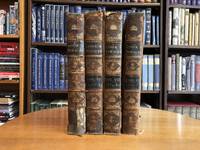
1784réf. 9900042258London: W. and A. Strahan 1784. 1st edition. Hardcover. charts engravings. 4to. Complete four volume set of the first edition. In the original boards but boards detached. Overall the contents remain tightly-bound and in remarkably good condition. Vol. I complete but for The List of Plates pp. xci to xcvi - however included in the fourth volume - see below and all seven maps on six plates four folding and one folding plate are present. Vol. II complete with all eleven maps or views six folding. Vol. III shows an early worm hole to the first few pages not affecting text. All six maps and plates are present two folding plus the folding table at the end but with no advertising leaf included. Vol IV contains 61 engravings of people places and animals visited by Capt. Cook in what is now Hawaii described as the Sandwich Islands Western British Columbia and Alaska. Forty of the plates are folding; 21 are large single-page plates. The volume begins with 'The List of Plates' and is numbered pages xci to xcvi see above. Some of the illustrations are foxed. This volume lacks three charts nos. I and VI from vol. I and no. XXXVI from vol. II. There is foxing off-setting really on the pages facing the plates and charts and occasional marginal foxing to the text but the latter is hardly untoward. Beddie Bibliography of Captain James Cook BCJC 1543 Streeter 3478. Sabin 16250 Howes 729a Sotheby's London sale 11/21/91 lot #377 three vols only. W. and A. Strahan hardcover
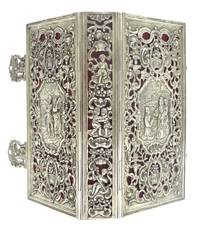
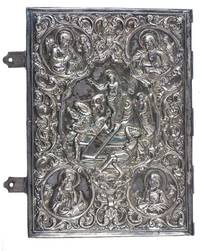
1686réf. 12464Rottterdam F. van Hoghstraeten 1686. Speculum Poenitentiae in quo ad peccatores convertendos praecipui tam veteris quam novi Testamenti poenitentes per tabulas exhibentur . Very finely worked French binding in the style of the Régence. The scene on the front cover with master's mark ""T.G. under lily"" and probably hallmarks. According to the assessment of a silver expert they point to France and date to the time before the Revolution of 1789. The binding of impeccable condition. With a copper-engraved frontispiece and 20 copper plates. 9 fol. 390 pp. incomplete end missing. Ornamentally pierced finely gauffered and embossed silver binding over red velvet. Front and back cover with central biblical scenes: ""Finding of the Moses Boy"" and ""Moses and Aaron as Warriors"" in the background the ""Dance around the Golden Calf"". Back with three putti as allegories for faith love and hope. Rocailles ribbon work and rich floral and figural decoration surround the motifs. Two openwork cast clasps. H. 14.4 x W. 8 x D. 3.3 cm. Rottterdam, F. van Hoghstraeten unknown
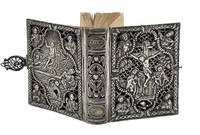
réf. 2026316mo 106 x 69 mm 165 i. e. 167-1 f. a–z8 A–H8; aa–xx8 text in greek some decorative headpieces Woodcut printer's device on the title and the verso of the last leaf XX8. 19 th C. Armenian silver binding openwork with embossed parts on red velvet spine decorated with putti and the letters TETP for Tetra in a medallion sides displaying on the front cover the Crucifixion and on the lower cover the Resurrection both with the four Evangelists in the corners; minor restoration to the margin of the final leaf. Second part of the New Testament printed by Benoît Prévost for Pierre Haultin. It contains the Epistles of Saint Paul the Catholic Epistles and the Apocalypse of Saint John. Both parts were published separately with their own pagination. The printer mark of Pierre Haultin I appears on the title page BATYR no. 27878 with his motto in Greek and Latin: Kratos thanatou kai zôēs. Imperium mortis & vitae. According to Renouard Benoît Prévost and Pierre Hautin share the same allegorical printer's mark: alpha and omega on an open Bible with a sword and pen intertwined beneath a radiant sun background. Fine copy in a lavish Armenian silver embossed binding. Provenance: Roderick Terry his bookplate clergyman and a renowned book collector of Newport Rhode Island not in his catalogue. References: USTC 160075. French Vernacular Books 57900; Renouard Imprimeurs parisiens 305-306 et 177-178. For example of Armenian silver binding see Kouymjian Dickran "Armenian bookbinding from manuscript to printed book Sixteenth to nineteenth century" in: Gazette du livre médiéval n°49. Automne 2006. pp. 1-14. Mariam Vardanyan "The Collection of Silver Book Bindings of the Armenian Museum in Bucharest and their Relationship to Eastern and Western Arts" in Series Byzantina Studies on Byzantine and Post -Byzantine Art Vol. XV 2017. pp. 81-96. Paris, Benedictus Praevotius, 1549 hardcover
1750réf. 4310The binding probably Augsburg 1750. Agenda-format binding size 155 x 78 x 24 mm. Contents: 143 small engravings all but the first 48-50 x 35-37 mm. the first mounted sideways measuring 50 x 97 mm. consisting of 11 engravings for each saint trimmed to borders and mounted on 78 leaves of wove paper. 18th-century German silver-gilt embossed binding regilt in the 19th century both covers with a large oval cartouche containing a scene of the Crucifixion on the upper cover and the Resurrection on lower cover both covers with cherubs within ornamental foliage at the four corners the pair at top holding a cartouche with a scene of the Entombment on upper cover and the Ascension on lower cover the pair at the foot holding laurel wreaths and flanking a winged angel’s head; spine with embossed flowers ribbons and foliate ornaments above and below a central scene of Moses with the brazen serpent at top a monogram of the letters CJ; two chased metal fore-edge clasps attaching on upper cover; lined in later 19th-century green watered silk edges gilt and gauffered. Housed in a folding cloth felt-lined folding case upper cover with morocco gilt label with Abbey’s named coat of arms; his paper shelf-mark label JA 2680 on lower cover. Provenance: unidentified monogram on binding; Major John Roland Abbey 1894-1969 bookplate on case; see Hayward Silver Bindings no. 17; Bernard Breslauer anonymous sale Sotheby’s 10 May 1985 “Silver and Enamel Bindings” lot 26 unsold. A stunning embossed silver-gilt binding almost certainly produced in Augsburg from the collection of Major Abbey. The binding dates from the “last phase of baroque and the fully developed rococo” Hayward the final culminating period of Augsburg craftsmanship in embossed silver. Describing this binding and two others from the collection Hayward wrote: “the most finely worked book-covers in the Abbey Collection date from the second quarter of the Eighteenth Century. The subjects are the familiar scenes from the life of Christ but treated even in the small compass of a book-cover with extraordinary dramatic force. The designs were probably derived from a contemporary illustrated Bible but their effectiveness is greatly enhanced by the relief in which they are rendered and by the strong contrasts of light and shade” p. 3. To accentuate the pathos the silversmith or designer chose to highlight minor characters: in the dramatic Crucifixion scene the most deeply embossed figures occupying the foreground are two soldiers throwing dice at the foot of the cross; similarly the centurion is the largest and most solid figure in the Resurrection scene on the lower cover. The binding encloses an album of 143 fine small unsigned 17th-century probably Flemish engravings of Franciscan saints neatly mounted on wove paper. The Antwerp engraver and print publisher Philips Galle had initiated the vogue for “Franciscan” prints with his series of engravings of the Life of St. Francis first produced before 1580 cf. Sellink pp. 129-131. The present suite contains 13 series each with 11 small engravings depicting a saint or group of saints as follows: St. Francis The 5 Martyred Saints the 7 Martyred Saints Anthony of Padua Bonaventura Ludovicus Episcopius Bernardino of Siena John of Capestrano Didacus Diego of Alcalá Clare of Assisi Elizabeth of Hungary S. Elizabeth vidua Louis of France and Elzear. With one exception John of Capestrano instead of St. Ivo of Brittany these were the saints chosen by Hendrik Sedulius guardian of the Antwerp Franciscans for his Imagines Sanctorum Francisci printed and illustrated by Philips Galle in 1602 but that quarto-format work only includes one large engraving per saint each accompanied by a page of text. The exact source of this more extensive small format suite remains to be identified. Each engraving has a caption citing a chapter number. Major John Roland Abbey assembled the largest English book collection of his generation. His first love was bindings and among these he brought together an exceptional group of silver bindings some of which were described and illustrated by John F. Hayward in an article published in The Connoisseur in 1952. The present binding is number 17; Hayward noted its earlier regilding as well as the “fine quality” of the embossing. Bernard Breslauer later bought the collection en bloc from Abbey’s widow “and in 1985 Bernard consigned the collection with some additions from his own stock to Sotheby’s London. Despite Sotheby’s well-illustrated and informative catalogue the sale was calamitous: of the fifty-eight silver and enamel bindings only fourteen met the reserve” Laird p. 67. This binding was not one of them. Cf. M. S. Sellink Philips Galle 1537-1612: engraver and print publisher in Haarlem and Antwerp PhD ThesisVrije Universiteit Amsterdam 1997 online. J. F. Hayward Silver Bindings from the J. R. Abbey Collection offprint from The Connoisseur October 1952. Cf. M. Laird “Bernd Bernard Hartmut Breslauer 1918-2004: A Personal Memoir” Gazette of the Grolier Club 72 2023 59-92. Thanks to Mr. Laird for sharing the sale results from B. Breslauer’s own catalogue in his possession. unknown
1750réf. 4310The binding probably Augsburg 1750. Agenda-format binding size 155 x 78 x 24 mm. Contents: 143 small engravings all but the first 48-50 x 35-37 mm. the first mounted sideways measuring 50 x 97 mm. consisting of 11 engravings for each saint trimmed to borders and mounted on 78 leaves of wove paper. 18th-century German silver-gilt embossed binding regilt in the 19th century both covers with a large oval cartouche containing a scene of the Crucifixion on the upper cover and the Resurrection on lower cover both covers with cherubs within ornamental foliage at the four corners the pair at top holding a cartouche with a scene of the Entombment on upper cover and the Ascension on lower cover the pair at the foot holding laurel wreaths and flanking a winged angel’s head; spine with embossed flowers ribbons and foliate ornaments above and below a central scene of Moses with the brazen serpent at top a monogram of the letters CJ; two chased metal fore-edge clasps attaching on upper cover; lined in later 19th-century green watered silk edges gilt and gauffered. Housed in a folding cloth felt-lined folding case upper cover with morocco gilt label with Abbey’s named coat of arms; his paper shelf-mark label JA 2680 on lower cover. Provenance: unidentified monogram on binding; Major John Roland Abbey 1894-1969 bookplate on case; see Hayward Silver Bindings no. 17; Bernard Breslauer anonymous sale Sotheby’s 10 May 1985 “Silver and Enamel Bindings” lot 26 unsold. A stunning embossed silver-gilt binding almost certainly produced in Augsburg from the collection of Major Abbey. The binding dates from the “last phase of baroque and the fully developed rococo” Hayward the final culminating period of Augsburg craftsmanship in embossed silver. Describing this binding and two others from the collection Hayward wrote: “the most finely worked book-covers in the Abbey Collection date from the second quarter of the Eighteenth Century. The subjects are the familiar scenes from the life of Christ but treated even in the small compass of a book-cover with extraordinary dramatic force. The designs were probably derived from a contemporary illustrated Bible but their effectiveness is greatly enhanced by the relief in which they are rendered and by the strong contrasts of light and shade” p. 3. To accentuate the pathos the silversmith or designer chose to highlight minor characters: in the dramatic Crucifixion scene the most deeply embossed figures occupying the foreground are two soldiers throwing dice at the foot of the cross; similarly the centurion is the largest and most solid figure in the Resurrection scene on the lower cover. The binding encloses an album of 143 fine small unsigned 17th-century probably Flemish engravings of Franciscan saints neatly mounted on wove paper. The Antwerp engraver and print publisher Philips Galle had initiated the vogue for “Franciscan” prints with his series of engravings of the Life of St. Francis first produced before 1580 cf. Sellink pp. 129-131. The present suite contains 13 series each with 11 small engravings depicting a saint or group of saints as follows: St. Francis The 5 Martyred Saints the 7 Martyred Saints Anthony of Padua Bonaventura Ludovicus Episcopius Bernardino of Siena John of Capestrano Didacus Diego of Alcalá Clare of Assisi Elizabeth of Hungary S. Elizabeth vidua Louis of France and Elzear. With one exception John of Capestrano instead of St. Ivo of Brittany these were the saints chosen by Hendrik Sedulius guardian of the Antwerp Franciscans for his Imagines Sanctorum Francisci printed and illustrated by Philips Galle in 1602 but that quarto-format work only includes one large engraving per saint each accompanied by a page of text. The exact source of this more extensive small format suite remains to be identified. Each engraving has a caption citing a chapter number. Major John Roland Abbey assembled the largest English book collection of his generation. His first love was bindings and among these he brought together an exceptional group of silver bindings some of which were described and illustrated by John F. Hayward in an article published in The Connoisseur in 1952. The present binding is number 17; Hayward noted its earlier regilding as well as the “fine quality” of the embossing. Bernard Breslauer later bought the collection en bloc from Abbey’s widow “and in 1985 Bernard consigned the collection with some additions from his own stock to Sotheby’s London. Despite Sotheby’s well-illustrated and informative catalogue the sale was calamitous: of the fifty-eight silver and enamel bindings only fourteen met the reserve” Laird p. 67. This binding was not one of them. Cf. M. S. Sellink Philips Galle 1537-1612: engraver and print publisher in Haarlem and Antwerp PhD ThesisVrije Universiteit Amsterdam 1997 online. J. F. Hayward Silver Bindings from the J. R. Abbey Collection offprint from The Connoisseur October 1952. Cf. M. Laird “Bernd Bernard Hartmut Breslauer 1918-2004: A Personal Memoir” Gazette of the Grolier Club 72 2023 59-92. Thanks to Mr. Laird for sharing the sale results from B. Breslauer’s own catalogue in his possession. unknown books
1725réf. 2168Netherlands 1725. Pair of embossed silver book covers 34 x 25 x 3 cm; each cover with a large scrollwork cartouche surrounded by extensive vine and flower decorations and with medallion portraits in each of the four corners the front showing the crucifixion flanked by Mary and St. John with an INRI scroll above flanked by a crescent moon and a sun and a skull and crossbones below with portraits of four saints each with a blank scroll above left bearded with a regal crown; above right clean-shaven with a round-topped mitre; below left and right bare-headed and bearded the back showing the resurrection with an angel and two astonished guards with portraits of the four Evangelists. Beautiful richly decorated early 18th-century Dutch silver binding. The large silver covers together weighing about 750 grams bear no silver marks. Although no spine is present the clasps show that the binding was made for a book about 2 cm thick suggesting 200 or 300 pages so most likely made for a folio missal. The clasps are hinged to the back cover each with a round hole that fastens to a round-headed pin on the fore-edge of the front cover.With a 1 cm crack on the fore-edge of the back cover another slightly affecting the arm of one guard and a few tiny holes where the tips of the noses of some figures have worn but still generally in good condition. A lovely and unusually large pair of embossed silver book covers.l Cf. J.W. Frederiks Dutch silver vol. 4 1961 nos. 238-239 & plates 235-237 vaguely similar silver bindings from 1732 & 1738; nothing similar in J.F. Hayward Silver bindings from the J.R. Abbey collection. unknown
1770réf. 97Birmingham or Sheffield 1770. Oblong folio. 390 x 220 mm. 15 1/4 x 8 3/4 inches. Vellum spine over decorative blue paper wrappers paper label with title in Italian on upper board and ink title in Italian on spine. Paper stock toned with age a few leaves with staining in the margin otherwise in good condition. Silversmith model book containing 80 full-page engravings of candles sticks and holders candelabra pitchers plates salt and pepper shakers serving utensils silverware and other household pieces. Each image is beautifully and careful engraved with rich detail and ornamentation. Each includes a printed product number as well as one in ink with a different item number and a price. Although there is no title-page or signatures of engravers this large sales catalogue appears to be English as some of the engravings have English words of explanation engraved in the text. The binding is definitely Italian and the paper label is in an Italian hand. The watermark is a "fleur de lis" pattern suggesting an international company manufacturing the silver. There were only a few English companies with the capacity to export at this time including silver works in Sheffield and Birmingham both of which by 1770's had established networks of dealers selling their wares across the continent. This catalogue with specific Italian connections is very unusual and suggests the scope of the business had reached export capacity by the third quarter of the century. The most important Italian silver makers at this time were Giardini of Rome and Venuti of Naples. . unknown
1770réf. 97Birmingham or Sheffield 1770. Oblong folio. 390 x 220 mm. 15 1/4 x 8 3/4 inches. Vellum spine over decorative blue paper wrappers paper label with title in Italian on upper board and ink title in Italian on spine. Paper stock toned with age a few leaves with staining in the margin otherwise in good condition. Silversmith model book containing 80 full-page engravings of candles sticks and holders candelabra pitchers plates salt and pepper shakers serving utensils silverware and other household pieces. Each image is beautifully and careful engraved with rich detail and ornamentation. Each includes a printed product number as well as one in ink with a different item number and a price. Although there is no title-page or signatures of engravers this large sales catalogue appears to be English as some of the engravings have English words of explanation engraved in the text. The binding is definitely Italian and the paper label is in an Italian hand. The watermark is a "fleur de lis" pattern suggesting an international company manufacturing the silver. There were only a few English companies with the capacity to export at this time including silver works in Sheffield and Birmingham both of which by 1770's had established networks of dealers selling their wares across the continent. This catalogue with specific Italian connections is very unusual and suggests the scope of the business had reached export capacity by the third quarter of the century. The most important Italian silver makers at this time were Giardini of Rome and Venuti of Naples. . unknown books
1415réf. ST21130bLondon: Printed for Js. Jenkins . . . by L. Harrison & J. C. Leigh 1814-15; leaves watermarked 1811. FIRST EDITION FIRST ISSUE. ONE OF 100 LARGE PAPER COPIES per Abbey. 414 x 330 mm. 16 1/4 x 14". viii pp. 1 leaf contents 60 leaves of description iv pp. list of subscribers. REGAL CONTEMPORARY BURGUNDY STRAIGHT-GRAIN MOROCCO LAVISHLY GILT covers bordered by decorative roll central panel framed by multiple gilt fillets and palmette roll royal arms of Great Britain at center enclosed within a fillet lozenge and octagon raised bands spine gilt in compartments that at head and tail with large ornate fleurons composed of lancet and palmette tools gilt lettering turn-ins with delicate gilt palmette roll leather hinges bright blue endleaves all edges gilt. Very expertly rebacked retaining original backstrip. Engraved title page with vignette uncolored and 53 SUPERB HAND-COLORED AQUATINT PLATES including the arms of the dedicatee the Duke of Wellington an allegorical frontispiece and 51 martial scenes mostly battles all with original tissue guards. WITH AN ORIGINAL WATERCOLOR OF ONE OF THE PLATES The meeting of the Emperors of Russia and Austria King of Prussia & Crown Prince of Sweden in the Great Square of Leipzig Oct. 18th 1813 SIGNED W. Heath 1814. A Large Paper Copy. Abbey Life 365; Prideaux p. 34; Tooley 281. Slight variation in color of spine leather a bit of shelfwear to tail edge of boards just a hint of wear elsewhere; tissue guards somewhat foxed but text and plates happily unaffected. AN ESPECIALLY FINE COPY--entirely clean fresh and bright internally with vibrant coloring in a stately binding brimming with extravagantly glittering gilt. In a spectacular period binding this monumental copy of Jenkins' tribute to the British army is accompanied by an original watercolor by its illustrator. Dedicated to the Duke of Wellington who Jenkins writes in the dedicatory letter has "raised the character of the British soldier in the scale of humanity" this volume is a celebration of the victory of Britain and its allies in the Napoleonic Wars. The richly colored plates are the work of William Heath 1794/5-1840; his original watercolor offered with our volume corresponds to the plate "Entrance of the Allied Sovereigns into Leipsic sic" commemorating a decisive victory for Britain and its allies that ended Napoleon's occupation east of the Rhine and paved the way for his eventual total defeat. The watercolor reveals a notable level of delicacy with carefully rendered details emerging from the hazy clouds of battle. Now best remembered for his career as a cartoonist and caricaturist Heath began as a military painter with the present work being his best known from the period. Full of movement and drama his scenes depict pivotal moments from major British military campaigns and are accompanied by descriptions of each battle often including excerpts from the letters or reports of the officers involved. In addition to its memorable binding and its early watermarks our copy is distinguished by its size--it measures a full three inches taller than the Abbey copy with broad impressive margins around the text and illustrations. Printed for Js. Jenkins . . . by L. Harrison & J. C. Leigh unknown
1415réf. ST21130bLondon: Printed for Js. Jenkins . . . by L. Harrison & J. C. Leigh 1814-15; leaves watermarked 1811. FIRST EDITION FIRST ISSUE. ONE OF 100 LARGE PAPER COPIES per Abbey. 414 x 330 mm. 16 1/4 x 14". viii pp. 1 leaf contents 60 leaves of description iv pp. list of subscribers. REGAL CONTEMPORARY BURGUNDY STRAIGHT-GRAIN MOROCCO LAVISHLY GILT covers bordered by decorative roll central panel framed by multiple gilt fillets and palmette roll royal arms of Great Britain at center enclosed within a fillet lozenge and octagon raised bands spine gilt in compartments that at head and tail with large ornate fleurons composed of lancet and palmette tools gilt lettering turn-ins with delicate gilt palmette roll leather hinges bright blue endleaves all edges gilt. Very expertly rebacked retaining original backstrip. Engraved title page with vignette uncolored and 53 SUPERB HAND-COLORED AQUATINT PLATES including the arms of the dedicatee the Duke of Wellington an allegorical frontispiece and 51 martial scenes mostly battles all with original tissue guards. WITH AN ORIGINAL WATERCOLOR OF ONE OF THE PLATES The meeting of the Emperors of Russia and Austria King of Prussia & Crown Prince of Sweden in the Great Square of Leipzig Oct. 18th 1813 SIGNED W. Heath 1814. A Large Paper Copy. Abbey Life 365; Prideaux p. 34; Tooley 281. Slight variation in color of spine leather a bit of shelfwear to tail edge of boards just a hint of wear elsewhere; tissue guards somewhat foxed but text and plates happily unaffected. AN ESPECIALLY FINE COPY--entirely clean fresh and bright internally with vibrant coloring in a stately binding brimming with extravagantly glittering gilt. In a spectacular period binding this monumental copy of Jenkins' tribute to the British army is accompanied by an original watercolor by its illustrator. Dedicated to the Duke of Wellington who Jenkins writes in the dedicatory letter has "raised the character of the British soldier in the scale of humanity" this volume is a celebration of the victory of Britain and its allies in the Napoleonic Wars. The richly colored plates are the work of William Heath 1794/5-1840; his original watercolor offered with our volume corresponds to the plate "Entrance of the Allied Sovereigns into Leipsic sic" commemorating a decisive victory for Britain and its allies that ended Napoleon's occupation east of the Rhine and paved the way for his eventual total defeat. The watercolor reveals a notable level of delicacy with carefully rendered details emerging from the hazy clouds of battle. Now best remembered for his career as a cartoonist and caricaturist Heath began as a military painter with the present work being his best known from the period. Full of movement and drama his scenes depict pivotal moments from major British military campaigns and are accompanied by descriptions of each battle often including excerpts from the letters or reports of the officers involved. In addition to its memorable binding and its early watermarks our copy is distinguished by its size--it measures a full three inches taller than the Abbey copy with broad impressive margins around the text and illustrations. Printed for Js. Jenkins . . . by L. Harrison & J. C. Leigh unknown books
AN IMPORTANT COLLECTION, IN EXCELLENT CONDITION, OF 19TH-CENTURY DEPICTIONS OF PYRENEAN SCENERY, executed in lithography (often hand-colored), aquatint, and engraving. ***(1) An unusually fine set of Melling's large folio "Voyage pittoresque dans les Pyrenees francais" (1826-1830), complete with 72 delicate aquatints, a map, a lithographed portrait of the artist, and the text by Cervini. Attractively bound and with clean, unfoxed plates (most unusual for this book). ***(2) TWO fine sets of Victor Petit's folio "Souvenirs des Pyrenees", with about 50 lithographs per set. The first set is beautifully hand-colored on fine wove paper; the second set uncolored on chine. As usual with these albums, the sets offer interesting bibliographical differences. ***(3) Two beautiful sets (30 lithographs per set) of Petit's folio "Bagneres de Luchon et ses environs", one colored and one uncolored on chine. ***(4) Two excellent (and different) complete sets of Ciceri's "Les Pyrenees dessinees d'apres nature", both very fresh, in their original bindings. ***(5) Two copies (one colored, one uncolored) of "Alpes et Pyrenees" (1842), both in publisher's cloth. ***(6) Several additional albums by Gorse (two, one with rectangular lithographs and one with oval), Allom, and others, including a few miniature albums. Many of these items are quite rare, and all are in very good condition. Several hundred prints in all. An outstanding collection. (I may consider selling one or more items separately. Please enquire.)