8039 resultados
ref. AQ28607s.i.: s.n. 1885-86 45 leaves 23 used the remainder blank. Later limp black cloth. Extremities worn. Internally clean and crisp. Armorial bookplates of Peter Campbell and Charles William Orde loosely inserted. A late nineteenth-century manuscript inventory in a single legible hand recording the silver plate gold plate and china at the estate of the Campbell-Orde baronets Kilmory House Argyll. The majority of the plate is registered by the chest in which it was housed one marked as the property of Royal Navy officer Admiral Sir John Orde 1751-1824 another as belonging to the second baronet Sir John Powlett Orde 1803-1878 who following the death of both his wife and father-in-law inherited Kilmory. Orde rebuilt the house in a Gothic style to a design by architect Joseph Gordon Davis and remodelled the grounds with the aid of William Jackson Hooker. He was succeeded by his son Sir John William Powlett Orde 1827-1897 who in 1880 obtained Royal Licence to assume the surname of Campbell- Orde. Kilmory is now the headquarters of Argyll and Bute Council. . Quarto. [s.n.], [1885-86] hardcover
ref. 4426Paris 18th century. Silver filigree binding 82 x 60 mm. including spine. The covers of filigree volutes and curling tendrils with inset painted enamel oval centerpiece and heart-shaped corner-pieces showing putti in pastoral settings below love-related mottos in French central plaque on front cover slightly damaged both covers decorated with ten glass “amethysts”; hollow tubular filigree spine pair of fore-edge clasps and catches the silver binding mounted over later yellow silk-covered thin pasteboards the yellow silk liners with pockets front and back; preserved in a modern morocco case. Containing a 20th-century illustrated manuscript on parchment pasted in partly loose. This silver binding with painted enamel plaques belongs to a group of similarly decorated late 17th- or 18th-century miniature bindings. Several are on late 17th-century printed books or 18th-century manuscripts which have an Italian connection and although their style may have been imitated in various centers of book production it seems likely that most of the bindings were produced in Italy. I know of 15 such bindings including this one. Most are found on various late 17th-century editions of the Office of the Virgin printed in Paris from the 1670s to the early 1690s but including editions in Italian; these little Offices seem to have been produced at least in part for the Italian market. Two of the bindings were used for Hebrew manuscript prayerbooks produced in Italy. A census is available on request: it expands on that drawn up and kindly shared by Dr. Jan Storm van Leeuwen who published an earlier version in the catalogue of Patricia Pistner’s miniature book collection A Matter of Size no. 123. All but one of the bindings are miniature measuring approximately 82 x 55/58 mm. and are adorned with 12 to 20 cut-glass “jewels.” The silverwork is of two types: ten are filigree with spiraling volutes as in this binding and five are in a floral ajouré or openwork design with stems leaves and blossoms as in the Pistner example. The enamel plaques are also of two types not correlated with the two different silverwork types. The majority eleven show Christian religious figures with no inscriptions; these are in at least two different styles and were probably produced in different workshops. They are all found on editions of the Office of the Virgin printed between 1672 and 1693 all but one in Paris. Four bindings including this one have secular plaques painted in a rough folk-art style with putti and archaically spelled mottos relating to love. The other three bindings with secular motifs are the Pistner binding which is empty and two other filigree examples both bound over Jewish or Hebrew manuscripts: one is in a private Swiss collection and the other in which the plaque inscriptions are in Italian is held by Penn State University acquired from us. All four of these “secular” bindings have oddly shaped spines some slightly deformed. This seems to be the result of reworking the spines to accommodate thinner text blocks than those for which they were originally intended. The design of the catches and joints of the present binding and its filigree silverwork are similar to the other filigree secular bindings. The plaques especially resemble those of the example in the Swiss collection; one of the central plaques shares the same inscription here Rien m’arrest; in the other binding Rien m’arreste. However the fine condition and perfectly rounded spine of this binding may also point to some 19th-century restoration. Bookbindings of silver and previous metal were kept and reused through generations and thus often appear on much later books or manuscripts. This binding presently houses a 20th-century mildly erotic manuscript in French on 10 vellum leaves the title Cantique de Salomon in a crowned frame the 9 following leaves containing amateurish pencil and watercolor drawings with one- or two-line captions on rectos only. Originally glued in most of the leaves are now loose. The manuscript is disposed in the style of a Hebrew codex with the page order from left to right and the Hebrew transcription of the name of God YHWH appears at the top of the title. For examples of the analogous bindings see A Matter of Size: Miniature bindings and texts from the collection of Patricia J. Pistner 2019 no. 123 referring to 7 such bindings; F. Malaguzzi Collezioni del Museo civico d'arte antica di Torino: legature Turin 2011 no. 92; Luigi Mallé Smalti - Avori del Museo d’Arte Antico Turin 1969 pp. 113-114; G. Fletcher Judging a Book by its Cover: Bookbindings in the Collections of the Grolier Club NY 2023 no. 3.13; Musinsky Rare Books Catalogue 28 item 7; Patrick Olson NY Book Fair List 2024. unknown
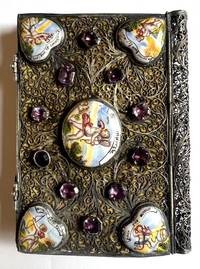
ref. 4426Paris 18th century. Silver filigree binding 82 x 60 mm. including spine. The covers of filigree volutes and curling tendrils with inset painted enamel oval centerpiece and heart-shaped corner-pieces showing putti in pastoral settings below love-related mottos in French central plaque on front cover slightly damaged both covers decorated with ten glass “amethysts”; hollow tubular filigree spine pair of fore-edge clasps and catches the silver binding mounted over later yellow silk-covered thin pasteboards the yellow silk liners with pockets front and back; preserved in a modern morocco case. Containing a 20th-century illustrated manuscript on parchment pasted in partly loose. This silver binding with painted enamel plaques belongs to a group of similarly decorated late 17th- or 18th-century miniature bindings. Several are on late 17th-century printed books or 18th-century manuscripts which have an Italian connection and although their style may have been imitated in various centers of book production it seems likely that most of the bindings were produced in Italy. I know of 15 such bindings including this one. Most are found on various late 17th-century editions of the Office of the Virgin printed in Paris from the 1670s to the early 1690s but including editions in Italian; these little Offices seem to have been produced at least in part for the Italian market. Two of the bindings were used for Hebrew manuscript prayerbooks produced in Italy. A census is available on request: it expands on that drawn up and kindly shared by Dr. Jan Storm van Leeuwen who published an earlier version in the catalogue of Patricia Pistner’s miniature book collection A Matter of Size no. 123. All but one of the bindings are miniature measuring approximately 82 x 55/58 mm. and are adorned with 12 to 20 cut-glass “jewels.” The silverwork is of two types: ten are filigree with spiraling volutes as in this binding and five are in a floral ajouré or openwork design with stems leaves and blossoms as in the Pistner example. The enamel plaques are also of two types not correlated with the two different silverwork types. The majority eleven show Christian religious figures with no inscriptions; these are in at least two different styles and were probably produced in different workshops. They are all found on editions of the Office of the Virgin printed between 1672 and 1693 all but one in Paris. Four bindings including this one have secular plaques painted in a rough folk-art style with putti and archaically spelled mottos relating to love. The other three bindings with secular motifs are the Pistner binding which is empty and two other filigree examples both bound over Jewish or Hebrew manuscripts: one is in a private Swiss collection and the other in which the plaque inscriptions are in Italian is held by Penn State University acquired from us. All four of these “secular” bindings have oddly shaped spines some slightly deformed. This seems to be the result of reworking the spines to accommodate thinner text blocks than those for which they were originally intended. The design of the catches and joints of the present binding and its filigree silverwork are similar to the other filigree secular bindings. The plaques especially resemble those of the example in the Swiss collection; one of the central plaques shares the same inscription here Rien m’arrest; in the other binding Rien m’arreste. However the fine condition and perfectly rounded spine of this binding may also point to some 19th-century restoration. Bookbindings of silver and previous metal were kept and reused through generations and thus often appear on much later books or manuscripts. This binding presently houses a 20th-century mildly erotic manuscript in French on 10 vellum leaves the title Cantique de Salomon in a crowned frame the 9 following leaves containing amateurish pencil and watercolor drawings with one- or two-line captions on rectos only. Originally glued in most of the leaves are now loose. The manuscript is disposed in the style of a Hebrew codex with the page order from left to right and the Hebrew transcription of the name of God YHWH appears at the top of the title. For examples of the analogous bindings see A Matter of Size: Miniature bindings and texts from the collection of Patricia J. Pistner 2019 no. 123 referring to 7 such bindings; F. Malaguzzi Collezioni del Museo civico d'arte antica di Torino: legature Turin 2011 no. 92; Luigi Mallé Smalti - Avori del Museo d’Arte Antico Turin 1969 pp. 113-114; G. Fletcher Judging a Book by its Cover: Bookbindings in the Collections of the Grolier Club NY 2023 no. 3.13; Musinsky Rare Books Catalogue 28 item 7; Patrick Olson NY Book Fair List 2024. unknown books
1893ref. 2111902160201402Seyama Sakichi 1893. Soft Cover. Fine. Volume: 1 Seyama Sakichi paperback
ref. 0663461715.Gpaperback. Good. Access codes and supplements are not guaranteed with used items. May be an ex-library book. paperback
ref. 0521343747.Ghardcover. Good. Access codes and supplements are not guaranteed with used items. May be an ex-library book. hardcover
1990ref. Q-0521387396Cambridge University Press 1990-07-12. Paperback. New. In shrink wrap. Looks like an interesting title! Cambridge University Press paperback
1990ref. x-0521387396Cambridge Univ Pr 1990. Paperback. New. 216 pages. 9.00x6.25x0.75 inches. Cambridge Univ Pr paperback
ref. B9780521387392Paperback / softback. New. Silver traces the effects of English settlement on South Atlantic ecology showing how three cultures interacted with their changing environment. paperback
ref. ria9780521387392_inpPaperback. New. New Book; Fast Shipping from UK; Not signed; Not First Edition; Silver traces the effects of English settlement on South Atlantic ecology showing how three cultures interacted with their changing environment. paperback
ref. 6380697Cambridge University Press CUP . Papeback. New. Cambridge University Press CUP unknown
2005ref. 2343162New York: Cambridge University Press 2005. 7th Printing. Trade Paperback. Very Good. 6x0x9. Seventh printing. Remainder mark minor tear to spine base. 2005 Trade Paperback. xii 204 pp. In this book Timothy Silver traces the effects of English settlement on South Atlantic ecology showing how all three cultures--Indian European and African--interacted with and were in turn affected by their changing environment. In assessing such ecological changes Silver pays particular attention to regional variations explaining how local geography and settlement patterns influenced the environment. And while his focus is the English South Silver also shows us how economic and ecological developments in Europe the Caribbean and elsewhere frequently dictated how South Atlantic colonists used their land. Consequently his book provides an engaging and detailed look at the complex relationships among humans plants and animals in a unique and diverse region of North America. Cambridge University Press paperback books
ref. 63-4579Bexhill-On-Sea England: Silver Thimble Books 1983. Micro-Miniature Book. 64mo. 46 pp. Decorative Cloth With Floral Motif On Boards with Printed Label Affixed to cover. Illustrations by Murray. Printed on double leaves. Near Fine.Fine miniature books from Silver Thimble Books 1982 - 1987. A nice selection of miniature books by British television producer puppeteer artist and miniature book publisher Gordon Murray. Bexhill-On-Sea, England: Silver Thimble Books, 1983. hardcover
2009ref. 11021Stephen Silver 2009. First edition. Hardcover. Fine. First edition. Hardcover. Quarto. Unpaginated. SIGNED WITH AN ORIGINAL SKETCH by Silver. Half red cloth stamped in silver black cloth spine. Profusely illustrated with full-page reproductions from Silver's sketchbooks. Stephen Silver hardcover
2012ref. Q-1566568870Olive Branch Pr 2012-06-04. Paperback. New. In shrink wrap. Looks like an interesting title! Olive Branch Pr paperback
ref. 1959285920.Gpaperback. Good. Access codes and supplements are not guaranteed with used items. May be an ex-library book. paperback
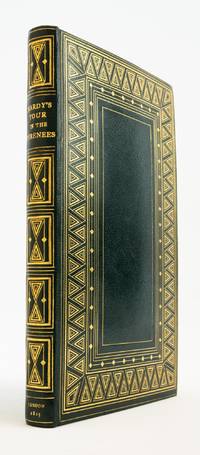
1825ref. ST20491London: R. Ackermann 1825. FIRST EDITION. 236 x 144 mm. 9 1/4 x 5 3/4". vii 1 84 pp. STRIKING DARK GREEN MOROCCO VERY ELABORATELY GILT BY CUNEO stamp-signed on lower front turn-in for Mildred B. Davey named stamped on upper front turn-in covers with geometric Art Deco frame smooth spine in compartments with triangle ornaments gilt lettering git-ruled turn-ins marbled endpapers. Housed in matching green morocco-backed clamshell box lined with fleece. Engraved map and 24 FINE DELICATELY HAND-COLORED PLATES inlaid on heavy stock as issued; original tissue guards. Verso of front free endpaper with engraved bookplate of Mildred Davey and red morocco ex-libris of Paul Edward Chevalier; front flyleaf with 19th century ink owner inscription of William Mitchell. A Large Paper Copy. Abbey Travel 210; Tooley 245; S. T. Prideaux "Aquatint Engraving: A Chapter in the History of Book Illustration" p. 229. See Peter Thorold "The British in France: Visitors and Residents since the Revolution" p. 64. A very small ink spot just intruding on very bottom edge of a handful of leaves a few vague spots of foxing to map isolated faint offsetting from illustrations but A VERY FINE COPY in all other ways--the text clean fresh and bright the plates immaculate the margins spacious the binding lustrous and sparkling. This is a lovely copy of a work with plates Prideaux considers "among the most beautiful to be found in aquatint engraving" and it comes in a handsome binding commissioned by Mildred Benson Davey and later owned by Paul Chevalier. Issued by a publisher known for his lavishly illustrated travelogues the volume takes us on a journey through the scenic French Pyrenees escorted by Englishman Joseph Hardy who adds his insights on the local population and government gives recommendations on the best mineral baths and describes in word and image the breathtaking scenery. The views are small measuring approximately 90 x 70 mm. but as Abbey notes "part of their charm is certainly in their small size." Sarah Prideaux praised their composition: "The ground is exceedingly fine and there is no line whatever. The colouring is most delicate and all the twenty-four illustrations are exquisite." We can only be impressed by the achievement of the colorist; the detail is cleanly executed the colors are luminescent and the images do not disappoint even under magnification. Thorold notes that this work was "a great success" and was later translated into French. Our copy was bound in a bold modern design at the Chicago workshop founded by in 1926 by John Cuneo 1884-1977. Cuneo hired fine British craftsmen like the Englishman Leonard Mounteney to create bibliophile-quality bindings for American collectors. After apprenticing at the bindery of G. & J. Abbott in Nottingham and studying ornamental design at the Battersea Polytechnic Mounteney worked as an exhibition finisher for Riviere before emigrating to Chicago where he initially worked with Alfred de Sauty at the R. R. Donnelley bindery before joining Cuneo's hand bindery. The present binding was a commission for Mildred Benson Davey 1890-1953 daughter of the founder of Benson & Rixon men’s clothiers. Cuneo also bound books for Chicago retail magnate Marshall Fields. Later our binding was appreciated by distinguished connoisseur Paul Chevalier whose library of beautiful volumes was uniformly characterized by outstanding workmanship and superb condition. The sale of his books in 1990 represented one of the best collections of 20th century bindings brought to auction in the past half century. Laid in is Christie's slip from Chevalier's 9 November sale where this appeared as lot 23 selling for $935. R. Ackermann unknown
1825ref. ST20491London: R. Ackermann 1825. FIRST EDITION. 236 x 144 mm. 9 1/4 x 5 3/4". vii 1 84 pp. STRIKING DARK GREEN MOROCCO VERY ELABORATELY GILT BY CUNEO stamp-signed on lower front turn-in for Mildred B. Davey named stamped on upper front turn-in covers with geometric Art Deco frame smooth spine in compartments with triangle ornaments gilt lettering git-ruled turn-ins marbled endpapers. Housed in matching green morocco-backed clamshell box lined with fleece. Engraved map and 24 FINE DELICATELY HAND-COLORED PLATES inlaid on heavy stock as issued; original tissue guards. Verso of front free endpaper with engraved bookplate of Mildred Davey and red morocco ex-libris of Paul Edward Chevalier; front flyleaf with 19th century ink owner inscription of William Mitchell. A Large Paper Copy. Abbey Travel 210; Tooley 245; S. T. Prideaux "Aquatint Engraving: A Chapter in the History of Book Illustration" p. 229. See Peter Thorold "The British in France: Visitors and Residents since the Revolution" p. 64. A very small ink spot just intruding on very bottom edge of a handful of leaves a few vague spots of foxing to map isolated faint offsetting from illustrations but A VERY FINE COPY in all other ways--the text clean fresh and bright the plates immaculate the margins spacious the binding lustrous and sparkling. This is a lovely copy of a work with plates Prideaux considers "among the most beautiful to be found in aquatint engraving" and it comes in a handsome binding commissioned by Mildred Benson Davey and later owned by Paul Chevalier. Issued by a publisher known for his lavishly illustrated travelogues the volume takes us on a journey through the scenic French Pyrenees escorted by Englishman Joseph Hardy who adds his insights on the local population and government gives recommendations on the best mineral baths and describes in word and image the breathtaking scenery. The views are small measuring approximately 90 x 70 mm. but as Abbey notes "part of their charm is certainly in their small size." Sarah Prideaux praised their composition: "The ground is exceedingly fine and there is no line whatever. The colouring is most delicate and all the twenty-four illustrations are exquisite." We can only be impressed by the achievement of the colorist; the detail is cleanly executed the colors are luminescent and the images do not disappoint even under magnification. Thorold notes that this work was "a great success" and was later translated into French. Our copy was bound in a bold modern design at the Chicago workshop founded by in 1926 by John Cuneo 1884-1977. Cuneo hired fine British craftsmen like the Englishman Leonard Mounteney to create bibliophile-quality bindings for American collectors. After apprenticing at the bindery of G. & J. Abbott in Nottingham and studying ornamental design at the Battersea Polytechnic Mounteney worked as an exhibition finisher for Riviere before emigrating to Chicago where he initially worked with Alfred de Sauty at the R. R. Donnelley bindery before joining Cuneo's hand bindery. The present binding was a commission for Mildred Benson Davey 1890-1953 daughter of the founder of Benson & Rixon men’s clothiers. Cuneo also bound books for Chicago retail magnate Marshall Fields. Later our binding was appreciated by distinguished connoisseur Paul Chevalier whose library of beautiful volumes was uniformly characterized by outstanding workmanship and superb condition. The sale of his books in 1990 represented one of the best collections of 20th century bindings brought to auction in the past half century. Laid in is Christie's slip from Chevalier's 9 November sale where this appeared as lot 23 selling for $935. R. Ackermann unknown books
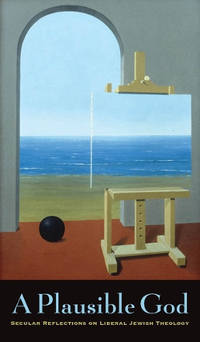
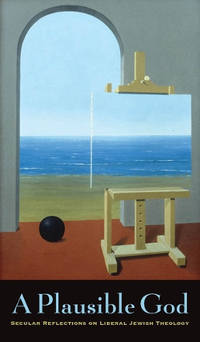
ref. A9780823226825Paperback / softback. New. Evaluates the new God by analyzing the theology of three Jewish thinkers - Mordechai Kaplan Michael Lerner and Arthur Green - and compares faith in the new God to disbelief in any gods. This book reveals what is at stake in the choice between naturalistic liberal theology and a nontheistic naturalism without gods. paperback
ref. A9780823226818Hardback. New. Evaluates the new God by analyzing the theology of three Jewish thinkers - Mordechai Kaplan Michael Lerner and Arthur Green - and compares faith in the new God to disbelief in any gods. This book reveals what is at stake in the choice between naturalistic liberal theology and a nontheistic naturalism without gods. hardcover
ref. ria9780823226825_inpPaperback. New. New Book; Fast Shipping from UK; Not signed; Not First Edition; At least since the seventeenth century the traditional God of Judaism Christianity and Islam has been under pressure to conform to the scientific worldview. Across the monotheistic traditions there has emerged a "liberal" c paperback
ref. ria9780823226818_inpHardcover. New. New Book; Fast Shipping from UK; Not signed; Not First Edition; Evaluates the new God by analyzing the theology of three Jewish thinkers - Mordechai Kaplan Michael Lerner and Arthur Green - and compares faith in the new God to disbelief in any gods. This book reveals what is at stake in the choice hardcover
ref. B9780823226825Paperback / softback. New. Evaluates the new God by analyzing the theology of three Jewish thinkers - Mordechai Kaplan Michael Lerner and Arthur Green - and compares faith in the new God to disbelief in any gods. This book reveals what is at stake in the choice between naturalistic liberal theology and a nontheistic naturalism without gods. paperback
ref. 62307612Fordham University Press . Hardback. New. pp. 184 Fordham University Press hardcover
ref. 56015701-6Fordham University Press. Used - Good. Former library copy. Pages intact with minimal writing/highlighting. The binding may be loose and creased. Dust jackets/supplements are not included. Includes library markings. Stock photo provided. Product includes identifying sticker. Better World Books: Buy Books. Do Good. Fordham University Press unknown