8,033 results
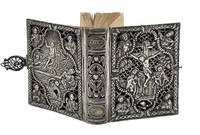
ref. 2026316mo 106 x 69 mm 165 i. e. 167-1 f. a–z8 A–H8; aa–xx8 text in greek some decorative headpieces Woodcut printer's device on the title and the verso of the last leaf XX8. 19 th C. Armenian silver binding openwork with embossed parts on red velvet spine decorated with putti and the letters TETP for Tetra in a medallion sides displaying on the front cover the Crucifixion and on the lower cover the Resurrection both with the four Evangelists in the corners; minor restoration to the margin of the final leaf. Second part of the New Testament printed by Benoît Prévost for Pierre Haultin. It contains the Epistles of Saint Paul the Catholic Epistles and the Apocalypse of Saint John. Both parts were published separately with their own pagination. The printer mark of Pierre Haultin I appears on the title page BATYR no. 27878 with his motto in Greek and Latin: Kratos thanatou kai zôēs. Imperium mortis & vitae. According to Renouard Benoît Prévost and Pierre Hautin share the same allegorical printer's mark: alpha and omega on an open Bible with a sword and pen intertwined beneath a radiant sun background. Fine copy in a lavish Armenian silver embossed binding. Provenance: Roderick Terry his bookplate clergyman and a renowned book collector of Newport Rhode Island not in his catalogue. References: USTC 160075. French Vernacular Books 57900; Renouard Imprimeurs parisiens 305-306 et 177-178. For example of Armenian silver binding see Kouymjian Dickran "Armenian bookbinding from manuscript to printed book Sixteenth to nineteenth century" in: Gazette du livre médiéval n°49. Automne 2006. pp. 1-14. Mariam Vardanyan "The Collection of Silver Book Bindings of the Armenian Museum in Bucharest and their Relationship to Eastern and Western Arts" in Series Byzantina Studies on Byzantine and Post -Byzantine Art Vol. XV 2017. pp. 81-96. Paris, Benedictus Praevotius, 1549 hardcover
1750ref. 4310The binding probably Augsburg 1750. Agenda-format binding size 155 x 78 x 24 mm. Contents: 143 small engravings all but the first 48-50 x 35-37 mm. the first mounted sideways measuring 50 x 97 mm. consisting of 11 engravings for each saint trimmed to borders and mounted on 78 leaves of wove paper. 18th-century German silver-gilt embossed binding regilt in the 19th century both covers with a large oval cartouche containing a scene of the Crucifixion on the upper cover and the Resurrection on lower cover both covers with cherubs within ornamental foliage at the four corners the pair at top holding a cartouche with a scene of the Entombment on upper cover and the Ascension on lower cover the pair at the foot holding laurel wreaths and flanking a winged angel’s head; spine with embossed flowers ribbons and foliate ornaments above and below a central scene of Moses with the brazen serpent at top a monogram of the letters CJ; two chased metal fore-edge clasps attaching on upper cover; lined in later 19th-century green watered silk edges gilt and gauffered. Housed in a folding cloth felt-lined folding case upper cover with morocco gilt label with Abbey’s named coat of arms; his paper shelf-mark label JA 2680 on lower cover. Provenance: unidentified monogram on binding; Major John Roland Abbey 1894-1969 bookplate on case; see Hayward Silver Bindings no. 17; Bernard Breslauer anonymous sale Sotheby’s 10 May 1985 “Silver and Enamel Bindings” lot 26 unsold. A stunning embossed silver-gilt binding almost certainly produced in Augsburg from the collection of Major Abbey. The binding dates from the “last phase of baroque and the fully developed rococo” Hayward the final culminating period of Augsburg craftsmanship in embossed silver. Describing this binding and two others from the collection Hayward wrote: “the most finely worked book-covers in the Abbey Collection date from the second quarter of the Eighteenth Century. The subjects are the familiar scenes from the life of Christ but treated even in the small compass of a book-cover with extraordinary dramatic force. The designs were probably derived from a contemporary illustrated Bible but their effectiveness is greatly enhanced by the relief in which they are rendered and by the strong contrasts of light and shade” p. 3. To accentuate the pathos the silversmith or designer chose to highlight minor characters: in the dramatic Crucifixion scene the most deeply embossed figures occupying the foreground are two soldiers throwing dice at the foot of the cross; similarly the centurion is the largest and most solid figure in the Resurrection scene on the lower cover. The binding encloses an album of 143 fine small unsigned 17th-century probably Flemish engravings of Franciscan saints neatly mounted on wove paper. The Antwerp engraver and print publisher Philips Galle had initiated the vogue for “Franciscan” prints with his series of engravings of the Life of St. Francis first produced before 1580 cf. Sellink pp. 129-131. The present suite contains 13 series each with 11 small engravings depicting a saint or group of saints as follows: St. Francis The 5 Martyred Saints the 7 Martyred Saints Anthony of Padua Bonaventura Ludovicus Episcopius Bernardino of Siena John of Capestrano Didacus Diego of Alcalá Clare of Assisi Elizabeth of Hungary S. Elizabeth vidua Louis of France and Elzear. With one exception John of Capestrano instead of St. Ivo of Brittany these were the saints chosen by Hendrik Sedulius guardian of the Antwerp Franciscans for his Imagines Sanctorum Francisci printed and illustrated by Philips Galle in 1602 but that quarto-format work only includes one large engraving per saint each accompanied by a page of text. The exact source of this more extensive small format suite remains to be identified. Each engraving has a caption citing a chapter number. Major John Roland Abbey assembled the largest English book collection of his generation. His first love was bindings and among these he brought together an exceptional group of silver bindings some of which were described and illustrated by John F. Hayward in an article published in The Connoisseur in 1952. The present binding is number 17; Hayward noted its earlier regilding as well as the “fine quality” of the embossing. Bernard Breslauer later bought the collection en bloc from Abbey’s widow “and in 1985 Bernard consigned the collection with some additions from his own stock to Sotheby’s London. Despite Sotheby’s well-illustrated and informative catalogue the sale was calamitous: of the fifty-eight silver and enamel bindings only fourteen met the reserve” Laird p. 67. This binding was not one of them. Cf. M. S. Sellink Philips Galle 1537-1612: engraver and print publisher in Haarlem and Antwerp PhD ThesisVrije Universiteit Amsterdam 1997 online. J. F. Hayward Silver Bindings from the J. R. Abbey Collection offprint from The Connoisseur October 1952. Cf. M. Laird “Bernd Bernard Hartmut Breslauer 1918-2004: A Personal Memoir” Gazette of the Grolier Club 72 2023 59-92. Thanks to Mr. Laird for sharing the sale results from B. Breslauer’s own catalogue in his possession. unknown
1770ref. 97Birmingham or Sheffield 1770. Oblong folio. 390 x 220 mm. 15 1/4 x 8 3/4 inches. Vellum spine over decorative blue paper wrappers paper label with title in Italian on upper board and ink title in Italian on spine. Paper stock toned with age a few leaves with staining in the margin otherwise in good condition. Silversmith model book containing 80 full-page engravings of candles sticks and holders candelabra pitchers plates salt and pepper shakers serving utensils silverware and other household pieces. Each image is beautifully and careful engraved with rich detail and ornamentation. Each includes a printed product number as well as one in ink with a different item number and a price. Although there is no title-page or signatures of engravers this large sales catalogue appears to be English as some of the engravings have English words of explanation engraved in the text. The binding is definitely Italian and the paper label is in an Italian hand. The watermark is a "fleur de lis" pattern suggesting an international company manufacturing the silver. There were only a few English companies with the capacity to export at this time including silver works in Sheffield and Birmingham both of which by 1770's had established networks of dealers selling their wares across the continent. This catalogue with specific Italian connections is very unusual and suggests the scope of the business had reached export capacity by the third quarter of the century. The most important Italian silver makers at this time were Giardini of Rome and Venuti of Naples. unknown books
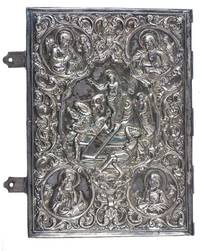
1725ref. 2168Netherlands 1725. Pair of embossed silver book covers 34 x 25 x 3 cm; each cover with a large scrollwork cartouche surrounded by extensive vine and flower decorations and with medallion portraits in each of the four corners the front showing the crucifixion flanked by Mary and St. John with an INRI scroll above flanked by a crescent moon and a sun and a skull and crossbones below with portraits of four saints each with a blank scroll above left bearded with a regal crown; above right clean-shaven with a round-topped mitre; below left and right bare-headed and bearded the back showing the resurrection with an angel and two astonished guards with portraits of the four Evangelists. Beautiful richly decorated early 18th-century Dutch silver binding. The large silver covers together weighing about 750 grams bear no silver marks. Although no spine is present the clasps show that the binding was made for a book about 2 cm thick suggesting 200 or 300 pages so most likely made for a folio missal. The clasps are hinged to the back cover each with a round hole that fastens to a round-headed pin on the fore-edge of the front cover.With a 1 cm crack on the fore-edge of the back cover another slightly affecting the arm of one guard and a few tiny holes where the tips of the noses of some figures have worn but still generally in good condition. A lovely and unusually large pair of embossed silver book covers.l Cf. J.W. Frederiks Dutch silver vol. 4 1961 nos. 238-239 & plates 235-237 vaguely similar silver bindings from 1732 & 1738; nothing similar in J.F. Hayward Silver bindings from the J.R. Abbey collection. unknown
1770ref. 97Birmingham or Sheffield 1770. Oblong folio. 390 x 220 mm. 15 1/4 x 8 3/4 inches. Vellum spine over decorative blue paper wrappers paper label with title in Italian on upper board and ink title in Italian on spine. Paper stock toned with age a few leaves with staining in the margin otherwise in good condition. Silversmith model book containing 80 full-page engravings of candles sticks and holders candelabra pitchers plates salt and pepper shakers serving utensils silverware and other household pieces. Each image is beautifully and careful engraved with rich detail and ornamentation. Each includes a printed product number as well as one in ink with a different item number and a price. Although there is no title-page or signatures of engravers this large sales catalogue appears to be English as some of the engravings have English words of explanation engraved in the text. The binding is definitely Italian and the paper label is in an Italian hand. The watermark is a "fleur de lis" pattern suggesting an international company manufacturing the silver. There were only a few English companies with the capacity to export at this time including silver works in Sheffield and Birmingham both of which by 1770's had established networks of dealers selling their wares across the continent. This catalogue with specific Italian connections is very unusual and suggests the scope of the business had reached export capacity by the third quarter of the century. The most important Italian silver makers at this time were Giardini of Rome and Venuti of Naples. . unknown
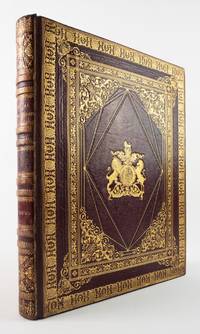
1415ref. ST21130bLondon: Printed for Js. Jenkins . . . by L. Harrison & J. C. Leigh 1814-15; leaves watermarked 1811. FIRST EDITION FIRST ISSUE. ONE OF 100 LARGE PAPER COPIES per Abbey. 414 x 330 mm. 16 1/4 x 14". viii pp. 1 leaf contents 60 leaves of description iv pp. list of subscribers. REGAL CONTEMPORARY BURGUNDY STRAIGHT-GRAIN MOROCCO LAVISHLY GILT covers bordered by decorative roll central panel framed by multiple gilt fillets and palmette roll royal arms of Great Britain at center enclosed within a fillet lozenge and octagon raised bands spine gilt in compartments that at head and tail with large ornate fleurons composed of lancet and palmette tools gilt lettering turn-ins with delicate gilt palmette roll leather hinges bright blue endleaves all edges gilt. Very expertly rebacked retaining original backstrip. Engraved title page with vignette uncolored and 53 SUPERB HAND-COLORED AQUATINT PLATES including the arms of the dedicatee the Duke of Wellington an allegorical frontispiece and 51 martial scenes mostly battles all with original tissue guards. WITH AN ORIGINAL WATERCOLOR OF ONE OF THE PLATES The meeting of the Emperors of Russia and Austria King of Prussia & Crown Prince of Sweden in the Great Square of Leipzig Oct. 18th 1813 SIGNED W. Heath 1814. A Large Paper Copy. Abbey Life 365; Prideaux p. 34; Tooley 281. Slight variation in color of spine leather a bit of shelfwear to tail edge of boards just a hint of wear elsewhere; tissue guards somewhat foxed but text and plates happily unaffected. AN ESPECIALLY FINE COPY--entirely clean fresh and bright internally with vibrant coloring in a stately binding brimming with extravagantly glittering gilt. In a spectacular period binding this monumental copy of Jenkins' tribute to the British army is accompanied by an original watercolor by its illustrator. Dedicated to the Duke of Wellington who Jenkins writes in the dedicatory letter has "raised the character of the British soldier in the scale of humanity" this volume is a celebration of the victory of Britain and its allies in the Napoleonic Wars. The richly colored plates are the work of William Heath 1794/5-1840; his original watercolor offered with our volume corresponds to the plate "Entrance of the Allied Sovereigns into Leipsic sic" commemorating a decisive victory for Britain and its allies that ended Napoleon's occupation east of the Rhine and paved the way for his eventual total defeat. The watercolor reveals a notable level of delicacy with carefully rendered details emerging from the hazy clouds of battle. Now best remembered for his career as a cartoonist and caricaturist Heath began as a military painter with the present work being his best known from the period. Full of movement and drama his scenes depict pivotal moments from major British military campaigns and are accompanied by descriptions of each battle often including excerpts from the letters or reports of the officers involved. In addition to its memorable binding and its early watermarks our copy is distinguished by its size--it measures a full three inches taller than the Abbey copy with broad impressive margins around the text and illustrations. Printed for Js. Jenkins . . . by L. Harrison & J. C. Leigh unknown
AN IMPORTANT COLLECTION, IN EXCELLENT CONDITION, OF 19TH-CENTURY DEPICTIONS OF PYRENEAN SCENERY, executed in lithography (often hand-colored), aquatint, and engraving. ***(1) An unusually fine set of Melling's large folio "Voyage pittoresque dans les Pyrenees francais" (1826-1830), complete with 72 delicate aquatints, a map, a lithographed portrait of the artist, and the text by Cervini. Attractively bound and with clean, unfoxed plates (most unusual for this book). ***(2) TWO fine sets of Victor Petit's folio "Souvenirs des Pyrenees", with about 50 lithographs per set. The first set is beautifully hand-colored on fine wove paper; the second set uncolored on chine. As usual with these albums, the sets offer interesting bibliographical differences. ***(3) Two beautiful sets (30 lithographs per set) of Petit's folio "Bagneres de Luchon et ses environs", one colored and one uncolored on chine. ***(4) Two excellent (and different) complete sets of Ciceri's "Les Pyrenees dessinees d'apres nature", both very fresh, in their original bindings. ***(5) Two copies (one colored, one uncolored) of "Alpes et Pyrenees" (1842), both in publisher's cloth. ***(6) Several additional albums by Gorse (two, one with rectangular lithographs and one with oval), Allom, and others, including a few miniature albums. Many of these items are quite rare, and all are in very good condition. Several hundred prints in all. An outstanding collection. (I may consider selling one or more items separately. Please enquire.)
ref. 7024Japan: 1816 or after. A fine complete and uncommonly well-illustrated set of scrolls concerning the famous gold silver and copper mine on Sado Island illustrating all the steps from mining to refining to minting along with the administrative and commercial activities associated with the mines. We have had several sets of "Sado Island Scrolls" and this is by far the finest in terms of the quality of the illustration completeness and richness of detail. The skilled artist of these scrolls has provided an enormous amount of valuable factual content by labeling each depicted person's role in the production of gold silver and copper. For a really excellent account of the history of mining on Sado Island and the scrolls produced there see Hamish Todd "The British Library's Sado Mining Scrolls" in The British Library Journal Vol. 24 No. 1 Spring 1998 pp. 130-43. Our description is largely based on this wonderful and beautifully researched article. Gold silver and copper mining on Sado Island just off the coast of Niigata Prefecture had its beginnings in ancient times. With the discovery in 1601 of the rich Aikawa gold and silver mine Sado experienced an economic boom. The Edo shogunate assembled miners and slave laborers mostly the homeless from throughout Japan and sent them to Sado to exploit the Aikawa mine and three other principal mines. It soon became the largest gold and silver mine in Japan attracting a population of 200000 and to a very large degree financed the Edo shogunate for several hundred years. A series of unique mining smelting and minting technologies developed at Sado were disseminated to other mines within Japan. Today the Sado complex of mines is on the "Tentative List" of Unesco World Heritage Sites. The Aikawa mine was one of the few mines at the time to be based on kodobori mine-digging. A series of pre-modern mine management systems and mining-related technologies ranging from mining to smelting were developed at Sado including methods for extracting gold from silver such as the Chinese haifuki cupellation method brought in from the Iwami Ginzan Silver Mine Shimane Prefecture; the yakikin method; as well as manufacturing-based operational formats such as the yoseseriba. It is particularly important to remember that the entire series of processes from mining and smelting to ultimately the production of gold coinage were carried out at this single mine and its environs. The finely drawn scrolls depict every process of extraction refining and minting. Each scroll has a title on a label on the outside: "Sado kozan saikutsu jikkei" "Actual View of Sado Mining". As we unroll the scroll we find another title "Sashu kingin saisei zenzu" "Sado Gold & Silver Extracted & Processed Illustrated" and a grand index of the pictorial contents of the three scrolls. The first scroll begins with a map showing the Aikawa mountain and the numerous entrances to the mining complex with names and locations of refining buildings. This is followed by wonderful paintings of the main entrance to the mine and the surrounding buildings; miners entering and working in the shafts; the ladders made from logs into which steps have been cut; lamps made of iron dishes to hold oil and attached to long iron handles; buckets and pulleys to remove water; baskets to carry ore; government officials the mine operator and surveyors discussing the best location for a new tunnel; carpenters constructing support beams; etc. Each person has a label so we know his exact title and function. The remainder of the scroll takes place outside of the mine: blacksmiths making tools; women removing waste material from the ore and placing the ore in sieves to be washed under the watchful eye of government supervisors; the administrative center for the mine where the ore is graded for sale to the smelters with a bookkeeper recording all the transactions; a back office where managers senior administrators of the mine and accountants are meeting; a room where the ore is examined once again; the ore sewn into sacks and carried out to be loaded onto oxen to be transported to the smelting works; a storage area with big locks; another government office where mine workers turned in their ID cards at the beginning of their shifts; the building known as Kanaba where the ore was pulverized to win the precious metals; a horsetail sieve to separate the ore into various constituents; grinding of the ore using ishiusu grindstones; the process of nekonagashi which used cotton cloth in wooden troughs to extract the very smallest particles using the gravimetric principle etc. The second scroll depicts the smelters called fukidaiku with men operating the bellows all watched by a guard. The gold/silver/lead alloy was then taken to an area called the Haifukidoko where the alloy was subjected to roasting in a cupel. The following scene shows the government office where the gold sujimengane and silver yamabukigin samples are examined. Now we shift to the scenes showing the processing of copper. We see the pulverizing and winning of the copper using methods similar to those for gold and silver with the addition of extensive smelting scenes employing large smelting furnaces nibukidoko mabukidoko and nanbandoko. There are a number of processing scenes including daifukisho which are not present in the BL set of scrolls. From the copper works we move to the coast of Sado where we see the extraction of alluvial gold and silver from the sand of the beaches by means of a technique called sluicing or nekonagashi. An Archimedes screw is used to draw water up to form a flow that could be used for sluicing. The material is then taken to a building called the Hamanagashi no seriba for further processing. The third scroll is devoted to minting in the Kobandokoro where small coins called koban were produced. Using the cementation process called shioyaki the partly refined gold is further refined. Above is a criss-cross construction of wooden planks known as a senryodana designed to trap any gold dust mixed with smoke from the smelting. The workers are wearing only loin cloths to prevent theft. The powdered gold is then mixed with salt and shaped into cones. Then the cones are burned slowly for seven or eight hours. Further processing steps are shown finally resulting in balls of gold called yosegane suitable for minting. Next the silver by-product is shown being processed and refined in a series of scenes. The following series of scenes show the gold being formed into metal strips called nobegane which were then polished by salt before being sent to the office run by the Goto family the Goto Yakusho. We see Sanemon Goto 2nd d. 1845 in his office. He succeeded to running the Goto Yakusho in 1816 and this is the basis for dating these scrolls. In this office the strips were tested for purity before being cut into small sections. In fine condition. There is minor marginal worming in the beginning of the second and third scrolls. hardcover books