Timothy SilverBiblio.com

6,819 results
ref. 6380697Cambridge University Press CUP . Papeback. New. Cambridge University Press CUP unknown
ref. 0663461715.Gpaperback. Good. Access codes and supplements are not guaranteed with used items. May be an ex-library book. paperback
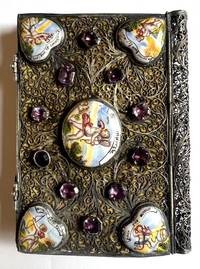
ref. 4426Paris 18th century. Silver filigree binding 82 x 60 mm. including spine. The covers of filigree volutes and curling tendrils with inset painted enamel oval centerpiece and heart-shaped corner-pieces showing putti in pastoral settings below love-related mottos in French central plaque on front cover slightly damaged both covers decorated with ten glass “amethysts”; hollow tubular filigree spine pair of fore-edge clasps and catches the silver binding mounted over later yellow silk-covered thin pasteboards the yellow silk liners with pockets front and back; preserved in a modern morocco case. Containing a 20th-century illustrated manuscript on parchment pasted in partly loose. This silver binding with painted enamel plaques belongs to a group of similarly decorated late 17th- or 18th-century miniature bindings. Several are on late 17th-century printed books or 18th-century manuscripts which have an Italian connection and although their style may have been imitated in various centers of book production it seems likely that most of the bindings were produced in Italy. I know of 15 such bindings including this one. Most are found on various late 17th-century editions of the Office of the Virgin printed in Paris from the 1670s to the early 1690s but including editions in Italian; these little Offices seem to have been produced at least in part for the Italian market. Two of the bindings were used for Hebrew manuscript prayerbooks produced in Italy. A census is available on request: it expands on that drawn up and kindly shared by Dr. Jan Storm van Leeuwen who published an earlier version in the catalogue of Patricia Pistner’s miniature book collection A Matter of Size no. 123. All but one of the bindings are miniature measuring approximately 82 x 55/58 mm. and are adorned with 12 to 20 cut-glass “jewels.” The silverwork is of two types: ten are filigree with spiraling volutes as in this binding and five are in a floral ajouré or openwork design with stems leaves and blossoms as in the Pistner example. The enamel plaques are also of two types not correlated with the two different silverwork types. The majority eleven show Christian religious figures with no inscriptions; these are in at least two different styles and were probably produced in different workshops. They are all found on editions of the Office of the Virgin printed between 1672 and 1693 all but one in Paris. Four bindings including this one have secular plaques painted in a rough folk-art style with putti and archaically spelled mottos relating to love. The other three bindings with secular motifs are the Pistner binding which is empty and two other filigree examples both bound over Jewish or Hebrew manuscripts: one is in a private Swiss collection and the other in which the plaque inscriptions are in Italian is held by Penn State University acquired from us. All four of these “secular” bindings have oddly shaped spines some slightly deformed. This seems to be the result of reworking the spines to accommodate thinner text blocks than those for which they were originally intended. The design of the catches and joints of the present binding and its filigree silverwork are similar to the other filigree secular bindings. The plaques especially resemble those of the example in the Swiss collection; one of the central plaques shares the same inscription here Rien m’arrest; in the other binding Rien m’arreste. However the fine condition and perfectly rounded spine of this binding may also point to some 19th-century restoration. Bookbindings of silver and previous metal were kept and reused through generations and thus often appear on much later books or manuscripts. This binding presently houses a 20th-century mildly erotic manuscript in French on 10 vellum leaves the title Cantique de Salomon in a crowned frame the 9 following leaves containing amateurish pencil and watercolor drawings with one- or two-line captions on rectos only. Originally glued in most of the leaves are now loose. The manuscript is disposed in the style of a Hebrew codex with the page order from left to right and the Hebrew transcription of the name of God YHWH appears at the top of the title. For examples of the analogous bindings see A Matter of Size: Miniature bindings and texts from the collection of Patricia J. Pistner 2019 no. 123 referring to 7 such bindings; F. Malaguzzi Collezioni del Museo civico d'arte antica di Torino: legature Turin 2011 no. 92; Luigi Mallé Smalti - Avori del Museo d’Arte Antico Turin 1969 pp. 113-114; G. Fletcher Judging a Book by its Cover: Bookbindings in the Collections of the Grolier Club NY 2023 no. 3.13; Musinsky Rare Books Catalogue 28 item 7; Patrick Olson NY Book Fair List 2024. unknown books
ref. 4426Paris 18th century. Silver filigree binding 82 x 60 mm. including spine. The covers of filigree volutes and curling tendrils with inset painted enamel oval centerpiece and heart-shaped corner-pieces showing putti in pastoral settings below love-related mottos in French central plaque on front cover slightly damaged both covers decorated with ten glass “amethysts”; hollow tubular filigree spine pair of fore-edge clasps and catches the silver binding mounted over later yellow silk-covered thin pasteboards the yellow silk liners with pockets front and back; preserved in a modern morocco case. Containing a 20th-century illustrated manuscript on parchment pasted in partly loose. This silver binding with painted enamel plaques belongs to a group of similarly decorated late 17th- or 18th-century miniature bindings. Several are on late 17th-century printed books or 18th-century manuscripts which have an Italian connection and although their style may have been imitated in various centers of book production it seems likely that most of the bindings were produced in Italy. I know of 15 such bindings including this one. Most are found on various late 17th-century editions of the Office of the Virgin printed in Paris from the 1670s to the early 1690s but including editions in Italian; these little Offices seem to have been produced at least in part for the Italian market. Two of the bindings were used for Hebrew manuscript prayerbooks produced in Italy. A census is available on request: it expands on that drawn up and kindly shared by Dr. Jan Storm van Leeuwen who published an earlier version in the catalogue of Patricia Pistner’s miniature book collection A Matter of Size no. 123. All but one of the bindings are miniature measuring approximately 82 x 55/58 mm. and are adorned with 12 to 20 cut-glass “jewels.” The silverwork is of two types: ten are filigree with spiraling volutes as in this binding and five are in a floral ajouré or openwork design with stems leaves and blossoms as in the Pistner example. The enamel plaques are also of two types not correlated with the two different silverwork types. The majority eleven show Christian religious figures with no inscriptions; these are in at least two different styles and were probably produced in different workshops. They are all found on editions of the Office of the Virgin printed between 1672 and 1693 all but one in Paris. Four bindings including this one have secular plaques painted in a rough folk-art style with putti and archaically spelled mottos relating to love. The other three bindings with secular motifs are the Pistner binding which is empty and two other filigree examples both bound over Jewish or Hebrew manuscripts: one is in a private Swiss collection and the other in which the plaque inscriptions are in Italian is held by Penn State University acquired from us. All four of these “secular” bindings have oddly shaped spines some slightly deformed. This seems to be the result of reworking the spines to accommodate thinner text blocks than those for which they were originally intended. The design of the catches and joints of the present binding and its filigree silverwork are similar to the other filigree secular bindings. The plaques especially resemble those of the example in the Swiss collection; one of the central plaques shares the same inscription here Rien m’arrest; in the other binding Rien m’arreste. However the fine condition and perfectly rounded spine of this binding may also point to some 19th-century restoration. Bookbindings of silver and previous metal were kept and reused through generations and thus often appear on much later books or manuscripts. This binding presently houses a 20th-century mildly erotic manuscript in French on 10 vellum leaves the title Cantique de Salomon in a crowned frame the 9 following leaves containing amateurish pencil and watercolor drawings with one- or two-line captions on rectos only. Originally glued in most of the leaves are now loose. The manuscript is disposed in the style of a Hebrew codex with the page order from left to right and the Hebrew transcription of the name of God YHWH appears at the top of the title. For examples of the analogous bindings see A Matter of Size: Miniature bindings and texts from the collection of Patricia J. Pistner 2019 no. 123 referring to 7 such bindings; F. Malaguzzi Collezioni del Museo civico d'arte antica di Torino: legature Turin 2011 no. 92; Luigi Mallé Smalti - Avori del Museo d’Arte Antico Turin 1969 pp. 113-114; G. Fletcher Judging a Book by its Cover: Bookbindings in the Collections of the Grolier Club NY 2023 no. 3.13; Musinsky Rare Books Catalogue 28 item 7; Patrick Olson NY Book Fair List 2024. unknown
ref. AQ28607s.i.: s.n. 1885-86 45 leaves 23 used the remainder blank. Later limp black cloth. Extremities worn. Internally clean and crisp. Armorial bookplates of Peter Campbell and Charles William Orde loosely inserted. A late nineteenth-century manuscript inventory in a single legible hand recording the silver plate gold plate and china at the estate of the Campbell-Orde baronets Kilmory House Argyll. The majority of the plate is registered by the chest in which it was housed one marked as the property of Royal Navy officer Admiral Sir John Orde 1751-1824 another as belonging to the second baronet Sir John Powlett Orde 1803-1878 who following the death of both his wife and father-in-law inherited Kilmory. Orde rebuilt the house in a Gothic style to a design by architect Joseph Gordon Davis and remodelled the grounds with the aid of William Jackson Hooker. He was succeeded by his son Sir John William Powlett Orde 1827-1897 who in 1880 obtained Royal Licence to assume the surname of Campbell- Orde. Kilmory is now the headquarters of Argyll and Bute Council. . Quarto. [s.n.], [1885-86] hardcover
ref. 133199487X.Gpaperback. Good. Access codes and supplements are not guaranteed with used items. May be an ex-library book. paperback
1988ref. x-0416092624Routledge 1988. Paperback. New. 1st edition. 277 pages. 8.19x5.51x1.02 inches. Routledge paperback
ref. 3999847-nnew. unknown
ref. 3999847like new. unknown
ref. A9780416092622Paperback / softback. New. Aims to rescue a usable interpretation of the vocational theory in higher education by describing the historical and policy frameworks of the debate. paperback
ref. B9780416092622Paperback / softback. New. Aims to rescue a usable interpretation of the vocational theory in higher education by describing the historical and policy frameworks of the debate. paperback
ref. 62505555Egmont Books Limited . Papeback. New. pp. 284 Egmont Books Limited unknown
1988ref. DADAX0416092624Routledge 1988-03-03. paperback. New. 5.50x0.64x8.50. Buy with confidence. Excellent Customer Service & Return policy. Routledge paperback
ref. 096270914X.Gpaperback. Good. Access codes and supplements are not guaranteed with used items. May be an ex-library book. paperback
1995ref. 124-08-53Tel Aviv: Mopane 1995. Limited/Numberedsigned by the Aritist. Stiff Wraps. Near Fine. unpaginated limited edition 68/150 signed by the artist and inscribed and signed by the artist. beautiful copy Mopane paperback
ref. 53351248-nnew. unknown
1974ref. 2609210018Basic Books Inc 1974-01-01. hardcover. Very Good. 0x0x0. 2 volume set. Near fine. Hardcover in slip case. Good binding and cover. Clean unmarked pages. This is an oversized or heavy book which WILL require additional postage for Priority Mail or International delivery outside the US. Basic Books, Inc hardcover
ref. A9781258465261Hardback. New. hardcover
ref. A9781258469849Paperback / softback. New. paperback
ref. KD-ZQEP-VMGSHardcover. Good. Jacket is worn torn faded and stained. Book has moderate wear a bumped corner foxing to textblock edges and endpapers pages yellowed with an occasional minor blemish binding firm. hardcover
ref. 106950Toronto: University of Saskatchewan and the University of Toronto Press 1973. Cloth 8vo Near fine in very good dust jacket. 1039p maps some folding in rear pocket. The second edition with a new preface and introduction by Lewis G. Thomas and an appendix compiled by the author. Peel 3693 first edition reference. Jacket clipped and shows edgewear Else a beautriful copy. University of Saskatchewan and the University of Toronto Press Hardcover
2014ref. 1-0807033111Beacon Pr 2014. Hardcover. New. 256 pages. 8.50x5.75x1.00 inches. Beacon Pr hardcover
ref. 1025713087.Ghardcover. Good. Access codes and supplements are not guaranteed with used items. May be an ex-library book. hardcover
ref. 53351248like new. unknown