3 547 résultats
1952réf. 63445Shishmaref Nome & Anchorage Alaska: Published exclusively by Alaska Crippled Children’s Association 1952. 12mo. 1 36 1 leaves mimeograph typescript throghout. Light-green tinted illustrated softcovers yapp fore-edges minor soiling edgewear some rubbing still a good copy. Second edition of this fascinating fund-raiser local cookbook drawn from recipes collected and edited by the Shismaref Day School students from their family traditions. These fascinating recipes with instructions encompass desserts such as Lingcod Eskimo Ice-Cream & Sue-wok Dried Salmon Eggs assorted boiled fried and dried fish; Pussy Willow greens Sourah & Ah-lowe-kuk Wild Chard along with roasted bear meat fried & baked seal liver and others. Sockpick Evans 1937-2021 helped to raise her 12 brothers & sisters in Shishmaref attended the Day School through the 8th Grade contracted tuberculosis during the epidemic and spent two years in the same sanatorium as Betty MacDonald and was noted for her accomplished ivory carfvings and traditional parkas uspuks and Eskimo dolls. Published exclusively by Alaska Crippled Children’s Association, paperback
1940réf. 64674Chicago IL: Published by Jessie Marie DeBoth 1940. 8vo. 96 pp. Illustrated title page text illustrations throughout. Pictorial blue cloth gilt illustration & lettering w/ d.j. minor shelfwear rubbing NF/NF copy. First edition of this wonderful anthology sportsmen’s recipes recommending how to handle fish wild game and fowl by such authors as Chef Amiet of the Palmer House Chicago; explorer and wild animal collector Frank Buck; western author Zane Grey; big game hunter Elmer Keith; actor & gourmand Vincent Price’s Brook Trout au vin blanc; and Theodore Roosevelt’s duck rolled and baked in clay. Ms. DeBoth 1890-1959 was a noted homemaker’s popular lecturer toured the country delivering sessions at cooking and homemaking classes in Home Economics lectures and her daily column “Jessie’s Notebook” was a popular daily installment in the Chicago Daily Tribune and also owned and operated the DeBoth Homemakers Schools and later expanded to radio and television cooking programming by the 1940’s-1950’s. Published by Jessie Marie DeBoth, hardcover
1920réf. 64634Minneapolis MN & Chicago IL: Washburn-Crosby Co. Edwards & Deutsch Lithographing Co. ca. 1920. Two large colour lithograph linen-backed posters sized 28 x 41 in. with the first illustrating the 24 steps with illustrations and text in green black & red green & red borders and lettering; 2nd cutaway image of wheat kernel on deep blue background minor edgewear dustsoiling to fore-edges some minor creasing & wear still a VG pair of original posters. First editions thus of these marvelous colour lithograph advertising and education posters detailing the Gold Medal Flour Milling process by the Washburn-Crosby Co. mills during the Progressive Era. Washburn-Crosby Co. had been founded in the 19th-Century and after inventing the middlings purifier for producing high quality flour from the Spring wheat grown in Minnesota and the Dakotas quickly expanded. Washburn-Crosby also introduced the gradual reduction process through pulverizing porcelain chilled iron or steel rollers to gradually pulverize the purified middlings and integrate the gluten with starch and finally they installed the exhaust system of William de la Barre to reduce the risk of explostions. A smaller version of this cutaway design of a Washburn-Crosby flour mill first appeared in the 1915 Wheat & Flour Primer advertising their Gold Medal Flour and this one was issued just a few hours later in a larger format detailing how the consumer could trust the purity of Gold Medal Flour. The second cutaway poster vividly illustrates the ideal Spring wheat kernel used by the company and details the various layers and their terminology. Edwards & Deutsch Lithographing Co. was first founded in 1896 and continued to be one of Chicago’s most successful poster and packaging colour lithography printers through the 1920’s. Worldcat locates 2 copies of the 1st Cleveland Pub. & Nat. Agr. Lib.; No copies located of 2nd. Washburn-Crosby Co., Edwards & Deutsch Lithographing Co., unknown
1936réf. 64381New York: Emerson Books Inc. 1936. 8vo. xii 13-252 pp. Green publisher’s cloth gilt lettering slight sunning to fore-edges w/ d.j. minor tears & chipping to foot of spine shelfwear slight sunning still NF/G copy from the library of Eleanore Weinstock. First edition of this informative work detailing food history and physiology as well as introducing the author’s new 14-day diets for reducing putting on weight and staying put. These are offered with detailed daily menus valuable charts on calorie content vitamins food values as well as height-and-weight figures. Emerson Books, Inc., hardcover
1953réf. 63789New York: John Wiley & Sons Inc. 1953. 8vo. viii 444 pp. Text illustrations diagrams tables. Blue publisher’s cloth dark blue & gilt lettering front cover & spine minor offset soiling from old brodart cover fore-edges w/ d.j. minor edgewear old tape repair to closed tear w/ offsetting still G/G copy. Third edition significantly revised & enlarged from the original first issued in 1937 and featuring a much expanded section on the use of frozen foods in large institutional menus and food service. All the recipes were standardized for 50 or more servings definitely applicable to cafeteria and food service settings in hospitals residence halls state institutions schools and more. Fowler was a longtime dietician and instructor in food service and management with St. Mary Hospital Kankakee Kansas State College Butler and later the U.S. Army & Navy. West was professor of Institutional Management at Kansas State as well as teaching at the Univ. of Washington Columbia and the Univ. of Hawaii through World War II. John Wiley & Sons, Inc., hardcover
1934réf. 62684West Bend WI: West Bend Aluminum Feb. 1934. 8vo. 15 1 pp. printed in green & black throughout. With photo & text illustrations throughout self-printed colour-illustrated softcovers Art Deco cover art of lunch counter small tear back cover minor dustsoiling darkening to fore-edges VG- copy. First edition of this remarkably scarce collection of recipes targeting drug stores soda fountains and lunch counters designed by the West Bend Aluminum cookware Home Economics Department to aid in selling cookware and economical large serving recipes. The supplied recipes include those for chili Corn Chowder Griddle Cakes Spanish Steak hot sandwiches with beef made slow cooked in the Dutch Oven and more. Of particular interest are the directions on making drip coffee with West Bend drip coffee makers and even a one-cup coffee maker. No copies in Worldcat. West Bend Aluminum, paperback
1931réf. 64685Schenectady & Albany NY; Cleveland OH; Sales Promotion Division Electric Refrigeration Dept. General Electric Co. 1931-1932. Two vols. 1st -- Seven parts. in 1 vol. 4to. 174 19 leaves w/ hand-penciled numeration i.e. 384 pp. photo-illustrated text illustrations colour-illustrated diagrams throughout colour blueprints mimeographed & dittoed typescript price lists for a couple sections and divided by orange-coloured sheets w/ thumb tabs confiled to the rear most individual parts w/ self-printed illustrated softcovers or printed softcovers occasional thumbing edgewear & toning. Deep burgundy-brown flexible cloth post-binder 3 brass screw-posts at gutter margin rounded corners embossed gilt illustration on front cover of GE Refrigerator minor shelfwear rubbing still VG bright copy; 2nd - 8vo. 5.75 x 8 in. 2 75 7 pp. With numerous text illustrations colour diagram. Flexible textured dark-brown paper split-bin binder embossed gilt illustration of GE Refrigerator on front cover minor scuffing edgewear occasional soiling still VG copy. First editions thus of these exceedingly scarce General Electric sales catalogues containing price lists sales brochures sales information and technical instructions for salesmen to retail appliance department stores hardware stores and electrical utilities across America detailing to their potential customers the home and commercial refrigerator possibilities for better preserving foodstuffs and providing cool water and ice cream. General Electric during the opening years of the Great Depression launched themselves to the top of the fast expanding refrigeration and electrification movement as they transitioned to their Monitor Top refrigerator as well as introducing their “Thermocraft” insulation material which significantly reduced weight per cubic foot and allowed them to easily out-compete their main competitors including Westinghouse and Maytag. These Monitor-top refrigerator units were marketed widely with an ad campaign emphasizing the sanitary white enamel finish on steel that “simplifies housekeeping and safeguards health” for the family built as one air-tight units for both home and commercial uses operating relatively quitely and protecting the food inside from unwanted bacteria and decay. The name Monitor-Top derives from the refrigeration unit’s resemblance to the turret on the Civil War battleship the USS Monitor and would become the bestselling refrigerator over the next decade. The Salesman’s Handbook emphasizes how the interest on the money invested in an electric refrigerator is less than the average price paid by a consumer for ice deliveries for antiquated “Iceboxes” as well as emphasizing just how much food can be stored in them ice made inside the units and how invaluable they are for keeping healthy milk and dairy products at the proper temperatures. No similar salesman’s catalogues or individual brochures located in Worldcat; See: Andrew Shanken Better Living: Toward a Cultural History of a Business Slogan Enterprise and Society Advance Access 2006 pp. 17-30; GE Monitor-Top Refrigerator The Capital Region in 50 Objects Albany Institute of History & Art 2025; Large Appliances: Innovating the Kitchen Google Arts & Culture Celebrating 1s! 2026. Sales Promotion Division, Electric Refrigeration Dept., General Electric Co., paperback
1925réf. 52767Philadelphia PA: Giunta Brothers Manufacturing Co. ca. 1925. Oblong 4to. 23 1 pp. Numerous photo illustrations text illustrations and diagrams throughout. Self-printed yellow softcovers cover art of Giunta Brothers Italian import business on front cover w/ wine presses displayed up and down the street slight shelfwear w/ original purple colour-tinted mailing envelope some chipping edgewear rubbing still NF/VG- copy. First edition of this scarce and fascinating manufacturing catalogue for the famed Philadelphia Italian importers. Featured are numerous different sizes and styles of wine and cider presses fruit grinders for the mash ice cream makers Italian style coffee roasters waffle makers and more. Of particular interest is the Giunta Brothers pasta machines which are believed by the family to have been the first patented in the United States. The company operated from 1915 to 2002 until it had to close due to the owner’s poor health. Worldcat locates 2 copies Clements Library Harvard. Giunta Brothers Manufacturing Co., paperback
1938réf. 64754New York NY & Chicago IL: National Nutrition Society 1938. 4to. 96 pp. Photo frontisp. tables charts. Textured copper-metallic publisher’s cloth red & white printed label on front cover slight bumping to couple corners some edgewear rubbing still a VG bright copy. Second printing of this scarce work by the noted American osteopath and health food writer who adapted the food healing methods and virtues of the Lindlahr Sanitarium’s “Nature Cure” and focused on combining certain foods for improving health and dieting. His father Henry Lindlahr 1862-1924 had started his practice in 1902 and in 1914 expanded to the former Lathrop Estate in Elmhurst where he treated over 80000 patients during his career including Eugene Debs who died at the Lindlahr Sanitarium and even authored five books on Natural Therapeutics. Dr. Victor Hugo Lindlahr 1897-1969 continued the Sanitarium for another four years and after its’ closing went onto a very successful career as an American health food and weight loss pioneer. See: Wilson Lindlahr Sanitarium Elmhurst Historical Museum; Sander Diets and Dieting: A Cultural Encyclopedia 2007 p. 178. National Nutrition Society, hardcover
1962réf. 63752Seattle WA: Ivar’s Acres of Clams ca. 1962. 4to. 9 x 11.25 in. 4 pp unpaginated. printed in blue on thick gray paper stock die-cut in the shape of a clam self-printed illustrated softcovers edgewear scuffing remnants of glue & black scrapbook paper on back cover still G copy. First edition thus of this promotional souvenir menu for the famed and beloved seafood restaurant first founded in 1938 by Ivar Haglund 1905-1985 alongside his longtime Aquarium tourist attraction. Although undated this menu includes mention of his popular “Clam Digger Room” cocktail lounge as well as his short-lived “Sravi” gift store opened in 1961 just prior to the opening of the 1962 Century 21 Seattle World’s Fair. Specialties included the beloved clam chowder Dungeness Crab Louie whole cracked crabs and even Wente Bros. and B.V. California wines for purchase. No copies located in Worldcat U of W does locate an earlier version dated ca. 1950 as part of their Menu Collection. Ivar’s Acres of Clams, paperback
1934réf. 63742Philadelphia PA: Dr. D. Jayne & Son Inc. 250 Delaware 1934. 12mo. 132 pp. plus 8 pp. publisher’s ads. With text illustrations. Tan illustrated softcovers Art Deco lettering front cover yapp fore-edges minor shelfwear pulling to lower fore-edge of title at gutter margin slight creasing still a VG copy from the library of Samuel S. Berman 1906-1982 longtime San Francisco attorney patron of the arts. First edition of this popular cocktail guide issued by the Philadelphia patent quackery medicine supply house first founded by David Jayne before the Civil War intending to capitalize on the revival of cocktails following the repeal of Prohibition. Including sections on drinks cobblers brandies punches cocktails theatrical drinks fizzes syrups and even helpful hints this guidebook was intended to ensure that bars & taverns offered the purest and best cocktails & drinks to their customers. Along with the myriad of cocktails & mixed drinks featuring bitters absinthe and others the work includes an extensive section on wines. Of course Jayne & Son as evidenced by the ads at the rear did not overlook the opportunities to sell their “cures” for upset stomachs constipation hangovers erectile dysfunction and skin cleansers. Dr. D. Jayne & Son, Inc., 250 Delaware, paperback
1932réf. 64228Battle Creek MI: Kellogg’s Department C 1932. 4to. 6.5 x 6.5. Colour-illustrated round volvelle w/ die-cut windows w/ small map of the United States and direction finder sized 5.5 in. in diameter affixed w/ rivet to colour-printed board illustraions in corners surrounding wheel illustration of all the states and illustrated on verso of bottom board. NF copy. First edition thus US Population 122775046 of this wonderful interactive volvelle offering children and adults not only vital statistics about each US State but also mentioning their most popular ready-to-eat cereals in each area. Kellogg’s cereals were marketed as essential health food by athletes coaches and doctors as they contained muscle-building elements. In addition children were encouraged to have another bowl after school as snack or event another at bedtime. Worldcat locates 4 copies Boston Pub. U of MI McGill Henry Ford. Kellogg’s Department C, unknown
1947réf. 64164Washington D.C.: Ice Cream Merchandising Inc. 1947. 4to. 351 1 pp. Double-page title in blue & black text in red & black with 100’s of photo and colour illustrations throughout. Brick-red publisher’s cloth lettered in black & yellow front cover spine minor bumping head & foot of spine slight fraying to corners slight interior age toning still a VG bright copy from the Excelsior Creamery Co. w/ ownership stamp on ffep. First edition of this informative and lavishly illustrated sales and merchandising manual for ice cream and frozen dairy products in the Mid-20th-Century following World War II. Sponsored by the International Association of Ice Cream Manufacturers Hennerich emphasized sales ad campaigns and encouraged training of soda fountain employees using filmstrip/cartoon strip format with sample training scripts. He also emphasized local markets the importance of competent management and improved sales techniques. Over half the book is devoted to the best recipes for ice cream sodas sundaes banana splits freezes floats shakes and more. Of particular interest are specific instructions on post-War upgrading with Mid-Century Modern counters lettering window displays lighting cost controls and adding air conditioning. Ice Cream Merchandising, Inc., hardcover
1933réf. 64704Chicago IL: Morton Salt Company 1933. 4to. 8.5 x 11 in. 32 pp. printed throughout in red blue & black. Photo illustrations text illustrations. Colour-illustrated lithograph softcovers cover art view of bib overall-dressed butcher stuffing sausages by hand w/ rear cover art touting the new Morton’s Seasoning for Sausage and Sugar-Curing Smoke-Salt slight shelfwear minor rubbing still a NF copy. First edition of this uncommon cooking & butchering brochure from the Morton Salt Company touting their newly introduced Sausage seasoning during the Great Depression. Morton Salt Co. offers here specific instructions on cutting trimming curing and how to properly use their sugar and wood smoke infused salt for meat curing along with specific recipes and instructions on making liver sausage bologna sausage blood sausage Frankfurters jerked beef and more. Worldcat locates 4 copies Hagley IA State Chicago Hist. Mus. VA Tech. Morton Salt Company, paperback
1890réf. 62797Brooklyn NY: H.I. Blits 1890. 12mo. vi 106 pp. plus 4 pp. publisher’s ads. Cobalt-blue publisher’s cloth ruling & decoration in blind gilt lettering front cover minor soiling thumbing edgewear minor wear to corners still VG- copy. New & revised edition of Blits’s formulary for canning and preserves first published in 1888 intended to offer an excellent compact work on canning and preserving fruits vegetables vinegars berries and more. Of special interest are the chapters on winemaking such as Champagne and Elderberry Wine as well as beers mead and cordials. Also addressed are a myriad of ways to preserve foods without refrigeration in high heat and for months -- some of which are remotely questionable. The work closes with some patent medicine and quackery recipes including the historic Marseille Remedy or Thieves’ Oil supposedly a mixture to fight the plague and featuring vinegars with herbs spices garlic essential oils and more. H.I. Blits, hardcover
1930réf. 63763Battle Creek MI: Battle Creek Food Company ca. 1930. 12mo. 28 pp. With black & white and colour illustrations throughout. Colour-illustrated softcovers wraparound Arts & Crafts cover art minor shelfwear still a NF copy w/ small rubber stamps for the “Oakland Health Food Store” on front cover. First edition of this surprisingly uncommon cookbook issued by the Battle Creek food Company Dietetic department encouraging and explaining Dr. John Harvey Kellogg’s vegetarian food philosophy featuring tempting appetizers modern dinner menus entrees PEP building and more all featuring Kellogg’s pre-packaged products. Battle Creek Food Company, paperback
1911réf. 56761New York: Octave Grillon 705 W. 170th St. 1911. 12mo. 140 pp. plus 4 pp. illust. manufacturers ads. Numerous text illustrations photo plates. Quarter-brown cloth over beige-coloured boards brown lettering on front cover minor soiling edgewear some rubbing still VG- copy. First edition of this very scarce candy making work detailing the processes for manufacturing and producing gum drops chewing gum jelly gum marshmallows French Swiss & German Nougat rock candy jujube paste along with instructions on how to replace albumen and white of eggs in moonshine. The author not only includes many recipes but also the necessary specialized tools equipment cooking times molds and even includes recipes for medicated gum and confectionary products. Grillon b. 1865 was as an award-winning candy maker and foreman at a candy factory in New York who had immigrated from Beaugeney France in 1907 and winner of the Culinary Exhibition Gold Medal in 1899 at Toulouse. Worldcat locates 2 copies U of Chicago Nat. Lib. of Scotland; See: Publisher’s Weekly Nov. 4 1911 p. 1477. Octave Grillon, [705 W. 170th St.], hardcover
1958réf. 62679Honolulu Hawaii: M’s Ranch House 5156 Kalanianaole Highway ca. 1958. 4to. 7.75 x 11 in. 4 pp unpaginated. printed & illustrated in black sepia & red on yellow-tinted thick paper stock minor dustsoiling to rear cover slight shelfwear still NF copy. First edition thus of this Mid-20th-Century menu for the iconic Hawaiian restaurant on the East Side of Oahu Territory of Hawaii which featured a real covered wagon with canvas that children could play in. Along with the 72 oz. steak dinner customers could order Chicken Casserole Broiled Lobster Tail Hawaiian Chop Steak Japanese Shrimp Tempura a whole fresh Pineapple Ranch House Style with their famed breadsticks and cheese sauce. As per the image on the front cover this appears to have been issued after the restaurant was renovated moved to the middle of the property with a parking lot and updated with red brick and wood facade from the original white wooden siding. M’s Ranch House, 5156 Kalanianaole Highway, unknown
1519réf. 52512New York: National Bottlers’ Gazette June 15 1921. Folio. 202 pp. 100s of text illustrations photo illustrations several colour-tinted advertising plates colour lithograph plates diagrams cartoons. Red-colour tinted softcovers yapp edges cover art advertisement for Cascade Ginger Ale in California minor edgewear rubbing dustsoiling slight chipping head & foot of spine still VG- copy. First edition of this exceedingly scarce installment in the famed trade magazine which during prohibition was directed towards the manufacturers and purveyors of carbonated beverages mineral waters fruit juices and soft drinks. Of particular interest are the lavish number of advertisements for Graham Brothers bottlers’ trucks Old Faithful bottles Martin’s Concentrated Colas Belmont Label Co. labels Green River lime drink from Schoenhofen Co. in Chicago Hurty-Peck Orange Soda in Indianapolis IN the Coca-Cola Bottling Works and so much more. This trade magazine offers an invaluable history and reference work for the thriving bottling industry and equipment during Prohibition and reinforces just how much infrastructure there was available for bootleggers which accelerated the grown of Organized Crime in the United States. National Bottlers’ Gazette, paperback
1937réf. 63534Seattle WA: Carl W. Art Lloyd Building 1937. 12mo. 109 3 pp. Illustrated title text illustrations throughout. Quarter-green publisher’s cloth over Spruce wooden covers black decorative lettering on front cover very slight chipping to couple corners still a VG bright copy w/ bookseller’s label for Frederick & Nelson on front pastedown. First edition of this surprisingly scarce and inventive travel guide for motorists and travelers to Seattle Tacoma & Spokane as well as Vancouver and Victoria BC at the end of the Great Depression modeled off of the author’s very successful “Curious California Customs” 1935. Alongside such landmarks as the Frozen Fish Aquarium Meany Hotel Smith Tower & the Persian Dining Room Herrick 1894-1994 breezily details as well the famed Shell House at the University of Washington where George Pocock built racing shells for West Coast championship rowing teams; Maneki’s Japanese-American restaurant at 212 Sixth South or the several Chinese-American restaurants along King Street where the wait staff speak Oxonian English. Herrick Steake was married to Spokane WA realtor printer and publisher Arthur Steake her father H.A. Herrick was a prominent New York newspaperman and in the 1930’s she tried her hand on inventive guidebooks. This work includes illustrations created by students at the famed Cornish School in Seattle. Carl W. Art, Lloyd Building, hardcover
1935réf. 58780Lowell MA & Boston MA: J.W. Greer Co. The Fellman Studio for Creative Photography 30 Huntington Ave.; Marion Photographers ca. 1935. Ten silver gelatin photographs sized 8 x 10 in. inserted through corner slots on Bainbridge Board sized 10.5 x 12 in. mimeograph typescript labels neatly mounted at lower fore-edge of all images some creasing to corners from having been inserted into slots many w/ pencil annotations nearly all w/ photographer’s imprints on versos minor scuffing & wear to boards some edgewear wear to corners still VG set. A scarce group of original sales photographs for Greer biscuit cracker & cookie making machinery which allowed automated production and packaging. The first image depicts the “Cutting Machine” which rolled the dough into sheets and cut out the individual crackers placing them onto conveyors to the ovens. The immense gas burning oven with valves and temperature mixers mounted alongside includes photos of both the discharge from the cutting machine onto the oven conveyor and the discharge onto the cooling conveyors. The final five photos focus on the filling and weighing machinery which would ensure the correct amounts per package and then pack them in rolls insert into cartons and tightly seal each carton. Greer 1876-1950 was a machinist and inventor who began producing some of the world’s first automated bakery and confectionery equipment before World War I founded J.W. Greer Co. in 1919 and would eventually grow to a company of over 650 employees. The company continued to expand through World War II and later became the Wire Belt Co. still operating today in Londonderry NH. Since half of these photographs were shot by a Lowell MA photographer these could possibly have been automated machines installed for use by the Lowell Cracker Co. beloved for their soda oyster crackers or the Johnson Educator Food Company best known for Crax crackers sprayed with butter oil. J.W. Greer Co., The Fellman Studio for Creative Photography, 30 Huntington Ave.; Marion Photographers, hardcover
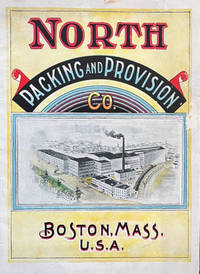
1893réf. 59948Chicago & Boston MA: North Packing & Provision Co. Alfred Mudge & Son Printers 24 Franklin St. Swift & Co. 1893. Small 4to. 64 pp. Photo-illustrated throughout. Colour-illustrated softcovers birds-eye view of Packing House on Medford Street in Somerville colour labels of all the company’s meat products on the back cover minor creasing to spine age wear slight scuffing at fore-edge very small closed tear at upper fore-edge still a VG bright copy. First edition of this exceedingly scarce promotional catalogue for the Swift & Co.’s newly opened subsidiary packing house in Boston MA featuring on the rear cover all the New England market specific product labels. The new packing house in Somerville MA included 6 acres of cold storage for dressed meats and packaged meats brought into the East from Chicago as well as maintaining local stockyards and slaughter house operations in and around Boston. Swift 1839-1903 had originally grown up and worked in West Sandwich Cape Cod MA and in the 1870’s moved to Chicago where he became a driving force in the meatpacking industry. He was the first to employ refrigerated cars over protests of other butchers and major railroads which rightly believed the refrigerated systems would threaten their lockhold on stock cars and animal pens. By the 1890’s Swift & Co. had established North Packing & Provision Co. and were transporting over 3000 carcasses a week into Boston forcing other firms such as Armour & Co. to copy their methods. The subsidiary also allowed him to overcome resistance from East Coast meat retailers who questioned safety of frozen meat and so vastly did he increase production the packing house was able to dominate the Eastern markets. No copies located in Worldcat. North Packing & Provision Co., Alfred Mudge & Son, Printers, 24 Franklin St., [Swift & Co.], paperback
1979réf. 63295La Mesa CA: Price-Pottenger Nutrition Foundation 1979. Two works in one. 8vo. xxiv 4 431 1; 4 433-526 pp. Photo frontisp. over 150 photos illustrations plates x-rays. Blue cloth gilt lettering NF from the libraries of Betty Surprise and Eleanore Weinstock. First Heritage edition early printing of this scarce work on anthropology medicine diet and nutrition. The author examines in detail the diets and nutrition of primitive cultures including the Eskimos North American Indians Polynesians African Tribes New Zealand Maori Peruvian Indians and more and compares their results to that of modern urban countries. Continually pointing out that modern diet and eating when it supplants the native diet leads invariably to physical degeneration in the ethnic populations offering an object lesson to modern western civilization. Supplement includes sections on soil fertility dangers of pesticides fluoride chemicals and means by which to combat this. Price-Pottenger Nutrition Foundation, hardcover
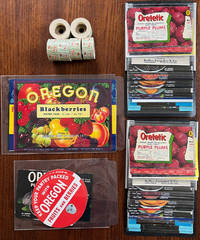
1955réf. 61665Salem OR: Oregon Fruit Products Co. 1955. Oblong 4to. Sales kit archive: 1st - Oblong 4to. 11 x 6.75 in. Two sales counter displays w/ 25 mylar louvered leaves for with nearly all featuring inserted labels catalogue and Real Photo Postcard of company products; 2nd - 31 separate can and fruit box labels sized from 4 x 5 in. up to 7 x 10.5 in. large 12 oz. can labels folded in half; 3rd - two circular mountable clips 5.25 in. round for removing fruit can lids w/ adhesive and instructions on verso still intact; 4th - 5 unused rolls of adhesive labels marking Oregon Fruit Products Co. items. Preserved in original Dubl-Frunt File Pocket printed label for Oregon Fruit Products at upper fore-ede expandable sized 9.5 x 11.5 in. minor edgewear couple minor closed tears in the folds still a VG exemplar. First edition of this exceedingly scarce original salesman sample kit for the Oregon Fruit Products Co. in the Mid-20th-Century featuring over 50 different labels used on fruit crates canned fruit and frozen fruit packages two promotional photo postcards showing off their new frozen product line as well as touting their latest offering of Sucaryl-packed fruit products for the dieter or diabetic. Their locally Pacific Northwest-sourced fruit offerings included BlackberriesBoysenberries Royal Anne Cherries dark Sweet Cherries Purple Plums Strawberries Gooseberries Loganberries Peaches and whole Apricots. A wide variety of packing options included water pack light syrup heavy syrup and frozen offerings which were packed into 10 oz. metal and paper fibre cans. Oregon Fruit Products was one of the many U.S. Companies to quickly expand their offerings with Abbot Laboratories notorious artificial sweetener Sucaryl Calcium Cyclamate which was marketed towards those dieters and customers with diabetes or other metabolic disorders wishing for sweet-tasting foods. However within 12 years after the “Oretetic” brand products were introduced in 1969 the FDA banned cyclamates due to two 1968 studies tracing links to bladder cancer. Gehlhar 1886-1969 originally purchased 10 acres in the West Side Fruit Farm district of Salem OR in 1910 and began farming and by 1920 was operating 160 acres producing cherries & prunes and later built the Gehlhar prune dryer in 1926. In 1931 he served as the first Oregon State Director of Agriculture and after a 1935 fire destroyed his fruit dryer the cannery remained and he chose to instead focus on canning and marketing canned fruit products for distribution in the Pacific Northwest. Although originally focused on canned fruits and then later frozen products by the late 1980’s and early 1990’s the company began diversifying their product line. In 2011 the Gehlhar family sold the company to Ed Maletis who have now expanded to a new location in Salem OR. No similar copies of this collection located in Worldcat 1 WWII-era fruit label located at Wolfsonian several 1950’s labels located at OHS in Portland. Oregon Fruit Products Co., unknown
1976réf. 63553Seattle WA: Peanut Butter Partners Epicure 1976. 4to. 160 pp. printed on tan-tinted paper illustrations throughout 1 map. Colour-illustrated softcovers wraparound cover art photo birdseye view of Portland OR by Jan Jackson shot from Washington Park slight shelfwear very slight scuffing back cover NF copy. First edition thus of this installment in the noted Epicure menu guidebook for Portland OR purportedly issued biannually from 1976 through 1983 by the entrepreneurial Mort Cone partner with his brother Gerald Cone in Cone Company Printers and later editor and publisher for Epicure menu guides in Portland Seattle Sun Valley Aspen Vail St. Louis and even Hawaii. Featuring a blizzard of original restaurant menus in the Bicentennial Year with all their original cover art this guidebook covering Portland Vancouver and environs includes such noted local staples as Asparro’s Union Ave. Social Club the Dan & Louis Oyster Bar the Fish Grotto Henry Thiele’s London Grill Mr. C’s Hippopotamus Old Spaghetti Factory The Ringside Trader Vic’s and any others. Also included are a significant number of Asian and Hispanic ethnic restaurants including Casa Molina The Chili Pepper Hong’s Cantonese Pavilion Benihana of Tokyo Paco’s Sang’s Chinatown Zen and others. Worldcat locates 3 copies Multnomah Co. U of W State Lib. of OR. Peanut Butter Partners], Epicure, paperback