[Alletz (Edouard)]Livre Rare Book
3 617 résultats
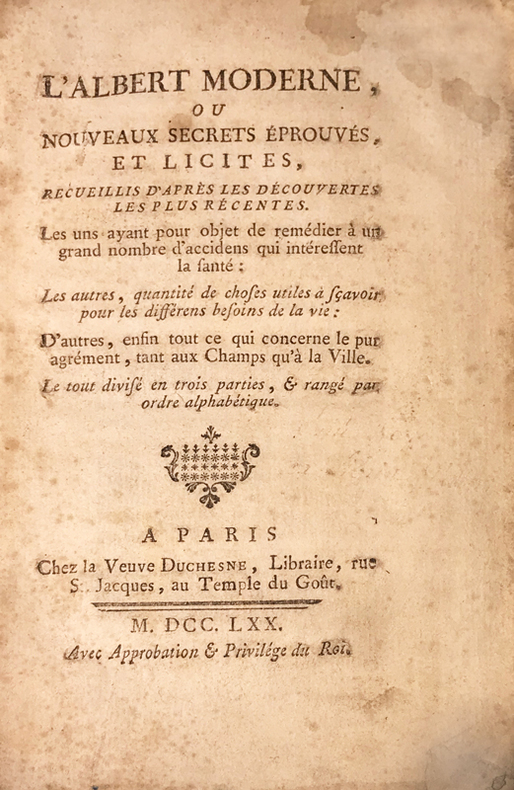
1770réf. 11006Paris, Veuve Duchesne, 1770 ; in-12 ; cartonnage rigide de papier marbré bleu, étiquette manuscrite au dos, non rogné ; XXII pp. (y compris le titre), (1) f., 384 pp.
réf. 0353788317.Ghardcover. Good. Access codes and supplements are not guaranteed with used items. May be an ex-library book. hardcover
1920réf. 29267Partitions sur la Boisson Salabert 1920
1912réf. 30844Partitions sur les Autres régions,Partitions sur la Boisson Durand 1912
1889réf. 32897Partitions sur le Militaria Lafleur 1889
1940réf. 88257Partitions sur la Seconde guerre mondiale,Partitions sur la Boisson 1940 approx.
1950réf. 32534Partitions sur la Boisson 1950 approx.
2000Colonia, Naumann & Gobel, s.d. (anni 2000), 8vo cartonato editoriale con copertina illustrata a colori, pp. 96 completamente illustrate con fotografie a colori.
1860Two Parts. pp. 56: 48. Illustrated with top margin woodcuts. 4to. Original full purple cloth binding. Edges sun faded. Owned by Judge Mayer Sulzberger (1843-1923). XLib. [Dropsie College]. Scarce reprint of the rare original 1700's edition. Interesting poems describing public houses (Pubs) in London and Westminister during the 1700's. Describes the kinds of beers they served and the sorts of people that frequented them. Wood cut images accompany each verse. Ward (1667-1731), was a humourist, of `low extraction' and with little education. In early life he visited the West Indies, and afterwards he began business as a publican in Moorfields. By 1699 he had moved to Fulwood's Rents, where he kept a punch-shop and tavern (probably the King's Head), next door to Gray's Inn, until his death. Giles Jacob (Poetical Register, 1723) says: `Of late years he has kept a public-house in the city (but in a genteel way), and with his wit, humour, and good liquor, has afforded his guests a pleasurable entertainment; especially the high-church party. A man of considerable natural parts and with a gift of humour, `Ned Ward,' as he is frequently called, imitated Butler's `Hudibras' both in his style and in his attacks on the Whigs and low-church party. Though vulgar and often grossly coarse, his writings throw considerable light on the social life of the time of Queen Anne, and especially on the habits of various classes in London; but much allowance has to be made for exaggeration" - DNB. **PRICE JUST REDUCED! WHISKEY 4
1990Sqaure medium octavo in green boards and blue illus DJ; 167p, illus in b/w and color. An uncommon wine book. No copy found in OCLC WorldCat at time of cataloging. Some portions in Catalan, Spanish and English. Numerous photos. Contributions by Pere Grases, Josep Tarin Iglesias, Miquel A. Torres, Mauricio Wiesenthal, Emili Giralt I Reventos. Rough translation of title: 1000 Years of Wine-Making in Catalonia. // Food. Drink. Cooking. Wine, Enology; Viticulture. Grape-growing. Spanish Wine. Grapes. Thirst!
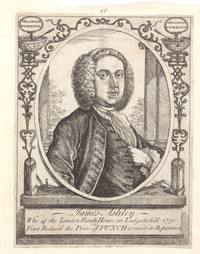
réf. 267136London: Thomas Worlidge n.d. ca mid-18th century. Engraved portrait of James Ashley in cartouche flanked by ornate pedestals supporting two punch bowls with engraved caption as above by Thomas Worlidge. 1 vols. 7-9/16 x 5-3/4 in. A strong impression laid down light creases from prior folding small pin hole near engraved caption. Engraved portrait of James Ashley in cartouche flanked by ornate pedestals supporting two punch bowls with engraved caption as above by Thomas Worlidge. 1 vols. 7-9/16 x 5-3/4 in. Scarce trade card of James Ashley proprietor of the London Coffee House and Punch-House 1731-1776 who was "London's leading purveyor of Punch in the eighteenth century" Wondrich Punch p. 65 and "the world's first celebrity mixologist the first man to become famous for compounding and selling a mixed drink" ibid p. 172. Ashley a former cheese merchant opened his Punch-House in 1731 in Ludgatehill London. Extensive advertising in London papers as well as the distinct ornate pedestals surmounted by iron punch bowls which flanked its entrance made the London Punch-House one of the most well-known drinking establishments in the city. Clientele included Hogarth Boswell Oliver Goldsmith and Benjamin Franklin. A large sign outside of the Punch-House echoes the caption on this trade card "Pro bono publico. James Ashley in 1731 first reduced the price of punch raised its reputation and brought it into universal esteem." Ashley did indeed reduce the price of punch - from 8 shillings for punch made from a quart of arrack to 6 shillings - but his great innovation was to offer punch in smaller portions in servings as small as two ounces. These small servings made to order for the customer were the precursor to the modern cocktail. This trade card is engraved by Ashley's friend Thomas Worlidge 1700-1766 dubbed "the English Rembrandt" who also engraved portraits of Ashley's wife and one Mrs. Graywood the bar-keep at the London Punch-House. Not in ESTC Thomas Worlidge unknown books
réf. 267079London: Thomas Worlidge mid-18th century. Engraved portrait of James Ashley in cartouche flanked by ornate pedestals supporting two punch bowls with engraved caption as above by Thomas Worlidge. 7-9/16 x 5-3/4 in. A strong impression with very slight rubbing and discoloration. Engraved portrait of James Ashley in cartouche flanked by ornate pedestals supporting two punch bowls with engraved caption as above by Thomas Worlidge. 7-9/16 x 5-3/4 in. Scarce trade card of James Ashley proprietor of the London Coffee House and Punch-House 1731-1776 who was "London's leading purveyor of Punch in the eighteenth century" Wondrich Punch p. 65 and "the world's first celebrity mixologist the first man to become famous for compounding and selling a mixed drink" ibid p. 172. Ashley a former cheese merchant opened his Punch-House in 1731 in Ludgatehill London. Extensive advertising in London papers as well as the distinct ornate pedestals surmounted by iron punch bowls which flanked its entrance made the London Punch-House one of the most well-known drinking establishments in the city. Clientele included Hogarth Boswell Oliver Goldsmith and Benjamin Franklin. A large sign outside of the Punch-House echoes the caption on this trade card "Pro bono publico. James Ashley in 1731 first reduced the price of punch raised its reputation and brought it into universal esteem." Ashley did indeed reduce the price of punch - from 8 shillings for punch made from a quart of arrack to 6 shillings - but his great innovation was to offer punch in smaller portions in servings as small as two ounces. These small servings made to order for the customer were the precursor to the modern cocktail. This trade card is engraved by Ashley's friend Thomas Worlidge 1700-1766 dubbed "the English Rembrandt" who also engraved portraits of Ashley's wife and one Mrs. Graywood the bar-keep at the London Punch-House. Not in ESTC Thomas Worlidge unknown books
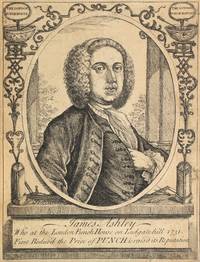
réf. 267136London: Thomas Worlidge n.d. ca mid-18th century. Engraved portrait of James Ashley in cartouche flanked by ornate pedestals supporting two punch bowls with engraved caption as above by Thomas Worlidge. 1 vols. 7-9/16 x 5-3/4 in. A strong impression laid down light creases from prior folding small pin hole near engraved caption. Engraved portrait of James Ashley in cartouche flanked by ornate pedestals supporting two punch bowls with engraved caption as above by Thomas Worlidge. 1 vols. 7-9/16 x 5-3/4 in. Scarce trade card of James Ashley proprietor of the London Coffee House and Punch-House 1731-1776 who was "London's leading purveyor of Punch in the eighteenth century" Wondrich Punch p. 65 and "the world's first celebrity mixologist the first man to become famous for compounding and selling a mixed drink" ibid p. 172. Ashley a former cheese merchant opened his Punch-House in 1731 in Ludgatehill London. Extensive advertising in London papers as well as the distinct ornate pedestals surmounted by iron punch bowls which flanked its entrance made the London Punch-House one of the most well-known drinking establishments in the city. Clientele included Hogarth Boswell Oliver Goldsmith and Benjamin Franklin. A large sign outside of the Punch-House echoes the caption on this trade card "Pro bono publico. James Ashley in 1731 first reduced the price of punch raised its reputation and brought it into universal esteem." Ashley did indeed reduce the price of punch - from 8 shillings for punch made from a quart of arrack to 6 shillings - but his great innovation was to offer punch in smaller portions in servings as small as two ounces. These small servings made to order for the customer were the precursor to the modern cocktail. This trade card is engraved by Ashley's friend Thomas Worlidge 1700-1766 dubbed "the English Rembrandt" who also engraved portraits of Ashley's wife and one Mrs. Graywood the bar-keep at the London Punch-House. Not in ESTC Thomas Worlidge unknown
réf. 267079London: Thomas Worlidge mid-18th century. Engraved portrait of James Ashley in cartouche flanked by ornate pedestals supporting two punch bowls with engraved caption as above by Thomas Worlidge. 7-9/16 x 5-3/4 in. A strong impression with very slight rubbing and discoloration. Engraved portrait of James Ashley in cartouche flanked by ornate pedestals supporting two punch bowls with engraved caption as above by Thomas Worlidge. 7-9/16 x 5-3/4 in. Scarce trade card of James Ashley proprietor of the London Coffee House and Punch-House 1731-1776 who was "London's leading purveyor of Punch in the eighteenth century" Wondrich Punch p. 65 and "the world's first celebrity mixologist the first man to become famous for compounding and selling a mixed drink" ibid p. 172. Ashley a former cheese merchant opened his Punch-House in 1731 in Ludgatehill London. Extensive advertising in London papers as well as the distinct ornate pedestals surmounted by iron punch bowls which flanked its entrance made the London Punch-House one of the most well-known drinking establishments in the city. Clientele included Hogarth Boswell Oliver Goldsmith and Benjamin Franklin. A large sign outside of the Punch-House echoes the caption on this trade card "Pro bono publico. James Ashley in 1731 first reduced the price of punch raised its reputation and brought it into universal esteem." Ashley did indeed reduce the price of punch - from 8 shillings for punch made from a quart of arrack to 6 shillings - but his great innovation was to offer punch in smaller portions in servings as small as two ounces. These small servings made to order for the customer were the precursor to the modern cocktail. This trade card is engraved by Ashley's friend Thomas Worlidge 1700-1766 dubbed "the English Rembrandt" who also engraved portraits of Ashley's wife and one Mrs. Graywood the bar-keep at the London Punch-House. Not in ESTC Thomas Worlidge unknown
197013.5" x 15.5". Two-color menu from the "Nandina" Ristorante of Firenze, Italy, Proprietor G. Sassoli. Possibly circa 1970? Unmarked with moderate wear and age-toning. Folded twice vertically and once horizontally. A charming Italian gastronomic memento. Book
1980Introduction by John Doxat. 12367. eng
1983Introduction by John Doxat. 20719. eng
réf. 1292.1aaf90.5x127.5 cm
réf. 4181aafFribourg, Fragnière, 1960, gr. in-8°, 124 p., avec 10 planches, brochure originale.
Illustrated, ink notes on back cover. eng
réf. 652901985 divers autocollant 19,5*6 pages
201322 pages, illustrated. eng
201330 pages, illustrated. eng
No publication date, over 40 pages, illustrated in colour. eng
197724 pages, illustrated, recipes. eng