1897réf. 45502Salt Lake City: The Salt Lake Tribune 1897. First edition. Hardcover. Quarto 28.5 cm Rebound in blue cloth over boards with the original front wrap bound in. With a number of contemporary advertisements. Illustrations throughout. Very good. The extremities are rubbed including the gilt stamped title on the backstrip and there are several light scratches on the front board. There is a 4" closed tear in the top edge of the original front wrap along with a handful of shorter closed tears in the edges a few of which have been backed with tape. The last couple of pages also have small closed tears in the edges. Else the pages are free of tears and marks. Flake 7510. A collection of accounts printed in the Salt Lake Tribune between Monday April 5 1897 - July 24 1847 relating the events that happened on the very same day fifty years earlier during the Mormon trek west in the year of 1847. The Salt Lake Tribune hardcover books
1975réf. 287571975. Mimeographed 118 pages plus additional revised pages dated 9/26-10 /73 pinned in plain covers. Occasional pencil marks and dog ears reveal it was obviously used at some point in production. Directed by John Schlesinger. Signed by the cinematographer Conrad L. Hall and inscribed and signed by Karen Black. unknown books
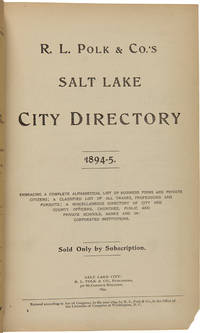
1894réf. 35120Salt Lake City: R.L. Polk & Co. 1894. An exhaustive directory with numerous illustrated advertisements. The chromolithographic plate advertises "The Orcutt Company Leading Lithographers" and depicts a middle eastern market scene. Original black half cloth gilt and boards printed with advertisements. Boards and preliminary leaves detached closed tear in cloth of spine. Plate fold strengthened. Internally fine. Overall very good. hardcover books
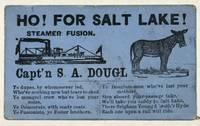
1860réf. 422661860. Printed oblong blue card 3-1/4" x 2" with illustrations of a steamship and a donkey. Some wear to the blank verso. Very Good. This rare and apparently unrecorded satiric political card celebrates the defeat of Lincoln's opponents in the 1860 presidential election. References to "Salt River" or "Salt Lake" were common in mid-19th century political slang. A losing candidate took a trip up Salt River and was frequently depicted purchasing a ticket to Salt Lake. The poem accompanying this ticket is reproduced here: Ye dupes by whomsoever led Who've nothing now but tears to shed Ye mongrel crew who've lost your votes Ye Democrats with seedy coats Ye Fusionists ye Foster brothers Ye Douglass-men who've lost your mothers Step aboard your passage take. We'll take you safely to Salt Lake. There Brigham Young & broth'r Hyde Each one upon a rail will ride. The song mocks Fusionists whose effort to preserve the Union by uniting Douglas and Bell-Everett men was defeated. "Douglass-men who've lost your mothers" refers to Douglas's campaign trip to New England in 1860 purporting to visit his elderly mother and family. Active campaigning by candidates was frowned upon. When it took him over a month to go from Washington to New York Republicans taunted him as 'A little boy' a reference to his shortness of stature 'lost in search of his mother' Reilly 1860-35. Currier & Ives satirized the issue with a lithograph "Stephen Finding 'His Mother'." We have not located another copy of this unusual item. unknown books
réf. 160111N.p.: N.p. 1977. Draft script for the 1978 film. Copy belonging to Lucile Jones credited in the film as a "friend who did everything" with her first name in manuscript ink on the title page. Laid in with the screenplay are three photographs from the set of the film: one black-and-white studio still photograph showing actors Bruce Dern and Jane Fonda and two borderless color reference photographs of director Hal Ashby with an unknown woman possibly Jones on the set. A key Vietnam-era film and one of noted director Hal Ashby's finest efforts. Ostensibly a war film "Coming Home" is really more about the lives of the women left behind during the war tracking the progress of a housewife who finds herself unexpectedly liberated in her husband's absence falling into an affair with a wounded veteran. Winner of three Academy Awards including Best Screenplay and nominated for five others including Best Picture and Best Director. Nominated for the Palme d'Or. Screenplay: Red titled wrappers. Title page present with credits for screenwriters Waldo Salt and Bob Jones and director Hal Ashby. 134 leaves with last page of text numbered 132. Xerographic duplication rectos only with four blue revision pages dated 1/3/77. Pages Near Fine wrapper Near Fine bound with two gold screw brads. Photographs: Two 7 x 5 inches one 8 x 10 inches. Near Fine. N.p. unknown books
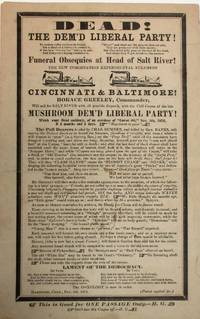
1872réf. 38915Hartford 1872. Broadside 6" x 9-1/2" text surrounded by mourning border. A few spots Very Good. Illustrations of two steamers. At the bottom: "This is Good for ONE PASSAGE Only. - H.G." Dated at Hartford November 5 1872. "Salt River" is 19th century American slang: a losing candidate for office was taking a trip "up Salt River." Tickets for passage "up Salt River" were frequently printed to mock supporters of losing candidates. This humorous scarce broadside taunts Horace Greeley and other defectors from the Republican Party for their support of Greeley in 1872. "On the overwhelming defeat of the Liberal Republican Party and its candidate Horace Greeley in the presidential election of 1872. Greeley had been nominated at a Liberal Republican convention at Cincinnati in May and at the Democratic National Convention at Baltimore in July 1872" AAS description. Pall bearers include Charles Sumner and General Banks prominent Republican supporters of Greeley. OCLC 191231113 2- AAS Middlebury 47090036 1- CT Hist. Soc. as of August 2025. unknown books
1891réf. 322358London: Sampson Low Marston and Co 1891. First edition no. 7 of 50 copies on Large Paper. xliv 64pp. 1 vols. 4to. Quarter publisher's green morocco and boards. With the bookplate of Leon Gruel famous French binder and Randeria bookplate. Light traces of rubbing. Very good plus. First edition no. 7 of 50 copies on Large Paper. xliv 64pp. 1 vols. 4to. S-K 1103; Mejer 1205 Sampson Low, Marston and Co unknown books
1938réf. 140293Beverly Hills CA: Metro-Goldwyn-Mayer MGM 1938. Draft script for the 1938 film. Based on the short story "Private Pettigrew's Girl" by Dana Burnet and published in "The Saturday Evening Post" on September 14 1918. Copy belonging to an unknown crew member with manuscript pencil annotations throughout. Jimmy Stewart plays an idealistic soldier who convinces a Broadway star Margaret Sullavan to pretend they're dating in order to impress his other soldier friends. Meanwhile Sullivan's manager Walter Pidgeon has always been in love with her and objects to the pair's closeness even as they decide to get married before Stewart is shipped out to France. Stewart and Sullivan pull off surprisingly believable roles for a plot of such sickly sweetness in this their second on-screen pairing. The third film based on Burnet's "Saturday Evening Post" story the first two being the 1919 George Melford silent film "Pettigrew's Girl" and Richard Wallace's part-talkie "The Shopworn Angel" 1928 starring Gary Cooper. Set in New York. Goldenrod titled wrappers rubber-stamped copy No. 2268 and production No. 25077 dated 3/16/38 with credits for producer Joseph L. Mankiewicz and screenwriter Waldo Salt. Distribution receipt laid into the script. Title page integral with the first page of the text as issued. 108 leaves with last page of text numbered 108. Mimeograph duplication. Pages Near Fine wrapper Very Good bound with two gold brads. Warner Archive. Metro-Goldwyn-Mayer [MGM] unknown books
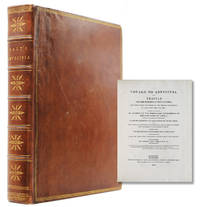
1816réf. 15180Philadelphia: M. Carey 1816. FIRST AMERICAN EDITION. With 1 folding map. Contemporary calf worn rebcked; interior lightly browned due to paper stock. Overall a very good copy. First American edition first printed in London 1814. A voyage to Abyssinia was produced after Salt’s second trip to Ethiopia. This travelogue provides detailed descriptions of material culture and social customs of Ethiopia and surrounding territories. He even includes vocabulary lists of languages spoken along the African coast spanning from Mozambique to Egypt. Undertaken on behalf of the British Government he opens his dedication to the Prince Regent with the request that His Royal Highness support advancement of the Christian religion in that territory. Originally trained as an artist Salt 1780–1827 was a diplomat and Egyptologist. He first traveled to Ethiopia in 1805 to establish a British relationship with the Ras of Tigre and returned again in 1809 for two years. Salt traveled extensively and collected antiquities which now form part of the British Museum the Sir John Soane Museum in London and the Louvre. M. Carey unknown books
réf. 146780N.p.: Paramount Pictures 1973. Vintage US silkscreen banner poster for the 1973 film. Based on Peter Maas' 1973 biography "Serpico: The Cop Who Defied the System" about a plainclothes police officer who exposes corruption in the New York City Police Department only to face harassment and threats from his fellow officers. Nominated for two Academy Awards for Best Actor and Best Screenplay. Set in and shot on location in New York. 82 x 24 inches. Rolled. Very Good plus overall with no restoration. Lightly soiled with a few pin holes in upper right of image two holes about 1/8" one small closed tear in bottom margin and 1 chip in the upper right margin bright and unfaded. Eureka! #79. Spicer US Neo-Noir. Paramount Pictures unknown books
réf. CA08AA-00820Collectible - Very Good. Mizoram: Printed at Manna Printer 2020. 1st edition. 8vo. xxvi334pp. Mizo. Very Good book. Good dust jacket. Bible Christianity books in Mizo Inquire if you need further information. unknown books
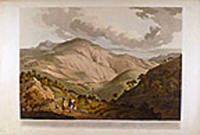
1812réf. 27080London: William Miller 1812. Hand-coloured aquatint engraving by D. Havell after Henry Salt on wove paper watermark 'J Whatman 1812'. View of the British colonial island St. Helena prior to its becoming Napoleon's last residence Henry Salt artist traveller diplomat and collector of antiquities was born at Lichfield Staffordshire England 14 June 1780. He was destined to be a portrait-painter and on leaving school was taught drawing by Glover the watercolour-painter of Lichfield. In 1797 he went to London and became a pupil of Joseph Farington R.A. and in 1800 of John Hoppner R.A. The turning point in his career was 3 June 1802 when Salt left London for an eastern tour with George viscount Valentia afterwards Lord Mountnorris whom he accompanied as secretary and draughtsman. He visited India Ceylon and in 1805 Abyssinia returning to England on 26 Oct. 1806. He made many drawings some of which served to illustrate Lord Valentia's Voyages and Travels to India published in 1809. The present image is from a work titled Twenty-four Views in St. Helena the Cape India Ceylon the Red Sea Abyssinia and Egypt published by William Miller with hand-coloured aquatints by D. Havell and J. Bluck from Salt's own drawings. The originals of all these drawings were retained by Lord Valentia who also retained the ownership of the copper plates after Salt's death. The format and style of presentation of the plates is similar to Thomas and William Daniell's great work Oriental Scenery 1795-1808 and the artistry displayed by both Salt and his engravers is in many cases more than a match for the Daniell's images. Abbey Travel II 515 no.5. William Miller unknown books
1809réf. 17298London: William Miller 1809. Hand-coloured aquatint engraving by D. Havell after Henry Salt on wove paper watermark 'J Whatman'. View of the British colonial island St. Helena prior to its becoming Napoleon's last residence Henry Salt artist traveller diplomat and collector of antiquities was born at Lichfield Staffordshire England 14 June 1780. He was destined to be a portrait-painter and on leaving school was taught drawing by Glover the watercolour-painter of Lichfield. In 1797 he went to London and became a pupil of Joseph Farington R.A. and in 1800 of John Hoppner R.A. The turning point in his career was 3 June 1802 when Salt left London for an eastern tour with George viscount Valentia afterwards Lord Mountnorris whom he accompanied as secretary and draughtsman. He visited India Ceylon and in 1805 Abyssinia returning to England on 26 Oct. 1806. He made many drawings some of which served to illustrate Lord Valentia's Voyages and Travels to India published in 1809. The present image is from a work titled Twenty-four Views in St. Helena the Cape India Ceylon the Red Sea Abyssinia and Egypt published by William Miller with hand-coloured aquatints by D. Havell and J. Bluck from Salt's own drawings. The originals of all these drawings were retained by Lord Valentia who also retained the ownership of the copper plates after Salt's death. The format and style of presentation of the plates is similar to Thomas and William Daniell's great work Oriental Scenery 1795-1808 and the artistry displayed by both Salt and his engravers is in many cases more than a match for the Daniell's images. Abbey Travel II 515 no.5. William Miller unknown books
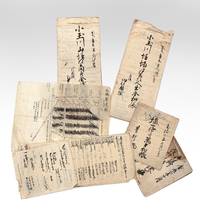
réf. 11058Two formats 190 x 152 mm. & 150 x 365 mm. Oguni machi Kotamagawa å°å›½ç”ºå°çŽ‰å·: 1865-67. This archive describes the manufacture and regulation of yamajio mountain salt in the town of Oguni machi on the Tama River in the mountainous area of Yamagata Prefecture north of Niigata. The onsen springs of the town are rich in minerals and were used to manufacture salt for local and regional inhabitants. Today there are very few producers of mountain salt due to the laborious process but it is highly valued by connoisseurs of salt for its delicate taste. Our archive consists of: 1. Manuscript drawing 243 x 327 mm. showing the process of spraying the water on well-ventilated racks covered with branches of the shiba 柴 tree. This allowed the mineral-rich water to slowly drip into a large deep basin. The gathered water would then be boiled down leaving salt crystals. 2 & 3. The first two notebooks 10 & 5 leaves dated February and August 1865 contain details of production of the salt and names of those involved. 4. This notebook 11 leaves dated February 1865 is entirely devoted to the business of making and selling salt with records of quantities sellers and buyers prices received etc; 5. A document 14 leaves from the local magistrate's office dated February 1865 gives the names of salt manufacturers. 6. A notebook 5 leaves produced by the local magistrate's office regarding the sale and distribution of salt to many wholesalers in the city of Yonezawa with their seals dated October 1866. Somewhat stained but very legible. 7. Dated 1867 this notebook 8 leaves describes in great detail the process of saltmaking with descriptions of tools and other equipment techniques etc. unknown books
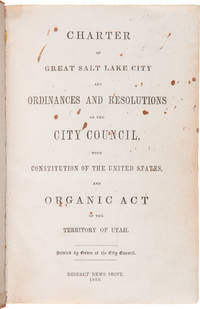
1860réf. 57842Salt Lake City: Deseret News Print 1860. Salt Lake City's New Charter The first edition of the new charter of Salt Lake City passed on January 20 1860 an uncommon imprint from the press of the Deseret News. In the two years previous to this new charter the whole of the Mormon community in Utah was recovering from the Utah War which saw increased United States government influence and presence in the territory. The present work includes a membership list of the Salt Lake City Council lists of city officials four major sections and provides indexes to those four sections. The first prominent work printed here is the United States Constitution with the twelve Amendments passed up until that time. This work was not printed in the 1859 edition of the 1851-53 Salt Lake city charter but is added here. The second major work is the "Act to Establish a Territorial Government for Utah." This act which provided for the establishment of all aspects of the Utah government and delineated the boundaries of the territory was first published in 1852. The third and most important text is the "Charter of Great Salt Lake City" beginning on page xxix. This is the first edition of the new city charter for Salt Lake City presumably passed in response to the changes wrought by the Utah War. The Charter is comprised of "An Act Incorporating Great Salt Lake City" and is laid out in eighty-eight sections and invests most of the power for regulating the city in the City Council. This differs from the earlier city charter which was comprised of only fifty-three sections most passed in 1851 with five passed in 1853. The penultimate section of the present work section 87 repeals and replaces the earlier charter. The charter sets the boundaries for the city and gives the city the authority to control all manner of issues related to city management and maintenance such as organizing the city setting electoral guidelines for officials eminent domain business licensing and regulation public cleanliness providing police and fire departments regulations for tobacco and liquor and many others. Section 26 even outlaws "playing at ball" or flying a kite. The fourth and longest section of the work is entitled "Ordinances of Great Salt Lake City" and consists of fifty-eight specific rules regulating elections creating city offices naming the streets dividing the city into wards providing for water defining police duties collecting taxes creating schools governing distribution of liquor regulating city quarantine setting penalties for criminal activity and more. Interestingly Section 3 of the Ordinances prohibits any officer or soldier of the United States Army from holding office or voting in Salt Lake City unless they live in the city; the Mormon population in Salt Lake City seems to have had enough of the American military by 1860. A short Appendix prints six more ordinances passed later in 1860 including one governing the discharge of firearms and another stipulating a $100 fine and six months in jail for operation of a brothel. Revised ordinances for the city would be published in 1875 and amendments would be added to the city charter beginning in 1862 but the latter essentially remained in effect until statehood in 1896. The present copy was owned by a contemporary Salt Lake City resident Thomas Burchell. Burchell was born in Blackwood Wales baptized into the LDS faith in 1856 and immigrated to Salt Lake City by wagon train in September 1859. He died in 1871 according to the Latter-Day Saints' Millenial Star of "asthma and dropsy." Not in Flake or Draper. OCLC records just twelve institutional copies. A scarce work under-represented in Mormon bibliographical literature. Contemporary half diced sheep and marbled boards. Binding quite rubbed and worn. Light tanning scattered ink spotting primarily to titlepage. Contemporary ownership inscription on rear endpaper see below. A very good copy overall. SABIN 75840. OCLC 2872974. hardcover books
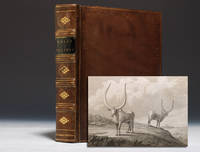
1814réf. 314823London: F.C. and J. Rivington 1814. First edition. With 28 engraved plates on 27 leaves 7 engraved maps and charts on 6 sheets including 4 folding and 1 hand-colored and 2 vignettes. xi 5 506 lxxv pp. 4to. Contemporary brown russia neatly rebacked. Fine copy. First edition. With 28 engraved plates on 27 leaves 7 engraved maps and charts on 6 sheets including 4 folding and 1 hand-colored and 2 vignettes. xi 5 506 lxxv pp. 4to. A fine copy of this important work by Salt on his two years journey to Abyssinia. "On 2 March 1809 Salt sailed on a mission from the British government to Abyssinia to carry presents to the king and report on the state of the country. Owing to factious unrest he was prevented from going to the king at Gondar and was obliged to deliver the presents instead to the ras of Tigré. While in Abyssinia he made many observations on the geography the customs of the people and the flora and fauna. He brought back many specimens including a previously unknown dik-dik . In 1812 he was elected one of the very few honorary members of the African Association in acknowledgement of information he had procured in its interest. In 1814 he published A Voyage to Abyssinia which was received with some acclaim" ODNB. Salt was subsequently appointed consul-general in Egypt and played an important role in fostering Egyptology financing the excavations of Belzonia Caviglia and d'Athanasi. Blackmer 1479; Czech African p. 141; Fumagalli 139; Gay 2683 F.C. and J. Rivington unknown books
1809réf. 41444London: William Miller 1809. Hand-coloured aquatint engraving by D. Havell after Henry Salt on wove paper watermark 'J Whatman'. A view of Lucknow showing the famous Asafi Mosque. Henry Salt artist traveller diplomat and collector of antiquities was born at Lichfield Staffordshire England on 14 June 1780. He was determined to become a portrait-painter and upon leaving school was taught drawing by Glover the watercolour-painter of Lichfield. In 1797 he went to London to study with Joseph Farington R.A. and then with John Hoppner R.A. in 1800. The turning point in his career was 3 June 1802 when Salt left London for an Eastern tour with George viscount Valentia afterwards Lord Mountnorris whom he accompanied as secretary and draughtsman. He visited India Sri Lanka and Abyssinia returning to England on 26 Oct. 1806. He made many drawings some of which served to illustrate Lord Valentia's Voyages and Travels to India published in 1809. The present image is from a work titled Twenty-four Views in St. Helena the Cape India Ceylon the Red Sea Abyssinia and Egypt published by William Miller with hand-coloured aquatints by D. Havell and J. Bluck from Salt's own drawings. The originals of all these drawings were retained by Lord Valentia who also retained the ownership of the copper plates after Salt's death. The format and style of presentation of the plates is similar to Thomas and William Daniell's great work Oriental Scenery 1795-1808 and displays great artistry by both Salt and his engravers. The Asafi Mosque is part of the larger Bara Imambara complex which was commissioned by Nawab Asaf-ud-Daula the fourth Nawab of Awadh in 1784 and was completed in 1791. The Asafi Mosque follows the Mughal architectural style characterized by grand arches domes and intricate designs. The mosque is a prominent example of the cultural and artistic heritage of the region during the Nawabi era. Abbey Travel II 515 no.3. William Miller unknown books
1809réf. 9205London: William Miller 1809. Hand-coloured aquatint engraving by J. Bluck after Henry Salt on wove paper. A lyrical South African view from the 'Roode Zand' Red Sand Pass inland from the Cape of Good Hope. Henry Salt artist traveller diplomat and collector of antiquities was born at Lichfield Staffordshire England 14 June 1780. He was destined to be a portrait-painter and on leaving school was taught drawing by Glover the watercolour-painter of Lichfield. In 1797 he went to London and became a pupil of Joseph Farington R.A. and in 1800 of John Hoppner R.A. The turning point in his career was 3 June 1802 when Salt left London for an eastern tour with George viscount Valentia afterwards Lord Mountnorris whom he accompanied as secretary and draughtsman. He visited the Cape India Sri Lanka and in 1805 Abyssinia returning to England on 26 Oct. 1806. He made many drawings some of which served to illustrate Lord Valentia's Voyages and Travels to India published in 1809. The present image is from a work titled Twenty-four Views in St. Helena the Cape India Ceylon the Red Sea Abyssinia and Egypt published by William Miller with hand-coloured aquatints by D. Havell and J. Bluck from Salt's own drawings. The originals of all these drawings were retained by Lord Valentia who also retained the ownership of the copper plates after Salt's death. The format and style of presentation of the plates is similar to Thomas and William Daniell's great work Oriental Scenery 1795-1808 and displays great artistry by both Salt and his engravers. Abbey Travel II 515 no.3. William Miller unknown books
1809réf. 41443London: William Miller 1809. Hand-coloured aquatint engraving by D. Havell after Henry Salt on wove paper watermark 'J Whatman'. An excellent view of Tamil Nadu including one of the great irrigation tanks: a true masterpiece of early technology. Henry Salt artist traveller diplomat and collector of antiquities was born at Lichfield Staffordshire England on 14 June 1780. He was determined to become a portrait-painter and upon leaving school was taught drawing by Glover the watercolour-painter of Lichfield. In 1797 he went to London to study with Joseph Farington R.A. and then with John Hoppner R.A. in 1800. The turning point in his career was 3 June 1802 when Salt left London for an Eastern tour with George viscount Valentia afterwards Lord Mountnorris whom he accompanied as secretary and draughtsman. He visited India Sri Lanka and Abyssinia returning to England on 26 Oct. 1806. He made many drawings some of which served to illustrate Lord Valentia's Voyages and Travels to India published in 1809. The present image is fromTwenty-four Views in St. Helena the Cape India Ceylon the Red Sea Abyssinia and Egypt published by William Miller with hand-coloured aquatints by D. Havell and J. Bluck from Salt's own drawings. The originals of all these drawings were retained by Lord Valentia who also retained the ownership of the copper plates after Salt's death. The format and style of presentation of the plates is similar to Thomas and William Daniell's great work Oriental Scenery 1795-1808 and the artistry displayed by both Salt and his engravers is in many cases more than a match for the Daniell's images. Salt visited Sri Lanka only a few years after the British had wretes power from the Dutch who had been the dominant western presence on the island from the middle of the 17th century until 1795. Abbey Travel II 515 no.13. William Miller unknown books
1809réf. 34489London: William Miller 1809. Hand-colored aquatint by Daniel Havell. Sheet: 21 1/4 x 29 inches. Mild bubbling in places. This view of Cairo from a hilltop near the Citadel shows Old Cairo with its walls domed buildings and minarets. Across the Nile in the hazy distance are the pyramids of Giza. Heny Salt later returned to Cairo as consul-general for the British. Henry Salt artist traveller diplomat and collector of antiquities was born at Lichfield Staffordshire England 14 June 1780. He was destined to be a portrait-painter and on leaving school was taught drawing by Glover the watercolour-painter of Lichfield. In 1797 he went to London and became a pupil of Joseph Farington R.A. and in 1800 of John Hoppner R.A. The turning point in his career was 3 June 1802 when Salt left London for an eastern tour with George viscount Valentia afterwards Lord Mountnorris whom he accompanied as secretary and draughtsman. He visited the Cape India Sri Lanka and in 1805 Abyssinia returning to England on 26 Oct. 1806. He made many drawings some of which served to illustrate Lord Valentia's Voyages and Travels to India published in 1809. The present image is from a work titled Twenty-four Views in St. Helena the Cape India Ceylon the Red Sea Abyssinia and Egypt published by William Miller with hand-coloured aquatints by D. Havell and J. Bluck from Salt's own drawings. The originals of all these drawings were retained by Lord Valentia who also retained the ownership of the copper plates after Salt's death. The format and style of presentation of the plates is similar to Thomas and William Daniell's great work Oriental Scenery 1795-1808 and displays great artistry by both Salt and his engravers. Abbey 515. William Miller unknown books
1809réf. 34488London: William Miller 1809. Hand-colored aquatint by R. Havell. Sheet size: 21 1/2 x 29 3/4 inches. In this large panoramic view Salt demonstrates the appropriateness of the sobriquet "City of a Thousand Minarets". In the foreground is the great Sultan Hussan Mosque one of the largest mosques in Cairo. As we look through the streets towards the distant Nile we see many neighborhood mosques and holy places. Henry Salt artist traveller diplomat and collector of antiquities was born at Lichfield Staffordshire England 14 June 1780. He was destined to be a portrait-painter and on leaving school was taught drawing by Glover the watercolour-painter of Lichfield. In 1797 he went to London and became a pupil of Joseph Farington R.A. and in 1800 of John Hoppner R.A. The turning point in his career was 3 June 1802 when Salt left London for an eastern tour with George viscount Valentia afterwards Lord Mountnorris whom he accompanied as secretary and draughtsman. He visited the Cape India Sri Lanka and in 1805 Abyssinia returning to England on 26 Oct. 1806. He made many drawings some of which served to illustrate Lord Valentia's Voyages and Travels to India published in 1809. The present image is from a work titled Twenty-four Views in St. Helena the Cape India Ceylon the Red Sea Abyssinia and Egypt published by William Miller with hand-coloured aquatints by D. Havell and J. Bluck from Salt's own drawings. The originals of all these drawings were retained by Lord Valentia who also retained the ownership of the copper plates after Salt's death. The format and style of presentation of the plates is similar to Thomas and William Daniell's great work Oriental Scenery 1795-1808 and displays great artistry by both Salt and his engravers. William Miller unknown books
1814réf. 885241814. First Edition. EAST AFRICA SALT Henry. A Voyage to Abyssinia and Travels into the Interior of that Country ExecutedÉ in the Years 1809 and 1810. London: F.C. and J. Rivington 1814. Large quarto contemporary full diced brown calf rebacked black morocco spine label raised bands original marbled endpapers and edges. $4800.First edition of this fascinating travel narrative chronicling SaltÕs expeditions across Egypt and Ethiopia illustrated with two vignettes and 34 splendid copper-engraved plates and maps four folding one hand-colored in contemporary calf boards.The renowned English diplomat archaeologist Henry Salt initially studied as a painter and it was his artistic talents that Òrecommended him to the collector George Annesley Viscount of Valentia who took him on a tour of the East in 1802-06 during which he visited Egypt Ethiopia and India. In 1809-10 Salt returned to Ethiopia as a quasi-official envoy under CanningÕs sponsorship marching from the Red Sea coast with an escort of 160 bearers to explore trade and diplomatic links with the Ethiopian emperor Wolde Selassie. Britain fearing a French alliance with Egypt wished to secure a port on the Red Sea. Salt carried out a little archaeology discovering at Aksum three large Ethiopian inscriptionsÓ and documenting his work in this impressive volume Howgego II:S6. SaltÕs role in three key excavations Belzoni Caviglia and dÕAthanasi yielded splendid collections of Egyptian antiquities many of which are now in the British Museum Clayton 44. In 1815 Salt was appointed Consul-General in Egypt and a year later together with John Burckhardt employed Giovanni Baptista Belzoni to remove the colossal bust of Rameses II from Thebes now also in the British Museum. For this Salt was hailed as Òthe second Lord Elgin.Ó Voyage to Abyssinia includes Òparticulars respecting the aboriginal African tribes extending from Mosambique to the borders of EgyptÓ and a lengthy glossary of local languages. The numerous full-page illustrations are made by Charles Heath from original sketches by Salt and include Òperhaps the earliest printed illustration of hippo shootingÓ Czech which took place on the River Tacazzi. Blackmer 1479. Gay 184. Czech African Big Game Hunting 141. Old bookbinder ticket to front pastedown.Large folding hand-colored map reinforced along fold on verso infrequent spotting to text. A very good copy in an attractive binding. hardcover books
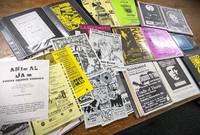
réf. 71248Salt Lake County 2001. Ephemera. Fine. More images available upon request. 745 items. Almost all in fine condition. The flyers and posters range from 1/2 standard sheet size approx. 8.5" x 5" to large posters approx. 17" x 14". Most are standard sheet size 8.5" x 11". Roughly a dozen duplicates are present. An enormous collection documenting live music festivals and performance in the Salt Lake area through the 1990s in the clubs and small venues of the valley. Legendary clubs like the Speedway Cafe Pompadour Bar & Grill Bricks Spanky's Playscool the basement of DV8 Burt's Tiki Lounge Dead Goat Saloon Area 51 The Zephyr Club The Holy Cow now the Urban Lounge and Kilby Court are well represented as well as the holes-in-the-wall like the Moroccan Painted Word Shaggy's Living Room and Green Guinea. Educational and cultural institutions and outdoor venues are also prominently featured in this collection including Bryant Intermediate School the University of Utah Ballroom in the Union Building Westminster College the Indian Walk In Center Draper Park and the Fairgrounds Creative Arts Building. Some places provided venues on a weekly basis other places provided them only a few times or maybe even just once. A number of flyers showcase then unknown bands who first played tiny venues like these and who went on to gain a larger audience and in some cases are still performing today The Vandals Social Distortion Bad Religion GWAR Slayer Johnny Rotten Suicidal Tendencies Korn and many others. Countless local acts are represented including those that performed steadily throughout these years Iceburn; Endless Struggle; Starmy; Red Bennies; Bob Moss; Daughters of the Nile as well as bands that were together for slightly shorter periods Mouthbreather; Gnawing Suspicion; Wovoka etc. Interestingly a handful of local bands that had their origins in the 1980s appear such as Bad Yodelers Potato Heads Dinosaur Bones The Clocks a noise band Slaughterchrist and the Stench. The bands are announced in a way that was standard during this period- with imaginatively designed often do-it-yourself paper flyers posters and handbills. The lion's share are illustrated with no mention of the artist. Some are very simple just delivering the necessary information. This collection manages to document the entirety of the music scene instead of a single genre with numerous examples of posters and handbills promoting Hardcore Punk Pop Rap Metal Industrial Folk Bluegrass Rockabilly Psychobilly Ska/Reggae etc. Not only does this archive highlight the bands and the incredibly diverse musical movements that were moving through Utah during this period but at the same time it calls attention to the promoters who worked so hard to put the shows together find willing venues and get the word out to the public- promoters such as Raunch Modified Heavy Metal Shop Graywhale KRCL and Slug Productions. Finally when flipping through the flyers one can't help but think of the artists behind the scenes who created the flyers thereby playing a large role in advertising the events. The bands that passed through Utah came from far and wide as is evidenced in these flyers and they performed at all types of different venues. They came from Washington D.C. California Missouri Michigan the UK Canada and a multitude of other places. More often than not after a band played the members did not disappear backstage never to be seen again. Instead most of them watched the other bands that were playing and they mingled with the people who had come to support them creating a significant exchange of experiences and ideas. The shows were frequent widening the audience's world and cultivating a sense that there was something to do in a state known for its sheltered lifestyle and conservatism. Many of the shows took place in Salt Lake City however they also radiated out to areas which included Murray Provo Bountiful and Logan. This certainly wasn't the only time in Utah's history that an energetic and creative music movement took hold of the musicians promoters and audiences however the period represented in this collection does symbolize an important piece of the puzzle in the counter-culture history of Utah's live music scene. First and foremost these flyers underscore the ideas and values that were important to the musicians and the people attending these shows: providing "all ages" venues; charging low entry fees often $3 to $7 and occasionally organizing free events; working around Utah's quirky laws such as the private club law which required a patron to pay a fee and fill out an application before entering a bar; and banding together to put on benefit shows for the unsheltered Food Not Bombs Rape Recovery Center Utah Humane Society Best Friends Animal Society Utah Food Bank and U.S. Cuba Friendshipment/Right to Travel among others. A large extremely well preserved assortment of visually interesting concert flyers. While the archive illustrates how diversified the music scene in Utah was during the nineties at the same time it demonstrates the cohesiveness of the local music community- a community which possessed a strong ability to foster an environment which promoted individuality and activism. "Witness the shredding of the Zion Curtain" - from the flyer for Head Fest 95'. unknown books
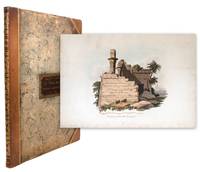
1822réf. 323375London: William Miller 1822. First edition later issue. Hand-colored aquatint dedication/title and 24 hand colored aquatint plates by D. Havell J. Hill and J. Bluck supervised by Robert Havell after Henry Salt on thick Whatman paper watermarked 1822. Interleaved throughout with blanks. Without the separately-issued octavo text as usual. Elephant folio. Contemporary half calf and marbled paper boards large morocco label on the upper cover spine gilt. Foxing to a few plates. First edition later issue. Hand-colored aquatint dedication/title and 24 hand colored aquatint plates by D. Havell J. Hill and J. Bluck supervised by Robert Havell after Henry Salt on thick Whatman paper watermarked 1822. Interleaved throughout with blanks. Without the separately-issued octavo text as usual. Elephant folio. A very fine set of views after drawings by Henry Salt. Salt left London in 1802 for an eastern tour with Lord Valentia visiting Indian and Ceylon and taking part in the first British mission to Abyssinia. At Calcutta they were entertained by the Governor-General Marquis Wellesley the dedicatee and travelled to Benares Lucknow Ceylon and Madras. From Mangalore Salt explored the Red Sea. After returning to Bombay and Poona he travelled again to the Red Sea and made an extensive journey inland to the Abyssinian Highlands. Salt's original drawings remained in Valentia's possession and after Salt's death the plates too became his property. Like Fraser's Himala Salt's Twenty-Four Views was published in the same size and style as Daniell's Oriental Scenery and is seen very much as a continuation of that great work. The plates include fine views of Chowringhee; the fort of Jaunpur; 2 aquatints of Lucknow including the mosque in the Great Imambara; the great Temple at Tanjore; Poona; the Chaitya Cave; 2 aquatints of Cairo; Cape Town etc. The present example is the reissue by Thomas M'Lean printed on Whatman paper watermarked 1822 but otherwise printed from the same plates as the 1809 edition. Abbey Travel 515; Tooley 440; Prideaux Aquatint Engraving pp.234-237 William Miller unknown books