GIRAULT LANGROIS SimonLivre Rare Book

2190 risultati
1592rif. 1118101592 A Lengres, Par Jehan des Preyz (Jean), 1592, 1 volume in-4 de 155x210 mm environ, 91 feuillets paginés, (1) f. (Table). Parchemin souple avec traces de liens. Ouvrage INCOMPLET DES ILLUSTRATIONS ET DU TEXTE : globe de la page de titre découpé, sans les figures ou cartes dépliantes (mais la carte in-texte d'Europe est bien présente), feuillets 2, 3, 8, 28, 58 et 59 manquants. Ouvrage en partie dérelié méritant une restauration : reliure salie comptant quelques manques, traces de mouillures importantes, déchirure avec manque au feuillet 54, mais de nombreuses gravures sur bois.
rif. 107873Paris, Dépôt Général de la Marine, 1852, Tome 1/2 vendu seul, 1 volume in-folio de 354x260x15 mm environ, 1f. blanc, page de titre, 1f. (Avertissement), 23 cartes montées sur onglet, 1f.blanc, demi percaline bleu-gris, titres dorés sur dos lisse. Quelques rousseurs et pages légèrement brunies, couverture frotté avec accrocs et manque de papier marbré par endroits, dos en partie décollé, intérieur bon état.
rif. 9781628089622NOVA SCIENCE PUBLISHERS INC
1922rif. 234471922. Salt Creek Haydite Plant album documenting shale extraction rotary-kiln aggregate production and water-control construction in Natrona County Wyoming 1922-1924 recording the first commercially manufactured lightweight structural concrete aggregate in the United States patented by Kansas City brickmaker Stephen J. Hayde in 1918 after he discovered that certain shales and clays could be expanded by rapid kiln-firing into a strong lightweight ceramic. Haydite transformed twentieth-century construction by reducing the dead load of concrete by roughly forty percent enabling taller buildings longer spans and the lightweight concrete masonry block industry that followed. The plant's location adjacent to the Salt Creek Oil Field then the largest producing oil field in the United States and the source of the Teapot Dome scandal that erupted in 1922 to 1923 ties the album directly to two converging industrial histories: the patented invention of expanded-shale aggregate and the height of Wyoming oil extraction. Photo archive of 91 silver gelatin photographs ranging from 2.5" x 4.5" to 5.5" x 3.5" mounted on album leaves with ink manuscript captions throughout bound in black leather with gilt-stamped cover reading "Salt Creek Construction" Natrona County Wyoming circa 1922-1924. The album's leather cover is inscribed "John B. Cleary Salt Creek Construction." It opens with exterior views of the Salt Creek Haydite Plant captioned "Const 1922 Com. Oper. Sept. 1" showing the main buildings the upper crusher and shale storage shed with stovepipe and yard-light and a loaded shale car at the trap of the shale pit. Successive pages document the production sequence by component: the upper crusher "jaw" with raw shale tumbling into the grates the ore feeder with belt-driven shafts the rotary kiln an Allis-Chalmers unit by the partially visible nameplate with a worker ascending its steel staircase the fire box of the kiln in close view the finish conveyor running to the haydite storage bin and piles of raw "hadite" being measured by two men in work clothes and wide-brimmed hats. A page is devoted to the Haydite Plant truck an FWD chain-drive with "Haydite Plant" lettered on its dump body and "M.B.Co. 81" stenciled above photographed both in service and at the loading dock. Named portraits include "W.B. Shilling Const. Engr." in a pith helmet and white shirt and a group portrait dated 1923 captioned "Mr. S.J. Hayde inventor of 'Haydite' Mrs. Hayde Mrs. C J.B.C. S.P. Boozell Plant Supt. John C." Later pages shift to a separate but related project: the "Cooling Pond No. 1 Sta. Salt Creek Field" under construction in the spring of 1923 with photographs of pile drivers drain tile staging at stations 960 to 000 workers troweling the concrete pond bottom and views captioned "Cooling Pond Finishing." A dam project follows including "Progress on Core Wall" views captioned "After Flood of Sept. '23 32000 S.F. Loss of 40' of Emb. & Core Wall" showing the breach riprap construction captioned "The Completed Project Before Storage Was Started" and a final image inscribed "Completed July 1 1924." A late page shows the failed spillway with the caption "Erosion of Spillway After Cut-Off Wall Failed" alongside a "Survey after Flood." Named figures include W.F. Edwards J.B.C. and "J.B.C. H.M. Pursel Contr." Stephen Hayde received U.S. Patent 1255878 for his rotary-kiln process of bloating shale into lightweight aggregate in 1918 and licensed the technology under the Haydite trade name beginning in 1920; the Salt Creek plant was among the earliest licensee operations and supplied aggregate for oilfield infrastructure at a time when the Salt Creek field's production peaked at over 32 million barrels in 1923. The cooling pond and dam pages document infrastructure built to handle produced water from the Salt Creek oilfield's No. 1 station capturing both the September 1923 flood failure with the specific 32000 square foot loss recorded on the leaf and the July 1924 rebuild. Overall in very good condition with expected toning foxing and edge wear to album leaves and mild silvering to several prints. The album constitutes a named dated and captioned firsthand record of early Haydite manufacturing and Salt Creek oilfield support construction anchored by an identified portrait of the inventor himself. unknown
1922rif. 234471922. Salt Creek Haydite Plant album documenting shale extraction rotary-kiln aggregate production and water-control construction in Natrona County Wyoming 1922-1924 recording the first commercially manufactured lightweight structural concrete aggregate in the United States patented by Kansas City brickmaker Stephen J. Hayde in 1918 after he discovered that certain shales and clays could be expanded by rapid kiln-firing into a strong lightweight ceramic. Haydite transformed twentieth-century construction by reducing the dead load of concrete by roughly forty percent enabling taller buildings longer spans and the lightweight concrete masonry block industry that followed. The plant's location adjacent to the Salt Creek Oil Field then the largest producing oil field in the United States and the source of the Teapot Dome scandal that erupted in 1922 to 1923 ties the album directly to two converging industrial histories: the patented invention of expanded-shale aggregate and the height of Wyoming oil extraction. Photo archive of 91 silver gelatin photographs ranging from 2.5" x 4.5" to 5.5" x 3.5" mounted on album leaves with ink manuscript captions throughout bound in black leather with gilt-stamped cover reading "Salt Creek Construction" Natrona County Wyoming circa 1922-1924. The album's leather cover is inscribed "John B. Cleary Salt Creek Construction." It opens with exterior views of the Salt Creek Haydite Plant captioned "Const 1922 Com. Oper. Sept. 1" showing the main buildings the upper crusher and shale storage shed with stovepipe and yard-light and a loaded shale car at the trap of the shale pit. Successive pages document the production sequence by component: the upper crusher "jaw" with raw shale tumbling into the grates the ore feeder with belt-driven shafts the rotary kiln an Allis-Chalmers unit by the partially visible nameplate with a worker ascending its steel staircase the fire box of the kiln in close view the finish conveyor running to the haydite storage bin and piles of raw "hadite" being measured by two men in work clothes and wide-brimmed hats. A page is devoted to the Haydite Plant truck an FWD chain-drive with "Haydite Plant" lettered on its dump body and "M.B.Co. 81" stenciled above photographed both in service and at the loading dock. Named portraits include "W.B. Shilling Const. Engr." in a pith helmet and white shirt and a group portrait dated 1923 captioned "Mr. S.J. Hayde inventor of 'Haydite' Mrs. Hayde Mrs. C J.B.C. S.P. Boozell Plant Supt. John C." Later pages shift to a separate but related project: the "Cooling Pond No. 1 Sta. Salt Creek Field" under construction in the spring of 1923 with photographs of pile drivers drain tile staging at stations 960 to 000 workers troweling the concrete pond bottom and views captioned "Cooling Pond Finishing." A dam project follows including "Progress on Core Wall" views captioned "After Flood of Sept. '23 32000 S.F. Loss of 40' of Emb. & Core Wall" showing the breach riprap construction captioned "The Completed Project Before Storage Was Started" and a final image inscribed "Completed July 1 1924." A late page shows the failed spillway with the caption "Erosion of Spillway After Cut-Off Wall Failed" alongside a "Survey after Flood." Named figures include W.F. Edwards J.B.C. and "J.B.C. H.M. Pursel Contr." Stephen Hayde received U.S. Patent 1255878 for his rotary-kiln process of bloating shale into lightweight aggregate in 1918 and licensed the technology under the Haydite trade name beginning in 1920; the Salt Creek plant was among the earliest licensee operations and supplied aggregate for oilfield infrastructure at a time when the Salt Creek field's production peaked at over 32 million barrels in 1923. The cooling pond and dam pages document infrastructure built to handle produced water from the Salt Creek oilfield's No. 1 station capturing both the September 1923 flood failure with the specific 32000 square foot loss recorded on the leaf and the July 1924 rebuild. Overall in very good condition with expected toning foxing and edge wear to album leaves and mild silvering to several prints. The album constitutes a named dated and captioned firsthand record of early Haydite manufacturing and Salt Creek oilfield support construction anchored by an identified portrait of the inventor himself. unknown books
rif. 1358This is a Standard AFTRA contract between Sal Mineo and NBC expressing that Mineo will receive $650 for his performance on December 4 1955 as Johnny Swaboda in "Trees" sponsored by Goodyear. Signed in blue ink by the seventeen year old "Sal Mineo" and also by his mother "Josephine Mineo". Many of his youthful roles were variations of his role in "Rebel Without a Cause" and he often played juvenile delinquents. unknown
rif. 1358This is a Standard AFTRA contract between Sal Mineo and NBC expressing that Mineo will receive $650 for his performance on December 4 1955 as Johnny Swaboda in "Trees" sponsored by Goodyear. Signed in blue ink by the seventeen year old "Sal Mineo" and also by his mother "Josephine Mineo". Many of his youthful roles were variations of his role in "Rebel Without a Cause" and he often played juvenile delinquents. unknown books
1930rif. 23719Grosset & Dunlap 1930. HARDBACK NODustJacket 1930 1st Edition 1st printing VG/VG AS-IS NOJACKET Pretext & ADS in Back Lists thru this Title THICK Red Cloth lettered in Yellow Outlined in Black 228 pgs ADS ending with Roy Blakeley Wild Goose Cloth Cover light Rub Wear Interior Nice tight Clean Light FoX Wear The inscription is to a young reader and contributor to the "Our Chatterbox" section preceding the story. This is a 12 page section paginated in Roman numerals of contributions from readers and a bit of chat from the author. . Signed by Author. First Edition. Hard Cover. Grosset & Dunlap hardcover
1866rif. 22020London: John Churchill 1866. First Edition. Original publisher's green cloth. Fine unopened copy. 8vo 2 xxii inserted errata slip 1 - 206 2 34 pp. inserted catalog dated May 1866 Frontispiece & 19 partially color and tinted plates and 7 inserted leaves of subscriber's names lithographically printed recto only. The author was not a physician but a "mechanician" in Birmingham. The book offered here is his analysis of the systems foreign and domestic of mechanical corrections for orthopedic deformities. John Churchill hardcover books
1894Paris, 1894. 4 volumes In/4 demi-chagrin rouge, dos à nerfs à fleurons et titres dorés, illustrations in-texte, 1940 pages, 4 ff. Petites usures sur les coiffes. Plus de 3500 recettes, prés de 5000 articles, prés de 800 figures dans le texte Fruit de dix années de travail, cet ouvrage répertorie par ordre alphabétique recettes, moyens réfrigérants, végétaux... bref, tout ce qui a un rapport avec l’alimentation de l’homme. Vicaire col. 356 pour la première édition de 1883.
1814rif. 60635London: Printed for F. C. and J. Rivington by W. Bulmer and Co 1814. First Edition. First printing. Quarto 32cm. Rebound in modern half marbled calf and marbled paper over boards titled in gilt on red leather spine label; modern brown endpapers; iii-xvi506lxxv1pp; 7 maps 5 folding one also hand-colored engraved by A. MacPherson after drawings by J. Outhett 27 plates and two in-text vignettes engraved by C. Heath after drawings by H. Salt and occasional relief diagrams. Errata to p.xvi. Former owner T. Bateman's stamp to title page. Lacking the half-title and the chart of Annesley Bay otherwise complete. A sturdy copy board edges gently rubbed slight dustiness to plate edges very occasional spots of foxing generally bright and fresh: Very Good. A handsome account of exploration in Ethiopia including depictions of notable nobles archaeological discoveries and hippopotamus hunting. Salt accompanied George Annesley on a tour of Egypt Ethiopia and India in 1802-06; following that he toured Ethiopia in 1809-1810 "as a quasi-official envoy under Canning's sponsorship marching from the Red Sea coast with an escort of 160 bearers to explore trade and diplomatic links with the Ethiopian emperor Wolde Selassie. Britain fearing a French alliance with Egypt wished to secure a port on the Red Sea. Salt carried out a little archaeology discovering at Aksum three large limestone tablets engraved with ancient Ethiopian inscriptions. Little came of the mission for the government but Salt earned over £1000 for the first edition of this book" HOWGEGO II S6. LOWNDES p.2180. Printed for F. C. and J. Rivington by W. Bulmer and Co unknown books
1897rif. 45502Salt Lake City: The Salt Lake Tribune 1897. First edition. Hardcover. Quarto 28.5 cm Rebound in blue cloth over boards with the original front wrap bound in. With a number of contemporary advertisements. Illustrations throughout. Very good. The extremities are rubbed including the gilt stamped title on the backstrip and there are several light scratches on the front board. There is a 4" closed tear in the top edge of the original front wrap along with a handful of shorter closed tears in the edges a few of which have been backed with tape. The last couple of pages also have small closed tears in the edges. Else the pages are free of tears and marks. Flake 7510. A collection of accounts printed in the Salt Lake Tribune between Monday April 5 1897 - July 24 1847 relating the events that happened on the very same day fifty years earlier during the Mormon trek west in the year of 1847. The Salt Lake Tribune hardcover
1897rif. 45502Salt Lake City: The Salt Lake Tribune 1897. First edition. Hardcover. Quarto 28.5 cm Rebound in blue cloth over boards with the original front wrap bound in. With a number of contemporary advertisements. Illustrations throughout. Very good. The extremities are rubbed including the gilt stamped title on the backstrip and there are several light scratches on the front board. There is a 4" closed tear in the top edge of the original front wrap along with a handful of shorter closed tears in the edges a few of which have been backed with tape. The last couple of pages also have small closed tears in the edges. Else the pages are free of tears and marks. Flake 7510. A collection of accounts printed in the Salt Lake Tribune between Monday April 5 1897 - July 24 1847 relating the events that happened on the very same day fifty years earlier during the Mormon trek west in the year of 1847. The Salt Lake Tribune hardcover books
1975rif. 287571975. Mimeographed 118 pages plus additional revised pages dated 9/26-10 /73 pinned in plain covers. Occasional pencil marks and dog ears reveal it was obviously used at some point in production. Directed by John Schlesinger. Signed by the cinematographer Conrad L. Hall and inscribed and signed by Karen Black. unknown
1975rif. 287571975. Mimeographed 118 pages plus additional revised pages dated 9/26-10 /73 pinned in plain covers. Occasional pencil marks and dog ears reveal it was obviously used at some point in production. Directed by John Schlesinger. Signed by the cinematographer Conrad L. Hall and inscribed and signed by Karen Black. unknown books
rif. H4030Weimar Landes-Industrie-Comptoir 1815. Neue Bibliothek der wichtigsten Reisebeschreibungen zur Erweiterung der Erd- und Völkerkunde hrsg. von F. J. Bertuch Bd. 4. 8vo. XVI 480 Seiten mit 1 mehrf. gefalt. kolor. Kupferstich-Karte. Pappband der Zeit mit Rückenschild kl.Bibl.-Nr. am unteren Rücken kl.St. der aufgelösten Bibliothek von Donaueschingen verso Titel. Sehr gutes sauberes Exemplar. Henry Salt 1780-1827 hatte zunächst Lord Valentia als Zeichner und Sekretär auf seinen Expeditionen begleitet; die Reise nach Abessinien im Jahre 1809/10 unternahm er als Gesandter der britischen Regierung. Als Ergebnis brachte diese Reise eine genauere Untersuchung und Aufnahme des Küstenstrichs zwischen der Assab-Bai und Massaua Henze IV 731. - Die große Faltkarte in kräftigem originalen Grenzkolorit zeigt Abessinien heute: Äthiopien und die angrenzenden Gebiete Ostafrikas entworfen nach Beobachtungen und eingezogenen Nachrichten Notizen von Heinrich Salt. - Henze IV 731f; Engelmann 103; Kainbacher 402. unknown
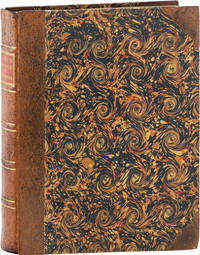
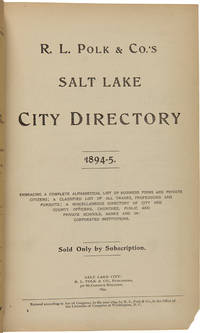
1894rif. 35120Salt Lake City: R.L. Polk & Co. 1894. An exhaustive directory with numerous illustrated advertisements. The chromolithographic plate advertises "The Orcutt Company Leading Lithographers" and depicts a middle eastern market scene. Original black half cloth gilt and boards printed with advertisements. Boards and preliminary leaves detached closed tear in cloth of spine. Plate fold strengthened. Internally fine. Overall very good. hardcover
1894rif. 35120Salt Lake City: R.L. Polk & Co. 1894. An exhaustive directory with numerous illustrated advertisements. The chromolithographic plate advertises "The Orcutt Company Leading Lithographers" and depicts a middle eastern market scene. Original black half cloth gilt and boards printed with advertisements. Boards and preliminary leaves detached closed tear in cloth of spine. Plate fold strengthened. Internally fine. Overall very good. hardcover books
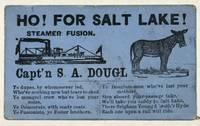
1860rif. 422661860. Printed oblong blue card 3-1/4" x 2" with illustrations of a steamship and a donkey. Some wear to the blank verso. Very Good. This rare and apparently unrecorded satiric political card celebrates the defeat of Lincoln's opponents in the 1860 presidential election. References to "Salt River" or "Salt Lake" were common in mid-19th century political slang. A losing candidate took a trip up Salt River and was frequently depicted purchasing a ticket to Salt Lake. The poem accompanying this ticket is reproduced here: Ye dupes by whomsoever led Who've nothing now but tears to shed Ye mongrel crew who've lost your votes Ye Democrats with seedy coats Ye Fusionists ye Foster brothers Ye Douglass-men who've lost your mothers Step aboard your passage take. We'll take you safely to Salt Lake. There Brigham Young & broth'r Hyde Each one upon a rail will ride. The song mocks Fusionists whose effort to preserve the Union by uniting Douglas and Bell-Everett men was defeated. "Douglass-men who've lost your mothers" refers to Douglas's campaign trip to New England in 1860 purporting to visit his elderly mother and family. Active campaigning by candidates was frowned upon. When it took him over a month to go from Washington to New York Republicans taunted him as 'A little boy' a reference to his shortness of stature 'lost in search of his mother' Reilly 1860-35. Currier & Ives satirized the issue with a lithograph "Stephen Finding 'His Mother'." We have not located another copy of this unusual item. unknown
1860rif. 422661860. Printed oblong blue card 3-1/4" x 2" with illustrations of a steamship and a donkey. Some wear to the blank verso. Very Good. This rare and apparently unrecorded satiric political card celebrates the defeat of Lincoln's opponents in the 1860 presidential election. References to "Salt River" or "Salt Lake" were common in mid-19th century political slang. A losing candidate took a trip up Salt River and was frequently depicted purchasing a ticket to Salt Lake. The poem accompanying this ticket is reproduced here: Ye dupes by whomsoever led Who've nothing now but tears to shed Ye mongrel crew who've lost your votes Ye Democrats with seedy coats Ye Fusionists ye Foster brothers Ye Douglass-men who've lost your mothers Step aboard your passage take. We'll take you safely to Salt Lake. There Brigham Young & broth'r Hyde Each one upon a rail will ride. The song mocks Fusionists whose effort to preserve the Union by uniting Douglas and Bell-Everett men was defeated. "Douglass-men who've lost your mothers" refers to Douglas's campaign trip to New England in 1860 purporting to visit his elderly mother and family. Active campaigning by candidates was frowned upon. When it took him over a month to go from Washington to New York Republicans taunted him as 'A little boy' a reference to his shortness of stature 'lost in search of his mother' Reilly 1860-35. Currier & Ives satirized the issue with a lithograph "Stephen Finding 'His Mother'." We have not located another copy of this unusual item. unknown books
rif. 2602420 of Brassington’s 21 letters from between 1899 and 1902 and on letterheads of Shakespeare Memorial Stratford-upon-Avon; the other is from 1910. Among the other items are ones dated from between 1899 and 1928. The Shakespeare Memorial Theatre was founded through the efforts of local brewer Charles Edward Flower 1830-1892 after whose death its management was taken over by his brother Edgar Flower 1833-1903 also Chairman of the Shakespeare Birthplace Trust. On Edgar’s death these duties fell to his son Archibald Flower 1865-1950 several times mayor of Stratford-upon-Avon. The present correspondence concerns a gift to Shakespeare Memorial Association by the appropriately-named anatomist Evan Marlett Boddy. Between 1899 and 1901 Boddy donated at least twelve portraits to be hung in the Shakespeare Memorial reading room from the correspondence wood carvings also appear to have been donated. Details of the first seven portraits are contained in a letter of 11 December 1899 from Boddy to the Shakespeare Memorial librarian the archaeologist W. S. Brassington for which see below. The paintings included supposed works by Henry Fuseli ‘The Fuseli Macbeth’ and Sir Peter Lely Nell Gwynne Henry Wyatt Coleridge and a portrait said to be by Romney of a young Percy Bysshe Shelley five letters by Brassington relating to which are offered separately one of Alexander Pope ‘attributed to Hogarth’ as well as a ‘Garrick portrait’ one of Nell Gwynne and a ‘Spanish Lady’. In 1916 Boddy demanded their return on discovering that the Archibald Flower had broken the condition that Boddy had arranged in 1900 with the then librarian W. S. Brassington: ‘The Portraits were to be hung together and remain so.’ The present collection of 37 items is in good condition lightly aged apart from a couple of items are creased and worn both being repaired with archival tape. The 20 of Brassington’s 21 letters dating from the years 1899 to 1902 totaling 39pp 12mo; and 1p 4to convey his enthusiasm with regard to the donation. In the first letter 9 December 1899 Brassington acknowledges receipt of a letter from Boddy ‘respecting portraits of Shakespeare’ noting with pleasure Boddy’s ‘kind proposal to present the pictures to the Shakespeare Memorial’. Three days later 12 December 1899 he arranges to ‘come over and view’ ‘the pictures which you so generously propose to bestow upon the Shakespeare Memorial’. On 16 December arrangements are made for the removal of the pictures by ‘stage carpenter’ Henry Mann with Brassington reporting that ‘Mr Flower our Chairman who is at present away from home . thinks it most kind of you to make this very handsome present’. And a week later 19 December 1899 he acknowledges receipt of ‘the seven portraits which you so generously bestow upon the Shakespeare Memorial’ adding ‘Now that the portraits are in a good light I am more than ever delighted with them and I think you will be so when you see them in the Gallery.’ On the same day 19 December 1899 Edgar Flower writes to Boddy from The Hill Stratford-on-Avon as ‘Chairman of the Council’ to report ‘how greatly the gift is approved’. He continues: ‘In due course you will receive an official acknowledgment but in the meantime allow me to say personally that I consider each of the portraits as of great merit and interest and that they wil be conserved as your gift in the gallery to which they are a magnificent addition’. Six months later the works have been properly hung and on 23 June 1900 he writes that the ‘beautiful pictures have been much admired to-day by our London visitors many of whom had not seen Stratford before’. Four days later he informs Boddy that his ‘beautiful pictures reached here in safety. The “lady” is before me in a good north light and looks magnificent.’ Shortly afterwards 10 July 1900 he goes into some detail with regard to the hanging: ‘The “Spanish Lady” and other pictures now adorn the walls of the Memorial and are being very greatly admired. Mr Flower is unwell and I have not been able to obtain his signature to a card of thanks but at the monthly committee meeting great satisfaction was expressed at your generosity. The Grinling Gibbons’ carving now stands upon the carved oak mantle shelf of the Reading Room. It is most handsome and suitable since it represents the arms of London where Shakespeare lived for the greater part of his life. Moreover the carving hides an ugly modern Dutch bronze portrait of Shakespeare now well out of sight! / The Seven ages of Man adorn the staircase. And the “Spanish Lady” hangs over-against Nell Gwynne above the other portraits in the end gallery.’ The letter continues with speculation about the subject’s identity. On 23 July 1900 he reports: ‘The two valuable additions to the collection of paintings so kindly presented by you to the gallery are now placed on the walls. The Fuseli hangs near another example by the same master in the 1st gallery the Sir Peter Lely is placed with the other portraits between Nell Gwynn and the Spanish Lady’ which is ‘one of the most beautifully painted pictures I have ever seen’. He is so struck by it that he ‘went to the Dulwich Gallery last week to make notes but found nothing like this picture there’. A letter of 1 November 1900 begins by commending Boddy’s gift of the proof of his ‘brochure’ ‘Shakespeare’s Garden’. Brassington then discusses his holiday ‘in a cottage on the quay at Minehead. We had a good time at that old-world place and I ventured to Stratford refreshed. I had found the summer season with its crowd of Americans rather trying.’ He is relieved that Boddy was well treated by the staff in his absence: ‘they all take the greatest interest in the work of the memorial . Unfortunately of late there has been a discordant note sounded by Miss Corelli but people here are now aware that a great fuss is being made about a little matter.’ Turning to Boddy’s gift he writes: ‘I am glad you approve of the arrangement of the portraits. We expect next week to receive a portrait and a bust of Miss Mary Anderson and possibly a bust of Ellen Terry so you see we are adding to the collection and to the interest of the place.’ On 27 November 1900 he reports that he has been told by ‘Elliott’ that ‘the portrait of the boy with a dog which you recently presented to the Memorial appears to me to be more like the work of Vandyck than of any other artist. I sincerely hope it may be so’. And on 18 January 1901 he writes: ‘The two paintings reached here safely - they are beauties.’ On 3 June 1901 Brassington writes on the wider question of ‘Memorial Picture Gallery’ reporting that he has had ‘a call from Mr Frank Richards 1863-1935; Newlyn School an artist late of Birmingham now of No. 6 Addison Studios West Kensington. / Mr Richards has painted a large picture of “Hamlet” which he wishes to place in the Memorial Picture Gallery. Sir Henry Irving and Mr Flower have offered £10. each towards a subscription to buy the picture for the Memorial and it is possible that Mr Richards may write to you on this subject.’ He gives further details of appeal reporting Edgar Flowers’ opinion that that painting is ‘a fine work of art though in his opinion the face of Hamlet is too old looking’. He discusses the difficulties involved in dealing with such a ‘large Shakespearian picture’ two or three of which have been offered to the Memorial there being ‘no fund for the purchase’ and a reluctance on the part of the governors ‘to make an appeal either to the Governors or the public. The Committee feel that any suggestion of begging for donations should be avoided at the same time they dont like the idea of refusing a good and suitable picture’.Fifteen years later the mood has drastically worsened. Seven items from 1916 mostly carbon copies of TLsS dealing with a complaint by Boddy regarding the handling of a collection of historic portraits presented by him to the Shakespeare Memorial Association in 1900. Boddy states in a TLS copy to Steward Dick from Ashted Row Birmingham 17 June 1916: ‘I was certainly more than surprised to find my pictures scattered about the building in a most indiscriminate manner. I presented them to the Memorial on the distinct understanding that they were to be kept together’. Edgar Flower’s son Archibald replies in an undated carbon from The Hill Stratford on Avon: ‘I am indeed sorry that there should have been any misunderstanding and that you who have been a govener sic so long should have been caused pain by the rehanging of these pictures / At the time you gave these my father was chairman and I had no knowledge of your having expressed any special wish as to the grouping.’ The other five items relating to this complaint are a copy of a letter of complaint from Boddy to W. S. Brassington ‘being that you were Librarian at the Memorial Theatre when I presented my collection of pictures’ stating that he has ‘demanded the return of all my pictures’ and two copy letters from W. S. Brassington to Boddy one referring to ‘these tiresome people at Stratford’ and copies of a memorandum ‘Suggestion for Inscription / Collection of Historic Portraits’ and note to Stewart Dick see below stating that the matter is in the hands of Boddy’s solicitor. Other material comprises: ONE: ALS copy from Boddy to Brassington Ashted Row Birmingham 11 December 1899. Giving details of seven portraits he would be ‘pleased to present’ and suggesting that he visit to view them. ‘Though the portraits do not relate to Shakespeare I think when you see them you will agree with me that they will be a valuable and most interesting addition to your collection.’ TWO: An ALS from Brassington 31 August 1910 hinting at trouble to come with regard to ‘the circumstances connected with your suggestion for a tablet’: ‘Your wishes were clearly expressed to the committee when the pictures were received & would be recorded in the Minute book. / It seems to me that the words quoted by Mr Archibald Flower constitute a condition & that the gift was accepted on those terms - certainly that is what I understood.’ THREE: Two ALsS to Boddy from Stewart Dick one 22 July 1916 on letterhead of the Old Brewery House Stratford-upon-Avon the other undated on same letterhead cancelled in favour of Shakespeare Memorial Theatre. He begins the dated letter: ‘Mr Lowndes has handed me the letter from Messrs Philip Baker & Co regarding your pictures. Dont you think that the best plan will be for me to run up to you one day next week . I am sure after meeting you the other day that we can arrange the matter quite amicably without troubling the lawyers further.’ On the reverse of the letter is a pencil draft of Boddy’s reply informing him that ‘the matter is now entirely in the hands of my solicitors’ for typed carbon of which see above. Dick’s second undated letter is a longish one 4pp 12mo 67 lines apparently from the time of the donation commenting enthusiastically on the pictures and asking for information about them. FOUR: Transcription by Brassington of ‘Suggestion for Inscription’ by Edgar Flower dated April 1900. States that the collection of twelve paintings was ‘presented to the Shakespeare Memorial Association by Evan Marlett Boddy Esqr. F.R.C.S. on condition that the pictures be kept together and not removed from the Memorial Buildings at Stratford on Avon.’ FIVE: An ALS to Boddy from Charles Lowndes 26 April 1900 on Shakespeare Memorial letterhead apologising for spelling Boddy’s name wrongly. SIX: Signed receipt for ‘Black & gold frame’ from J. Morgan of Stratford-upon-Avon 12 January 1901 on his letterhead. SEVEN. Printed notice by ‘Edgar Flower / Chairman’ Shakespeare Memorial Stratford-upon-Avon dated 20 June 1900 regarding ‘Presentation of William Page’s Bronze Bust of Shakespeare’ to the Whitefriars’ Club City of London. EIGHT: Printed ‘Fifty-second Report of the Council to be submitted to the General Meeting of the Governors of the Shakespeare Memorial Theatre Stratford-upon-Avon convened for Monday April 23rd 1928.’ 4pp folio. With long list of officers and governors statement of expenditure and receipts and report of executive council. 20 of Brassington’s 21 letters from between 1899 and 1902, and on letterheads of Shakespeare Memorial, Stratford-upon-Avon; th unknown
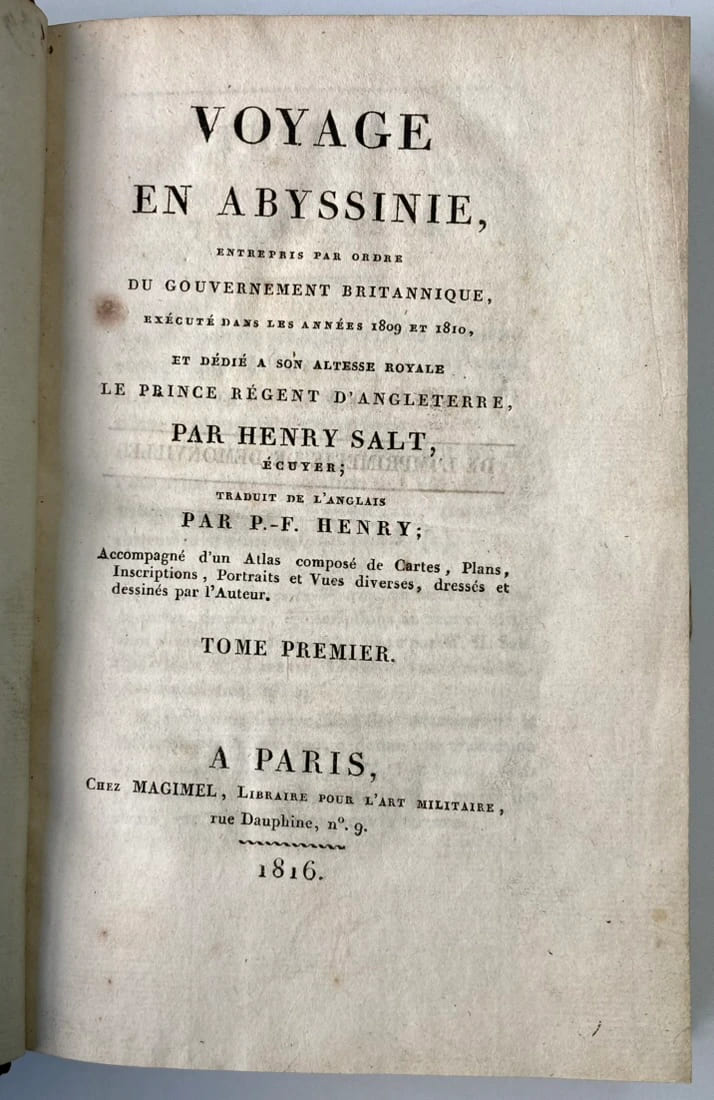
1816rif. 455491816 Paris. Magimel (Dabo pour l’Atlas). 1816. 3 volumes in-8 dont 1 oblong, demi-veau brun, dos lisses titrés doré; l'atlas est en reliure moderne à l'imitation.(2) ff. ; X pp. ; (1) f. ; 406 pp. ; (1) f. - (2) ff. ; 473 pp. ; (1) p.- (2) ff. ; 33 planches.
1707rif. ys3847Lugduni Batavorum, apud Fredericum Haaring Relié 1707 In-12 (10,5 x 16,5 cm), reliure plein veau, dos à 5 nerfs orné de caissons dorés, pagination comme suit : faux-titre, titre, Lectori Benevolo (11 pp.), Noi Reformatori (1 pp.), puis 280 pp., texte en latin, rare seconde édition de ce livre de Domenico Guglielmini, un des initiateurs de la cristallographie. Il s'agit ici d'une étude sur le sel, dont la première édition a été imprimée en 1705 à Venise ; pièce de titre manquante au dos, petits manques de cuir aux coiffes, coins, et petits trous dans le cuir au premier plat, par ailleurs bon état général. Livraison a domicile (La Poste) ou en Mondial Relay sur simple demande.
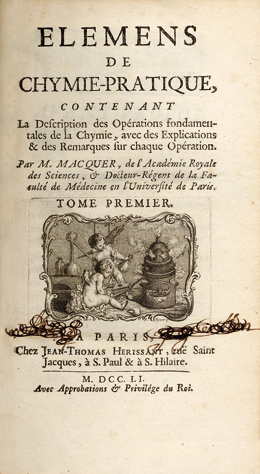
1751rif. 15490Paris, Hérissant, 1751 ; 2 t. petit in-8 ; veau havane marbré glacé, dos à nerfs décorés et dorés, pièces de titre fauve et de tomaison vert foncé, roulette sur les coupes, tranches rouges (rel. de l'époque) ; ((4), XVI, (8) (table), 517 pp., (3) pp. bl. ; (16), 574 pp., (1) f. bl., vignette gravée de titre, répétée, par R. Brunet d'après C. Challe, angelots qui s'activent au milieu des cornues auprès d'un fourneau.
1766rif. 21550Paris, Pierre-François Didot, le Jeune, 1766 ; in-12, veau marbré, dos lisse à faux nerfs dorés, décoré et doré, pièce de titre grenat, tranches rouges (reliure de l’époque) ; [8], 392 pp.