7.607 resultados
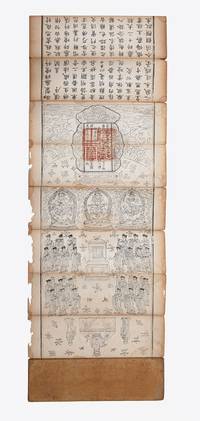
ref. 10529Two & one-half woodcut illus. 44 sheets each folded into multiple pages. Oblong small 8vo 89 x 288 mm. orig. stiff boards in concertina format one board loose. Beijing: Fanjing chang 番經廠 1617 date of colophon; woodblocks carved in 1599. One of three surviving copies of a Tibetan-Chinese bilingual liturgy of Bhaiṣajyaguru the Medicine Buddha printed under Ming imperial patronage at the Tibetan scripture workshop Ch. fanjing chang 番經廠. Tibetan books printed in pre-1644 Beijing are very rare and precious; this is the only copy we have encountered. Our copy has the well-known 廣é‹ä¹‹å¯¶ seal on the frontispiece representing Ming royal provenance. Many of the early-Ming emperors were devout followers of Tibetan Buddhism and sponsored large-scale sutra printing projects including the first printed edition of the Tibetan Kanjur canon completed in 1411 under the patronage of the Yongle Emperor r. 1402-24. This veneration declined during the reign of the Jiajing Emperor r. 1521-64 who favored Daoism and dissolved many longstanding Buddhist institutions in the capital. It was after his rule in 1572 that the court reestablished the Tibetan scripture workshop in part to secure the alliance of the Altan Khan 1508-82 of the Tümed Mongols a powerful patron of the Gelug sect. Despite its name the Tibetan scripture workshop seems to have printed few Buddhist texts with the notable exception of a new 1605 edition of the Kanjur. Falling under the jurisdiction of the Directorate of Ceremonials Ch. Silijian å¸ç¦®ç›£ the workshop's main responsibility was to officiate routine Buddhist rituals within the palace complex. As the court was hesitant to admit Tibetan Buddhist monks into the inner palace these rituals were led instead by trained eunuchs and courtesans some of whom lived and practiced as nuns within the workshop 陳楠 "法渊寺與明代番經廠雜考" ä¸åœ‹è—å¸ 2006.2 pp. 138-43. According to the Preface in our copy this bilingual ritual of the 12 vows of the Medicine Buddha was prepared in Wanli 27 1599 by the palace eunuch Zheng Li 鄭利 master of rituals at the Tibetan scripture workshop. The Tsinghua University Library currently exhibiting one of the two other surviving copies describes the book as follows in trans.: "First edition published in 1599 by the scripture workshops of the Directorate of Ceremonials in the inner palace. Only surviving copy sic. It begins with a frontispiece in three pages followed by the preface of Zheng Li explaining the conditions around the translation and publication of the text which is valuable for understanding the functions of the Ming scripture workshops. The text consists of prayers for incense offering light offering and purification followed by the twelve vows of the Medicine Buddha and the dedication of merit.The page is wide and large the layout is generous the characters are large as coins the engraving is exquisite and the paper is of high quality. These are typical of the 'palace workshop' editions. To accommodate the bilingual text the Chinese text is written horizontally from left to right making it an exemplar of early horizontally written Chinese texts. The binding also differs from the traditional Chinese sutra binding. To accommodate the horizontal text the tuipeng 推篷 or 'push-awning' binding is used instead. It is a rare example of a Ming-era book in the 'push-awning' binding."-"万å·ç³ç…--馆è—å部善本特展" accessed Oct. 3 2026. A provisional comparison of the Chinese and Tibetan texts shows that with the exception of a few short passages neither is a direct translation of the other and the bilingual text likely formed an integrated liturgy conducted with a mixture of languages including Sanskrit mantras in Tibetan transliteration. This linguistic hybridity is echoed by the unusual choice of a vertical concertina binding which ingeniously brings together the layout and reading practices of the Tibetan pecha with a Chinese binding traditionally associated with Buddhist scriptures. As mentioned above ours is one of three surviving copies. While the exact state of completeness and condition of the Tsinghua University copy is unclear a comparison with the copy digitized by the Berlin State Library Pander C 18 shows that its frontispiece with the colophon dated Wanli dingsi 1617 when 120 copies were printed and royal seal fully present in our copy is damaged and mostly lacking in the Berlin copy. The front board of the Berlin copy has the bilingual title Mi 'khrugs pa'i 'cho ga dang po bzhugs sto A chu fo tan chang jing 阿閦佛壇塲經 but its relation to the text is unclear. The comparison also shows the final part of the illustration at the end of our copy to be damaged and incomplete. Our copy nevertheless contains a short final inscription "shang g.yi kyen tha'i kyen zin gon dbang shing tshin kci yin tsog" which appears to transcribe an unidentified Chinese phrase and is lacking in the Berlin copy. The Berlin copy was evacuated to Silesia during the World War II and then taken to Krakow when that region became part of Poland. It remains in Krakow. We believe that our book comes from the collection of Japanese sinologist Kanda Nobuo 神田信夫 1921-2003. As mentioned Tibetan books published in Ming-era Beijing are extremely rare; we find no other example in WorldCat. The Tibetan scripture workshop was dissolved during the Ming-Qing transition and the region later became home to the famous Songzhusi 嵩ç¥å¯º temple complex the center of Tibetan publishing in Qing Beijing. Fine copy; some tears in the margins with no loss of text and some marginal dampstaining as well as the aforementioned loss of half an illustration at the end. One board is loose. Preserved in a modern hantao. unknown books
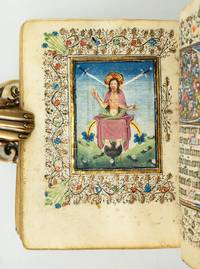
1450ref. ST20835Flanders ca. 1450. 109 x 81 mm. 4 1/4 x 3 1/8". Single column 14 lines in a gothic book hand. 161 leaves. COMPLETE. Contents: Calendar f. 1r; Mass of the Holy Spirit f. 14r; Mass of the Holy Cross f. 23r; Requiem Mass f. 30r; Prayer on the Seven Last Words of Christ by the Venerable Bede f. 36v; Passion according to John f. 40v; blank f. 53; Hours of the Holy Cross f. 55r; Mass of the Virgin Mary f. 60r; Gospel Lessons f. 66v; Hours of the Virgin f. 73r; Penitential Psalms f. 126r; Litany f. 138r; Office of the Dead f. 144r. PLEASING NEAR-CONTEMPORARY BLIND-ROLLED CALF apparently with some old skilled restoration to joints spine and corners covers with rolled vine border surrounding a panel of three columns bearing a roll with parts of the inscription "AVE MARIA GRACIA PLENA" each word separated by one of four small motifs a flower a human profile the lamb of god and a sitting animal--perhaps a lion raised bands compartments with part of the same inscription roll. Lacking the original ties. Housed in a very attractive custom-made brown calf folding case with blind-stamped lettering on the spine interior lined in suede the whole within a calf-lipped suede-lined matching slipcase. Rubrics in red numerous one-line initials in blue with red penwork or gold with dark blue penwork many two-line initials in burnished gold on pink and blue ground with white embellishments several larger "I" initials between four and 11 lines in burnished gold on pink and blue ground with white embellishments 12 six- to seven-line initials some painted pink or blue with white embellishments and filled with flowers and tendrils on a gold ground or the initial in burnished gold on pink and blue ground with white embellishments EIGHT LARGE MINIATURES each inside a thin gold frame and with a three-quarter border of gilt leaves hairline vines and floral spays each facing page with a similar three-quarter border the subjects of the miniatures being: the Holy Spirit in the form of a dove f. 13v; St. Helena and the True Cross f. 22v; Raising of Lazarus f. 29v; Crucifixion f. 54v; Virgin and Child Enthroned f. 59v; Annunciation f. 72v; Last Judgment f. 125v; Funeral Mass f. 143v. Prickings visible in fore margins. See: Defoer et. al "The Golden Age of Dutch Manuscript Illumination" pp. 75-86. Just minor wear to the solid very pleasing early binding. A little chipping almost always mild to four of the miniatures with square frames the fifth the Annunciation somewhat rubbed and faded the three domed miniatures perfectly intact vellum with minor soiling and thumbing in places especially in lower corners of leaves in second half other trivial imperfections but overall a very well-preserved manuscript with no major issues. This enchanting little prayer book features eight attractive miniatures large gleaming burnished gold initials and a pleasing period binding--all in an excellent state of preservation. The miniature program here can be attributed to the so-called Masters of Otto van Moerdrecht the name given to a variety of Dutch artists active in the 1430s and '40s all working in a similar mode rather than to a specific master or workshop. According to Defoer et al. the work of these miniaturists "exhibit varied compositional formulas and bright highly contrasting colors . . . . The small somewhat doll-like figures appear rather wooden but their expressive gestures give the scenes a varied and vivid character." Two artistic hands are responsible for the present miniatures. The artist behind the first three miniatures all set within domed gilt frames the Holy Spirit St. Helena and Raising of Lazarus shows particular skill with a very smooth application of color figures with long eloquent hands and faces with subtle white highlighting. A second artist was responsible for the remaining five miniatures set within square golden frames Crucifixion Virgin and Child Enthroned Annunciation Last Judgment and Funeral Mass. Though this hand is less polished and the miniatures slightly smaller in size the scenes are all quite charming and attractively colored with vivid splashes of bright orange bubblegum pink sky blue and pale green. It is worth noting that the miniatures differ not only because of the artists' degree of success but also because of their condition: whereas the five are generally well preserved the other three are in a virtually perfect state. In addition to the central text of the Hours of the Virgin this manuscript contains several Masses each of which is preceded by a miniature. Perhaps the most interesting of these is the Mass of the Holy Cross which is paired with a miniature of St. Helena mother of Constantine the Great. According to Christian tradition Helena found the wooden cross used in the Crucifixion while she was travelling in Jerusalem in the fourth century. Constantine built the Basilica of the Holy Sepulchre in its honor and installed the relic there to be venerated. Britannica says that the adoration of the True Cross led to wide-spread sale of its fragments sought after as objects of devotion. It is unusual to find St. Helena depicted in a Book of Hours and this image is especially appealing with Helena in a beautiful red robe crown and halo embracing a large wooden cross in the center of the composition. The background is reminiscent of the work of the Gold Scrolls group with small swirls of liquid gold swimming in a scarlet sky the same scrolling motif graces the Holy Dove miniature. There is no indication of former ownership in this manuscript although the Calendar presents a few unusual saints that confirm a Flanders connection. These include St. Amandus in red known as the "Apostle of Flanders" on 2 February; St. Guido known as the "Poor Man of Anderlecht" on 9 September; St. Bavo in red patron saint of Ghent where a Cathedral is named in his honor on 10 October; and St. Eligius patron saint of goldsmiths and metalworkers on 1 December. The binding here is very close to contemporary and probably dates to the late 15th century. Neither the floral roll nor the "Ave Maria" roll seems to appear in EBDB. Similar rolls include r001954 r000623 and r000670 but ours is the only one with four different and charming tools one of each used between every "Ave" and "Maria." For a manuscript only slightly bigger than the palm of one’s hand this Book of Hours has a great deal to offer. In addition to its early binding and lovely illumination by an influential group of artists great care has been put into its preservation so that it resolutely endures for our pleasure and for owners in the centuries to come. unknown books
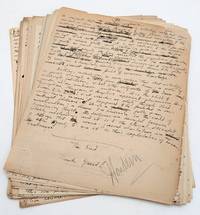
1926ref. 71978Providence RI: H. P. Lovecraft 1926. Manuscript. Very Good. Twenty-three letter-sized manuscript leaves approx. 8.5" x 11". Written in dark ink and hand-numbered by Lovecraft: page numbers 16 18 24 25 26 26b and 27-43. The manuscript pages feature heavy contemporary ink revisions cancellations interlinear additions and a data table. Lovecraft concludes on page 43 in ink: "The End / Thank Gawd!" and the manuscript is signed "Houdini" by Harry Houdini in pencil at the conclusion. The manuscript is written on the reverse sides of correspondence and constitutes a rich literary archive preserving original incoming letters to H.P. Lovecraft. Professional and personal correspondence typescript poetry submissions and editorial rejections sent to Lovecraft between 1922 and 1926 by associates editors and other contemporaries are represented here. Some horizontal folding creases sporadic edge wear and chipping age-toning. The Manuscript Rectos: A major autograph working draft of The Cancer of Superstition the ghostwritten treatise commissioned by Harry Houdini in 1926 to combat spiritualism and commercial fortune-telling. Writing entirely in his own hand Lovecraft systematically deconstructs astrology using modern astronomical scientific knowledge-citing the precession of the equinoxes light-speed delays and extragalactic nebulae-while refuting astrological claims through logic probability and history. Lovecraft mounts a rigorous scientific assault on astrology treating pseudoscience not merely as an intellectual failing but as a cosmic absurdity. On page 39 he constructs a detailed planetary data table tracking diameters solar distances and revolution periods arguing that when viewing these immense scales "we can no longer entertain the astrological illusion that our earth is a considerable object for whose benefit the rest of the universe is arranged." Turning his venom toward the commercial occult trade Lovecraft decries "how many dollars are snatched from the unwary by a device so ancient & so simple" warning that "many lives have been utterly wrecked through the random bombast & gibberish of some ignorant & unscrupulous soothsayer" page 26. Elsewhere he dismantles horoscopic predictions through celestial mechanics noting that zodiac signs "sprang partly from apparent conditions no longer existing" 35 and questions the clockwork of the planets reckoning with light-speed delays crossing vast distances of the cosmos: "If the planets rule the earth why are not the real times of their aspects calculated; instead of the apparent times as judged by their light as it reaches us" 38. Driving his argument to its climax Lovecraft brands astrology as "a legacy from primitive times; a sister of witchcraft fetichism . a shame & a nuisance in the world of broadening thought" and brings his draft to an exhausted close: "The End / Thank Gawd!" 43. The Correspondence Versos: Lovecraft reused the blank backs of incoming correspondence received between 1922 and 1926 to draft the text-a lifelong habit born of extreme poverty and his frequent inability to afford fresh writing paper. These versos contain letters poems and notes from key associates including W. Paul Cook James F. Morton Jr. Anne T. Renshaw Horace L. Lawson Leo Fritter Edward L. Sechrist and John Ravenor Bullen. Notably Leaf 26b preserves a typed rejection letter from Macfadden Publications Ghost Stories magazine dated September 13 1926 establishing the precise date of composition weeks prior to Houdini's death on October 31 1926. Beyond serving as draft paper these recycled letters capture vivid glimpses into Lovecraft's inner circle and literary network. James F. Morton Jr. bemoans his paid ghostwriting work lamenting "The more I work on this stuff the more I realize the hopeless inadequacy of the profanity division of the English language" while praising mutual associate Samuel Loveman as "a greater genius than both of us together" see letter on reverse of HPL's corresponding manuscript page 41. A remarkably interesting and macabre letter from entomologist Edward L. Sechrist is present. Inspired by Lovecraft's horror fiction Sechrist muses on having little "reverence for human meat than for any other kind of flesh and I believe I could contentedly pick a bone with the rest of a group of cannibals squatted beside a little fire. So I rather appreciate your Doctor's experiments. I have no shivers for anything." 28-29. Crucially anchoring the entire assembly is a formal rejection letter 26b from Macfadden Publications' Ghost Stories magazine "I regret that I am unable to use it" typed September 13 1926-providing the definitive date of this manuscript composition just weeks before Houdini's untimely death. Historical & Publication Context: Following their successful 1924 collaboration on "Imprisoned with the Pharaohs" Harry Houdini retained Lovecraft to spearhead a book-length crusade against spiritualism and pseudoscience. Lovecraft devised the work's master outline and drafted its core scientific arguments bringing in his Providence associate C. M. Eddy Jr. to expand prose chapters under his editorial direction. The project came to a sudden halt when Houdini unexpectedly died on Halloween 1926 prompting his widow Bess Houdini to discontinue the work. Long regarded as a legendary lost collaboration-represented in print for decades only by Lovecraft's outline in Arkham House's The Dark Brotherhood 1966 and a partial typescript discovery in 2016-the text remained unpublished for nearly a century until its debut release in March 2025 by 1878 Press Co. titled The Cancer of Superstition and credited to "Harry Houdini & C.M. Eddy Jr. Outline by H.P. Lovecraft." Here preserving twenty-three pages written entirely in Lovecraft's own hand this manuscript proves he penned far more than a mere outline for this famous lost work. H. P. Lovecraft unknown books
1956ref. 140943102Various Places: The War Relocation Authority 1956. A substantial archive of over 300 individual documents plus a few duplicates relating to Japanese internment during WWII forming a very thorough view of the federal agency that directed their imprisonment The War Relocation Authority. Such a sizeable collection of WRA documents is extremely rare in commerce. All the major facets of the dark disturbing episode of Japanese internment are represented in this archive: its basic legal and historical outlines the WRA's publicity and propaganda and its reception in the US the WRA's groundbreaking use of social sciences in service of repressive American policies life and death in the camps and the ending of internment. The essential history of internment can be said to begin with Franklin D. Roosevelt's Executive Order 9102 establishing the War Relocation Authority included in mimeograph format. Around that time and later an Index-Digest of Opinions by the Office of the Solicitor compiles legal opinions about internment with commentary by regional attorneys. Additionally included are many of the WRA's quarterly and semi-annual reports as well as a nearly 300-page contemporary history of the agency by an unknown author untitled and likely written in late 1944. The publicity campaigns of the agency are reflected in collections of the propaganda leaflets the WRA issued a near-complete run of the abstracts the WRA prepared on press coverage it faced mimeographed speeches presented by WRA head Dillon S. Myer and other agency figures and a file of documents relating to the WRA's investigation by the House Committee on Un-American Activities HUAC which would become famous under Joseph McCarthy in the early 1950s. The WRA's sensitivity to criticism is readily apparent especially in their robust reaction to HUAC's critiques. One of the most controversial sections of the WRA the Community Analysis Section is heavily represented in this archive by near-complete runs of their Community Analysis and Project Analysis Reports. The Community Analysis Section was largely composed of social scientists primarily anthropologists who studied life in America's WWII concentration camps. Their aim was to aid Franklin D. Roosevelt's administration in running the camps with as little resistance as possible by applying lessons learned in the disciplines of Japan studies and the human sciences. Although some Community Analysts voiced objections within restricted internal communications few brought these objections before the American public. Throughout the next six decades anthropologists psychologists and sociologists would become increasingly integral in US military operations and counterinsurgency campaigns leading to controversy with the revelation of their complicity in acts of torture by the American military in Iraq and Afghanistan. Life and death in the camps is revealed in the previously mentioned reports of the Community Analysis Section as well as in detailed reports of Americans of Japanese ancestry who died in the camps and in military service Cumulative Casualties by Center documents about Tule Lake and a death there. The thoroughness of these reports is undoubtedly of use to future historians looking into various rebellions within the camps and the repression which followed as well as deaths of Nissei in WWII. A smaller collection of documents outlines the closing of the camps and attempts to transition their residents back to normal life. Most are stapled mimeographed documents; a few are carbon copy typescriptsas indicated in their descriptions. Very Good condition overall. Around ten of the documents are ex-library copies with their stamps and "discard" written on them. Occasional holograph notations for routing in the WRA bureaucracy. Some documents marked "Confidential" and "Do Not Publish." Manuscript annotations to some leaves. A remarkable collection of documents that reveal not only what the WRA did but how its bureaucrats perceived it and themselves. There is a strange but quintessentially American mixture of professionalism media savviness cruelty optimism and racism for historians and researchers to study here and hopefully for us all to learn from. DETAILED DESCRIPTION OF CONTENTS AVAILABLE UPON REQUEST. The War Relocation Authority unknown books
ref. BOH 217FASCINATING MEDIEVAL BOOK OF HOURS WITH EXTENSIVE ILLUMINATIONS BY THREE DIFFERENT ARTISTS. In Latin and some French illuminated manuscript on parchment Southern Netherlands Mons c. 1460 original portion c. 1480-1490 updated. Dimensions 167 x 116 mm. 199 folios lacking one text leaf written by two different scribes in gothic textualis bookhand in single column on 17 lines; BINDING: seventeenth century brown calf over wooden boards spine with four raised bands gold-tooled gilt title "OFFICIU / BEATEM / VIRGIN" partly worn out gilt edges. ILLUSTRATION: 22 full-page miniatures within full rinceaux borders by the Mildmay Master 13 the Master of Philippe de Croÿ 7 and a third Mons illuminator follower of Simon Marmion 2 and 4 small miniatures by the Mildmay Master additional sixteen full rinceaux borders and 5-line initials in pink or blue on burnished gold grounds. The Mildmay Master was responsible for the core of the original manuscript; the artist paints elongated figures with small heads and slender bodies mostly situated on pale yellow tiled grounds. His outdoor landscapes are cursory. Unusual here are his delicate acanthus and floral borders sprinkled with fanciful grotesques. The artist responsible for updating the manuscript is the Philippe de Croÿ Master. He favors tiled floors in brown or gray and white with a generally somber almost grisaille palette with blue and white grey and a burnt brownish orange. A third painter a follower of Simon Marmion intervened during this second campaign. The most skilled of the three illuminators his delicate figures are well-modeled with tiny hands and individualized faces. PROVENANCE: The manuscript was made in Southern Netherlands probably in two different stages. The core of the Hours and the calendar were written in Mons for an unknown patron c. 1460. Then around 1480 the manuscript was updated also in Mons for a couple represented in prayer in the manuscript: Jean Antoine de Mahieu Lord of Bosqueau and his wife Jacqueline de Sivry Lady of Buath; belonged to Jean-Baptiste-Florentin Gabriel de Meyran marquis de Lagoy 1764-1829; inside front cover: "Jean Fransois de Lescluse demeurant a Frasne." CONDITION: ink stain in the margin of f. 1 water stains in lower margins of first 32 leaves colors slightly faded on marginal decoration f. 120v stain in the marginal decoration f. 77v other minor signs of use otherwise in very good condition. Binding condition: leather very rubbed gold tooling worn front cover almost detached hinges of the back cover fragile. Full description and images available. BOH 217 Southern Netherlands, Mons, c. 1460 (original portion), updated c. 1480-1490 books
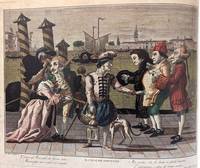
ref. 1219A source collection of antiquarian books and engravings formed by Richard von Hunderdorff on Cicisbeismo the unusual social convention peculiar to the Italian Enlightenment. The subject of the catalogue is the relationship between married women and young men of noble birth in 18th century Italy and Spain. This collection is a sophisticated look at 18th century continental women and their position in society. The collection deals with the status of noble women their place in society the restraints to their freedoms and the ways they were able to engage men as escorts and confidants which allowed them to participate more openly in the social setting of their period. What is perhaps most interesting about the collection is that it not only chronicles the evolution of the position of women in Italy and Spain but records the reaction to this social phenomenon by French German and English writers and visitors to these countries. The criticism was almost universal and at times ferocious. The English and the Germans in particular portrayed the women as prostitutes the young gentleman as sodomites and the husbands as cockolds and by doing so provide stunning insights into the social status of women in their own country. This collection is a remarkable library of books and illustrations documenting the struggle for women to become greater participants in the societies in which they lived. A Copy of a Printed Catalogue is Available upon Request. Payment terms are available. . unknown books
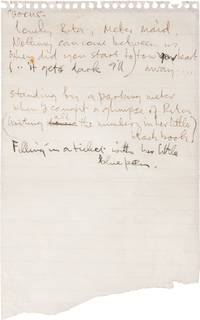
1967ref. 2451967. Paul McCartney's handwritten working manuscript as Beatle for "Lovely Rita" from the album Sgt. Pepper's Lonely Hearts Club Band. the most famous album in the entire panorama of modern music. This is the very first rough draft 10 lines in ink all in Paul's handwriting and all written on a single side of an irregular scrap of lined paper 7 1/2" X 5" torn from a spiral notebook. 7 lines in black are Paul's first concept. 3 lines of changes have been added later in blue such as "writing all the numbers in her little black book" changed to "filling in a ticket with her little blue pen" and still later recorded as "filling in a ticket in her little white book." Near fine condition. Lavishly matted and framed with a full size uncorrected 1st state proof photograph of the album cover varying in that McCartney is kneeling the band instruments have been passed around and 2 people are among the onlookers who would not sign releases and therefore did not appear on the published album. Ex-Butterfield's Dec. 12 1993. Rare. Icon time. Beatles manuscripts from Sargent Pepper held all the rock & roll world records until Bob Dylan's Like a Rolling Stone sold at auction for $2000000 in 2014. But it's been a while now and another Sgt. Pepper manuscript will take the record back eventually and someday soon the only way to see one will be in a museum at the end of a long line behind velvet ropes. The last authentic Sgt. Pepper manuscript at auction A Day in the Life admittedly a greater song sold for $1202500 at Sotheby's in 2010. The last real McCartney manuscript of a Beatles song at auction was an abridged later fair copy of 10 condensed lines from Hey Jude that he wrote out to be used as a key by the band at a recording session $910000 at Julian's in 2020 and again $1016000 at Christie's 2026 and that one in contrast to ours was not a working manuscript carrying his thoughts inner debates and changes. The handwritten lyrics to "Lovely Rita Meter Maid" represent an intimate window into The Beatles' conceptual shift during their psychedelic period showcasing McCartney's evolving storytelling approach. Unlike their earlier love songs centered on direct romantic sentiments this track exemplifies their move toward character-driven narratives with whimsical scenarios and playful humor. This creative direction coincided with broader cultural movements challenging conventional structures and celebrating the previously overlooked aspects of daily life. The track's transformation of a mundane authority figure into the subject of amorous pursuit subtly subverted social norms while maintaining a façade of innocent charm-a hallmark of the band's distinctive cultural impact during this period. McCartney's composition emerged during a pivotal moment in Western society when art was increasingly blurring distinctions between "high" and "low" culture. The Beatles' work on "Sgt. Pepper" helped legitimize popular music as culturally significant with songs like "Lovely Rita" demonstrating how seemingly simple pop compositions could contain nuanced social observation. The character sketch format allowed the band to adopt personas and perspectives outside their own experiences expanding their artistic range while connecting with the era's interest in identity exploration and social role-playing. This approach positioned the band as both participants in and commentators on the rapid social changes reshaping 1960s culture making even their lighthearted works like "Lovely Rita" meaningful cultural documents of their time. unknown books