191.994 resultados
1971ref. 2090502113715432Not Available 1971. Soft Cover. Fine. The book is in fine condition. Not Available paperback
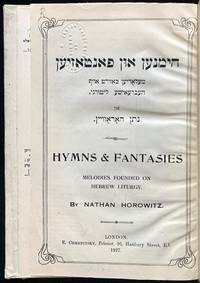
1927ref. 43504London: E. Chernitsky 1927. First edition. Original boards 8vo 16 pages including portrait of the author. 21 cm. In Yiddish. Title translates as "Hymns and Fantasies: Melodies based on Hebrew liturgy." Yiddish poetry and songs by Nathan Horowitz. Page 3 shows corrections to the text one dated 23/12/27 in year of publication which may be by the author. See photo "Horowitz was born in Vilna. Until age seventeen he studied in the Slobodka yeshiva later leaving for London where from 1907 he published poetry articles and translations from English in various periodicals-under his own name as well as the pseudonyms of N. Rokhlin Y. Funk and N-ts. .He subsequently became a reporter and proofreader for Idisher Ekspres Jewish Express in London. In 1911 he published in book form a translation Ferzen-fun'm Bavustn Perzishn Dikhter Omar Khayam Verses from the Famed Persian Poet Omar Khayyam London: Fridman 19 pp.He died in Vilna." Leksikon fun der Nayer Yidisher Literatur SUBJECTS: Jewish hymns. Yiddish poetry -- Texts. Songs Jewish. Yiddish poetry. Jewish hymns. OCLC: 1315569363 43587927. OCLC locates 6 copies worldwide British Library HUC Biblio Nat France UT-Austin Nat Lib Wales Staatsbiblio Berlin only 2 in the US Ex-library with blindstamps some light discoloration to covers but otherwise a very good copy. Good Condition. PSB-1-6. London: E. Chernitsky unknown
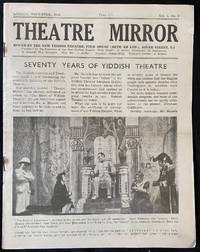
1946ref. 43547London: Nay-Idish teater 1946. Paperback. First edition. Original stapled paper wrappers 4to 16 4 pages including illustrations and photos. 29 cm. Text in Yiddish 16 pages and English 4 pages. Monthly periodical published by the New Yiddish Theater in London. Numbering was continuous despite the volume change with the start of the new calendar year. "In 1945 playwright producer and manager Abish Meisels staged an adaptation of Abraham Goldfaden's The Ten Commandments at the New Yiddish Theatre in the East End. An Austrian refugee Meisels immigrated to London in 1938. Five years later he walked down Adler Street and entered Adler Hall. He turned a key unlocking the doors to the New Yiddish Theatre. According to Meisels his mission was 'to present the best in Jewish drama; to keep alive the art of the Jewish theatre and to inculcate into the minds of the younger generation a love and appreciation of their lives customs and language.' .Meisels' production may have been salient for London's post-war Jewish community. Many of his 20-person company were refugees from Nazi-occupied Europe as were others of London's Jewish population. They found in Meisels' theatre as he put it a 'much needed cultural educational and social centre' and a sense of belonging. By the time Meisels opened his theatre in 1943 the Yiddish stage had been in existence for nearly 70 years. Its story began in 1876 when writer Abraham Goldfaden staged the first Yiddish theatrical productions in Romania and Russia. Yiddish plays were first performed in the UK in the 1880s concurrent with the mass migration of Yiddish-speaking Eastern European Jews to Britain. Between 1881 and 1914 nearly 120000 of these immigrants entered the country most settling in the East End. These Yiddish-speaking Jews brought with them the desire for entertainment in their native tongue. Meisels' company was the last theatre in Britain devoted to Yiddish productions. It followed the Hebrew Dramatic Club on Princes Street 1886-1887; the Pavilion Theatre onWhitechapel Road 1906-1934; the Temple of Art known as the Feinman Yiddish People's Theatre on Commercial Road; the Grand Palais on Commercial Road 1934-1970 and the Jewish National Theatre at Adler Hall 1936- 1939. The use of Yiddish declined asthe community became assimilated. In 1947 Meisels locked the doors to the NewYiddish Theatre for the last time." Stefanie Halpern Jewish Renaissance.For more on London's New Yiddish Theatre and Theater Mirror/Teater Shpigl see the London Jewish Museum's interview with Katie Power https://jewishmuseum.org.uk/whats-on/exhibitions-2/pitch-up-community-voices-katie-power. SUBJECTS: Jewish theater -- Periodicals. Jewish theater. OCLC: 35448905. OCLC locates 5 holdings in the US NYPL LOC Columbia HUC UWisc-Madison Archival corner repair rusting to staples. Good Condition. BER-1 YID-48-82A-GGX-'mccel. London: Nay-Idish teater paperback
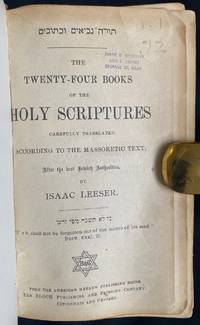
1880ref. 43529Cincinnati & Chicago: From the American Hebrew Publishing House the Bloch Publishing and Printing Company 1880. 1880s Preface is dated 1856. Original Full Leather binding with black & gilt spine label 12mo 2 leaves iii-xii 1243 pages. 17 cm. Title in Hebrew at head of title. Copyright page lists 1853 the copyright date for the first edition of Leeser's original translation of the Twenty Four Books of the Holy Scriptures published in 1854. The present Preface is dated Philadelphia 1856. The 1880s date is based on Singerman 3204 which notes the presence of the "undated 'Advertisement to the London Edition.' Repeated.in undated Bloch editions 1243 p. with acopyright date of 1853." Preceding the 1856 Preface is the undated 4-page "Advertisement to the London Edition" which notes that "This corrected version supplies an admitted want to our times. The so-called Authorized or Anglican version of the Scriptures.betrays great need for revision.Jews who of their own accord introduce the Anglican version into their households and who provide none other for the schools commit a flagrant breach of sacred trust in the abandonment of those for whose safe guidance they are immediately responsible to a helpless ignorance of truth-an ignorance all the more fatal because false interpreataions are obtruded in season and out of season with an unscrupulous object-to procure apostasy i.e. conversion from Judaism.Hence this version accomplished by a learned and conscientious Hebraist i.e. Leeser has found acceptance from all denominations. In the 10-page 1856 Preface Leeser explains in detail the need for his new translation giving many examples from earlier Christian translations of what we would today call "Christian bias." Leeser here acknowledges recent partial Jewish translations noting "Hitherto-at least before the completion of the first edition of this work two years ago-no other translation in the English had been completed by Jews although several had been commenced; for instance Dr. Raphall's and Mr. A. De Sola's and Mr Lindenthal's book of Genesis with Hebrew text and ample notes and Dr. Benische's version with Hebrew text to the end of the Second Book of Kings." OCLC 233529725 locates 4 copies worldwide U Illinois Andrews U Community of Christ MO UPenn of an "1853" edition published in "Cincinnati ; Chicago : from the American Hebrew Pub. House the Bloch Pub. and Print. Co." with 1243 pages and 17 cm high ours is 16 cm. However the OCLC listing notes neither the "Advertisement to the London Edition" nor Leeser's Preface of 1856 both of whose pagination does not affect that of the main text. Such was the enmity between Leeser and leaders of the Reform movement that it would seem surprising that Leeser would authorize a Bloch publication of his bible during his lifetime given that Bloch was owned by Isaac M. Wise' brother-in-law Edward Bloch. Only a year after the date of the preface in our copy Leeser famously printed an "anonymous attack on Wise signed 'Lawyers' in the pages of his Occident shortly after the appearance of Minhag Amerika in 1857. Leesers' anti-Reform rejoinder singled out Bloch & Co. for allegedly keeping its store open on the Jewish Sabbath and closing it on Sunday the Christian Sabbath." Singerman. In our Bloch copy the copyright is still held by Isaac Leeser; It was not until 1888 20 years after Leeser's death in 1868 that "his Bloch's firm obtained the copyright of this popular and frequently reprinted landmark text." Neither Singerman nor Goldman list any edition published by Bloch before 1884. Singerman Nr 1418 and Goldman Nr 13 both list a similar edition 1856 published in Philadelphia by C. Sherman & Son also with the 1856 Preface and identical pagination and physically smaller than the 1853 ed.with a new preface by Leeser." Goldman specifically writes that the "Advertisement to the London Edition" does not appear until an 1865 edition is "published in London in 5625 1865 by Trubner & Co. printed by John Childs and Son. Explaining the need for a new translation in the prefatory 'advertisement' the publisher criticized the standard King James Version authorized by the English Church for being flawed with 'abundant cases of false rendering' and 'propagandist tendencies.' They thus chose to issue Leeser's translation despite the existence of English translations by Christians because "this version accomplished by a learned and conscientious Hebraist has found acceptance from all denominations." This may be a previously unrecorded stereotype reissue of Trubner's London edition by Bloch issued with the 1853 Copyright date the 1856 Preface and the undated Advertisement though its mid-19th Century binding with black leather spine label would not be much later than 1880. Some pencil underlining to Advertisement and Preface with small owner's stamps and pulling as well. Gutter margin at title page is thin and crowds the title page text see photo. Spine reinforced with leather at edges boards show wear especially at corners but a solid Good Condition copy. A rare Leeser variant. B AMR-38-23. Cincinnati & Chicago: From the American Hebrew Publishing House, the Bloch Publishing and Printing Company unknown
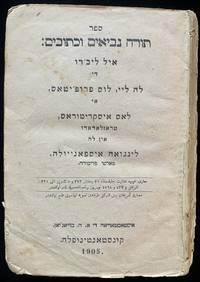
1905ref. 43537Konstantinoplah Constantinople: A. H. Boyagian Boyag'yan 1905. 8vo Original boards on Vol II lacking on Vol I 560 630 leaves 21 cm. In Hebrew and Ladino in rabbinic type on facing pages. Legal notice in Persian on title page. Ladino and Hebrew bible published during the Ottoman period in Constantinople. "The translation of the Pentateuch in Hebrew vocalized square characters Constantinople 1547 was the first larger work which the Sephardic Jews of Turkey published in the language 'which the old Jews use. ' Twenty years later the entire Bible was published in several parts the third of which included the Later Prophets. This translation which agreed almost entirely with the one that appeared at Ferrara in Latin letters in 1553 was followed by another in four parts Constantinople 1739-45 in Ladino 'entero bien Ladinado'; seventy years later Israel b. Hayyim of Belgrade issued a translation Vienna 1813-16; the Constantinople edition was reprinted at Smyrna in 1838 et seq and again at Constantinople in 1873 all of these being in Rashi characters." EJ The Ladino Bible was later used by modern scholars and writers such as Holocaust survivor and poet Moshe Ha-Elion as a linguistic reference point to study authentic traditional Salonican and Turkish Ladino vocabulary. "All in all between 1493 and 1940 approximately 260 books and thirty periodicals were printed in Ladino in Istanbul most of them printed after 1730 out of a total of 758 publications in Hebrew type. As we have noted early Ladino publications focused on religion: Biblical commentary and texts religious law ethics and prayer books. These topics continued in the nineteenth century but the majority of publications in the later period were belles lettres history and biography sciences and communal and state laws and regulations. Of special social and cultural importance since the second half of the nineteenth century were Ladino periodicals which also served as publishers of books in Ladino. Having initially aimed to "Judaize" the Jews the objective of Ladino publishing in the later period was to modernize and entertain them while at the same time attempting to spread Judaic knowledge." Rachel Simon The Contribution of Hebrew Printing Houses and Printers in Istanbul to Ladino Culture and Scholarship OCLC: 970892548. OCLC locates 6 sets in North America HUC UMaryland AmerSephardicAssoc YIVO Yeshiva Stanford only 3 outside NYC and none at any Ivy League Institution. Vol I lacks boards; Vol II has heavy wear to boards spine rebacked; otherwise clean. Fair Condition Complete. PSB-1-28. Konstantinoplah [Constantinople]: A. H. Boyagian [Boyag'yan] unknown
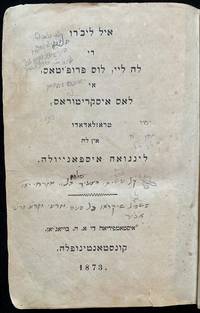
1873ref. 43536Konstantinoplah Constantinople: A. H. Boyagian Boyag'yan 1873. 8vo Original boards 2 volumes bound together 560 630 pages. 22 cm. 23 cm. In Ladino Only. Title translates as "The Book of the Law the Prophets and the Writings Translated into Ladino/Spanish." Ya'ari Reshimat Sifre Ladino no. 3. The publisher also issued a more common parallel Hebrew and Ladino bible the same year; this edition however is the scarcer Ladino only edition. "The translation of the Pentateuch in Hebrew vocalized square characters Constantinople 1547 was the first larger work which the Sephardic Jews of Turkey published in the language 'which the old Jews use. ' Twenty years later the entire Bible was published in several parts the third of which included the Later Prophets. This translation which agreed almost entirely with the one that appeared at Ferrara in Latin letters in 1553 was followed by another in four parts Constantinople 1739-45 in Ladino 'entero bien Ladinado'; seventy years later Israel b. Hayyim of Belgrade issued a translation Vienna 1813-16; the Constantinople edition was reprinted at Smyrna in 1838 et seq and again at Constantinople in 1873 all of these being in Rashi characters." EJ The Ladino Bible was later used by modern scholars and writers such as Holocaust survivor and poet Moshe Ha-Elion as a linguistic reference point to study authentic traditional Salonican and Turkish Ladino vocabulary. "All in all between 1493 and 1940 approximately 260 books and thirty periodicals were printed in Ladino in Istanbul most of them printed after 1730 out of a total of 758 publications in Hebrew type. As we have noted early Ladino publications focused on religion: Biblical commentary and texts religious law ethics and prayer books. These topics continued in the nineteenth century but the majority of publications in the later period were belles lettres history and biography sciences and communal and state laws and regulations. Of special social and cultural importance since the second half of the nineteenth century were Ladino periodicals which also served as publishers of books in Ladino. Having initially aimed to "Judaize" the Jews the objective of Ladino publishing in the later period was to modernize and entertain them while at the same time attempting to spread Judaic knowledge." Rachel Simon The Contribution of Hebrew Printing Houses and Printers in Istanbul to Ladino Culture and Scholarship SUBJECTS: Ladino literature. OCLC:79281753 & 976898012. OCLC locates only 4 sets of this rare Ladino-only edition only 2 in North America Harvard & UToronto. Well bound with some edgewear. Some markings and an inscription on the title page. Good Condition. Rare and important PSB-1-29-CC-'. Konstantinoplah [Constantinople]: A. H. Boyagian [Boyag'yan] unknown
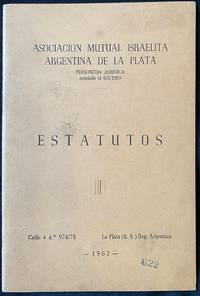
1962ref. 37000La Plata B. A. Rep. Argentina: La Asociación 1962. Paperback. Original Paper Wrappers. 8vo. 25 pages; 19 cm. In Spanish. Title translates into English as "Statutes." This is a copy of the 1962 Asociación Mutual Israelita Argentina de La Plata AMIA La Plata by-laws. AMIA La Plata was founded in 1907 as the principle Jewish Community Center in the City of La Plata to promote and enhance the expression and development of Jewish life in the area. La Plata the capital of the Buenos Aires Province in Argentina is home to a Jewish community of approximately 2000 to 4000 residents with a history spanning over a century OCLC: 93785178. OCLC lists 1 copy worldwide Univ. Of Florida. Small tamp on front cover. Very small stain on front cover otherwise in about very good condition. Rare PBERL-1-13. La Plata (B. A.), Rep. Argentina: La Asociación paperback
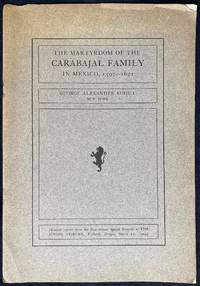
1904ref. 43512No Place Portland OR: No Publisher The Jewish Tribune 1904. No Date 1904. 1st Separate Edition. Original printed paper wrappers Large 8vo 8 pages. "Revised reprint from the First Annual Special Number of the Jewish Tribune Portalnd Oregon March 25 1904." The Carvajal Caravajal Carabjal family were prominent 16th-century crypto-Jews in colonial Mexico. Led by the conquistador and governor Luis de Carvajal y de la Cueva and his nephew Luis de Carvajal the Younger the family was ultimately prosecuted tortured and executed by the Mexican Inquisition. Luis de Carvajal the Elder c. 1540-1590 was a Portuguese-born explorer and conquistador appointed governor of the vast frontier province of Nuevo Reino de León in northern Mexico. He brought numerous family members over from Iberia many of whom secretly kept Jewish traditions despite outward conversion to Catholicism. Luis de Carvajal the Younger c. 1566-1596 was the governor's nephew and a crypto-Jewish writer. He left behind memoirs a spiritual autobiography written under the name Joseph Lumbroso and a book of psalms Lex Adonai which represent the earliest known Jewish writings in the Americas. Denounced to the Holy Office of the Inquisition the family was first arrested in 1589. Under intense interrogation and torture family members implicated one another leading to a public penance auto-da-fé. Arrested a second time for relapsing into secret Jewish practices Luis the Younger along with his mother Francisca and several sisters including Isabel and Catalina were condemned as heretics On December 8 1596 they were burned at the stake in a massive auto-da-fé in Mexico City. Luis the Younger's surviving trial records and personal manuscripts vanished from the Mexican National Archives in 1932. After decades of being lost the stolen documents surfaced in the United States and were officially repatriated to the National Archives of Mexico in 2017. For more see www.tabletmag.com/sections/arts-letters/articles/crypto-jewish-diaries-mexico-city SUBJECTS: Jews -- Mexico -- Genealogy. OCLC: 10706617. OCLC Locates 8 copies worldwide HUC Princeton Gratz UPenn JTS Yale Balch Harvard None south or west of Cincinnati. Rust stains at staples light wear Good Condition. Attractive Copy. PBERL-1-3-XX. No Place [Portland, OR?]: No Publisher [The Jewish Tribune?] unknown
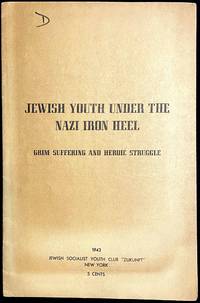
1942ref. 43351New York: Jewish Socialist Youth Club 1942. Paper Wrappers. Illustrated by 2 Facimilie Illustrations. 1st edition Original Paper Wrappers 8vo 16 pages another variant we have seen has 15 pages. From the year before the Warsaw Ghetto Uprising an early 1942 report by the American branch of the Bund on Jewish resistance by young people in Eastern Europe. "Hand in hand with the underground organizations of the General Jewish Labor Union and in contact with the organization of the Polish socialists the Youth Union 'Zukunfst' conducts an untiring and ramified activity which is preparing the ground for the open struggle of tomorrow against Hitlerism" p. 13. "Tsukunft or Cukunft or Zukunft Yiddish for future was the youth organization of the General Jewish Labor Union or Bund. It was founded in 1910 and in 1916 it was officially called Yugnt-Bund Tsukunft. Their newspaper was the Yugnt veker. In 1922 the organization changed its name to Yugnt-bund "Tsukunft" in poyln 'Youth Bund "Tsukunft" in Poland'.At the time of the sixth Tsukunft conference in 1936 the last before the outbreak of the Second World War the organization counted with 184 local groups. On the eve of the Second World War the organization had 15000 members. The Tsukunft took part in the Warsaw ghetto uprising as part of the Jewish Fighting Organization" Wikipedia. SUBJECTS: Jewish youth -- Poland. Holocaust Jewish 1939-1945 -- Jewish resistance. World War 1939-1945 -- Atrocities. OCLC: 6871875. Covers toning with pen notation to cover otherwise Very Good Condition B Holo2-139-22A-XAECC-'l. Jewish Socialist Youth Club unknown
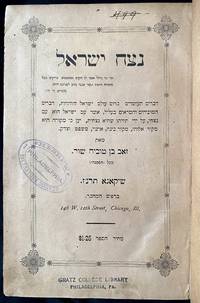
1897ref. 43553Shikago Chicago: Bi-Defus ha-Mahaver 1897. 1st Edition. Original printed paper wrappers bound into period buckram boards 8vo 273 pages misprinted as "173" 1 leaf; 25 cm. In Hebrew. English title from original rear paper wrapper present here. Title translates as "The Eternity of Israel: Things That Stand Above the World of Israel and Judaism." Goldman 1067. Deinard 582. Singerman 5264. Deinard 582. Mishkin Defuse Shikago be-'ivrit ube-yidish 24. "The first Hebrew work in America to react favorably to political Zionism" Eisig Silberschlag in EJ with publication in the same year as the First Zionist Congress in Basle. "Schur wrote Netsah Yisrael in response to the threat to American Jews posed by Christian missionaries particularly William Blackstone Reform rabbis and socialists" Goldman. Not coincidentally the book's publication in 1897 also coincides with the founding in Vilna of the Jewish Labor Bund whose goal was to bring Jewish workers across the Russian Empire into a single socialist party. Netsah Yisrael "compared the Mosaic law with every known ancient or modern religious or political system. in a manner which well demonstrates his broad culture and extensive reading and comes to the conclusion that.Mosaism is immeasurably superior to all othersystems from those of ancient Canaan and Egypt to Christianity" Drachman 81. Zev Wolf Schur aka William; 1884-1910 was a "pioneer Hebrew writer and journalist in the United States. Born in Lithuania he settled in the United States in 1888 and spent most of his life in poverty. A friend of Abraham Mapu Schur devoted himself to Hebrew literature traveled and taught in many countries including the Far East and wrote about his voyages in the periodicals Ha-Meliz Ha-Yom and Ha-Shahar. He was an ardent pioneer of the Hebrew press in America and later of political Zionism participating in the Fourth Zionist Congress. Under his editorship the periodical Ha-Pisgah 1889-99 in which Tchernichowsky made his literary debut attracted the best Hebrew writers in America and some Hebrew writers from abroad. After it ceased publication it was continued as Ha-Tehiyyah 1899-1900. Schur wrote several novels in Hebrew. His most important book is Nezah Yisrael 1897 a defense of Judaism against Christian attacks against Reform Judaism against socialism and anarchism. It affirms the twin axiom: the eternal existence of Jewry and the eternality of the Torah. Supporting nationalism it was the first Hebrew work in America to react favorably to political Zionism" Eisig Silberschlag in EJ. Goldman notes additionally that Schur "lived in New York Baltimore Boston St. Louis and Chicago." His "Hebrew journal Ha-Pisgah Hapisgoh" was "at times was the only Hebrew periodical publication in America and he operated a Hebrew printing press." In Orthodox Judaism the phrase Netzach Yisrael the Eternity of Israel proclaims the metaphysical belief that the Jewish people are immortal and destined to eternally endure regardless of the historical physical or spiritual challenges they face. Rooted in the verse Netzach Yisrael lo yeshaker 1 Samuel 15:29 this foundational concept addresses the most vital questions regarding Jewish destiny faith and survival. An English translation was proposed but it never appeared Kabakoff. OCLC: 19150692. YIVO keeps their copy in their Rare Book Collection. Card pocket removed. Modern Jewish Library bookplate as well as turn of the 20th Century stamps & labels of the "Hebrew Literature Society Philadelphia." Donation inscription to the Society in year of publication on title page. Spine label small stamp to margin of title page. Good Condition. Important work from an important leader of the turn of the century American Hebrew press. BER-1 AMR-72-11A-GGBBBDRLKKF. Shikago [Chicago]: Bi-Defus ha-Mahaver unknown
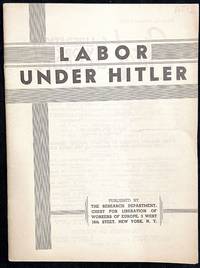
1935ref. 43345New York : Published by the Research Department. Chest for Liberation of Workers of Europe 1935. 1st edition original printed paper wrappers 31 pages; 18 cm. "When it became apparent that the German government was determined to absolutely destroy the trade union movement in that country the American Federation of Labor in convention assembled in 1933 declared a boycott against German made goods and German service such boycott to continue until such time as the German government recognized the right of the working people of Germany to organize in bona fide trade unions of their own choosing and until Germany ceased its policy of persecution of Jewish people merely because of their religious beliefs. Subsequent events which have transpired in Germany and in Austria have fully justified the position taken by the American Federation of Labor in 1933 and reaffirmed in 1934" from the foreword. The "Chest for Liberation of Workers of Europe" was an American organization formed in the 1930s to oppose European fascism and support labor victims of dictatorships. Led by prominent labor leaders including American Federation of Labor president William Green its activities involved educating the public about the dangers of Nazism and Fascism organizing boycotts against goods from Nazi Germany and fundraising to aid European labor movements. For more see a period description by the executive secretary Harry Lee Franklin at https://cdnc.ucr.edu/a=d&d=OLSF19350713.2.36&e=-------en--20--1--txt-txIN-------- . OCLC: 444336. Very Good Condition an excellent example. B Holo2-163-18-LAMMFVDECCXI-BB@. New York : Published by the Research Department. Chest for Liberation of Workers of Europe unknown
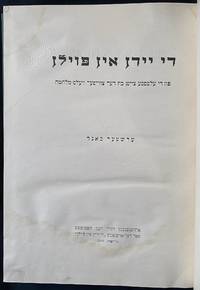
1946ref. 43556New York The Committee For The Publication Of "the Jews In Poland' 1946. Hardcover. 1st Edition. Later boards 4to. Xxviii 890 pages; 31 cm. In Yiddish with added English title page. Title translates as "The Jews in Poland Vol. 1." Historical study on the life of Jews in Poland written just after the Holocaust. Contains essays: -- Der Poylisher Yid in der Yidisher geshikhte by A. Menes -- Di Yidn in amolikn Poyln. by Refa'el Mahler -- Di Yidn in Poyln fun 1772 biz 1914. by Ya'akov Shatski -- In di yorn fun der ershter velt-milhome by Viktor Shulman. OCLC: 19304047. Faint dampstaining to bottom few inches of textblock otherwise Very Good Condition. BER-1HOLO2-134-74C-CCLEX-'. New York, The Committee For The Publication Of "the Jews In Poland' hardcover
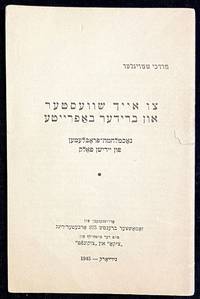
1945ref. 43346Nyu-York New York: Zamoshtser Brentsh 375 Arbeter-Ring 1945. 1st edition of author’s first of seven published monographs all on the Shoah. Original printed paper wrappers small 8vo 31 pages 20 cm. In Yiddish. Title translates as “To You My Freed Brothers and Sisters: Postwar Problems of the Jewish People.” Author's afterword: “In 1939 the author published a book about the formation of a young Jew. The author then wrote his book on Orthodox concepts. During the six years of camp life he grew older and changed. Along with all his works and writings this work was also lost to him. His motto at the time ‘Turn my back to Europe!’ confirmed the story with his bloodiest pen. It is still quite a long way even with the current treacherous number of Jews in Europe to bring them all out in the best and only way for them: To the Land of Israel! With the ending of the exile we will lose the last psychologically and morally broken Jews. A seriously ill person is not taken a long way to a ‘Fulkom Heilanstalt’ but is given first aid on the spot right where he is lying! And here is the cry for immediate momentary help concerning the present brochure. As with a seriously ill patient - it has no son to lead in political or religious discussions! And so it is for the rest of our nation still in danger of going under as a nation perhaps even more than in the past! This brochure is therefore an appeal first of all to all political parties about the over-political danger of moral and physical collapse; About the suicidal and self-deprecating mendation of weak sick souls and the various evildoers of all kinds. Of course it still lacks the concreteness the planning. But it is only a shriek which cannot be evaluated according to all the rules of the art of singing. Here it is shouted: from one who has not lost the last bit of fire and the last bit of patience! It is only to encourage to remind and to make attention in every way. To all those who consider themselves to be Jewish organizations this should be the call of the Ribs: come and strengthen the Jewish trembling knees! Keep them first at the Jewish consciousness and at their human height and later my dear later we will discuss. Paris June 1945.” Mordechai Strigler 1918/21-1998 was a “prolific Polish-born Yiddish writer and editor of the Yiddish Forward…. He…obtained a rabbi diploma….From 1937 he worked as a moral preacher in the Warsaw Great Synagogue. After the Germans invaded Poland he tried to return to his parents. However he failed was captured by the Germans and spent the following years in various forced ghettos and concentration camps. From June 1943 he was then a prisoner in the Majdanek concentration camp. On July 28 1943 he was transported from there to work camp C in Skarzysko-Kamienna by prisoner transport. It was an ammunition factory belonging to the HASAG Group in which the prisoners without protective clothing were exposed to the picric acid used to fill underwater mines. This yellowing substance led to severe poisoning and reduced the life expectancy of the inmates to three months. He wrote about his one-year stay there during his imprisonment but these records were lost. He was released on 11 April 1945 in Buchenwald…. After the end of the World War Strigler found a job with the Yiddish magazine Undzer Vort in Paris and settled there for the next seven years. The six-volume work Oisgebrente Likht Extinguished Lights was written here between 1948 and 1952 in which Strigler reports on his experience of the Shoah. Strigler had been in contact with the American-Jewish poet H. Leivick since 1945. He quickly recognized its literary potential. In 1952 Strigler emigrated to the United States and became editor of the Yiddish weekly Yidischer Kemfer in New York. He worked there until 1995 and wrote countless articles under 20 pseudonyms; between 1987 and 1998 the year of his death he also worked for the then Yiddish daily newspaper Forverts. In addition to his journalistic texts Strigler also wrote poems memoirs political commentaries and stories and novels. The focus of his fictional narrative texts was the life of Polish Jews before the Second World War. It was also important to him not only to depict the personal and collective experience of the camp stays during the Nazi regime in a literary way but also to analyze it…. In 1978 Strigler received the Itzik Manger Prize for Yiddish Literature. In 1998 he was to be awarded an honorary doctorate in Hebrew literature from the Jewish Theological Seminary of America. A few days before the award ceremony however Strigler died” Wikipedia. OCLC: 7413354. The University of Toronto keeps their copy in their Rare Book Collection Light toning Very Good Condition. Important work holo2-163-19-XLGGAEO-IBB-’. Nyu-York [New York]: Zamoshtser Brentsh 375 Arbeter-Ring unknown
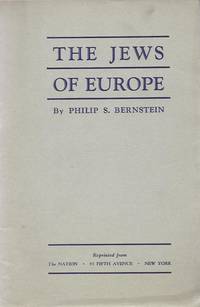
1943ref. 35037New York: The Nation 1943. First Edition Thus. Paper Wrappers. First separate edition. Original Paper Wrappers. 8vo. 38 pages. 22 cm. "Reprinted from the Nation." Holocaust-era analysis and proposals for post-war solutions for Jewish settlement citizenship and rights from this important Left-Liberal American magazine. During the critical period for the Displaced Persons DPs of August 1945- December 1949 seven American Jews served as Advisers on Jewish Affairs to the Theater Commanders of the U.S. Forces in Europe interpreting Army regulations to the DPs and advising and guiding the American commanders who were not familiar with Jewish matters. The longest serving of these advisors was the author Philip S. Bernstein. For a full analysis of Bernstein’s role and biography see Haim Genizi’s excellent essay “Philip S. Bernstein: Adviser on Jewish Affairs May 1946-August 1947” at https://www.museumoftolerance.com/education/archives-and-reference-library/ online-resources/simon-wiesenthal-center-annual-volume-3/annual-3-chapter-6 .html Contents include: The remnants of a people; Seven ways to help them now; Alternatives to Zion; The case for Zionism. Nice clean copy in very good condition. B/3 HOLO2-65-22/W-62-XX. The Nation unknown
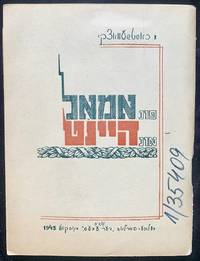
1943ref. 43487Moscow: Der Emes 1943. First edition. Original illustrated paper wrappers 16vo 62 pages. In Yiddish. Title translates as "From Then and Now: Songs and Ballads About War" War poems by Soviet-Yiddish poet Moyshe Khashtshevatski. "Khashtshevatski was a poet prose writer and playwright born in Buki near Uman Ukraine.In 1918 April 6 he debuted in print with a poem entitled 'Friling Kumt' Spring Comes in the Kiev newspaper Di Naye Tsayt The New Times-using the pen name M. Mishal. In 1921 he moved to Kiev where he forged a strong bond with the local Yiddish writers Yekhezkl Dobrushin Dovid Hofshteyn and Der Nister among others and from that point he enhanced ever more his reputation as a creator and builder of Soviet Yiddish literature.From 1923 over the course of three years he contributed intensively to Emes Truth in Moscow and he actively took part in the Soviet community and political life. Although his first works were in the symbolist vein he would later switch to a more realistic depiction of life and address the major issues and events of the time. He brought new motifs and artistic imagery into Soviet Yiddish poetry. The range of his interests was extremely broad. He also masterfully translated from the Russian and Ukrainian classics as well as from other languages. In 1943 the Moscow publisher Der Emes The Truth brought out two books by him: a poetry collection entitled Fun Amol un Haynt Of Then and Now this work and jottings about the hero of the Soviet Union Khayim Diskin Khayim Diskin. The majority of poems in the former were dedicated to war themes. Shortly after the outbreak of the Nazi-Soviet war in 1941 he was evacuated to Samarkand Uzbekistan and there he learned of the death of his only son at the front. He proceeded to volunteer for mobilization into the Red Army despite the fact that he was forty-six years of age. He contributed in the harshest of battles in that period of the fighting and died in battle." Leksikon Fun Der Nayer Yidisher Literatur SUBJECTS: Yiddish poetry. OCLC: 233117501 Number penned to front wrapper & title page; edgewear to one corner on many leaves no text affected and paper is browning and somewhat fragile but otherwise Good Condition. BK YID-48-111A-L-'mexcc. Moscow: Der Emes unknown
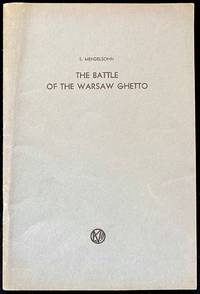
1944ref. 4620New York: Yiddish Scientific Institute 1944. Paperback. 1st separate edition. Original Paper Wrappers. 8vo. 28 pages. 23 cm. Wolff #I: 1441. Includes map in black red and white as the full-page center spread. Early report on the uprising: "It is as yet impossible to give a complete picture of the resistance in the Warsaw Ghetto.The material is as yet too scarce. " "This paper was read at the eighteenth annual conference of the Yiddish scientific institute on January 9 1944 .The paper was delivered in Yiddish and is published in the Yivo bleter Journal of the Yiddish scientific institute XXIII 1 January-February 1944." Very good condition. B HOLO2-65-17. Yiddish Scientific Institute paperback
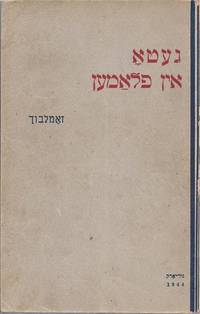
1944ref. 40092New York: Nyu-York: Amerikaner reprezentants fun "Bund" in Poyln 1944. Paperback. 1st edition. Original printed paper wrappers 8vo 206 pages. Includes illustrations & facsimiles. 21 cm. In Yiddish. Title translates as "Ghetto in Flames." Early report from the year following the Warsaw Ghetto Uprising published by one of the participating organizations the Jewish Bund. SUBJECTS: Jews -- Poland -- Warsaw. World War 1939-1945 -- Jews. Geographic: Poland -- History -- Occupation 1939-1945. Warsaw Poland -- History -- Warsaw Ghetto Uprising 1943. OCLC: 1227410408. Wear to corwn and foot of spine otherwise Very good Condition. Important. BER-1 HOLO2-98-26A-. Nyu-York: Amerikaner reprezentants fun "Bund" in Poyln paperback
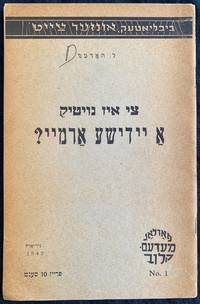
1942ref. 43432New York: Farlag Medem-Klub 1942. 1st edition. Original Paper Wrappers 8vo 39 pages. 21 cm. In Yiddish. Title translates as "Is it Necessary to have a Jewish Army" A leading Bundist journalist's call for a Jewish Brigade in WW II to fight the Nazis. "Our answers are based on the firm conviction that Jewish misery and Jewish pain are part of the evil that prevails in the world today; that in a world of slavery and chains this misfortune will follow and follow the path of the Jewish masses where they will not escape from it; That in such a world Palestinian's i.e. the Jews in Palestine and everyone else's own 'territory' can be the bitterest exile; and that on the other hand in a liberated world the earth under their feet will become the most beautiful and safest home where the Jewish masses will enjoy full civil and national rights as people and as Jews. The answers are filled with steel certainty that today the world stands on the threshold of liberation that the terrible sufferings will not be in vain that in pain misery and suffering a new better world is born; A world of exploiters and exploited a world of true equality and freedom.Today the eyes and hearts of the Jewish masses in the ghettos are turned to this world. To this world will turn their eyes all those who are able to take the voice of the ghetto. For this world today in the ghettos and on all the battlefields of the earth proud hosts of Jewish fighters are bleeding as Jewish parts of the great freedom army of humanity which is marching towards the new tomorrow" from the conclusion. Contents include: • The commotion around the Jewish army • Behind the ghetto walls • Death diagnoses instead of help • The crooked mirror • Where did "unity" come from • The Zionist Department Star • About dual citizenship • "The right to fight" • Our answer to Hitler • Flag emblem and equal rights • The Jewish account of the world • In the land of bitterest "exile" • "Safety on the Volcano" • There is an advice • Sober warnings and reality • "Shame" of the Palestinian Jewish youth • About apparition • Who will protect the Near East • For whom the Jewish army is necessary • The voice of the ghetto Series: Bibliotek "Unzer tsayt" No. 1. SUBJECTS: Jews -- Politics and government. Holocaust Jewish 1939-1945 Great Britain. Army. Jewish Brigade. OCLC: 19313178/970890673. OCLC lists only 2 copies worldwide Harvard YU. Pen mark and toning to front wrapper otherwise Very Good Condition. Rare and important B holo2-163-17C-XX-ECCX-BBIMM@. New York: Farlag Medem-Klub unknown
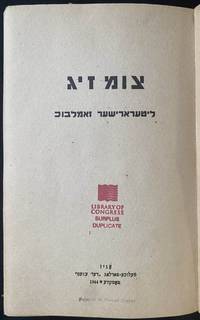
1944ref. 43560Moskve Moscow: Der Emes 1944. Paper Wrappers. 1st edition. Original Stiff Printed paper wrappers 8vo 336 pages. Errata slip present at rear. 23 cm. In Yiddish with table of contents in Yiddish and Russian. Title translates as "On To Victory: An Anthology." Title in Russian "K Robede: Literaturnyi Sbornik" appears on rear cover. One of 7000 copies printed. Cover design by Aron Hefter aka Gefter 1894-1963 an artist who studied at VKhUTEIN from 1921-1924. Starting in 1925 Hefter began creating political and anti-religious caricatures for Soviet periodicals that were as aggressive as works by Cheremnykh and Moor. He was the main artist associated with the magazine 'Der Apikoires' aka 'Bezbozhnik'. Artist Gersh Inger 1910-1995 produced the two dramatic illustrated half titles for the book.This publication from the height of the Holocaust collects together the works of 45 poets and writers; by the time of publication in August 1944 three of them had already died on the frontlines battling the Nazis. Their names-L. Reznik G. Shvedik and M. Goldstein-are thus memorially framed in the table of contents. Edited by poet Peretz Markish 1895-1952 whose two poems open the second section of the book which is entitled "Will Not Forget and Will Not Forgive." Markish a member of the Jewish Anti-Nazi Committee waswas arrested in 1949 and shot together with other accused writers on the Night of the Murdered Poets Aug 12 1952. SUBJECTS: Yiddish literature -- Soviet Union. Litte´rature yiddish -- URSS. World War 1939-1945--Poetry.--Fiction. OCLC: 794979796. As sometimes happens on OCLC it is likely that at least some of the copies listed as digital "internet resources" OCLC: 12794047 are in fact hard copies. Ex-library stamp on title page small 2-letter stamp on upper margin of front cover no other marks. Wear to paper spine as often found but no loss of text. A bit of edgewear to covers covers Paper internally is toning as expected but is strong with no tears. Good Condition. BER-1 Yid-43-20-EL-GGCCAX. Moskve [Moscow]: Der Emes unknown
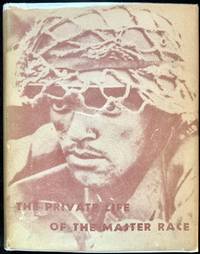
1944ref. 43498New York: New Directions Books Published by James Laughlin 1944. First English Language Edition. 8vo Original boards with dustjacket. 140 pages. illustrated with a portrait of Brecht and his wife by Ernst van Leyden. 19 x 15 cm. In English. This Holocaust-era play consists of seventeen of the twenty-eight scenes of Brecht's chronicle "Fears and miseries of the third reich." It gives a description of Hitler's New Order in Germany in the 20th century. "Fear and Misery of the Third Reich German: Furcht und Elend des Dritten Reiches also known as The Private Life of the Master Race is one of Bertolt Brecht's most famous plays and the first of his openly anti-Nazi works. It premiered on 21 May 1938 in Paris. This production was directed by Slatan Dudow and starred Helene Weigel. The production employed Brecht's epic theatre techniques to defamiliarize the behaviour of the characters and to make explicit the play's underlying message. The play consists of a series of playlets portraying National Socialist Germany of the 1930s as a land of poverty violence fear and pretence. Nazi antisemitism is depicted in several of the sketches including 'the Physicist' 'Judicial Process' and 'the Jewish Wife'. It was followed by many more plays that were openly anti-Nazi Arturo Ui etc. and attempted a Marxist analysis. They were written while Brecht was in exile in Denmark and were inspired by a visit to Moscow where he experienced the growing significance of the anti-Nazi movement there." Wikipedia SUBJECTS: Fascism -- Germany -- 20th century -- Drama. Authors German -- 20th century. German literature -- 20th century. German drama -- 20th century. OCLC: 611844 Some markings. Light wear to dust jacket. Very Good Condition in Very Good Jacket. Very Attractive Copy PSB-1-12-LEXCCGG-'m. New York: New Directions Books, Published by James Laughlin unknown
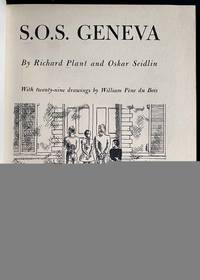
1939ref. 43552New York: Viking Press 1939. Paperback. 1st English-Language Edition May be simultaneous with or even predate the 1st German-language edition. Later library cloth binding 8vo 246 pages. Spalek & Srelka Deutschsprachige Exilliterature seit 1933 New York; I:794ff; Deutschsprachige Exilliterature seit 1933 Bibliographien: USA p.1441. Holocaust-era juvenile novel written by 2 Gay German Jewish exiles to promote peace and international cooperation on the eve of WW II. The story follows the adventures of a group of children who are evacuated from their homeland of Romania to Switzerland because their country is hit by a disastrous flood. In Switzerland they hear about the League of Nations and set off to Geneva to ask for help for their country and their relatives. The children win support from many corners and in the end they win the support they were seeking-a metaphor for countries uniting to stop the flood that has already begun to hit Europe. According to the jacket the tale was written on a bet that the authors "could not write an exciting book about peace." Plant aka Plaut and Seidlin aka Koplowitz worked together on the book after fleeing Nazi Germany where they were in danger not only as Jews but also as open out homosexuals. After emigrating to New York and Americanizing their names in 1938 Plant and Seidlin began intensive English language learning part of which involved the writing of this very book. Both writers went on to long academic careers in the U.S. with Plant achieving prominence with his seminal study of the Nazi persecution of gay people titled The Pink Triangle: The Nazi War Against Homosexuals 1986. A German-language version was published around the same time in Geneva under the title S.O.S. Genf. The American edition includes color illustrations by William Pène Du Bois which were not used in the Swiss edition. Illustrator William Sherman Pène du Bois 1916-1993 "was an American writer and illustrator of books for young readers. He is best known for The Twenty-One Balloons published in April 1947 by Viking Press for which he won the 1948 Newbery Medal. He was twice a runner-up for the Caldecott Medal for illustrating books written by others and the two Caldecott Honor picture books which he also wrote. From 1953 to 1960 Pène du Bois was art editor of The Paris Review working alongside founder and editor George Plimpton" Wikipedia. Though distributed by a mainstream commercial publisher the American edition comes up surprisingly rarely. SUBJECTS: Children -- Romania -- Juvenile fiction. Floods -- Inondations -- Romans nouvelles etc. pour la jeunesse. Switzerland -- Juvenile fiction. OCLC: 5989347 with OCLC listing only 17 copies in US libraries. Ex-library with usual markings to library binding but original text block remains clean save for marks on the lower margin of the title page. Good Condition. BER-1 Holo2-162-17-GGWWD-'abcclex. New York: Viking Press paperback
1892ref. 43454Washington D.C.: American Oriental Society 1892. 1st separate edition Original printed paper wrappers detached 8vo ccxxix 2 pages; 22 cm. "Reprinted from the proceedings of the American Oriental Society Washington April 21-23 1892." "Paul Anton de Lagarde was a German biblical scholar and orientalist sometimes regarded as one of the greatest orientalists of the 19th century. Lagarde's strong support of anti-Semitism vocal opposition to Christianity his Social Darwinism and his anti-Slavism are viewed as having been among the most influential in supporting the ideology of Nazism." wikipedia. Gottheil "was an English American Semitic scholar Zionist founding father of Zeta Beta Tau fraternity and one of the founders of the Jewish Institute of Religion in New York." He was also "president of the American Federation of Zionists from 1898 to 1904 and worked with both Stephen S. Wise and Jacob De Haas as organizational secretaries. Gottheil attended the second Zionist Congress in Basel establishing relationships with Theodor Herzl and Max Nordau" Wikipedia. SUBJECTS: Bibliography. OCLC: 21968572. Wrappers have grown brown and fragile with expected separation. Internal paper remains bright and strong. Good Condition Thus. BAMR-68-5A-DB. Washington (D.C.): American Oriental Society unknown
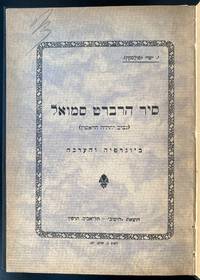
1926ref. 43378Tel Aviv: Hotsa'at "ha-Yishuv 1926. 1st edition. Period boards with original printed paper wrappers bound in 8vo 11 127 pages. Includes illustrations. 22 cm. In Hebrew. Title translates as “Sir Herbert Samuel the First Governor of Judah: Biography and Assessment.” Herbert Louis Samuel 1st Viscount Samuel 1870-1963 “was a British Liberal politician who was the party leader from 1931 to 1935. He was the first nominally-practising Jew to serve as a Cabinet minister and to become the leader of a major British political party. Samuel had promoted Zionism within the British Cabinet beginning with his 1915 memorandum entitled The Future of Palestine. In 1920 he was appointed as the first High Commissioner for Palestine in charge of the administration of the territory” Wikipedia. Poleskin was born in the Ukraine in 1886 and relocated to Palestine in 1905 where he worked on some of the earliest kibbutzim though he found himself exiled to America during the first world war. He returned to Palestine in 1920 and wrote as an overseas journalist for the Forverts. SUBJECTS: Statesmen -- Great Britain -- Biography. Zionism -- History. Hommes d'E´tat -- Grande-Bretagne -- Biographies. Politics and government -- History -- 20th century. Great Britain -- Politique et gouvernement -- 20e sie`cle. Grande-Bretagne --Middle East. OCLC: 19201104. Date stamp on final blank endpaper toning as expected Very Good Condition. B Zion2-4-9-BECCMZZ-'lxgg. Tel Aviv: Hotsa'at "ha-Yishuv unknown
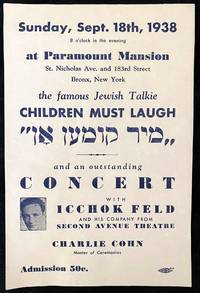
1938ref. 43522New York: No Publisher Paramount Mansion 1938. 1st edition. 5.5x8.5 inches blue on white photographic flyer in English with Yiddish film title. The film title "Mir Kumen On" can be translated directly as "We are Coming" though in the US the title was translated as "Children Must Laugh" and in France and Belgium as "Nous Arrivons." The restored film is viewable online at www.youtube.com/watchv=vozD_XbGHGA and was featured at the Museum of Modern Art's To Save and Project: The 14th MoMA International Festival of Film Preservation in 2016. "A rare record of Jewish life in Poland before World War II this 1936 film Children Must Laugh was produced in several language versions as an international fundraiser for the Medem Sanatorium near Warsaw a clinic sponsored by the General Union of Jewish Workers the Bund that provided care and an escape from urban poverty for some 10000 children between 1926 and 1939. Directed in a Soviet-influenced style by Alexander Ford a committed Communist who later became the head of Poland's National Film School the film follows three children as they gradually overcome their emotional withdrawal and distrust and enter the communal life of the institution" MoMA 2016. Full text: Sunday Sept. 18 1938 8 o'clock in the evening At Paramount Mansion St. Nicholas Ave and 183rd Street Bronx New York The famous Jewish Talkie CHILDREN MUST LAUGH "MIR KUMEN ON" And an outstanding CONCERT WITH ICCHOK FELD AND HIS COMPANY FROM SECOND AVENUE THEATRE CHARLIE COHN Master of Ceremonies Admission 50c. A massive fundraising campaign for the Medem Sanitorium was undertaken in 1937-38 and the film was shown internationally as a way to build support and solicit funds. We were able to locate no copies using OCLC nor with a google search. Apparently an unrecorded promotional flyer for a very important film. Near Fine Condition. Important displayable and exceedingly rare. PBERL-1-10-XX. New York: No Publisher [Paramount Mansion?] unknown
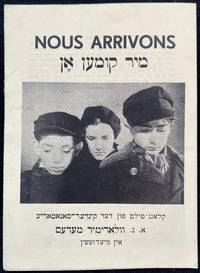
1938ref. 43520No Place Paris: No Publisher The Bund 1938. No Date 1938. 1st edition. Single fold pamphlet 12mo 3 pages. Includes photo on cover & inside. All text in Yiddish. Title translates as "We are Coming. A Sound-Film from the Children's Sanatorium Vladimir Medem in Miedzshin" a neighborhood in Warsaw. Promotional pamphlet for use in France and Belgium and possibly elsewhere for Aleksander Ford's 1936 film re-released in 1937-1938 for fundraising purposes on the children of the Medem Sanatorium entitled "Mir Kumen On" which translates literally as "We are Coming." For the English release of the film the title was instead translated as "Children Must Laugh;" it is viewable online at www.youtube.com/watchv=vozD_XbGHGA. The restored film was featured at the Museum of Modern Art's To Save and Project: The 14th MoMA International Festival of Film Preservation in 2016. "A rare record of Jewish life in Poland before World War II this 1936 film Mir Kumen Onwas produced in several language versions as an international fundraiser for the Medem Sanatorium near Warsaw a clinic sponsored by the General Union of Jewish Workers the Bund that provided care and an escape from urban poverty for some 10000 children between 1926 and 1939. Directed in a Soviet-influenced style by Alexander Ford a committed Communist who later became the head of Poland's National Film School the film follows three children as they gradually overcome their emotional withdrawal and distrust and enter the communal life of the institution" MoMA 2016. From the pamphlet text: "Narrow and dark streets of Greater Warsaw. Crowded and wet attics attics and cellars. 'Apartments' filled with people who lack mother's breasts for the always screaming child. An unemployed father. And - children everywhere many children. Children - withered rickety with crooked legs sunken chests and pale faces they - the children - know all the bitterness of life from a very early age. Often very often they are already 'earners' themselves - in a poor workshop in the street or until late at night they sell th apples and 'hot warm bagels'. And now from this environment the children arrive at the Medem sanatorium: Hanale from the Jewish secular school the pale Zalmanka from Cheder and Laser - the bagel seller. In the beginning everything is strange to them in the 'strange' Medem-Sanatorium: no one punishes no one shouts no one is angry. Everything is friendly to them everyone strives to understand them as their best friend. Joy and freedom mixed with free independent work rule over everything here. And our three heroes quickly got used to the new life-forms. They flourish. They become stronger physically and mentally they actively participate in the work of the 'self-management' of children they begin to understand that the world does not have to be like that as they realized in Warsaw that they can and must be someone else someone free someone equal someone beautiful. The children are taken in by the spirit of true friendship they begin to understand that person's suffering and get an aspiration to help that person. And when their daily newspaper brings news that the coal miners are on strike in Zaglembia that their children are starving they are deeply moved. Because - who can understand better than them what a strike means and feel more than them what is called hunger And at a general meeting the children according to their own proposal give each one a day of their time in the sanatorium so that the 180 children - create 180 days for their brothers in Zaglembia Times flies in the sanatorium. And now we see our 3 'heroes' as they drive off back home. The faces of all 3 are drawn. A deep sadness lies on the young childish faces." Both the pamphlet and the film end with the song "Mir Kumen On"--We Are Coming-the words by Nokhem Yud 1888-1966 and music by Yankl Troupianski 1909-1944. The film's theme song was also used by Camp Hemshekh in New York as its anthem in the 1960s & 1970s. "Everything in the film is factual and authentic. There is not a single artist in the film - everything is performed by the participating children of the Medem Sanatorium." We were unable to locate any copies using OCLC nor with a google search. An unrecorded promotional brochure for a very important film. Near Fine Condition. Very important. Exceedingly rare. PBERL-1-9-XX. No Place [Paris?]: No Publisher [The Bund?] unknown