LECHNER, GAntiquariat.de
ZUN LIKHT UN FRAYD FAR UNDZERE KINDER!
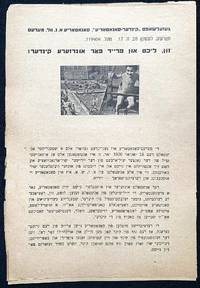
1938ref. 43519Gezelshaft "Kinder-Sanatorye" Sanatorye A.N. Vl. Medem 1938. No Date 1938. 1st edition. Original photographic paper wrappers 12mo 5 pages. In Yiddish. Title translates as "Sun Light and Joy for our Children!" A rare Holocaust-era fundraising brochure for the Medem Children's Sanatorium in Warsaw "the only Jewish Children's Sanatorium in Poland." The 1938 fundraising campaign was accompanied by the re-release with an English-language prologue of Aleksander Ford's 1936 Yiddish-language Film on the children of the Sanitorium entitled "Mir Kumen On." The title translates as "We are Coming" but for the film was translated into English as "Children Must Laugh" and is viewable online at www.youtube.com/watchv=vozD_XbGHGA. The restored film was featured at the Museum of Modern Art's To Save and Project: The 14th MoMA International Festival of Film Preservation in 2016. The Medem Sanatorium was an "Educational and clinical facility for children and young adults at risk for tuberculosis. This sanatorium which functioned in Miedzeszyn near Warsaw between 1926 and 1942 was named after Bundist leader Vladimir Medem 1879-1923 and was the best-known establishment of the Bund and of TSYSHO the Central Yiddish School Organization in Poland. The clinic was funded by donations from Jewish unions in Poland and American Jewish workers' organizations" as well as the Joint Bund Melbourne. The pamphlet describes the harsh realities of life for Jewish children before they come to the Sanatorium reporting that "Up to 75% come from proletarian and working classes" with many coming from homes where 6 7 8 even 10 12 or 16 people live together in one room. "More than 65% of the total number of children do not experience a separate bed. Over 45% of Warsaw's children live in apartments without electricity without plumbing and without sewerage. it is therefore no wonder that tuberculosis is spreading among these children to such a terrible extent. The history and philosophy of the Sanatorium are also described in detail: "The environment and language of education is Yiddish.The healing resources of the Institution are: air sun nutrition good self-esteem of children constant medical and sanitary supervision an atmosphere of rationalism etc. A quartz lamp local pharmacy laboratory red carpet forest dentist's cabinet etc. are available for use by the children. The educational methods of the sanatorium are based on the basic idea that the child's body can be healed and cured only when the self-esteem of the child and his mood are happy and satisfied therefore in caring for the welfare of the weak child his spirit is constantly taken care of. The educational strategies of the sanatorium are: creating appropriate groups of people: raising the cultural level of the children; Encouraging the children to take charge of the institution; bring them closer to nature; develop their aesthetic and musical sense; develop the necessary areas of hygiene acquaint the children with the world and Jewish literature; Develop in them love and understanding for sports; Make the life of the children useful and pleasant." Across multiple buildings and acres of fields and woods the slots for 130 children in the Winter and 200 in the Summer provide access to "the natural history museum a building for chicken breeding.a fruit orchard and a garden with one farm.a toboggan gate skating rink skiing etc. In all these facilities like chickens bees silk breeding etc. the children take an active part." The fundraisers note that as of January 1 1938 7563 children had been served over 21 years-and every year that number is growing with 755 children served in 1937 alone. They explain that while the majority of children come from Warsaw over 1100 had come from the provinces a number which "is constantly growing." The proposal then is for expansion of a property purchased in Warsaw the year prior as well as the development of centers in other Jewish centers in Poland. In the now dystopian year of 1938 the Medem Sanatorium wants to develop these new urban complexes "mainly for children who come back from the sanatorium but their health condition their social situation requires the necessity of continued medical and general assistance and supervision." In this new center in urban Warsaw already "the children spend half a day they receive food medical and dental assistance hygienic and educational supervision help in preparing the school lessons" as well as training in workshops art classes musical auditions a choir etc. are also introduced. "The popularity of this new institution is despite the short time of its existence enormous. Unfortunately we are also not in a position to satisfy even a part of the requests which are constantly growing in number. The management of the sanatorium therefore decided in the near future to establish another similar institution in Warsaw and 3 similar institutions in the province. In the first phase in Lodz Bialystock and Lublin. The economic crisis and the particularly difficult situation in which the Jewish masses find themselves has a grave impact the health condition of the masses of Jewish children" and the center is deluged with "Thousands of messages from parents.This situation demands for the management of theSanatorium A new task: to expand and rebuild the institution in order to to enable additional thousands of children to enter the friendly and joyful walls of the Medem sanatorium." Goals for the coming Spring of 1938 include: "A new pavilion with 100 seats." A sports and play area arranged according to the requirements of the latest medicine and hygiene. The construction of the new building will enable the admission of 230 children in the winter and 350 in the summer." So a fundraising campaign is underway already being "conducted throughout the country and everywhere with great success. Everywhere in all strata of the population it was met with a lot of sympathy with a much warmer and sincere relationship." We appeal to all those who follow these lines of thinking.For the construction of the Medem sanatorium. We know the situation and are clear-eyed about it: the time is difficult and the task to which we set ourselves is not an easy one. But we are sure of its success because this action is an action for the health for the future of our children." We were unable to locate any copies anywhere on OCLC nor using standard online searches. Bottom quarter of the final page is removed-as it is on the one other example of this pamphlet we have examined. This suggests either a tear-off donation coupon or perhaps a removed section referencing a now-passed event. We present this rare pamphlet as "complete as issued." Toning as expected very light edgewear to outer margin about Good Condition. Exceedingly rare. PBERL-1-8-XX. Gezelshaft "Kinder-Sanatorye" Sanatorye A.N. Vl. Medem unknown
Dan Wyman Books · Estados UnidosUS$ 275,00≈ € 245,69