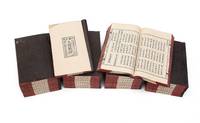
ref. 1094021 vols. of 24; see below. Small folio 305 x 197 mm. orig. dark brown wrappers edges dyed red lower fore-edges with titles volume numbers & number of parts in manuscript stitched. Hà Nội: Linh Quang Tự Bà Äá 1929. A very rare set of the woodblock-printed Sutra of the Heap of Jewels Skt. MahÄratnakūṭa Sūtra T. 0310 from northern Vietnam here in 21 volumes our set lacks Vols. 1 13 & 20. We identify only one other surviving copy in the Institute of Sino-Nôm Studies in Hanoi Viện nghiên cứu Hán Nôm AC.666/1-24. We do not know if that set is complete. “The MahÄratnakūṭa Sūtra is not a single Buddhist work but a large collection of forty-nine works which in its present Chinese form was compiled in the T’ang dynasty by Bodhiruci a South Indian Brahman and illustrious Tripiṭaka master who arrived in China in 693” K. Priscilla Pedersen “Notes on the Ratnakūṭa Collection” Journal of the International Association of Buddhist Studies 3.2 1980 p. 60. In 1926 the first year of the Bảo Äại reign a meeting was held among the high-ranking monks of modern-day Hanoi to continue a project left behind in 1917 by the deceased abbot of the Linh Quang Tự éˆå…‰å¯º temple which was to carve a set of woodblocks for printing the MahÄratnakūṭa Sūtra or the Sutra of the Heap of Jewels. Led by Bhikṣu Thông Mệnh 通命 of the Äà o Xuyên tự 桃å·å¯º temple and Bhikṣu Thanh Thứ æ¸…æ• of the Linh Sóc tự éˆæœ”寺 temple the project was very much a product of its time. Rather than merely reprinting the Sutra as it was already known to Vietnamese Buddhists the monks were delighted to discover — and incorporate into their edition — two further versions of the text one being from the Japanese Buddhist Canon held at the colonial Bác cổ trÆ°á»ng åšå¤å ´ i.e. l’École française d’Extrême-Orient in Hanoi the other being a Chinese copy brought by Bhikṣu Tâm Trí 心智. The three versions — referred to as the “southern version” nam bổn å—本 the “northern version” bắc bổn 北本 and the “Japanese version” nhật bổn 日本 — were carefully compared and collated by the editors whose notes at the end of each chapter list all textual variants down to the page and line numbers Preface transcribed in Phạm Lê Huy “Nihon no kanyaku DaizÅkyÅ” 日本ã®æ¼¢è¨³å¤§è”µçµŒ Riterashī shi kenkyū リテラシーå²ç ”究 14 2021 p. 97. The resulting edition of the Sutra of the Heap of Jewels despite the traditional-seeming xylographic form and the use of Sinographs which were being quickly replaced by the Latin-based quốc ngữ after the abolition of the civil service exams in 1919 is therefore a product of its time enabled by the forces of colonial modernity and partaking in the Buddhist revival movements that were to unfold over the next few decades across the Asiatic world. The carving of the 1300 woodblocks for this Sutra was an expensive affair and the final volume ends by listing the names affiliations and contributions of over 100 donors mostly monks and nuns of various temples who had contributed to its making. Their donations ranged from 300 Indochinese piastre from Bhikṣu Tâm Trí himself to one piastre the contribution of many nuns placed at the end of the list. The woodblocks were kept — and might still be kept — at the Linh Quang Tự temple in Hanoi which based on a recent count preserves about 2600 woodblocks to this day Nguyễn Tuấn CÆ°á»ng et al. “Buddhist Print Culture in Nineteenth-Century Northern Vietnam” Journal of Vietnamese Studies 13.3 2018 pp. 74–75. Finally a note on Vietnamese books in general. Despite the country’s long history of Buddhist and Confucian learning woodblock-printed books published within Vietnam are far fewer in number than their Chinese or Japanese counterparts. This scarcity was due to the high cost of domestic production. According to the estimate of Kathlene Baldanza as late as the 19th century “the labor cost of printing in Vietnam was five to ten times higher than in China. Even ink and brushes were more expensive to produce in Vietnam.” Extensive international trade between northern Vietnam and southern China — where plentiful numbers of books were printed at very low costs — meant that “it was generally cheaper to purchase books from China than to buy them locally” “Publishing Book Culture and Reading Practices in Vietnam” Journal of Vietnamese Studies 13.3 2018 pp. 10–11. Beyond the limited cases of official and temple-based publishing Vietnamese publishers were pushed toward niche genres such as Sino-Vietnamese dictionaries ritual manuals or morality books. Regardless of genre woodblock-printed books from Vietnam are very difficult to find today outside a few major collections such as the Institute of Sino-Nôm Studies in Hanoi and l’École française d’Extrême-Orient in Paris. We will not focus on the massive destruction of the nation’s cultural heritage during its long war of independence in the post World War II period. Fine and fresh set. ⧠Yuenan Hannan wenxian ziliaoku 越å—漢喃文ç»è³‡æ–™åº« Academia Sinica. unknown books
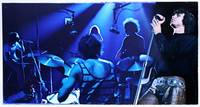
1970ref. 3038Los Angeles: Elektra Records 1970. first edition. Very Good. STUNNING ORIGINAL DYE-TRANSFER PRODUCTION PHOTOGRAPH used in the preparation of the cover for the band’s first—and only—live album issued during Jim Morrison’s lifetime. With important provenance. Original vintage color dye-transfer print 12 x 23 inches dry-mounted to Bainbridge Bristol Board with visible period blue art-department retouching along the upper and lower edges; accompanied a backing board signed and inscribed in 1975 by Bob Heimall the art director/designer for the album to music-industry executive Stephen Dessau: “To: Stephan sic P. Dessau as in Nassau / Happy Holiday Diamond Studs! / Remember – your sic in over your head! / Bob Heimall ’75”. Issued by Elektra on July 20 1970 Absolutely Live was the Doors’ first live album and the only one released during Jim Morrison’s lifetime; Morrison would be dead in Paris less than a year later on July 3 1971. As such the album occupies a singular place in the group’s history: the sole contemporaneous live statement through which audiences could hear the Doors officially present themselves as a concert act while Morrison was still alive. Compiled by producer Paul A. Rothchild from performances recorded in 1969 and 1970 including material from the Aquarius Theatre and Felt Forum the album captured the band in the form for which many admirers considered them most powerful—improvisatory theatrical blues-driven and unstable in the best sense. It also contained the first full official release of “Celebration of the Lizard” among the most mythic and elusive works in the Doors canon. The present dye-transfer print with extremely rich color preserves the underlying live image taken by photographer Frank Lisciandro used in the preparation of the cover prior to the addition of typography and logo design. Morrison – in a superimposed image taken at an earlier date – appears at right isolated at the microphone with the remaining members of the band receding into a saturated blue stage space behind him. The image possesses the nocturnal theatricality appropriate to the band at this moment while the object itself retains the physical traces of period record-cover manufacture: board mount hand retouching and signs of studio handling. Contemporary and later accounts held that Elektra initially favored a grainy bluish rear-view stage image from the Aquarius Theatre performances but judged it insufficiently exciting for commercial use. A different earlier more conventionally iconic image of Morrison was then incorporated into the final design. Morrison is said to have hated the final version. By 1969–70 his appearance had changed markedly: heavier bearded and far removed from the lean black-leather rock-star persona through which he had first entered the popular imagination. The dispute reflected a deep struggle over who would determine Morrison’s public image at the end of the Doors’ great period: Morrison himself or the commercial machinery that preferred the older myth. Provenance: From the art director for the album Bob Heimall to music-executive Stephen P. Dessau. With an additional CBS memorandum dated 1979 identifying Dessau as Director of Product Management East Coast Epic/Portrait/CBS Associated Labels and a copy of the album. Los Angeles: Elektra Records 1970. Original vintage color dye-transfer print 12 x 23 inches. Only the most trivial wear with absolutely no fading - the colors are superbly rich. A remarkable survival. Elektra Records unknown books
1873ref. 55762Hertford: Printed by Stephen Austin and Sons 1873. Hardcover. vg to fine. Quarto. 11 1/4 x 8 3/4". 7 1 12pp. Period full pebbled green morocco with elaborate gilt tooling and ruling on covers. Housed in a custom green cloth slipcase. 7 pages of text in English left to right followed by 12 pages in Persian right to left. Lavishly decorated binding with Islamic motifs produced by the publisher Stephen Austin and Sons. Each page contains elaborate decorative borders in gilt along with either red or purple framing the text. Title page includes a printed image of the Qajar Dynasty coat of arms with the Lion and Sun motif. This extremely scarce text printed in both English and Persian was presented by a delegation of the Anglo-Jewish Association to Nasar al-Din 1831-1896 the fourth Shah of Qajar Iran during an audience at Buckingham Palace on June 24th 1873. An exceedingly lavish copy of the bound text was gifted to the Shah which included the Qajar Dynasty coat of arms inlaid to the middle of the front cover and was signed by the members of the delegation in the area following the end of the Persian text. According to contemporary reporting in the Jewish Chronicle the English text was translated into Persian by a Syd Abdullah. Our book is one of a very limited but unknown number of additional copies of this bilingual text likely printed for the members of the delegation and/or other members of the Shah's entourage. It is possible than less than 10 of these additional copies were produced and we have currently only been able to confirm one other extant copy. The Shah's visit to the United Kingdom was part of his European tour of that year which was significant in that it marked the first time a modern Persian monarch had traveled to the continent. On numerous stops in various cities throughout Europe the Shah was presented with Jewish appeals from local representatives of their respective communities advocating for the improvement of the conditions of the Jews in Iran. Most notably in addition to the British Jewish delegations in June the Shah met with a member of the Rothschild family likely Baron Alphonse de Rothschild and Adolphe Crémieux head of the Alliance Israélite Universelle in Paris in July. On the 24th of June two delegations of prominent members of the British-Jewish community visited the Shah at Buckingham Palace for the same purpose. The first group consisted of members of the Board of Deputies of British Jews comprising Sir Moses Montifiore Joseph Meyer Montefiore Morris S. Oppenheim and Sir Joseph Sebag-Montefiore. The second delegation who presented this text was from the Anglo-Jewish Association and comprised Sir Julian Goldsmid Sir John Simon Baron George de Worms Frederick David Mocatta Reuben David Sassoon and Herbert G. Lousada. In the text here presented to the Shah the delegation of the Anglo-Jewish Association states that advocacy on behalf of our "brethern-in-faith" in promoting their "moral social and intellectual well-being" is the organization's aim. Presented is a list of eight grievances on behalf of the Jewish community of Iran relating to their systemic religious legal and economic persecution in the country often originating in the long held pervasive Islamic belief in the ritual impurity of Jews. Ideas for increased civil rights and economic opportunities for Jews are advanced in the text with specific remedies for some these issues proposed especially in regard to taxation and prejudice in the judicial system. The history of anti-Semitic persecution in Europe and the subsequent emancipation of Jews in the modern period is held up as an example for an enlightened ruler. Jewish contributions to broad social improvements and economic success in their respective countries is discussed as a positive result of such changes. The text extolls their "industry energy and integrity" as well as "their loyal devotion to their sovereign and their country. There is scarcely a trade profession or art in which they do not excel; and in the various spheres of intellectual distinction the countries of Europe derive a considerable portion of their renown from the activity and perseverance of their Jewish citizens." The tone of the text consistently appeals to the just enlightened and modern nature of the Shah and draws a clear lineage of rule between Cyrus the Great of the ancient Persian Empire liberator of the Jews and the then current monarchy of Iran. Bilingual text in English and Persian. Interior with some smudging to the endpapers. Ex-libris ink stamps at the bottom of the interior covers. Binding in near fine interior in very good slipcase in fine condition overall. Ex-libris ink stamps of Dr. Eugen Meyer. A card with printed text 'Ex-libris Eugen Meyer' and some notes in ink below laid in. Meyer served as a district Rabbi in Zweibrücken Germany. Title text in Persian: حيدا شاهنشاه خورشید کلاه Ùلك بارگاه جهان پناه Ú©Ù‡Ù امن و امان نوشیروان زمان وارث ملك سليمان مولى الملوك العرب والعجم سلطان البر و البحر خد يوكشور ستان اعني اعلیٰ حضرت قدر قدرت ØاÙظ شریعت غÙرا و ناصر ملت بیضا السلطان ابن السلطان الخاقان ابن الخاقان ناصر الدین شاه قاجار Bibliographic sources: The Jewish Chronicle London No. 222 June 27th 1873;. Printed by Stephen Austin and Sons hardcover books
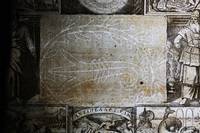
1627ref. 18927Frankfurt: Matthaeus Merian 1627. First edition. Hardcover. Very good. Matthaeus Merian. Oblong folio leaves: 20.6 by 31.2 cm; plates: 10 to 11.5 by 14.5 to 15.5 cm. Engraved titlepage borders without letterpress; 231 of 233 engraved plates printed on the rectos with no printed text depicting biblical scenes from the Old and New Testaments lacks Gen. XIX: Lot and his daughters after the destruction of Sodom and Gomorrah; Exod. VIII & IX: The plague of frogs. Recent marbled calf lightly rubbed at extremities bordered in blind; gilt-tooled spine with raised bands gilt lettering pieces. Occasional light stains and smudges especially at the outermost leaves and almost entirely restricted to the blank margins; old mostly marginal repairs and reinforcement of tears to about 30 leaves Matt. IV plate with loss of about 10 words of manuscript text. Protected by wide margins the plates are clean fresh and bright with relatively few minor blemishes. Housed and protected in a custom luxurious modern leather clamshell box. Rare suite of biblical illustrations printed before letter perhaps as proofs comprising 231 of 233 engraved plates from the Icones Biblicae of Matthaeus Merian the elder 1593-1650. The engravings are printed on large paper and lack any printed text. They are preceded by a leaf of the engraved title borders to the first part in which the central cartouche which would have contained a letterpress title and imprint is here blank. Neat manuscript annotations appear throughout: atop each engraving is a brief title along with a notation of the biblical book and chapters; beneath each engraving are six-lines of rhyming verse in German; at the top corners are leaf numbers in Arabic numerals. All are penned in black ink in the same old cursive German hand. The engraved title leaf is not included in the manuscript foliation. The first three leaf numbers and several others among the first 23 leaves are obscured by wear or later marginal repairs. The foliation ends at leaf 233 and is discontinuous where one would expect to find numbers 15 and 38 corresponding to the missing plates noted above. As noted by Wütrich only four of the 233 plates are signed by Merian all in the New Testament series. Each of these signed plates appears in our suite: Matthaei I. - page 7; Johannis VIII. - page 65; Matthaei XXVII. - page 101; Apocalyps. IX. - page 145 header titles and page numbers from the first edition. The first editions were published at Frankfurt in four parts between 1625 and 1627. The Pentateuch series was published in 1625. The second part illustrating the Old Testament books from Joshua to Kings appeared in 1626. These first two series were published under the name of Merian's father-in-law the printer and bookseller Johann Theodor de Bry 1561-1623 whose heirs retained title to the business. The third part illustrates the remainder of the Old Testament and Apocrypha; the fourth the New Testament. These last two parts were published in 1627 under the engravers's own name. Verses in Latin German and French accompany each plate in the three Old Testament series the French verses being omitted in the 1627 New Testament series. While the eminent Swiss draughtsman and engraver Matthaeus Merian is best known for his topographical depictions of the German speaking lands which appeared in the Theatrum Europaeum his novel selection of biblical stories and innovative stylistic approach revealed in the present series of plates proved highly influential ushering in a new age of copperplate engraving in Bible illustration. Merian broke with the century-long tradition of woodcuts which had accompanied countless editions of Luther's German Bible. Even as he drew on the Bible illustrations of Jost Amman Hans Holbein Virgil Solis and Tobias Stimmer Merian greatly expanded the traditional iconographic and compositional repertoire. The Old Testament alone contains 23 prints depicting stories that had never before been the subject of an engraver. While earlier New Testament woodcuts focused on the Book of Revelation Merian now provided a rich series of plates to illustrate the Gospels and Acts of the Apostles as well. Merian had an obvious preference for crowd scenes and battles along with some of the novelistic features of the Old Testament such as Jacob's lentil dish Solomon and Shulamit in the Song of Songs or the apocryphal story of the Dragon in Babylon. Merian sometimes provides local color from his home town of Basel as in his depiction of Solomon's Temple Consecration in which despite the baroque redesign the Basel Cathedral with the old choir is easily recognizable. The costumes and gestures of Merian's biblical characters display a baroque fantasy of the ancient Near East as reflected in the theater of his day; in depicting cities and buildings however Merian generally prefers to follow contemporary models. In individual cases such as Bathsheba's Bath he succumbed to the temptation as an engraver and artist to show off his skills in a magnificent fashionable palace and garden complex. All-in-all Merian's engravings initiated a development in Bible illustration "that led further and further away from the didactic Reformation purpose of Bible pictures to purely artistic-representational purposes and finally ended in the well-known pathos of the German Romantic Nazarenes" Schmidt. In the first few decades after their appearance these Bible plates were widely copied throughout Europe especially in the Netherlands and France Poortman. The first folio Bible to use Merian's copper plates to illustrate the text was published by the heirs of Lazarus Zetzner at Strasbourg in 1630. Subsequent editions of the "Merian Bible" were published at Frankfurt where Merian had taken over his father-in-law Johann de Bry's business. For over a century as Merian's heirs continued to publish new editions this would become "the most widespread German illustrated Bible in southern Germany Basel and Alsace primarily in wealthy households" Schmidt. After the demise of the Merian publishing house in 1727 the bookseller Philip Heinrich Hütter acquired the copper plates which he used to illustrate a Catholic Bible edition published at Frankfurt in 1740 Poortman. A very notable instance of transposing Merian's biblical engravings into another context occurs in the famous and oft-reprinted Amsterdam Haggadah the ritual for the Jewish Passover meal first published in 1695. The engravings were made by Abraham ben Jacob a former Protestant preacher who converted to Judaism. Introducing skills he had earlier acquired when working outside the Jewish community Abraham ben Jacob "widened the scope of Jewish book illustration" Rosenau and introduced new elements into the traditional iconography of the Haggadah. "He chose many of the same incidental scenes as had appeared in the Venice Haggadot 1599-1604 but he drew them afresh basing his work on the biblical pictures in the Icones Biblicae by Matthew Merian" EJ. Among them was the image of the Temple of Solomon in Jerusalem. As Merian used a wide variety of prototypes Rosenau suggests that the two free-standing columns Jachin and Boaz depicted at the front porch of the Temple in Merian's engraving and Abraham ben Jacob's adaptation may have ultimately been derived from the woodcuts which accompany Estienne's Bible Paris 1540 based upon the scholarship of Franciscus Vatablus. In Das druckgraphische Werk von Matthaeus Merian d. Ae. 1993 L. H. Wüthrich describes a "Spezialausgabe ohne Drucktext" complete with 233 biblical engravings located in Darmstadt at the Hessische Landesbibliothek 31/643. This "separate edition without text or a series of proofs" which he describes has three notable features: 1 an undated first edition title page of the second part Pars II of the Old Testament which has been "corrected. by crossing out or shaving" to read "Pars I"; 2 the first edition title page of the New Testament series dated 1627; 3 an engraving of the The Fall of Man probably after Johann Theodor de Bry which later appears in Gottfried's Chronicle part 1 1629/1630 but which differs from that found in most copies of the first edition Wütrich 1a. The copies containing this plate after de Bry Wütrich 1aa. were likely printed in 1626. Further research perhaps locates only one other suite of Merian plates without text at the Herzog August Bibliothek Wolfenbüttel catalogued under two call numbers: the Old Testament series dated 1626-1627 comprising 157 leaves including an engraved title A: 30.1 Geom. 2 "Ausg. ohne Text von Ps. 1 und 2." = VD17 23:289608V and the New Testament series dated 1627 comprising 78 leaves including an engraved title A: 30.1 Geom. 3 "Ausg. ohne Text" = VD17 23:655618H. The catalogue entry for the Old Testament series references Wütrich's "Spezialausgabe ohne Drucktext." Surprisingly the key images provided for this entry illustrate the same three notable features of the "Spezialiausgabe" which Wütrich located at Darmstadt !. Our suite of plates is provided with a single blank engraved title leaf the one used for the first series of the Old Testament plates which lacks any letterpress. The third plate which depicts the Fall of Man is here in Merian's style and is the image more commonly found in the first printings Wütrich 1a. In the first edition of the Icones Biblicae the title page notes "Mit Versen und Reymen in dreien Sprachen geziert und erkläret Durch Johann Ludwig Gottfried" decorated and described with verses and rhymes in three languages by Johann Ludwig Gottfried. In the first three parts of Icones Biblicae Gottfried's German verses are in four lines with a rhyme scheme of ABBA. In the fourth part the New Testament the German verses are modified to six lines with a rhyme scheme of AABCCB. The manuscript verses in German which accompany each of the 231 plates in our suite differ from both of these formats being composed in six lines of iambic hexameter with a rhyme scheme of ABABCC. To give a sense of how these versions differ the four lines of the German printed verses which accompany the first plate The Creation may be compared with the following transcript of the written verses which describe this scene in our set. in the first edition of Merian's Bilderbibel Im Anfang Gott Erschuff den Himmel und die Erden Die Wasser und das Meer das Liecht der Sternenschein Die Vögel Fisch Gewürm alle Thier groß und klein Warauß sein Gütigkeit und Kraft erkant mag werden. the hand of anonymous versifier Im Anfang schuff der Herr den Himmel und die Erden Das Licht die Sonn den Mond die Sternen und das Meer Gras Bäume Laub und Kraut und was genannt mag werden Von Thieren Vögel Fisch in ihrem grosen Heer Nur durch ein einig Wort: Ich kan hieraus erkennen O Gott! dein ew'ge Krafft und dich den Schöpffer nennen. Watermark: flambeau surrounded by garland Provenance: laid-in typed description on a half-sheet bearing the early twentieth-century letterhead of Harry A. Levinson Rare Books: "There appears to be no record of another such copy of proofs before letter." References: L. H. Wüthrich Das druckgraphische Werk von Mattaeus Merian d. Ae. Basel: Bärenreiter 1993 vol. 3 p.16: "Spezialausgabe ohne Drucktext;" Enc. Jud. 2nd ed. 8:215; W. C. Poortman Bijbel en Prent 's-Gravenhage 1986 2:56-59; H. Rosenau Vision of the Temple London: Oresko 1979 pp. 135; 146f. Ph. Schmidt Die Illustration der Lutherbibel Birsfelden/Basel 1977 pp. 304-329; VD17 23:289608V and 23:655618H. [Matthaeus Merian] hardcover books
ref. TM 796MEDIEVAL ILLUMINATED MANUSCRIPT IN ITALIAN ON PAPER Northeastern Italy Veneto Venice c. 1474. Dimensions 328-332 x 230 mm. 188 folios missing at least three leaves written in brown ink in an Italian cursiva libraria script EIGHT ILLUMINATED INITIALS of seven lines one-line paraphs in red or blue simple two- to four-line in red or blue initials. BINDING: re-cased using original binding materials of brown half leather over bevelled wooden boards with three double bands remains of four straps present. TEXT: Italian translation of Gregory the Great's Moralia in Job one of the most important and widely copied texts of the Middle Ages. Though forty copies of this translation survive this volume is unusual in its incorporation of Venetian dialectal forms. All other copies are in European institutions and have not been on the market for the last century. PROVENANCE: scribal colophon on f. 190v provides a date for this manuscript's completion and helps localize its production within Italy: "Scripto per mi zuane de zane zoielier condam per simon et chi li lezeranno priegi dio per lo scriptore. MCCCCLXXIIII" Written by me Zuane de Zane jeweler once for Simon and may whoever will read it pray to God for the writer. 1474. There is no Zuane de Zane on record elsewhere as a scribe; the name itself is Venetian and evidence of the manuscript's watermark and decoration also suggest an origin in the region of Veneto and possibly Venice specifically. The manuscript was later acquired by a private European collection. CONDITION: slight tears in the lower margin of f. 25 and upper margin of ff. 37 and 160 from f. 161 to the end there is a slight loss to the upper outer corner slight water staining visible parchment reinforcement present prickings visible. Full description and images available. TM 796 Northeastern Italy, Veneto (Venice?), dated 1474 books
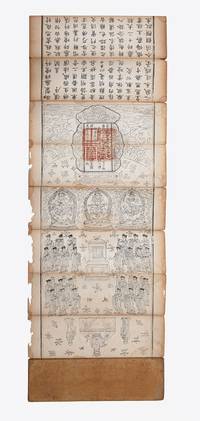
ref. 10529Two & one-half woodcut illus. 44 sheets each folded into multiple pages. Oblong small 8vo 89 x 288 mm. orig. stiff boards in concertina format one board loose. Beijing: Fanjing chang 番經廠 1617 date of colophon; woodblocks carved in 1599. One of three surviving copies of a Tibetan-Chinese bilingual liturgy of Bhaiṣajyaguru the Medicine Buddha printed under Ming imperial patronage at the Tibetan scripture workshop Ch. fanjing chang 番經廠. Tibetan books printed in pre-1644 Beijing are very rare and precious; this is the only copy we have encountered. Our copy has the well-known 廣é‹ä¹‹å¯¶ seal on the frontispiece representing Ming royal provenance. Many of the early-Ming emperors were devout followers of Tibetan Buddhism and sponsored large-scale sutra printing projects including the first printed edition of the Tibetan Kanjur canon completed in 1411 under the patronage of the Yongle Emperor r. 1402-24. This veneration declined during the reign of the Jiajing Emperor r. 1521-64 who favored Daoism and dissolved many longstanding Buddhist institutions in the capital. It was after his rule in 1572 that the court reestablished the Tibetan scripture workshop in part to secure the alliance of the Altan Khan 1508-82 of the Tümed Mongols a powerful patron of the Gelug sect. Despite its name the Tibetan scripture workshop seems to have printed few Buddhist texts with the notable exception of a new 1605 edition of the Kanjur. Falling under the jurisdiction of the Directorate of Ceremonials Ch. Silijian å¸ç¦®ç›£ the workshop's main responsibility was to officiate routine Buddhist rituals within the palace complex. As the court was hesitant to admit Tibetan Buddhist monks into the inner palace these rituals were led instead by trained eunuchs and courtesans some of whom lived and practiced as nuns within the workshop 陳楠 "法渊寺與明代番經廠雜考" ä¸åœ‹è—å¸ 2006.2 pp. 138-43. According to the Preface in our copy this bilingual ritual of the 12 vows of the Medicine Buddha was prepared in Wanli 27 1599 by the palace eunuch Zheng Li 鄭利 master of rituals at the Tibetan scripture workshop. The Tsinghua University Library currently exhibiting one of the two other surviving copies describes the book as follows in trans.: "First edition published in 1599 by the scripture workshops of the Directorate of Ceremonials in the inner palace. Only surviving copy sic. It begins with a frontispiece in three pages followed by the preface of Zheng Li explaining the conditions around the translation and publication of the text which is valuable for understanding the functions of the Ming scripture workshops. The text consists of prayers for incense offering light offering and purification followed by the twelve vows of the Medicine Buddha and the dedication of merit.The page is wide and large the layout is generous the characters are large as coins the engraving is exquisite and the paper is of high quality. These are typical of the 'palace workshop' editions. To accommodate the bilingual text the Chinese text is written horizontally from left to right making it an exemplar of early horizontally written Chinese texts. The binding also differs from the traditional Chinese sutra binding. To accommodate the horizontal text the tuipeng 推篷 or 'push-awning' binding is used instead. It is a rare example of a Ming-era book in the 'push-awning' binding."-"万å·ç³ç…--馆è—å部善本特展" accessed Oct. 3 2026. A provisional comparison of the Chinese and Tibetan texts shows that with the exception of a few short passages neither is a direct translation of the other and the bilingual text likely formed an integrated liturgy conducted with a mixture of languages including Sanskrit mantras in Tibetan transliteration. This linguistic hybridity is echoed by the unusual choice of a vertical concertina binding which ingeniously brings together the layout and reading practices of the Tibetan pecha with a Chinese binding traditionally associated with Buddhist scriptures. As mentioned above ours is one of three surviving copies. While the exact state of completeness and condition of the Tsinghua University copy is unclear a comparison with the copy digitized by the Berlin State Library Pander C 18 shows that its frontispiece with the colophon dated Wanli dingsi 1617 when 120 copies were printed and royal seal fully present in our copy is damaged and mostly lacking in the Berlin copy. The front board of the Berlin copy has the bilingual title Mi 'khrugs pa'i 'cho ga dang po bzhugs sto A chu fo tan chang jing 阿閦佛壇塲經 but its relation to the text is unclear. The comparison also shows the final part of the illustration at the end of our copy to be damaged and incomplete. Our copy nevertheless contains a short final inscription "shang g.yi kyen tha'i kyen zin gon dbang shing tshin kci yin tsog" which appears to transcribe an unidentified Chinese phrase and is lacking in the Berlin copy. The Berlin copy was evacuated to Silesia during the World War II and then taken to Krakow when that region became part of Poland. It remains in Krakow. We believe that our book comes from the collection of Japanese sinologist Kanda Nobuo 神田信夫 1921-2003. As mentioned Tibetan books published in Ming-era Beijing are extremely rare; we find no other example in WorldCat. The Tibetan scripture workshop was dissolved during the Ming-Qing transition and the region later became home to the famous Songzhusi 嵩ç¥å¯º temple complex the center of Tibetan publishing in Qing Beijing. Fine copy; some tears in the margins with no loss of text and some marginal dampstaining as well as the aforementioned loss of half an illustration at the end. One board is loose. Preserved in a modern hantao. unknown books
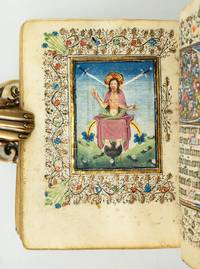
1450ref. ST20835Flanders ca. 1450. 109 x 81 mm. 4 1/4 x 3 1/8". Single column 14 lines in a gothic book hand. 161 leaves. COMPLETE. Contents: Calendar f. 1r; Mass of the Holy Spirit f. 14r; Mass of the Holy Cross f. 23r; Requiem Mass f. 30r; Prayer on the Seven Last Words of Christ by the Venerable Bede f. 36v; Passion according to John f. 40v; blank f. 53; Hours of the Holy Cross f. 55r; Mass of the Virgin Mary f. 60r; Gospel Lessons f. 66v; Hours of the Virgin f. 73r; Penitential Psalms f. 126r; Litany f. 138r; Office of the Dead f. 144r. PLEASING NEAR-CONTEMPORARY BLIND-ROLLED CALF apparently with some old skilled restoration to joints spine and corners covers with rolled vine border surrounding a panel of three columns bearing a roll with parts of the inscription "AVE MARIA GRACIA PLENA" each word separated by one of four small motifs a flower a human profile the lamb of god and a sitting animal--perhaps a lion raised bands compartments with part of the same inscription roll. Lacking the original ties. Housed in a very attractive custom-made brown calf folding case with blind-stamped lettering on the spine interior lined in suede the whole within a calf-lipped suede-lined matching slipcase. Rubrics in red numerous one-line initials in blue with red penwork or gold with dark blue penwork many two-line initials in burnished gold on pink and blue ground with white embellishments several larger "I" initials between four and 11 lines in burnished gold on pink and blue ground with white embellishments 12 six- to seven-line initials some painted pink or blue with white embellishments and filled with flowers and tendrils on a gold ground or the initial in burnished gold on pink and blue ground with white embellishments EIGHT LARGE MINIATURES each inside a thin gold frame and with a three-quarter border of gilt leaves hairline vines and floral spays each facing page with a similar three-quarter border the subjects of the miniatures being: the Holy Spirit in the form of a dove f. 13v; St. Helena and the True Cross f. 22v; Raising of Lazarus f. 29v; Crucifixion f. 54v; Virgin and Child Enthroned f. 59v; Annunciation f. 72v; Last Judgment f. 125v; Funeral Mass f. 143v. Prickings visible in fore margins. See: Defoer et. al "The Golden Age of Dutch Manuscript Illumination" pp. 75-86. Just minor wear to the solid very pleasing early binding. A little chipping almost always mild to four of the miniatures with square frames the fifth the Annunciation somewhat rubbed and faded the three domed miniatures perfectly intact vellum with minor soiling and thumbing in places especially in lower corners of leaves in second half other trivial imperfections but overall a very well-preserved manuscript with no major issues. This enchanting little prayer book features eight attractive miniatures large gleaming burnished gold initials and a pleasing period binding--all in an excellent state of preservation. The miniature program here can be attributed to the so-called Masters of Otto van Moerdrecht the name given to a variety of Dutch artists active in the 1430s and '40s all working in a similar mode rather than to a specific master or workshop. According to Defoer et al. the work of these miniaturists "exhibit varied compositional formulas and bright highly contrasting colors . . . . The small somewhat doll-like figures appear rather wooden but their expressive gestures give the scenes a varied and vivid character." Two artistic hands are responsible for the present miniatures. The artist behind the first three miniatures all set within domed gilt frames the Holy Spirit St. Helena and Raising of Lazarus shows particular skill with a very smooth application of color figures with long eloquent hands and faces with subtle white highlighting. A second artist was responsible for the remaining five miniatures set within square golden frames Crucifixion Virgin and Child Enthroned Annunciation Last Judgment and Funeral Mass. Though this hand is less polished and the miniatures slightly smaller in size the scenes are all quite charming and attractively colored with vivid splashes of bright orange bubblegum pink sky blue and pale green. It is worth noting that the miniatures differ not only because of the artists' degree of success but also because of their condition: whereas the five are generally well preserved the other three are in a virtually perfect state. In addition to the central text of the Hours of the Virgin this manuscript contains several Masses each of which is preceded by a miniature. Perhaps the most interesting of these is the Mass of the Holy Cross which is paired with a miniature of St. Helena mother of Constantine the Great. According to Christian tradition Helena found the wooden cross used in the Crucifixion while she was travelling in Jerusalem in the fourth century. Constantine built the Basilica of the Holy Sepulchre in its honor and installed the relic there to be venerated. Britannica says that the adoration of the True Cross led to wide-spread sale of its fragments sought after as objects of devotion. It is unusual to find St. Helena depicted in a Book of Hours and this image is especially appealing with Helena in a beautiful red robe crown and halo embracing a large wooden cross in the center of the composition. The background is reminiscent of the work of the Gold Scrolls group with small swirls of liquid gold swimming in a scarlet sky the same scrolling motif graces the Holy Dove miniature. There is no indication of former ownership in this manuscript although the Calendar presents a few unusual saints that confirm a Flanders connection. These include St. Amandus in red known as the "Apostle of Flanders" on 2 February; St. Guido known as the "Poor Man of Anderlecht" on 9 September; St. Bavo in red patron saint of Ghent where a Cathedral is named in his honor on 10 October; and St. Eligius patron saint of goldsmiths and metalworkers on 1 December. The binding here is very close to contemporary and probably dates to the late 15th century. Neither the floral roll nor the "Ave Maria" roll seems to appear in EBDB. Similar rolls include r001954 r000623 and r000670 but ours is the only one with four different and charming tools one of each used between every "Ave" and "Maria." For a manuscript only slightly bigger than the palm of one’s hand this Book of Hours has a great deal to offer. In addition to its early binding and lovely illumination by an influential group of artists great care has been put into its preservation so that it resolutely endures for our pleasure and for owners in the centuries to come. unknown books
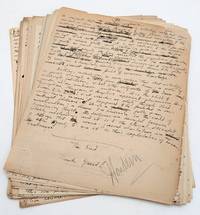
1926ref. 71978Providence RI: H. P. Lovecraft 1926. Manuscript. Very Good. Twenty-three letter-sized manuscript leaves approx. 8.5" x 11". Written in dark ink and hand-numbered by Lovecraft: page numbers 16 18 24 25 26 26b and 27-43. The manuscript pages feature heavy contemporary ink revisions cancellations interlinear additions and a data table. Lovecraft concludes on page 43 in ink: "The End / Thank Gawd!" and the manuscript is signed "Houdini" by Harry Houdini in pencil at the conclusion. The manuscript is written on the reverse sides of correspondence and constitutes a rich literary archive preserving original incoming letters to H.P. Lovecraft. Professional and personal correspondence typescript poetry submissions and editorial rejections sent to Lovecraft between 1922 and 1926 by associates editors and other contemporaries are represented here. Some horizontal folding creases sporadic edge wear and chipping age-toning. The Manuscript Rectos: A major autograph working draft of The Cancer of Superstition the ghostwritten treatise commissioned by Harry Houdini in 1926 to combat spiritualism and commercial fortune-telling. Writing entirely in his own hand Lovecraft systematically deconstructs astrology using modern astronomical scientific knowledge-citing the precession of the equinoxes light-speed delays and extragalactic nebulae-while refuting astrological claims through logic probability and history. Lovecraft mounts a rigorous scientific assault on astrology treating pseudoscience not merely as an intellectual failing but as a cosmic absurdity. On page 39 he constructs a detailed planetary data table tracking diameters solar distances and revolution periods arguing that when viewing these immense scales "we can no longer entertain the astrological illusion that our earth is a considerable object for whose benefit the rest of the universe is arranged." Turning his venom toward the commercial occult trade Lovecraft decries "how many dollars are snatched from the unwary by a device so ancient & so simple" warning that "many lives have been utterly wrecked through the random bombast & gibberish of some ignorant & unscrupulous soothsayer" page 26. Elsewhere he dismantles horoscopic predictions through celestial mechanics noting that zodiac signs "sprang partly from apparent conditions no longer existing" 35 and questions the clockwork of the planets reckoning with light-speed delays crossing vast distances of the cosmos: "If the planets rule the earth why are not the real times of their aspects calculated; instead of the apparent times as judged by their light as it reaches us" 38. Driving his argument to its climax Lovecraft brands astrology as "a legacy from primitive times; a sister of witchcraft fetichism . a shame & a nuisance in the world of broadening thought" and brings his draft to an exhausted close: "The End / Thank Gawd!" 43. The Correspondence Versos: Lovecraft reused the blank backs of incoming correspondence received between 1922 and 1926 to draft the text-a lifelong habit born of extreme poverty and his frequent inability to afford fresh writing paper. These versos contain letters poems and notes from key associates including W. Paul Cook James F. Morton Jr. Anne T. Renshaw Horace L. Lawson Leo Fritter Edward L. Sechrist and John Ravenor Bullen. Notably Leaf 26b preserves a typed rejection letter from Macfadden Publications Ghost Stories magazine dated September 13 1926 establishing the precise date of composition weeks prior to Houdini's death on October 31 1926. Beyond serving as draft paper these recycled letters capture vivid glimpses into Lovecraft's inner circle and literary network. James F. Morton Jr. bemoans his paid ghostwriting work lamenting "The more I work on this stuff the more I realize the hopeless inadequacy of the profanity division of the English language" while praising mutual associate Samuel Loveman as "a greater genius than both of us together" see letter on reverse of HPL's corresponding manuscript page 41. A remarkably interesting and macabre letter from entomologist Edward L. Sechrist is present. Inspired by Lovecraft's horror fiction Sechrist muses on having little "reverence for human meat than for any other kind of flesh and I believe I could contentedly pick a bone with the rest of a group of cannibals squatted beside a little fire. So I rather appreciate your Doctor's experiments. I have no shivers for anything." 28-29. Crucially anchoring the entire assembly is a formal rejection letter 26b from Macfadden Publications' Ghost Stories magazine "I regret that I am unable to use it" typed September 13 1926-providing the definitive date of this manuscript composition just weeks before Houdini's untimely death. Historical & Publication Context: Following their successful 1924 collaboration on "Imprisoned with the Pharaohs" Harry Houdini retained Lovecraft to spearhead a book-length crusade against spiritualism and pseudoscience. Lovecraft devised the work's master outline and drafted its core scientific arguments bringing in his Providence associate C. M. Eddy Jr. to expand prose chapters under his editorial direction. The project came to a sudden halt when Houdini unexpectedly died on Halloween 1926 prompting his widow Bess Houdini to discontinue the work. Long regarded as a legendary lost collaboration-represented in print for decades only by Lovecraft's outline in Arkham House's The Dark Brotherhood 1966 and a partial typescript discovery in 2016-the text remained unpublished for nearly a century until its debut release in March 2025 by 1878 Press Co. titled The Cancer of Superstition and credited to "Harry Houdini & C.M. Eddy Jr. Outline by H.P. Lovecraft." Here preserving twenty-three pages written entirely in Lovecraft's own hand this manuscript proves he penned far more than a mere outline for this famous lost work. H. P. Lovecraft unknown books
1956ref. 140943102Various Places: The War Relocation Authority 1956. A substantial archive of over 300 individual documents plus a few duplicates relating to Japanese internment during WWII forming a very thorough view of the federal agency that directed their imprisonment The War Relocation Authority. Such a sizeable collection of WRA documents is extremely rare in commerce. All the major facets of the dark disturbing episode of Japanese internment are represented in this archive: its basic legal and historical outlines the WRA's publicity and propaganda and its reception in the US the WRA's groundbreaking use of social sciences in service of repressive American policies life and death in the camps and the ending of internment. The essential history of internment can be said to begin with Franklin D. Roosevelt's Executive Order 9102 establishing the War Relocation Authority included in mimeograph format. Around that time and later an Index-Digest of Opinions by the Office of the Solicitor compiles legal opinions about internment with commentary by regional attorneys. Additionally included are many of the WRA's quarterly and semi-annual reports as well as a nearly 300-page contemporary history of the agency by an unknown author untitled and likely written in late 1944. The publicity campaigns of the agency are reflected in collections of the propaganda leaflets the WRA issued a near-complete run of the abstracts the WRA prepared on press coverage it faced mimeographed speeches presented by WRA head Dillon S. Myer and other agency figures and a file of documents relating to the WRA's investigation by the House Committee on Un-American Activities HUAC which would become famous under Joseph McCarthy in the early 1950s. The WRA's sensitivity to criticism is readily apparent especially in their robust reaction to HUAC's critiques. One of the most controversial sections of the WRA the Community Analysis Section is heavily represented in this archive by near-complete runs of their Community Analysis and Project Analysis Reports. The Community Analysis Section was largely composed of social scientists primarily anthropologists who studied life in America's WWII concentration camps. Their aim was to aid Franklin D. Roosevelt's administration in running the camps with as little resistance as possible by applying lessons learned in the disciplines of Japan studies and the human sciences. Although some Community Analysts voiced objections within restricted internal communications few brought these objections before the American public. Throughout the next six decades anthropologists psychologists and sociologists would become increasingly integral in US military operations and counterinsurgency campaigns leading to controversy with the revelation of their complicity in acts of torture by the American military in Iraq and Afghanistan. Life and death in the camps is revealed in the previously mentioned reports of the Community Analysis Section as well as in detailed reports of Americans of Japanese ancestry who died in the camps and in military service Cumulative Casualties by Center documents about Tule Lake and a death there. The thoroughness of these reports is undoubtedly of use to future historians looking into various rebellions within the camps and the repression which followed as well as deaths of Nissei in WWII. A smaller collection of documents outlines the closing of the camps and attempts to transition their residents back to normal life. Most are stapled mimeographed documents; a few are carbon copy typescriptsas indicated in their descriptions. Very Good condition overall. Around ten of the documents are ex-library copies with their stamps and "discard" written on them. Occasional holograph notations for routing in the WRA bureaucracy. Some documents marked "Confidential" and "Do Not Publish." Manuscript annotations to some leaves. A remarkable collection of documents that reveal not only what the WRA did but how its bureaucrats perceived it and themselves. There is a strange but quintessentially American mixture of professionalism media savviness cruelty optimism and racism for historians and researchers to study here and hopefully for us all to learn from. DETAILED DESCRIPTION OF CONTENTS AVAILABLE UPON REQUEST. The War Relocation Authority unknown books
ref. BOH 217FASCINATING MEDIEVAL BOOK OF HOURS WITH EXTENSIVE ILLUMINATIONS BY THREE DIFFERENT ARTISTS. In Latin and some French illuminated manuscript on parchment Southern Netherlands Mons c. 1460 original portion c. 1480-1490 updated. Dimensions 167 x 116 mm. 199 folios lacking one text leaf written by two different scribes in gothic textualis bookhand in single column on 17 lines; BINDING: seventeenth century brown calf over wooden boards spine with four raised bands gold-tooled gilt title "OFFICIU / BEATEM / VIRGIN" partly worn out gilt edges. ILLUSTRATION: 22 full-page miniatures within full rinceaux borders by the Mildmay Master 13 the Master of Philippe de Croÿ 7 and a third Mons illuminator follower of Simon Marmion 2 and 4 small miniatures by the Mildmay Master additional sixteen full rinceaux borders and 5-line initials in pink or blue on burnished gold grounds. The Mildmay Master was responsible for the core of the original manuscript; the artist paints elongated figures with small heads and slender bodies mostly situated on pale yellow tiled grounds. His outdoor landscapes are cursory. Unusual here are his delicate acanthus and floral borders sprinkled with fanciful grotesques. The artist responsible for updating the manuscript is the Philippe de Croÿ Master. He favors tiled floors in brown or gray and white with a generally somber almost grisaille palette with blue and white grey and a burnt brownish orange. A third painter a follower of Simon Marmion intervened during this second campaign. The most skilled of the three illuminators his delicate figures are well-modeled with tiny hands and individualized faces. PROVENANCE: The manuscript was made in Southern Netherlands probably in two different stages. The core of the Hours and the calendar were written in Mons for an unknown patron c. 1460. Then around 1480 the manuscript was updated also in Mons for a couple represented in prayer in the manuscript: Jean Antoine de Mahieu Lord of Bosqueau and his wife Jacqueline de Sivry Lady of Buath; belonged to Jean-Baptiste-Florentin Gabriel de Meyran marquis de Lagoy 1764-1829; inside front cover: "Jean Fransois de Lescluse demeurant a Frasne." CONDITION: ink stain in the margin of f. 1 water stains in lower margins of first 32 leaves colors slightly faded on marginal decoration f. 120v stain in the marginal decoration f. 77v other minor signs of use otherwise in very good condition. Binding condition: leather very rubbed gold tooling worn front cover almost detached hinges of the back cover fragile. Full description and images available. BOH 217 Southern Netherlands, Mons, c. 1460 (original portion), updated c. 1480-1490 books
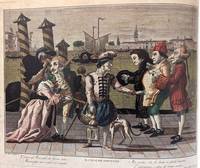
ref. 1219A source collection of antiquarian books and engravings formed by Richard von Hunderdorff on Cicisbeismo the unusual social convention peculiar to the Italian Enlightenment. The subject of the catalogue is the relationship between married women and young men of noble birth in 18th century Italy and Spain. This collection is a sophisticated look at 18th century continental women and their position in society. The collection deals with the status of noble women their place in society the restraints to their freedoms and the ways they were able to engage men as escorts and confidants which allowed them to participate more openly in the social setting of their period. What is perhaps most interesting about the collection is that it not only chronicles the evolution of the position of women in Italy and Spain but records the reaction to this social phenomenon by French German and English writers and visitors to these countries. The criticism was almost universal and at times ferocious. The English and the Germans in particular portrayed the women as prostitutes the young gentleman as sodomites and the husbands as cockolds and by doing so provide stunning insights into the social status of women in their own country. This collection is a remarkable library of books and illustrations documenting the struggle for women to become greater participants in the societies in which they lived. A Copy of a Printed Catalogue is Available upon Request. Payment terms are available. . unknown books
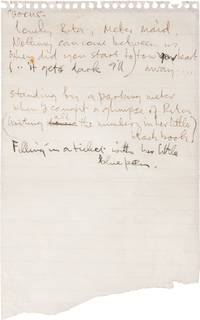
1967ref. 2451967. Paul McCartney's handwritten working manuscript as Beatle for "Lovely Rita" from the album Sgt. Pepper's Lonely Hearts Club Band. the most famous album in the entire panorama of modern music. This is the very first rough draft 10 lines in ink all in Paul's handwriting and all written on a single side of an irregular scrap of lined paper 7 1/2" X 5" torn from a spiral notebook. 7 lines in black are Paul's first concept. 3 lines of changes have been added later in blue such as "writing all the numbers in her little black book" changed to "filling in a ticket with her little blue pen" and still later recorded as "filling in a ticket in her little white book." Near fine condition. Lavishly matted and framed with a full size uncorrected 1st state proof photograph of the album cover varying in that McCartney is kneeling the band instruments have been passed around and 2 people are among the onlookers who would not sign releases and therefore did not appear on the published album. Ex-Butterfield's Dec. 12 1993. Rare. Icon time. Beatles manuscripts from Sargent Pepper held all the rock & roll world records until Bob Dylan's Like a Rolling Stone sold at auction for $2000000 in 2014. But it's been a while now and another Sgt. Pepper manuscript will take the record back eventually and someday soon the only way to see one will be in a museum at the end of a long line behind velvet ropes. The last authentic Sgt. Pepper manuscript at auction A Day in the Life admittedly a greater song sold for $1202500 at Sotheby's in 2010. The last real McCartney manuscript of a Beatles song at auction was an abridged later fair copy of 10 condensed lines from Hey Jude that he wrote out to be used as a key by the band at a recording session $910000 at Julian's in 2020 and again $1016000 at Christie's 2026 and that one in contrast to ours was not a working manuscript carrying his thoughts inner debates and changes. The handwritten lyrics to "Lovely Rita Meter Maid" represent an intimate window into The Beatles' conceptual shift during their psychedelic period showcasing McCartney's evolving storytelling approach. Unlike their earlier love songs centered on direct romantic sentiments this track exemplifies their move toward character-driven narratives with whimsical scenarios and playful humor. This creative direction coincided with broader cultural movements challenging conventional structures and celebrating the previously overlooked aspects of daily life. The track's transformation of a mundane authority figure into the subject of amorous pursuit subtly subverted social norms while maintaining a façade of innocent charm-a hallmark of the band's distinctive cultural impact during this period. McCartney's composition emerged during a pivotal moment in Western society when art was increasingly blurring distinctions between "high" and "low" culture. The Beatles' work on "Sgt. Pepper" helped legitimize popular music as culturally significant with songs like "Lovely Rita" demonstrating how seemingly simple pop compositions could contain nuanced social observation. The character sketch format allowed the band to adopt personas and perspectives outside their own experiences expanding their artistic range while connecting with the era's interest in identity exploration and social role-playing. This approach positioned the band as both participants in and commentators on the rapid social changes reshaping 1960s culture making even their lighthearted works like "Lovely Rita" meaningful cultural documents of their time. unknown books