Bureau of the Lord ChamberlainBiblio.com

261.043 resultados
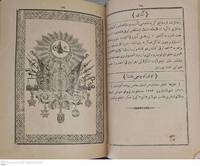
1946ref. 000271Limited to 150 copies. From the library of Huseyn Ghalib Rushdi Topuz-zade Bey Minister Plenipotentiary and Extraordinary Delegate of the King of Egypt. Finely printed for constables. 24 pages of text accompanied by 29 finely executed illustrations printed on thick paper depicting military and civil orders decorations and badges of honour of the Kingdom of Egypt from the reign of Muḥammad ʿAlī Pasha to King Farouk. Includes one folding plate. Government press paperback
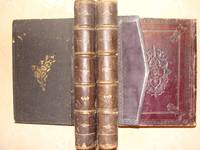
1883ref. 000519Istanbul: Matbaa-i Bahriye the Navy press 1883 Book. Very Good. Hardcover. 1st Edition. 8vo - over 7¾ - 9¾" tall. THE MOST COMPREHENSIVE ENCYCLOPAEDIA IN THE OTTOMAN TURKISH ABOUT THE ARABIAN PENINSULA AND THE TOW HOLY SANCTUARIES IN HEDJAZ BY THE WELL-KNOWN AUTHOR WHO WAS EMPLOYED IN THE OTTOMAN ARMY IN HEJAZ IN C. 1865 AND THEN BECAME AN ADMIRAL IN THE OTTOMAN NAVY. EYUP SABRI PASHA WAS BORN IN TASALYA THESSALIA IN THE 19th C. AND DIED IN ISTANBUL IN 1890. HE IS BETTER KNOWN WITH HIS DESCRIPTIVE BOOKS ABOUT MECCA MEDINA THE ARABIAN PENINSULA AND THE WAHHABY ACTIVITIES BESIDE HIS RELIGIOUS BOOKS. HE WAS AWARE OF THE OFFICIAL ISSUES OF THE HEJAZ BECAUSE OF HIS BEING ACQUAINTED ON THE OFFICIAL CORREPONDENCE BETWEEN THE VILAYET OF HEJAZ AND THE CENTRAL AUTHORITY IN ISTANBUL. PART 1 MIR'AT MECCA TOW SECTIONS IN ONE VOLUME. 22 INDEX 1175 P WITH SEVERAL LITHOGRAPHIC PLATES OF WHICH TOW ARE IN COLOURS. CONTEMPORARY FULL LEATHER OTTOMAN BINDING WITH FLAP. PART 2 MIR'AT AL MEDINA TOW SECTIONS IN TOW VOLUMES. PRINTED IN 1886. VOL.1 8 INDEX PAGES 1 TO 642 WITH 3 LITHOGRAPHIC PLATES OF WHICH ONE IS FOLDING AND IN COLOURS. VOL.2 PAGES 643 TO 1343 WITH ONE FOLDING PLAN OF THE HOLY MOSQUE IN MEDINA AND ONE DIAGRAM. PART 3 MIR'AT JAZIRAT AL 'ARAB VIEW OF THE ARABIAN PENINSULA INDEX 416 P WITH 2 LITHOGRAPHIC PLATES. PRINTED IN 1888. THE THREE VOLUMES OF MIR'AT AL MEDINA AND MIR'AT JAZIRAT AL 'ARAB ARE IN SIMILAR GILTED OTTOMAN BINDINGS. Tall 8vo. THE FIRST AND ONLY EDITION. For other set of this book see no. 000276 in our inventory. Matbaa-i Bahriye (the Navy press) hardcover
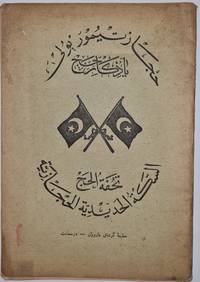
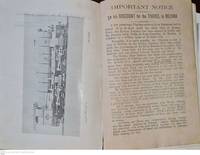
1913ref. 000166Very rare brochure printed in Armenian house in İstanbul 1913. In English Ottoman Turkish Arabic Russian and Urdu. 10 p. Text with 11 plates. In the printer wrappers. Archak Garoyan paperback
1900ref. 00020910 p. Of text in English Ottoman Turkish Arabic Urdu and Russian with 9 full page plates. A hajj travel brochure printed in İstanbul supposed to be by an Armenian press in c. 1900. Rare An Armenian press paperback
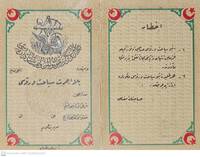
ref. 000177Ottoman Turkish script with crescent figures and map on the back of the Ottoman Railway. A free boarding pass should be declared on demand. Holder can carry up to 30 kg . 14.5 x 11 cm. Seruchin (?) An Armenian press
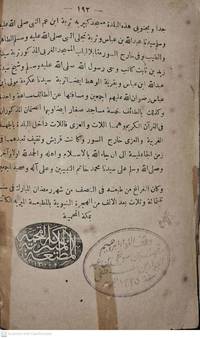
1885ref. 000205192 p. Arabic text a rare print. Stamp of the general Ibrahim Rif'at Pasha in 1335 an endorsement copy. With several notes during the copy. Modern binding. Hejaz printing house hardcover
1891ref. 000206310 p. Ottoman Turkish text. Ownership by Mesud Qasim zaynal Ali Riza in jeddah the son of the Ottoman delegate of Jeddah. Hejaz printing house hardcover
1885ref. 000210182 pages. Ottoman Turkish text. The first official yearbook printed by a lithographic press in Mecca. An early work printed in the Hejaz. Rare. Lithograph press hardcover
1908ref. 059007London: Crosby Lockwood And Son 1908. 2nd Edition 1st Printing. Hardcover. Very Good . Maps Charts Photographs. Xix 504 Pp 5 Pp Ads At End. Second Edition Revised And Expanded. Original Blue Cloth Gilt Beveled Edges. Inscribed In London By The Author To California Petroleum Geologist Ralph Arnold And Dated In 1921. Covers Clean All Gilt Still Brilliant Light Fraying At Tips And Top Edge. Very Scarce Only Three Institutional Holdings Of This 1908 Second Edition Are Shown In Worldcat. For An Excellent Summary Of Beeby-Thompson's Unparalleled Association With Baku See"Arthur Beeby-Thompson: Oil Pioneer" On The Internet. Of Little Interest Today The Oil Fields Of Baku Were Hitler's Major Interest In His Attempted Subjugation Of Russia In World War Ii A Fact Well Known To Many Russians But Known By Few Living Westerners. There Is A Plausible Argument That The National Economics Politics And Militarization Of Oil And Gas Is So Important That Twentieth Century And Twenty-First Century National Economics Politics And Militarization May To A Considerable Degree Be Considered As Just Aspects Of The Oil And Gas Business; Petroleum And Gas Derivatives Provide Not Just Energy But The Chemicals Used In All Industry Including The Lubrication Of Essential Machines. This Business Is Below The Radar Of The Media Indispensably Dependent Upon The Oil Equipment Supply Business An Oligopoly Where Equipment Is Never Sold Only Leased Making The Users Dependent Upon Such Firms "Forever" And Giving Them Incomparable Political Leverage. Per The Huntington Library Ralph Arnold A Leading Consulting Geologist And Petroleum Engineer In The United States Came To Pasadena California From Iowa With His Family In 1880 And Was Educated At Stanford University. Arnold Became A Member Of The U.S. Geological Survey Wrote And Lectured Extensively On Geological Subjects Engaged In Numerous Mining And Petroleum Ventures And Was Active In Republican Politics Especially In The Presidential Campaign Of Herbert Hoover One Of Hoover's Sons Was A Worldwide Petroleum Drilling Business Operator. Excellent Background For Motivations For Sacrifice Of Ukraine For American Access To Fees And Profits For Drilling Storing Transporting Marketing And De-Regulating Russian Oil And Gas. Crosby, Lockwood And Son hardcover
1579ref. 63961Frankfort & Wechelus: Francofurti Ad Moenum Apud and Wechelum 1579. Around 1961 a previous owner writes "According to the recent national archives survey this is the second oldest book in the State of Florida." Ask for scanned images of this rare volume and the laid-in notes of early researcher. "THIS CONSISTS OF ORATIONS AND COMMENTS OF FAZELLUS or FAZELUS WHO WAS PROFESSOR OF THE CUSTOMS OF THE SICILIAR AND SACRED HERITAGE OF THE PREACHER.". First Edition 1st Edition. Hardback LEATHERBOUND. Good Used Antique Condition. 13 3/4 Inches X 8 1/5 Inches X 2 1/4 Inches. Francofurti Ad Moenum Apud and Wechelum Paperback
1963ref. 2916London: np 1963. First edition. Very Good. Vintage 8x10 glossy photograph by Dezo Hoffmann from 1963 SIGNED BY ALL FOUR BEATLES. The image is one of several taken by the Czech-born photographer Dezo Hoffmann on July 2 1963 – the day after the band recorded She Loves You / I’ll Get You. Hoffmann met The Beatles in 1962 and as the first professional photographer they hired played a pivotal role in documenting their early years. Hoffmann preferred photographs that showed the members of the band in candid spontaneous or unguarded moments both on and off the stage and consequently his photos made the public feel like they connected with and knew the band on a more intimate level. His timing was perfect: he helped shape the image of The Beatles just as their popularity began to grow. In this photo The Beatles are posing together in the gardens of London’s Russell Square. It is signed on the back “To Carol love” and then the signatures of the band members in full: Paul McCartney George Harrison John Lennon and Ringo Star. The “To Carol love” appears to be in McCartney’s hand. The McCartney Harrison and Lennon signatures are very strong in deep black ink while Ringo Starr’s signature signed with a different pen has faded but is still legible. Size: 8x10 inches. London: 1963. Some light creases visible mainly in raking light; Ringo signature with fading as noted above. Housed in custom presentation folder. A important signed image at a critical moment in the history of The Beatles. np unknown
1963ref. 2916London: np 1963. First edition. Very Good. Vintage 8x10 glossy photograph by Dezo Hoffmann from 1963 SIGNED BY ALL FOUR BEATLES. The image is one of several taken by the Czech-born photographer Dezo Hoffmann on July 2 1963 – the day after the band recorded She Loves You / I’ll Get You. Hoffmann met The Beatles in 1962 and as the first professional photographer they hired played a pivotal role in documenting their early years. Hoffmann preferred photographs that showed the members of the band in candid spontaneous or unguarded moments both on and off the stage and consequently his photos made the public feel like they connected with and knew the band on a more intimate level. His timing was perfect: he helped shape the image of The Beatles just as their popularity began to grow. In this photo The Beatles are posing together in the gardens of London’s Russell Square. It is signed on the back “To Carol love” and then the signatures of the band members in full: Paul McCartney George Harrison John Lennon and Ringo Star. The “To Carol love” appears to be in McCartney’s hand. The McCartney Harrison and Lennon signatures are very strong in deep black ink while Ringo Starr’s signature signed with a different pen has faded but is still legible. Size: 8x10 inches. London: 1963. Some light creases visible mainly in raking light; Ringo signature with fading as noted above. Housed in custom presentation folder. A important signed image at a critical moment in the history of The Beatles. np unknown books
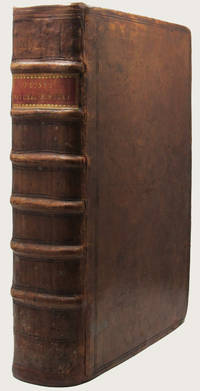
1634ref. 34275London: Printed by Adam Islip and to be sold by John Grismond in Ivy-lane and to be sold at the Signe of the Gun 1635 1634 1634. The first Tome. The second Tome. The second printing with numerous corrections of the first English translation. Printed by Adam Islip in 1634 the first volume contains the title-page dated 1635 which was offered for sale by John Grismond the second volume retains the 1634 title-page. Elaborate woodcut printer's device to title engraved floriated initials and fine head and tail pieces throughout. Folio in 6s 2 vols. bound in one an excellent copy bound in full contemporary polished calf in original state the back with raised bands over cords covers with double fillet rules in blind. 56 614 42; 12 632 86. Advertisement leaf at end of vol. II pp. Collated complete. An especially desirable copy of this highly important book. In its rare original state this book is seldom encountered. The textblock is crisp and unpressed and remains in a very pleasing state of preservation some minor evidence of damp in a few places as to be expected the spine with expert restoration at the head and tail of the panel a beautiful copy. IMPORTANT EARLY ISSUE OF THE GREAT TRANSLATION OF PLINY INTO ENGLISH BY PHILEMON HOLLAND. The second printing of the first full English translation of this important book. First published in Venice in 1469 “The ‘Natural History” of Pliny the Elder is more than a natural history: it is an encyclopaedia of all the knowledge of the ancient world. .He was a compiler rather than an original thinker and the importance of this book depends more on his exhaustive reading he quotes over four hundred authorities Greek and Latin than on his original work. All the spare time allowed him by a busy administrative career was devoted to reading; he began long before daybreak his nephew the younger Pliny recorded and grudged every minute not spent in study; no book was so bad he used to say as not to contain something of value. When he died the 'Natural History' the sole extant work out of one hundred and two volumes from his pen was still incomplete. It comprises thirty-seven books dealing with mathematics and physics geography and astronomy medicine and zoology anthropology and physiology philosophy and history agriculture and mineralogy the arts and letters. He is scrupulous in his acknowledgment of his sources you must he wrote with honest humility declare those from whom you have profited and the whole of the first book is devoted to the tables of contents and authorities which bear witness to his method. The HISTORIE soon became a standard book of reference: abstracts and abridgments appeared by the third century. Bede owned a copy Alcuin sent the early books to Charlemagne and Dicuil the Irish geographer quotes him in the ninth century. It was the basis of Isidorets Etymologiae and such medieval encyclopedias as the Speculum Majus of Vincent of Beauvais and the Catholicon of Balbus. One of the earliest books to be printed at Venice the center from which so much of classical literature was first dispensed it was later translated into English by Philemon Holland in 1601 and twice reprinted a notable achievement for so vast a text. . More recently scholars as various as Humboldt and Grimm have praised and acknowledged their debt to it. Over and over again it will be found that the source of some ancient piece of knowledge is Pliny. PMM The standard of reference for scholars since the 15th century Holland’s translation made it available to the English speaking world for the first time. Although not strictly scientific itself mingling a good deal of the author's fancy with fact Pliny's NATURALL HISTORIE was important in stimulating scientific thought in succeeding generations. "It is an encyclopedia of all the knowledge of the ancient world set out in an orderly fashion. It was the source of much medieval knowldege--and legend--and the model for such works as the SPECULUM MAJUS of Vincent of Beauvais. The high regard in which it was held in the world of the Renaissance can be seen by its early appearance in print 1472" PMM. The HISTORIE divided into 37 libri or "books" was completed except for finishing touches in 77 CE. In the preface dedicated to Titus who became emperor shortly before Pliny's death Pliny justified the title and explained his purpose on utilitarian grounds as the study of "the nature of things that is life" "Preface" 13. Heretofore he continued no one had attempted to bring together the older scattered material that belonged to "encyclic culture" egkyklios paideia the origin of the word encyclopaedia. Disdaining high literary style and political mythology Pliny adopted a plain style--but one with an unusually rich vocabulary--as best suited to his purpose. A novel feature of the NATURALL HISTORIE is the care taken by Pliny in naming his sources more than 100 of which ae authors and sometimes the titles of the books many of which are now lost from which Pliny derived his material. The HISTORIE properly begins with Book II which is devoted to cosmology and astronomy. Here as elsewhere Pliny demonstrated the extent of his reading especially of Greek texts. Books VII through XI treat zoology beginning with humans VII then mammals and reptiles VIII fishes and other marine aninmals IX birds X and insects XI. In Books XII throuogh XIX on botany Pliny came closest to making great contributions to science. He drew heavily upon Theophrastus and still made important independent observations particularly those made during his travels in Germany. Pliny is one of the chief sources of modern lknowledge of Roman gardens early botanical writings and the introduction into Italy of new horticultural and agricultural discoveries. Born at Como in 23 Pliny died while observing the eruption of Vesuvius in 79 A.D. His NATURALIS HISTORIA is a scientific encyclopedia often uncritical but very elaborate and of great value. Pliny attached to each book the list of his authorities 146 Roman and 327 Greek being quoted. He explained that people may be living at the antipodes and stated that the speed of light is greater than that of sound. His work includes the oldest account of ancient art. In addition it contains a remarkable amount of early information on Asia and Africa. Its influence throughout the Middle Ages was very great. This is an especially nice copy of the second offering of the work in English. This issue corrected the many errors of the first English edition. As with the copy listed in the British Museum the first tome has a new title page dated 1635. Further this is a variant issue with “and are to be sold by John Grismond” after Adam Islip on the imprint. Dedicated to Sir Robert Cecil. Printed by Adam Islip and to be sold by John Grismond, in Ivy-lane and to be sold at the Signe of the Gun hardcover
1775ref. ABC_50430Amsterdam 1775. Folio. widow of Jacobus Loveringh and Johannes Allart Kept in a dark brown buckram folder lined with blue patterned paper remnants of green closing ties. With 12 full-page engravings printed on silk with the selvedge on the bottom captioned in Dutch with the word "proefdruk" proof printed in the lower right. Rare suite of twelve engraved views printed on silk as proof impressions depicting the catastrophic Dutch flood disasters of 1775 and 1776. Engraved chiefly by Noach van der Meer II active 1740-1794 after drawings by Hendrik Kobell 1751-1779 with one plate ad 4 by Simon Fokke 1712-1784 the series was published in Amsterdam between 1775 and 1776. Several plates were later incorporated into Johan Hendrik Hering's 1731-1790 Bespiegeling over Neêrlandsch waternood 1776-1778 the principal contemporary account of the disasters. Printed on silk rather than paper these impressions were almost certainly intended as presentation or luxury proofs.The series records the devastating storm surges that struck the Dutch Republic in consecutive years. The North Sea flood of 14-15 November 1775 caused by a violent north-easterly storm breached dikes across Holland Waterland Texel and the Zuiderzee region inundating towns and villages from Scheveningen to Kampen. Only a year later on 20-21 November 1776 an equally destructive south-westerly storm again overwhelmed coastal defences producing one of the most severe flood disasters of the eighteenth century. Together these engravings form an exceptional visual chronicle of the Republic's struggle against the sea.The artistic quality of the engravings owes much to Kobell one of the finest Dutch marine painters of the late 18th century. His dramatic compositions combine topographical accuracy with vivid narrative while Van der Meer who trained in Paris and worked in Amsterdam translated Kobell's drawings into finely executed engravings. The Texel view was entrusted to the celebrated Amsterdam engraver Fokke one of the leading Dutch printmakers of his generation.Besides their artistic merit these prints constitute important historical documents. They belong to the earliest wave of illustrated Dutch disaster literature produced in response to the catastrophic floods that profoundly affected the economy landscape and collective memory of the Dutch Republic. Hering's Bespiegeling over Neêrlandsch waternood for which several of these plates were used became the standard contemporary account of the disasters and laid the foundation for later historical studies of the floods.All engravings with a number written in pencil in the lower right. The folder shows minor traces of use. Some very minor browning and light staining to some parts of the silk and some fraying alone the edges. Otherwise in very good condition.l Muller De Nederlandsche geschiedenis in platen II p. 220 nos. 4314-5; cf. for the work of Hering see: STCN 160342767 and 160344492. hardcover
1961Signed and inscribed by author upon front free endpaper to Swedish journalist Arvid Fredborg, dated 1982 in Berlin. 570 pages. A National Review Panel ranked this work as the ninth best non-fiction book of the twentieth century. "A positive statement of the principles of society that in scope and breadth is more like a new Wealth of Nations... A thorough exposition of a social philosophy which ranges from ethics and anthropology through jurisprudence and the history of ideas to the economics of the modern welfare state." - Publisher. Moderate wear to clean and unmarked book. Binding sound. Dust jacket in poor condition with numerous defects.. Book
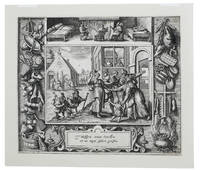
1590ref. ABC_46070Antwerp 1590. Folio 7 of 8 plates trimmed. Adriaen Collaert 7 plates with the Acts of Mercy & Johannes Galle the Last Judgement Loose prints. 8 engravings ca. 17.5 x 20.5 cm on laid paper by Crispijn de Passe I the elder after Maarten de Vos with the central scene framed by an exquisite ornamental border showing crafts tools and scenes relating to the subject. All engravings captioned with engraved Latin text in a cartouche below the images. Complete series of the Acts of Mercy including the plate of the Last Judgement engraved by the engraver illustrator and publisher Crispijn de Passe I ca. 1564-1637 after Maarten de Vos 1532-1603 one of the most prolific and influential print designers of his generation. They were first published by the engraver Crispijn de Passe the elder I and subsequently by Adriaen Collaert Theodoor Galle and Johannes Galle. Our set shows the 7 prints of the Acts of Mercy in their second state of 4 by Collaert with his monogram "AC" in the plates. The eighth print showing the Last Judgement is in its third state published by Johannes Galle. The acts of mercy depicts feeding the hungry giving drink to the thirsty clothing the naked in a dress shop housing the homeless tending the sick visiting prisoners and burying the dead.One print feeding the hungry untrimmed. The 7 trimmed prints are reinforced with two small white paper slips in the head margin the Last Judgement very slightly toned and with a few spots. Otherwise in good condition with very sharp and dark impressions of the plates. The complete series of the Acts of Mercy including the Last Judgement.l Hollstein XV 471-477; New Hollstein Maarten de Vos 613.3; 614-620.2. ABE CAT Art History ABE CAT Bibles Sermons & Psalmbooks hardcover
1962ref. 2409180259xbvkJamaica, Island Worcester [and Things] - Ceramics, 1962. Material: Ceramic / Total height (Pot with lid): ca. 39 cm; diameter at foot: ca. 15 cm, largest diameter (open top of 'pot'): ca. 24 cm. / Colour: lightbrown-rosé with white partly gilt-lined embossments and partly gilt inscriptions; foot and pineapple-top: white. / Weight: ca. 3 kg.
1930xx,853,viii,899 pages. Index in each volume. First printing. Reflections and recollections of Paul Warburg [1868 - 1932], considered by many to have been the main driver behind the establishment of the Federal Reserve System in 1913. Warburg was reluctant to publish this work until, in the autumn of 1928, "I became convinced that the Federal Reserve System had entered upon a gravely critical period in its career, and that for the discussion about to ensue it was highly important that certain vital facts in the origin and growth of the System be adequately understood." - viii [v1]. Gilt lettering upon spines. Average wear to publisher's navy cloth. Bookplate of prior owner, a Dutch doctor, inside each front board. Laid in is the original handwritten purchase receipt, dated 1931, issued by an Amsterdam book dealer. Front free endpaper of volume 2 neatly removed. Bindings and hinges intact. Dust jackets not included. A sound copy of this essential chronicle of early twentieth century American central bank history. Masui p.1431, Rist p.321. Book
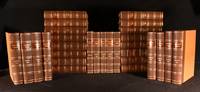
1839ref. 965Z28DLondon: The Railway Times Office 1839-63. First edition. Leather. Very Good Indeed. 11" by 9". None stated. An impressive run of early issues of the 'Railway Times' periodical an important railway periodical which documented developments and current news in the railway industry during the 1800s. A beautifully bound set of a very scarce periodical. An extensive twenty-nine volume set featuring a collection of the 'Railway Times' periodical from 1839-1863. All being the first edition. The periodical provides an impressive historical account of the current news and developments in the railway industry during the early to mid nineteenth century. The articles range from finances stock information new patents and inventions accidents and updates on railways from across the globe. Notable articles include; an article on Mr Robert Stephenson's new 1842 locomotive which proposed to use less fuel and a Testimonial to Isambard Kingdom Brunel the legendary engineer. This set includes; '1839' Vol II No. 71-72 85-94 and '1840' Vol III No. 27-41 and Vol II No. 52 of the 'Railways Magazine & Commercial Journal' bound into one volume. The rest of the years are bound over two volumes and feature complete runs of the magazine for that year with these being; '1841' Vol I- No.157 Vol III No. 1 - No.182 Vol Iv-No. 26. Vol II- No.183 Vol IV No.27 - No. 208 Vol IV No.52. '1842' Vol I- No. 209 Vol IV No.1 - No.234 Vol V-No.26. Vol II- No.235 Vol V No.27 - No.261 Vol V No.53. '1846' Vol I- No.418 Vol IX No.1 - No.443 Vol IX No.26. Vol II- nO.44 Vol IX No.27 - No.469 Vol IX No. 52. '1847' Vol I- No.470 Vol X No.1 - No.495 Vol X No.26. Vol II- No.496. Vol X No.27 - No.521 Vol X No.52. '1854' Vol I - No.836 Vol XVII No.1 - No.860 Vol XVII No.25.Vol II - No.861 Vol XXII No.26 - No.887 Vol XVII No. 52. '1855' Vol I - No.888 Vol xviii No.1 - No.913 Vol xviii No.26. Vol II - No. 914 Vol XVII No.27-No.939 Vol XVIII No. 52. '1856' Vol I - No. 940 Vol XIX No.1 - No.965 Vol XIX No.26.Vol II - No. 966 Vol XIX No.27 - No.991 Vol XIX No.52. '1857' Vol I- No.992 Vol XX No.1 - No.1017 Vol XX No.26. Vol II - No.1018 Vol XX No.27 - No.1043 Vol XX No.52. No. 18-22 have been misnumbered with No.18 numbered twice and missing No.21 however the work is complete with the pagination continuous as is expected. '1858' Vol I-No.1044 Vol XXI No.1 - No.1069 Vol XXI No.26. Two of the issues are numbered '23' but nothing is lacking. Vol II- No.1070 Vol XXI No.27-No.1094 Vol XXI No.52. '1859' Vol I- No.1095 Vol XXII No.1 - No.1120 Vol XXII No.26. Vol II - No.1121 Vol XXII No.27 - No.1147 Vol XXII No.53. '1860' Vol I- No.1148 Vol XXIII No.1 - No.1173 XXIII No.26. Vol II- No.1174 XXIII No.27 - No.1199 Vol XXIII No.52. '1861' Vol I- No.1200 Vol XXIV No.1 - No.1225 Vol XXIV No.26.Vol II - No.1251 Vol XXIV No.27 - No.1251 XXIV No.52.'1862' Vol I - No.1252 Vol XXV No.1 - No.1277 Vol XXV No.26. Vol II - No.1278 Vol XXV No.27 - No.1303 Vol XXV No.52. '1863' Vol I - No.1305 Vol XXVI No.1 - No.1329 Vol XXVI No.26.Vol II - No.1330 Vol XXVI No.27 - No.1355 Vol XXVI No.52. Illustrated heavily with numerous monochrome vignettes and the occasional full page illustration. Volume '1854' contains a folding map to pp. 356. A very scarce and important periodical with this being some of the earliest examples of the magazine currently on the market. A beautifully bound and uniform set. Bound in modern crushed quarter morocco with cloth to the boards. Endpapers renewed.All pages and issues present after the 1839-40 volumes. The occasional article clipped. Bound in modern crushed quarter morocco with cloth to the boards. Endpapers renewed. Externally lovely with only very minimal edge wear and slight leans to the odd volume. Internally generally firmly bound with the title page to pp.22 to '1854' tender and minimal strain in places otherwise firmly bound. Pages generally bright with only light age toning to the odd volume. Pages generally clean with only the odd spot slightly heavier to '1855' the occasional ink mark to '1841' and a more significant tidemark to '1856' pp. 569. Very minimal handling marks and occasional 'Railway Times' stamps to all the volumes. The odd page closely cropped to '1839-40' and the odd small closed tear and chip to the extremities. Several articles have been clipped from the pages heavier to the earlier volumes. Minor ink notations to '1847'. Hand written notes written on separate papers inserted into the odd volume. All in all a beautifully bound set with generally clean and bright pages with only the odd clipped article and mark. Very Good Indeed The Railway Times Office hardcover
ref. 172349Katoomba NSW: The Wayzgoose Press 1996. Long single sheet printed and decorated in various colours on one side only and folded concertina-style to form 24 pages last colophon; within a printed paper wrap-around inner sleeve which is contained in a red yellow & black cloth and paper portfolio with shoelace side-tie and printed paper title label; accompanied by two separate essays: Jas H. Duke the Dadaist by fellow poet Pi O; and A Concise Gloss on Dadaism by Mike Hudson both printed in red & black in a smaller concertina format and housed together in a compartmented printed paper pocket on verso of upper board; within solander box which is a trifle marked; a little light foxing; The Wayzgoose Press Katoomba NSW 1996. Edition limited to 34 numbered copies signed by Mike Hudson and Jadwiga Jarvis; this being one of 24 copies thus bound. With the original prospectus slightly foxed loosely inserted. A typographic rendering designed by Mike Hudson of a work by the Melbourne performance poet Jas H. Duke who died in 1992. The title translates as Dada fight for life and death. 'The text in all its graphic arrangements ran from top to bottom for an uninterrupted eight metres . . . A verbal description of Dada Carpenas impossible'. Jadwiga Jarvis The Wayzgoose Affair. The Wayzgoose Press unknown
1688ref. 31913London: by Miles Flesher for Richard Tonson 1688. First Edition in English. This copy has two title pages one with the Tonson imprint rubricated black and red the other with the Heyrick imprint in black only. Sabin states: “As some copies have only the black titles and some only the rubricated ones while others have both it seems possible that all the issues were originally published with two titles.” Engraved portrait frontispiece of translator Paul Rycaut the rubricated title page in red and black and 10 copperplate engravings. Folio an especially handsome copy bound in its original contemporary speckled English calf the spine with raised bands the compartments with floriated panels decorated in gilt red morocco lettering piece gilt the covers with a border decorations rolled in blind and double-filleted rules at the borders. 1019. A superb copy of this rare and early work. The book remains in its original binding. The text-block is crisp clean and unpressed The engraved illustrations are all in excellent condition. A truly wonderful copy and especially fine survival of a book rarely if ever found in such condition. RARE FIRST EDITION OF THIS HIGHLY IMPORTANT EARLY HISTORY OF THE INCAN CIVILIZATION AND OF THE CONQUEST OF PERU BY THE SPANISH. De la Vega was a prince of Incan royalty by virtue of his mother who was descended from the last Incan King of Peru. He took great pride in his Incan ancestry styling himself “Garcilasso Inca” and becoming a dedicated student of the Peruvian language and traditions. However the translator also tells us that “the Spanish humour was most prevalent in him so that he delighted much to tell us as in diverse places that he was also the son of Garcilasso de la Vega one of the first Conquerours of the new World.” Such an illustrious ancestry provides for a rendering of the history of the Incan civilization from a unique point of view. The first section of the text details the early history of the Incas before the Spanish conquest including their laws and government and other “particulars relating to their Empire and Policies.” The second part details the Spanish conquest and the various civil wars and rebellions that came along with them and after them. The first part was published in Lisbon in 1609 and the second part in 1617. This edition is the first English translation by Sir Paul Rycaut. This is a classic work comprehensive and painstakingly researched and remains today one of the chief authorities on the subject of ancient Peru. by Miles Flesher for Richard Tonson hardcover
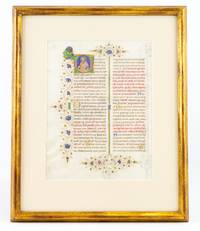
1441ref. ST19880Italy Ferrara 1441-48. Visible leaf: 245 x 187 mm. 9 5/8 x 7 3/8"; Frame: 380 x 315 mm. 15 x 12 1/4". Double column 30 lines in a very fine rounded gothic hand a few lines of text in the same hand but smaller. Mounted and in a simple but pleasing gold frame. Visible side with rubrics in red one-line initials in burnished gold or painted blue one two-line initial in burnished gold on a pale pink ground with white tracery a lovely illuminated bar between the columns with a central plant knot AND SPROUTING IN UPPER AND LOWER MARGINS CLUSTERS OF FLOWERS AND LEAVES IN VARIOUS COLORS AS WELL AS GOLD BEZANTS outer margin with swirling penwork studded with gilt bezants running the length of the column each penwork swirl enclosing a painted and gilt flower with ONE FIVE-LINE HISTORIATED INITIAL DEPICTING ST. PAUL HOLDING A SWORD AND BOOK the initial painted pink with green leaves and a blue and green acanthus extension on a gilt ground. ◆Not examined outside of frame but in very fine condition: vellum slightly wavy text in the bottom margin just a bit faded but by all appearances A VERY CLEAN BRIGHT LEAF SPARKLING WITH GILT. Executed with great skill and delicacy and in sensitive Italianate colors highlighted especially by spring green and pink the present leaf is from a manuscript intended for a powerful aristocrat. It comes from the celebrated Breviary illuminated for the chapel of the Marquises of Este rulers of Ferrara and Mantua a manuscript commissioned by Leonello d'Este duke of Ferrara from 1441-50. Because the d'Este family kept excellent records we have confidence that this manuscript was done for Leonello by Giorgio d'Alemagna Bartolomeo de Benincà Guglielmo Giraldi and Matteo de' Pasti see Toniolo "La Miniatura a Ferrara dal Tempo di Cosmè Tura all'eredità di Ercole de' Roberti" 1998 pp. 19-20 and 76-77. The leaves show subtle variations in the style of the illuminations a result of work done by a team of artists doing variations on a theme. At one time in a Spanish library the manuscript was brought to Britain during the Peninsular War and came to be owned by the Rolls family later Lords Llangattock of Monmouth in Wales from whom it takes its name. By the time the work reached Britain most of the miniatures had already been cut out. The Breviary sold at Christie's on 8 December 1958 lot #190 to Goodspeed's of Boston who broke it up. The intact first quire of 10 leaves was purchased by Philip Hofer and given to Harvard cf. Wieck "Late Medieval and Renaissance Illuminated Manuscripts" p. 130 and fig. 74 and individual leaves appeared in 1967 in the catalogues of Folio Fine Art "the quality of the leaves is extremely high" Maggs Brothers "of a very high quality" and Alan Thomas "of exquisite quality". The present example is especially desirable for the portrait of St. Paul who is depicted holding a sword and book and whose carefully molded features reflect the growing interest in realistic portraiture in Renaissance Italy. unknown
1441ref. ST19880Italy Ferrara 1441-48. Visible leaf: 245 x 187 mm. 9 5/8 x 7 3/8"; Frame: 380 x 315 mm. 15 x 12 1/4". Double column 30 lines in a very fine rounded gothic hand a few lines of text in the same hand but smaller. Mounted and in a simple but pleasing gold frame. Visible side with rubrics in red one-line initials in burnished gold or painted blue one two-line initial in burnished gold on a pale pink ground with white tracery a lovely illuminated bar between the columns with a central plant knot AND SPROUTING IN UPPER AND LOWER MARGINS CLUSTERS OF FLOWERS AND LEAVES IN VARIOUS COLORS AS WELL AS GOLD BEZANTS outer margin with swirling penwork studded with gilt bezants running the length of the column each penwork swirl enclosing a painted and gilt flower with ONE FIVE-LINE HISTORIATED INITIAL DEPICTING ST. PAUL HOLDING A SWORD AND BOOK the initial painted pink with green leaves and a blue and green acanthus extension on a gilt ground. ◆Not examined outside of frame but in very fine condition: vellum slightly wavy text in the bottom margin just a bit faded but by all appearances A VERY CLEAN BRIGHT LEAF SPARKLING WITH GILT. Executed with great skill and delicacy and in sensitive Italianate colors highlighted especially by spring green and pink the present leaf is from a manuscript intended for a powerful aristocrat. It comes from the celebrated Breviary illuminated for the chapel of the Marquises of Este rulers of Ferrara and Mantua a manuscript commissioned by Leonello d'Este duke of Ferrara from 1441-50. Because the d'Este family kept excellent records we have confidence that this manuscript was done for Leonello by Giorgio d'Alemagna Bartolomeo de Benincà Guglielmo Giraldi and Matteo de' Pasti see Toniolo "La Miniatura a Ferrara dal Tempo di Cosmè Tura all'eredità di Ercole de' Roberti" 1998 pp. 19-20 and 76-77. The leaves show subtle variations in the style of the illuminations a result of work done by a team of artists doing variations on a theme. At one time in a Spanish library the manuscript was brought to Britain during the Peninsular War and came to be owned by the Rolls family later Lords Llangattock of Monmouth in Wales from whom it takes its name. By the time the work reached Britain most of the miniatures had already been cut out. The Breviary sold at Christie's on 8 December 1958 lot #190 to Goodspeed's of Boston who broke it up. The intact first quire of 10 leaves was purchased by Philip Hofer and given to Harvard cf. Wieck "Late Medieval and Renaissance Illuminated Manuscripts" p. 130 and fig. 74 and individual leaves appeared in 1967 in the catalogues of Folio Fine Art "the quality of the leaves is extremely high" Maggs Brothers "of a very high quality" and Alan Thomas "of exquisite quality". The present example is especially desirable for the portrait of St. Paul who is depicted holding a sword and book and whose carefully molded features reflect the growing interest in realistic portraiture in Renaissance Italy. unknown books
2008ref. 2091502135700155Kashiwashobo 2008. Soft Cover. Fine. The book is in fine condition. Kashiwashobo paperback
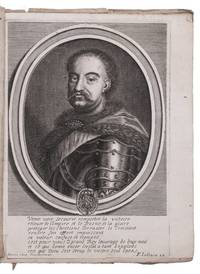
1687ref. 22346Bordeaux: Pierre Abegou 1687. Marbled wrappers. 4to. With an inserted latter engraved frontispiece portrait of the Polish King Jan III Sobieski engraved by F. Jollain. Very rare pamphlet published during the European wars against Turkey with a frontispiece portrait of the Holy Roman Emperor Léopold I 1640-1705 Archduke of Austria and King of Bohemia and Hungary. He succeeded his father Ferdinand III in 1657 and immediately had to fight against the Turks in the Great Turkish War also known as the War of the Holy League 1683-1699. This war finally led to the Peace of Karlowitz in 1699.This work gives directions and arrangements for ritual processions that the Turkish Sultan Suleiman III ordered after his victories during the so-called Holy Wars against the Christians. It is of great importance for our understanding of the problematic Turkish-European relations during the 17th century especially as an interesting example of counter-propaganda. One of Suleiman IIIs directions presented in the book for example ordered that one Christian slave or one Jew was to be killed every fifteen minutes as part of the procession. One can imagine the reaction of a Christian reading this text: although the crusades were over this could provoke war and violence between the parties.Wrappers worn and somewhat frayed a few worm holes but still in good condition.l Bibliotheca bibliographica Aureliana CX XVIIe siècle XIV Bordeaux 2176 not mentioning the portrait; cf. Desgraves Bordeaux 1580. Pierre Abegou, unknown