331 469 résultats
1905réf. 42829Leipzig S. Hirzel 1905. No wrappers. Issued in "Jahrbuch der Radioaktivität und Elekronik" 2. Bd. Heft 3. Hahn's paper: pp. 233-264. Enntire issue: pp. 233-262 = entire "Heft 3". Fine and clean. First printing of this paper which is Hahn's Habilitation paper announcung his discovery of a new element in residues from a Ceylon mineral called Thorianite. He later showed that it is an intermediate disintegration product."Because the sample thorianite was small Ramsay proposed that Hahn confirm Marie Curie's determination of the atomic weight of radium by preparing it in some organic compounds thereby greatly increasing the total amount being examined and calculating the atomic weight from the measured molecular weights. Chance sometimes favors the unprepared mind and Hahn who familiarized himself with only the basic of radioactivity followed the prescribed separationss technique and found himself the discovere of a new radioelement: radiothorium. The explanation was that the material given him came from an ore which contained a large percentage of thorium in addition to the radium. Thus upon completion of the chemical procedure not all the activity was confined in the radium-containg fraction; indeed the nes subsyance in the remainder was several hundred thousand times more active than thorium and ultimately yielded the characteristic one.minute halflife of thorium emanation."DSB VI p. 15. - Weeks Discovery of the Elementsp. 308 ff. unknown
1979réf. 185339Bonn, 1979. 64 S., 1 Bl. OBr. Umschl. etwas randgebäunt.
1907réf. 1512996Leipzig, 1907. 8, 107, (1) S. OBr. Rücken etwas angerissen.
1884réf. 1041947Marburg, 1884. 44 S. Rückenbr.
1907réf. 53408Leibzig Johann Ambrosius Barth 1907. 8vo. Contemp. hcalf. Spine gilt and with gilt lettering. Slightly rubbed and light wear to spineends. In "Annalen der Physik" Vierte Folge Band 23. VIII1000 pp. a. 4 plates. The entire volume offered. Einstein's paper: pp.371-384. Stamps on titlepage Allgemeine Electricitäts-Gesellschaft a. AEG Forschungsinstitut. Internally clean. First edition of the first explicit statement of Einstein's energy-mass equation E=mc2.Nearly all descriptions of Einstein's scientific work state that the mass-energy equivalence E=mc2 was first formulated in Einstein's 1907 review paper 'Über das Relativitätsprinzip und die aus demselben gezogenen.' published in 'Jahrbuch der Radioaktivität und Elektronik' see Weil no. 21 and Dictionary of Scientific Biography vol. 4 pp.323 for examples. However in his paper 'Über die von Relativitätsprincip geforderte Trägheit der Energie' the offered paper which predates the former mentioned by six months Einstein gave a clear statement of the mass-energy equivalence E=mc2. See Lanczos: The Einstein Decade pp.149-150 and 153 as well as Volume 2 of 'The Collected Papers of Albert Einstein' pp. 428.Einstein's first paper regarding the relation E=mc2 is his fourth 1905 paper 'Ist die Trägheit eines Körpers von seinem Energieinhalt abhängig'. In this short paper Einstein showed that a body releasing the energy E in the form of radiation will have its mass decreased by E/c2 and concluded that the mass of a body is a measure of its energy content e.g. that all energy has mass. The next time Einstein returns to the subject is in his 1906 paper 'Das Prinzip von der Erhaltung der Schwerpunkts Bewegung und die Trägheit der Energie.'. Here Einstein concluded that one must either ascribe the inertial mass E/c2 to any form of energy E or else give up the fundamental law mechanics regarding conservation of the motion of the center of gravity. Then finally in the 1907 paper 'Über die von Relativitätsprincip geforderte Trägheit der Energie.' the offered paper Einstein makes the decisive step of assuming that all mass has energy. On page 382 Einstein considers the total energy of a moving mass point as the sum of its kinetic energy and its rest energy. In classical mechanics it is most convenient to set the second term to zero but in relativistic mechanics one obtains the simplest expression by setting the rest energy equal to mc2. Einstein then continues to show that this stipulation cannot lead to a contradiction in any relativistic argument. In a footnote on page 382 Einstein states for the first time the equation E=mc2 and mentions that this equation is the expression of the principle of the equivalence of mass and energy - see Volume 2 of 'The Collected Papers of Albert Einstein' pp. 428.The volume contains another paper by Einstein "Bemerkungen zu der Notiz von Hrn. Paul Ehrenfest: "Die Translation deformierbarer Elektronen und der Flächensatz"" pp.206-208. - Weil No. 18. Further with 2 importent papers by Max v. Laue.Collected Works Doc. 45. Weil 19. Boni 19. unknown
1907réf. 47457Leibzig Johann Ambrosius Barth 1907. 8vo. Contemp. hcalf. Spine gilt. Title-and tomelabels with gilt lettering. Slightly rubbed. In "Annalen der Physik" Vierte Folge Band 23. VIII1000 pp. a. 4 plates. The entire volume offered. Einstein's paper: pp.371-384. A small stamp on titlepage Gmelin.Institut. Internally clean and fine. First edition of the first explicit statement of Einstein's energy-mass equation E=mc2.Nearly all descriptions of Einstein's scientific work state that the mass-energy equivalence E=mc2 was first formulated in Einstein's 1907 review paper 'Über das Relativitätsprinzip und die aus demselben gezogenen.' published in 'Jahrbuch der Radioaktivität und Elektronik' see Weil no. 21 and Dictionary of Scientific Biography vol. 4 pp.323 for examples. However in his paper 'Über die von Relativitätsprincip geforderte Trägheit der Energie' the offered paper which predates the former mentioned by six months Einstein gave a clear statement of the mass-energy equivalence E=mc2. See Lanczos: The Einstein Decade pp.149-150 and 153 as well as Volume 2 of 'The Collected Papers of Albert Einstein' pp. 428.Einstein's first paper regarding the relation E=mc2 is his fourth 1905 paper 'Ist die Trägheit eines Körpers von seinem Energieinhalt abhängig'. In this short paper Einstein showed that a body releasing the energy E in the form of radiation will have its mass decreased by E/c2 and concluded that the mass of a body is a measure of its energy content e.g. that all energy has mass. The next time Einstein returns to the subject is in his 1906 paper 'Das Prinzip von der Erhaltung der Schwerpunkts Bewegung und die Trägheit der Energie.'. Here Einstein concluded that one must either ascribe the inertial mass E/c2 to any form of energy E or else give up the fundamental law mechanics regarding conservation of the motion of the center of gravity. Then finally in the 1907 paper 'Über die von Relativitätsprincip geforderte Trägheit der Energie.' the offered paper Einstein makes the decisive step of assuming that all mass has energy. On page 382 Einstein considers the total energy of a moving mass point as the sum of its kinetic energy and its rest energy. In classical mechanics it is most convenient to set the second term to zero but in relativistic mechanics one obtains the simplest expression by setting the rest energy equal to mc2. Einstein then continues to show that this stipulation cannot lead to a contradiction in any relativistic argument. In a footnote on page 382 Einstein states for the first time the equation E=mc2 and mentions that this equation is the expression of the principle of the equivalence of mass and energy - see Volume 2 of 'The Collected Papers of Albert Einstein' pp. 428.The volume contains another paper by Einstein "Bemerkungen zu der Notiz von Hrn. Paul Ehrenfest: "Die Translation deformierbarer Elektronen und der Flächensatz"" pp.206-208. - Weil No. 18.Collected Works Doc. 45. Weil 19. Boni 19. unknown
1965Fine German Paperback. Cr. 8vo. (20 x 14 cm). In German. 17, [1] p. Über die Tabakproduktion in der Türkei. Stand: November 1964.
1907réf. 1041961Greifswald, 1907. Gr.-8vo. 82 S. Rückenbr. (angeschmutzt).
1904réf. 1016712Halle-Wittenberg, 1904. 66 S. Br.
1891réf. 1016732Halle - Wittenberg, 1891. 43 S. Br.
1920réf. 48726Braunschweig Vieweg & Sohn 1920. Contemp. Hcloth. Stamp on titlepage. In "Zeitschrift für Physik" Bd. 2. IV478 pp. Entire volume offered. Bohr's paper: pp. 423-469. A very faint dampstain to right margins. First edition of this fundamental paper in which Bohr for the first time gives name to a theory which was for the first time used in his work "The quantum theory of line Spectra" from 1918 but now for the first time called "Korrespondenzprincip" The Principle of Correspondence and explained in the offered paper. The principle was introduced "in order to obtain the necessary relation to the ordinary theory of radiation in the limit of slow vibrations we are therefore led directlyto certain conclusions about the probability of transition between two stationary states in this limit.".The "Principle of Correspondence" is the physical priciple that the behaviour of atomic and other systems should approximate to that predicted by classical physics in certain specific circumstances where quantum effects are expected to be unimportent. Bohr used the principle to explain his theory of the hydrogen atom which among other things successfully predicted many features of the spectrum of light emitted by energetic hydrogen atoms. The principle formed an importent component of the early quantum theory of Bohr Sommerfeld and others.Betty Schultz: 17. hardcover
1884réf. 1069079Kiel, 1884. (Kopie). Quer-4to. Kart.
1926réf. 013916Berlin: Verlag von Gebruder Borntraeger 1926. Very Good condition. Chips to paper label on spine. Bound in black cloth-backed boards. Original printed wraps bound-in. "Mit 6 Textfiguren und 6 Tafeln." This copy is from the library of geologist and author Robert B. Sosman with his small ink-stamp. A geophysicist and physical chemist Robert Browning Sosman received his Ph.D. from the Massachusetts Institute of Technology in 1907 at the age of 26. By 1908 he had joined the Geo-Physical Laboratory of the Carnegie Institution. Dr. Sosman worked at the Geo-Physical Laboratory for 20 years serving 8 years as Assistant Director. During World War I his contributions there were instrumental in establishing America's capacity for manufacturing optical glass. In 1928 he left to join the United States Steel Corporation as Assistant Director of Research. Following his retirement from U.S. Steel in 1947 he became visiting professor of Ceramics at Rutgers University. Dr. Sosman was a past president of the American Ceramic Society. In his honor the Society established The Robert B. Sosman Award "the highest recognition of scientific accomplishment given by the Basic Science Division. in recognition of outstanding achievement in basic science of an area that results in a significant impact to the field of ceramics." Keywords: Marine iron silicates. First Edition 1. Auflage. Hardcover. Very Good condition. 8vo. viii pp365-521 6 plates 12 photos. Verlag von Gebruder Borntraeger Hardcover
1990réf. 77246ABBayreuth 1990. 4°. 13, (3) S., blindgepr. OPp. mit Schutzumschlag. Gutes Exemplar. blindgepr. OPp. mit Schutzumschlag. Gutes Exemplar.
1934réf. 2138603Sapporo: ohne Verlag 1934. Seiten 279-287, (1). Gr. 8° (22,5-25 cm) Orig.-Broschur. [Softcover / Paperback].
1921réf. 30108Leipzig S. Hirzel 1921. Cont. hcalf. Titlelabel gilt on back. Small stamp on title. 435 pp. First German edition and the first edition in book-form as this Bakerian lecture was published in the Proceedings 1920. In this work Rutherford not only considered the neutron as a possibility but he furthermore predicted its likely properties "the idea of the possible existence of an atom of mass one which has a zero nuclear charge". unknown
1868réf. 47990Wien Karl Gerold's Sohn 1868. 8vo. Uncut and unopened in orig. printed wrappers. In: "Sitzungsberichte der kaiserlichen Akademie der Wissenschaften" 58. Band 1. Heft - Juni. Pp. 1- 155 a. 7 plates.Entire issue offered. Boltzmann's paper: pp. 54-59. Clean and fine. First apperance of an importent paper in which Boltzmann from a mathematical point of view defends atomism. "Throughout his career even in his works on subjects other than kinetic theory Boltzmann was concerned with the mathematical problems arising from the atomic nature of matter. Thus an early paper with the title "Über die Integrale linearer Differentialgleichungen mit periodischcn Koeffizienten" 1868 turned out to be an investigation of the validity of Cauchy’s theorem on this subject which is needed to justify the application of the equations for an elastic continuum to a crystalline solid in which the local properties vary periodically from one atom to the next." DSB. The issue contains an importent paper by JOHANN JOSEPH LOSCHMIDT "Ableitung des Potentiales bewegter elektrischer Massen aus dem Potentiale für die Ruhestand" pp. 7-14 in which he attempted to derive the Weber-Ampère law from that of Coulomb and in accordance with Kirchhoff to derive Ohm’s law from hydrodynamic flow laws analogous to Poiseuille’s law. unknown
1907réf. 1307231Lund, Berling, 1907. Gr.-8vo. 2 Bl., 112, 8 S. Hlwdbd d. Zeit m. goldgeprägtem Rückentitel (Einbd etwas verblaßt, Besitzvermerk auf Vorsatz, die ersten u. letzten Seiten gering stockfleckig).
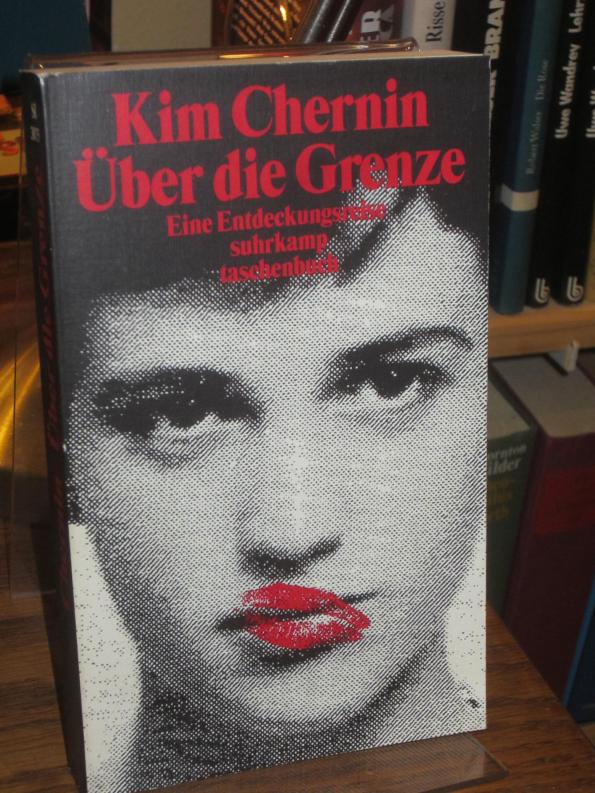
2000réf. 54786Frankfurt am Main: Suhrkamp, 2000. 1. Aufl.; 317 S.; 18 cm; OKart. (Taschenbuch);
1957Fine German Paperback. 4to. (29 x 20 cm). In German and Turkish. 219-245 pp., 2 folding maps. Signed and inscribed by Gürsoy to Talip Yücel. Über die Geographische Gliederung der türkei und Einege Verbessrungsvorschlage (Zusammenfassung).= Türkiye'nin cografî taksimatinda yapilmasi icabeden bazi tashihler (Mit deutscher Zusammenfassung).
1914réf. 1083126Jena, 1914. 77 S. Br.
réf. 5e4978Verlag von Theodor Steinkopff Dresden und Leipzig 1938. Band 85 S. 119 - 128 von insgesamt ca. 600 Seiten Leinen quart Seiten leicht gebräunt. - Svedberg erhielt 1926 den Nobelpreis für Chemie/ Dieses Buch enthält zudem zahlreiche Beiträge u. a. der folgenden Autoren: Krishnan R. S./ v. Buzagh A./ Liesegang R. Ed./ Kanamaru K./ Umstätter H./ Pauli Wo./ Kratzky O./ Frimberger F. / Der genannte Beitrag stammt aus der Kolloid-Zeitschrift. Zeitschrift für wissenschaftliche und technische Kolloidchemie. Organ für das Gesamtgebiet der reinen und angewandten Kolloidchemie und für die Veröffentlichungen der Kolloid-Gesellschaft hrsg. von Wolfgang Ostwald Band 84 Juli - September 1938 und Band 85 Oktober - Dezember in einem Band - unknown
1913réf. 45816Leipzig S. Hirzel 1913. 8vo. Orig. printed wrappers no backstrip. Wrappers loose. In "Jahrbuch der Radioaktivität und Elektronik" 10. bd. Heft 1. Pp. 1-138 entire issue offered. Wilson's paper: pp. 34-54 textillustrations showing apparatus and 5 photographic plates showing ionizing by Alpha- Beta- and Röntgen- radiation. Together with the English version - published 1912 in the Proceedings of the Royal Society - this is Wilson's main paper relating "that the track of an ionizing particle might be made visible and photographed by condensing water of the ions which is liberated". The first trails were obtained in 1911 where he submitted a short note of this to the Proceedings. In the offered paper he published the first tracks made by the ionizing particles of alpha beta and Röntgen-rays. This Wilson Cloud-Chamber became an extremely valuable instrument of fundamental research the discovery of the positron in 1932 and the kaon in 1963 were made by using cloud chambers as detectors."But the whole course of the particle appears infinitely more clearly by the method invented by C.T.R. Wilson in 1911 and named after him. The radiation is allowed to enter an expansion-chamber containing a gas saturated with water vapour. A sudden expansion of the chamber cools the gas and cloud-drops are then formed instantly around the ions produced along the tracks of the particles. By suitable illumination these tracks can be made to stand out clearly as if they had been described by luminous projectiles. The "Altmeister" of modern nuclear physics Lord Rutherford once called the Wilson chamber "the most original and wonderful instrument in scientific history"."Thomson Rees Wilson 1869-1959 a Scottish physicist is credited with inventing the cloud chamber. Inspired by sightings of the Brocken spectre while working on the summit of Ben Nevis in 1894 he began to develop expansion chambers for studying cloud formation and optical phenomena in moist air. Very rapidly he discovered that ions could act as centers for water droplet formation in such chambers. He pursued the application of this discovery and perfected the first cloud chamber in 1911. In Wilson's original chamber the air inside the sealed device was saturated with water vapor then a diaphragm is used to expand the air inside the chamber adiabatic expansion. This cools the air and water vapor starts to condense. When an ionizing particle passes through the chamber water vapor condenses on the resulting ions and the trail of the particle is visible in the vapor cloud. Wilson along with Arthur Compton received the Nobel Prize in Physics in 1927 for his work on the cloud chamber. Wikipedia. unknown
1887réf. 1142224Erlangen, Deichert, 1887. Gr.-8vo. 158 S., 2 Bl. Hlwdbd d. Zeit (bestoßen).
1935réf. 0258751935. INSCRIBED by the AUTHOR. Very Good condition. Light cover wear/soil. Horizonal crease from folding in half for mailing Pages are clean and unmarked. Inscribed on the front cover: "With the author's compliments to Prof. T. R. Hollcroft." This is the original 1935 publication -- NOT print on demand edition or modern reprint. Published by Nicola Zanichelli Editore Bologna 1935 Annali della Scuola Normale Superiore di Pisa Serie II Vol. IV 1935 - XIII. Bound in the original wraps stamped in black. This volume was among several dozen books from Temple Rice Hollcroft's library that we were lucky enough to purchase at auction in New Jersey. The American mathematician Temple Rice Hollcroft 1889 - 1967 received B.S. in 1912 and A.B. in 1914 from Hanover College and then A.M. in 1915 from the University of Kentucky. He received his Ph.D. in 1917 from Cornell University under Virgil Snyder. Hollcroft was a mathematics professor at Wells College from 1918 to 1954 from which he retired as professor emeritus. Hollcroft served for 14 years as Associate Secretary of the American Mathematical Society. In 1932 in Zurich he was an Invited Speaker of the International Congress of Mathematician ICM. His subject was THE GENERAL WEB OF SURFACES AND THE SPACE INVOLUTION DEFINED BY IT . Being invited to talk at the ICM has been called "the equivalent of induction to a hall of fame." - from Wikipedia. From the first page:"Am Schlusz seiner Verhandlung: Les groupes reels simples finis et continus Annales Scientifiques de 1Pcole normale superieure 3 31 1914 gibt E. CARTAN eine Aufzählung bemerkenswerter Beispiele von aequivalenten Gruppen 1. Dabei wird eine dieser Gruppen stets gebildet von den reellen linearen Transformationen n mit Determinante gleich 1 die eine der n=4 5 6 invariant i=1 lassen; m. a. W. eine dieser Gruppen ist die Drehungsgruppe im vier- fünf- und sechsdimensionalen euclidischen oder pseudo-euclidischen Raume.". INSCRIBED / SIGNED by the AUTHOR. First Edition. Softcover. Very Good condition. Illus. by NOT a library discard. 12 pages. Great Packaging Fast Shipping. Paperback