12 630 résultats
1912réf. 601766Mainz, Zabern, 1896-1912. Fol. Hlwd. Einbde. etwas fleckig u. berieben. Etwas angestaubt. Teils m. St.
1955réf. 105420Frankfurt, 1955-57.
réf. 92866aaf1788 und 1803, 33x21 cm 1 Doppelbl. u. 4 broschierte Bl. (o.U.), hs. in deutscher Kurrentschrift mit schwarzer Tinte, kalligraphische Titelzeile u. Papiersiegel in der Broschüre, letztes (leeres) Bl. mit fehlender Ecke, sonst guter Zustand.
1750réf. 45405London, John and Paul Knapton, 1750. Small 8vo. Contemp. full calf. Spine worn and frontcover detached. Corners of binding worn. (12),420 pp., textdiagrams and textfigs. (12),420 pp. Browning to titlepage and repairs to verso of. A bit of inner lower corner of titlepage gone, loosing 3 letters in ""Printed for"" Some brownspots to outer margins. Some traces of use. Internally generally clean and printed on good paper.
1916Mm 130x185 Collana "Biblioteca Agraria Ottavi" - Quinta edizione. Volume nella sua brossura originale, xiii-123 pagine con alcuni disegni nel testo. Buona copia; spedizione in 24 ore dalla conferma dell'ordine.
1863réf. 48186(Paris, Mallet-Bachelier), 1863 a. 1864. 4to. No wrappers. In: ""Comptes Rendus Hebdomadaires des Séances de L'Academie des Sciences"", Tome 57, No 23 a. Tome 58, No 3. Pp. (925-) 964 a. pp. (141- 180. (2 entire issues offered). Pasteur's paper: pp. 936-942 a. 142-150 and 1 engraved plate (Maladies des Vins - leurs Fermets..).
réf. DADAX0244455856New unknown
réf. R320074255MARETHEUX A. NON DATE. In-4. Cartonné. Etat d'usage, Plats abîmés, Dos satisfaisant, Intérieur frais. 4 pages - Dechirure sur les tranches (en gouttiere) et les plis sans conséquence sur la lecture.. . . . Classification Dewey : 634.8-Viticulture, vin
réf. RO80051498CHEZ L'AUTEUR. Non daté. In-4. Broché. Bon état, Couv. fraîche, Dos satisfaisant, Intérieur frais. 57 pages illustrées en noir et blanc et en couleurs dans le texte et hors-texte. Textes en anglais, français, italien et allemand.. . . . Classification Dewey : 663-Technologie des boissons
réf. mon0000279548Running PressU.S. 17/10/2001 00:00:01. paperback. Very Good. 6.0954 in x 28.3285 in x 24.4114 in. SOME DAMAGE TO OUTER BOX BUT INTERNAL CONTENTS EXCELLENT CONDITION Running Press,U.S. paperback
réf. 42324Montpellier Editions de '' La Journée Vinicole '', vers 1937 in 4 (26,5x21,5) 1 fort volume broché, couverture illustrée, 51 pages [1], avec de nombreuses illustrations en noir et blanc. Bel exemplaire ( Photographies sur demande / We can send pictures of this book on simple request )
1932Imprimerie Draeger, 1932. In folio reliure cartonnée à ressort, couverture illustrée, 5 illustrations de Paul Iribe, une photographie, 20 pages. Minuscules trous d’insecte sur la couverture intérieure et le 1er feuillet. Album édité à la mémoire de Dom Pérignon et à l’occasion du 250ème anniversaire de la découverte du Champagne par 35 maisons champenoises perpétuant son oeuvre.
1910réf. 86531910. Paris. Fort volume in/4 toilé vert, plat à impression et vignette à froid 891 pages.
réf. 23038Imprimé au Méteil par Vertèbres Cérébrales en novembre 2008. Boîte en carton remplié contenant une cinquantaine de carte illustrées, tirées en sérigraphie, au format 8 x 8 cm. Tirage unique à 120 exemplaires numérotés ( n° 92 ). Belle objet au format 8 x 8 x 5,5 cm, réalisé par Frankyravy & Lasco. Mémory collectif sur le thème du vin, executé par de nombreux artistes pour la soirée qui eut lieu au café " le Monte-en-l'Air ", à Paris, le vendredi 19 décembre 2008. Etat superbe proche du neuf. Très rare.
1802Serrière, le six germinal an 11, feuillet double sur papier bleuté filigrané “timbre national” rédigé à Serrière (Ain) - feuillet double : 29.5 x 21 cm. Tache rousse sur les pliures.
1910réf. 86531910. 1910. Paris. Fort volume in/4 toilé vert plat à impression et vignette à froid 891 pages. Législation et taxes analyse douanes carte du vignoble de France adresses les travaux des mois. unknown
19101910. Paris. Fort volume in/4 toilé vert, plat à impression et vignette à froid 891 pages. Législation et taxes, analyse, douanes, carte du vignoble de France, adresses, les travaux des mois.
198422x29 cm., 182 p., 173 ill. in nero e a col. n.t., decine ill. in nero n.t. riproducenti "gli strumenti del vino", bibliografia, bross. edit., sovr. ill. a col., perfetto stato. DAL SOMMARIO: IL MONDO DEL VINO E NOI PER UNA STORIA DELLA VITICOLTURA LA FERMENTAZIONE. DALL'ANTICHITA' ALL'INIZIO DEL XX SECOLO SANT'ALBERTO BRENTATORE VINUM IN CATHEDRA VINUM VERITAS ALCUNE NOTE INTORNO AL VINO E ALLE IMMAGINI FOTOGRAFICHE DEL VINO, DI CHI LO BEVE ECC. DALL'ANFORA AL CARTONE ATLANTE DELLE IMMAGINI: IL TEMPIO IL PALAZZO IL MERCATO LA MESCITA LA VIGNA GLI STRUMENTI DEL VINO 432
2011Aux éditions de Jusaine, Florennes (Belgique), 2011. Plaquette in/8 brochée, couverture imprimée, cahier cousu lié par une cordelière, 12 pages. Édition tirée à 66 exemplaires numérotés, celui-ci sur Rives Sensation. Nouvelle babiole cynégétique n°25. J. L. Vaudoyer, de l'Académie Française, est également l'auteur de l'Eloge de la gourmandise.
Casale Monferrato, Stab. Tip. Ditta C. Cassone, 1916. Biblioteca Minima Ottavi. Dall’indice: Discorrendo con Tonio, il cantiniere nuovo; Tempi lisci - Le soddisfazioni di Tonio; Il vino vive...; E vuol esser pulito...; Cinque primi comandamenti; La buona botte fa il buon vino; La botte vuota...ma piena...di zolfo; Via anche la camicia di taso o greppo!; Le botti forti o infortite; Le botti colla muffa; Botti aperte o chiuse?; Da la piena alle botti che scemano; Il travaso del vino; Oh, e la luna?; Tempi burrascosi - Le disgrazie di Tonio; Ma il vino torbido?; Il vino difettoso; Come curerai il vino che ha la punta di forte; E la muffa?; Il vino che si fa scuro all’aria. In 16mo (cm. 18,2); brossura originale illustrata a colori con titoli al piatto; pp. 30, (2). Con 4 illustrazioni nel testo. Ottima copia. PAx
19501950. In/8 carré broché, couverture illustrée, photographies noir/blanc, illustrations couleurs in et hors texte. L’histoire et le mode de fabrication de la fameuse bière danoise Carlsberg. Texte en anglais.
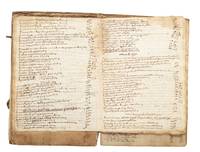
1792réf. 65431792. 59 leaves enumerating the names of grapes cereal crops and oils and their prices for nearly two centuries. Small folio 273 x 178 mm. 18th-cent. vellum over boards tail of spine defective two of four ties lacking. Burgundy: 1622-1792. A fascinating and rare survival which details the precipitous rise in the prices of Burgundian wine and the emergence of a hierarchy among regions and vintages over a 170-year period. This document consisting of three gatherings 28; 28; 3 leaves bound together and written in several legible hands provides a wealth of information on grain harvests in the region which varied greatly from year to year and indicates years with disastrous harvests. The present manuscript constitutes a unique history of agriculture in Burgundy especially pertaining to the evolving market for Côte de Nuits wine. “Burgundy had no experience like the boomtime of 18th-century Bordeaux. No new wines were invented no new districts planted. The Bordeaux picture is all expansion and creation; the Burgundy one of evolving tastes and techniques of new market forces and overall of slowly progressing definition: a more precise notion of the character style and value of the wine from each corner of the Côte…In the Côte de Nuits the notion of the ‘cru’ was further advanced…The vineyards were generally less overcrowded and by now planted with cuttings rather than layers; hence more deep-rooting. Increasingly in the 18th century owners of the most prestigious crus selected their best grapes to make separate cuvées the best vat being called the ‘tête de cuvée’.”–Hugh Johnson Vintage 1989 pp. 267 & 272. The motivation for compiling this record-book may have come from the introduction of a law in 1622 that outlawed the sale of Lyonnais and Beaujolais wines as Burgundian. The records of the first three decades consist mostly of grains and oil from the region but in the early 1670s wines begin to predominate and the lists for each year become increasingly long. It is very likely that at this point landowners would have shifted to using any arable land for vastly more lucrative grapes. By the 1690s dozens of grape varietals are noted from communes such as Auvilliers Les Cailles Chambolle Chorey Comblanchien Corgoloin Côte de Beaune Gilly Magny Saint Georges Saint Julien Les Cailles Vaucrains Pouilly Prissey etc. Prices for wine rose enormously from the 1690s and experienced peaks in 1701 1733 and 1770. Wines are increasingly categorized by the mid-18th century according to vineyard and in some cases cru. The name “de Bays” appears several times in the manuscript and the signature of “de Bays” is found at the end of the year 1771. Very few comparable documents survive and the present manuscript provides a vast amount of data on the prices for wine grapes and grains in the 17th and 18th centuries. A couple leaves browned. unknown
1792réf. 65431792. 59 leaves enumerating the names of grapes cereal crops and oils and their prices for nearly two centuries. Small folio 273 x 178 mm. 18th-cent. vellum over boards tail of spine defective two of four ties lacking. Burgundy: 1622-1792. A fascinating and rare survival which details the precipitous rise in the prices of Burgundian wine and the emergence of a hierarchy among regions and vintages over a 170-year period. This document consisting of three gatherings 28; 28; 3 leaves bound together and written in several legible hands provides a wealth of information on grain harvests in the region which varied greatly from year to year and indicates years with disastrous harvests. The present manuscript constitutes a unique history of agriculture in Burgundy especially pertaining to the evolving market for Côte de Nuits wine. “Burgundy had no experience like the boomtime of 18th-century Bordeaux. No new wines were invented no new districts planted. The Bordeaux picture is all expansion and creation; the Burgundy one of evolving tastes and techniques of new market forces and overall of slowly progressing definition: a more precise notion of the character style and value of the wine from each corner of the Côte…In the Côte de Nuits the notion of the ‘cru’ was further advanced…The vineyards were generally less overcrowded and by now planted with cuttings rather than layers; hence more deep-rooting. Increasingly in the 18th century owners of the most prestigious crus selected their best grapes to make separate cuvées the best vat being called the ‘tête de cuvée’.”–Hugh Johnson Vintage 1989 pp. 267 & 272. The motivation for compiling this record-book may have come from the introduction of a law in 1622 that outlawed the sale of Lyonnais and Beaujolais wines as Burgundian. The records of the first three decades consist mostly of grains and oil from the region but in the early 1670s wines begin to predominate and the lists for each year become increasingly long. It is very likely that at this point landowners would have shifted to using any arable land for vastly more lucrative grapes. By the 1690s dozens of grape varietals are noted from communes such as Auvilliers Les Cailles Chambolle Chorey Comblanchien Corgoloin Côte de Beaune Gilly Magny Saint Georges Saint Julien Les Cailles Vaucrains Pouilly Prissey etc. Prices for wine rose enormously from the 1690s and experienced peaks in 1701 1733 and 1770. Wines are increasingly categorized by the mid-18th century according to vineyard and in some cases cru. The name “de Bays” appears several times in the manuscript and the signature of “de Bays” is found at the end of the year 1771. Very few comparable documents survive and the present manuscript provides a vast amount of data on the prices for wine grapes and grains in the 17th and 18th centuries. A couple leaves browned. unknown books
1950P., ateliers ABC, sans date (env. 1950). Grand in-12 couverture illustrée agraffée, 30 pages non numérotées. Chacune des chansons est ornée de dessins en noir et blanc ou en 3 couleurs avec la musique en vis-à-vis. Illustrations de R. Auger, J. Debadier, L. Keller. Bon état
Firenze, Palazzo Gaddi, Galleria Giorgi, 1976, in-8, br.