(MEMORY). BIONDO, MICHELANGELOBiblio.com
3.383 resultados
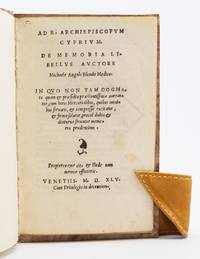
1545ref. ST19432bVenetiis Venice: Giovanni Antonio & Pietro Nicolini da Sabbio 1545. FIRST EDITION. 152 x 97 mm. 6 3 3/4". 20 leaves. Modern rose and cream-colored marbled paper boards. Verso of title page stamped in red ink: "Duplicate / ex-libris Bernard Zufall." Young "Bibliography of Memory" p. 34. ◆Paper boards lightly soiled negligible foxing to a couple of leaves but a fine copy clean and fresh in a sturdy binding. This rare work on the preservation of memory offers advice to those seeking to optimize their cognitive functions providing guidance about the best foods to eat and avoid the best days and times for recollection according to the planetary hours and most interestingly recipes to calm the mind and boost one's memory. This last section includes several formulas for various drams salves and confections that incorporate ingredients such as gingers cinnamon coriander and rosemary. The compact size of this work suggests that it was meant to be portable and consulted frequently; our copy however has obviously been very little used and consequentially is extremely well preserved. Italian physician and polymath Michelangelo Biondo or Blondus 1497-1565 was the author of at least two dozen works on a variety of subjects including art astronomy rhetoric medicine cognition and philosophy. The present copy comes from the library of magician and memory expert Bernard Zufall 1894-1971 known as the "Human Encyclopedia." Zufall amassed the largest known collection of books on mnemonics in excess of 1000 titles which except for duplicates like the present work he donated to Yale University. This appears to be a genuinely rare book: RBH records just one copy at auction selling at Lyon and Turnbull in 2015 for 1000 approximately $1640 all in. Giovanni Antonio & Pietro Nicolini da Sabbio unknown
1546In-4°; edizione originale; cc. 91, 1 cb, bel ritratto xilografico dell’autore al frontespizio. Mezza pelle rossa. Niccolò Martelli (1498- fiorentino di nascita studiò e visse a Roma dove fu introdotto da Pietro Aretino nella cerchia letteraria di papa Leone X. Gran parte della sua produzione è costituita dal ricco epistolario che intrattenne con i maggiori esponenti della cultura umanistica del tempo (Bembo, Aretino, Brucioli, Varchi, Doni, Alamanni, Firenzuola), e artisti primi fra tutti Michelangelo Buonarroti e Cellini. Questo Primo libro delle lettere ci restituisce una straordinaria ricchezza di notizie sulla società dell’epoca.
1623ref. 67330Rime di Michelagnolo Buonarroti Now Hailed a Classic in Modern Gay Literature MICHELANGELO BUONAROTTI. Rime di Michelagnolo Buonarroti. Raccolta da Michelagnolo suo Nipote. Florence: Appresso i Giunti 1623. First edition. Small quarto 9 1/4 x 6 1/4 inches. 12 88 pp. Woodcut device on title-page decorative woodcut head- and tail-pieces and initials typographic ornaments throughout. Uncut and bound in modern full brown speckled calf decoratively blindstamped on covers gilt-stamped on spine with five raised bands. Minimal foxing throughout. We read in the preface that the intent of Michelangelo's heirs was to publish a definitive volume of verses as an antidote to the many spurious editions produced since his death. Michelangelo's grandnephew goes on to say that these verses were in large part taken from a manuscript in the Vatican Library most of which is in his granduncle's hand. While this book is now hailed as a classic in modern gay literature for many years this was not the case due to some creative editing by Michelangelo the Younger. The homoeroticism of Michelangelo's poetry was obscured when his grand nephew Michelangelo the Younger published an edition of the poetry in 1623 with the gender of pronouns changed from male to female. John Addington Symonds reclaimed Michelangelo's homoeroticism by translating his sonnets into English and writing a two-volume biography and publishing it in 1893. "But when the queer art historian John Addington Symonds was granted access to the Buonarroti family archives in Florence in 1863 he discovered a note written in the margin of the poems by Michelangeloís grand-nephew called Michelangelo the Younger saying that the poems must not be published in their original form because they expressed ëamor .†.†. virileí literally ëmasculine loveí a Renaissance polite euphemism for paiderastia better translated as ëmaleñmale desireí. Symonds thus was able to make public the fact that when Michelangelo the Younger prepared his great-uncleís poetry for posthumous publication in 1623 he had changed all the masculine pronouns in the love poems to feminine pronouns thus ensuring that any sentiments in the poems that could not be interpreted as being merely platonic would at least be interpreted as being normal i.e. heterosexual" Rictor Norton. This edition was printed by one of the most famous printers of their day the Giunti family whose device on the title page included the Florentine giglio or lily. These fine productions are still known to book collectors as "Giuntine." Gamba 248. HBS 67330 $5000 Appresso i Giunti hardcover books
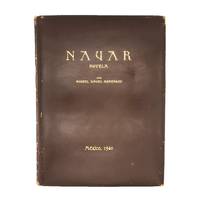
1940ref. 61ORIGINAL TYPESCRIPT ANNOTATED BY THE AUTHOR OF THE NOVEL THAT WON THE FIRST MEXICAN NATIONAL PRIZE FOR LITERATURE AND THE HONOURABLE MENTION AT THE FIRST LATIN AMERICAN PRIZE NOVEL CONTEST IN NEW YORK 1940-41. Large 4to. Initial blank title leaf 197 ff. final blank. Occasional pen annotations in dark blue ink throughout the text by the author. Elegant presentation binding in brown soft faux leather with gilt letterings stamped on front cover and spine. Brown synthetic cloth endpapers with light reflective effect creating wavy lines. Typed on high-quality paper handmade thin and very crisp showing pattern of half rising suns as watermark. Trimmed edges styled unevenly rough irregular surface. A few marks chipping and rubbing to binding mostly along board extremities and spine. We did not manage to locate duplicates nor other similar typescripts in public libraries. Excellent condition. An exceptional item through which the final steps of the novel's genesis can be studied. Thanks to the annotations of the author who proofread the text sometimes elegantly overwriting little parts of it adding words and entire phrases or erasing unnecessary elements one can appreciate the last changes the final touching and retouching of the author before submitting his typescript to the jury. A comparison between this typescript and the novel's first printed edition reveals that not all these changes were eventually included in the final version. It is of the greatest interest to observe the "labor limae" of the artist and be in the capacity to learn which words he first used and then decided to exclude forever from the text. THE NOVEL. There are no better words than those chosen by Howard S. Phillips in his article Mexico's Prize Novel which appeared in the University of Oklahoma literary magazine Books Abroad 1941 to introduce this outstanding piece of writing on the everyday life and exploitation of the indigenous Cora people in the Nayarit state: "Original in structure word-lean yet evolved in distinguished lyrical prose allusive rather than graphic in its nonetheless profoundly incisive characterization the story of Nayar dealing with a small and isolated corner of Mexico projects in its social purport a singularly true and comprehensive panorama of the entire country and even more – of all Latin America. Though as an example of creative writing its virtues are manifold this is its salient merit. Its opening chapters devoted in large part to the creation of the primordial background the description of the sierra and jungle of Nayarit attain a beauty and puissance fairly comparable to Hudson's 'Green Mansions.' The episodes though wrought with an almost austere realism are not presented mainly for their story content but each embodies a profound symbolical significance." Furthermore as Phillips pointed out this important novel that contributed to popularise greatly the Latin American "indigenista" genre is also: "a deeply penetrating study … of the mestizo: the most authentic Mexican type who after four centuries of biological assimilation has yet failed to achieve his complete social and psychological integration. The book voices the drama of the Mexican mestizo aimlessly groping through the jungles of his existence in pursuit of his own ultimate destiny." In addition to this splendidly written review it should be stated that Nayar impresses also for the powerful magical elements illustrated in it taken from the old traditions of the native world as well as its richness in indigenous vocabularies a list of which follows the text at the end of the book. THE AUTHOR. Born in Izamal the author Miguel Ãngel Menéndez 1905-1982 studied at the Escuela Modelo and the Instituto Literario de Yucatán. Then he moved to Hollywood where he worked for a while in the film industry. Returned to Mexico he held political charges and contributed to founding the National Revolutionary Party 1929. Throughout more than 60 years he dealt with journalism publishing several reports and articles and also establishing and directing the Mexico City Herald. Besides award-winning novels he wrote essays and several poems. In his crucial study on C20th Mexican literature José Luis Martínez has it this way while introducing the author: "Menéndez que se dio a conocer como poeta alcanzó su mayor acierto con una hermosa novela indigenista… Pese a sus restricciones y a una consistencia más lírica que genuinamente novelesca Nayar de Miguel Ãngel Menéndez es la mejor novela aparecida en 1941. El cuidado estilo la atención que tuvo el autor en su composición y las dotes de mesura unidas a la buena intención social con que Menéndez se encaró al problema de los indígenas nayaritas justifican sin duda tal aserto." p. 116 see references section. THE CONTEXT. It is worth illustrating thoroughly the historical and political context in which Nayar originated in order to fully understand its relevance which is not just literary but diplomatic as well. In 1940 Washington-based Pan-American Union 1889-1949 today's OAS Organization of American States jointly with Farrar & Rinehart Publishing House of New York summoned the writers of all the Latin American countries to take part in a continental competition for the first Pan-American literary award. This event was part of a number of initiatives taken in several fields and at various levels aimed to tighten friendly relationships between North Central and South America. In the wake of the tragic outbreak of WWII and the proliferations of dictatorial regimes and extreme ideologies the PanAmerican Union felt urgently the need to foster peace and unity within the Americas. Thus following the idea known as Moral Disarmament and the Good Neighbour policy the Union started to encourage international cooperation and understanding to ensure that war between nations could no longer be possible. In this scenario the main obstacle to the Pan-American Union's plan was to beat the historical distrust that Latin America had towards the idea of Pan-Americanism especially if it came from an organisation on which the United States had great influence. Any such attempt coming from the US was often seen as northern American imperialism. However as Veremundo Carillo Reveles showed in his crucial study on the topic this problem found solution mainly thanks to the woman behind the organisation of the Latin American Prize Novel Contest Mexican Concha Romero James who in 1935 became head of the Division of Intellectual Cooperation of the Pan-American Union. Thanks to Concha Romero the competition had an important feature: the organisers sought the support of circles of Latin American thinkers and their collaboration with US writers and publishers. In other words it was not just unilateral initiative coming from the north to the south of the continent but it was structured horizontally on two levels. The call for participants and selection of the novels that represented the 20 Latin American republics and Puerto Rico were carried out by independent national committees. Then the selected works competed in front of an international jury that granted the final award. The international jury had a double function: to offer certainty of impartiality and to include the United States so that the contest had a true Pan-American meaning. Its members were carefully selected. American novelist John Dos Passos was the most relevant figure among the judges who provided highlevel legitimacy to the competition. At that time Dos Passos son to Portuguese immigrants was already a world-renowned storyteller with several works translated into Spanish. The second member of the jury was Chilean writer Ernesto Montenegro whose moral authority was greatly appreciated among the literary circles of Latin America and the United States. In addition to collaborating with various newspapers including The New York Times El Mercurio La Nación Excelsior and El Universal de Venezuela Montenegro delivered lectures at various US universities on Latin American literature. In this sense he was a link between the two Americas the Latin and the Anglo-Saxon. The third person to join the international jury was American novelist Blair Niles. She was a student of the indigenous and Afro-descendant peoples from various regions of Latin America. Her inclusion also sought to promote the participation of Latin American female writers and make visible in general the intellectual work of women. The collaboration of the New York publisher Farrar & Rinehart and Reedbook Magazine was in turn a central element. On the one hand it showed the interest of certain sectors of the North American literary scene to meet and connect with the storytellers from the south of the continent. On the other hand it validated the seriousness of the competition and was a great incentive both for the commitment to publish the winning novel and for the prize offered: 2500 dollars plus royalties on sold copies. The call specified that only original typescripts of unpublished novels whose rights were the exclusive property of the author would be accepted precisely in order to guarantee that the benefits of the distribution would fall to the winning authors and the publishers. No restriction was imposed on the subject of the novel but it was pointed out that it had to have a minimum length of 50 thousand words and be presented by Latin American writers who resided in any Latin American nation even if it was not the country of birth and that the text had to be written in the language of the country in which he lived. In this way the works were intended to be effectively representative of local literary scenes. 300 novels participated at continental level. The Mexican board of judges was formed by Alfonso Reyes Genaro Fernández MacGregor Julio Jiménez Rueda Alfonso Teja Zabre and Octavio Barreda. Letras de México the most prestigious periodical in the Central American country at the time was the advertiser of the competition at national level. The magazine gave birth to vast debates on the essence of Americanity and in particular on Ibero-American literature. Hence the contest was welcomed with interest and sympathy. Both the judges and the periodical assumed the organisation of the event as their own to the extent of introducing an innovation: the author of the winning novel as well as the second and third places would be awarded by the Mexican government. Thanks to an agreement with the Ministry of Public Education the National Prize for Literature was instituted with a total purse of 10000 pesos half of which being reserved for the first place. It was a way to fully "nationalise" the Pan-American award. 34 novels were eventually submitted. Miguel Ãngel Menéndez obtained the first place with Nayar Gregorio López y Fuentes the second with A los cuatro vientos and En la Rosa de los Vientos by José Mancisidor the third position. Nayar was Menéndez's first novel ever. López and Mancisidor were already renowned novelists. The decisions drawn up by the national jury were published in Letras de México No. 24 vol. 2 p. 4 December 16 1940. As the Mexican winner Nayar competed with the novels that won the other national contests about 24 before the international jury. The verdict was announced in early March 1941 and the news spread immediately via Associated Press cables throughout the continent. Peruvian writer Ciro Alegría's El mundo es ancho y ajeno was the winner. The jury awarded also three honourable mentions: to the Mexican Menéndez Ecuadorian Enrique Gil Gilbert for Nuestro Pan and Brazilian Cecilio J. Carneiro for his A Fogueira. Farrar & Rinehart committed to publish all four novels. The formal announcement of the awards was scheduled on one of the most symbolic dates for Pan-Americanism: April 14 1941 Day of the Americas. Thanks to the coverage of agencies such as the Associated Press and the radio broadcasting of the Columbia Broadcasting System with which the Pan-American Union constantly collaborated news of the awards spread at national and international level. The works were reviewed by The New York Times The Nation The Chicago News The Philadelphia Inquirer and by specialised magazines such as The Antioch Review the afore-mentioned Books Abroad and Columbia University's Revista Hispánica Moderna. Latin American countries had as well great expectations. In 1941 the novels of Alegría and Menéndez were published in Spanish in Santiago del Chile and Mexico respectively. Menéndez's work appeared in the classic paperback edition for the wider public see image on this page and a limited hardback edition of 600 copies 500 of which numbered and signed by the author dated 1940 and illustrated by M. Cadena. Ãngel Flores's English translation of Nayar published by Farrar & Rinehart appeared on the US market in early January 1942. It had great sales success in bookstores. In response to the demand of the Latin American public Mexican publisher La Prensa reprinted it in 1959 and 1965 and later Editorial Porrúa in 1978 and 1991. PROVENANCE AND AUTHENTICITY. According to the newspaper article reporting the Mexican jury's decision which was published in Letras de México on the 15th of December 1940 Menéndez submitted his typescript under the pseudonym of "Manuel Briseño". The judges eventually found out the real name of the author only on the day of the public announcement of the awards. Thus bearing the name of Menéndez clearly stated on the title-page there is reason to believe that this is the typescript prepared for submission to the Pan American contest in New York in which the author participated with his real name as the official winner of the Mexican award. Indeed in addition to show all the physical features of a book that has to be presented for evaluation on an important occasion that is it is made of high-quality materials for presentation the typescript was acquired by its previous owner exactly in New York. It was part of Italian Hispanist Gaetano Massa's private library. Arrived in New York in 1933 Massa lived and worked in the American metropolis for about 40 years. He first studied Spanish and Portuguese literature at Columbia University then being aware of the rising success of Spanish literature in the city he founded the publishing house and bookstore Las Américas which marked an entire tradition of Spaniards and Latin Americans in the US. Among Massa's early undertakings as a publisher there was Las Américas Series of Contemporary Latin American Writers 1942-43. Throughout 30 years Massa's Manhattan-based Las Américas was the heart of the Latin American intellectual community in New York. A voracious book collector he was acquainted with the most influential writers and thinkers of the time. In 1971 Massa returned to Italy with his private library and sold his firm to publisher Germán Sánchez Ruipérez who in turn sold it to legendary bookseller Eliseo Torres. The latter is renowned for having stored about one million books in a Bronx building which at his death were acquired by another bookseller Abelardo Linares from Sevilla who took all of them to Spain for more information on Massa and his activity see Fernando González Ariza "Las Americas 1940-1970 una editorial hispánica en Nueva York" en Encarnación Castro Páez Pedro Cervera Corbacho y Ana María Bocanegra Valle coords. Historias y desafíos de la edición en el mundo hispánico vol II 2013 pp. 289-303. San Nicolás de Los Garza's Capilla Alfonsina University Library which is part of the Universidad Autónoma de Nuevo León Mexico preserves the library of Alfonso Reyes one of the most prestigious members of the Mexican jury that awarded Menéndez. The Capilla Alfonsina holds the copy of Nayar's hardback limited edition that the author dedicated to Reyes. Through the person of Dr Leticia Garza Moreno who is Head of Public Relations the Capilla Alfonsina confirmed the authenticity of the item. By comparing Menéndez's handwritten dedication on the Reyes copy with the manuscript notes on this typewritten copy it is possible to acknowledge a common feature relating to the author's style that is the roundness and clarity of the handwriting. REFERENCES: CARRILLO REVELES V. "'Las Américas' una historia de novelas. El Concurso Literario de la Unión Panamericana como instrumento diplomático The Americas a story of novels. The Latin American Prize Novel of the Pan American Union as a diplomatic tool" Revista de Historia de América no. 156 Jan-Jun. 2019 pp. 279-319; MARTÃNEZ J. L. La literatura mexicana del siglo XX 1910-1949 2001; PANE R. U. "A Selected Bibliography of Latin-American Literature in English Translation" The Modern Language Journal Vol. 26 No. 2 Feb. 1942 pp. 116-122; PHILLIPS H. S. "Mexico's Prize Novel" Books Abroad Vol. 15 No. 3 Summer 1941 pp. 276-79; Diccionario de escritores mexicanos siglo XX Vol. 5 desde las generaciones del Ateneo y Novelistas de la Revolución hasta nuestros días 2000 p. 291-92; MORAN LÓPEZ G. Nayar Novela Indigenista De Miguel Ãngel Menéndez doctoral dissertation Mexico D. F.1990.
1623In-4°; pp. (12), 88; marca tipografica su legno al frontespizio, fregi tipografici nel testo. Al frontespizio una nota manoscritta “Crusca. Costò L. 24”. A p. 28 l'errata incollata su "El or" per "El'onor". Esemplare in barbe. Legatura in cartonato antico. Buona copia. Dedica al cardinal Maffeo Barberini. EDIZIONE ORIGINALE dell’intera opera poetica di Michelangelo (1475-1564), che Michelangelo Buonarroti il Giovane fece pubblicare attingendo a manoscritti dello zio conservati nella “Libreria Vaticana” e presso gli eredi. Buonarroti il Giovane professò lungo tutta la vita un vero e proprio culto dell’antenato; amante delle lettere e delle arti studiò filosofia a Pisa dove conobbe Galileo e consolidò l’amicizia con Maffeo Barberini. La dedica a Maffeo Barberini ancora Cardinale avviene nello stesso anno in cui diverrà papa col nome di Urbano VIII. Gamba 248: «Il Buonarroti nipote dedica quest'edizione al card. Maffeo Barberini. [...] Le Rime furono in gran parte tratte da Codici esistenti in Roma e in Firenze; ma [...] furono omessi alcuni componimenti spezzatamente citati dal Varchi e da altri, col desiderio di pubblicarli quando venisse fatto di ritrovarli integri». Razzolini, p. 77; Parenti, p. 108; Brunet I, 1394. In-4 °; pp. (12), 88; woodcut printer’s mark on the title page, typographical friezes in the text. On the title page a handwritten note “Crusca. It cost L. 24 ". On p. 28 the errata glued on "El or" for "El'onor". Deckle edges. Contemporary hardcover binding. Dedication to Cardinal Maffeo Barberini. ORIGINAL EDITION of Michelangelo's entire poetic work (1475-1564), which Michelangelo Buonarroti the Younger had published checking his uncle's manuscripts kept in the "Vatican Library" and with his heirs. Buonarroti the Younger professed a real cult of the ancestor throughout his life; lover of letters and arts, he studied philosophy in Pisa where he met Galileo and consolidated his friendship with Maffeo Barberini. The dedication to Maffeo Barberini as Cardinal takes place in the same year in which he will become pope with the name of Urban VIII. Gamba 248: «The nephew Buonarroti dedicates this edition to card. Maffeo Barberini. [...] The Rhymes were largely taken from existing Codes in Rome and Florence; but [...] some compositions were omitted variously cited by Varchi and others, with the desire to publish them when it was done to find them intact ». Razzolini, p. 77; Relatives, p. 108; Brunet I, 1394.
1550ref. 5044Rome: ca 1550. SECOND STATE of three with the addition of "Romae" incised at lower right. Hardcover. Fine. A very fine example with high contrast of this rare print. This is the first published engraving dedicated to Michelangelo's Moses and one of only two made in the 16th century. The funerary monument of Julius II occupied Michelangelo in various phases from 1505 to the 1540s. Prints of the entire monument are few. In them the figure of Moses is necessarily reduced in size and imperfectly executed. Later prints of the statue in isolation such as that by the Netherlandish artist Jacob Matham 1571-1631 in which the figure is shown in reverse fail to match the standard set by this early engraving. The inscription reads: Moysis ingens ex marmore simulacrum in Julij Secundi/ Pontificis Maximi ad petri in Exquilijs uincula sepulcro / præstanti Michaelis Angeli Bonarotae manu fictum. The immense marble statue of Moses in the Church of San Pietro in Vincoli on the Esquiline Hill sculpted by the hand of Michelangelo Buonarroti for the tomb of Pope Julius II. Michelangelo's design for the tomb of Pope Julius II with the master's iconic figure of Moses was originally intended for St. Peter's but was ultimately installed in the church of San Pietro in Vincoli in Rome. The work was commissioned by Pope Julius in 1505 at which time Michelangelo received an initial payment of 100 gold ducats but was not completed until March 1545. Michelangelo re-worked his initial design numerous times first in 1513 after Julius' death and again in 1516 1525/1526 1532 and 1542. The final monument includes three figures carved by Michelangelo: the aforementioned Moses and Leah and Rachel symbols respectively of the active and contemplative life. Michelangelo's sculptures of the dying and rebellious slaves now in the Louvre and the Genius of Victory Palazzo Vecchio Florence were not used in the final design. On the second tier of the monument as it stands is an effigy of the reclining Julius II attributed to Tommaso di Pietro Boscoli 1503-1574 but with the face possibly the work of Michelangelo watched over by the Madonna and Child carved by Alessandro Scherano di Settignano after a model by Michelangelo and flanked by a sibyl and a prophet; these last two sculptures were carved by Michelangelo's pupil Raffaello da Montelupo ca. 1504-ca. 1567. "The engraving reproduces accurately in the same direction and without substantial variations the sculpture of the tomb of Julius II identifying the light source at the top left. The work attributed by Bottari to Beatrizet Heinecken 1768 was treated as anonymous by Heinecken in the Nachrichten of 1768 but later included by him in the list of Beatrizet's works Dictionnaire 1788. Nagler recorded it both under the monogram of Cornelis Bos and as the work of Beatrizet. Appearing in the Hollstein repertoire as Bos it was subsequently treated among works of doubtful attribution both of Bos Schéle 1965 and of Beatrizet Bianchi 2004. "Due to the fact that copies of this print are found in volumes of Roman composition on the model of the Speculum Romanae Magnificentiae El Escorial; Madrid Biblioteca Nacional; both datable between the mid-1580s and the 1590s one would be led to believe that the plate was engraved in Rome where in the last decade of the 16th century it was acquired by Van Aelst. This does not however exclude Cornelis Bos as a possible author since more than one of his plates is known to bear a Roman address in late editions even if it makes it more likely -in our opinion- the identification with a Flemish engraver active in Italy. In the sparse and luminous texture and in the clean geometries one could also perceive the burin of Niccolò della Casa."Alberti Rovetta and Salsi "D'après Michelangelo"2015 p. 219 ff. ca hardcover
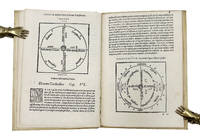
ref. 20264Small 4to 192 x 137 mm 18 pp. A-D4 E2 woodcut printer's device on title four woodcut illustrations in text historiated initials italic and roman types. Modern binding reusing an old parchment. First edition of Biondo's extremely rare treatise on navigation. This important and exceedingly scarce work presents one of the earliest systematic treatments of navigation. It includes detailed chapters on the causes and dangers of winds the classification and names of the cardinal winds storms and their effects and the influence of celestial bodies on navigation. A further section discusses the dimensions of the Earth. Chapter 23 introduces a new compass. "The writer gives on fol. 14 ch. xxiii a careful description of the compass including theory and rules for use. The compass is called on fol. 15 pixis or buxulos cf. "the French boussole" Wheeler. One chapter is devoted to America folio 16: De navigatione oceani ad novum orbem. Biondo offers one of the earliest attempts to calculate the breadth of the Atlantic Ocean and to explain how navigation across it is possible. He estimates that the sea from the Straits of Gibraltar to the newly discovered lands beyond the Equator the New World extends about 64000 stadia or roughly 8000 Roman miles. Michelangelo Biondo was born in Venice and studied the humanities and medicine under Agostino Nifo in Naples where he also practiced as a physician. Between 1535 and 1545 he resided primarily in Rome with a brief return to Venice in 1542. During his Roman period he secured the patronage of Pope Paul III and published numerous works. He took part in the controversy on dies critici between Fracastoro and the papal physician Andrea Turino revealing he still adhered to Arabic astrology. In 1545 Biondo settled permanently in Venice and became the editor of his own writings as well as those of other authors. Although he styled himself "bookseller and printer" and his publications typically carry the imprint "Ex Tigurio Blondi" the printing was carried out by established Venetian presses such as those of the Sabbio brothers or Comin da Trino. REFERENCES: BM/STC Italy p.105; Harrisse 274; Libri 341: "one of the rarest books respecting America"; Sabin 5518; Wheeler Gift 24: "very rare". G. Innamorati "Ex tugurio Blondi" Paragone. Letteratura XXXVI/428 1985 pp. 10–37. . [Colophon: Ex Tigurio Blondi. Venice: Cominus de Tridino Montisferrati, 1546.] hardcover
1568ref. 48781Florence.: Nella Stamperia de' Giunti. 1568. Later full limp vellum with Yapp edges. Small 4to. 240 x 166 mm. Leaf with printed pictorial title with elaborate decorative woodcut border the central block reused from vols. II and III of the 1568 'Vite' title i.e. with the woodcut view of Florence surmounted by the Medici arms leaf with decorative woodcut head-piece and seven-line inhabited initial with Vasari's dedication to Alessandro de Medici recto and verso dated 1567 see below leaf with half-page woodcut portrait of Michelangelo within decorative architectural border with five-line woodcut initial and Vasari's text in Tuscan in Roman type 46 lines with headline and catchword conclusion of text in italic with small decorative typographic woodcut tail-piece final leaf with 'Registro' and decorative typographic woodcut recto and colophon with large woodcut Giunta device verso numerous mispaginations and errors in signature as usual but complete marginal manuscript annotations and underlining in sepia ink throughout; sheet size: 235 x 155 mm. PROVENANCE: Ownership signature in sepia ink to title effaced purchasse note to foot of title in sepia ink also effaced. An excellent large margined and annotated copy of the rare first offprint from any work the discrete edition of the first artistic biography of Michelangelo by Giorgio Vasari.The second edition of Giorgio Vasari's famous biographical compendium the 1568 illustrated edition of 'Le Vite de' piu eccellenti Pittori Scultori et Architettori . &c.' included an updated biography of Michelangelo from 1550 the date of the first unillustrated edition until 1564 the date of Michelangelo's death. So popular did Vasari imagine this particular biography would prove shortly after the dedication of the whole edition to Cosimo de' Medici in January 1568 he wrote a new dedication to Alessandro de' Medici later very briefly the shortest-serving pontiff Pope Leo XI in February 1568 and issued the present work. The sheets of the printed text for the biography in the 'Vite' were used here the pagination and signatures remain the same together with three new and additional leaves: a new title it uses only the most central of the blocks from the 'Vite' titles with the arms of the Medici at the head and the vignette view of Florence beneath with the new dedication mentioned above and a final inserted leaf with 'Registro' recto and the colophon and large woodcut device of the Giunti verso. Whether the idea for this edition was Vasari's - he claims credit in the dedication see below and as PMM indicates 'Michelangelo was his great hero' - or that of the Giuntas the precedent for the offprint was established and a clever piece of cost-reducing marketing implemented. The fact that two issues of the work are known suggests too that the device was successful.This copy is from the first issue with Vasari's dedication to Alessandro de' Medici dated February 6th 1567; as Breslauer states so succinctly: 'As it is unthinkable that the dedication for the offprint should have been written eleven months before the dedication for the entire work i.e. the whole of the 'Vite' to Cosimo de' Medici which is dated January 1568 the date 1567 is obviously a printer's error which was corrected in later copies'. It should be added that the date of the dedication in the present separatum is also an interesting indication of how soon Vasari's or the Giuntas intention or decision to publish the discrete biography occurred after the dedication of the whole edition a period of only a few weeks and is a further measure of how important this offfprint was considered to be. A final irony is that the note in OCLC regarding the dating of the dedication of this first issue is also in error and gives the year as '1857' 'In this state the dedication has old-style date Feb. 6 1857' and misspells Buonarroti giving it three instances of the letter 'R'; that the error is repeated across multiple entries is suggestive of the practices of modern bibliographers rather than Florentine typesetters in the Cinquecento.The annotations in the present copy all in sepia ink mainly consist of highlighting and underlining but there are also marginal notes dates names and places and other indications some faded but all untrimmed of a clear engagement with Vasari's text.'C'est un tirage à part de la grande édition des Vite . mais il a un titre particulier et une dédicace spéciale . Le dernier f. qui porte le colophon est également spéciale à cette pièce extrêmement rare.' Brunet. 'An offprint from the 1568 Vite with a title-page and dedication leaf added at front and a new half sheet EEeee at the end . The new signature EEeee2 contains a new setting of the last two text pages from the Vite with a type-ornament tailpiece added to EEeeee1v a register on EEeee2r and Giunta device and colophon on EEeee2v. Otherwise the setting is that of the Vite with page numbers and signature marks unchanged.' Ruth Mortimer.We trace copies at the British Library in London the Bibliothèque Mazarine in Paris the Metropolitan Museum in New York and the Universiteit Leiden; we trace a number of further copies all with the errors cited above i.e. with the dedication dated '1857' and 'Buonarrroti' in the title as follows: New York University the Getty Research Institute Yale Harvard two copies Wake Forest North Carolina Brigham Young Utah and the National Art Library at the V & A. Three further copies all suspiciously give the same provenance are held at the Courtauld Oxford and the British Library. Needless to say these errors in bibliography rather undermine confidence in what may otherwise be accurate records.Brunet Suppl. II 846; Mortimer Italian 517; not in Cicognara; see Bernard Breslauer's response to A. N. L. Munby's original query 'Query 85. The Origin of Offprints': ' . Can any reader cite examples of offprints before 1772' in 'Bibliographical Notes and Queries' in 'The Book Collector' Vol. 6 Nos. 3 Autumn & 4 Winter 1957; see PMM 88 for the 1568 'Vite'. Nella Stamperia de' Giunti. hardcover