1 209 résultats
1997réf. C86661Taschen. As New. Hardcover. FREE UPGRADE to Courier/Priority Shipping Upon Request - IN STOCK AND IMMEDIATELY AVAILABLE FOR SHIPMENT - Flawless copy brand new pristine never opened -- FOUR 4 VOLUME SET. 1060 pages with profuse illustrations in color and black and white. Catalogue Raisonné Catalogue Raisonne Catalog Raisonnee Complete Works -- with a bonus offer-- - May be EITHER: out of print OOP and extremely rare in this pristine condition; signed by author or contributor; or a first or special edition; inquire for details; This four-volume work contains all of Monet's 2000 pictures as well as almost 100 rediscovered canvases. The first volume acts as an introduction to Monet's life and the others present his complete work in chronological historical and scientific terms. . 1997. 3822885592 . Taschen hardcover
réf. 1883Double-page autograph postcard written in ink. Dated on September 28 1910. Addressed to Claude Monet in Giverny. Notes on recto in pencil. Otherwise in fine condition. Double-page autograph postcard written in ink. Dated on September 28 1910. Addressed to Claude Monet in Giverny. Autograph postcard by Renoir to Monet. Renoir informs Monet that he’d like to visit him at his house in Giverny together with his wife and with Paul Durand-Ruel one of the most important French art-dealers of the time or Durand-Ruel’s son Joseph. . unknown
1906réf. 87491H. Floury | Paris 1906 | 20.50 x 27 cm | relié
1997réf. 86661Taschen. New. 1997. Hardcover. 3822885592 . FREE UPGRADE to Courier/Priority Shipping Upon Request - IN STOCK AND IMMEDIATELY AVAILABLE FOR SHIPMENT - Flawless copy brand new pristine never opened -- FOUR 4 VOLUME SET. 1060 pages with profuse illustrations in color and black and white. Catalogue Raisonné Catalogue Raisonne Catalog Raisonnee Complete Works -- with a bonus offer . Taschen hardcover
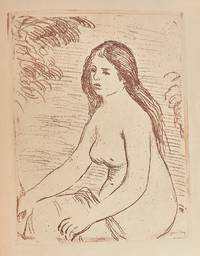
1906réf. 39070Paris: H. Floury 1906. A pristine deluxe copy of the most important early monograph on impressionism COMPLETE WITH ELEVEN ORIGINAL ETCHINGS BY RENOIR 5 PISSARRO 2 CEZANNE 2 AND GUILLAUMIN 2. IV 214 pp plus numerous hors-texte plates in two states. ONE OF ONLY 100 COPIES PRINTED ON IMPERIAL JAPANESE PAPER WITH THE PLATES IN TWO STATES. Includes the following original etchings: 1 Pissarro "Faneuses" 1890 Delteil 94 in bistre on Japanese paper and in black on Dutch laid paper. 2 Renoir "Femme nue assise" 1906 Delteil 12 in bistre on Japanese paper and in black on Dutch laid paper. 3 Renoir "Femme couchée tournée à gauche" 1906 Delteil 15 in sanguine on Japanese paper and in black on Dutch laid paper. 4 Renoir "Femme nue couchée tournée à droite 2e planche" 1906 Delteil 14 in sanguine on Japanese paper--this etching appears ONLY in the deluxe edition of the book. 5 Cézanne "Guillaumin au pendu" 1873 Cherpin 2 in bistre on Japanese paper and in black on Dutch laid paper. 6 Guillaumin "Vue prise de Saardam" in black on Japanese paper and printed in colors on wove paper. Also includes in two states "Le laboureur" an original woodcut by Lucien Pissarro after Camille Pissarro and "Bords du Loing" an etching by Roy after Sisley. 4to. A PRISTINE COPY IN THE ORIGINAL DECORATED WRAPS WITH PAPER LABELS ON FRONT COVER AND SPINE in the original board slipcase. Completely uncut. Minimal wear to wraps otherwise FINE AND BRIGHT WITH THE ETCHINGS IN PERFECT CONDITION. Most copies were broken up for the original prints and most of the remaining copies were rebound so a pristine copy like this one is a very rare survival. H. Floury paperback
1906réf. 87491Paris: H. Floury 1906. Fine. H. Floury Paris 1906 20.50 x 27 cm relié First edition one of 100 copies on Japon the only deluxe issue. Navy blue half shagreen with slight color restoration spine with five raised bands abundantly framed in gilt blue watered silk flyleaves marbled endpapers and pastedowns original wrappers and spine preserved gilt top edge binding signed J. Querelle. A superb copy on japon of the first authoritative publications on the history of Impressionism and the first bibliophile edition centered around this movement. Illustrated edition with 6 original etchings by Pissarro Les Faneuses; Renoir Femme nue assise and Femme nue couchée; one of only three etchings ever made by Cézanne Portrait of Guillaumin; Armand Guillaumin Vue près de Saardam - the copy is complete with the additional etching by Renoir on bistre Seated Nude Woman' reserved for copies on japon. The work also features a frontispiece rotogravure of Fantin-Latour's Atelier aux Batignolles. In addition to the six original etchings the book features 21 full-page plates including a colour rotogravure of Monet's famous Impression sunrise and no fewer than 105 reproductions of works and portraits of artists in the text. Théodore Duret paints here the great history of the movement he championed collected and theorized from its very beginnings. As early as 1878 he had published a small study that made him the first historian of these artists if not of the group itself just four years after their first exhibition at Nadar's studio. Twenty years after the last Impressionist exhibition Duret establishes the comprehensive story of this artistic revolution: ""For the early twentieth century and the decades to follow the history of Impressionism is Duret's 'The history of the Impressionist painters'."" Laura Iamurri. Renowned for its chronological accuracy - although in many cases Duret recalls events from his own memories - this work became a reference and was widely reprinted and translated London: Grant Richards 1910; Berlin: B. Cassirer 1909. Duret dedicates a monograph to each painter he mentions with the exception of Caillebotte and places Berthe Morisot in what he refers to as ""the core group of Impressionists."" Absent from his 1878 study Paul Cézanne now considered a post-Impressionist and Armand Guillaumin make their appearance here. A true art gallery on papier japon this text of reference for generations of readers' Laura Iamurri was the first to find a legitimate place for Impressionism in French art history. Not in Carteret. Etchings by Renoir Delteil 12 14 15; Camille Pissarro Delteil 94/XII Cézanne Venturi 1159; Armand Guillaumin Armand Guillaumin 1841-1927 gravures et lithographies 1995 p. 41. H. Floury hardcover
1909réf. 205221New York: Self-Published 1909. First Edition; First Printing. Ephemera. Autograph letter in French signed by Claude Monet regarding the shipment of his paintings one page on his personal stationery measuring 8.25 by 5.25 inches. Created in Giverny France on December 6 1909. Sunning fading to the ink and evidence of mounting on the verso.; Penned and signed by Claude Monet.; Signed by Author. Self-Published unknown
1900réf. 13587JLondon: 3 pages octavo February 28 1900. A remarkable historic letter quoted and discussed in Daniel Wildenstein’s definitive Claude Monet biography Monet or the Triumph of Impressionism page 348. Written in French on the printed stationery of the Savoy Hotel in London during one of Monet’s most important periods while he was painting his classic series of the bridges over the Thames river and the Houses of Parliament attempting to capture the unusual and often spooky effects of light and fog while looking out his window at the Savoy Hotel. Monet has dated the letter at 10 a.m. and literarily stops in the middle of painting to quickly write to his wife. “.A few words in haste between two strokes so that you get news before you leave for Rouen.” Monet’s son is ill with the measles and is staying with English friends who were taking care of him while he recovers. “.I could not see Michel yesterday because Mr. Darby was not expected to come back here unless Michel felt worse and he did not show up which is a good sign. I will go immediately to see him tonight because he must be truly bored but as the days grow longer I am more and more busy. I think I will take care of him for the revision but without letting him now.” Monet’s great friends French politician Georges Clemenceau and art critic and Monet supporter Gustave Geffroy visited Monet during his London sojourn. “.Clémenceau and Geffroy left a while ago we dined together yesterday at the restaurant at the Savoy after we saw the Minstrels at St. James. Both of them were very nice and did not prevent me at all from working.” Monet then remarks on his artist friend the great American painter John Singer Sargent who had worked in France becoming good friends with Monet and after the public scandal of Sargent’s daring Portrait of Madame X had relocated to London. “.I just received a note from Sargent who apologizes for not having come by to see me because he has people sitting for him morning and afternoon. He invited me for dinner this coming Monday so that I may meet a couple of young artists who love my work.” Often waiting hours for just the right effect of light to take place while painting a scene Wildenstein writes in his biography “Like a sentinel on the city wall the painter would lie in wait for the returning effect. When it came Monet rushed to his canvas abandoning everything else.” In this letter Monet finds that the light has reached the right effect and time has come to return to his painting. “.But here comes my effect. I must leave you for today. I send you tender hugs and all of my thoughts. Love to Germaine. Regards to Miss Jeans. Your old man who loves you Claude.” Wildenstein remarks that when Monet came to receive Sargent at the Savoy “.the visitor was ‘a little astonished by some of the canvases but full of admiration for others’. In fact the main impression Sargent took away was of too many pictures in progress simultaneously.he watched Monet struggling surrounded by 80 canvases searching desperately for the right one when the effect he was waiting for occurred and as often as not unable to lay hands on it until the effect had passed.” Wildenstein also notes that in Geffroy’s book Claude Monet he devotes four pages to his visit to Monet at the Savoy quoting Geffroy “.Whenever the fog had completely blotted out the the view Monet would remark: ‘Theres no more sun and stop painting. When a little later he would all of the sudden pick up his palette again saying ‘The sun is back ‘ his guests were often bemused. It took them a good while before they could discern the faint premonitory glow of the emerging sun. Monet alone had been able to detect it.” 3 pages, octavo unknown
1991réf. ART5722MRelié, 329 pages, paru le 1er août 1991 chez RMN, très bon état général, quasi neuf.