HUGNET, Georges - DALI, SalvadorLivre Rare Book

5 418 résultats
1934réf. 1495Éditions surréalistes, Paris, 1934. Petit in-4 (284 x 228 mm), broché, couverture décorée imprimée rempliée, chemise demi maroquin titrée au dos et étui. Édition originale. Tirage à 77 exemplaires (3 Chine + 7 Monvtal + 40 Arches + 25 HC). UN DES 40 EXEMPLAIRES NUMÉROTÉS SUR VERGÉ D'ARCHES COMPORTANT UNE EAU-FORTE ORIGINALE NUMÉROTÉE ET SIGNÉE DE SALVADOR DALI. L'exemplaire porte un magnifique envoi signé de Georges Hugnet au photographe surréaliste belge Léo Dohmen : "…Et des membres virils surgissaient dans tous les lieux où Onan répandait à terre sa semence, en vérité je vous le dis… des deux mains Georges Hugnet". Le maître surréaliste ne pouvait donner qu'une explication "dalinienne" sur la conception de sa gravure, "Espasmo-graphisme obtenu les yeux fermés avec la main gauche pendant que, avec la main droite je me masturbe jusqu'au sang, jusqu'à l'os, jusqu'aux délices du calice" !
1956réf. 89526Cannes 5 juin 1956 | 13.5 x 21 cm | un feuillet
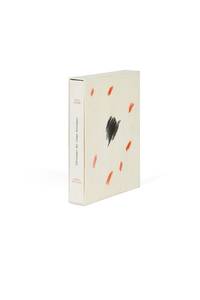
1956réf. 2198Paris, Albin Michel, 1956. Un volume in-8 (203 x 135 mm) broché, couverture illustrée imprimée. ÉDITION ORIGINALE. EXEMPLAIRE DE TÊTE COMPRENANT LA LITHOGRAPHIE ORIGINALE JUSTIFIÉE À 40 EX. ET SIGNÉE PAR JOAN MIRÓ. - TIRAGE : un des 37 exemplaires de tête sur vélin du marais (+ 3 nominatifs, soit 40 ex), celui-ci n° 14, les seuls à comporter la lithographie. - ILLUSTRATION : une lithographie originale en couleurs signée de Joan Miró ; 8 reproductions photographiques. ÉTAT DE NEUF, non coupé. RARISSIME. Bibliographie: Malet-Cramer, Miró, n° 35. - ENGLISH: PÉRET, Benjamin, and Joan MIRÓ: Anthologie de l’amour sublime (Anthology of Sublime Love). Paris, Albin Michel, 1956. One volume (203 x 135 mm), paperback, illustrated printed cover. HEAD COPY INCLUDING THE ORIGINAL LITHOGRAPHY JUSTIFIED 14/40 AND SIGNED BY JOAN MIRÓ. ORIGINAL FIRST EDITION. - EDITION: one of the 37 head copies on vellum of the marsh, this one n° 14, the only ones to include the lithograph.(+ 3 added nominative copies hc). - ILLUSTRATION: an original lithograph in colors numbered 14/40 and signed by Joan Miró; 8 photographic reproductions. NEW CONDITION, uncut. Very scarce. Bibliography: Malet-Cramer, Miró, n° 35.
1955réf. 8555720 décembre 1955 | 26.80 x 20.90 cm | un feuillet
1943réf. 48790Lausanne.: Louis Grosclaude. 1943. Loose ass issued in original publisher's grey cloth-backed grey paper-covered board box gilt title to spine. Small folio. 420 x 314 mm. Leaf with title justification verso and 14 etchings after Picasso printed on large paper each numbered at lower left in pencil from the edition of 300; sheet size: 405 x 299 mm. Louis Grosclaude's portfolio of etchings after Picasso's original drawings.From the edition limited to 300 copies numbered in ink and signed by the publisher to the justification; each etching is numbered in pencil from the edition of 300.These prints - or ones that are from the same carnet - were also used to illustrate a volume from the same publisher 'Gràce et Mouvements' illustrating fourteen of poems by Sappho.'Ces 14 compositions originales de Pablo Picasso ont été gravées sur cuivre à l'eau-forte par la maison Haefli & Cie Arts Graphiques à la Chaux-de-Fonds Suisse . Raymond Haasen maître taille-doucier les a tirées à la main sur les presses à bras des ateliers Paul Haasen à Paris . André Tournon & Cie à Paris a imprimé la présente justification.' From the justification. Louis Grosclaude. hardcover
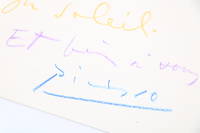
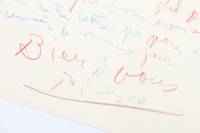
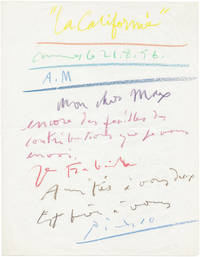
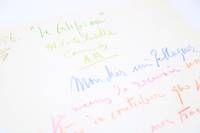
1956réf. 89526Cannes 1956. Fine. A polychrome and artistic link in an epistolary chain that linked Picasso to his prominent patron for decades Cannes 5 juin 1956 13.5 x 21 cm un feuillet Multi-coloured autograph letter from Pablo Picasso to Max Pellequer signed and dated by the artist on June 5 1956. The document includes the autograph address of his villa La Californie. Twelve lines in orange pink blue yellow and purple pencil on one sheet. Minor folds. A very elegant letter written in pastel colours by Pablo Picasso. Despite his prolific correspondence Picasso's entirely autographed letters are extremely rare as Laurence Madeline points out in her article on the confidential activity of the great artist:The inertia paralyzing Picasso who preferred his work as an artist to that of a secretary made the letters he took pleasure in writing more essential and more touching Laurence Madeline Picasso épistolier L'Herne no. 106. Living on the hills over Cannes the painter was indeed helped by his faithful secretary and childhood friend Jaume Sabartés who was responsible for writing numerous missives save a few correspondents notably Pellequer. Picasso wrote each of Pellequer's letters even the most insignificant in an ample voluptuous script playing with letters and words as graphic objects blending aesthetically in the space of the page in perfect contrast to the prosaic nature of the letter's content. It could even be argued that his artistic soul largely invaded his daily and administrative correspondence with his banker and ardent collector of his works. Part of their correspondence is kept at the National Picasso Museum in Paris. An extraordinary recipient. Banker and collector Max Pellequer was introduced to Picasso in 1914 by his uncle by marriage André Level. He quickly became one of Picasso's most important collectors and his financial advisor for over 30 years. Pellequer's interest in his art began as early as the 1910's when he purchased a Picasso bronze from the art dealer Ambroise Vollard. During the 1930s and 1940s as Picasso's personal banker he secured and enhanced the painter's wealth and allowed him to settle comfortably in the South of France. Picasso created a superb ex-libris on copper for him bought him paintings including La mer à L'Estaque by Cézanne now in the Picasso museum and offered him a few works. Pellequer assembled a vast collection of paintings by the great masters of modern art: Degas Raoul Dufy Paul Gauguin Fernand Léger Henri Matisse Joan Miró Modigliani and Maurice Utrillo today preserved in the most important international museums. The epistolary art of Picasso. Picasso's epistolary production acted as an outlet for his incessant creative energy which was expressed in ceramics sculptures photographs illustrations collages or poetry. Each letter was an opportunity for genius to blossom regardless of the administrative content of his exchanges with Pellequer. Perhaps to counteract the dullness of his work Picasso redoubled his efforts: an explosion of color calligraphic letters across the page. to conjure up beauty and adorn his words in shimmering hues using oil pastels black felt-tip pens or colored pencils.These alphabet letters numbers words and sentences placed on the paper like so many musical scales are literally brought to life by the creative power of the painter. The years of La Californie in Cannes. Living with Jacqueline Roque in the villa La Californie at the time of this letter the painter was producing a series of captivating lithographed portraits of his partner. Paradoxically this colorful letter corresponds to a very monochrome period of his work a superb counterpart to the black washes on zinc. Matisse with whom Pellequer also corresponded had died a month earlier. A very beautiful and visual illustration of Picasso's need for total expression through his correspondence with one of his close advisors and friends. unknown
1996réf. C129565Kornfeld Et Klipstein & Editions Kornfeld. As New. Hardcover. FREE UPGRADE to Courier/Priority Shipping Upon Request - IN STOCK AND IMMEDIATELY AVAILABLE FOR SHIPMENT - AS NEW THE TEXT BLOCK IS PRISTINE CLEAN UNMARKED AND IN EXCELLENT CONDITION - Complete seven 7 volume set - Catalogue Raisonné Catalogue Raisonne Catalog Raisonnee Complete Works -- with a bonus offer-- - May be EITHER: out of print OOP and extremely rare in this pristine condition; signed by author or contributor; or a first or special edition; inquire for details . 1996. 3857730269 . Kornfeld Et Klipstein & Editions Kornfeld hardcover
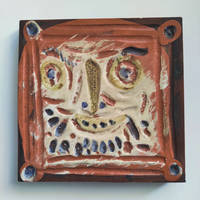
1968réf. 74908PABLO PICASSO Spanish 1881-1973 Petit visage barbu A.R. 557 Verso impressed "Madoura Plein Feu" and "Empreinte Originale de Picasso" Hand-numbered "J139A 9/100" Size 17.2 X 17.2 cm Partially glazed and engraved terracotta plaque Conceived in December 1968 - January 1969 and executed in a numbered edition of 100
1956réf. 29341Trois lithographies et 24 dessins de Picasso Paris, Louis Broder, coll. « Écrits et Gravures », n° 2, (24 octobre) 1956. 1 vol. (185 x 250 mm) de 126 p., [8] f. En feuilles, sous couverture illustrée, chemise illustrée et étui de l'éditeur. Édition originale, posthume, du texte de Max Jacob considéré comme ses « Mémoires ». Elle est illustrée par Pablo Picasso de 3 lithographies originales en couleurs et en noir (étui, couverture et portrait-frontispice), 3 pointes-sèches originales et 24 dessins inédits gravés sur bois par Georges Aubert qui rappellent les illustrations du Chef-d’œuvre inconnu. Tirage unique à 170 exemplaires sur vergé de Montval, celui-ci un des 30 numérotés en chiffres romains, auxquels sont joints 2 états de la lithographie pour l’étui (exemplaire n° II), signé par Picasso.
réf. 29341Paris Louis Broder coll. « Écrits et Gravures » n° 2 24 octobre 1956. 1 vol. 185 x 250 mm de 126 p. 8 f. En feuilles sous couverture illustrée chemise illustrée et étui de l'éditeur. . Édition originale posthume du texte de Max Jacob considéré comme ses « Mémoires ». Elle est illustrée par Pablo Picasso de 3 lithographies originales en couleurs et en noir étui couverture et portrait-frontispice 3 pointes-sèches originales et 24 dessins inédits gravés sur bois par Georges Aubert qui rappellent les illustrations du Chef-d’œuvre inconnu. Tirage unique à 170 exemplaires sur vergé de Montval celui-ci un des 30 numérotés en chiffres romains auxquels sont joints 2 états de la lithographie pour l’étui exemplaire n° II signé par Picasso. . Max Jacob livre ici un témoignage de premier ordre celui de ses souvenirs littéraires et artistiques de Montmartre. Il rencontre Pablo Picasso en 1901 à Paris et s'en suit une fraternelle amitié qui fait de lui le témoin quasi quotidien du travail de Picasso désigné comme son héros aux côtés d'Apollinaire lorsqu'il doit écrire sur l'époque de la rue Ravignan. À la mort du marchand Paul Guillaume sa veuve lui demande une préface à un volume des mémoires de son mari. C'est ce projet qui est l'acte fondateur du texte et deviendra ce récit fondamental sur le cubisme : La Chronique des temps héroïques. On y croise outre Picasso et Apollinaire les futuristes et les avant-gardes du XXe siècle. Arrêté et déporté à Drancy où il périra le 5 mars 1944 Jacob ne verra jamais la publication de ces lignes rédigées en 1936-37. Louis Broder se chargera de l'édition d'après un manuscrit complet des huit chapitres et Pablo Picasso se fera un honneur de l'illustrer : il composera une lithographie sur papier report 3 pointes sèches et 2 lithographies en couleurs pour la couverture et l'étui ; 24 gravures sur bois dans le texte de Georges Aubert d'après les dessins de Picasso. Signalons qu'il existe un exemplaire unique sur japon réalisé pour Louis Broder. Il n'existe pas de témoignage aussi vivant et direct que celui-ci sur l'aventure de l'art moderne depuis la bohème montmartroise jusqu'aux frasques des années folles. Complet du bulletin de souscription. Habiles restaurations à la chemise-étui. Paris, Louis Broder, coll. « Écrits et Gravures », n° 2, (24 octobre) 1956. 1 vol. (185 x 250 mm) de 126 p., [8] f. En feuil unknown
1956réf. 89529Cannes 27 janvier 1956 | 21 x 27 cm | un feuillet
1960réf. 1338Pablo Picasso Spanish 1881 - 1973 Vallauris Exposition 1960 Linocut on Arches Bloch 1290 signed in pencil "Picasso. " 1 of 170 copies. Image Size: 25 x 21 inches. Size: 29.5 in. x 24.5 in. 74.93 cm x 62.23 cm. In the late 1940s Picasso became interested in ceramics. He wanted to design a ceramic form that could be produced in a small limited edition just as he would produce a print on paper. In 1953 Picasso met artist Jacqueline Roque at Madoura Pottery in Vallauris where she worked. Together they created his ceramics. In 1961 they married and moved to Mougins France where Picasso continued creating ceramics until his death in 1973. Annually he created a poster to advertise his show and sale of new ceramics. This run of posters included a small signed limited edition on special paper as here. Nicely framed. Picasso books
1918réf. 78956Mercure de France | Paris 1918 | 14.50 x 23 cm | relié
1957réf. 68709Louis Broder | Paris 1957 | 13.50 x 16.50 cm | relié sous chemise et étui
1957réf. 3181Henri Jonquières, Paris 1957. Un volume in-folio (387 x 292 mm) en feuilles sous couverture imprimée rempliée, chemise-étui de l'éditeur. Fac-similé de l'exemplaire enluminé et offert par Picasso à Dora Maar (édition Fabiani 1942) reproduisant l'ensemble des dessins originaux. Tirage à 2226 exemplaires : 226 sur vélin d'Arches comprenant une gravure à la gouge signée + 2000 sur vélin du Marais. Celui-ci exemplaire de luxe (n° 140) comportant LA LINOGRAVURE ORIGINALE gravée en 1939 et signée au crayon de couleur (vert) par PICASSO. Notre épreuve, imprimée sur une feuille de vélin d'Arches (37,5 x 28,2 cm), porte la justification 140/226 au crayon noir et la signature au crayon vert. La signature au crayon de couleur est très recherchée des amateurs. Catalogues raisonnés : Bloch 326 ; Baer 1028 ; Cramer Les Livres illustrés 84 ; MoMA 1017.1964.1-2.
1996réf. C129566Kornfeld Et Klipstein & Editions Kornfeld. As New. Hardcover. CORRESPONDES TO ISBN: 3857730269/ INCLUDES VOLUMES 1 - VII PLUS ADDENDUM FREE UPGRADE to Courier/Priority Shipping Upon Request - IN STOCK AND IMMEDIATELY AVAILABLE FOR SHIPMENT - AS NEW THE TEXT BLOCK IS PRISTINE CLEAN UNMARKED AND IN EXCELLENT CONDITION - - Catalogue Raisonné Catalogue Raisonne Catalog Raisonnee Complete Works One Two Three Four Five Six Seven Il Ill IV V VI VII 2 3 4 5 6 7 -- with a bonus offer-- - May be EITHER: out of print OOP and extremely rare in this pristine condition; signed by author or contributor; or a first or special edition; inquire for details . 1996. 3857730269 . Kornfeld Et Klipstein & Editions Kornfeld hardcover
1967réf. 5281Pablo Picasso - Hélène Parmelin. Saint-Paul-de-Vence Au Vent d'Arles 1967. Limited edition one of 500 numbered copies. Portfolio with 15 pochoirs by Jacomet of drawins watercolors and wash-drawings by Picasso complete of title text colophon and table of contents printed in Verge d'Auvergne corail paper and the 15 pochoirs printed in Auvergne Richard de Bas paper all guarded in the original cloth folder. IN ORIGINAL SHIPPING CASE Au Vent d'Arles. hardcover books
1962réf. 94703Monaco: Editions du Rocher 1962. Signed limited folio edition of original lithographs by Pablo Picasso reproducing his major works between 1916 and 1961 and produced by Jean Cocteau upon the occasion of Picasso's 80th birthday. One of only 199 copies signed by both Picasso and Cocteau this is number 46. Folio loose leaves as issued in the original pictorial wrappers lithographic frontispiece and 22 original lithographs by Picasso 6 of which are full page and 2 of which are double-page. In fine condition. Housed in the original vellum-backed portfolio with gilt titles to the spine and original slipcase. Rare and desirable linking two great artists of the 20th century. Picasso and Cocteau met in 1916 towards the end of World War I at the height of Picasso's synthetic cubism period. The period marked the first use of collage in the history of fine art and the series depicted highly geometric and minimalist Cubist objects mainly pipes guitars and glasses. Picasso and Cocteau would later collaborate on several projects including the present volume which offers an overarching collection of Picasso's diverse periods from Cubism to Picasso's late years. Editions du Rocher hardcover books
1964réf. 5267PICASSO. Le Carmen des Carmen. With three aquatints one drypoint and one lithograph in color by Picasso. La Bibliothèque Française Paris 1949 Editeurs Français Réunis Paris 1964. Portfolio with three aquatints one dry point and one lithograph in colors by Picasso loose as issued complete of title justification page and text with numerous illustrations and border decorations also by Picasso. Signed by Picasso and Aragon on the justification page; one of 245 copies on Arches wove paper well preserved in the original publisher box. Total edition 275 copies. Reference Bloch. 1000-1005; Cramer books 126. Editeurs Français Réunis hardcover books
1960réf. 1535Paris, Jean Hugues, 1960. Un volume petit in-4 (195 x 142 mm) broché. 31 pages + fnch., couverture blanche imprimée rempliée. Édition originale de ce recueil de quatorze poèmes en prose précédés d'un prologue par René Cazelles. L'ouvrage est orné d'UNE LITHOGRAPHIE ORIGINALE EN COULEURS DE JOAN MIRO. Tirage : 25 ex. avec la lithographie en trois états + 50 ex. avec la lithographie à l'état définitif + tirage typographique courant de 300 ex. tous sur Arches. Notre exemplaire est l' 1 des 25 de tête (n° 14) comprenant, sur un cahier dépliant formant triptyque, LA LITHOGRAPHIE EN 3 ÉTATS SIGNÉE AUX CRAYONS DE COULEUR ET JUSTIFIÉE 3/25 sur le deuxième volet : 1er état couleurs, 2ème état avec des modifications dans l'encadrement et ajout d'étoiles, 3ème état avec modification des couleurs et ajout d'un gaufrage. La typographie est dûe à l'imprimerie Union et le tirage de la lithographie à Mourlot. René Cazelles, ami de René Char, fut publié par Guy Lévy-Mano, Pierre-André Benoit, Aimé Maeght, Jean Hugues…
1946réf. 3933Éditions du Chêne, Paris 1946. In-4 (340 x 260 mm) en feuilles. 95 pp. + ffnch., en feuilles, sous couverture rempliée illustrée sur les deux plats, chemise titrée toilée et étui de l'éditeur. Édition originale des poésies de Pierre Reverdy "illustrée" de 14 LITHOGRAPHIES ORIGINALES A PLEINE-PAGE PAR HENRI MATISSE, tirées en sanguine, 17 LINOGRAVURES en noir et blanc (3 sur la couverture et 14 culs-de-lampe) et 14 lettrines composées par l'artiste. Tirage à 250 exemplaires : celui-ci, 1 des 200 numérotés sur vélin à la forme de Lana, SIGNÉ AU CRAYON PAR LE PEINTRE ET LE POÈTE. Les lithographies ont été tirées par Mourlot Frères, les linogravures et le texte par Fequet et Baudier, Paris. - ENGLISH DESCRIPTION: The complete book/portfolio with 14 original full-page original lithographs in sanguine, 14 original linocuts in black with 3 on the wrappers. The book is signed with pencil by Pierre Reverdy and Henri Matisse on the justification page. The 14 hors-text lithographs are in perfect condition, no offseting, no foxing, no dirt or stains. A perfect copy in loose sheets as issued. Suite de très beaux portraits féminins illustrée par la poésie de Pierre Reverdy et non l'inverse comme le précise Matisse dans le titre.
1955réf. 855571955. Fine. 20 décembre 1955 26.80 x 20.90 cm un feuillet Multi-colored autograph letter to Max Pellequer Elegant multi-colored autograph letter by Pablo Picasso to Max Pellequer signed and dated 'December 20 1955'. A leaf in multi-color pencil blue green orange and red. Traces of transverse folds. This ""graphic"" letter in the most literal sense constitutes a superb polychrome and artistic link in an epistolary chain that linked Picasso and his prominent patron for decades. Despite his prolific correspondence Picasso's entirely autographed letters are extremely rare as Laurence Madeline points out in her article on the confidential activity of the great artist:The inertia paralyzing Picasso who preferred his work as an artist to that of a secretary made the letters he took pleasure in writing more essential and more touching Laurence Madeline Picasso épistolier L'Herne no. 106. Living on the hills over Cannes the painter was indeed helped by his faithful secretary and childhood friend Jaume Sabartés who was responsible for writing numerous missives save a few correspondents notably Pellequer. Picasso wrote each of Pellequer's letters even the most insignificant in an ample voluptuous script playing with letters and words as graphic objects blending aesthetically in the space of the page in perfect contrast to the prosaic nature of the letter's content. It could even be argued that his artistic soul largely invaded his daily and administrative correspondence with his banker and ardent collector of his works. Part of their correspondence is kept at the National Picasso Museum in Paris. An extraordinary recipient. Banker and collector Max Pellequer was introduced to Picasso in 1914 by his uncle by marriage André Level. He quickly became one of Picasso's most important collectors and his financial advisor for over 30 years. Pellequer's interest in his art began as early as the 1910's when he purchased a Picasso bronze from the art dealer Ambroise Vollard. During the 1930s and 1940s as Picasso's personal banker he secured and enhanced the painter's wealth and allowed him to settle comfortably in the South of France. Picasso created a superb ex-libris on copper for him bought him paintings including La mer à L'Estaque by Cézanne now in the Picasso museum and offered him a few works. Pellequer assembled a vast collection of paintings by the great masters of modern art: Degas Raoul Dufy Paul Gauguin Fernand Léger Henri Matisse Joan Miró Modigliani and Maurice Utrillo today preserved in the most important international museums. The epistolary art of Picasso. Picasso's epistolary production acted as an outlet for his incessant creative energy which was expressed in ceramics sculptures photographs illustrations collages or poetry. Each letter was an opportunity for genius to blossom regardless of the administrative content of his exchanges with Pellequer. Perhaps to counteract the dullness of his work Picasso redoubled his efforts: an explosion of color calligraphic letters across the page. to conjure up beauty and adorn his words in shimmering hues using oil pastels black felt-tip pens or colored pencils.These alphabet letters numbers words and sentences placed on the paper like so many musical scales are literally brought to life by the creative power of the painter. The years of La Californie in Cannes. Living with Jacqueline Roque in the villa La Californie at the time of this letter the painter was producing a series of captivating lithographed portraits of his partner. Paradoxically this colorful letter corresponds to a very monochrome period of his work a superb counterpart to the black washes on zinc. Matisse with whom Pellequer also corresponded had died a month earlier. A very beautiful and visual illustration of Picasso's need for total expression through his correspondence with one of his close advisors and friends. unknown
1959réf. 1719Alès, PAB, 1959. Un volume In-8° (232 x 175 mm), broché, couverture de papier bleu orné de papiers découpés (pour chaque exemplaire l'artiste a fait un découpage particulier et dessiné les étoiles à l'encre de Chine). 2 POINTES SÈCHES ORIGINALES EN BLEU, hors-texte à pleine page. Édition originale de ce court et spirituel poème pour enfant. Édition totale à 35 exemplaires + 5 HC, celui-ci bien signé à l'encre par l'auteur, l'artiste et l'éditeur au colophon.
1956réf. Picasso19PICASSO Pablo 1881-1973 Autograph letter signed " Picasso " to Max Pellequer " La Californie " Cannes 21 August 1956 1 p. in-4° in colored oil pastels Watermark 'BFK RIVES.' Faint traces of pastel transfer revealing a hasty fold made by Picasso in order to enclose the sheet creasing minute loss to the lower right corner. Picasso or the Art of Correspondence A spectacular letter from the master to his friend Max executed in ten shades of oil pastel " Mon cher Max Encore des feuilles des contributions que je vous envoie. Je travaille Amitié à vous deux et bien à vous Picasso " Settled at "La Californie" in the hills above Cannes Picasso relied on the good offices of his secretary Jaume Sabartés to handle the bulk of his correspondence. Max Pellequer a close friend of the painter was nonetheless among the rare privileged few to receive letters written entirely by Picasso's own hand. Oil pastels in hand the painter deploys his nervous sweeping handwriting alternating between no fewer than ten colors—so many graphic nuances echoing and harmonizing with elegance across the surface of the sheet. A banker and discerning art collector Max Pellequer began assembling a considerable collection of modernist works in the 1920s. In 1920 he married Francine Level niece of the dealer and businessman André Level. It was through André Level that he first met Picasso in 1914 forging an enduring friendship. Pellequer became one of the artist's closest friends as well as his banker and financial advisor. Over more than thirty years he acquired from the master a remarkable collection of paintings and sculptures. Provenance: Max Pellequer's estate ; private collection
1956réf. 89529Cannes 1956. Fine. 'I continue my work with passion' Cannes 27 janvier 1956 21 x 27 cm un feuillet Autograph letter by Pablo Picasso to Max Pellequer vividly executed in multiple colours signed and dated by the artist 27 January 1956 addressed from his villa La Californie. Fourteen lines written in green blue pink orange red violet and turquoise pencil on a watermarked BFK Rives sheet.A few negligible transverse folds as expected from mailing. Picasso did not regularly employ colour in his correspondence. Here however he seems to have offered a gracious gesture to his friend and banker Max Pellequer as the more visually striking his letters the more sought-after they become. To speak of his work Picasso turns to red pencil: je continue mon travail avec ardeur - a telling choice that conveys the fervour he wished to bring to his art. Although Picasso maintained a substantial correspondence letters written entirely in his own hand remain exceedingly scarce. As Laurence Madeline observes in her study of this private facet of the artists life: The inertia that paralyses Picasso who prefers his activity as an artist to that of a secretary renders the letters he does choose to write all the more essential and touching Picasso épistolier LHerne no. 106. From his home overlooking Cannes Picasso was assisted by his devoted secretary and childhood companion Jaume Sabartés who penned many of the artists letters - except those destined for Pellequer. To him Picasso wrote every message himself however trivial in a generous flowing script playing with letters and words as though they were graphic elements arranged in an aesthetic dialogue across the sheet far removed from the sobriety of the text. His artistic impulse seems to have seeped into even his most routine administrative exchanges with his banker and impassioned collector. Part of the Picasso-Pellequer correspondence is held today by the Musée national Picasso in Paris. A singular recipient Max Pellequer banker and collector was introduced to Pablo Picasso in 1914 by his uncle by marriage André Level. He quickly emerged as one of the artists foremost collectors and in time became Picassos financial adviser for over three decades. Pellequers engagement with Picassos oeuvre began in the 1910s notably through a bronze jester acquired from Ambroise Vollard. During the 1930s and 1940s he became Picassos personal banker safeguarding the artists wealth and facilitating his comfortable establishment in the South of France. Their friendship was lifelong and intensely collaborative. Among other commissions Picasso executed a splendid copper ex-libris for Pellequer; Pellequer purchased paintings such as Cézannes La mer à LEstaque Musée Picasso Paris; and Picasso reciprocated with gifts of several works. A discerning and avid collector Pellequer assembled one of the finest collections of modern masterworks - Degas Dufy Gauguin Léger Matisse Miró Modigliani and Utrillo - today preserved in major international museums. The epistolary art of Picasso Picassos correspondence served as an outlet for his relentless creative energy expressed across ceramics sculpture photography illustrations collages and poetry. Every letter provided a space for the emergence of genius irrespective of the prosaic content of his exchanges with Pellequer. To counterbalance such banality Picasso took care to arrange his letters diagonally across the page enlivening them with colour from pastels felt pens or coloured pencils. Letters numerals words and sentences became visual and musical elements animated by the painters imaginative force. A striking and vividly visual illustration of Picassos imperative for total self-expression manifested through his correspondence with one of his closest friends and advisers. unknown