844 risultati
1912rif. 5917Havana 1912. Good plus. 196pp. Original printed front wrapper bound into 20th-century faux leather paper boards spine and front board gilt lettered. Contemporary ownership inscription and bookseller's ink stamp on title page. Lower corners of initial and final leaves repaired with tissue. Even tanning occasional foxing heavier to initial leaves. A scarce contemporary account of what the authors term the "Guerra de Razas" also known as the 1912 Cuban War an uprising by parts of the island's Afro-Cuban population demanding equal rights which was brutally extinguished by government forces. The conflict had its roots in racial tensions between Cuba's Hispanic and Black populations after the reestablishment of self-government in 1909. Race-based political parties such as the Partido Independiente de Color had been established in the 1900s to fight for the civil rights of Black Cubans but these groups were outlawed by the predominantly Hispanic government in 1910. The PIC continued to operate however and its leaders Evaristo Esteñoz and Pedro Ivonet agitated for a rebellion that would force the government to reverse the law. When the uprising finally occurred in the eastern provinces of Cuba on May 20 1912 it was met with extreme force with contemporary accounts and eyewitnesses numbering the executed and massacred at anywhere between 2000 and 6000 people including Esteñoz and Ivonet. The authors of the present work present their account from a pro-government perspective but nevertheless make some attempt toward social history and analysis of the causes of conflict. The whole is photographically illustrated with numerous portraits of significant military figures. OCLC locates a small handful of copies in U.S. institutions. unknown books
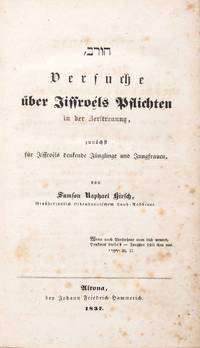
1837rif. 48406Altona Hamburg: Johann Friedrich Hammerich 1837. First edition. Hardcover. g to g. Octavo. xvi 800pp. Bound in brown pebbled half cloth over black pebbled boards. Treatise of Jewish law and observances by Samson Raphael Hirsch the German Orthodox Rabbi who founded the school of contemporary Orthodox Judaism Today's modern Orthodoxy and a vocal opponent of Reform Judaism. The work is organized in six sections according to Hirsch's classification of the commandments: Thaurauß Laws derived from the Five Books of Moses Edauß Jewish Holidays Mischpotim Laws Between Man and Man Chukim Laws Regarding Daily Life and Animals Mizwauß Laws about Devotion and Awaudoh Service and Prayer. The book was written in a literary German to explain Jewish customs ceremonies and doctrines with the special emphasis on German-Jewish youth. List of abbreviations and symbols in German and Hebrew at front and registers in German and Hebrew an addendum of explanation and abbreviations in Hebrew and errata at rear. Publisher's advertisement for the German Bible for Israelites a new translation from the Masoretic text and edited by Gotthold Salomon on last page. Text in German Gothic script titles subtitles and abbreviations in Hebrew. Binding with some wear along edges small chips and some scuffing along leather spine. Light foxing of block diminishing towards end of block. Binding in overall good interior in good to goo condition. Johann Friedrich Hammerich hardcover books
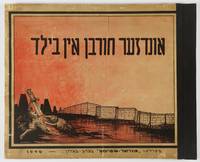
1946rif. 54171Bergen-Belsen: Our Voice/ Unzer Sztyme 1946. First edition. Hardcover. vg- to vg. Oblong small folio. 38pp. single-sided leaves. Recased with a black cloth spine with the original illustrated tan and red paper front wrapper laid down. Original black paper back wrapper. New endpapers. Content printed on large heavy stock paper leaves. This scarce powerful and disturbing collection of Holocaust images predominantly taken in the ghettos of Bedzin and Lodz and the camp in Bergen-Belsen by captured Nazi soldiers might best be described in the words of the editors: "The incentive to produce this collection gave us our deepest desire to show the world the crimes of Germany to give expression to the throttled cry of pain of the Jews to the sighs of our fathers and mothers sisters and brothers during the frozen nights of winter and the overpowering heat of the summer which was spent in sealed railway trucks the desire to bring back to our memories of the Jewish settlements which were drowned in torrents of Jewish blood". This notable work was prepared in advance of the Nuremberg Trials as a further evidence of Nazi crimes and is considered one of the most important works assembled by Jews in the aftermath of destruction to visually document the horrors of the Holocaust. The work features 115 striking b/w photographic reproductions. with captions in Yiddish Hebrew English and German. Separate title pages in all four languages as well. Binding with some rubbing chipping and small tears to the edges of the covers. A few creases closed tears and a small stain to the main portion of the cover which is otherwise quite clean and vibrant. Title pages with some slight abrasions and age toning with all text still clean and vibrant. The rest of the pages throughout clean with only very minor age toning mostly to the edges with all images and text clean. Book block tight. Binding in very good- interior in overall very good condition. Scarce with its original cover in good shape which is usually found in quite damaged states. Protected in modern mylar. Yiddish title: ××•× ×“×–×¢×¨ חורבן ×ין בילד Authors: ×’×¢×–×מלט ×ון רעד×גירט דורך רפ×ל ×לעווסקי פ×ול טרעפמ×ן דוד ר××–× ×˜×ל Publication: בערגן-בעלזן ×רויסגעבער ×¦×¢× ×˜×¨×ל ק×מיטעט פון די ב×פרייטע יידן ×ין דער בריטישער ×–×× ×¢/ פ×רל××’ ××•× ×“×–×¢×¨ ×©×˜×™× Hebrew title: חורבננו בתמונות Authors: נלקט ונערך בידי רפ×ל ×ולבסקי פ×ול טרפמן דוד רוזנטל Publication: ברגן-בעלזן הועד המרכזי ×œ×™×”×•×“×™× ×”×ž×©×•×—×¨×¨×™× ×‘×זור הבריטי/הוצ×ת ××•× ×“×–×¢×¨ שטימע. Our Voice/ Unzer Sztyme hardcover books
1801rif. 6589London: Published by John Raphael Smith 1801. Mezzotint with roulette coloured by hand. Image size: 17 1/4 x 21 1/2 inches. A touching scene after Morland: 'a master of genre and animal painting an artist worthy to be placed in the same rank as the best of those Dutch masters whom he studied as a boy' DNB This print is a wonderful example of the manner in which Morland perfectly conveys the hardships and beauties of country life his depiction of a poor country family battling the hardships of winter shows the bitter side of the pastoral life with grace and sympathy. George Morland was one of the most successful genre painters of his time creating during his industrious career some of England's most cherished paintings. At an early age Morland displayed his artistic genius he learned to paint at three and exhibited his first work at the Royal Academy at the mere age of ten. Morland was a prodigious painter producing more than 4000 paintings during the entirety of his career and sometimes painting two or three works in a day. His beautiful idealistic scenes were a favorite source of inspiration for contemporary engravers and as many as 250 separate engravings were done of his paintings during his lifetime. One such engraver was John Raphael Smith who throughout his career translated many of Morland's paintings to print. Smith was a highly influential figure in the late eighteenth-century British art world he quickly became an impresario of the print-publishing trade producing nearly 400 prints during his lifetime 130 of which were of his own design. This beautiful print refelects both the talents of the engraver and the genius of the artist in its sentiment and execution it demonstrates the best of English genre. Published by John Raphael Smith unknown books
1786rif. 8168London: Published by J. R. Smith No. 83 Oxford Street 1786. Coloured mezzotint. In good condition with the exception of some faint soiling in upper margin. Bottom margin outside platemark is coated with white paint. Water stains on verso of sheet not noticeable on front of sheet. Image size: 14 3/4 x 17 inches. Plate size: 17 7/8 x 19 5/8 inches. Sheet size: 19 5/8 x 20 inches. A wonderful mezzotint after Rev. Matthew William Peters by one of the finest eighteenth century engravers. This charming print is engraved after a painting by Rev. Matthew William Peters and is a fascinating example of this period in British printmaking. Matthew Peters was trained in London under the portraitist Thomas Hudson. He quickly became a prominent member of the Society of Artists exhibiting portraits in oil and pastel and attracting a number of prominent aristocratic patrons including the Duke of Manchester the Marquess of Granby and Lord Grosvenor for whom he painted some of his most controversial pictures. Urged by his patrons Peters painted a series of quasi-erotic character studies of courtesans which at that time were quite unusual in Britain. These controversial pictures were eagerly reproduced by industrious printmaker/publishers such as Smith and caused a flurry of curious customers to hurry to London print-shops. Following his ordination in 1781 Peters quickly denounced his early erotic pictures as immoral. Upon being appointed Honorary Chaplain to the Royal Academy Peters expressed a profound regret "that he ever devoted his talents to such subjects". With this in mind this picture becomes extremely interesting. In this work Peters continues to observe and appreciate charming subjects in fancy costumes but eliminates the erotic overtones present in his earlier works. Instead he has chosen to depict an age-old moral subject fortune-telling an institution in western art since the Renaissance. This print which is expertly engraved by one of the finest eighteenth century printmakers is a fascinating view into a turbulent period in Peters' life when he struggled to produce images that would appeal to his viewers while remaining true to his moral beliefs. D'Oench Copper into Gold: Prints by John Raphael Smith 1751-1812 p. 224 No. 274; Smith Catalogue No. 135 & 136; Ackermann 1802 p. 9 described as companion prints; Chaloner Smith British Mezzotinto Portraits Ward 97 Smith 186; Frankau An 18th Century Artist and Engraver: John Raphael Smith 146. Published by J. R. Smith, No. 83 Oxford Street unknown books
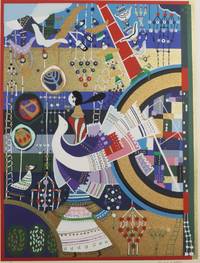
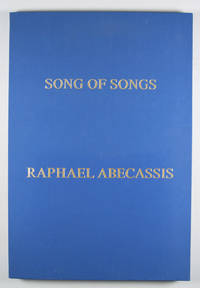
rif. 55254Jerusalem: Safrai Gallery 1989. Limited edition. Hardcover. vg to fine. 34/240 numbered and signed in pencil by Abecassis on each serigraph 17 1/4 x 12 1/4" on 22 x 15 1/4" handmade paper. 9 double pages including title page holding eight original serigraphs housed in original blue cloth portfolio with gilt lettering on cover. Abecassis rendering of the Song of Songs a conversation of two lovers and in Jewish tradition held as an allegory of the bond between god and the Jewish people is an exquisite example of artistic Biblical interpretation. Divided into the traditional eight chapters with printed b/w illustrations accompanying each text page the serigraphs feature bold colors and forms presented in a generous color palette with no fewer than twelve colors and overprinted in gold. Serigraphs uncut at top. Portfolio with 3 x 0.5" staineat lower front cover and light rubbing light wear and rubbing at edge of vertical flap else in fine condition. Raphael Abecassis born in 1953 in Morocco immigrated to Israel as a young child. He attended the Beer Sheva College of Education. Many of his works recount Biblical stories in a colorful refreshing way. He was awarded prizes for an Independence Day poster in 1986 a Ministry of Education Award for his "Psalms of David" as well as the illumination of President Chaim Herzog's speech at the Western Wall commemorating Israel's 40th birthday. Safrai Gallery hardcover books
1869rif. 236593Paris: l'auteur rue Royer-Collard 1869. First edition. 200 sepia-toned plates bound out of sequence. 1 vols. Folio. Three quarter green morocco spine richly gilt hinges repaired bookplates discreet embossed library stamp to title page some edges rough plates clean. First edition. 200 sepia-toned plates bound out of sequence. 1 vols. Folio. Lipperheide 337; Colas 1528; Hiler p. 473 l'auteur, rue Royer-Collard unknown books
1825rif. 11300London: Knight and Lacey 1825. Seventh Edition First Edition thus. Half Calf. Very Good. Seventh Edition First Edition thus. Half Calf. Robert Cross Smith 1795-1832 a former carpenter was an English astrologer writing under the pseudonym of "Raphael." He also referred to himself as the Royal Merlin. He married in 1820 and moved to London where he became interested in astrology. Together with G. W. Graham he published a book on geomancy in 1822. Smith began to edit a periodical The Straggling Astrologer in 1824 but failed to receive enough subscribers and the periodical had to be discontinued after a few issues. He collected the issues of the failed periodical in a volume entitled The Astrologer Of The Nineteenth Century in the same year. From 1827 until his death in 1832 he edited an astrological almanac entitled The Prophetic Messenger. Also published by Smith was The Familiar Astrologer and A Manual of Astrology both in 1828. Smith died on 26 February 1832 in London. His almanac continued to be edited as Raphael's Ephemeris and would become a standard work in British and US American astrology. Raphael's Ephemeris popularized the system of Placidian system of astrological houses in the English-speaking world and in modern western astrology in general. Published posthumously. The name Raphael one of the names given to one of the three archangels in the Old Testament was used as Smith's pseudonym. The Astrologer of the Nineteenth Century covers in quite dramatic prose a multitude of occult topics in ten chapters or "circles." Raphael contends that he believes firmly in astrology fairly firmly in geomancy and not much in magic rites charms or incantations. Includes many necromantic workings including a summoning spell for Oberon. He only includes these last to satisfy "those who delight in the terrific and the horribly sublime." The book makes a range of arguments for the veracity of astorlogy the most ingenious being that "the greatest rulers and statesmen and chiefs of the present age" are part of a conspiracy. Formerly owned by Alfred Pearce noted 19th century astrologer. Scarce. Boards rubbed and soiled loose and shaken verso boards chipping and cracking printed paper label rubbed and worn foxing throughout unprofessional repairs otherwise tight and sound contents fine. Half marbled boards with printed paper label on spine worn. Lacking all but one color plates. Former owner label. 8vo. xvi 509pp. Illus. b/w engravings 1 color plate "Awful Appearance of a Spirit.". Knight and Lacey unknown books
1774rif. 17011Rome 1774. Copper engraving by Ottaviani after drawings by Savorelli and Camporesi printed in light brown coloured ink with contemporary hand-colouring. Good condition. Shaved within plate mark expert neat repairs to left margin one just affecting the image area. A stunning plate from "Logge di Rafaele nel Vaticano": with contemporary colouring of the highest quality from the golden age of the hand-coloured print. A very fine image from the second part of a work titled "Loggie di Rafaele nel Vaticano" depicting the decorative work executed by Raphael and his assistants between 1518-1519 in the Vatican. They were drawn by Gaetano Savorelli a Roman painter and draughtsman best known for his Raphael drawings and Pietro Camporesi a Roman architect who worked for Pope Clemens XIII and Pius VI on rooms for the Vatican Museum. The first to illustrate the famous frescoes these beautiful plates were probably planned as early as 1760 but were not executed until 1772 to 1776. The plate is remarkable not only as the first important visual record of Raphael's work but also for the quality of the hand-colouring - the work on this image is in our opinion some of the greatest to be produced in Europe during the whole of the eighteenth century: the golden age of the hand-coloured print. They were remarkable not just for their size and magnificent colouring but also because of the influence they had on contemporary taste. The decision was made to "borrow" elements from Raphael's Vatican tapestries and insert them where the original frescoes were in too poor a state to be legible. The finished plates therefore represented an amalgam of design elements presented with a crisp freshness of colour that held enormous appeal and did much to stimulate the taste for the "grotesque" in the Neo-classical period. A year after the death of his principal patron Julius II Raphael succeeded Donato Bramante in 1514 as the official Vatican architect. Having previously adorned the "Stanze" or chambers of Julius on the second floor of the papal apartments in the Vatican palace he was commissioned by Leo X in 1517 to decorate the adjacent Logge. He designed an elaborate cycle of ornamental frescoes for the room's ceiling vaults doors and auxiliary pillars which were executed by his assistants Giulio Romano and Giovanni da Udine. Twelve of the quadrilateral ceiling vaults were adorned with murals of familiar Old Testament scenes and one with a scene from the New Testament while the more decorative frescoes painted on the pilasters by Udine were covered with imaginative compositions of 'grotesque' motifs like foliage fruit and chimerical beasts. The biblical scene depicted shows the infant brothers Cain and Abel vying for their mother's attention. Adam is sowing nearby. Cf. Brunet IV 1110 & 1111; cf. Berlin Katalog. 4068 & 4066; "Raphael Invenit: Stampe da Rafaello" 1985 Ottaviano 22; cf. "Raphael: Reproduktions-graphik aus vier Jahrhunderten" Coburg 1984 104 & no. 245. unknown books
1770rif. 20166Rome 1770. Copper engraving on two joined sheets by Ottaviani after drawings by Savorelli and Camporesi printed in light brown coloured ink with contemporary hand-colouring. Neat marginal restoration. A stunning plate from "Logge di Rafaele nel Vaticano": with contemporary colouring of the highest quality from the golden age of the hand-coloured print. The main panel shows Jacob at Luza having a vision of the angels ascending and descending by a ladder which reached from earth to heaven. A very fine image from the second part of a work titled "Loggie di Rafaele nel Vaticano" depicting the decorative work executed by Raphael and his assistants between 1518-1519 in the Vatican. They were drawn by Gaetano Savorelli a Roman painter and draughtsman best known for his Raphael drawings and Pietro Camporesi a Roman architect who worked for Pope Clemens XIII and Pius VI on rooms for the Vatican Museum. The first to illustrate the famous frescoes these beautiful plates were probably planned as early as 1760 but were not executed until 1772 to 1776. The plate is remarkable not only as the first important visual record of Raphael's work but also for the quality of the hand-colouring - the work on this image is in our opinion some of the greatest to be produced in Europe during the whole of the eighteenth century: the golden age of the hand-coloured print. They were remarkable not just for their size and magnificent colouring but also because of the influence they had on contemporary taste. The decision was made to "borrow" elements from Raphael's Vatican tapestries and insert them where the original frescoes were in too poor a state to be legible. The finished plates therefore represented an amalgam of design elements presented with a crisp freshness of colour that held enormous appeal and did much to stimulate the taste for the "grotesque" in the Neo-classical period. A year after the death of his principal patron Julius II Raphael succeeded Donato Bramante in 1514 as the official Vatican architect. Having previously adorned the "Stanze" or chambers of Julius on the second floor of the papal apartments in the Vatican palace he was commissioned by Leo X in 1517 to decorate the adjacent Logge. He designed an elaborate cycle of ornamental frescoes for the room's ceiling vaults doors and auxiliary pillars which were executed by his assistants Giulio Romano and Giovanni da Udine. Twelve of the quadrilateral ceiling vaults were adorned with murals of familiar Old Testament scenes and one with a scene from the New Testament while the more decorative frescoes painted on the pilasters by Udine were covered with imaginative compositions of 'grotesque' motifs like foliage fruit and chimerical beasts. Cf. Brunet IV 1110 & 1111; cf. Berlin Katalog 4068 & 4066; "Raphael Invenit: Stampe da Rafaello" 1985 Ottaviano 22; cf. "Raphael: Reproduktions-graphik aus vier Jahrhunderten" Coburg 1984 104 & no. 245. unknown books
1774rif. 20167Rome 1774. Copper engraving on two joined sheets by Ottaviani after drawings by Savorelli and Camporesi printed in light brown coloured ink with contemporary hand-colouring. Neat marginal restoration. A stunning plate from "Logge di Rafaele nel Vaticano": with contemporary colouring of the highest quality from the golden age of the hand-coloured print. The main panel shows Joseph telling his brothers of his prophetic dreams "Hear my dream which I dreamed. I thought we were binding sheaves in the field: and my sheaf arose as it were and stood and your sheaves standing about bowed down before my sheaf . I saw in . another dream as it were the sun and the moon and eleven stars worshipping me." A very fine image from the second part of a work titled "Loggie di Rafaele nel Vaticano" depicting the decorative work executed by Raphael and his assistants between 1518-1519 in the Vatican. They were drawn by Gaetano Savorelli a Roman painter and draughtsman best known for his Raphael drawings and Pietro Camporesi a Roman architect who worked for Pope Clemens XIII and Pius VI on rooms for the Vatican Museum. The first to illustrate the famous frescoes these beautiful plates were probably planned as early as 1760 but were not executed until 1772 to 1776. The plate is remarkable not only as the first important visual record of Raphael's work but also for the quality of the hand-colouring - the work on this image is in our opinion some of the greatest to be produced in Europe during the whole of the eighteenth century: the golden age of the hand-coloured print. They were remarkable not just for their size and magnificent colouring but also because of the influence they had on contemporary taste. The decision was made to "borrow" elements from Raphael's Vatican tapestries and insert them where the original frescoes were in too poor a state to be legible. The finished plates therefore represented an amalgam of design elements presented with a crisp freshness of colour that held enormous appeal and did much to stimulate the taste for the "grotesque" in the Neo-classical period. A year after the death of his principal patron Julius II Raphael succeeded Donato Bramante in 1514 as the official Vatican architect. Having previously adorned the "Stanze" or chambers of Julius on the second floor of the papal apartments in the Vatican palace he was commissioned by Leo X in 1517 to decorate the adjacent Logge. He designed an elaborate cycle of ornamental frescoes for the room's ceiling vaults doors and auxiliary pillars which were executed by his assistants Giulio Romano and Giovanni da Udine. Twelve of the quadrilateral ceiling vaults were adorned with murals of familiar Old Testament scenes and one with a scene from the New Testament while the more decorative frescoes painted on the pilasters by Udine were covered with imaginative compositions of 'grotesque' motifs like foliage fruit and chimerical beasts. Cf. Brunet IV 1110 & 1111; cf. Berlin Katalog 4068 & 4066; "Raphael Invenit: Stampe da Rafaello" 1985 Ottaviano 22; cf. "Raphael: Reproduktions-graphik aus vier Jahrhunderten" Coburg 1984 104 & no. 245. unknown books
1774rif. 20169Rome 1774. Copper engraving on two joined sheets by Ottaviani after drawings by Savorelli and Camporesi printed in light brown coloured ink with contemporary hand-colouring. Neat marginal restoration. A stunning plate from "Logge di Rafaele nel Vaticano": with contemporary colouring of the highest quality from the golden age of the hand-coloured print. The main panel shows King David having subdued Syria returning to Jersusalem with armour made of gold. A very fine image from the second part of a work titled "Loggie di Rafaele nel Vaticano" depicting the decorative work executed by Raphael and his assistants between 1518-1519 in the Vatican. They were drawn by Gaetano Savorelli a Roman painter and draughtsman best known for his Raphael drawings and Pietro Camporesi a Roman architect who worked for Pope Clemens XIII and Pius VI on rooms for the Vatican Museum. The first to illustrate the famous frescoes these beautiful plates were probably planned as early as 1760 but were not executed until 1772 to 1776. The plate is remarkable not only as the first important visual record of Raphael's work but also for the quality of the hand-colouring - the work on this image is in our opinion some of the greatest to be produced in Europe during the whole of the eighteenth century: the golden age of the hand-coloured print. They were remarkable not just for their size and magnificent colouring but also because of the influence they had on contemporary taste. The decision was made to "borrow" elements from Raphael's Vatican tapestries and insert them where the original frescoes were in too poor a state to be legible. The finished plates therefore represented an amalgam of design elements presented with a crisp freshness of colour that held enormous appeal and did much to stimulate the taste for the "grotesque" in the Neo-classical period. A year after the death of his principal patron Julius II Raphael succeeded Donato Bramante in 1514 as the official Vatican architect. Having previously adorned the "Stanze" or chambers of Julius on the second floor of the papal apartments in the Vatican palace he was commissioned by Leo X in 1517 to decorate the adjacent Logge. He designed an elaborate cycle of ornamental frescoes for the room's ceiling vaults doors and auxiliary pillars which were executed by his assistants Giulio Romano and Giovanni da Udine. Twelve of the quadrilateral ceiling vaults were adorned with murals of familiar Old Testament scenes and one with a scene from the New Testament while the more decorative frescoes painted on the pilasters by Udine were covered with imaginative compositions of 'grotesque' motifs like foliage fruit and chimerical beasts. Cf. Brunet IV 1110 & 1111; cf. Berlin Katalog 4068 & 4066; "Raphael Invenit: Stampe da Rafaello" 1985 Ottaviano 22; cf. "Raphael: Reproduktions-graphik aus vier Jahrhunderten" Coburg 1984 104 & no. 245. unknown books
1774rif. 20170Rome 1774. Copper engraving on two joined sheets by Ottaviani after drawings by Savorelli and Camporesi printed in light brown coloured ink with contemporary hand-colouring. Neat marginal restoration. A stunning plate from "Logge di Rafaele nel Vaticano": with contemporary colouring of the highest quality from the golden age of the hand-coloured print. The main panel shows the moment during the Last Supper when Jesus announces that one of the twelve disciples will betray him. A very fine image from the second part of a work titled "Loggie di Rafaele nel Vaticano" depicting the decorative work executed by Raphael and his assistants between 1518-1519 in the Vatican. They were drawn by Gaetano Savorelli a Roman painter and draughtsman best known for his Raphael drawings and Pietro Camporesi a Roman architect who worked for Pope Clemens XIII and Pius VI on rooms for the Vatican Museum. The first to illustrate the famous frescoes these beautiful plates were probably planned as early as 1760 but were not executed until 1772 to 1776. The plate is remarkable not only as the first important visual record of Raphael's work but also for the quality of the hand-colouring - the work on this image is in our opinion some of the greatest to be produced in Europe during the whole of the eighteenth century: the golden age of the hand-coloured print. They were remarkable not just for their size and magnificent colouring but also because of the influence they had on contemporary taste. The decision was made to "borrow" elements from Raphael's Vatican tapestries and insert them where the original frescoes were in too poor a state to be legible. The finished plates therefore represented an amalgam of design elements presented with a crisp freshness of colour that held enormous appeal and did much to stimulate the taste for the "grotesque" in the Neo-classical period. A year after the death of his principal patron Julius II Raphael succeeded Donato Bramante in 1514 as the official Vatican architect. Having previously adorned the "Stanze" or chambers of Julius on the second floor of the papal apartments in the Vatican palace he was commissioned by Leo X in 1517 to decorate the adjacent Logge. He designed an elaborate cycle of ornamental frescoes for the room's ceiling vaults doors and auxiliary pillars which were executed by his assistants Giulio Romano and Giovanni da Udine. Twelve of the quadrilateral ceiling vaults were adorned with murals of familiar Old Testament scenes and one with a scene from the New Testament while the more decorative frescoes painted on the pilasters by Udine were covered with imaginative compositions of 'grotesque' motifs like foliage fruit and chimerical beasts. Cf. Brunet IV 1110 & 1111; cf. Berlin Katalog 4068 & 4066; "Raphael Invenit: Stampe da Rafaello" 1985 Ottaviano 22; cf. "Raphael: Reproduktions-graphik aus vier Jahrhunderten" Coburg 1984 104 & no. 245. unknown books
1772rif. 16447Rome 1772. Copper engraving with stunning early colour. Printed on laid paper with added wove margins. In excellent condition with the exception of some light foxing in the margins. Image size: 22 7/8 x 15 3/4 inches. This beautiful perspective view of Raphael's Loggia with contemporary colouring of the highest quality from the golden age of the hand-coloured print served as the frontispiece to the celebrated text "Loggie di Rafaele nel Vaticano". This arresting print is a general perspective view of Raphael's design for the Loggia at the Vatican with a large profile portrait of Raphael in a medallion over the entrance to the corridor. The plate served as the frontispiece to the first part of the "Logge di Rafaele nel Vaticano" which depicted the decorative work executed by Raphael and his assistants between 1518-1519 in the Vatican. The project as a whole was carried out by the painter Gaetano Savorelli the draughtsman Ludovico Teseo the architect Pietro Camporesi and the engravers Giovanni Ottaviani and Giovanni Volpato. The plate is remarkable not only as the first important visual record of Raphael's work but also for the quality of the hand-colouring - the work on this image is in our opinion some of the greatest to be produced in Europe during the whole of the eighteenth century: the golden age of the hand-coloured print. The whole series was remarkable not just for the size and magnificent colouring of the prints but also because of the influence they had on contemporary taste. The decision was made to "borrow" elements from Raphael's Vatican tapestries and insert them where the original frescoes were in too poor a state to be legible. The finished plates therefore represented an amalgam of design elements presented with a crisp freshness of colour that held enormous appeal and stimulated the taste for the "grotesque" in the neo-classical period. Cf. Brunet IV 1110; cf. Berlin Katalog 4068; Lambert Pattern and Design V. & A.: 1983 p. 26; "Raphael Invenit: Stampe da Rafaello" 1985 Volpato 1; Raphael: Reproduktions-graphik aus vier Jahrhunderten Coburg: 1984 p. 104; G. Marini editor Giovanni Volpato 1735-1803 1988 no. 198. unknown books
1774rif. 20168Rome 1774. Copper engraving on two joined sheets by Ottaviani after drawings by Savorelli and Camporesi printed in light brown coloured ink with contemporary hand-colouring. Neat marginal restoration. A stunning plate from "Logge di Rafaele nel Vaticano": with contemporary colouring of the highest quality from the golden age of the hand-coloured print. The main panel shows Moses coming down from Mount Sinai holding the tablets bearing the ten words of the Covenant his face "horned from the conversation of the Lord". Aaron and the children of Israel seeing the face of Moses "horned" are afraid to come near. A very fine image from the second part of a work titled "Loggie di Rafaele nel Vaticano" depicting the decorative work executed by Raphael and his assistants between 1518-1519 in the Vatican. They were drawn by Gaetano Savorelli a Roman painter and draughtsman best known for his Raphael drawings and Pietro Camporesi a Roman architect who worked for Pope Clemens XIII and Pius VI on rooms for the Vatican Museum. The first to illustrate the famous frescoes these beautiful plates were probably planned as early as 1760 but were not executed until 1772 to 1776. The plate is remarkable not only as the first important visual record of Raphael's work but also for the quality of the hand-colouring - the work on this image is in our opinion some of the greatest to be produced in Europe during the whole of the eighteenth century: the golden age of the hand-coloured print. They were remarkable not just for their size and magnificent colouring but also because of the influence they had on contemporary taste. The decision was made to "borrow" elements from Raphael's Vatican tapestries and insert them where the original frescoes were in too poor a state to be legible. The finished plates therefore represented an amalgam of design elements presented with a crisp freshness of colour that held enormous appeal and did much to stimulate the taste for the "grotesque" in the Neo-classical period. A year after the death of his principal patron Julius II Raphael succeeded Donato Bramante in 1514 as the official Vatican architect. Having previously adorned the "Stanze" or chambers of Julius on the second floor of the papal apartments in the Vatican palace he was commissioned by Leo X in 1517 to decorate the adjacent Logge. He designed an elaborate cycle of ornamental frescoes for the room's ceiling vaults doors and auxiliary pillars which were executed by his assistants Giulio Romano and Giovanni da Udine. Twelve of the quadrilateral ceiling vaults were adorned with murals of familiar Old Testament scenes and one with a scene from the New Testament while the more decorative frescoes painted on the pilasters by Udine were covered with imaginative compositions of 'grotesque' motifs like foliage fruit and chimerical beasts. Cf. Brunet IV 1110 & 1111; cf. Berlin Katalog 4068 & 4066; "Raphael Invenit: Stampe da Rafaello" 1985 Ottaviano 22; cf. "Raphael: Reproduktions-graphik aus vier Jahrhunderten" Coburg 1984 104 & no. 245. unknown books
1774rif. 20165Rome 1774. Copper engraving on two joined sheets by Ottaviani after drawings by Savorelli and Camporesi printed in light brown coloured ink with contemporary hand-colouring. Neat marginal restoration. A stunning plate from "Logge di Rafaele nel Vaticano": with contemporary colouring of the highest quality from the golden age of the hand-coloured print. In the main panel the Lord appears to Isaac and tells him not to go down into Egypt but to stay in Gerara. A very fine image from the second part of a work titled "Loggie di Rafaele nel Vaticano" depicting the decorative work executed by Raphael and his assistants between 1518-1519 in the Vatican. They were drawn by Gaetano Savorelli a Roman painter and draughtsman best known for his Raphael drawings and Pietro Camporesi a Roman architect who worked for Pope Clemens XIII and Pius VI on rooms for the Vatican Museum. The first to illustrate the famous frescoes these beautiful plates were probably planned as early as 1760 but were not executed until 1772 to 1776. The plate is remarkable not only as the first important visual record of Raphael's work but also for the quality of the hand-colouring - the work on this image is in our opinion some of the greatest to be produced in Europe during the whole of the eighteenth century: the golden age of the hand-coloured print. They were remarkable not just for their size and magnificent colouring but also because of the influence they had on contemporary taste. The decision was made to "borrow" elements from Raphael's Vatican tapestries and insert them where the original frescoes were in too poor a state to be legible. The finished plates therefore represented an amalgam of design elements presented with a crisp freshness of colour that held enormous appeal and did much to stimulate the taste for the "grotesque" in the Neo-classical period. A year after the death of his principal patron Julius II Raphael succeeded Donato Bramante in 1514 as the official Vatican architect. Having previously adorned the "Stanze" or chambers of Julius on the second floor of the papal apartments in the Vatican palace he was commissioned by Leo X in 1517 to decorate the adjacent Logge. He designed an elaborate cycle of ornamental frescoes for the room's ceiling vaults doors and auxiliary pillars which were executed by his assistants Giulio Romano and Giovanni da Udine. Twelve of the quadrilateral ceiling vaults were adorned with murals of familiar Old Testament scenes and one with a scene from the New Testament while the more decorative frescoes painted on the pilasters by Udine were covered with imaginative compositions of 'grotesque' motifs like foliage fruit and chimerical beasts. Cf. Brunet IV 1110 & 1111; cf. Berlin Katalog 4068 & 4066; "Raphael Invenit: Stampe da Rafaello" 1985 Ottaviano 22; cf. "Raphael: Reproduktions-graphik aus vier Jahrhunderten" Coburg 1984 104 & no. 245. unknown books
1915rif. 80765London: Martin Secker 1915. Hardcover. Very Good. First edition. Some modest spotting to the boards lettering rubbed but easily readable a near very good copy lacking the rare dust jacket. Along with Captain Blood and Scaramouche one of a trio of swashbuckling novels that helped to define the genre. This was the basis for one of the great silent adventure films directed in 1924 by Frank Lloyd and featuring Milton Sills as the Sea Hawk with Enid Bennett Lloyd Hughes Wallace MacDonald Marc McDermott and Wallace Beery. Also well-known is the 1940 Michael Curtiz swashbuckler with Errol Flynn which kept the Sabatini title but used an original story-line loosely based on the exploits of Sir Francis Drake and modified to draw obvious parallels to England on the verge of WWII. Martin Secker hardcover books
1937rif. 46644Jerusalem: Monsohn Print 1937. Original artwork. Framed. Atlas Folio 25 1/4 x 16 1/4". Lithograph on heavy stock paper. Printed by Shimon Barmatz. Monsohn Print unknown books
1658rif. LV2725A Paris: chez Adrien Menier a la Porte Saint-Victor 1658. 1658. 4to. 24 cm. 8 45 3 pp. 72 double-sided plates. Dedication signed: Du Fresne. With a special added engraved title page preceding the plates with the title: Briefve Histoire de l'Institution de toutes les Religions avec leurs habits granez par Odard Fialetti . . . 1658. Each plate has engraved descriptive text on facing page printed on verso of preceding plate. Contemporary red turkey morocco gilt-stamping and spine; neat restoration to spine corner bumped. Stamp on title and rear: Le Mrs. Marquis de Courtanvaux Le Tellier Marquis de Courtanvaux Francois-Cesar 1718-1781. CHOICE COPY IN A BEAUTIFUL CONTEMPORARY BINDING. Rare. First printing of an important book showing 72 standard costumes worn for 72 religious orders mostly Italian orders seventeenth century. There is a section devoted to the east and one plate to an order in India. Odoardo Fialetti whose real name was Edouard Viallet provided the remarkable engravings. The dedicatory epistle is addressed to Pierre de La Porte first valet de chambre of Louis XIV. / Trichet du Fresne described as erudite he took his education at the College de Guyenne Paris. While working for the brother of Louis XIII Gaston d'Orleans 1608-60 he acquired works of art on buying excursions. He began his career as a bookseller before becoming corrector at the newly established Imprimerie du Roi in 1640. In 1651 he published Leonardo da Vinci's treatise on painting Trattato della pittura which had circulated in manuscript form. His Trattato contained an early biography of Leonardo and Alberti and contained a list of books at the end forming the first annotated bibliography of art literature Dictionary of Art Historians. After the death of Naude he was appointed librarian of Queen Christina of Sweden. His own library comprised about 10000 volumes. Colbert acquired his manuscripts from his widow Francoise Duvivier for the Royal Library for 27700 livres. The printed books were bought by Nicolas Fouquet after whose disgrace and imprisonment they were confiscated and incorporated into the Royal Library in 1665. When in 1651 the Swedish Queen abdicated and emigrated to Italy Trichet followed her to Rome. REFERENCES: Blechet p.59; Pollard & Ehrman Table XXV; Taylor p. 265ff. See: Smith Paul J. "COGNITION IN EMBLEMATIC FABLE BOOKS: AEGIDIUS SADELER'S THEATRUM MORUM 1608 AND ITS RECEPTION IN FRANCE 1659–1743" Within: Cognition and the Book: Typologies of Formal Organisation of Knowledge in the Printed Book of the Early Modern Period; Series: Intersections Volume: 4. 2005. chez Adrien Menier, a la Porte Saint-Victor, 1658. unknown books
1782rif. 189785Bologna: In the Institute os Science 1782. Hardcover. Very Good Cover has general wear Leather peeling corner/edge damage. Spine has damage to top/bottom. Bookblock has age toning. Interior pages have age toning and foxing. Brown cloth boards with gilt highlights Black leather corners and spine. Gilt lettering and design elements on 5 raised band spine. xiii 3 341 pages 69 leaves of plates some folded : illustrations plans. Title vignette tail-pieces and plates engraved by Pio Panfili. In the Institute os Science hardcover books
1856rif. 41810Mexico City. 1856. Route Guides in Mexico and the Southwest An extremely valuable compilation which gives detailed data including route scenery and other key information about many various parts of Mexico. By piecing together the different itineraries it offers a traveler could basically go anywhere in Mexico and into the U.S. already provided with extremely detailed instructions about the best route and what facilities - such as water grass and shelter - were available every step of the way. A detailed name index listing routes and where they are to be found in the book further enhances the volume's usefulness for travelers be they headed to destinations great or small. Many of the routes described begin in Mexico City; some routes extend into Texas and New Mexico. Among the most interesting are two itineraries concerning California. One describes a journey from La Paz at the far southern end of Baja California to the U.S. border. This is one of the most detailed and expansively described routes in the entire book preserving a wealth of geographic and natural details. Many of the places detailed in this section have either disappeared or been extensively altered. The other journey is along the Sonora Route from Ures to Sonora to the California gold fields. This trip passes through Los Angeles and includes some commentary on the missions in the area. "An important guide book giving the routes and mileage with sketches of the country throughout Mexico" - Eberstadt. Small quarto. Contemporary red half sheep and boards spine gilt with raised bands. Boards and extremities rubbed. Contemporary bookplate on front pastedown. Light toning and minor foxing. Very good. PALAU 9290. SABIN 976. EBERSTADT 138:033. BARRETT 34. hardcover books
1674rif. 23439Rome: Jo. Jacobus de Rubeis Giovanni Giacomo de Rossi 1674. First edition. Hardcover. Near fine. Oblong folio. 13 by 18 inches. Engraved title/dedication to and with portrait of Queen Christina followed by an engraved depiction of Raphael who died in 1520. These are followed by 52 etchings which reproduce Raphael's paintings and which were executed by Cesare Fantetti or Pietro Aquila. Page edges are toned with age but the etchings are in fine condition. The title'dedication has a small right margin restoration else it is in near fine condition. Bound to style in quarter morocco gilt spine title printed paper boards. Overall a verygood to near fine examplar. Text in Latin. . Jo. Jacobus de Rubeis (Giovanni Giacomo de Rossi) hardcover books
rif. 45532Jerusalem: Safrai Gallery 1989. Limited edition. Hardcover. vg to fine. 141/240 numbered and signed in pencil by Abecassis on each serigraph 17 1/4 x 12 1/4" on 22 x 15 1/4" handmade paper. 9 double pages including title page holding eight original serigraphs housed in original blue cloth portfolio with gilt lettering on cover. Abecassis rendering of the Song of Songs a conversation of two lovers and in Jewish tradition held as an allegory of the bond between god and the Jewish people is an exquisite example of artistic Biblical interpretation. Divided into the traditional eight chapters with printed b/w illustrations accompanying each text page the serigraphs feature bold colors and forms presented in a generous color palette with no fewer than twelve colors and overprinted in gold. Serigraphs uncut at top. Portfolio with light wear and rubbing minor smudge on title page else in fine condition. Raphael Abecassis born in 1953 in Morocco immigrated to Israel as a young child. He attended the Beer Sheva College of Education. Many of his works recount Biblical stories in a colorful refreshing way. He was awarded prizes for an Independence Day poster in 1986 a Ministry of Education Award for his "Psalms of David" as well as the illumination of President Chaim Herzog's speech at the Western Wall commemorating Israel's 40th birthday. Safrai Gallery hardcover books
rif. 312476London: Stanley Paul & Co. et al. vd. 19 vols. various sizes. Bound in full polished brown calf gilt spines red leather title-pieces t.e.g. for Hatchards Piccadilly. Fine. 19 vols. various sizes. Stanley Paul & Co. et al. unknown books
rif. 211707Signed Raphael Soyer lower left inscribed Kelekian center right. 1 vols. 14 x 9.25 inches. Fine. In frame. Signed Raphael Soyer lower left inscribed Kelekian center right. 1 vols. 14 x 9.25 inches. Kelekian 1868-1951 one of the most important art/antiquites dealers of the modern era. Known to his peers as the "dean of antiquities" Kelekian's connoisseurship of the ancient art of the Near East opened the eyes of many Americans to a heritage hitherto unknown and unappreciated. Kelekian was born in Kayser in modern-day Turkey began his career in Constantinople opened a gallery in Paris in 1891 and moved to New York shortly after the 1893 Chicago World's Fair. Very quickly Kelekian's gallery developed clients among America's wealthiest families e.g. the Havermeyers John D. Rockefeller Jr. the Astors the Walters of Baltimore et. al. Kelekian ws primarlily responsible for building the Coptic Early Christian and Classical collections of Henry Walters later founder of the Walters Art Museum in Baltimore and the Gothic collection of financier and Metropolitan Museum of Art president George Blumenthal. Kelekian was equally well known as an early champion of modern art and began collecting and promoting such artists as Henri Matisse André Derain and Pablo Picasso at a very early date. Boisterous expansive a friends to many artists he died in his eighties at his hime in New York with world-wide reputation. for a sketch of his life and career see the excellent sketch by Hrag Vartanian for the Armenian General benevolent Fund http://www.agbu.org/agbunews/display.aspA_ID=69. unknown books