851 résultats
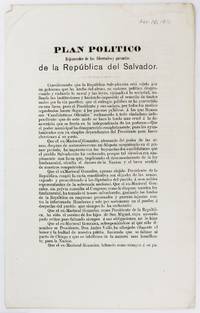
1876réf. 5735Chalchuapa El Salvador 1876. Still very good. 3pp. on a bifolium. Folio. Crinkling and minor wear at edges. Faint dampstain to upper right corner. The president of Guatemala Justo Rufino Barrios invaded El Salvador in 1876 following the presidential election there. Barrios suspected that both the elected and former presidents had been harboring Guatemalan opponents to his regime and hope to install someone more favorable. The present "political plan" for El Salvador reads more as an indictment of the two leaders Santiago Gonzalez and Andres del Valle than an as organizing document for a new government. The first signer here is Rafael Zaldivar the choice of Barrios for next president of El Salvador and the work was printed in the field at Chalchuapa on April 10 1876 approximately one week before the decisive battles that forced the capitulation of the Salvadoran government. Not in OCLC. unknown books
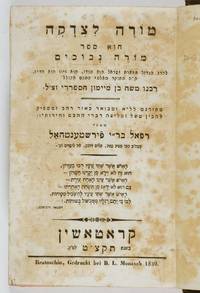
1864réf. 50647Krotoschin Krotoszyn/ Vienna/ Frankfurt am Main: Printed by B.L. Monasch/ Jacob Schlossberg's Buchhandlung/ Printed by Ferdinand Hauch 1864. First German translations. Hardcover. g to vg-. Octavo. 3/4 black morocco over buckram boards. Gilt lettering and ruling on the spine. Red speckled edges of book block. A complete set of the three parts of Maimonides acclaimed work The Guide for the Perplexed in German and Hebrew bound in one volume. All of the editions included here contain the first German translations of their respective parts of the text. Maimonides' intention with this work was to reconcile Aristotelian thought and logic with traditional Rabbinical Jewish theology. Originally written circa 1190 in Judeo-Arabic as Dalalat al-Ha'irin these writings takes the form of a lengthy three-part letter to his student Rabbi Joseph ben Judah of Ceuta and are seen as the main source for understanding Maimonides' philosophic view rather than his strictly being his views on Jewish law. It is the most known of his works in the non-Jewish world. The work's first translation into Hebrew was in 1204 by Rabbi Samuel ben Judah ibn Tibbon c.1150 - c.1230 a contemporary of Maimonides. Content: Moreh li-Tsedakah. Hu Sefer Moreh Nevukhim FIRST PART. 1839. Second German-language edition. 19 double-sided leaves with Hebrew pagination. 392pp. 3. In 1835 the first part of Maimonides acclaimed work was first translated into German with added commentary in Hebrew by Jacob Raphael Fürstenthal 1781-1855. That first edition featured the German translation printed in Latin script to accompany the Hebrew text. However for this second edition of that translation it is interesting to note that the text of the German is printed in Hebrew script. Content finely printed in double and single-column layouts with commentary printed in Rashi script. Divided in 76 chapters this part of the work contains discussions of an understanding and definition of the nature of God and divine anthropomorphism in the Hebrew bible including a detailed analysis of the Biblical Hebrew of the text to these ends. The final three pages included here contain and index in both Hebrew and German. BOUND WITH More Nebochim. Wegweiser für Berirrte SECOND PART. 1864. First German-language edition. x 99pp. This is the first German translation of the work's second part taken from the original Arabic text by way of the French translation by Salomon Munk 1861. The original Hebrew translation of the text is accompanied throughout by a translation and commentary in German by Max Emanuel Stern 1811-1873. Divided into 48 chapters the second part involves Maimonides discussion of proof of the existence of God the nature of creation the concept of prophecy and an examination of the 26 propositions for Aristotle's metaphysics. The initial pages contain introduction and foreword by Stern. Also included is a fold-out plate containing facsimile text from an original signed manuscript note from the hand of Maimonides himself written in Japhet son of Solomon's corrected manuscript copy of the Mishneh Torah held at Bodleian Library at Oxford MS Hunt.80 leaf 165a. AND WITH Dalalat al Haiirin Burechtweisung der Verirrten. Dritter Theil. THIRD PART. 1838. First German-language edition. viii 9 454pp. 5. This is the first German translation of the work's third part. Simon B. Scheyer 1804-1854 provides the translation and scholarly commentary in German to accompany the Hebrew of the text. This third and final part of Guide for the Perplexed is divided into 54 chapters and is considered the climax of the work and the culmination of Maimonides' previous analysis. Discussed are concepts including Jewish mysticism the Chariot of Ezekiel the moral aspects of the universe the problem of evil free will and the 613 mitzvot of the Torah. The final pages contain a scholarly index in German. Binding tight with some rubbing to extremities including the hinges of the spine. Spine and covers lightly sunned. Text throughout with some sporadic minor to light foxing. Much of the text is quite clean. A very few instances of underlining or notes in pencil. Binding in good interior in very good- condition overall. Hebrew title: מורה לצדקה .×”×•× ספר מורה × ×‘×•×›×™×/ מורה × ×‘×•×›×™×/ מורה × ×‘×•×›×™×. ×•×”×•× ספר דל×לה ×לח×ירין .חלק שלישי Author: משה בן מימון רפ×ל בר"י ×¤Ö¼×™×¨×©×˜×¢× ×˜×”×ל Publication: פרנקפורט/ קר×ט×שין תקצ״ט Alternate titles and transliterations: Moreh Nevukim Doctor Perplexorum Bibliographic references: PART 1 Vinograd Krotochin 14. PART 3 Vinograd Frankfurt 578 Provinence: Previously owned by Oxford religion scholar O.H.M. Lehmann dated 1949. Printed by B.L. Monasch/ Jacob Schlossberg's Buchhandlung/ Printed by Ferdinand Hauch hardcover books
1922réf. 298565Boston: Houghton Mifflin Co 1922. First Edition. Hard Cover. Very Good binding/Fair dust jacket. A first edition with a pencilled name and address on the front endpaper. The dustjacket is Fair only. The jacket has not been price-clipped and has the correct First Edition price of $2.00 on the flap. There is about a 1” piece gone from the top the jacket spine and about 2” from the bottom. The N. C. Wyeth illustration to the front panel is mostly present but has a 1/2” x 1” amount of loss at the top edge of the illustration and there is minor loss at the front fold. The front of the jacket was in two pieces and has been discreetly repaired on the verso. Very Good binding / Fair dust jacket. Houghton Mifflin Co unknown books
1957réf. 150334N.p.: N.p. 1957. Vintage oversize borderless double weight reference photograph from the 1957 film showing actors Anthony Perkins and Norma Moore. With the stamps of photographer Bill Avery and editor Bud Fraker on the verso along with the stamp of Photoplay and several manuscript pencil and ink annotations regarding layout. A dramatization of the experiences of major league baseball star Jimmy Piersall loosely based on his own 1955 memoirs following his 1948 contract with the Boston Red Sox to his eventual nervous breakdown and hospitalization for bipolar disorder. Bill Avery worked as a photographer at Columbia Pictures in the early 20th century with a brief interlude working as a combat cameraman during World War II. He also worked at MGM under noted photographer C.S. Bill and occasionally worked as a freelance publicity photographer shooting iconic images of Elvis Presley Jack Lemmon Katharine and Audrey Hepburn and Shirley MacLaine among many others. Set in Boston Massachusetts and Waterbury Connecticut. 8.3 x 13.5 inches. Very Good plus with a few small manuscript pencil annotations regarding cropping on the bottom edge. N.p. unknown books
1856réf. 11298London: Sherwood and Company; James Cornish Booksellers 1856. Fourth Edition. Full Calf. Very Good. Fourth Edition. Full Calf. "This essay is intended as a foundation for belief in revealed religion in connection with the theory of celestial influences or astrology." Richard James Morrison 15 June 1795 - 5 April 1874 was an English astrologer commonly known by his pen name Zadkiel and best known for the series known as Zadkiel's Almanac. Morrison in 1831 issued The Herald of Astrology subsequently known as Zadkiel's Almanac. In this annual pamphlet he published predictions of the chief events of the coming year. Morrison wrote with the signature Zadkiel Tao-Sze. Morrison wrote such articles as The New Principia or true system of astronomy in which the Earth is proved to be the stationary centre of the Solar System 1868 which made him a charlatan in the eyes of scientists. In 1863 he won a libel suite against Admiral Sir Edward Belcher who wrote in the Daily Telegraph that Morrison was "the crystal globe seer who gulled many of our nobility about the year 1852." He was awarded twenty shillings one pound damages but was deprived of his costs. The Athenaeum 16 May 1874 p. 666 noted that Morrison was "the restorer and Grand Master in this country of Tao-Sze a secret society intended to be of immense power and to outshine the Free-masons but which most probably by his death is reduced to two members and inanition". Robert Cross Smith 1795-1832 was an English astrologer writing under the pseudonym of "Raphael." Starting on upper and rear joints cracking rubbing to extremities repair to folding color plate otherwise tight bright and unmarred. Full blind stamped red calf with worn gilt decorative vignette. Red titling on tp. and charts. Elaborate large folding frontispiece printed in colors unprofessionally repaired backed with linen. xix 66pp. Illus. color b/w. Sherwood and Company; James Cornish, Booksellers unknown books
1912réf. 190356Paris: `H. Floury 1912. Hardcover. VG light soiling and scuffing to boards age toning and foxing spots to ffep plates are very crisp and clean all plates present. Oversized off-white paper over boards with orange and black lettering; 3 pp; 20 full page etchings with protective guard sheets. Issued in edition of 100 numbered and signed copies this being number 41 signed by Raphael Schwartz. Text is in French. Collection of etching portraits by R. Schwartz by Anatole France André Gide Emile Verhaeren Albert Bartholomé Auguste Rodin Albert Besnard etc. Preface by Anatole France. 19x15x1" `H. Floury hardcover books
1947réf. 28251New York: Forward Association 1947. Hardcover. vg to near fine. Oblong 4to. 575pp. 21 x 27 cm. Red cloth with woodcut-illustrated paste-down and gold lettering. Illustrated title-page. This 1947 publication is the finest photographic documentary of Jewish life in Eastern Europe during the 1920's and 30's. It has never been superseded. In addition to choosing from some thousands of postcards and family photographs submitted by readers of the Yiddish "Daily Forward" the editors were able to reproduce images previously published in the Forward's Rotogravure section by the photographers Alter Kacyzna and M. Kipnis. Additionally the now famous images of Roman Vishniak were first presented to the public in this work. Profusely illustrated with b/w reproductions of photographs. In two parts: 1 Jewish Cities. 2 Jewish People. Text in Yiddish and English. One of the most powerful photographic works on Eastern European Jewry ever published. Binding with some light sunning light staining extending slightly to the back cover and a sticker residue to the spine. A few tiny stains to the front cover. Book block tight with interior clean. Binding in very good interior in near fine condition overall. Protected in modern mylar. "In presenting this book to our readers we intend to give them the picture of the Jewish world in Eastern Europe as it existed during the 1920's and 1930's previous to the Second World War. This world does not exist any longer. It is a vanished world the world of East European Jewry that world in which for centuries the greatest concentration of Jewish people in history lived and worked. On the eve of the Second World War over seven million Jews resided in that part of Eastern Europe which was swept by Hitler's divisions in the years 1939-45. If we also include sections of Southern and Western Europe the Balkans Italy France Belgium Holland and Scandinavia the Jewish population under Nazi rule may be estimated at approximately 7.8 million persons. More than 9400000 Jews lived in the whole of Europe in 1939. Only about 3700000 are left now including the "Displaced Persons" in the UNRRA camps and those repatriated from Soviet Russia and Poland. Five million of these were exterminated in the death camps and the ghettos. About seven hundred thousand perished from starvation deportation epidemics and as a result of military operations. The East European period of Jewish history ended in the greatest catastrophe known to mankind." Raphael Abramovitch was a 20th century Russian Jewish political activist. As a Marxist he was part of the Jewish Bund. He took part in the Russian Revolution on the side of the Mensheviks. After the Bolshevik victory he fled to Germany France and eventually to the United States. Abramovitch was a vocal opponent of both Nazi Germany and the Soviet Union. Forward Association hardcover books
1912réf. 5917Havana 1912. Good plus. 196pp. Original printed front wrapper bound into 20th-century faux leather paper boards spine and front board gilt lettered. Contemporary ownership inscription and bookseller's ink stamp on title page. Lower corners of initial and final leaves repaired with tissue. Even tanning occasional foxing heavier to initial leaves. A scarce contemporary account of what the authors term the "Guerra de Razas" also known as the 1912 Cuban War an uprising by parts of the island's Afro-Cuban population demanding equal rights which was brutally extinguished by government forces. The conflict had its roots in racial tensions between Cuba's Hispanic and Black populations after the reestablishment of self-government in 1909. Race-based political parties such as the Partido Independiente de Color had been established in the 1900s to fight for the civil rights of Black Cubans but these groups were outlawed by the predominantly Hispanic government in 1910. The PIC continued to operate however and its leaders Evaristo Esteñoz and Pedro Ivonet agitated for a rebellion that would force the government to reverse the law. When the uprising finally occurred in the eastern provinces of Cuba on May 20 1912 it was met with extreme force with contemporary accounts and eyewitnesses numbering the executed and massacred at anywhere between 2000 and 6000 people including Esteñoz and Ivonet. The authors of the present work present their account from a pro-government perspective but nevertheless make some attempt toward social history and analysis of the causes of conflict. The whole is photographically illustrated with numerous portraits of significant military figures. OCLC locates a small handful of copies in U.S. institutions. unknown books
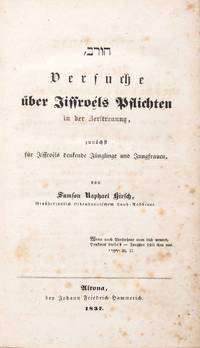
1837réf. 48406Altona Hamburg: Johann Friedrich Hammerich 1837. First edition. Hardcover. g to g. Octavo. xvi 800pp. Bound in brown pebbled half cloth over black pebbled boards. Treatise of Jewish law and observances by Samson Raphael Hirsch the German Orthodox Rabbi who founded the school of contemporary Orthodox Judaism Today's modern Orthodoxy and a vocal opponent of Reform Judaism. The work is organized in six sections according to Hirsch's classification of the commandments: Thaurauß Laws derived from the Five Books of Moses Edauß Jewish Holidays Mischpotim Laws Between Man and Man Chukim Laws Regarding Daily Life and Animals Mizwauß Laws about Devotion and Awaudoh Service and Prayer. The book was written in a literary German to explain Jewish customs ceremonies and doctrines with the special emphasis on German-Jewish youth. List of abbreviations and symbols in German and Hebrew at front and registers in German and Hebrew an addendum of explanation and abbreviations in Hebrew and errata at rear. Publisher's advertisement for the German Bible for Israelites a new translation from the Masoretic text and edited by Gotthold Salomon on last page. Text in German Gothic script titles subtitles and abbreviations in Hebrew. Binding with some wear along edges small chips and some scuffing along leather spine. Light foxing of block diminishing towards end of block. Binding in overall good interior in good to goo condition. Johann Friedrich Hammerich hardcover books
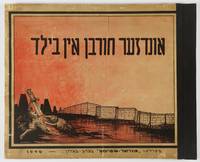
1946réf. 54171Bergen-Belsen: Our Voice/ Unzer Sztyme 1946. First edition. Hardcover. vg- to vg. Oblong small folio. 38pp. single-sided leaves. Recased with a black cloth spine with the original illustrated tan and red paper front wrapper laid down. Original black paper back wrapper. New endpapers. Content printed on large heavy stock paper leaves. This scarce powerful and disturbing collection of Holocaust images predominantly taken in the ghettos of Bedzin and Lodz and the camp in Bergen-Belsen by captured Nazi soldiers might best be described in the words of the editors: "The incentive to produce this collection gave us our deepest desire to show the world the crimes of Germany to give expression to the throttled cry of pain of the Jews to the sighs of our fathers and mothers sisters and brothers during the frozen nights of winter and the overpowering heat of the summer which was spent in sealed railway trucks the desire to bring back to our memories of the Jewish settlements which were drowned in torrents of Jewish blood". This notable work was prepared in advance of the Nuremberg Trials as a further evidence of Nazi crimes and is considered one of the most important works assembled by Jews in the aftermath of destruction to visually document the horrors of the Holocaust. The work features 115 striking b/w photographic reproductions. with captions in Yiddish Hebrew English and German. Separate title pages in all four languages as well. Binding with some rubbing chipping and small tears to the edges of the covers. A few creases closed tears and a small stain to the main portion of the cover which is otherwise quite clean and vibrant. Title pages with some slight abrasions and age toning with all text still clean and vibrant. The rest of the pages throughout clean with only very minor age toning mostly to the edges with all images and text clean. Book block tight. Binding in very good- interior in overall very good condition. Scarce with its original cover in good shape which is usually found in quite damaged states. Protected in modern mylar. Yiddish title: ××•× ×“×–×¢×¨ חורבן ×ין בילד Authors: ×’×¢×–×מלט ×ון רעד×גירט דורך רפ×ל ×לעווסקי פ×ול טרעפמ×ן דוד ר××–× ×˜×ל Publication: בערגן-בעלזן ×רויסגעבער ×¦×¢× ×˜×¨×ל ק×מיטעט פון די ב×פרייטע יידן ×ין דער בריטישער ×–×× ×¢/ פ×רל××’ ××•× ×“×–×¢×¨ ×©×˜×™× Hebrew title: חורבננו בתמונות Authors: נלקט ונערך בידי רפ×ל ×ולבסקי פ×ול טרפמן דוד רוזנטל Publication: ברגן-בעלזן הועד המרכזי ×œ×™×”×•×“×™× ×”×ž×©×•×—×¨×¨×™× ×‘×זור הבריטי/הוצ×ת ××•× ×“×–×¢×¨ שטימע. Our Voice/ Unzer Sztyme hardcover books
1801réf. 6589London: Published by John Raphael Smith 1801. Mezzotint with roulette coloured by hand. Image size: 17 1/4 x 21 1/2 inches. A touching scene after Morland: 'a master of genre and animal painting an artist worthy to be placed in the same rank as the best of those Dutch masters whom he studied as a boy' DNB This print is a wonderful example of the manner in which Morland perfectly conveys the hardships and beauties of country life his depiction of a poor country family battling the hardships of winter shows the bitter side of the pastoral life with grace and sympathy. George Morland was one of the most successful genre painters of his time creating during his industrious career some of England's most cherished paintings. At an early age Morland displayed his artistic genius he learned to paint at three and exhibited his first work at the Royal Academy at the mere age of ten. Morland was a prodigious painter producing more than 4000 paintings during the entirety of his career and sometimes painting two or three works in a day. His beautiful idealistic scenes were a favorite source of inspiration for contemporary engravers and as many as 250 separate engravings were done of his paintings during his lifetime. One such engraver was John Raphael Smith who throughout his career translated many of Morland's paintings to print. Smith was a highly influential figure in the late eighteenth-century British art world he quickly became an impresario of the print-publishing trade producing nearly 400 prints during his lifetime 130 of which were of his own design. This beautiful print refelects both the talents of the engraver and the genius of the artist in its sentiment and execution it demonstrates the best of English genre. Published by John Raphael Smith unknown books
1786réf. 8168London: Published by J. R. Smith No. 83 Oxford Street 1786. Coloured mezzotint. In good condition with the exception of some faint soiling in upper margin. Bottom margin outside platemark is coated with white paint. Water stains on verso of sheet not noticeable on front of sheet. Image size: 14 3/4 x 17 inches. Plate size: 17 7/8 x 19 5/8 inches. Sheet size: 19 5/8 x 20 inches. A wonderful mezzotint after Rev. Matthew William Peters by one of the finest eighteenth century engravers. This charming print is engraved after a painting by Rev. Matthew William Peters and is a fascinating example of this period in British printmaking. Matthew Peters was trained in London under the portraitist Thomas Hudson. He quickly became a prominent member of the Society of Artists exhibiting portraits in oil and pastel and attracting a number of prominent aristocratic patrons including the Duke of Manchester the Marquess of Granby and Lord Grosvenor for whom he painted some of his most controversial pictures. Urged by his patrons Peters painted a series of quasi-erotic character studies of courtesans which at that time were quite unusual in Britain. These controversial pictures were eagerly reproduced by industrious printmaker/publishers such as Smith and caused a flurry of curious customers to hurry to London print-shops. Following his ordination in 1781 Peters quickly denounced his early erotic pictures as immoral. Upon being appointed Honorary Chaplain to the Royal Academy Peters expressed a profound regret "that he ever devoted his talents to such subjects". With this in mind this picture becomes extremely interesting. In this work Peters continues to observe and appreciate charming subjects in fancy costumes but eliminates the erotic overtones present in his earlier works. Instead he has chosen to depict an age-old moral subject fortune-telling an institution in western art since the Renaissance. This print which is expertly engraved by one of the finest eighteenth century printmakers is a fascinating view into a turbulent period in Peters' life when he struggled to produce images that would appeal to his viewers while remaining true to his moral beliefs. D'Oench Copper into Gold: Prints by John Raphael Smith 1751-1812 p. 224 No. 274; Smith Catalogue No. 135 & 136; Ackermann 1802 p. 9 described as companion prints; Chaloner Smith British Mezzotinto Portraits Ward 97 Smith 186; Frankau An 18th Century Artist and Engraver: John Raphael Smith 146. Published by J. R. Smith, No. 83 Oxford Street unknown books
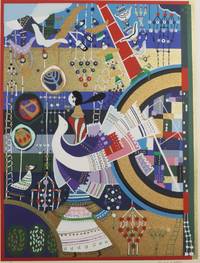
réf. 55254Jerusalem: Safrai Gallery 1989. Limited edition. Hardcover. vg to fine. 34/240 numbered and signed in pencil by Abecassis on each serigraph 17 1/4 x 12 1/4" on 22 x 15 1/4" handmade paper. 9 double pages including title page holding eight original serigraphs housed in original blue cloth portfolio with gilt lettering on cover. Abecassis rendering of the Song of Songs a conversation of two lovers and in Jewish tradition held as an allegory of the bond between god and the Jewish people is an exquisite example of artistic Biblical interpretation. Divided into the traditional eight chapters with printed b/w illustrations accompanying each text page the serigraphs feature bold colors and forms presented in a generous color palette with no fewer than twelve colors and overprinted in gold. Serigraphs uncut at top. Portfolio with 3 x 0.5" staineat lower front cover and light rubbing light wear and rubbing at edge of vertical flap else in fine condition. Raphael Abecassis born in 1953 in Morocco immigrated to Israel as a young child. He attended the Beer Sheva College of Education. Many of his works recount Biblical stories in a colorful refreshing way. He was awarded prizes for an Independence Day poster in 1986 a Ministry of Education Award for his "Psalms of David" as well as the illumination of President Chaim Herzog's speech at the Western Wall commemorating Israel's 40th birthday. Safrai Gallery hardcover books
1869réf. 236593Paris: l'auteur rue Royer-Collard 1869. First edition. 200 sepia-toned plates bound out of sequence. 1 vols. Folio. Three quarter green morocco spine richly gilt hinges repaired bookplates discreet embossed library stamp to title page some edges rough plates clean. First edition. 200 sepia-toned plates bound out of sequence. 1 vols. Folio. Lipperheide 337; Colas 1528; Hiler p. 473 l'auteur, rue Royer-Collard unknown books
1825réf. 11300London: Knight and Lacey 1825. Seventh Edition First Edition thus. Half Calf. Very Good. Seventh Edition First Edition thus. Half Calf. Robert Cross Smith 1795-1832 a former carpenter was an English astrologer writing under the pseudonym of "Raphael." He also referred to himself as the Royal Merlin. He married in 1820 and moved to London where he became interested in astrology. Together with G. W. Graham he published a book on geomancy in 1822. Smith began to edit a periodical The Straggling Astrologer in 1824 but failed to receive enough subscribers and the periodical had to be discontinued after a few issues. He collected the issues of the failed periodical in a volume entitled The Astrologer Of The Nineteenth Century in the same year. From 1827 until his death in 1832 he edited an astrological almanac entitled The Prophetic Messenger. Also published by Smith was The Familiar Astrologer and A Manual of Astrology both in 1828. Smith died on 26 February 1832 in London. His almanac continued to be edited as Raphael's Ephemeris and would become a standard work in British and US American astrology. Raphael's Ephemeris popularized the system of Placidian system of astrological houses in the English-speaking world and in modern western astrology in general. Published posthumously. The name Raphael one of the names given to one of the three archangels in the Old Testament was used as Smith's pseudonym. The Astrologer of the Nineteenth Century covers in quite dramatic prose a multitude of occult topics in ten chapters or "circles." Raphael contends that he believes firmly in astrology fairly firmly in geomancy and not much in magic rites charms or incantations. Includes many necromantic workings including a summoning spell for Oberon. He only includes these last to satisfy "those who delight in the terrific and the horribly sublime." The book makes a range of arguments for the veracity of astorlogy the most ingenious being that "the greatest rulers and statesmen and chiefs of the present age" are part of a conspiracy. Formerly owned by Alfred Pearce noted 19th century astrologer. Scarce. Boards rubbed and soiled loose and shaken verso boards chipping and cracking printed paper label rubbed and worn foxing throughout unprofessional repairs otherwise tight and sound contents fine. Half marbled boards with printed paper label on spine worn. Lacking all but one color plates. Former owner label. 8vo. xvi 509pp. Illus. b/w engravings 1 color plate "Awful Appearance of a Spirit.". Knight and Lacey unknown books
1774réf. 17011Rome 1774. Copper engraving by Ottaviani after drawings by Savorelli and Camporesi printed in light brown coloured ink with contemporary hand-colouring. Good condition. Shaved within plate mark expert neat repairs to left margin one just affecting the image area. A stunning plate from "Logge di Rafaele nel Vaticano": with contemporary colouring of the highest quality from the golden age of the hand-coloured print. A very fine image from the second part of a work titled "Loggie di Rafaele nel Vaticano" depicting the decorative work executed by Raphael and his assistants between 1518-1519 in the Vatican. They were drawn by Gaetano Savorelli a Roman painter and draughtsman best known for his Raphael drawings and Pietro Camporesi a Roman architect who worked for Pope Clemens XIII and Pius VI on rooms for the Vatican Museum. The first to illustrate the famous frescoes these beautiful plates were probably planned as early as 1760 but were not executed until 1772 to 1776. The plate is remarkable not only as the first important visual record of Raphael's work but also for the quality of the hand-colouring - the work on this image is in our opinion some of the greatest to be produced in Europe during the whole of the eighteenth century: the golden age of the hand-coloured print. They were remarkable not just for their size and magnificent colouring but also because of the influence they had on contemporary taste. The decision was made to "borrow" elements from Raphael's Vatican tapestries and insert them where the original frescoes were in too poor a state to be legible. The finished plates therefore represented an amalgam of design elements presented with a crisp freshness of colour that held enormous appeal and did much to stimulate the taste for the "grotesque" in the Neo-classical period. A year after the death of his principal patron Julius II Raphael succeeded Donato Bramante in 1514 as the official Vatican architect. Having previously adorned the "Stanze" or chambers of Julius on the second floor of the papal apartments in the Vatican palace he was commissioned by Leo X in 1517 to decorate the adjacent Logge. He designed an elaborate cycle of ornamental frescoes for the room's ceiling vaults doors and auxiliary pillars which were executed by his assistants Giulio Romano and Giovanni da Udine. Twelve of the quadrilateral ceiling vaults were adorned with murals of familiar Old Testament scenes and one with a scene from the New Testament while the more decorative frescoes painted on the pilasters by Udine were covered with imaginative compositions of 'grotesque' motifs like foliage fruit and chimerical beasts. The biblical scene depicted shows the infant brothers Cain and Abel vying for their mother's attention. Adam is sowing nearby. Cf. Brunet IV 1110 & 1111; cf. Berlin Katalog. 4068 & 4066; "Raphael Invenit: Stampe da Rafaello" 1985 Ottaviano 22; cf. "Raphael: Reproduktions-graphik aus vier Jahrhunderten" Coburg 1984 104 & no. 245. unknown books
1770réf. 20166Rome 1770. Copper engraving on two joined sheets by Ottaviani after drawings by Savorelli and Camporesi printed in light brown coloured ink with contemporary hand-colouring. Neat marginal restoration. A stunning plate from "Logge di Rafaele nel Vaticano": with contemporary colouring of the highest quality from the golden age of the hand-coloured print. The main panel shows Jacob at Luza having a vision of the angels ascending and descending by a ladder which reached from earth to heaven. A very fine image from the second part of a work titled "Loggie di Rafaele nel Vaticano" depicting the decorative work executed by Raphael and his assistants between 1518-1519 in the Vatican. They were drawn by Gaetano Savorelli a Roman painter and draughtsman best known for his Raphael drawings and Pietro Camporesi a Roman architect who worked for Pope Clemens XIII and Pius VI on rooms for the Vatican Museum. The first to illustrate the famous frescoes these beautiful plates were probably planned as early as 1760 but were not executed until 1772 to 1776. The plate is remarkable not only as the first important visual record of Raphael's work but also for the quality of the hand-colouring - the work on this image is in our opinion some of the greatest to be produced in Europe during the whole of the eighteenth century: the golden age of the hand-coloured print. They were remarkable not just for their size and magnificent colouring but also because of the influence they had on contemporary taste. The decision was made to "borrow" elements from Raphael's Vatican tapestries and insert them where the original frescoes were in too poor a state to be legible. The finished plates therefore represented an amalgam of design elements presented with a crisp freshness of colour that held enormous appeal and did much to stimulate the taste for the "grotesque" in the Neo-classical period. A year after the death of his principal patron Julius II Raphael succeeded Donato Bramante in 1514 as the official Vatican architect. Having previously adorned the "Stanze" or chambers of Julius on the second floor of the papal apartments in the Vatican palace he was commissioned by Leo X in 1517 to decorate the adjacent Logge. He designed an elaborate cycle of ornamental frescoes for the room's ceiling vaults doors and auxiliary pillars which were executed by his assistants Giulio Romano and Giovanni da Udine. Twelve of the quadrilateral ceiling vaults were adorned with murals of familiar Old Testament scenes and one with a scene from the New Testament while the more decorative frescoes painted on the pilasters by Udine were covered with imaginative compositions of 'grotesque' motifs like foliage fruit and chimerical beasts. Cf. Brunet IV 1110 & 1111; cf. Berlin Katalog 4068 & 4066; "Raphael Invenit: Stampe da Rafaello" 1985 Ottaviano 22; cf. "Raphael: Reproduktions-graphik aus vier Jahrhunderten" Coburg 1984 104 & no. 245. unknown books
1774réf. 20167Rome 1774. Copper engraving on two joined sheets by Ottaviani after drawings by Savorelli and Camporesi printed in light brown coloured ink with contemporary hand-colouring. Neat marginal restoration. A stunning plate from "Logge di Rafaele nel Vaticano": with contemporary colouring of the highest quality from the golden age of the hand-coloured print. The main panel shows Joseph telling his brothers of his prophetic dreams "Hear my dream which I dreamed. I thought we were binding sheaves in the field: and my sheaf arose as it were and stood and your sheaves standing about bowed down before my sheaf . I saw in . another dream as it were the sun and the moon and eleven stars worshipping me." A very fine image from the second part of a work titled "Loggie di Rafaele nel Vaticano" depicting the decorative work executed by Raphael and his assistants between 1518-1519 in the Vatican. They were drawn by Gaetano Savorelli a Roman painter and draughtsman best known for his Raphael drawings and Pietro Camporesi a Roman architect who worked for Pope Clemens XIII and Pius VI on rooms for the Vatican Museum. The first to illustrate the famous frescoes these beautiful plates were probably planned as early as 1760 but were not executed until 1772 to 1776. The plate is remarkable not only as the first important visual record of Raphael's work but also for the quality of the hand-colouring - the work on this image is in our opinion some of the greatest to be produced in Europe during the whole of the eighteenth century: the golden age of the hand-coloured print. They were remarkable not just for their size and magnificent colouring but also because of the influence they had on contemporary taste. The decision was made to "borrow" elements from Raphael's Vatican tapestries and insert them where the original frescoes were in too poor a state to be legible. The finished plates therefore represented an amalgam of design elements presented with a crisp freshness of colour that held enormous appeal and did much to stimulate the taste for the "grotesque" in the Neo-classical period. A year after the death of his principal patron Julius II Raphael succeeded Donato Bramante in 1514 as the official Vatican architect. Having previously adorned the "Stanze" or chambers of Julius on the second floor of the papal apartments in the Vatican palace he was commissioned by Leo X in 1517 to decorate the adjacent Logge. He designed an elaborate cycle of ornamental frescoes for the room's ceiling vaults doors and auxiliary pillars which were executed by his assistants Giulio Romano and Giovanni da Udine. Twelve of the quadrilateral ceiling vaults were adorned with murals of familiar Old Testament scenes and one with a scene from the New Testament while the more decorative frescoes painted on the pilasters by Udine were covered with imaginative compositions of 'grotesque' motifs like foliage fruit and chimerical beasts. Cf. Brunet IV 1110 & 1111; cf. Berlin Katalog 4068 & 4066; "Raphael Invenit: Stampe da Rafaello" 1985 Ottaviano 22; cf. "Raphael: Reproduktions-graphik aus vier Jahrhunderten" Coburg 1984 104 & no. 245. unknown books
1774réf. 20169Rome 1774. Copper engraving on two joined sheets by Ottaviani after drawings by Savorelli and Camporesi printed in light brown coloured ink with contemporary hand-colouring. Neat marginal restoration. A stunning plate from "Logge di Rafaele nel Vaticano": with contemporary colouring of the highest quality from the golden age of the hand-coloured print. The main panel shows King David having subdued Syria returning to Jersusalem with armour made of gold. A very fine image from the second part of a work titled "Loggie di Rafaele nel Vaticano" depicting the decorative work executed by Raphael and his assistants between 1518-1519 in the Vatican. They were drawn by Gaetano Savorelli a Roman painter and draughtsman best known for his Raphael drawings and Pietro Camporesi a Roman architect who worked for Pope Clemens XIII and Pius VI on rooms for the Vatican Museum. The first to illustrate the famous frescoes these beautiful plates were probably planned as early as 1760 but were not executed until 1772 to 1776. The plate is remarkable not only as the first important visual record of Raphael's work but also for the quality of the hand-colouring - the work on this image is in our opinion some of the greatest to be produced in Europe during the whole of the eighteenth century: the golden age of the hand-coloured print. They were remarkable not just for their size and magnificent colouring but also because of the influence they had on contemporary taste. The decision was made to "borrow" elements from Raphael's Vatican tapestries and insert them where the original frescoes were in too poor a state to be legible. The finished plates therefore represented an amalgam of design elements presented with a crisp freshness of colour that held enormous appeal and did much to stimulate the taste for the "grotesque" in the Neo-classical period. A year after the death of his principal patron Julius II Raphael succeeded Donato Bramante in 1514 as the official Vatican architect. Having previously adorned the "Stanze" or chambers of Julius on the second floor of the papal apartments in the Vatican palace he was commissioned by Leo X in 1517 to decorate the adjacent Logge. He designed an elaborate cycle of ornamental frescoes for the room's ceiling vaults doors and auxiliary pillars which were executed by his assistants Giulio Romano and Giovanni da Udine. Twelve of the quadrilateral ceiling vaults were adorned with murals of familiar Old Testament scenes and one with a scene from the New Testament while the more decorative frescoes painted on the pilasters by Udine were covered with imaginative compositions of 'grotesque' motifs like foliage fruit and chimerical beasts. Cf. Brunet IV 1110 & 1111; cf. Berlin Katalog 4068 & 4066; "Raphael Invenit: Stampe da Rafaello" 1985 Ottaviano 22; cf. "Raphael: Reproduktions-graphik aus vier Jahrhunderten" Coburg 1984 104 & no. 245. unknown books
1774réf. 20170Rome 1774. Copper engraving on two joined sheets by Ottaviani after drawings by Savorelli and Camporesi printed in light brown coloured ink with contemporary hand-colouring. Neat marginal restoration. A stunning plate from "Logge di Rafaele nel Vaticano": with contemporary colouring of the highest quality from the golden age of the hand-coloured print. The main panel shows the moment during the Last Supper when Jesus announces that one of the twelve disciples will betray him. A very fine image from the second part of a work titled "Loggie di Rafaele nel Vaticano" depicting the decorative work executed by Raphael and his assistants between 1518-1519 in the Vatican. They were drawn by Gaetano Savorelli a Roman painter and draughtsman best known for his Raphael drawings and Pietro Camporesi a Roman architect who worked for Pope Clemens XIII and Pius VI on rooms for the Vatican Museum. The first to illustrate the famous frescoes these beautiful plates were probably planned as early as 1760 but were not executed until 1772 to 1776. The plate is remarkable not only as the first important visual record of Raphael's work but also for the quality of the hand-colouring - the work on this image is in our opinion some of the greatest to be produced in Europe during the whole of the eighteenth century: the golden age of the hand-coloured print. They were remarkable not just for their size and magnificent colouring but also because of the influence they had on contemporary taste. The decision was made to "borrow" elements from Raphael's Vatican tapestries and insert them where the original frescoes were in too poor a state to be legible. The finished plates therefore represented an amalgam of design elements presented with a crisp freshness of colour that held enormous appeal and did much to stimulate the taste for the "grotesque" in the Neo-classical period. A year after the death of his principal patron Julius II Raphael succeeded Donato Bramante in 1514 as the official Vatican architect. Having previously adorned the "Stanze" or chambers of Julius on the second floor of the papal apartments in the Vatican palace he was commissioned by Leo X in 1517 to decorate the adjacent Logge. He designed an elaborate cycle of ornamental frescoes for the room's ceiling vaults doors and auxiliary pillars which were executed by his assistants Giulio Romano and Giovanni da Udine. Twelve of the quadrilateral ceiling vaults were adorned with murals of familiar Old Testament scenes and one with a scene from the New Testament while the more decorative frescoes painted on the pilasters by Udine were covered with imaginative compositions of 'grotesque' motifs like foliage fruit and chimerical beasts. Cf. Brunet IV 1110 & 1111; cf. Berlin Katalog 4068 & 4066; "Raphael Invenit: Stampe da Rafaello" 1985 Ottaviano 22; cf. "Raphael: Reproduktions-graphik aus vier Jahrhunderten" Coburg 1984 104 & no. 245. unknown books
1772réf. 16447Rome 1772. Copper engraving with stunning early colour. Printed on laid paper with added wove margins. In excellent condition with the exception of some light foxing in the margins. Image size: 22 7/8 x 15 3/4 inches. This beautiful perspective view of Raphael's Loggia with contemporary colouring of the highest quality from the golden age of the hand-coloured print served as the frontispiece to the celebrated text "Loggie di Rafaele nel Vaticano". This arresting print is a general perspective view of Raphael's design for the Loggia at the Vatican with a large profile portrait of Raphael in a medallion over the entrance to the corridor. The plate served as the frontispiece to the first part of the "Logge di Rafaele nel Vaticano" which depicted the decorative work executed by Raphael and his assistants between 1518-1519 in the Vatican. The project as a whole was carried out by the painter Gaetano Savorelli the draughtsman Ludovico Teseo the architect Pietro Camporesi and the engravers Giovanni Ottaviani and Giovanni Volpato. The plate is remarkable not only as the first important visual record of Raphael's work but also for the quality of the hand-colouring - the work on this image is in our opinion some of the greatest to be produced in Europe during the whole of the eighteenth century: the golden age of the hand-coloured print. The whole series was remarkable not just for the size and magnificent colouring of the prints but also because of the influence they had on contemporary taste. The decision was made to "borrow" elements from Raphael's Vatican tapestries and insert them where the original frescoes were in too poor a state to be legible. The finished plates therefore represented an amalgam of design elements presented with a crisp freshness of colour that held enormous appeal and stimulated the taste for the "grotesque" in the neo-classical period. Cf. Brunet IV 1110; cf. Berlin Katalog 4068; Lambert Pattern and Design V. & A.: 1983 p. 26; "Raphael Invenit: Stampe da Rafaello" 1985 Volpato 1; Raphael: Reproduktions-graphik aus vier Jahrhunderten Coburg: 1984 p. 104; G. Marini editor Giovanni Volpato 1735-1803 1988 no. 198. unknown books
1774réf. 20168Rome 1774. Copper engraving on two joined sheets by Ottaviani after drawings by Savorelli and Camporesi printed in light brown coloured ink with contemporary hand-colouring. Neat marginal restoration. A stunning plate from "Logge di Rafaele nel Vaticano": with contemporary colouring of the highest quality from the golden age of the hand-coloured print. The main panel shows Moses coming down from Mount Sinai holding the tablets bearing the ten words of the Covenant his face "horned from the conversation of the Lord". Aaron and the children of Israel seeing the face of Moses "horned" are afraid to come near. A very fine image from the second part of a work titled "Loggie di Rafaele nel Vaticano" depicting the decorative work executed by Raphael and his assistants between 1518-1519 in the Vatican. They were drawn by Gaetano Savorelli a Roman painter and draughtsman best known for his Raphael drawings and Pietro Camporesi a Roman architect who worked for Pope Clemens XIII and Pius VI on rooms for the Vatican Museum. The first to illustrate the famous frescoes these beautiful plates were probably planned as early as 1760 but were not executed until 1772 to 1776. The plate is remarkable not only as the first important visual record of Raphael's work but also for the quality of the hand-colouring - the work on this image is in our opinion some of the greatest to be produced in Europe during the whole of the eighteenth century: the golden age of the hand-coloured print. They were remarkable not just for their size and magnificent colouring but also because of the influence they had on contemporary taste. The decision was made to "borrow" elements from Raphael's Vatican tapestries and insert them where the original frescoes were in too poor a state to be legible. The finished plates therefore represented an amalgam of design elements presented with a crisp freshness of colour that held enormous appeal and did much to stimulate the taste for the "grotesque" in the Neo-classical period. A year after the death of his principal patron Julius II Raphael succeeded Donato Bramante in 1514 as the official Vatican architect. Having previously adorned the "Stanze" or chambers of Julius on the second floor of the papal apartments in the Vatican palace he was commissioned by Leo X in 1517 to decorate the adjacent Logge. He designed an elaborate cycle of ornamental frescoes for the room's ceiling vaults doors and auxiliary pillars which were executed by his assistants Giulio Romano and Giovanni da Udine. Twelve of the quadrilateral ceiling vaults were adorned with murals of familiar Old Testament scenes and one with a scene from the New Testament while the more decorative frescoes painted on the pilasters by Udine were covered with imaginative compositions of 'grotesque' motifs like foliage fruit and chimerical beasts. Cf. Brunet IV 1110 & 1111; cf. Berlin Katalog 4068 & 4066; "Raphael Invenit: Stampe da Rafaello" 1985 Ottaviano 22; cf. "Raphael: Reproduktions-graphik aus vier Jahrhunderten" Coburg 1984 104 & no. 245. unknown books
1774réf. 20165Rome 1774. Copper engraving on two joined sheets by Ottaviani after drawings by Savorelli and Camporesi printed in light brown coloured ink with contemporary hand-colouring. Neat marginal restoration. A stunning plate from "Logge di Rafaele nel Vaticano": with contemporary colouring of the highest quality from the golden age of the hand-coloured print. In the main panel the Lord appears to Isaac and tells him not to go down into Egypt but to stay in Gerara. A very fine image from the second part of a work titled "Loggie di Rafaele nel Vaticano" depicting the decorative work executed by Raphael and his assistants between 1518-1519 in the Vatican. They were drawn by Gaetano Savorelli a Roman painter and draughtsman best known for his Raphael drawings and Pietro Camporesi a Roman architect who worked for Pope Clemens XIII and Pius VI on rooms for the Vatican Museum. The first to illustrate the famous frescoes these beautiful plates were probably planned as early as 1760 but were not executed until 1772 to 1776. The plate is remarkable not only as the first important visual record of Raphael's work but also for the quality of the hand-colouring - the work on this image is in our opinion some of the greatest to be produced in Europe during the whole of the eighteenth century: the golden age of the hand-coloured print. They were remarkable not just for their size and magnificent colouring but also because of the influence they had on contemporary taste. The decision was made to "borrow" elements from Raphael's Vatican tapestries and insert them where the original frescoes were in too poor a state to be legible. The finished plates therefore represented an amalgam of design elements presented with a crisp freshness of colour that held enormous appeal and did much to stimulate the taste for the "grotesque" in the Neo-classical period. A year after the death of his principal patron Julius II Raphael succeeded Donato Bramante in 1514 as the official Vatican architect. Having previously adorned the "Stanze" or chambers of Julius on the second floor of the papal apartments in the Vatican palace he was commissioned by Leo X in 1517 to decorate the adjacent Logge. He designed an elaborate cycle of ornamental frescoes for the room's ceiling vaults doors and auxiliary pillars which were executed by his assistants Giulio Romano and Giovanni da Udine. Twelve of the quadrilateral ceiling vaults were adorned with murals of familiar Old Testament scenes and one with a scene from the New Testament while the more decorative frescoes painted on the pilasters by Udine were covered with imaginative compositions of 'grotesque' motifs like foliage fruit and chimerical beasts. Cf. Brunet IV 1110 & 1111; cf. Berlin Katalog 4068 & 4066; "Raphael Invenit: Stampe da Rafaello" 1985 Ottaviano 22; cf. "Raphael: Reproduktions-graphik aus vier Jahrhunderten" Coburg 1984 104 & no. 245. unknown books
1915réf. 80765London: Martin Secker 1915. Hardcover. Very Good. First edition. Some modest spotting to the boards lettering rubbed but easily readable a near very good copy lacking the rare dust jacket. Along with Captain Blood and Scaramouche one of a trio of swashbuckling novels that helped to define the genre. This was the basis for one of the great silent adventure films directed in 1924 by Frank Lloyd and featuring Milton Sills as the Sea Hawk with Enid Bennett Lloyd Hughes Wallace MacDonald Marc McDermott and Wallace Beery. Also well-known is the 1940 Michael Curtiz swashbuckler with Errol Flynn which kept the Sabatini title but used an original story-line loosely based on the exploits of Sir Francis Drake and modified to draw obvious parallels to England on the verge of WWII. Martin Secker hardcover books
1937réf. 46644Jerusalem: Monsohn Print 1937. Original artwork. Framed. Atlas Folio 25 1/4 x 16 1/4". Lithograph on heavy stock paper. Printed by Shimon Barmatz. Monsohn Print unknown books