844 résultats
1772réf. 17002Rome 1772. Copper engraving by Ottaviani after drawings by Savorelli and Camporesi printed in light brown coloured ink with contemporary hand-colouring. Good condition. Trimmed to just within plate mark along lower margin expert repairs to left margin not affecting image area. A highly decorative print from the famous "Loggie di Rafaele nel Vaticano" series with contemporary colouring of the highest quality from the golden age of the hand-coloured print. A very fine image from the first part of a work titled "Loggie di Rafaele nel Vaticano" depicting the decorative work executed by Raphael and his assistants between 1518-1519 in the Vatican. This remarkable print one of the first to be published of the decoration of the Logge on the main storey of the Vatican apartments was probably planned as early as 1760 but was not executed until between 1772 and 1776. The project as a whole was carried out by the painter Gaetano Savorelli the draughtsman Ludovico Teseo the architect Pietro Camporesi and the engravers Giovanni Ottaviani and Giovanni Volpato. The plate is remarkable not only as the first important visual record of Raphael's work but also for the quality of the hand-colouring - the work on this image is in our opinion some of the greatest to be produced in Europe during the whole of the eighteenth century: the golden age of the hand-coloured print. The whole series was of importance not just for the size and magnificent colouring of the prints but also because of the influence they had on contemporary taste. The decision was made to "borrow" elements from Raphael's Vatican tapestries and insert them where the original frescoes were in too poor a state to be legible. The finished plates therefore represented an amalgam of design elements presented with a crisp freshness of colour that held enormous appeal and stimulated the taste for the "grotesque" in the neo-classical period. Cf. Brunet IV 1110; cf. Berlin Katalog 4068; cf. Lambert Pattern and Design V. & A.: 1983 p. 26; "Raphael Invenit: Stampe da Rafaello" 1985 Ottaviano 4; Raphael: Reproduktions-graphik aus vier Jahrhunderten Coburg: 1984 p. 104. unknown books
1772réf. 17009Rome 1772. Copper engraving by Ottaviani after drawings by Savorelli and Camporesi printed in light brown coloured ink with contemporary hand-colouring. Good condition. Trimmed to just within plate mark along lower margin expert repair to upper left corner just affecting image area small repairs to right blank margin. A highly decorative print from the famous "Loggie di Rafaele nel Vaticano" series with contemporary colouring of the highest quality from the golden age of the hand-coloured print. A very fine image from the first part of a work titled "Loggie di Rafaele nel Vaticano" depicting the decorative work executed by Raphael and his assistants between 1518-1519 in the Vatican. This remarkable print one of the first to be published of the decoration of the Logge on the main storey of the Vatican apartments was probably planned as early as 1760 but was not executed until between 1772 and 1776. The project as a whole was carried out by the painter Gaetano Savorelli the draughtsman Ludovico Teseo the architect Pietro Camporesi and the engravers Giovanni Ottaviani and Giovanni Volpato. The plate is remarkable not only as the first important visual record of Raphael's work but also for the quality of the hand-colouring - the work on this image is in our opinion some of the greatest to be produced in Europe during the whole of the eighteenth century: the golden age of the hand-coloured print. The whole series was of importance not just for the size and magnificent colouring of the prints but also because of the influence they had on contemporary taste. The decision was made to "borrow" elements from Raphael's Vatican tapestries and insert them where the original frescoes were in too poor a state to be legible. The finished plates therefore represented an amalgam of design elements presented with a crisp freshness of colour that held enormous appeal and stimulated the taste for the "grotesque" in the neo-classical period. Cf. Brunet IV 1110; cf. Berlin Katalog 4068; cf. Lambert Pattern and Design V. & A.: 1983 p. 26; "Raphael Invenit: Stampe da Rafaello" 1985 Ottaviano 5; Raphael: Reproduktions-graphik aus vier Jahrhunderten Coburg: 1984 p. 104. unknown books
1772réf. 14588Rome 1772. Copper engraving by Ottaviani after drawings by Ludovico Teseo printed in black with stunning later professional hand-colouring. Very good condition. A highly decorative print from the famous "Loggie di Rafaele nel Vaticano" series with later professional hand-colouring. A very fine image from the first part of a work titled "Loggie di Rafaele nel Vaticano" depicting the decorative work and executed by Raphael and his assistants between 1518-1519 in the Vatican. This remarkable print one of the first to be published of the decoration of the Logge on the main storey of the Vatican apartments was probably planned as early as 1760 but was not executed until between 1772 and 1776. The project as a whole was carried out by the painter Gaetano Savorelli the draughtsman Ludovico Teseo the architect Pietro Camporesi and the engravers Giovanni Ottaviani and Giovanni Volpato. The whole series was remarkable not just for the size and magnificent colouring of the prints but also because of the influence they had on contemporary taste. The decision was made to "borrow" elements from Raphael's Vatican tapestries and insert them where the original frescoes were in too poor a state to be legible. The finished plates therefore represented an amalgam of design elements presented with a crisp freshness of colour that held enormous appeal and stimulated the taste for the "grotesque" in the neo-classical period. Cf. Brunet IV 1110; cf. Berlin Katalog 4068; cf. Lambert Pattern and Design V. & A.: 1983 p. 26; "Raphael Invenit: Stampe da Rafaello" 1985 Ottaviano 2; Raphael: Reproduktions-graphik aus vier Jahrhunderten Coburg: 1984 p. 104. unknown books
1772réf. 17013Rome 1772. Copper engraving by Ottaviani after drawings by Savorelli and Camporesi printed in light brown coloured ink with contemporary hand-colouring. Good condition. Three repaired tears to the left blank margin. Sight size: 31 1/8 x 18 1/4 inches. A highly decorative print from the famous "Loggie di Rafaele nel Vaticano" series with contemporary colouring of the highest quality from the golden age of the hand-coloured print. A very fine image from the first part of a work titled "Loggie di Rafaele nel Vaticano" depicting the decorative work executed by Raphael and his assistants between 1518-1519 in the Vatican. This remarkable print one of the first to be published of the decoration of the Logge on the main storey of the Vatican apartments was probably planned as early as 1760 but was not executed until between 1772 and 1776. The project as a whole was carried out by the painter Gaetano Savorelli the draughtsman Ludovico Teseo the architect Pietro Camporesi and the engravers Giovanni Ottaviani and Giovanni Volpato. The plate is remarkable not only as the first important visual record of Raphael's work but also for the quality of the hand-colouring - the work on this image is in our opinion some of the greatest to be produced in Europe during the whole of the eighteenth century: the golden age of the hand-coloured print. The whole series was of importance not just for the size and magnificent colouring of the prints but also because of the influence they had on contemporary taste. The decision was made to "borrow" elements from Raphael's Vatican tapestries and insert them where the original frescoes were in too poor a state to be legible. The finished plates therefore represented an amalgam of design elements presented with a crisp freshness of colour that held enormous appeal and stimulated the taste for the "grotesque" in the neo-classical period. Cf. Brunet IV 1110; cf. Berlin Katalog 4068; cf. Lambert Pattern and Design V. & A.: 1983 p. 26; "Raphael Invenit: Stampe da Rafaello" 1985 Ottaviano 17; Raphael: Reproduktions-graphik aus vier Jahrhunderten Coburg: 1984 p. 104. unknown books
1925réf. 533276London: Hutchinson & Co 1925. Hardcover. Near Fine/Near Fine. First edition. 12mo. Bookplate of Lady Martin Harvey on the front pastedown corners a trifle bumped near fine in near fine pictorial dust jacket with tiny tears and very shallow nicking at the crown. Warmly Inscribed by Sabatini to Lady Harvey on the dedication page. Also laid in is a page and a quarter Autograph Letter Signed from Sabatini to Lady Martin warmly recounting their past acquaintance and sending along this copy of the book. Aside from the limited and signed set of the author's Collected Works Sabatini books are seldom found signed by the author. This title is exceptionally uncommon in jacket or signed and especially both. Hutchinson & Co hardcover books
1922réf. 54897Paris: Romagnol 1922. Limited first edition. Softcover. near fine. 1/300. Two volumes octavo. Vol. 1: 129 1 blank pp. frontispiece 16 three-quarter page colored vignettes scene divisions 8 hors texte full page colored plates; 20 woodcut ornaments in red and gray; Vol. 2: 56 plates loose in illustrated wrappers as issued comprising: two states each of the the cover illustration frontispiece and the 8 full page plates uncolored; colored with added reproductions of ink drawings -- the illustrator's studies -- appearing in the margin; 16 three-quarter page colored scene divisions and 20 woodcut ornaments all printed before letter. Illustrated tan paper wrappers with white and red lettering on the front covers protected in the original glassine as issued. Engraved images in the first volume and the first section of the second are protected in their original tissue guards. Housed in a custom decorative lustrous multicolored paper-covered slipcase with a protective insert for the spines lettered and embossed in red. Edition limited 301 copies this being a special unnumbered deluxe copy on japan paper of which 100 numbered copies are noted at the limitation page; unlike the ordinary numbered copies the limitation page here notes: "Exemplaire imprimé pour M. Georges Calmann-Levy." A notable limited illustrated edition of Sophocles' classic Greek tragedy issued with an additional full suite of plates. Vol.1 contains the text of Oedipus Rex "Oedipe Roi" in French and a significant portion of Raphaël Freida's original engravings and drawings integrated directly with the text. This integration is vital as Freida's artwork is not merely decorative; it serves to amplify the emotional intensity and psychological depth of the tragedy. The quality of the printing and the paper in this volume are of high importance. Volume 2 "États des Planches" States of the Plates is dedicated to showcasing the "states of the plates" providing a detailed look at the various stages of the engraving process allowing the viewer to observe the evolution of Freida's artwork from initial sketches to finished gorgeous engravings. This volume is of particular interest to those interested in the technical aspects of printmaking. It should be noted that surprisingly Freida's powerful illustrated edition has never been subsequently reissued. Volume one has some closed tearing on the original glassine and wrappers at the head and tail of the spine. A closed tear to the head of the spine itself. Volume with only a few minor instances of tearing to the glassine. Interiors with all images pristine and vibrant. Wrappers and glassines in very good- to very good interiors in near fine condition overall. Georges Calmann-Levy was at one time the head of the Calmann-Lévy publishing house in France the son of it's founder Kalmus "Calmann" Lévy 1819-1891. Romagnol unknown books
1772réf. 21936Rome 1772. Copper engraving by Ottaviani after drawings by Savorelli and Camporesi printed in light brown coloured ink with contemporary hand-colouring. Trimmed to platemark left margin. Good condition. A highly decorative print from the famous "Loggie di Rafaele nel Vaticano" series with contemporary colouring of the highest quality from the golden age of the hand-coloured print. A very fine image from the first part of a work titled "Loggie di Rafaele nel Vaticano" depicting the decorative work executed by Raphael and his assistants between 1518-1519 in the Vatican. This remarkable print one of the first to be published of the decoration of the Logge on the main storey of the Vatican apartments was probably planned as early as 1760 but was not executed until between 1772 and 1776. The project as a whole was carried out by the painter Gaetano Savorelli the draughtsman Ludovico Teseo the architect Pietro Camporesi and the engravers Giovanni Ottaviani and Giovanni Volpato. The plate is remarkable not only as the first important visual record of Raphael's work but also for the quality of the hand-colouring - the work on this image is in our opinion some of the greatest to be produced in Europe during the whole of the eighteenth century: the golden age of the hand-coloured print. The whole series was of importance not just for the size and magnificent colouring of the prints but also because of the influence they had on contemporary taste. The decision was made to "borrow" elements from Raphael's Vatican tapestries and insert them where the original frescoes were in too poor a state to be legible. The finished plates therefore represented an amalgam of design elements presented with a crisp freshness of colour that held enormous appeal and stimulated the taste for the "grotesque" in the neo-classical period. Cf. Brunet IV 1110; cf. Berlin Katalog 4068; cf. Lambert Pattern and Design V. & A.: 1983 p. 26; "Raphael Invenit: Stampe da Rafaello" 1985 Ottaviano 11; Raphael: Reproduktions-graphik aus vier Jahrhunderten Coburg: 1984 p. 104. unknown books
1772réf. 17014Rome 1772. Copper engraving by Ottaviani after drawings by Savorelli and Camporesi printed in light brown coloured ink with contemporary hand-colouring. Good condition. Sight size: 43 x 17 1/4 inches. A highly decorative print from the famous "Loggie di Rafaele nel Vaticano" series with contemporary colouring of the highest quality from the golden age of the hand-coloured print. A very fine image from the first part of a work titled "Loggie di Rafaele nel Vaticano" depicting the decorative work executed by Raphael and his assistants between 1518-1519 in the Vatican. This remarkable print one of the first to be published of the decoration of the Logge on the main storey of the Vatican apartments was probably planned as early as 1760 but was not executed until between 1772 and 1776. The project as a whole was carried out by the painter Gaetano Savorelli the draughtsman Ludovico Teseo the architect Pietro Camporesi and the engravers Giovanni Ottaviani and Giovanni Volpato. The plate is remarkable not only as the first important visual record of Raphael's work but also for the quality of the hand-colouring - the work on this image is in our opinion some of the greatest to be produced in Europe during the whole of the eighteenth century: the golden age of the hand-coloured print. The whole series was of importance not just for the size and magnificent colouring of the prints but also because of the influence they had on contemporary taste. The decision was made to "borrow" elements from Raphael's Vatican tapestries and insert them where the original frescoes were in too poor a state to be legible. The finished plates therefore represented an amalgam of design elements presented with a crisp freshness of colour that held enormous appeal and stimulated the taste for the "grotesque" in the neo-classical period. Cf. Brunet IV 1110; cf. Berlin Katalog 4068; cf. Lambert Pattern and Design V. & A.: 1983 p. 26; "Raphael Invenit: Stampe da Rafaello" 1985 Ottaviano 13;Raphael: Reproduktions-graphik aus vier Jahrhunderten Coburg: 1984 p. 104. unknown books
1772réf. 17012Rome 1772. Copper engraving by Ottaviani after drawings by Savorelli and Camporesi printed in light brown coloured ink with contemporary hand-colouring. Good condition. Sight size: 43 x 17 inches. A highly decorative print from the famous "Loggie di Rafaele nel Vaticano" series with contemporary colouring of the highest quality from the golden age of the hand-coloured print. A very fine image from the first part of a work titled "Loggie di Rafaele nel Vaticano" depicting the decorative work executed by Raphael and his assistants between 1518-1519 in the Vatican. This remarkable print one of the first to be published of the decoration of the Logge on the main storey of the Vatican apartments was probably planned as early as 1760 but was not executed until between 1772 and 1776. The project as a whole was carried out by the painter Gaetano Savorelli the draughtsman Ludovico Teseo the architect Pietro Camporesi and the engravers Giovanni Ottaviani and Giovanni Volpato. The plate is remarkable not only as the first important visual record of Raphael's work but also for the quality of the hand-colouring - the work on this image is in our opinion some of the greatest to be produced in Europe during the whole of the eighteenth century: the golden age of the hand-coloured print. The whole series was of importance not just for the size and magnificent colouring of the prints but also because of the influence they had on contemporary taste. The decision was made to "borrow" elements from Raphael's Vatican tapestries and insert them where the original frescoes were in too poor a state to be legible. The finished plates therefore represented an amalgam of design elements presented with a crisp freshness of colour that held enormous appeal and stimulated the taste for the "grotesque" in the neo-classical period. Cf. Brunet IV 1110; cf. Berlin Katalog 4068; cf. Lambert Pattern and Design V. & A.: 1983 p. 26; "Raphael Invenit: Stampe da Rafaello" 1985 Ottaviano 11; Raphael: Reproduktions-graphik aus vier Jahrhunderten Coburg: 1984 p. 104. unknown books
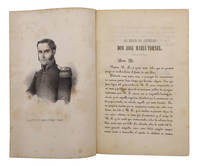
1850réf. 69045Mexico: Tipografia De Juan R. Navarro 1850. Mier y Teran's Expedition to Establish the Mexico-Texas Boundary with Observations on Natural History "Berlandier spent the years 1827 to 1831 exploring the north and western boundaries of Mexico at the request of Mexican Boundary Commission. The day-by-day records of the expedition were published in this volume possibly as an aftermath of the Mexican War" - Wagner-Camp-Becker. First edition of this essential book for the study of the Southwest with the oft-lacking portrait. Becker does not mention a portrait and it was lacking from the Jennie Crocker Henderson copy Howell catalogue 50. Jean Louis Berlandier was actually a native of France joined the Mexican Boundary Commission as a zoologist and botanist studying the region's natural history. During his time studying the flora and fauna of the Mexico-Texas border he also became fascinated with the Indigenous people of the region. Berlandier settled in Matamoros after the survey continuing his studies of natural history until he was drowned during a perilous crossing of the San Fernando River in 1851. Collections of his papers and journals and sketches are held at the Smithsonian at Harvard and at Yale University. "A few copies are known with a frontispiece.the best scientific study of Texas during the colonial period. Berlandier came to Mexico to collect botanical specimens for a group of Swiss naturalists and to accompany Gen. Manuel de Mier y Teran on his scientific expedition to Texas in 1828.he was observant careful and intelligent and he left us a record that is unmatched for his era in Texas" - Jenkins. Quarto. Marbled boards backed in green morocco spine gilt. Extremities worn boards somewhat scraped some staining to leather. Even tanning and light scattered staining. About very good. WAGNER-CAMP-BECKER 178a. GOMEZ & GONZALES 467. BASIC TEXAS BOOKS 14. HOWES B379 "aa". hardcover books
1670réf. 18794Rome: Giovanni Giacomo de Rossi 1670. First edition. Hardcover. Very good. Oblong folio of engravings. The first work has 43 numbered plates beginning with a dedication: "Eminentissimo ac reuerendissimo Principi Camillo Maximo S.R.E. Cardinali amplissimo." The 43 plates were engraved by Pietro Santo Bartoli and are complete. Bound with: "D. Nicolao Simonello picturae omiumque bonarum artium cultori eximio." 15 engraved plates complete. Bound with: "Serenissimo Principi Medices Leonis X admirandae virtutis imagines ab Hetruriae legatione ad Pontificatum a Raphaeli Urbinata ad vivum et ad miraculum expressas in Aulaeis Vaticanis." 15 engraved plates complete. The dedicatee of the first work Carlo Cardinal Massimo was created a cardinal in 1670; he died in 1677. This helps date the present work. The engravings are printed on one side only of each leaf. The leaves are bound along the left side in a contemporary or near contemporary binding of quarter leather gilt spine rules decorated paper boards. Edges corners and hinges are scuffed and worn small spine repair else this is very good with the engravings in fine condition. The engravings of each work are complete and rare thus. Giovanni Giacomo de Rossi hardcover books
1782réf. 287287London: Boydell 1782. Second. hardcover. very good. Raphael. Illustrated with 106 engraved plates 45 in outline some foxing throughout. Tall folio recently rebound in 1/2 crimson morocco marbled boards. London: Printed for John Boydell 1782. Second edition. A very good copy in a fine binding. An elaborate artist's manual first published in 1759. It celebrates Raphael's cartoons purchased by William and Mary and then housed in their own gallery within Hampton Court. Ralph's book begins with 12 plates "of the Study of Geometrical Figures." These are followed by 4 plates of human bodies engraved as academic designs by B. Picart. The bulk of the book shows heads of figures from Raphael's cartoons. The plates each depict two heads which are shown in simple line drawings followed with a finished engraving of the same heads. This second edition contains one hundred and six plates as opposed to 75 plates in the first edition of 1759. Boydell unknown books
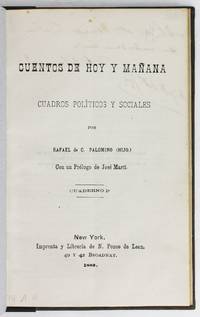
1883réf. 4665New York: Imprenta y Libreria de N. Ponce de Leon 1883. Very good. vii53pp. Modern quarter calf and marbled boards spine gilt. Inscribed by the author on verso of title page. Manuscript pencil numbering to top corner of each page. Minor foxing. One of the most important and intriguing 19th century Cuban-American imprints featuring two Socialist 'morality tales' that while lauding the quest for social and economic equally also decry the risks posed by human nature and totalitarianism upon the practical application of Marxism. It was written by the prominent Cuban émigré Rafael de Castro Palomino and features a famous prologue by his close friend and colleague José Martí. From the 1870s to 1890s New York City was the heart of the Cuban community in exile. During the Ten Years' War 1868-1878 a wave of Cuban dissidents many being highly educated and with financial resources arrived in New York forming a vibrant and politically active community. There they had almost unfettered freedom to publish raise money and buy arms to support the struggle in the homeland especially since the U.S. Government hoped to exploit instability in Cuba for its own imperialistic advantage. From 1881 until 1895 José Martí 1853-1895 the brilliant author philosopher poet and journalist who was the 'Apostle of Cuban Independence' often made New York his home. Upon Martí's arrival in New York in 1881 he was greatly assisted by Rafael de Castro Palomino a long-established Cuban resident of the city. Palomino was a prominent Socialist writer and journalist being the author of numerous articles and short books. Even though his name comes up frequently much of Palomino's biography remains hazy. We do know that he was considerably older than Martí hailed form an affluent Havana family and had been educated in France. Like Martí he was deeply concerned about the potential excesses and pitfalls of Marxism as applied on the real world. Notably Martí and Palomino were close friends of Néstor Ponce de León y de la Guardia 1837-1899. An exiled Cuban lawyer and bibliophile he founded the Imprenta y Librería de N. Ponce de León in the early 1870s a Spanish-language printing house and bookstore that became the intellectual center of the New York Cuban émigré community. As an interesting side note he possessed the largest Spanish language private library in New York featuring more than 1700 titles which he made openly available to his colleagues such as Martí and Palomino. The work is relatively rare and particularly so in commerce. We locate four copies in OCLC at the University of Florida's Cuban collection Harvard Yale and the University of Chicago. An important work from the Cuban exile community. Imprenta y Libreria de N. Ponce de Leon unknown books
réf. 542567Softcover. Near Fine. Typed carbon manuscript. Two volumes. Quartos. 393 leaves typed rectos only 1-196; 197-393 pp. Bound in quarter black canvas and flexible black wrappers with typed labels. Light edgewear very near fine. A collection of 16 stories which was published in 1946. On the contents page a title of a story is added in ink presumably by Sabatini and nearly every title has a penciled note as to where it was first published etc. in a different hand. In the typescript itself there are 42 revisions totaling some 57 words plus deletions on 29 pages numbered approximate – again all presumably by Sabatini; together with 10 typos corrected on 8 pages. The corrections and revisions are made in ink and red pencil. Sabatini’s stories are tales of bravery heroism intrigue and adventure. His manuscripts are exceptional uncommon. xxxcheck stories for any significancexxx. unknown books
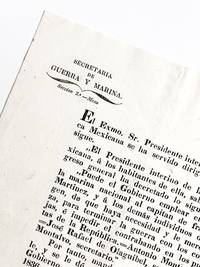
1836réf. 52758Mexico City: Palacio del Gobierno Nacional 1836. Fine. Official printed government notice of Mexico's continuing efforts to maintain control over Texas immediately after the loss at San Jacinto - here working with privateers to harass Texans at sea. When Mexico finally won its independence from Spain in 1821 its territory included modern-day Texas settled by a mix of Tejano Mexican and Texian Anglo-American populations in addition to indigenous tribes and enslaved African Americans. Tensions between the Tejano and Texian factions increased and finally erupted into full-scale violence in 1835 beginning what is now called the Texas Revolution. Its most famous battle at the Alamo occurred a few months before this broadside was issued. The decisive battle of the war San Jacinto occurred on 21 April a Mexican defeat that led to the formation of the Republic of Texas. While the Mexican general Santa Anna negotiated a surrender the Mexican government deposed him for it and refused to recognize an independent Texas. After San Jacinto Mexico avoided pitched battles but continued to take action to undermine and antagonize the new Texas nation. This broadside was one such effort issued just over a week after the defeat at San Jacinto. It announces the formal employment in the navy of private ships to aid in attacking Texans at sea and forming a blockade "para terminar la guerra con los colonos de Tejas é impedir el contrabando en los puertos y costas de la República". Privateers were necessary because the Mexican government did not yet have a robust navy a weakness that the United States would later exploit in the Mexican-American War of 1846-1848. Ephemeral broadsides like this survive in few numbers; many of this era during José Justo Corro's interim presidency show only two or three institutional holdings via OCLC. This particular imprint shows three institutional holdings in the US Baylor Texas A&M and Brigham Young. A rare piece of Texana. 12'' x 8.25''. Single letterpress broadside printed recto only. A bit of faint wrinkling. Crisp and bright. Palacio del Gobierno Nacional unknown books
réf. 9178New York: Dieu Donné Papermill Inc 2002. Limited Edition. Hardcover. Fine in Fine Slipcase. Limited Edition. Hardcover. An artist book with poems by Raphael Rubinstein. "Each book cover is a one-of-a-kind handmade paper collage created by the artist in the papermaking studio assisted by Susan Gosin and Mina Takahashi. The white cotton text paper and colored abaca chapter covers were handmade at Dieu Donne Papermill. The circles in the chapter covers were die-cut by hand. Carol Joyce bound the edition and slipcase each book in one of four colors of raw Indian silk to match the colored chapter covers. The text is letterpress printed in Avenir types by Ruth Lingen." from the colophon. OCLC finds 5 copies only Getty U.Minnesota U.Wisconsin U.Washington BNF; we find 2 additional copies at the Met and MoMA. Tight bright and unmarred. Collaged covers composed of hand-cut paper and string with translucent paper overlaid onto boards; contents variously letterpressed photo-copied and digitally printed with die-cut chapter covers and various inserts; matching slipcase in gold silk. 4to. np. Illus. color and b/w plates. Numbered limited edition this being 15 of 17 Artists Proofs in addition to the 30 of the Standard edition for a total of 47 copies. Dieu Donné Papermill, Inc hardcover books
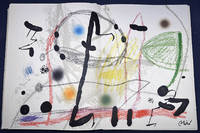
réf. B-26-040005MIRÓ Joan 1893–1983 & ALBERTI Rafael 1902–1999. Maravillas con Variaciones Acrósticas en El Jardín de Miró Wonders with Acrostic Variations in Miró's Garden. Barcelona: Ediciones Polígrafa S.A. 1975. Folio complete portfolio loose as issued housed in the original publisher's cloth slipcase and lithographic chemise. A vibrant collaboration between two titans of 20th-century Spanish art and literature pairing Rafael Alberti's celebratory acrostic poems with Joan Miró's expressive surrealist graphics. Beautifully illustrated with 15 original color lithographs by Miró signed in the stone including 6 double-page spreads plus 2 additional original color lithographs decorating the chemise and slipcase printed on fine Guarro paper with custom watermark. From a limited edition of 315 copies this copy is #259 of the primary edition run of 225 hand-signed in pencil on the colophon page by both Joan Miró and Rafael Alberti. Reference: Cramer Books 211; Mourlot 1051–1072. Ediciones Polígrafa books
1693réf. 15680Rome: Domenico de' Rossi 1693. Large folio. 10 hand-coloured engraved plates by Dorigny on laid paper each 15 7/8 x 26 inches approximately titles and imprints printed in gold black ink-ruled borders each plate cut to the edge of the image mounted on large sheets of contemporary thick laid paper each 29 3/8 x 40 3/8 inches approximately. Unbound A suite of ten engraved plates with very fine original hand colouring offering a stunning visual record of one of the best of the decorative interior schemes carried out by Raphael in Rome. This wonderful series records Raphael's 'Cupid and Psyche' series of frescoes carried out by him between 1516 and 1518 in the Loggia of Psyche in the villa Farnesina in Rome. The series also comes with a title and an eleventh plate of the ceiling fresco in the adjoining Sala di Galatea executed in 1512: neither the plate nor the title are present here. Originally published by the Rossis the engravings are the work of Nicolas Dorigny 1658-1746 who lived and worked in Rome between about 1690 and 1719. The painter classicist and art historian Giovanni Pietro Bellori 1613-1696 provided the text at the foot of the plates appropriate excerpts from Apuleuis's Golden Ass. "Raphael Invenit: Stampe da Rafaello" 1985 Dorigny 37-46; cf. Brunet IV 1111; cf. Berlin Katalog 4066. Domenico de' Rossi unknown books
1587réf. 68909London: H. Denham 1587. Full description: HOLINSHED Raphael. The First and second volumes of Chronicles comprising 1 The Description of England 2 The Description and Historie of Ireland 3 The Description and Historie of Scotland: First collected and published by Raphael Holinshed William Harrison and others: now newlie augmented and continued with manifold matters of singular note and worthie memorie to the year 1586 by John Hooker alias Vowell Gent and others. London: at the expenses of John Harrison George Bishop Rafe Newberie Henrie Denham and Thomas Woodcocke 1587. Together with: HOLINSHED Raphael. The Third volume of Chronicles beginning at duke William the Norman commonlie called the Conqueror; and descending by degrees of yeares to all the kings and queenes of England in their orderlie successions. London: at the expenses of John Harrison George Bishop Rafe Newberie Henrie Denham and Thomas Woodcocke 1587. Second edition of the true Shakespeare edition. Three volumes bound in four. Four folios 13 7/8 x 9 1/8 inches; 353 x 232 mm. viii 250 iv 202 27 table 1 blank; 8 9-61 1 blank; 121 183 1 blank 10 table; 431 437-438 431-432 438-464 16 table; viii 132 135-798; 799-1080 1080-1189 1191-1192 1192-1371 1371-1592 58 table. Seven title pages within engraved woodcut borders McKerrow and Ferguson 147a148 122 and 138 numerous ornamental intials head- and tailpieces. Black letter double column. Index to Vols I and II divided and bound at end of each section. The History of Scotland is bound after the two parts of the History of Ireland in Volume II as in Lowndes. Complete but with many of the usual excised leaves apparently supplied from 18th-century printings as is commonly found and mostly in the third volume. Full 18th-century tan calf. Boards ruled and stamped in gilt. Spines ruled and lettered in gilt. Board edges ruled in gilt. Gilt dentelles. All edges gilt. Marbled endpapers. Green silk page-markers. Some rubbing and repairs along outer joints. Title-page for History of Ireland with a small marginal tear not affecting engraving. Vol III part I: Title-page is trimmed and mounted. There is some staining to inner margin. Volume III part II with the penultimate leaf with repairs and the final leaf being cut down and mounted to verso. Previous owner's bookplate on front pastedown of each volume. Still overall a very good clean copy. Holinshed's Chronicles was the source for many of Shakespeare's plays including Richard II Richard III the Henry Plays Macbeth and Cymbeline. The first edition of the Chronicles was originally thought to be Shakespeare's source but the work of Boswell-Stone and Anders established this second edition as the true Shakespeare edition. The Chronicles were always politically sensitive. This 'newlie augmented' edition contained several passages which were brought to the attention of Queen Elizabeth I. These were mainly concerned with Anglo-Scottish affairs Mary Queen of Scots the Babington conspiracy and Leicester's campaign in the Low Countries. Elizabeth ordered the Archbishop of Canterbury to recall the book which resulted in the numerous cancels to be found in volumes II and III. "In 1587 a second edition of Holinshed's Chronicles appeared. It was a substantial undertaking. The colophon to this text indicates that it was printed cum privilegio that is under a royal privilege by Henry Denham at the sign of The Star in Aldersgate at the expense of John Harrison George Bishop Ralph Newbury and Thomas Woodcocke. Holinshed's Chronicles of 1587 were castrated and reformed in three stages. The hands of Randolph Killigrew and Hammond clearly dictated the earliest stage of censorship evident in the earliest revised state of the text. Their work removed passages in the continuation of the Scottish history that might jeopardize Anglo-Scottish relations especially those concerned with English intervention in Scottish factional politics. In the continuation of the 'History of England' their reforms enhanced the stature of Leicester distanced England from the duc d'Alençon who had recently offended the Dutch and polished accounts of English legal practice to insist that trials and executions in England were administered fairly and according to due process of law. The censors apparently acted with the speed required by the privy council's order since the first stage of the censorship was probably completed during the first week of February. This can be detected in one cancel in the 'History of Scotland' containing revised text that refers to the 'now imprisoned queene of Scotland' p. 443 sig. A6-7. Since the page with this reference was reset the initial review and reformation including the resetting of the cancel leaves must have taken place within a week of the initial order for censorship and before Mary's execution on 8 February 1587. Then once the text had been reformed to meet Killigrew's Randolph's and Hammond's requirements it was fine-tuned probably by Whitgift since at this stage censorship eliminated much of a long history of the archbishops of Canterbury. All the castrations and cancels appear in the sections of the 1587 Chronicles that extended Holinshed's earlier histories of Scotland and England. Besides the few extant copies of the Chronicles that escaped castration and reformation some copies exist that contain variant cancels together with more original leaves than the state of the text described in the STC. Without a census of extant copies of Holinshed's 1587 Chronicles it is unclear how many copies reflect each successive state of the text. Since the sale was stayed and the subsequent reformations made within a month of the book's completion and initial publication copies with a fully uncensored text appear to be very rare. And although a particular copy may predominantly reflect a given state of the text of 1587 two circumstances may produce yet more variation. It is possible that in any one copy where leaves should have been castrated and replaced with cancels the site none the less may have been overlooked and the castration not made. Thus original leaves in one site or more may coexist in a copy with cancels elsewhere. Conversely a castration may have been made but the cancel not added. As a further complication besides the variations that may have been produced in the sixteenth-century printing house some copies of the Chronicles result from changes produced by antiquarian interests in the eighteenth century. Between 1723 and 1728 three facsimile reprints of the castrated leaves were sold with the clear intention that they should be sophisticated into existing copies of the Chronicles to replace cancels and missing leaves. Consequently many copies of the 1587 edition have eighteenth-century leaves sophisticated at one or more of the castration sites." Oxford DNB. Lowndes p1086; Pforzheimer 1577 9 first edition; STC 13569. HBS 68909. $27500. H. Denham unknown books