2178 risultati
188016pp., with ills. in text + 3 engraved plates out-of-text, 41cm., text in German, hardcover binding (marbled baords, spine in red leather), marbled endpapers, some foxing, good condition, S97564
1969rif. 87772Unterschneidheim: Uhl 1969. 10 Bl., 72 Taf. 2° Ln. *sehr gutes, sauberes Expl.*.
1994rif. S79061Boston, Museum of Fine Arts 1994 630pp. richly illustrated in colour and bl/w, 33cm., hardcover (publisher's cloth), illustrated dustwrapper, Good condition, [Exhibition catalogue containing some important essays regarding Rubens], weight is 4kg. (extra shipping expenses might be required), S79061
1994630pp. richly illustrated in colour and bl/w, 33cm., hardcover (publisher's cloth), illustrated dustwrapper, Good condition, [Exhibition catalogue containing some important essays regarding Rubens], weight is 4kg. (extra shipping expenses might be required), S79061
rif. 66867Turnhout, Brepols, 2006 Hardback, original editor's jacket, english, german, french, dutch, 19x25 cm., VIII+688 pp., 190 x 250 mm. ***library stamps present on title page and spine ISBN 9782503515663.
rif. 0666008078.Ghardcover. Good. Access codes and supplements are not guaranteed with used items. May be an ex-library book. hardcover
1958rif. AUB-3013Genève, A. Skira 1958. Bel exemplaire relié, reliure pleine toile ornée d'éd., gd in-4, 203 pages avec planches dépliantes.
rif. 1258410877.Gpaperback. Good. Access codes and supplements are not guaranteed with used items. May be an ex-library book. paperback
rif. 0266363407.Ghardcover. Good. Access codes and supplements are not guaranteed with used items. May be an ex-library book. hardcover
rif. ria9783388701288_inpHardcover. New. New Book; Fast Shipping from UK; Not signed; Not First Edition; Réimpression inchangée de l'édition originale de 1877. La maison d'édition Antigonos est spécialisée dans la publication de réimpressions de livres historiques. Nous veillons à ce que ces ouvrages soient mis à la disposition du public d hardcover
rif. ria9783385024137_inpHardcover. New. New Book; Fast Shipping from UK; Not signed; Not First Edition; Réimpression inchangée de l'édition originale de 1877. hardcover
rif. ria9781484262894_inpPaperback. New. New Book; Fast Shipping from UK; Not signed; Not First Edition; Childhood learning is now more screen-based than ever before and app developers are flocking in droves to this lucrative and exciting market. The younger generation deserves the best and growing up in a digital world has made them dis paperback
1962rif. 617734London: Eyre & Spottiswoode 1962. First edition hard cover with clipped dust jacket both in very good condition. Jacket design by Nicholas Jenkins. From the collection of Ian Angus former librarian at King's College London and deputy librarian at University College London ownership pencilled to FEP. General shelf and handling wear including sunning and light creasing and wear to jacket. Spine slightly cocked. Purple cloth boards are in fine condition pages tightly bound content unmarked. CN. First Edition. Hardcover. Very Good/Very Good. Eyre & Spottiswoode Hardcover
rif. 6202179325.Gpaperback. Good. Access codes and supplements are not guaranteed with used items. May be an ex-library book. paperback
2017rif. 2-6202402997Novas Edições Acadêmicas 2017. Paperback. New. 64 pages. 8.66x5.91x0.15 inches. Novas Edições Acadêmicas paperback
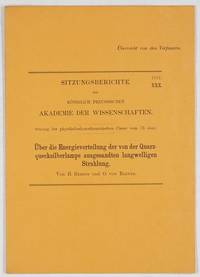
1914rif. 111891914. S.ber. Akad. Wiss. Berl. 1914. - Berlin 1914 8° pp.169-190 7 Fig. orig. Broschur; Umschl. etw. angeschm. Rare Offprint! Heinrich Rubens 1865-1922 physicist. He is known for his measurements of the energy of black-body radiation which led Max Planck to the discovery of his radiation law. This was the genesis of quantum theory. Rubens worked on electromagnetic radiation particularly in the infrared. In 1900 he proved through measurements with Ferdinand Kurlbaum that Wien's law of radiation does not apply to the long-wave range. These precise investigations into the radiation of black bodies were essential for the development of the origins of quantum theory by Max Planck. He used the Auer gas incandescent light and proved that Planck's law of radiation also applies in the infrared part of the spectrum. He developed the method of Rubens' residual rays to generate infrared radiation and the Rubens flame tube named after him. He was regarded as a masterful experimenter who did not spare himself in his experiments he carried out the precision measurement of blackbody radiation for a long time at night in winter in an unheated laboratory in favourable weather conditions. His lecture experiments were also considered exemplary. Hans Joachim von Wartenberg 1880-1960 Chemiker für Anorganische Chemie und Physikalische Chemie. unknown
1898rif. 111801898. Am. J. Sc. 5. - 1898 8° pp.33-46 5 Fig. orig. Broschur. Rare Offprint! Heinrich Rubens 1865-1922 physicist. He is known for his measurements of the energy of black-body radiation which led Max Planck to the discovery of his radiation law. This was the genesis of quantum theory. Rubens worked on electromagnetic radiation. particularly in the infrared. In 1900j he proved through measurements with Ferdinand Kurlbaum that Wien's law of radiation does not apply to the long-wave range. These precise investigations into the radiation of black bodies were essential for the development of the origins of quantum theory by Max Planck. He used the Auer gas incandescent light and proved that Planck's law of radiation also applies in the infrared part of the spectrum. He developed the method of Rubens' residual rays to generate infrared radiation and the Rubens flame tube named after him. He was regarded as a masterful experimenter who did not spare himself in his experiments he carried out the precision measurement of blackbody radiation for a long time at night in winter in an unheated laboratory in favourable weather conditions. His lecture experiments were also considered exemplary. Augustus Trowbridge 1870-1934 was a physics professor and dean at Princeton University. unknown
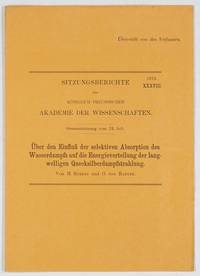
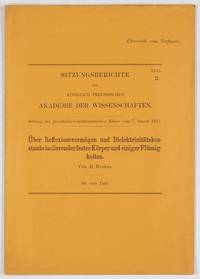
1913rif. 111871913. S.ber. Akad. Wiss. Berl. 1913. - Berlin 1913 Gr.8° pp.802-809 4 Fig. orig. Broschur. Rare Offprint! Heinrich Rubens 1865-1922 physicist. He is known for his measurements of the energy of black-body radiation which led Max Planck to the discovery of his radiation law. This was the genesis of quantum theory. Rubens worked on electromagnetic radiation particularly in the infrared. In 1900 he proved through measurements with Ferdinand Kurlbaum that Wien's law of radiation does not apply to the long-wave range. These precise investigations into the radiation of black bodies were essential for the development of the origins of quantum theory by Max Planck. He used the Auer gas incandescent light and proved that Planck's law of radiation also applies in the infrared part of the spectrum. He developed the method of Rubens' residual rays to generate infrared radiation and the Rubens flame tube named after him. He was regarded as a masterful experimenter who did not spare himself in his experiments he carried out the precision measurement of blackbody radiation for a long time at night in winter in an unheated laboratory in favourable weather conditions. His lecture experiments were also considered exemplary. Otto von Baeyer 1877-1946 was a German physicist. Otto Hahn and Lise Meitner together with Otto von Baeyer focussed on the magnetic deflection of ß-rays. They succeeded for the first time in obtaining beta-ray spectra from a series of radioactive emitters. unknown
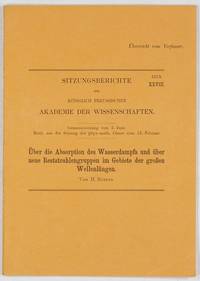
1913rif. 111861913. S.ber. Akad. Wiss. Berl. 1913. - Berlin 1913 8° pp.513-549 14 Fig. orig. Broschur. Rare Offprint! Heinrich Rubens 1865-1922 physicist. He is known for his measurements of the energy of black-body radiation which led Max Planck to the discovery of his radiation law. This was the genesis of quantum theory. Rubens worked on electromagnetic radiation particularly in the infrared. In 1900 he proved through measurements with Ferdinand Kurlbaum that Wien's law of radiation does not apply to the long-wave range. These precise investigations into the radiation of black bodies were essential for the development of the origins of quantum theory by Max Planck. He used the Auer gas incandescent light and proved that Planck's law of radiation also applies in the infrared part of the spectrum. He developed the method of Rubens' residual rays to generate infrared radiation and the Rubens flame tube named after him. He was regarded as a masterful experimenter who did not spare himself in his experiments he carried out the precision measurement of blackbody radiation for a long time at night in winter in an unheated laboratory in favourable weather conditions. His lecture experiments were also considered exemplary. unknown
1911rif. 111831911. S.ber. Akad. Wiss. Berl. 1911. - Berlin 1911 8° pp.666-677 5 Fig. orig. Broschur. Rare Offprint! Heinrich Rubens 1865-1922 physicist. He is known for his measurements of the energy of black-body radiation which led Max Planck to the discovery of his radiation law. This was the genesis of quantum theory. Rubens worked on electromagnetic radiation particularly in the infrared. In 1900 he proved through measurements with Ferdinand Kurlbaum that Wien's law of radiation does not apply to the long-wave range. These precise investigations into the radiation of black bodies were essential for the development of the origins of quantum theory by Max Planck. He used the Auer gas incandescent light and proved that Planck's law of radiation also applies in the infrared part of the spectrum. He developed the method of Rubens' residual rays to generate infrared radiation and the Rubens flame tube named after him. He was regarded as a masterful experimenter who did not spare himself in his experiments he carried out the precision measurement of blackbody radiation for a long time at night in winter in an unheated laboratory in favourable weather conditions. His lecture experiments were also considered exemplary. Otto von Baeyer 1877-1946 was a German physicist. Otto Hahn and Lise Meitner together with Otto von Baeyer focussed on the magnetic deflection of ß-rays. They succeeded for the first time in obtaining beta-ray spectra from a series of radioactive emitters. unknown
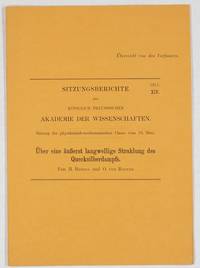
1911rif. 111841911. S.ber. Akad. Wiss. Berl. 1911. - Berlin 1911 8° pp.339-345 1 Fig. orig. Broschur. Rare Offprint! Heinrich Rubens 1865-1922 physicist. He is known for his measurements of the energy of black-body radiation which led Max Planck to the discovery of his radiation law. This was the genesis of quantum theory. Rubens worked on electromagnetic radiation particularly in the infrared. In 1900 he proved through measurements with Ferdinand Kurlbaum that Wien's law of radiation does not apply to the long-wave range. These precise investigations into the radiation of black bodies were essential for the development of the origins of quantum theory by Max Planck. He used the Auer gas incandescent light and proved that Planck's law of radiation also applies in the infrared part of the spectrum. He developed the method of Rubens' residual rays to generate infrared radiation and the Rubens flame tube named after him. He was regarded as a masterful experimenter who did not spare himself in his experiments he carried out the precision measurement of blackbody radiation for a long time at night in winter in an unheated laboratory in favourable weather conditions. His lecture experiments were also considered exemplary. Otto von Baeyer 1877-1946 was a German physicist. Otto Hahn and Lise Meitner together with Otto von Baeyer focussed on the magnetic deflection of ß-rays. They succeeded for the first time in obtaining beta-ray spectra from a series of radioactive emitters. unknown
1915rif. 111901915. S.ber. Akad. Wiss. Berl. 1915 . Berlin 1915 8° pp.4-20 1 Falttafdel orig. Broschur. Rare Offprint! Heinrich Rubens 1865-1922 physicist. He is known for his measurements of the energy of black-body radiation which led Max Planck to the discovery of his radiation law. This was the genesis of quantum theory. Rubens worked on electromagnetic radiation particularly in the infrared. In 1900 he proved through measurements with Ferdinand Kurlbaum that Wien's law of radiation does not apply to the long-wave range. These precise investigations into the radiation of black bodies were essential for the development of the origins of quantum theory by Max Planck. He used the Auer gas incandescent light and proved that Planck's law of radiation also applies in the infrared part of the spectrum. He developed the method of Rubens' residual rays to generate infrared radiation and the Rubens flame tube named after him. He was regarded as a masterful experimenter who did not spare himself in his experiments he carried out the precision measurement of blackbody radiation for a long time at night in winter in an unheated laboratory in favourable weather conditions. His lecture experiments were also considered exemplary. unknown
Rubens and his Workshop. The flight of Lot and his family from Sodom. Exhibition: Tokyo, National Museum of Western Art, 1994. 140 pages, fully illustrated in colour and black & white. Paperback. 28 x 23cms. A record of the research performed on the occasion of the study exhibition 'The flight of Lot and his family from Sodom', including comparisons with related works and technical analysis of the ground, pigments and painting techniques. A record of the research performed on the occasion of the study exhibition 'The flight of Lot and his family from Sodom', including comparisons with related works and technical analysis of the ground, pigments and painting techniques.
Jaffe, Michael: Rubens e l'Italia. Fratelli Palombi, 1984. 132 pages of text and 346 plates in black & white. Hardback. 29 x 23cms. Study on Rubens and the influence of his diplomatic travels to Italy on his work. Text in Italian. Study on Rubens and the influence of his diplomatic travels to Italy on his work. Text in Italian
Sutton, Peter C: The Age of Rubens. Exhibition: Boston, Museum of Fine Arts, 1993. 500pp with 140 colour and 250 monochrome illustrations. Cloth. 32.4x24.1cms. Scholarly new examination of the works of Rubens,focusing on his studio, colleagues and period. With contributions by experts in the field, discussing patronage,the role of Flemish Baroque painting in the Counter Reformation in the Netherlands, and the influence of the classical and humanist traditions on the art of Rubens and his circle. With bibliography, biographies. Scholarly new examination of the works of Rubens,focusing on his studio, colleagues and period. With contributions by experts in the field, discussing patronage,the role of Flemish Baroque painting in the Counter Reformation in the Netherlands, and the influence of the classical and humanist traditions on the art of Rubens and his circle. With bibliography, biographies. Text in English