730 resultados
ref. 8287470 x 33 cm am Bildrand beschnitten 69 x 32 cm Kleine Randläsuren schönes Exemplar. Lith. de A. Merian aus der Folge: Auswahl der Werke Hans Holbein des jüngeren. I. Theil. Passionsgeschichte in 8 Abtheilungen. Nagler 10 314 6-13. - Oeri Hans Jakob 1782 Kyburg - Zürich 1868 Sohn des Hans Georg Pfarrers und der Cleophea von Meiss. Ledig. 1800 Lehre beim Landschaftsmaler Johann Kaspar Kuster. Ab 1802 Teilnahme an den lokalen Ausstellungen in Zürich. 1803-07 mit David Sulzer in Paris Arbeit im Atelier von Jacques-Louis David. 1809 mit Jakob Christoph Miville Reise nach Moskau dort Lehrer und Porträtist. 1812 wegen Napoleons Russlandfeldzug Flucht aus Moskau nach Lübeck Verlust zahlreicher Studien. 1819 Rückkehr nach Zürich. Lithograf für den Basler Kunstverlag Birmann & Söhne sowie die Hofkunsthandlung von Johann Velten in Karlsruhe. Später Reisen nach Dresden Frankfurt a.M. und Kassel. O. schuf Porträts grossformatige Lithografien nach Hans Holbein dem Jüngeren Raffael oder Fra Bartolomeo zeichnete und aquarellierte hist. Szenen sowie "Kostüm-Studien aller Jahrhunderte christl. Zeitrechnung". Tapan Bhattacharya HLS 010 unknown
ref. 8287269 x 33 cm am Bildrand beschnitten 67 x 32 cm Etwas stockfleckig schönes Exemplar. Lith. de A. Merian aus der Folge: Auswahl der Werke Hans Holbein des jüngeren. I. Theil. Passionsgeschichte in 8 Abtheilungen. Nagler 10 314 6-13. - Oeri Hans Jakob 1782 Kyburg - Zürich 1868 Sohn des Hans Georg Pfarrers und der Cleophea von Meiss. Ledig. 1800 Lehre beim Landschaftsmaler Johann Kaspar Kuster. Ab 1802 Teilnahme an den lokalen Ausstellungen in Zürich. 1803-07 mit David Sulzer in Paris Arbeit im Atelier von Jacques-Louis David. 1809 mit Jakob Christoph Miville Reise nach Moskau dort Lehrer und Porträtist. 1812 wegen Napoleons Russlandfeldzug Flucht aus Moskau nach Lübeck Verlust zahlreicher Studien. 1819 Rückkehr nach Zürich. Lithograf für den Basler Kunstverlag Birmann & Söhne sowie die Hofkunsthandlung von Johann Velten in Karlsruhe. Später Reisen nach Dresden Frankfurt a.M. und Kassel. O. schuf Porträts grossformatige Lithografien nach Hans Holbein dem Jüngeren Raffael oder Fra Bartolomeo zeichnete und aquarellierte hist. Szenen sowie "Kostüm-Studien aller Jahrhunderte christl. Zeitrechnung". Tapan Bhattacharya HLS 010 unknown
ref. 8287171 x 37 cm beschnitten 70 x 32 cm Etwas stockfleckig schönes Exemplar. Lith. von Schmidt aus der Folge: Auswahl der Werke Hans Holbein des jüngeren. I. Theil. Passionsgeschichte in 8 Abtheilungen. Nagler 10 314 6-13. - Oeri Hans Jakob 1782 Kyburg - Zürich 1868 Sohn des Hans Georg Pfarrers und der Cleophea von Meiss. Ledig. 1800 Lehre beim Landschaftsmaler Johann Kaspar Kuster. Ab 1802 Teilnahme an den lokalen Ausstellungen in Zürich. 1803-07 mit David Sulzer in Paris Arbeit im Atelier von Jacques-Louis David. 1809 mit Jakob Christoph Miville Reise nach Moskau dort Lehrer und Porträtist. 1812 wegen Napoleons Russlandfeldzug Flucht aus Moskau nach Lübeck Verlust zahlreicher Studien. 1819 Rückkehr nach Zürich. Lithograf für den Basler Kunstverlag Birmann & Söhne sowie die Hofkunsthandlung von Johann Velten in Karlsruhe. Später Reisen nach Dresden Frankfurt a.M. und Kassel. O. schuf Porträts grossformatige Lithografien nach Hans Holbein dem Jüngeren Raffael oder Fra Bartolomeo zeichnete und aquarellierte hist. Szenen sowie "Kostüm-Studien aller Jahrhunderte christl. Zeitrechnung". Tapan Bhattacharya HLS 010 unknown
ref. 8287375 x 36 cm beschnitten 71 x 32 cm Etwas stockfleckig schönes Exemplar. Gedruckt von S. Leuthe aus der Folge: Auswahl der Werke Hans Holbein des jüngeren. I. Theil. Passionsgeschichte in 8 Abtheilungen. Nagler 10 314 6-13. - Oeri Hans Jakob 1782 Kyburg - Zürich 1868 Sohn des Hans Georg Pfarrers und der Cleophea von Meiss. Ledig. 1800 Lehre beim Landschaftsmaler Johann Kaspar Kuster. Ab 1802 Teilnahme an den lokalen Ausstellungen in Zürich. 1803-07 mit David Sulzer in Paris Arbeit im Atelier von Jacques-Louis David. 1809 mit Jakob Christoph Miville Reise nach Moskau dort Lehrer und Porträtist. 1812 wegen Napoleons Russlandfeldzug Flucht aus Moskau nach Lübeck Verlust zahlreicher Studien. 1819 Rückkehr nach Zürich. Lithograf für den Basler Kunstverlag Birmann & Söhne sowie die Hofkunsthandlung von Johann Velten in Karlsruhe. Später Reisen nach Dresden Frankfurt a.M. und Kassel. O. schuf Porträts grossformatige Lithografien nach Hans Holbein dem Jüngeren Raffael oder Fra Bartolomeo zeichnete und aquarellierte hist. Szenen sowie "Kostüm-Studien aller Jahrhunderte christl. Zeitrechnung". Tapan Bhattacharya HLS 010 unknown
ref. 25092Köln DuMont 1997. 4° 256 S. über 250 teilw. farb. Abb. OLwd. m. OU OU tlw. etw. wellig sonst tadellos. Dt. EA nach der ebnglischsprachigen EA. Mit dem «oft vernachlässigten Teil» von Holbeins Schaffen «den nur in wenigen Resten erhaltenen Monumentaldekorationen». 010 Köln, DuMont, 1997 unknown
ref. 33988München G. Müller 1918. Kl.8° 207 S. u. zahlr. Taf. Priv.-HLdr. m. gold. Rückenpräg. Kapitale etw. berieben vord. Gelenk geplatzt sonst tadell. EA dieser Ausg.: Reprint der Ausgabe bei Georg Decker Berlin 1781. = Die Bücherei der Abtei Thelem 12. Bd. 010 München, G. Müller, 1918 unknown
ref. 58528Uttweil am Bodensee Conrad Uhler 1845. 8°. VIII mit 48 getönt. Holzst.-Tafeln OLwd. d. Zt. mit Deckeltitel gold- u. blindgepr. Deckel etwas fleckig Rücken sauber verstärkt innen durchgehend fingerfleckig Nicht in Pfister/Oppermann u. Massmann.- Seltene Ausgabe mit 48 Wiedergaben inkl. Titel nach den Radierungen von Christian de Mechel aus "Le Triomphe de la mort" Basel 1780. Die letzten beiden Blätter zeigen die zwei Seiten einer Dolchscheide mit dem Totentanz-Motiven in der Art eines Resumées. 010 Uttweil am Bodensee, Conrad Uhler, [1845] unknown
ref. 68935Edinburgh o. Vlg. 1788. 8° 1 Bl. 2 Kupfern Portrait D. Deuchar; frz. Titelkupfer von Mechels Kupferstich von 1780 aber mit Duchars Namen u. der Jahreszahl 1786 als Fronti. bzw. Taf. I Titelbl. Portrait H. Holbein 2 S. Preface 1 Kupfer «Creatio Mundi» 46 S. Text wechselnd mit 46 Kupfern. Zusätzlich: 1 Kupfer Mortalium Nobilitas 2-streifiger Kupferstich: Dolchscheiden-Totentanz. Ldr. d. Zeit gold.geprägt. m. Rückenschild. Blätter durchgängig fingerfleckig Monogramm a. erstem Kupferstich a. Vs. Meist Abklatsch der Kupfern auf Textseite ein Blatt am Steg minimal verstärkt. Die Kupfern manchmal etwas flach abgezogen. Ohne das Wappen des Todes. Die Bildunterschriften in den Kupfern in Latein die erläuternden Texte engl./frz. - David Deuchar 1743 - 1808 kopierte recht unbeschwert die 30 Totentanzstiche von Wenzel Hollar 1607-1677 den jener nach Holbein neu gestochen hatte. Die dekorative Rahmen um die Kupferstiche nach Abraham van Diepenbeck 1596-1675. - Massmann 57. - 010 Edinburgh, o. Vlg., 1788 unknown
1832ref. 233834München 1832. 53 lithographs on tissue tipped in. 1 vols. 8vo. Bound in full brown morocco a.e.g. Very good. Bookplate of Van Nest. 53 lithographs on tissue tipped in. 1 vols. 8vo. unknown
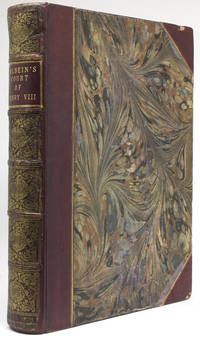
1828ref. 44152London: William Bulmer and Co. Shakespeare Printing-Office 1828. Second edition. With 84 hand-colored stipple engravings after drawings by Hans Holbein in the Royal collections with tissue guards. Printed on pink or white paper. Unpaginated. 1 vols. Folio 14 x 10 inches. Contemporary 3/4 red morocco panelled spine elaborately gilt with brown morocco lettering-piece a.e.g. original spine neatly laid down. Second edition. With 84 hand-colored stipple engravings after drawings by Hans Holbein in the Royal collections with tissue guards. Printed on pink or white paper. Unpaginated. 1 vols. Folio 14 x 10 inches. A handsome collection of portraits many printed on toned paper with letterpress commentaries on the subjects' lives. In addition to the 80 portraits called for in the printed "List of Plates" there should also be 4 plates which that list omits: the portrait of Holbein himself that of his wife and the portraits of Henry and Charles sons of Charles Brandon Duke of Suffolk. William Bulmer and Co., Shakespeare Printing-Office unknown
ref. 0348-25London um 1630. Radierung. 27 5 x 20 2 cm. Plattengr. Mit schmalem Rand. Auf Trägerkarton montiert. Sonst gut erhalten. Gestochenes Portrait des britischen Adeligen und Staatsmannes Thomas Howard 3. Duke of Norfolk 1473-1554 nach dem Gemälde von Hans Holbein d. J. 1497-1543 aus dem Jahr 1539. Lucas Vorsterman 1595-1675 dürfte das Gemälde Holbeins in einem der Anwesen der Earls of Arundel gesehen und studiert haben. In der Platte mit gestochenem Vermerk: Visitur in Aedibus Arondelianis Londini Vorsterman fecit". London?, um 1630. unknown
ref. 114481London Printed by William Bulmer and Co/ Shakespeare Printing-Office 1812. 4to 338x265 mm. 71 ll. 84 engr. colour plates several printed on pink paper. One plate with stain. Contemporary red half calf spine gilt with raised bands embossed red cloth boards spine and corners a bit worn. Abbey Life in England 205 note. Second edition complete with all 84 finely colour printed portraits after Holbein including the two full page portraits of Hans Holbein and his wife and the two finely coloured miniatures. It was first published in 1792-1800 in folio. The plates are re-engraved to this new edition in a lesser size and by several new engravers. The biographical notices were provided by Edmund Lodge 1756-1839. ”The original Holbein drawings upon which these prints are based were nearly lost and were hardly seen for centuries until their rediscovery by none other than Queen Caroline of England. Upon being liberated from a bureau of the queen's personal closet at Kensington Palace colour printed 'imitations' of the drawings were subsequently published under the auspices of John Chamberlaine 1745-1812 Keeper of the drawings of George III.” hardcover
ref. B9781019202142Hardback. New. hardcover
ref. B9781108488426Hardback. New. This potentially paradigm-shifting book uses an interdisciplinary perspective to challenge existing theories of voter turnout focusing on solutions geared towards civic education and electoral reform to increase dismal rates of youth turnout. The authors investigate reasons and remedies for the gap between youth turnout intentions and behaviors. hardcover
ref. #[60354]Half length portrait of Erasmus of Rotterdam in elaborated oval frame with caduceus and shield with Medusa's head. Inscription on plynth below:' DESIDERIO ERASMO / ROTTERODAMO. / Effigiem Desiderii qui cernis Erasmi / Humano quiddam grandius ore vides. / Perlege Scriptoris divina volumina magni / Coelesti dices scripta fuisse manu. / Doctrinam eloquium pietatem singula spirat / Pagina: nec quicquam tersius esse potest. / Ardua qui studiis et seria junxit amoenis / Utile qui dulci miscuit; ille fuit / Editus ad Mosam Rheni delatus ad amnem / Praeposuit patriae te Basilea suae. / Terra Virum repetit post mortem Belgica; jamque / Nascitur in Batavo rursus ut ante solo. / Petrus Francius'. In 'Desiderii Erasmi Roterodami Opera omnia emendatiora et auctiora . in decem tomos distincta.' Leiden: Pieter van der Aa 1703. l Engraving on paper with margins; platemark: 413 x 301 mm; total: 453 x 335 mm; few tiny holes some dirt on the left margin. W 20; M 1493. PP02E Erasmus unknown
1812ref. 73606London: John Chamberlaine 1812. Bartolozzi developed his style to imitate the subtleties of renaissance and baroque chalk drawings and became deservedly famous for his stipple engraving. The portraits in this collection show how effective this technique was in reproducing with such incredible fidelity Holbein's original designs. Engraved by BARTOLOZZI Francesco in IMITATIONS OF ORIGINAL DRAWINGS BY HANS HOLBEIN IN THE COLLECTION OF HIS MAJESTY FOR THE PORTRAITS OF ILLUSTRIOUS PERSONS OF THE COURT OF HENRY VIII. WITH BIOGRAPHICAL TRACTS. Stipple engraving. Printed colour. Size: 333 x 250 mm Fine condition. unknown
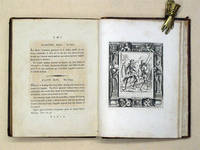
1803ref. FB5537 /4DRed leather binding with raised banding gilt decoration and title on the spine. Gilt 'Cambridge panel' on the boards. "Descriptions of each plate in French and English with the Scripture Text from which the designs were taken. Printed by W. Smith and Co. King Street Seven Dials for John Scott No. 447 Strand: & Thomas Ostell No. 3 Ave Maria Lane 1803". Engraved frontispiece engraved title engraved portrait of Holbein. Full leather cover with embossed design and gilt decoration. This is a very hard to find rare book. Note: this book is lovingly reset in its original papers by the expert bookbinder Brian Cole. It is again in fantastic condition which ought to see out a further two hundred years. The Dance of Death 1493 by Michael Wolgemut from the Nuremberg Chronicle of Hartmann Schedel The Danse Macabre also called the Dance of Death is an artistic genre of allegory from the Late Middle Ages on the universality of death. The Danse Macabre consists of the dead or a personification of death summoning representatives from all walks of life to dance along to the grave typically with a pope emperor king child and laborer. The effect is both frivolous and terrifying beseeching its audience to react emotionally. It was produced as memento mori to remind people of the fragility of their lives and how vain the glories of earthly life. Its origins are postulated from illustrated sermon texts; the earliest recorded visual scheme apart from 14th century Triumph of Death paintings was a now-lost mural at Holy Innocents' Cemetery in Paris dating from 1424 to 1425. Hans Holbein the Younger Hans Holbein der Jüngere; c. 1497 – between 7 October and 29 November 1543 was a German-Swiss painter and printmaker who worked in a Northern Renaissance style and is considered one of the greatest portraitists of the 16th century. He also produced religious art satire and Reformation propaganda and he made a significant contribution to the history of book design. He is called "the Younger" to distinguish him from his father Hans Holbein the Elder an accomplished painter of the Late Gothic school. Holbein was born in Augsburg but worked mainly in Basel as a young artist. At first he painted murals and religious works and designed stained glass windows and illustrations for books from the printer Johann Froben. He also painted an occasional portrait making his international mark with portraits of humanist Desiderius Erasmus of Rotterdam. When the Reformation reached Basel Holbein worked for reformist clients while continuing to serve traditional religious patrons. His Late Gothic style was enriched by artistic trends in Italy France and the Netherlands as well as by Renaissance humanism. The result was a combined aesthetic uniquely his own. Holbein travelled to England in 1526 in search of work with a recommendation from Erasmus. He was welcomed into the humanist circle of Thomas More where he quickly built a high reputation. He returned to Basel for four years then resumed his career in England in 1532 under the patronage of Anne Boleyn and Thomas Cromwell. By 1535 he was King's Painter to Henry VIII of England. In this role he produced portraits and festive decorations as well as designs for jewellery plate and other precious objects. His portraits of the royal family and nobles are a record of the court in the years when Henry was asserting his supremacy over the Church of England. Holbein's art was prized from early in his career. French poet and reformer Nicholas Bourbon the elder dubbed him "the Apelles of our time" a typical accolade at the time. Holbein has also been described as a great "one-off" in art history since he founded no school. Some of his work was lost after his death but much was collected and he was recognized among the great portrait masters by the 19th century. Recent exhibitions have also highlighted his versatility. He created designs ranging from intricate jewellery to monumental frescoes. Holbein's art has sometimes been called realist since he drew and painted with a rare precision. His portraits were renowned in their time for their likeness and it is through his eyes that many famous figures of his day are pictured today such as Erasmus and More. He was never content with outward appearance however; he embedded layers of symbolism allusion and paradox in his art to the lasting fascination of scholars. In the view of art historian Ellis Waterhouse his portraiture "remains unsurpassed for sureness and economy of statement penetration into character and a combined richness and purity of style'. Renowned for his Dance of Death series the famous designs by Hans Holbein the Younger 1497–1543 were drawn in 1526 while he was in Basel. They were cut in wood by the accomplished Formschneider block cutter Hans Lützelburger. William Ivins quoting W. J. Linton writes of Lützelburger's work wrote: "'Nothing indeed by knife or by graver is of higher quality than this man's doing.' For by common acclaim the originals are technically the most marvelous woodcuts ever made." These woodcuts soon appeared in proofs with titles in German. The first book edition containing forty-one woodcuts was published at Lyons by the Treschsel brothers in 1538. The popularity of the work and the currency of its message are underscored by the fact that there were eleven editions before 1562 and over the sixteenth century perhaps as many as a hundred unauthorized editions and imitations. Ten further designs were added in later editions. The Dance of Death 1523–26 refashions the late-medieval allegory of the Danse Macabre as a reformist satire and one can see the beginnings of a gradual shift from traditional to reformed Christianity. That shift had many permutations however and in a study Natalie Zemon Davis has shown that the contemporary reception and afterlife of Holbein's designs lent themselves to neither purely Catholic or Protestant doctrine but could be outfitted with different surrounding prefaces and sermons as printers and writers of different political and religious leanings took them up. Most importantly "The pictures and the Bible quotations above them were the main attractions … Both Catholics and Protestants wished through the pictures to turn men's thoughts to a Christian preparation for death.". The 1538 edition which contained Latin quotations from the Bible above Holbein's designs and a French quatrain below composed by Gilles Corrozet 1510–1568 actually did not credit Holbein as the artist. It bore the title: Les simulachres & / HISTORIEES FACES / DE LA MORT AUTANT ELE/gammēt pourtraictes que artifi/ciellement imaginées. / A Lyon. / Soubz l'escu de COLOIGNE. / M.D. XXXVIII. "Images and Illustrated facets of Death as elegantly depicted as they are artfully conceived." These images and workings of death as captured in the phrase "histories faces" of the title "are the particular exemplification of the way death works the individual scenes in which the lessons of mortality are brought home to people of every station." John Scott & Thomas Ostell. hardcover
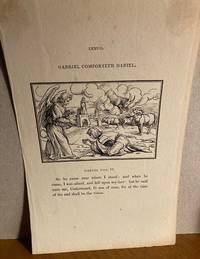
1858ref. 16035London:: Henry G. Bohn 1858. 7.5 x 4.75 inches. Single leaf from the 1858 edition of Hans Holbeins Dance of Death by Francis Douce & Thomas Frognall Dibdin. The leaf portrays the angel Gabriel comforting Daniel - Daniel VIII:17. with text lines beneath. Excellent woodblock and leaf in excellent condition. Top corners with a little bit of bleed from previous adhesive on verso overall excellent and suitable for framing. 7.5 x 4.75 inches. The reproduction fomr the Douce & Dibdin were cut from wood by Messrs. Bonner and Byfield. The authors aimed to provide extremely accurate woodcut representations of the original Holbein designs to readers. This leaf shows the clarity of line and beautiful use of light and shade which Holbein had achieved in his original work . [Henry G. Bohn,] unknown
1649ref. 15442Antwerp:: Adam Alexius Bierling 1649. First state. Rare. 10 x 14 cm. A fine impression. Clean with strong lines wide margins. A beautiful portrait. Suitable for framing. Pennington believes this portrait to be of Dr. Butts Henry VIIIÕs physician. New Hollstein suggests the sitter resembles Chas. Brandon Duke of Suffolk. Pennington 1554. Hollstein 1066. BM: 1853 0112.1938. Adam Alexius Bierling, unknown
ref. 15454London:: G. Smeeton 19th century early. Rare. We find no other copies of this particular print published by G. Smeeton other copies scarce as well appear later than ours. 11.5 x 19 cm. Fine impression. Minor edge wear at bottom edge margin no affect with large clean margins. Suitable for framing. Apparently created after Holbein portrait. ÒAndrew Boorde Boorde also spelled Borde born c. 1490 - 1549 English physician and author of the first English guidebook to Europe.Boorde was educated at the University of Oxford and was admitted as a member of the Carthusian order while still a minor. In 1521 he was Òdispensed from religionÓ to act as suffragan bishop of Chichester though he never filled the office and in 1529 he was freed from his monastic vows not being able to endure the hardships of religiosity. He visited the universities of Orlans Poitiers Toulouse Montpellier and Wittenberg saw Òmuch abominable vicesÓ at Rome and went on pilgrimage to Santiago de Compostela in Spain. In 1534 Boorde was again in London at the Charterhouse. Then the statesman Thomas Cromwell seems to have sent him to determine public feeling abroad about Henry VIIIÕs policies. In 1536 however he was studying and practicing medicine at Glasgow.About 1538 Boorde again traveled extensively visiting nearly all the countries of Europe and later making his way to Jerusalem. He settled for a time at Montpellier in France and before 1542 had completed his First Book of the Introduction of Knowledge in prose and Òryme doggerelÓ 1548 which ranks as the earliest continental guidebook. He also published Dietary of Health 1542 and Breviary 1547. He probably returned to England in 1542. His imprisonment toward the end of his life may have been for keeping Òloose womenÓ in his quarters at Winchester.Ó -Encylopedia Britannica. Folger 21105. G. Smeeton, unknown
1981ref. SBBI-mon0000144840HarperCollins Distribution Servi 1981. paperback. Good. Our good condition books are generally good for reading but not for gifting or collecting. They could have imperfections such as creasing fanning inscriptions margin notes yellowing staining on edge or cover or pages bumps scuffs etc etc sometimes multiple of these. It's a wide category that encompasses anything that isn't almost-new down to anything that is slightly better than poor. We would NOT recommend gifting Good books - these should be considered reading copies. Our books are dispatched from a Yorkshire former cotton mill. We list via barcode/ISBN so please note that the images are stock images and may not be the exact copy you receive furthermore the details about edition and year might not be accurate as many publishers reuse the same ISBN for multiple editions and as we simply scan a barcode or enter an ISBN we do not check the validity of the edition data when listing. If you're looking for an exact edition please don't order at least not without checking with us first although we don't always have time to check. We aim to dispatch prompty the service used will depend on order value and book size. We can ship to most countries see our shipping policies. Payment is via Abe only. HarperCollins Distribution Servi paperback
ref. 51931181-nnew. unknown
ref. 38583759-nnew. unknown
ref. 5291622-nnew. unknown
ref. PR120946-049Portret van schilder Holbein door Franquinet naar Holbein. Tiré du cabinet du Roi d'Angleterre.Portrait - 19th century - lithograph -kunstenaar - artist<dl></dl> Original lithograph 50 x 33 cm. With creases and foxing on the edges illustration in reasonable good condition. unknown