Kandinsky, Wassily - Max Bill (Einf)Biblio.com

1 050 résultats
réf. 5115Bern Benteli 1952 u. 1955. 8° 142 u. 209 S. Abb. Brosch. m. OU u. Transparent-OU Umschlag min. gebräunt sonst tadellos. Enthält: Bd. 1: Über das Geistige in der Kunst 4. Aufl.; Bd. 2: Punkt und Linie zu Fläche. Beitrag zur Analyse der malerischen Elemente 3. Aufl.; beide Bände mit einer Einführung von Max Bill. 010 Bern, Benteli, 1952 u. 1955 unknown
réf. 52926Milano Mazzotta 2001. 4° 329 S. zahlr. teilw. farb. Abb. Brosch. Name auf Schmutztitelbl. Verlagsschildchen auf letztem Bl. gutes Exemplar. Anlässlich der gleichnamigen Ausstellung. Text it. 010 Milano, Mazzotta, 2001 unknown
réf. 55822München Haus der Kunst 1994. 4° Fronti. 567 S. 516 farb. Abb. Brosch. Min. gebrauchsspurig sonst tadell. Anlässlich der gleichnamigen Ausstellung. Mit Werkverzeichnis u. umfangreichem Anhang. 010 München, Haus der Kunst, 1994 unknown
1958réf. 47380New York: Harry Abrams 1958. 920 illustrations including 41 in color. 428 pp. 1 vols. 4to. Cloth. Dust jacket chipped else very good. 920 illustrations including 41 in color. 428 pp. 1 vols. 4to. Harry Abrams hardcover
1958réf. 28584New York: Harry Abrams 1958. 920 illustrations including 41 in color. 428 pp. 1 vols. 4to. Cloth. Dust jacket chipped else very good. 920 illustrations including 41 in color. 428 pp. 1 vols. 4to. Harry Abrams hardcover
réf. 40373Munich Prestel 2008. Large Folio 320pp. Original boards in pictorila dustwrappervery slightly rubbed and bruised toward top corner. Numerous photogrpahic illustrations document reproductions and full-colour reproductions of Kandinsky's works many of them full-page alongside essays by Evelyn Bensch Christian Drouet Helmut Friedel Annegret Hoberg Noemi Smolik Reinhard Spieler and Christian Wolsdorff. Main volume is held in pictorial slipcase within which is held a black envelope containing a slim folio bearing 12 full-colour plates of Kandinsky's 'Little Worlds" Kleine Welten styed in the facsimile of a 1922 German language publication. A near-fine copy. Includes folio of plates Munich, Prestel, 2008. hardcover
1961réf. 109909Milano : Il Saggiatore 1961. reliure d'éditeur. Kandinsky Wassili.Wassili Kandinsky. Contrappunti. Aquerelli e disegni. Milano Il Saggiatore1961 330x300mm 56 pagine 15 incisione a colori legatura del editore. Bien complet des deux passes-partouts en fin de volume. Très bel exemplaire. No hidden customs fees for orders shipped to the U.S.A with a value of up to 800 USD PDDP shipping we pay the VAT in advance Il Saggiatore unknown
réf. 107138Paris : Delpire éditeur sans date. demi-toile. KANDINSKY Wassily.Wassily Kandinsky. Interférences. Aquarelles et dessins. Paris Delpire éditeur sans date 330x305mm 51 pages planches en couleurs et n/bavec deux passe-partout blanc et noir collation effectué: bien complet de toutes les planches détachables reliure demi-toile. Nom du possesseur sur le haut de la page de garde supérieure autrement bel exemplaire. No hidden customs fees for orders shipped to the U.S.A with a value of up to 800 USD PDDP shipping we pay the VAT in advance Delpire éditeur unknown
réf. 39225Paris Galerie Maeght 1957. 1 Doppelbl. Später als 1922 ausgeführte Gouache als Entwurf für ein Wandbild in der Ausstellung der Juryfreien Kunstschau Berlin unknown
réf. G9688671002I2N00COLOFON. Paperback. Like New. Pages are clean and are not marred by notes or folds of any kind. ~ ThriftBooks: Read More Spend Less.Dust jacket quality is not guaranteed. COLOFON paperback
2013réf. ABE-1756908033278Thornwillow Press 2013. Newburgh: Thornwillow Press 2013. 8vo 33 p. original wraps with french flaps. First edition of this title excerpted from "On the Spiritual in Art". One of 350 copies this copy being No. 254 designed by Luke Ives Pontifell. Light wear to spine heel and wrap edges else a NF copy in publisher's lightly discolored and creased paper folio. 1st Edition. Soft cover. Near Fine. Thornwillow Press Paperback
1934réf. 47944Paris.: Editions Surréalistes. 1934. Full black crushed morocco by Georges Leroux with his signature gilt boards with abstract geometric rules in gilt and green and outlined parallelograms several with inlaid café crème calf smooth spine with gilt titles café crème calf doublures bright green brushed suede free endpapers original publisher's printed wrappers in black and red and backstrip with titles in black preserved a.e.g. black morocco-edged green paper-covered board slipcase with additional signature at foot. 8vo. 192 x 146 mm. Leaf with half-title recto and 'Du Même Auteur' verso leaf with Kandinsky's dry point engraving as frontispiece verso printed title in red and black with copyright verso Char's verse two leaves with 'Table' and final leaf with justification and achevé d'imprimer recto. PROVENANCE: Discreet bookplate of bibliophile François Ragazzoni with his name and initials 'F R' in blue to front free endpaper verso. The édition de tête of the first edition of René Char's collection with Wassily Kandinsky's original frontispiece etching and bound by Georges Leroux. From the édition de tête limited to 20 numbered copies on papier de Hollande van Gelder with Kandinsky's original dry point engraving as frontispiece; only copies from the édition de tête were issued with the original engraving.Also included inserted loose is the scarce subscription announcement printed on yellow paper 172 x 272 mm with a quotation from the Comte de Lautréamont ' . Pour le moment et pour plus tard vous n'avez pas besoin d'en savoir davantage' and with manuscript notes verso in pencil in an unidentified hand these mention 'Picasso - Parade' 'Cocteau' 'No sur les Ballets Russes' etc.Kandinsky's untitled etching issued in only 20 impressions was followed by only two further etchings those for 'La Main Passe' 1934 and 'Fraternity' 1939 before Kandinsky's death in 1944. Pablo Picasso was a profound admirer of Char and of the work which collected all of Char's poems published after 1927 and submitted an etching for the second edition - printed in a very similar format to this edition - published again by José Corti's Editions Surréalistes in 1945. A third illustrated edition was also published illustrated by Joan Miró in 1976. This first edition and in this issue of 20 copies with Kandinsky's etching is the rarest of the editions; Picasso's etching for the édition de tête was issued in 25 copies while the version with Miró's etchings was an edition of 215 copies 50 with an additional suite.'Le Marteaus sans Maître' includes 'Abondance Viendra' 'Poèmes Militants' it appeared here for the first time 'Arsenal' corrected and with four new poems 'Artine' and 'L'Action de la Justice est Eteinte'. In the present copy the poems 'Sosie' and 'Détachement' feature corrections by Char in green ink. He has amended the last line of 'Sosie' to read: 'Je ne vais pas au bout de ta pauvreté' for 'tes misères' a change reflected in the subsequent editions. The first line of 'Détachement' 'La fleur du pissenlit a perdu son identité' is crossed through and Char has drawn an arrow to it from a note beneath: 'Ce vers ricanait qu'il meurs / comme tant ce fin ricane. / R. C.' 'Détachement' was renamed 'Dentelée' for subsequent editions but was altered considerably by Char and the first line crossed through here was removed entirely.'Des trois éditions illustrées du 'Marteau sans Maître' celle-ci la première est la plus rare . Dans une lettre à Char du 28.11.1933 Kandinsky accepte la demande de fournir une gravure pour son livre bien qu'il ne connaisse pas l'auteur. Avec 'La Main Passe' de Tzara c'est le seul ouvrage poétique illustré par Kandinsky sic . '. De Parallèlement à Chanson Complète.'Auflage: 20 eigenhandig signierte Exemplare auf Van-Gelder-Butten . Veroffentlicht in der Luxusausgabe von Rene Char 'Le Marteau sans Maître' Paris Editions Surréalsites 1934.' Roethel.Roethel 199; see 'De Parallèlement à Chanson Complète' pp. 357 - 364; see lot 100 'Bibliothèque François Ragazzoni Seconde Partie: Editions Originales' Paris 13 / 14 May 2003. Editions Surréalistes. hardcover
1924réf. 46222Tokyo.: Idea-Shoin. 1924 Tai Sho 13. Original publisher's scarlet cloth with gilt vignettes after Kandinsky to front and rear boards original card slipcase with illustration after Kandinsky to front cover and printed text in Japanese to spine and rear cover. 4to. 258 x 198 mm. Printed title in Japanese and Western characters on glossy paper monochrome photographic portrait of Kandinsky with reproduction of his signature as frontispiece Kandinsky's translated text in Japanese with occasional insertions in Western characters illustrated with 9 monochrome text vignettes 3 'Tabelle' of colour theory and 57 plates on a variety of paper stocks 9 in colour and 48 in monochrome several with multiple images on the same sheet including the 'Abbildungen' at rear final leaf with imprint verso; the illustration incorporates that for 'Uber das Geistige in der Kunst' as well as many from 'Klänge'. A very scarce edition of Kandinsky's Uber das Geistige in der Kunst published in Japan in 1924.Although Reinhard Piper feared that Kandinsky's treatise on abstraction would not sell well the book required three editions in the first year it was published. This Japanese edition published nearly 15 years after the original incorporates the text and woodcuts of the earlier editions as well as Kandinsky's later introductions to the first and second editions as well as illustration from 'Klänge'. The majority of the plates depict work by Kandinsky but works by Dürer Raphael Cézanne and others are also included.The Japanese translation is by Obara Kuniyoshi 1887 - 1977 the publisher translator and educational theorist and president of Tamagawa University which he founded. His Idea-Shoin publishing house later the Tamagawa University Press was established in 1923 and aimed to produce teaching material educational work for children Obara published the first encyclopedia for Japanese children as well as the complete works of the Swiss educator Johann Heinrich Pestalozzi. Obara's translation of the present work is not only an indication of the importance of Kandinsky's text and theories but also casts light on the emergence of Japan's own avant-garde and its international influences.'The book which he Kandinsky claimed had been gestating for nearly a decade elucidated his artistic theories and his valuing of expression and spirituality over naturalistic representation. It also introduced his new pictorial categories derived from the field of music - impressions improvisations and compositions - which further de-emphasized the importance of recognizable subject matter. On the cover and in ten woodcuts Kandinsky illustrated his ideas by reducing complex scenes of spiritual battle and redemption to simplified designs of lines and shapes. For Kandinsky abstraction was a weapon for transforming what he perceived to be a corrupt materialist society.' see MOMA catalogue.'One of the most important manifestos of modern art. Written in 1910 and first published in 1912 Kandinsky's book is anti-materialistic and anti-naturalistic calling for painting that goes beyond a recording of the visible world. The non-objective woodcuts are historically important as early graphic demonstrations of the artist's thesis.' The Artist and the Book.Obara's translation is scarce and we can trace only the copies at the Metropolitan Museum and the Phillips collection outside Japan for which OCLC list copies at the National Diet Library and Waseda University Library.see Roethel 82 - 92; see The Artist and the Book 137 for the first edition of 1912. Idea-Shoin. hardcover
1956réf. 13309Paris: Galerie 93 1956. First Edition. Original wraps. Fine. 10p octavo. 1/500 signed by Cesar Domela. Illustrated. Laid in is a black & white print signed by Domela. Fine in gray blue printed wraps. Signed by Authors Galerie 93 paperback
réf. 54647363like new. unknown
réf. 54647363-nnew. unknown
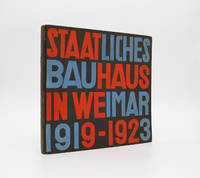
réf. 30686Weimar-München: Bauhausverlag. 1923. First edition first printing. First edition first printing. Publishers original black paper covered boards with titles in red and blue to the upper board. 24.8 x 25.4cm. 225pp. Text in German. Typographic cover design by Herbert Bayer. Page typography by László Moholy-Nagy. Illustrated profusely throughout with nine original full page colour lithographs by Herbert Bayer Marcel Breuer Ludwig Hirschfeld-Mack Peter Keler Wolfgang Molnar Kurt Schmidt Fritz Schleifer Rudolph Paris and László Moholy-Nagy with a further 11 full page colour plates and 147 black and white plates. Colour lithographs and cover printed by Dietsch & Bruckner Weimar. A genuinely very good copy the binding square and firm with mild rubbing to the extremities a few light marks to the boards the corners bumped. The contents with mild toning to the text pages not affecting the plates and few roughly cut edges to a couple of plates are otherwise clean throughout and free from inscriptions or stamps. All original lithographs are clean bright and free from tears. An attractive example of this notoriously fragile production which is very uncommon in this entirely original condition. The first book published by the legendary Bauhaus issued on the occasion of the landmark 1923 exhibition in Weimar. Following its reopening in 1919 the former state art school embarked on a radical new approach to art and education under the direction of Walter Gropius. The 1923 exhibition 'Art and Technology: A New Unity' offered the public its first comprehensive glimpse of the Bauhaus programme and its revolutionary synthesis of art craft architecture and design. The exhibition catalogue produced in a total edition of 2600 copies comprising 2000 in German 300 in English and 300 in Russian includes contributions by Gertrud Grunow Paul Klee Wassily Kandinsky László Moholy-Nagy and Oskar Schlemmer which offer rare insight into the Bauhaus's experimental teaching methods artistic philosophy and emerging theoretical principles. A landmark publication and an important primary document of the early Bauhaus that stands as a testament to the founding of one of the most influential institutions in twentieth-century art architecture and design. Further details and images for any of the items listed are available on request. All items are catalogued by humans. Lucius Books welcomes direct contact with our customers. Weimar-München: Bauhausverlag. 1923 hardcover
1973réf. 240202005AThe Pace Gallery 1973. Paperback. Like New. 0x0x0. LIKE NEW. Very Clean. No writing or tears. The Pace Gallery paperback
1976réf. 140655Wiesbaden: Hasso Ebeling Verlag 1976. Mit 4 Holzschnitten. Großformatige Hardcoverausgabe mit Schutzumschlag Leineneinband mit goldgeprägtem Rücken- und Deckeltitel 136 Seiten mit zahlreichen Abbildungen. Gutes Exemplar. Wiesbaden: Hasso Ebeling Verlag hardcover
1979réf. 137841München: R. Piper & Co. Verlag 1979. 2. Auflage des Faksimile-Drucks der Luxus-Ausgabe München Piper 1912 erschienen 1979 in einer Auflage von 1000 Exemplaren zum 75jährigen Jubiläum des Piper Verlages. Großformatige Paperbackausgabe mit Originalschuber 140 Seiten mit zahlreichen Abbildungen und mehreren Bildtafeln nebst zwei Beilagen. Gutes Exemplar. München: R. Piper & Co. Verlag paperback
réf. 32753109-nnew. unknown
réf. G3770147022I3N00DUMONT. Hardcover. Good. Pages can have notes/highlighting. Spine may show signs of wear. ~ ThriftBooks: Read More Spend Less.Dust jacket quality is not guaranteed. DUMONT hardcover
1912réf. 62248München Piper & Co 1912. Small 4to. Original illustrated full cloth stating Dritte Auflage - i.e. third issue. Binding brownspotted and with tear to lower capital. Internally a bit of occasional brownspotting. Owner's signature to title-page Fjeltofte. 8 104 pp. 8 plates 3 unnumbered leaves of tables Tabelle I-III advertisement leaf. Illustrated with original woodcuts in the text 10 in all. The scarce first edition first printing of Kandinsky’s landmark theoretical work of art ”A seminal text in the history of modern art” Guggenheim curiously bound in the third issue binding. The first issue is easily distinguishable from the second and third that also appeared in 1912 as they are both expanded and have 124 pp. whereas the first has 104. The present copy has small remains of stitching towards the inner margins so perhaps someone had this first issue printing inserted into the third issue binding which is sturdy as opposed to the wrappers of the first issue. “In Concerning the Spiritual in Art Wassily Kandinsky one of the most famous abstract painters of all time urges the reader to free themselves from art's traditional bonds to material reality. In this radical theoretical work he calls for a spiritual revolution in painting arguing that artists much like musicians should be allowed to express their own inner lives in abstract non-material terms. Investigating form and colour spirituality and tradition Kandinsky explores art's resonance with the soul its purpose and nature and its power to inspire us to stir our emotions and to help us see beyond the limits of our world. A significant contribution to the understanding of non-objectivism in art this book serves as an important landmark in modern art history and is necessary reading for every artist and art-lover.” From the Penguin Classics edition. “In this remarkable book anticipating “the spiritual turning-point” Kandinsky reflects on his understanding of progress in this direction. This is not a process that would happen automatically. It requires a lot of work and implies a great responsibility of both artist and viewer. The task of the artist is to find “the principle of the innermost necessity” that he or she can use through expressive means to achieve the goal “vibration of the human soul.” Using captivating analogies Kandinsky dwells at length on the artistic means: the psychology of color the compositional interrelation of forms etc. However the main goal of an artist still remains to find that very innermost necessity” that is based on the spiritual foundations of the individual. In his or her turn the work of the viewer is to find within him- or herself the purity of perception which at this level does not relate to the beauty of nature. The ideal imitation of nature as the summit point of artistic mastery has remained in the past. The impressions of impressionists the emotions of expressionists the experiments of cubists - all these stages have long been passed and now the task of the viewer is to see the beauty of pure color and pure shape. Kandinsky anticipates the emergence of abstract art as the purest form of influence on the human soul and views the future optimistically foretelling the upcoming emergences of the epoch of great spirituality.” from Sadler’s English translation hardcover
1939réf. SPENDERS007080Atelier 17 Paris & New York. March 1939. First edition. Octavo. Spender's poem ''Fall of a City'' and Louis Aragon's translation ''Chute d'une Cit�'' together with nine engravings loose within wrappers. The engravings were printed by Atelier 17 and Henri Hecht and include one with aquatint and roulette one with soft ground etching one drypoint and one etching. All are on Montval handmade paper with deckle-edges. Held within the original plain board chemise but lacking the slipcase which had a Hayter titling-piece pasted onto the front. Stanley Hayter founded Atelier 17 in Paris in 1927 and it continues to this day in Rue Didot albeit with the name changed to Atelier Contrepoint. This production was his contribution to the raising of funds to help children orphaned by the Spanish Civil War.101 numbered copies were printed for sale and 12 for the contributors. This copy is unnumbered and hors commerce marked ''h.c'' on the limitation page. Each copy including this one was signed by Spender and Aragon at their respective contribution and by each artist in the lower margin of the etched sheet.Fine in custom burgundy morocco box with ''FRATERNITY'' in gilt on the lid. Very scarce with all nine loose etchings as most sets have been broken up for piecemeal sale. Atelier 17, Paris & New York. March, unknown
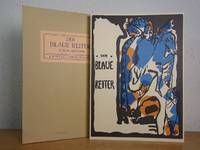
1912réf. 1720151912. KANDINSKY Wassily. Der Blaue Reiter. Edited by Kandinsky and Franz Marc. 4 140 10 pp. illustrated with numerous illustrations including 4 plates skillfully coloured in pochoir 5 leaves of music including 2 folding plates. 4to 298 x 220 mm. in later full morocco with the wrappers preserved. Munich: R. Piper & Co. 1912. First edition of this rare and important landmark of twentieth-century art. Although it contains no original prints Der Blaue Reiter is a key publication in any collection of twentieth century illustrated books especially in Germany. It features articles on a wide variety of subjects including one on the music of Arnold Schoenberg. Published just before the outbreak of the First World War copies of both the first and second edition have long been hard to obtain. a small advertisement has been excised at the rear otherwise a fine copy of a considerable rarity usually only encountered in the second edition. The Artist and the Book 139 listing the second edition. Johnson Artists' Books in the Modern Era 1870-2000 No20. unknown