558 résultats
1747réf. 16913Paris: chez Gersaint et chez Surugue 1747. Engraving printed on laid paper. Very good condition with the exception of some repair in the bottom right hand corner of sheet. Image size: 13 7/8 x 19 inches. A charming arabesque depicting a group of children playfully engaged in an argument from Moyreau's "Oeuvres Des Estampes Gravées d'après Les Tableaux & Desseins de feu Antoine Watteau." Born in Valenciennes in 1684 the versatile artist Jean-Antoine Watteau was primarily renowned for his fête galante paintings depicting aristocratic men and women amorously conversing in the outdoors. Following a brief apprenticeship to the local painter Jacques-Albert Gérin Watteau moved to Paris in 1702 where he later studied with Claude Gillot scene painter for the comédie italienne who introduced him to the commedia dell'arte which later became a recurrent theme in his work. In 1708 he began to work with the decorator Claude Audran under whose tutelage he produced several innovative ornamental decorations that were for porcelain furniture and textiles. Watteau was also a prolific draughtsman and his varied and substantial oeuvre includes military genre religious mythological and theatrical scenes as well as tapestry cartoons. After Watteau's death in 1721 his friend Jean de Jullienne commissioned a comprehensive body of engravings after the artist's drawings and paintings which further solidified his reputation as one of the most influential and prominent artists of the Rococo period. Cf. Benezit Dictionnaire des Peintres Sculpteurs Dessinateurs et Graveurs vol 14 p. 473-6; cf. Dacier & Vuaflart Jean de Jullienne et Les Graveurs de Watteau au XVIIIeime Siècle 119. chez Gersaint et chez Surugue unknown books
1929réf. 30574 tomes reliés en 2 volumes. Extraordinaire somme sur Watteau. 1/2 chagrin rouge, dos à nerfs, pièces de titre vertes, couvertures des plats supérieurs conservées, non rognés. Paris Rousseau 1929 2 forts volumes grands in-4°
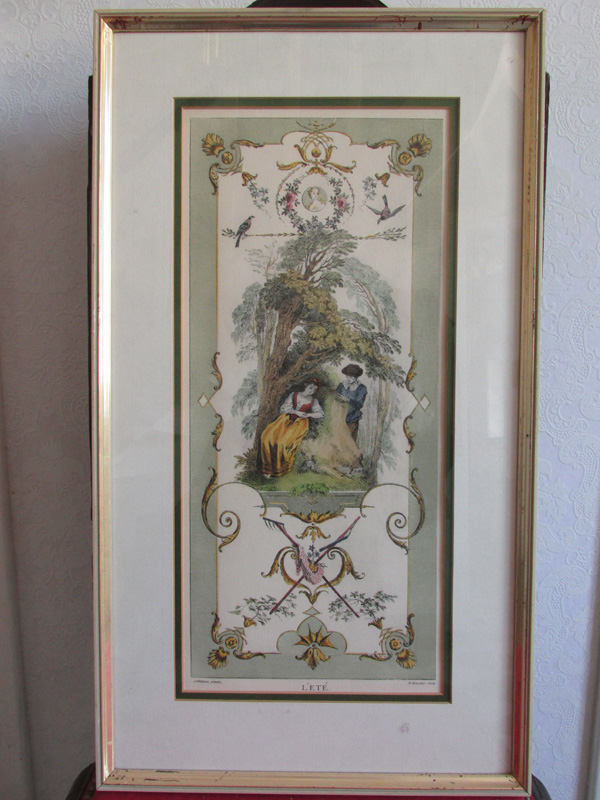
réf. BIL-17101Vermutlich frühes 20. Jahrhundert. Druckgraphiken im Format von 50 x 23 cm unter Passepartouts (Rahmenformat: 68 x 38 cm); jeweils unterzeichnet mit A. Watteau und F. Boucher. Stilistisch passende Rahmungen mit innenliegender Goldleiste und Verglasung. Mit enthalten sind zwei Seitenkopien eines Auktionskataloges, in dem die vier Werke beschrieben werden. Zum Frühlingsmotiv heißt es dort: "A Composition with two young Lovers (Le Printemps): The central group affords the usual connection between love and spring. The medallion contains an young girl's head. The trophy consists of an agricultural fork and a long spindle." Und zum Sommermotiv: "Composition with Young Country Couple (L'Été): In the medallion a girl's head. A rake and hoe make up the trophy." Rückwände jeweils mit Aufkleber der Kölner Kunsthandlung Goyert; eine Rückwand außerdem mit handschriftlicher Ankaufsnotiz. Druckgraphiken nach Wandpanelen oder Paravents von Antoine Watteau, gestochen von François Boucher. Es handelt sich um zwei Teile einer ehemals vierteiligen Jahreszeitenserie. Antoine Watteau (1684 - 1721) zählt zu den bedeutendsten Malern des französischen Rokoko. Mit seinen "Fêtes galantes", in denen in üppiger landschaftlicher Umgebung Liebespaare, schöne Frauen, Tänzer oder auch Hirten dargestellt werden, schuf er eine eigene Bildgattung. Die größte Anzahl von Watteau-Gemälden befindet sich heute, ehemals von Friedrich dem Großen erworben, im Besitz der Stiftung Preußische Schlösser und Gärten Berlin-Brandenburg. François Boucher (1703 - 1770), Maler, Zeichner und Kupferstecher, widmete sich in der Tradition Watteaus, den er bewunderte, künstlerisch ebenfalls der galanten Welt des Rokoko, die er in mythologischen, teilweise erotischen Motiven darstellte. Boucher hatte von 1742 an den Rang eines Hofmalers des französischen Königs inne, außerdem avancierte er zum Günstling der Maitresse des Königs, der einflussreichen Marquise de Pompadour. Es handelt sich bei den beiden angebotenen Darstellungen vermutlich nicht um Original-Kupferstiche der Zeit (18. Jahrhundert), sondern um Reproduktionen aus dem früheren 20. Jahrhundert.
réf. 100053aafParis, chez la Ve. de F. Chereau, s.d., après 1733, 45 x 60 cm, eau-forte et burin coloriée à la main, encadrement en bois doré (59 x 73.5 cm). (sans verre).
1780réf. P3198Paris c.1780. some restoration otherwise good. Notes: Jean-Antoine Watteau French pronunciation: ʒan‿ɑ̃twan wato; October 10 1684 – July 18 1721 was a French painter whose brief career spurred the revival of interest in colour and movement in the tradition of Correggio and Rubens. He revitalized the waning Baroque style and indeed moved it to the less severe more naturalistic less formally classical Rococo. Watteau is credited with inventing the genre of fêtes galantes: scenes of bucolic and idyllic charm suffused with an air of theatricality. Some of his best known subjects were drawn from the world of Italian comedy and ballet. Image Size : 422x538 mm 16.61x21.18 Inches Platemark Size : Paper Size : Coloring: Black & White Medium: Copper Engraving Categories: Performing Arts;Landscapes;Views Europe France Paris; unknown
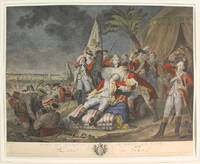
1783réf. P3317Paris. c. 1783. Very Good margins shaved closely. Notes: A depiction of General Louis-Joseph de Montcalm sustaining a fatal wound during the Battle of Quebec on September 13th 1759. Louis Joseph Watteau 1731- 1798 was a French painter active in Lille. He played a decisive role in the foundation of what would become the musée lillois des Beaux-Arts opened in 1803 by producing the first ever inventory of paintings confiscated by the state during the French Revolution. Image Size : 213x298 mm 8.40x11.75 Inches Platemark Size : Paper Size : 274x311 mm 10.80x12.25 Inches Coloring: Black & White Medium: Copper Engraving Categories: Military Canadian unknown
1983réf. 66292Frolich & Kaufmann Gmbh Distribution . As New. Hardcover. FREE UPGRADE to Courier/Priority Shipping Upon Request – – IN STOCK AND IMMEDIATELY AVAILABLE FOR SHIPMENT - AS NEW THE TEXT BLOCK IS PRISTINE CLEAN UNMARKED AND IN EXCELLENT CONDITION - - Text in German. 80 pp. With 57 ills. 5 col. . 30 x 25 cm. -- with a bonus offer-- . 1983. Frolich & Kaufmann Gmbh (Distribution) hardcover
1984réf. 36127National Gallery of Art. As New. Paperback. FREE UPGRADE to Courier/Priority Shipping Upon Request – – IN STOCK AND IMMEDIATELY AVAILABLE FOR SHIPMENT - AS NEW THE TEXT BLOCK IS PRISTINE CLEAN UNMARKED AND IN EXCELLENT CONDITION - 580 pages with 1273 ills. 104 col. . 28 x 22 cm. -- with a bonus offer--; T-Grawat; Grasselli Margaret M.; Rosenberg Pierre; Watteau Antoine; National Gallery of Art U.S.; Galeries Nationales Du Grand Palais France; Schloss Charlottenburg; Parmantier Nicole; et al Watteau 1684-1721 - National Gallery of Art Washington DC - June 17 - September 23 1984 WATTEAU JEAN ANTOINE 1684 1721 . 1984. 0894680749 . National Gallery of Art paperback
1969réf. 74185Galerie; Et Al. As New. Paperback. FREE UPGRADE to Courier/Priority Shipping Upon Request - IN STOCK AND IMMEDIATELY AVAILABLE FOR SHIPMENT - AS NEW THE TEXT BLOCK IS PRISTINE CLEAN UNMARKED AND IN EXCELLENT CONDITION - - Text in French. Includes essay by Andre Watteau. 40 works catalogued. Many illustrations including several in color. -- with a bonus offer-- . 1969. Galerie; Et Al paperback
réf. 91049Zoug Switzerland: Les Clefs Du Temps. As New. Hardcover. FREE UPGRADE to Courier/Priority Shipping Upon Request - IN STOCK AND IMMEDIATELY AVAILABLE FOR SHIPMENT - TEXT PRISTINE CLEAN & UNMARKED TIGHT TO SPINE - ND c 1974. 382 pages. Text in French. Among the artists included: Courbet Rousseau Troyon Francais Daubigny Harpignies Th. Ribot Bonvin Carolus-Duran Boudin and many others. Mint condition -- with a bonus offer--; T-Pilgeo; Pillement Georges; Preface By Watteau Andre Les Pre-Impressionnistes / The Pre-Impressionists Courbet Rousseau Troyon Francais Daubigny Harpignies Th. Ribot Bonvin Carolus-Duran Boudin . Les Clefs Du Temps hardcover
1924réf. 70285Bruxelles Belgium: Librairie National D'Art & D'Histoire / G. Van Oest & Cie. Very Good. Paperback. FREE UPGRADE to Courier/Priority Shipping Upon Request - IN STOCK AND IMMEDIATELY AVAILABLE FOR SHIPMENT - TEXT PRISTINE UNARKED---- 240 page monograph in French. Many black and white illustrations. -- with a bonus offer--; 040946; Pilon Edmond; Watteau Antoine Watteau et Son Ecole Bibliotheque De L'Art Du XVIIIe Siecle - Deuxième Édition Revue et Corrigée . 1924. Librairie National D'Art & D'Histoire / G. Van Oest & Cie. paperback
2010réf. 95916LE PASSAGE. New. Hardcover. FREE UPGRADE to Courier/Priority Shipping Upon Request - IN STOCK AND IMMEDIATELY AVAILABLE FOR SHIPMENT - Flawless copy brand new pristine never opened -- Text in French. 160 pp. ; 130 color illustrations. -- with a bonus offer-- . 2010. 2847421521 . LE PASSAGE hardcover
1970réf. 27666United Kingdom: Hamlyn. As New. Hardcover. FREE UPGRADE to Courier/Priority Shipping Upon Request - IN STOCK AND IMMEDIATELY AVAILABLE FOR SHIPMENT - Very Good. Light abrading creasing and chipping to edges of the DJ. -- with a bonus offer--; T-CORMACK . 1970. 0600025578 . Hamlyn hardcover
1912réf. 55051Stuttgart Germany: Deutsche Verlags-Anstalt. As New. Hardcover. FREE UPGRADE to Courier/Priority Shipping Upon Request – – IN STOCK AND IMMEDIATELY AVAILABLE FOR SHIPMENT - AS NEW THE TEXT BLOCK IS PRISTINE CLEAN UNMARKED AND IN EXCELLENT CONDITION - - Text in German. 200 pages. -- with a bonus offer-- . 1912. Deutsche Verlags-Anstalt hardcover
1984réf. 61075Museum. As New. Paperback. FREE UPGRADE to Courier/Priority Shipping Upon Request – – IN STOCK AND IMMEDIATELY AVAILABLE FOR SHIPMENT - AS NEW THE TEXT BLOCK IS PRISTINE CLEAN UNMARKED AND IN EXCELLENT CONDITION - - 64 pp. With 63 ills. 7 col. . 22 x 19 cm. -- with a bonus offer-- . 1984. 9171002596 . Museum paperback
1980réf. 64907Gallery. As New. Paperback. FREE UPGRADE to Courier/Priority Shipping Upon Request – – IN STOCK AND IMMEDIATELY AVAILABLE FOR SHIPMENT - AS NEW THE TEXT BLOCK IS PRISTINE CLEAN UNMARKED AND IN EXCELLENT CONDITION - - Text in French. 220 pp. With 237 ills. On 152 pls. 15 col. . 21 x 20 cm. -- with a bonus offer-- . 1980. Gallery paperback
1979réf. 57618Paris France: Editions Geoffroy-Dechaume. As New. Hardcover Monograph. FREE UPGRADE to Courier/Priority Shipping Upon Request – – IN STOCK AND IMMEDIATELY AVAILABLE FOR SHIPMENT - AS NEW THE TEXT BLOCK IS PRISTINE CLEAN UNMARKED AND IN EXCELLENT CONDITION - - - Text of this monograph on the artist Francois Bonvin in English and French. 328 pp. 355 illustrations some in color. -- with a bonus offer--; T-Weisf; Weisberg Gabriel P.; Translation Into French By Watteau Andre Bonvin Les Maitres Du XIXe Siecle . 1979. 2857870027 . Editions Geoffroy-Dechaume hardcover
1979réf. 29795Paris France: Editions Geoffroy-Dechaume. As New. Hardcover Monograph. FREE UPGRADE to Courier/Priority Shipping Upon Request - IN STOCK AND IMMEDIATELY AVAILABLE FOR SHIPMENT - TEXT PRISTINE & UNMARKED CRISP TIGHT TO THE SPINE - Text of this monograph on the artist Francois Bonvin in English and French. 166 pp. 95 illustrations 35 in color. Bibliography; exhibition history. -- with a bonus offer--; T-Weisf; Weisberg Gabriel P.; Translation Into French By Watteau Andre Bonvin Les Maitres Du XIXe Siecle . 1979. 2857870027 . Editions Geoffroy-Dechaume hardcover
1776réf. P1553Paris 1776. Very Good. Margins shaved closely. Laid on acid free canvas for long term preservation. Image Size : 425x590 mm 16.75x23.25 Inches Platemark Size : Paper Size : 475x595 mm 18.75x23.375 Inches Coloring: Hand Colored Medium: Copper Engraving Categories: Military Canadian; unknown
réf. 93145Rapilly Libraire et Marchand d'Estampes. As New. N.D. Paperback. FREE UPGRADE to Courier/Priority Shipping Upon Request - IN STOCK AND IMMEDIATELY AVAILABLE FOR SHIPMENT - AS NEW THE TEXT BLOCK IS PRISTINE CLEAN UNMARKED AND IN EXCELLENT CONDITION - -- Text in French. Reprint of 1875 edition. 400 pages. Catalogue Raisonne Catalog Raisonné Complete Works La Vie et L'uvre Oeuvre Raisonnee Rapilly, Libraire et Marchand d'Estampes paperback
1982réf. 86843FLAMMARION. As New. 1982. Hardcover. FREE UPGRADE to Courier/Priority Shipping Upon Request - IN STOCK AND IMMEDIATELY AVAILABLE FOR SHIPMENT - AS NEW THE TEXT BLOCK IS PRISTINE CLEAN UNMARKED AND IN EXCELLENT CONDITION - - 132 pages; 405 illustrations including 64 in color. Catalogue Raisonné Catalogue Raisonne Catalog Raisonnee uvre Oeuvre Complete Works -- with a bonus offer . FLAMMARION hardcover
1997réf. 91554Art Books Intl Ltd. New. 1997. Hardcover. 8878137030 . FREE UPGRADE to Courier/Priority Shipping Upon Request - IN STOCK AND IMMEDIATELY AVAILABLE FOR SHIPMENT - Flawless copy brand new pristine never opened -- Text in French. 1576 pages. Catalogue Raisonne Catalog Raisonné Complete Works La Vie et L'uvre Oeuvre Raisonnee Art Books Intl Ltd hardcover
1875réf. 93144Rapilly Libraire et Marchand d'Estampes. As New. 1875. HARDCOVER. FREE UPGRADE to Courier/Priority Shipping Upon Request - IN STOCK AND IMMEDIATELY AVAILABLE FOR SHIPMENT - AS NEW THE TEXT BLOCK IS PRISTINE CLEAN UNMARKED AND IN EXCELLENT CONDITION - -- HARDCOVER. Text in French. Catalogue Raisonne Catalog Raisonné Complete Works La Vie et L'uvre Oeuvre Raisonnee Rapilly, Libraire et Marchand d'Estampes hardcover
1740réf. 2420Augsburg: Johann Jacob Haid & son 1740. Six tall narrow folio-sized engravings with etching platemarks 400 x 207 mm. sheets 435 x 277 mm. deckle edges unsigned but by Jacop Wangner after Watteau numbered 1-6 in the plate at lower right imprint at lower right I. Haid et filius excudit A. V. Augustae Vindelicorum. Upper edges archivally tipped to mats. Fine. A perfectly preserved suite of six large rococo engravings reproducing Watteau's paintings for a folding screen intended to be cut out by ladies for use in furniture decoration. Watteau's influence on 18th-century decorative arts throughout Europe by way of the many engravings after his work published by Gersaint has long been recognized but the use of the engravings as actual sheets to be cut up and applied to household objects has garnered little attention until recently. The vogue for decoupage probably first appeared in the late seventeenth century and by the 1720s the hobby of cutting out colored prints for application to various household objects and pieces of furniture was all the rage in France Germany and beyond. The process which remained a favorite pastime throughout the eighteenth century was known as la découpure in French as Ausschneidekunst in German and as lacca contrafatta or lacca povera in Italian although "the latter term appears to be a true misnomer considering the amount of minute work involved" Kisluk-Grosheide p. 83. It consisted of neatly cutting out hand-colored engraved or woodcut motifs or figures applying them to a textile or sometimes cardboard ground and varnishing them. These creations were applied to furniture as well as to "screens folding screens wall hangings ceilings the tops of coaches and sedan chairs" loc. cit. affording a passable imitation of Asian lacquer. The craze which created a goldmine for certain print publishers reached the point that bibliophiles and collectors were warned to keep a vigilant eye on their most precious books prints and paintings lest eager young ladies attack them with scissors. In 1728 six engravings after Watteau's paintings for a folding screen were commissioned by the art collector Jean de Julienne as part of a vast program of reproductions of Watteau's painted oeuvre. They were engraved by Louis Crépy fils and published by the Paris marchand-mercier art dealer and print publisher Edmé-François Gersaint. An announcement of their upcoming publication in the November 1727 Mercure de France explicitly described them and two other Crépy-Watteau engravings as "marvelously appropriate for decoupages with which ladies these days make such pretty furniture" Crépy grave actuellement six morceaux en hauteur . d'après un Paravant peint par Watau dont les compositions sont très-galantes. De pareils sujets peints sur des fonds blancs conviennent à merveille aux découpures dont les Dames font aujourd'hui de si jolis meubles Mercure de France 1 Novembre 1727 p. 2492 digitized on Gallica. Indeed the publisher himself highlighted this usage in his own note in a later issue of the Mercure cited by Glorieux p. 212: pointing out that all of the decorative motifs in the Watteau engravings were "most useful for painters fan-makers sculptors goldsmiths tapestry-weavers embroiderers etc." he added that "all these ornaments can be perfectly used in decoupage" tous ces ornements réussissent parfaitement en découpure. These and other rococo engravings were quickly taken up by German publishers especially in Augsburg Metken p. 102. This paravent folding screen suite was one of the first of the Watteau engravings to be copied in Germany. The present very close reverse copies of Crépy's six plates appeared in Augsburg only a few months after their publication in June 1728 in Paris: engraved by Jacob Wangner or Wagner ca. 1703-1781 they were published by the heirs of Jeremias Wolff in 1729. This set is an otherwise unrecorded reissue of the Wangner copperplates. A lavishly decoupage-decorated secretary in the collections of the Metropolitan Museum of Art includes cutouts that were almost certainly from these Augsburg plates as they are from "reverse copies of the prints by Crépy" Kisluk-Grosheide p. 88 noting other examples of Augsburg copies of Watteau prints used on the same secretary. Her assertion that "it has not been shown that these engravings were actually used for this purpose" p. 84 is only applicable to the French plates. Indeed other examples of lacca povera objects described in her article point to the German production of copies of French rococo prints as the main source for decoupage at this time on pieces produced throughout Europe including in Italy and in France itself. The general title appears at the foot of the first plate. Each engraving presents a central figure or scene set within a frame of delicate rococo arabesques and ornaments. Three show the Comédie italienne figures of Pierrot Harlequin and Colombine a woman playing the lute on a rug-bedecked stage a pair of allegorical figures flanking an awning above and at bottom the smiling visage of a Commedia dell'Arte character of the opposite sex. The remaining pastoral scenes of courtship or douceur de vie are set within naturalistic elements two with streams flowing over a dripping shell-shaped basin or ledge under which a ghostly face can be dimly discerned. Watteau's designs were based on earlier designs by Claude III Audran decorative painter for Louis XIV at Versailles and Fontainebleau to whom Watteau had apprenticed. "After joining forces with ornamentalist Claude III Audran about 1708 he Watteau began inserting figures in Comédie-Italienne costumes into Audran's trademark arabesques" Judy Sund "Watteau's Pierrots Why so Sad" The Art Bulletin vol. 98 no. 3 2016 p. 325 reproducing the Pierrot panel from the present series. OCLC locates a single copy of the Wolff issue at the Bibliothèque nationale de France reproduced in Gallica. In the present issue of which I locate no other copies the engraver's signatures were removed. On the Wolff issue cf. W. Augustyn "Augsburger Buchillustration im 18. Jahrhundert" in Augsburger Buchdruck und Verlagswesen von den Anfangen bis zur Gegegenwart 1997 p. 820 citing E. Isphording Gottfried Bernhard Göz 1708-1774 1997 pp. 35 ff.; Thieme Becker 35:150. On the Crépy engravings cf. Guilmard Maitres ornemanistes p.145; Dacier & Vauflart Jean de Julienne et les graveurs de Watteau au XVIII. siècle 159-163; E. de Goncourt Catalogue Raisonné de l'Oeuvre . d'Antoine Watteau 1875 p. 224 nos. 309-314; G. Glorieux À l'enseigne de Gersaint: Edme-François Gersaint marchand d'art sur le Pont Notre Dame Paris 2002 pp. 189-192; Mark Millard Collection: French Books no. 170.35 5 of the 6 plates. On the use of these engravings for decoupage see: D. O. Kisluk-Grosheide "'Cutting up Berchems Watteaus and Audrans': A Lacca Povera Secretary at The Metropolitan Museum of Art" Metropolitan Museum Journal 31 1996 pp. 81-97; and S. Metken Geschnittenes Papier Munich 1978 pp. 101-2 & 113. Johann Jacob Haid & son unknown
1740réf. 2420Augsburg: Johann Jacob Haid & son 1740. Six tall narrow folio-sized engravings with etching platemarks 400 x 207 mm. sheets 435 x 277 mm. deckle edges unsigned but by Jacop Wangner after Watteau numbered 1-6 in the plate at lower right imprint at lower right I. Haid et filius excudit A. V. Augustae Vindelicorum. Upper edges archivally tipped to mats. Fine. A perfectly preserved suite of six large rococo engravings reproducing Watteau's paintings for a folding screen intended to be cut out by ladies for use in furniture decoration. Watteau's influence on 18th-century decorative arts throughout Europe by way of the many engravings after his work published by Gersaint has long been recognized but the use of the engravings as actual sheets to be cut up and applied to household objects has garnered little attention until recently. The vogue for decoupage probably first appeared in the late seventeenth century and by the 1720s the hobby of cutting out colored prints for application to various household objects and pieces of furniture was all the rage in France Germany and beyond. The process which remained a favorite pastime throughout the eighteenth century was known as la découpure in French as Ausschneidekunst in German and as lacca contrafatta or lacca povera in Italian although "the latter term appears to be a true misnomer considering the amount of minute work involved" Kisluk-Grosheide p. 83. It consisted of neatly cutting out hand-colored engraved or woodcut motifs or figures applying them to a textile or sometimes cardboard ground and varnishing them. These creations were applied to furniture as well as to "screens folding screens wall hangings ceilings the tops of coaches and sedan chairs" loc. cit. affording a passable imitation of Asian lacquer. The craze which created a goldmine for certain print publishers reached the point that bibliophiles and collectors were warned to keep a vigilant eye on their most precious books prints and paintings lest eager young ladies attack them with scissors. In 1728 six engravings after Watteau's paintings for a folding screen were commissioned by the art collector Jean de Julienne as part of a vast program of reproductions of Watteau's painted oeuvre. They were engraved by Louis Crépy fils and published by the Paris marchand-mercier art dealer and print publisher Edmé-François Gersaint. An announcement of their upcoming publication in the November 1727 Mercure de France explicitly described them and two other Crépy-Watteau engravings as "marvelously appropriate for decoupages with which ladies these days make such pretty furniture" Crépy grave actuellement six morceaux en hauteur . d'après un Paravant peint par Watau dont les compositions sont très-galantes. De pareils sujets peints sur des fonds blancs conviennent à merveille aux découpures dont les Dames font aujourd'hui de si jolis meubles Mercure de France 1 Novembre 1727 p. 2492 digitized on Gallica. Indeed the publisher himself highlighted this usage in his own note in a later issue of the Mercure cited by Glorieux p. 212: pointing out that all of the decorative motifs in the Watteau engravings were "most useful for painters fan-makers sculptors goldsmiths tapestry-weavers embroiderers etc." he added that "all these ornaments can be perfectly used in decoupage" tous ces ornements réussissent parfaitement en découpure. These and other rococo engravings were quickly taken up by German publishers especially in Augsburg Metken p. 102. This paravent folding screen suite was one of the first of the Watteau engravings to be copied in Germany. The present very close reverse copies of Crépy's six plates appeared in Augsburg only a few months after their publication in June 1728 in Paris: engraved by Jacob Wangner or Wagner ca. 1703-1781 they were published by the heirs of Jeremias Wolff in 1729. This set is an otherwise unrecorded reissue of the Wangner copperplates. A lavishly decoupage-decorated secretary in the collections of the Metropolitan Museum of Art includes cutouts that were almost certainly from these Augsburg plates as they are from "reverse copies of the prints by Crépy" Kisluk-Grosheide p. 88 noting other examples of Augsburg copies of Watteau prints used on the same secretary. Her assertion that "it has not been shown that these engravings were actually used for this purpose" p. 84 is only applicable to the French plates. Indeed other examples of lacca povera objects described in her article point to the German production of copies of French rococo prints as the main source for decoupage at this time on pieces produced throughout Europe including in Italy and in France itself. The general title appears at the foot of the first plate. Each engraving presents a central figure or scene set within a frame of delicate rococo arabesques and ornaments. Three show the Comédie italienne figures of Pierrot Harlequin and Colombine a woman playing the lute on a rug-bedecked stage a pair of allegorical figures flanking an awning above and at bottom the smiling visage of a Commedia dell'Arte character of the opposite sex. The remaining pastoral scenes of courtship or douceur de vie are set within naturalistic elements two with streams flowing over a dripping shell-shaped basin or ledge under which a ghostly face can be dimly discerned. Watteau's designs were based on earlier designs by Claude III Audran decorative painter for Louis XIV at Versailles and Fontainebleau to whom Watteau had apprenticed. "After joining forces with ornamentalist Claude III Audran about 1708 he Watteau began inserting figures in Comédie-Italienne costumes into Audran's trademark arabesques" Judy Sund "Watteau's Pierrots Why so Sad" The Art Bulletin vol. 98 no. 3 2016 p. 325 reproducing the Pierrot panel from the present series. OCLC locates a single copy of the Wolff issue at the Bibliothèque nationale de France reproduced in Gallica. In the present issue of which I locate no other copies the engraver's signatures were removed. On the Wolff issue cf. W. Augustyn "Augsburger Buchillustration im 18. Jahrhundert" in Augsburger Buchdruck und Verlagswesen von den Anfangen bis zur Gegegenwart 1997 p. 820 citing E. Isphording Gottfried Bernhard Göz 1708-1774 1997 pp. 35 ff.; Thieme Becker 35:150. On the Crépy engravings cf. Guilmard Maitres ornemanistes p.145; Dacier & Vauflart Jean de Julienne et les graveurs de Watteau au XVIII. siècle 159-163; E. de Goncourt Catalogue Raisonné de l'Oeuvre . d'Antoine Watteau 1875 p. 224 nos. 309-314; G. Glorieux À l'enseigne de Gersaint: Edme-François Gersaint marchand d'art sur le Pont Notre Dame Paris 2002 pp. 189-192; Mark Millard Collection: French Books no. 170.35 5 of the 6 plates. On the use of these engravings for decoupage see: D. O. Kisluk-Grosheide "'Cutting up Berchems Watteaus and Audrans': A Lacca Povera Secretary at The Metropolitan Museum of Art" Metropolitan Museum Journal 31 1996 pp. 81-97; and S. Metken Geschnittenes Papier Munich 1978 pp. 101-2 & 113. Johann Jacob Haid & son unknown books