3 010 résultats
réf. SONG0817646779Used: Good unknown
réf. SONG3775721371Used: Good unknown
réf. SONG0578061228Used: Good unknown
réf. SONG0300141408Used: Good unknown
réf. SONG0300123205Used: Good unknown
réf. SONG3791320866Used: Good unknown
réf. 2950broché - 20x28 - 25 pp - 1924 - éditions Georges PETIT, Paris.Vente à Paris, gallerie GEORGES PETIT, le lundi 25 février 1924.Avec 6 planches hors texte.
réf. 14658Broché 16 x 24 -241 à 480 pp - année 1924 n° 22 - Editeurs Calmann-Lévy Paris - illustrations -
réf. 14661Broché 15,5 x 23,5 -241 à 480 pp - année 1932 n°22 - Editeurs Calmann-Lévy Paris - illustrations -
réf. 14662Broché 15 x 23 -721 à 958 pp - année 1932 n° 16 - Editeurs Calmann-Lévy Paris
réf. 14663Broché 15,5 x 23 - de 361 à 537 pp - 47 ème année - 1940 n° 3 - Editeurs Calmann-Lévy Paris - illustrations -
réf. 14664Broché 15 x 23,5 - 541 à 716 pp - 47 éme année 1940 n° 4 - Editeurs Calmann-Lévy Paris - illustrations
réf. 18300Broché avec jaquette - 20 x 27 - 256 pp - année 1998 - Edition revue integralement par Juan. Luna - illustrations -
réf. 012913Jacques Raymond Brascassat (1804-1867), peintre, graveur, artiste du fameux tableaux de la tête de Giuseppe Fieschi. L.A.S., dimanche 20 juillet [1831], 1p in-12. Très intéressante lettre au baron Isidore Taylor (1789-1879) lui annonçant que la pierre pour la gravure de la vue général de Clermont-Ferrand est prête. Il s'agit de la vue se trouvant dans le cinquième volume des « Voyages pittoresques et romantiques de l'ancienne France », le second consacré à l'Auvergne, publié en 1833. Collée anciennement sur un autre papier. [163]
réf. 017393Gaston Neumans (1873-1948), marchand de tableaux, expert, collectionneur. P.A.S., Paris, 29 septembre 1911, 1p in-8. Facture pour l'achat d'un tableau XVIIIe, « Fête dans un parc » par François Thiébault-Sisson (1856-1944), critique d'art, pour la somme de 12000 francs. Le détail du paiement indique que Thiébault-Sisson a payé avec un autre tableau XVIIIe. Intéressant petit document.
réf. 017437Jacques Tedesco (1879-1950), marchand de tableaux. C.A., 24 août 1930, 2 lignes. Au critique d'art François Thiébault-Sisson (1856-1944). Jacques Tedesco « adresse à monsieur Thiébault Sisson ses très sincères félicitations ». Suite à sa promotion de commandeur de la Légion d'Honneur quelques jours plus tôt. [93]
réf. 019946Paul Barroilhet (1805-1871), baryton, collectionneur de tableaux. L.A.S., 11 octobre, 3p 1/2 in-8. Longue lettre à propos de l'organisation de concerts à Metz. Barroilhet y chantera notamment La Favorite de Donizetti. Belle lettre, peu commun. [476]
réf. 021841Louis Desouches (18.-18.), écrivain, auteur d'un roman, collectionneur de tableaux. L.A.S., [18 septembre 1865 selon une note], 1p in-8. Probablement à André-Hippolyte Delaunay. Il a distribué tous les exemplaires du Journal des Artistes que lui a fournis Delaunay et en demande « encore un ou deux numéros ». [530]
réf. 022455Gaston Prinet (1856-1933), diplomate, collectionneur de gravures et tableaux. L.A.S., Paris, 22 janvier 1925, 2p in-8. Il précise ne jamais avoir rien écrit « sur les déplacements successifs » du « domaine des affaires étrangères ». Ce qu'il a écrit dans L'Intermédiaire des chercheurs et des curieux est uniquement tiré de l'ouvrage de Frédéric Masson. [549]
réf. 8368. Imprimerie de l'Art E. Ménard et cie in-4 demi-chagrin bordeaux, 5 nerfs, tête dorée. 1er catalogue Paris, 1891, Commissaire-priseur : Me Paul Chevalier, Experts : Georges Petit pour les tableaux, M. A. Durel pour les livres, Charles Mannheim pour les objets d'art et Ed. Sagot pour les estampes. 83pp. 4 planches hors-texte gravées à l'eau forte en noir et blanc. Entre autres : Berne-Bellecour, Corot, Daubigny, Diaz, Dupré, Hébert Isabey, C. Jacque, Jacquet, Jongkind, Pasini, Pokitonow, Roybet, Veyrassat, Wahlberg, Boucher, Chaplin, Decamps, Detaille, Meissonnier, Millet, De Neuville, Ziem... 2ème catalogue à la suite : Katalog der Gemälde - Sammlung des Heen Ludwig R.-A. in Frankfurt, Versteigerung, 1900, Albert Riegner könig. Bayer. Hof-Kunsthänler, Hugo Helbing kunsthandlung und kunstantiquariat, München. 32 planches hors-texte en noir et blanc sur papier glacé. 3ème catalogue : Künstlericher Nachlass des Landschaftsmalers Eugène Jettel Ritters der Ehrenlegion. Verlag von C. J. Wawra, Wien, 1902, 35pp. 12 planches hors-texte en noir et blanc, reproductions aussi in-texte. 4ème catalogue : Tableaux anciens pastels, gouaches et dessins miniatures des Ecoles Anglaise, Allemande, Française du XVIIIème siècle et Hollandaise par Boucher, Charlier, Drouais, Gérard, Mlle Grassy Greuze, Guérin, Ingres, Perronneau, Raoux, Robert Tournières, De Troy, Watteau et Vernet. 1901. Commissaire-priseir : Me Paul Chevalier, expert : Georges Sortais. 32pp. 8 planches hors-texte en noir et blanc.
réf. 2609PA262Valores mitos arquétipos ideias. Publicações Europa-América. Mem Martins. 1992.De 21x14 cm. Com 343 vii págs. Brochado. Capa: arranjo gráfico dos Estúdios P. E. A. sobre pintura «Barcas do Pensamento» de Margarida Cepêda.Exemplar com leve desgaste nas capas e carimbo oleográfico de posse.Reunião de ensaios sobre a identidade portuguesa os mitos os arquétipos e a tradição espiritual e cultural do país. Aborda entre outros temas o saudosismo de Teixeira de Pascoaes Fernando Pessoa o sebastianismo o manuelino Raul Lino e pensadores como Agostinho da Silva Leonardo Coimbra e Ãlvaro Ribeiro. SACO PA698-01 unknown
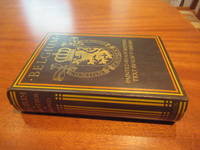
1908réf. 060492London Uk: A & C Black 1908. 1st Edition . Hardcover. Near Fine. Ix 300 Folding Map At Rear. First Edition Early But Not First Printing Red Shield On Title Page. Bright And Clean Slight Fading To Colors On Spine But All Gilt Still Brilliant. Armorial Bookplate Of Homeopathic Physician And Philanthropist Francis Gray Smart. Two A & C Black Specialist Catalogues Laid In Loosely Together With The Color Illustrated Bookmark For Donations To The Scottish Widows' Fund. A & C Black hardcover
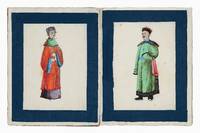
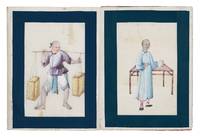
réf. 65895China c.1870. 8vo. 20 x 15 cm. Album of contemporary patterned cloth covered boards with 12 leaves of finely coloured illustrations on pith paper each secured with blue silk border. 4 of the images with just minimal cracking. Pith came into use for painting to satisfy the increasing demand for small inexpensive and easily transported souvenirs following the massive growth in the China Trade in the first half of the nineteenth century. Paintings in oils on board and canvas were costly and difficult to carry home. Earlier and more prestigious export water-colours had often been on a larger scale and painted on fine Chinese paper or on paper imported from Europe. The albums of pith paintings and later the little glass-fronted boxes were inexpensive light easy to pack and gave the pictures some protection on the long voyage home. Because many were sold in albums and hence protected from the light they retain their bright colours to this day. Pith comes from the central column of spongy cellular tissue in the stem of a small tree called Tetrapanax Papyrifera native to south-west China. It has had a variety of some going back many centuries. At the imperial court both men and women wore coloured flowers made from pith in their hair. For use in painting it is cut by hand with a knife into thin sheets from short lengths of the spongy tissue. Cutting is highly skilled and the constraints of the process mean that the finished sheets for painting seldom if ever measure more than about 30cms by 20cms. The sheets are dried trimmed and used for painting without any further processing. Because of the nature of pith and its cellular structure the gouache used by the Chinese sat on the surface and produced a bright and even sparkling effect. Very fine detail could be achieved but pith did not lend itself to the flat wash of colour favoured for European watercolours. These albums are difficult to date specifically as they are seldom signed and never actually dated. They are known to have been produced from the 1830s through to the 1870s [China, c.1870] hardcover
réf. 65894China c.1870. 8vo. 20 x 15 cm. Album of contemporary patterned cloth covered boards with 12 leaves of finely coloured illustrations on pith paper each secured with blue silk border. Just 2 short cracks generally very good condition. Pith came into use for painting to satisfy the increasing demand for small inexpensive and easily transported souvenirs following the massive growth in the China Trade in the first half of the nineteenth century. Paintings in oils on board and canvas were costly and difficult to carry home. Earlier and more prestigious export water-colours had often been on a larger scale and painted on fine Chinese paper or on paper imported from Europe. The albums of pith paintings and later the little glass-fronted boxes were inexpensive light easy to pack and gave the pictures some protection on the long voyage home. Because many were sold in albums and hence protected from the light they retain their bright colours to this day. Pith comes from the central column of spongy cellular tissue in the stem of a small tree called Tetrapanax Papyrifera native to south-west China. It has had a variety of some going back many centuries. At the imperial court both men and women wore coloured flowers made from pith in their hair. For use in painting it is cut by hand with a knife into thin sheets from short lengths of the spongy tissue. Cutting is highly skilled and the constraints of the process mean that the finished sheets for painting seldom if ever measure more than about 30cms by 20cms. The sheets are dried trimmed and used for painting without any further processing. Because of the nature of pith and its cellular structure the gouache used by the Chinese sat on the surface and produced a bright and even sparkling effect. Very fine detail could be achieved but pith did not lend itself to the flat wash of colour favoured for European watercolours. These albums are difficult to date specifically as they are seldom signed and never actually dated. They are known to have been produced from the 1830s through to the 1870s [China, c.1870] hardcover
1978réf. 87811Los Angeles California: Petersen Prints Petersen Publishing Co 1978. Three quarters red leather and grey cloth. Near Fine/Near Fine slipcase. David Maass. 29 x 31 cm. Oblong. Housed in slipcase. 120pp. Marble endpapers. This edition is limited to 1000 copies signed by both the artist and the author of which this is copy 621. Light rubbing to spine. Petersen Prints, Petersen Publishing Co unknown