2 490 résultats
1805réf. ST19580London: Printed for F. C. and J. Rivington et al. 1805. 238 x 145 mm. 9 3/8 x 5 3/4". 10 volumes. Edited by George Steevens and Alexander Chalmers. EXTREMELY PRETTY CONTEMPORARY DEEP PURPLE STRAIGHT-GRAIN MOROCCO VERY ELABORATELY DECORATED IN GILT AND BLIND covers with frame featuring heavy gilt stippling and tooling spine compartments densely gilt gilt-rolled turn-ins leather hinges all edges gilt. EACH VOLUME WITH AN ATTRACTIVE FORE-EDGE PAINTING featuring scenic views of waterways bridges cottages and castles and one figurative scene. With frontispiece portrait engraved ornament pasted down on title page apparently to cover up the mention of the engravings which this set was evidently issued without. A Large Paper Copy. Jaggard p. 510; Lowndes IV 2264. Just a hint of wear to joints and extremities and this expertly refurbished a small gouge on rear board of volume I internally with occasional mild browning scattered foxing and stains but the bindings lustrous and glittering with gold the fore-edge paintings well preserved and the interiors clean and fresh. AN EXTREMELY ATTRACTIVE COPY OF QUITE A SPECIAL ITEM. Enriched with learned essays and commentary this handsome printing of Steevens' acclaimed edition of Shakespeare's dramatic works comes in a lovely contemporary binding with later--but impressive--fore-edge paintings. Our set is the 10-volume version of Steevens printed on royal octavo paper a slightly less desirable nine-volume set on thinner octavo paper was also available. While the set was offered with plates the professionally printed and applied engraved ornaments covering the title page reference to engravings suggests that the publisher also sold sets without them auction records bear out this theory. The original owner may have chosen to save money on plates so he could splash out on the present richly gilt full morocco bindings that make an impressive appearance on the shelf. Then that owner or more likely a somewhat later one commissioned the paintings of the 10 fore edges. These are richly detailed crispy executed compositions mainly showing exterior scenes featuring castles or old city buildings. Although they do not necessarily have a clear connection with any individual play in any specific volume they do communicate the feeling of the period of Shakespeare's life. And most important they are skillfully done by an unusually deft painter. Steevens 1736-1800 had originally published his revision of Johnson's edition of Shakespeare in 1773 the revision being praised by Lowndes as combining "the native powers of Dr. Johnson with the activity sagacity and antiquarian learning of . . . Steevens." Volume I contains prefaces by Pope Johnson and Chalmers a sketch of Shakespeare's life by Chalmers Shakespeare's will and a history of the stage by Malone. Considered in all its aspects--as an esteemed edition of the bard's works as a gloriously decorated set on the shelf and as 10 expert fore-edge paintings--this item has much to recommend it. Printed for F. C. and J. Rivington et al. unknown books
1797réf. ST19344London: Printed by T. Gillet for Longman et al. 1797. 265 x 163 mm. 10 3/8 x 6 3/8". Two volumes. Contemporary green straight-grain morocco covers with double gilt fillet border raised bands gilt titling turn-ins with decorative gilt roll marbled endpapers all edge gilt inexpert older repairs to joints. EACH VOLUME WITH RICHLY DETAILED FORE-EDGE PAINTING that on volume I depicting the old Tabard Inn Southwark and that on volume II showing Furnival's Inn Holborn. Housed in a fleece-lined double-compartment slipcase. Title pages with engraved vignette. Front flyleaf of each volume with ink ownership inscription of Mary Erskine dated 1803 noting it was a wedding gift from her cousin Lord Wodehouse and with later ink presentation inscription to "Walter and Katherine" on their 13th wedding anniversary 17 February 1931 from "their mother Kate Goodrich." Spines faded to brown as usual with green morocco and with half a dozen minor abrasions joints somewhat worn front joint of vol. II with four-inch crack at head but the bindings entirely solid the contents clean and fresh with only insignificant imperfections and the fore-edge paintings very well-preserved. This is a charming pair of large fore-edge paintings depicting two historic London inns each full of detail and painted on text blocks that fan out beautifully with very little effort. The text here is a late 18th century edition of a controversial and short-lived periodical known as "The Guardian" spearheaded by writer and politician Richard Steele who also founded "The Tatler" and "The Spectator". "The Guardian" as DNB relates ran from 12 March to 1 October 1713 and "is chiefly remembered for the quality of the contributors on whom Steele drew including Edward Young George Berkeley Alexander Pope and of course Joseph Addison." The two inns depicted in the fore-edge paintings here also have literary credentials: the Tabard Inn in Southwark was chosen by Chaucer as the starting point for the "Canterbury Tales" and Furnival's Inn in Holborn will be known to Dickens enthusiasts as the place where he began writing "The Pickwick Papers." The original Tabard Inn burned down in the Great Fire but was immediately rebuilt and became a popular stopping point for stagecoaches as depicted in the present painting. The dirt road in front of the inn is dominated by a large covered wagon and team of horses with a pair of men gesturing in the foreground and others idling nearby; Furnival's Inn by contrast was an Inn of the Chancery and enjoyed much tidier surroundings: the streets in the fore-edge painting here are cobbled the ladies and gentlemen are well dressed and even the rubbish has been neatly piled to one side. Both paintings date from the late 19th century and are based on engravings found in "Old and New London" by George Walter Thornbury ca. 1880. Though unsigned they are extremely well done and offer wonderful views of London haunts from both sides of the Thames. Printed by T. Gillet for Longman et al. unknown books
1839192 p. Damp stain. Age stain. 12mo. 190 mm. Original cloth spine over paper covered boards. Boards damp stained with loss. Paper spine label perished. Hardbound. Fair. Haliburton was a Nova Scotian politician, judge, and author. Politically, he played a significant role in the history of Nova Scotia prior to its entry into Confederation. While Haliburton gained a reputation as a local businessman and as a judge, his greatest fame came from writing. He wrote a number of books on history, politics, and farm improvement. He rose to international fame with his Clockmaker serial, which first appeared in the Novascotian and later published as a book throughout the British Empire, becoming popular light reading. The work recounted the humorous adventures of the character Sam Slick. He was the first international best-selling author from what is now Canada. S&S/AI 56101. First edition of the second series. PAIMP 23
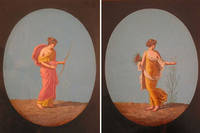
réf. 18236probably Italian 19th Century. 2 vols. Oval images each 10 x 8 inches vividly matted in gold and framed and glazed to 20 x 16-1/2 inches. Very good. 2 vols. Oval images each 10 x 8 inches vividly matted in gold and framed and glazed to 20 x 16-1/2 inches. Decorative studies probably from a larger series of classical divinities. unknown
réf. 18236probably Italian 19th Century. 2 vols. Oval images each 10 x 8 inches vividly matted in gold and framed and glazed to 20 x 16-1/2 inches. Very good. 2 vols. Oval images each 10 x 8 inches vividly matted in gold and framed and glazed to 20 x 16-1/2 inches. Decorative studies probably from a larger series of classical divinities. unknown books
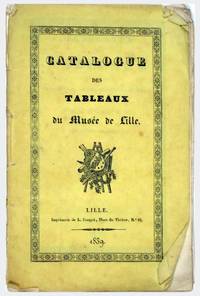
1839réf. 1001611839. Lille L. Jacqué 1839. Titlepage 231pp. pp. 3-6 loose. 8vo. Original yellow decorated wrappers dam. & dogeared some foxing throughout and a few pages loose. unknown
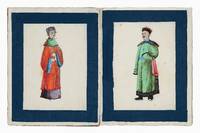
réf. 65895China c.1870. 8vo. 20 x 15 cm. Album of contemporary patterned cloth covered boards with 12 leaves of finely coloured illustrations on pith paper each secured with blue silk border. 4 of the images with just minimal cracking. Pith came into use for painting to satisfy the increasing demand for small inexpensive and easily transported souvenirs following the massive growth in the China Trade in the first half of the nineteenth century. Paintings in oils on board and canvas were costly and difficult to carry home. Earlier and more prestigious export water-colours had often been on a larger scale and painted on fine Chinese paper or on paper imported from Europe. The albums of pith paintings and later the little glass-fronted boxes were inexpensive light easy to pack and gave the pictures some protection on the long voyage home. Because many were sold in albums and hence protected from the light they retain their bright colours to this day. Pith comes from the central column of spongy cellular tissue in the stem of a small tree called Tetrapanax Papyrifera native to south-west China. It has had a variety of some going back many centuries. At the imperial court both men and women wore coloured flowers made from pith in their hair. For use in painting it is cut by hand with a knife into thin sheets from short lengths of the spongy tissue. Cutting is highly skilled and the constraints of the process mean that the finished sheets for painting seldom if ever measure more than about 30cms by 20cms. The sheets are dried trimmed and used for painting without any further processing. Because of the nature of pith and its cellular structure the gouache used by the Chinese sat on the surface and produced a bright and even sparkling effect. Very fine detail could be achieved but pith did not lend itself to the flat wash of colour favoured for European watercolours. These albums are difficult to date specifically as they are seldom signed and never actually dated. They are known to have been produced from the 1830s through to the 1870s [China, c.1870] hardcover
1804réf. 53481804 Paris, Auber, imprimé par Didot aîné, an XIII [1804] ; 3 vol. in-folio,( 49,5 x 34 cm) veau raciné (superbe, avec dentelles sur les plats …dos à faux nerfs , larges pièces de titre (bordeaux )et de tomaison (noires),caissons finement decorés . Édition originale, la plus complète, de cette monumentale entreprise éditoriale, la plus importante de l’époque. Paru pour la première fois en 1791, et rédigé par Fauché, Chamfort, Ginguené et Pagès, l’ouvrage donne une chronologie illustrée des événements ayant marqué la Révolution française .Il connut diverses éditions jusqu’en 1817, avec les textes remaniés à chaque fois.L’abondante illustration se compose de 3 frontispices et 154 figures et 66 portraits, gravés à l’eau-forte par Choffard, Berthault, Copia, Malapeau, Niquet, etc., d’après Fragonard fils, Duplessis, Ozanne, Girardet, Prieur, Desaulx, etc.. Les portrait, gravés à l’aquatinte, sont très vivants.Le premier tome contient les neuf Discours préliminaires, de 1787 à 1789, et 68 Discours historiques. Le tome second recouvre les années suivantes, jusqu’à la Journée mémorable du 18 Brumaire an VIII. Le troisième tome, dont le frontispice représente le tableau des Droits de l’Homme, est composé des Cinq Constitutions qui ont régi la France depuis 1791. Rares rousseurs, superbe ensemble dans de belles reliures de veau raciné
réf. 2081502111809475HP image available N.A. Soft Cover. Fine. Number of copies: sheets HP image available paperback
1930réf. 012910Paris 1930 In-12 agrafé, couverture illustrée
réf. 7669Paris, Drouot Montaigne, 1990. In-4, reliure toilée, reproductions, jaquette.
réf. GF30409Un catalogue in4 broché nde 16 pages sur papier vergé - reproductions d'oeuvres en noir -
réf. 11914P., Galerie Georges Petit, 1932 ; in-4. 40ff. dont 22 planches reproduisant 24 tableaux en noir. Relié dans sous couverture imprimée à rabats contrecollée sur toile noire. Dos recollé.
réf. GF20919Paris - Hotel Drouot - ventes des 25 et 26 février 1929 - Un volume in-4 broché de 44 pages de texte - 11 planches hors texte de reproductions en noir -
réf. GF30346Un volume grand in-4 de 101 pages sur beau papier teinté beige - Illustrations en noir hors texte protégées par une serpente. couverture rempliée - (311 lots sont décrits) -
1881réf. 35501390Paris, , 1881 ; in-8 br. 89 pp La vente comporte 175 tableaux anciens. 6 eaux-fortes reproduisent les très grandes oeuvres
1929réf. 89681929 Paris, mai 1929. Un volume in-4 broché, couverture beige imprimée et rempliée, 64 pp. et planches hors-texte. Bon état.
1936réf. 89691936 Paris, 1936. Un volume in-4 broché, couverture beige imprimée et rempliée, 165 pp. et planches hors-texte. Couverture défraîchie, intérieur frais.
1922réf. 89801922 Paris, Drouot, 1922. Un volume in-4 broché, couverture bleue imprimée, 88 pages, illustrations en n&b. Bon état.
1931réf. 89821931 Paris, Drouot, 1931. Un volume in-4 broché, couverture beige imprimée,31 pages, planches hors-texte. Bon état.
1932réf. 89841932 Paris, Drouot, 1932. Un volume in-4 broché, couverture beige imprimée, 29 pages, planches hors-texte. Bon état.
1922réf. 89851922 Paris, Drouot, 1922. Un volume in-4 broché, couverture bleue imprimée, 81 pages, planches hors-texte. Bon état.
1912réf. 93331912 Paris, Drouot, novembre 1912. Un cahier in-8 broché, couverture blanche, 53 pp., illustrations en n&b. Couverture défraîchie, néanmoins bon état.
1931réf. 93531931 Paris, Georges Petit, 3-5 juin 1931. Un fort volume in-4 broché sous chemise beige imprimée, frontispice en couleurs, 116 pp. et cv pl. en n&b. Chemise défraîchie, néanmoins bon état.
1928réf. 93541928 Paris, Georges Petit, 30 novembre - 1er décembre 1928. Un fort volume in-4 broché sous chemise beige imprimée, frontispice en couleurs, 112 pp. et pl. en n&b. Chemise défraîchie, néanmoins bon état.