3 010 résultats
réf. GF31865Un catalogue in4 broché non paginés imprimé sur beau papier crème -deux illustrations en noir pleine page (le buste de Geroges Gougenot par Pigalle)
1928réf. 93491928 Paris, Drouot, 9 juin 1928. Un cahier in-4 broché, couverture verte, 31 pp., illustrations en n&b. Couverture défraîchie, néanmoins bon état.
1928réf. 93401928 Paris, Drouot, 21 novembre 1928. Un cahier in-8 broché, couverture grise, 23 pp., illustrations en n&b. Bon état.
1919réf. 89771919 Paris, Drouot, 1919. Un volume in-4 broché, couverture orange imprimée, 20 pages, planches hors-texte. Bon état, exemplaire en partie non coupé.
1914réf. 89811914 Paris, Drouot, 1914. Un volume in-4 broché, couverture blanche imprimée, 43 pages, planches hors-texte, sous serpentes. Bon état.
1925réf. 93411925 Paris, Drouot, 19 et 20 juin 1925. Un cahier in-8 broché, couverture grise, 29 pp., illustrations en n&b. Bon état.
1930réf. 93501930 Paris, Drouot, 24 décembre 1930. Un cahier in-8 broché, couverture ocre, 14 pp., illustrations en n&b. Bon état.
1917réf. 89781917 Paris, Drouot, 1917. Un volume in-4 broché, couverture beige imprimée, 56 pages, planches hors-texte. Bon état.
1920réf. 89791920 Paris, Drouot, 1920. Un volume in-4 broché, couverture bleue imprimée, 45 pages, planches hors-texte. Rousseurs sur la couverture, néanmoins bon état.
1926réf. 93301926 Paris, Drouot, 30 avril 1926. Un cahier in-8 broché, couverture jaune, 24 pp., illustrations en n&b. Rousseurs.
1926réf. 93311926 Paris, Drouot, 17 mai 1926. Un cahier in-8 broché, couverture jaune, 11 pp., illustrations en n&b. Rousseurs.
1930réf. 92661930 Paris, Drouot, 19 décembre 1930. Un cahier in-8 broché, couverture grise, 20 pp. et illustrations en n&b. Bon état.
1923réf. 92671923 Paris, Drouot, 5 juin 1923. Un cahier in-8 broché, couverture verte, 38 pp. et illustrations en n&b. Bon état.
1917réf. 93551917 Paris, Georges Petit, 1er et 2 décembre 1917. Un fort volume in-4 broché sous chemise bleue imprimée, frontispice en couleurs, 160 pp. et pl. en n&b. Chemise défraîchie, néanmoins bon état.
réf. 7669Paris, Drouot Montaigne, 1990. In-4, reliure toilée, reproductions, jaquette.
1930réf. 012910Paris 1930 In-12 agrafé, couverture illustrée
réf. 2081502111809475HP image available N.A. Soft Cover. Fine. Number of copies: sheets HP image available paperback
réf. DADAX0486996778New unknown
réf. DADAX0486997413New unknown
réf. DADAX1844035638New unknown
réf. DADAX0789315246New unknown
réf. DADAX0789322315New unknown
1804réf. 53481804 Paris, Auber, imprimé par Didot aîné, an XIII [1804] ; 3 vol. in-folio,( 49,5 x 34 cm) veau raciné (superbe, avec dentelles sur les plats …dos à faux nerfs , larges pièces de titre (bordeaux )et de tomaison (noires),caissons finement decorés . Édition originale, la plus complète, de cette monumentale entreprise éditoriale, la plus importante de l’époque. Paru pour la première fois en 1791, et rédigé par Fauché, Chamfort, Ginguené et Pagès, l’ouvrage donne une chronologie illustrée des événements ayant marqué la Révolution française .Il connut diverses éditions jusqu’en 1817, avec les textes remaniés à chaque fois.L’abondante illustration se compose de 3 frontispices et 154 figures et 66 portraits, gravés à l’eau-forte par Choffard, Berthault, Copia, Malapeau, Niquet, etc., d’après Fragonard fils, Duplessis, Ozanne, Girardet, Prieur, Desaulx, etc.. Les portrait, gravés à l’aquatinte, sont très vivants.Le premier tome contient les neuf Discours préliminaires, de 1787 à 1789, et 68 Discours historiques. Le tome second recouvre les années suivantes, jusqu’à la Journée mémorable du 18 Brumaire an VIII. Le troisième tome, dont le frontispice représente le tableau des Droits de l’Homme, est composé des Cinq Constitutions qui ont régi la France depuis 1791. Rares rousseurs, superbe ensemble dans de belles reliures de veau raciné
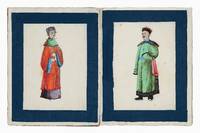
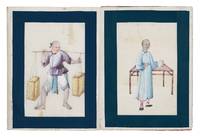
réf. 65895China c.1870. 8vo. 20 x 15 cm. Album of contemporary patterned cloth covered boards with 12 leaves of finely coloured illustrations on pith paper each secured with blue silk border. 4 of the images with just minimal cracking. Pith came into use for painting to satisfy the increasing demand for small inexpensive and easily transported souvenirs following the massive growth in the China Trade in the first half of the nineteenth century. Paintings in oils on board and canvas were costly and difficult to carry home. Earlier and more prestigious export water-colours had often been on a larger scale and painted on fine Chinese paper or on paper imported from Europe. The albums of pith paintings and later the little glass-fronted boxes were inexpensive light easy to pack and gave the pictures some protection on the long voyage home. Because many were sold in albums and hence protected from the light they retain their bright colours to this day. Pith comes from the central column of spongy cellular tissue in the stem of a small tree called Tetrapanax Papyrifera native to south-west China. It has had a variety of some going back many centuries. At the imperial court both men and women wore coloured flowers made from pith in their hair. For use in painting it is cut by hand with a knife into thin sheets from short lengths of the spongy tissue. Cutting is highly skilled and the constraints of the process mean that the finished sheets for painting seldom if ever measure more than about 30cms by 20cms. The sheets are dried trimmed and used for painting without any further processing. Because of the nature of pith and its cellular structure the gouache used by the Chinese sat on the surface and produced a bright and even sparkling effect. Very fine detail could be achieved but pith did not lend itself to the flat wash of colour favoured for European watercolours. These albums are difficult to date specifically as they are seldom signed and never actually dated. They are known to have been produced from the 1830s through to the 1870s [China, c.1870] hardcover
réf. 65894China c.1870. 8vo. 20 x 15 cm. Album of contemporary patterned cloth covered boards with 12 leaves of finely coloured illustrations on pith paper each secured with blue silk border. Just 2 short cracks generally very good condition. Pith came into use for painting to satisfy the increasing demand for small inexpensive and easily transported souvenirs following the massive growth in the China Trade in the first half of the nineteenth century. Paintings in oils on board and canvas were costly and difficult to carry home. Earlier and more prestigious export water-colours had often been on a larger scale and painted on fine Chinese paper or on paper imported from Europe. The albums of pith paintings and later the little glass-fronted boxes were inexpensive light easy to pack and gave the pictures some protection on the long voyage home. Because many were sold in albums and hence protected from the light they retain their bright colours to this day. Pith comes from the central column of spongy cellular tissue in the stem of a small tree called Tetrapanax Papyrifera native to south-west China. It has had a variety of some going back many centuries. At the imperial court both men and women wore coloured flowers made from pith in their hair. For use in painting it is cut by hand with a knife into thin sheets from short lengths of the spongy tissue. Cutting is highly skilled and the constraints of the process mean that the finished sheets for painting seldom if ever measure more than about 30cms by 20cms. The sheets are dried trimmed and used for painting without any further processing. Because of the nature of pith and its cellular structure the gouache used by the Chinese sat on the surface and produced a bright and even sparkling effect. Very fine detail could be achieved but pith did not lend itself to the flat wash of colour favoured for European watercolours. These albums are difficult to date specifically as they are seldom signed and never actually dated. They are known to have been produced from the 1830s through to the 1870s [China, c.1870] hardcover