Lafenestre, GeorgesLivre Rare Book
198 résultats
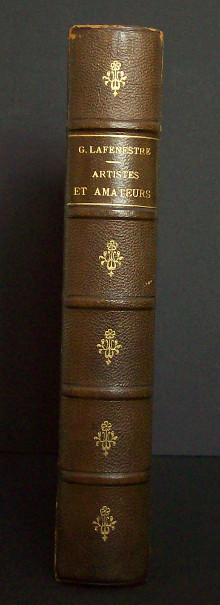
réf. 72Société d'édition artistique, Paris, s.d., vers 1900. In-8, demi-chagrin, dos à 5 nerfs orné de fleurons, titre en lettres dorées, 357 pp. Titien et les princes de son temps ; Van Dyck en France ; Rembrandt van Ryn (1606-1669) ; Jean de La Fontaine et les artistes de son temps ; Théophile Gautier, critique d'art (1811-1872) ; l'esprit français et les beaux-arts ...
1875réf. 059536London: Richard Clay & Sons Limited 1875. Not Given . Hardcover. Very Good Plus. LONDON & BUNGAY : 1875. "Van Dyck's version. With full vowel points." D. & M. Referenced by: Darlow & Moule 1712. ONly one copy held in the UK of the 1873 edition; 1 Holding library; University of Cambridge Libraries. Hardback. Flush-bound. Original purple pebble-grained cloth; blind-stamped title in Arabic to cover. Red sprinkled edges. Original yellow end-papers. Pencil name of Isaac Hutchinson 1906 to end-papers; no internal markings. Bright tight and clean. Minor wear only. VERY GOOD INDEED. 259 i pages. 8vo. Will be well-packed for posting/shipping. London: Richard Clay & Sons Limited. SCARCE. Richard Clay & Sons, Limited hardcover
1645Incisione tratta dalla celebre raccolta Icones principum, virorum, doctorum, pictorum, chalcographorum, di Anton van Dyck, edita per la prima volta ad Anversa verso il 1640. Opera celebre ed importante, vero monumento dell’arte incisoria fiamminga del sec. XVIII, contiene le biografie ed i ritratti degli uomini illustri che Van Dyck aveva conosciuto e con i quali aveva avuto importanti rapporti. L’artista ne eseguì le effigi in numerosi dipinti e disegni che poi decise di pubblicare, affidandone la trasposizione calcografica ai migliori incisori del suo tempo, come Bolswert, Pontius, Vorsterman, de Jode, Hollar, molti dei quali aveva avuto come condiscepoli nell’atelier di Rubens. "Sir Anthony Van Dyck stands out as the solitary great etcher of the school. Portrait etching had scarcely had an existence before his time, and in his work it suddenly appears at the highest point ever reached in the art" (Hind, p. 165). "The plan of this publication took shape after Van Dyck returned from Italy (1626) and before he went to England (1632). He made careful preparatory drawings in chalk and brush for the publication. He directed and revised the work of the engravers, the best of the Rubens circle; he collaborated with his etching needle in some of the plates and himself etched the most beautiful set, mainly portraits of artists. One of the most brilliant in human characterization is the portrait of Peter Brueghel the Younger, son of the great Peasant Brueghel. It is remarkable that the etching appeared in this sketchy form in the book, proving that the master regarded it as finished. All interest is focussed on the wonderful had. The first edition was published in Antwerp in 1635-1636. Yet it was not complete, and the title-page did not appear before the Gillis Hendricx edition of 1645, engraved by Jacob Neels" (Benesch, Artistic and Intellectual Trends, p. 32.) Hofer, Baroque Book Illustrations 132. Acquaforte con ritocchi al bulino, stampata su carta vergata coeva, filigrana del “giullare”, con margini, in ottimo stato di conservazione. Etching and engraving, circa 1645, signed on plate at lower edge. A fine impression, printed on contemporary laid paper, with margins, very good condition. From Icones principum, virorum, doctorum, pictorum, chalcographorum by Anton van Dyck, printed for the first time in Antwerp, 1645. A famous and important work, a real monument of the Flemish engraving art of the XVIII century, containing the biographies and portraits of the famous artists Van Dyck had met and with whom he had worked. Following the success of his portrait paintings and in the tradition of Italian and Flemish portrait series, Van Dyck decided to organise a print publication containing portraits of the most prominent men during his lifetime, divided into three categories: princes, politicians and soldiers (16), statesmen and scholars (12), artists and art connoisseurs (52). The initial idea could have been that Van Dyck would etch the faces (a process possibly learnt from Vorsterman) while others would finish the plates in engraving. Designs were needed for the plates and several drawings and oil sketches (grisailles, sometimes in different versions) have survived. Van Dyck only etched 17 plates himself, while he commissioned others to complete the set, overseen by Lucas Vorsterman I (especially after Van Dyck settled in England in the Spring of 1632). Although this project was started by Van Dyck around 1630, he never saw it completed. The Antwerp publisher Maarten van den Enden may have been involved from the start as eighty early impressions bear Van den Enden's address. They are engraved by Paulus Pontius (30 plates), Lucas Vorsterman I (22), Pieter de Jode II (12), Schelte a Bolswert (7), Robert van Voerst (4), Willem Hondius (2), Willem Jacobsz Delff (1), Cornelis Galle (1), and Nicolaes Lauwers (1). It is known that Van den Enden was in debt to Gillis Hendricx around 1644, the Antwerp publisher who must have obtained Van den Enden's plates which he published in 1645 in the first edition of these plates (containing between 100 and 104 portrait plates). Hendricx continued to publish these plates until his death in 1677 when they were auctioned off by the St Luke guild (keeping the Iconography plates together). It is not clear who bought these plates but they re-appeared around 1720 when they were published by Hendrick and Cornelis Verdussen in Antwerp.
2016réf. x-1107145945Cambridge Univ Pr 2016. Hardcover. New. 574 pages. 9.00x6.25x1.50 inches. Cambridge Univ Pr hardcover
1890réf. 15401Histoire anecdotique et pittoresque du mouvement social et de la guerre civile en Angleterre au XVIIe siècle. Par Philarète Chasles (1798-1873).Homme de lettres et journaliste français, auteur de nombreuses études littéraires, il a beaucoup contribué à faire connaître en France la littérature de langue anglaise.18 gravures sur acier d'après Van Dyck, Rubens et Cattermole.Paris, Madame Ve. Louis Janet - non daté (1890) - 262 pages. 24 hors texte (noté 18 sur le titre) et 25 dans le texte.Belle reliure demi-maroquin rouge à coins de l'époque. Dos lisse aux titre et auteur dorés. Couverture conservée. Non rogné. Pas de rousseur. Très bon état. Format in-4°(28x20).
1844réf. 48731844 Paris, Madame Ve Louis Janet. 1844. 18,5x28 cm. Reliure en simili cuir bleu signée, plat à grand coin. Dos comportant auteur et titre. Ouvrage illustré de 18 planches sur acier hors texte et de nombreuses gravures sur bois dans le texte. Livre non ébarbé. Envoi de photographies sur demande.
1967Hachette 1967. In-Folio broché couverture illustrée rempliée de 16 planches + texte .Bon état
réf. 1165310414.Gpaperback. Good. Access codes and supplements are not guaranteed with used items. May be an ex-library book. paperback
réf. 110402067X.Gpaperback. Good. Access codes and supplements are not guaranteed with used items. May be an ex-library book. paperback
1645Incisione tratta dalla celebre raccolta Icones principum, virorum, doctorum, pictorum, chalcographorum, di Anton van Dyck, edita per la prima volta ad Anversa verso il 1640. Opera celebre ed importante, vero monumento dell’arte incisoria fiamminga del sec. XVIII, contiene le biografie ed i ritratti degli uomini illustri che Van Dyck aveva conosciuto e con i quali aveva avuto importanti rapporti. L’artista ne eseguì le effigi in numerosi dipinti e disegni che poi decise di pubblicare, affidandone la trasposizione calcografica ai migliori incisori del suo tempo, come Bolswert, Pontius, Vorsterman, de Jode, Hollar, molti dei quali aveva avuto come condiscepoli nell’atelier di Rubens. "Sir Anthony Van Dyck stands out as the solitary great etcher of the school. Portrait etching had scarcely had an existence before his time, and in his work it suddenly appears at the highest point ever reached in the art" (Hind, p. 165). "The plan of this publication took shape after Van Dyck returned from Italy (1626) and before he went to England (1632). He made careful preparatory drawings in chalk and brush for the publication. He directed and revised the work of the engravers, the best of the Rubens circle; he collaborated with his etching needle in some of the plates and himself etched the most beautiful set, mainly portraits of artists. One of the most brilliant in human characterization is the portrait of Peter Brueghel the Younger, son of the great Peasant Brueghel. It is remarkable that the etching appeared in this sketchy form in the book, proving that the master regarded it as finished. All interest is focussed on the wonderful had. The first edition was published in Antwerp in 1635-1636. Yet it was not complete, and the title-page did not appear before the Gillis Hendricx edition of 1645, engraved by Jacob Neels" (Benesch, Artistic and Intellectual Trends, p. 32.) Hofer, Baroque Book Illustrations 132. Acquaforte con ritocchi al bulino, stampata su carta vergata coeva, filigrana del “giullare”, con margini, in ottimo stato di conservazione. Etching and engraving, circa 1645, signed on plate at lower edge. A fine impression, printed on contemporary laid paper, with margins, very good condition. From Icones principum, virorum, doctorum, pictorum, chalcographorum by Anton van Dyck, printed for the first time in Antwerp, 1645. A famous and important work, a real monument of the Flemish engraving art of the XVIII century, containing the biographies and portraits of the famous artists Van Dyck had met and with whom he had worked. Following the success of his portrait paintings and in the tradition of Italian and Flemish portrait series, Van Dyck decided to organise a print publication containing portraits of the most prominent men during his lifetime, divided into three categories: princes, politicians and soldiers (16), statesmen and scholars (12), artists and art connoisseurs (52). The initial idea could have been that Van Dyck would etch the faces (a process possibly learnt from Vorsterman) while others would finish the plates in engraving. Designs were needed for the plates and several drawings and oil sketches (grisailles, sometimes in different versions) have survived. Van Dyck only etched 17 plates himself, while he commissioned others to complete the set, overseen by Lucas Vorsterman I (especially after Van Dyck settled in England in the Spring of 1632). Although this project was started by Van Dyck around 1630, he never saw it completed. The Antwerp publisher Maarten van den Enden may have been involved from the start as eighty early impressions bear Van den Enden's address. They are engraved by Paulus Pontius (30 plates), Lucas Vorsterman I (22), Pieter de Jode II (12), Schelte a Bolswert (7), Robert van Voerst (4), Willem Hondius (2), Willem Jacobsz Delff (1), Cornelis Galle (1), and Nicolaes Lauwers (1). It is known that Van den Enden was in debt to Gillis Hendricx around 1644, the Antwerp publisher who must have obtained Van den Enden's plates which he published in 1645 in the first edition of these plates (containing between 100 and 104 portrait plates). Hendricx continued to publish these plates until his death in 1677 when they were auctioned off by the St Luke guild (keeping the Iconography plates together). It is not clear who bought these plates but they re-appeared around 1720 when they were published by Hendrick and Cornelis Verdussen in Antwerp.
1645Incisione tratta dalla celebre raccolta Icones principum, virorum, doctorum, pictorum, chalcographorum, di Anton van Dyck, edita per la prima volta ad Anversa verso il 1640. Opera celebre ed importante, vero monumento dell’arte incisoria fiamminga del sec. XVIII, contiene le biografie ed i ritratti degli uomini illustri che Van Dyck aveva conosciuto e con i quali aveva avuto importanti rapporti. L’artista ne eseguì le effigi in numerosi dipinti e disegni che poi decise di pubblicare, affidandone la trasposizione calcografica ai migliori incisori del suo tempo, come Bolswert, Pontius, Vorsterman, de Jode, Hollar, molti dei quali aveva avuto come condiscepoli nell’atelier di Rubens. "Sir Anthony Van Dyck stands out as the solitary great etcher of the school. Portrait etching had scarcely had an existence before his time, and in his work it suddenly appears at the highest point ever reached in the art" (Hind, p. 165). "The plan of this publication took shape after Van Dyck returned from Italy (1626) and before he went to England (1632). He made careful preparatory drawings in chalk and brush for the publication. He directed and revised the work of the engravers, the best of the Rubens circle; he collaborated with his etching needle in some of the plates and himself etched the most beautiful set, mainly portraits of artists. One of the most brilliant in human characterization is the portrait of Peter Brueghel the Younger, son of the great Peasant Brueghel. It is remarkable that the etching appeared in this sketchy form in the book, proving that the master regarded it as finished. All interest is focussed on the wonderful had. The first edition was published in Antwerp in 1635-1636. Yet it was not complete, and the title-page did not appear before the Gillis Hendricx edition of 1645, engraved by Jacob Neels" (Benesch, Artistic and Intellectual Trends, p. 32.) Hofer, Baroque Book Illustrations 132. Acquaforte con ritocchi al bulino, stampata su carta vergata coeva, filigrana del “giullare”, con margini, in ottimo stato di conservazione. Etching and engraving, circa 1645, signed on plate at lower edge. A fine impression, printed on contemporary laid paper, with margins, very good condition. From Icones principum, virorum, doctorum, pictorum, chalcographorum by Anton van Dyck, printed for the first time in Antwerp, 1645. A famous and important work, a real monument of the Flemish engraving art of the XVIII century, containing the biographies and portraits of the famous artists Van Dyck had met and with whom he had worked. Following the success of his portrait paintings and in the tradition of Italian and Flemish portrait series, Van Dyck decided to organise a print publication containing portraits of the most prominent men during his lifetime, divided into three categories: princes, politicians and soldiers (16), statesmen and scholars (12), artists and art connoisseurs (52). The initial idea could have been that Van Dyck would etch the faces (a process possibly learnt from Vorsterman) while others would finish the plates in engraving. Designs were needed for the plates and several drawings and oil sketches (grisailles, sometimes in different versions) have survived. Van Dyck only etched 17 plates himself, while he commissioned others to complete the set, overseen by Lucas Vorsterman I (especially after Van Dyck settled in England in the Spring of 1632). Although this project was started by Van Dyck around 1630, he never saw it completed. The Antwerp publisher Maarten van den Enden may have been involved from the start as eighty early impressions bear Van den Enden's address. They are engraved by Paulus Pontius (30 plates), Lucas Vorsterman I (22), Pieter de Jode II (12), Schelte a Bolswert (7), Robert van Voerst (4), Willem Hondius (2), Willem Jacobsz Delff (1), Cornelis Galle (1), and Nicolaes Lauwers (1). It is known that Van den Enden was in debt to Gillis Hendricx around 1644, the Antwerp publisher who must have obtained Van den Enden's plates which he published in 1645 in the first edition of these plates (containing between 100 and 104 portrait plates). Hendricx continued to publish these plates until his death in 1677 when they were auctioned off by the St Luke guild (keeping the Iconography plates together). It is not clear who bought these plates but they re-appeared around 1720 when they were published by Hendrick and Cornelis Verdussen in Antwerp.
1645Incisione tratta dalla celebre Icones principum, virorum, doctorum, pictorum, chalcographorum, di Anton van Dyck, edita per la prima volta ad Anversa nel 1645. Opera celebre ed importante, vero monumento dell’arte incisoria fiamminga del sec. XVIII, contiene le biografie ed i ritratti degli uomini illustri che Van Dyck aveva conosciuto econ i quali aveva avuto importanti rapporti. L’artista ne eseguì le effigi in numerosi dipinti e disegni che poi decise di pubblicare, affidandone la trasposizione calcografica ai migliori incisori del suo tempo, come Bolswert, Pontius, Vorsterman, de Jode, Hollar, molti dei quali aveva avuto come condiscepoli nell’atelier di Rubens. Acquaforte con ritocchi al bulino, stampata su carta vergata coeva, con margini, in ottimo stato di conservazione. Etching and engraving, circa 1645, signed on plate at lower edge. A fine impression, printed on contemporary laid paper, with margins, very good condition. From Icones principum, virorum, doctorum, pictorum, chalcographorum by Anton van Dyck, printed for the first time in Antwerp, 1645. A famous and important work, a real monument of the Flemish engraving art of the XVIII century, containing the biographies and portraits of the famous artists Van Dyck had met and with whom he had worked. Following the success of his portrait paintings and in the tradition of Italian and Flemish portrait series, Van Dyck decided to organise a print publication containing portraits of the most prominent men during his lifetime, divided into three categories: princes, politicians and soldiers (16), statesmen and scholars (12), artists and art connoisseurs (52). The initial idea could have been that Van Dyck would etch the faces (a process possibly learnt from Vorsterman) while others would finish the plates in engraving. Designs were needed for the plates and several drawings and oil sketches (grisailles, sometimes in different versions) have survived. Van Dyck only etched 17 plates himself, while he commissioned others to complete the set, overseen by Lucas Vorsterman I (especially after Van Dyck settled in England in the Spring of 1632). Although this project was started by Van Dyck around 1630, he never saw it completed. The Antwerp publisher Maarten van den Enden may have been involved from the start as eighty early impressions bear Van den Enden's address. They are engraved by Paulus Pontius (30 plates), Lucas Vorsterman I (22), Pieter de Jode II (12), Schelte a Bolswert (7), Robert van Voerst (4), Willem Hondius (2), Willem Jacobsz Delff (1), Cornelis Galle (1), and Nicolaes Lauwers (1). It is known that Van den Enden was in debt to Gillis Hendricx around 1644, the Antwerp publisher who must have obtained Van den Enden's plates which he published in 1645 in the first edition of these plates (containing between 100 and 104 portrait plates). Hendricx continued to publish these plates until his death in 1677 when they were auctioned off by the St Luke guild (keeping the Iconography plates together). It is not clear who bought these plates but they re-appeared around 1720 when they were published by Hendrick and Cornelis Verdussen in Antwerp.
1999réf. EL371411999 480 p., numerous coloured photographs and distribution maps, hardbound. Library stamps, else good copy.
réf. 13146, Antwerpen, Koninklijke Museum voor Schone Kunsten, 1966, 1966 Originele uitgeversomslag in kleur, 27.5x21.5 cm., 278 pp., geillustreerd z/w.
réf. 42730921like new. unknown
2021réf. __0822946947Univ of Pittsburgh Pr 2021. Hardcover. New. 276 pages. 9.00x6.25x1.25 inches. Univ of Pittsburgh Pr hardcover
réf. 0822946947.Ghardcover. Good. Access codes and supplements are not guaranteed with used items. May be an ex-library book. hardcover
2021réf. x-0822946947Univ of Pittsburgh Pr 2021. Hardcover. New. 276 pages. 9.00x6.25x1.25 inches. Univ of Pittsburgh Pr hardcover
1645Incisione tratta dalla celebre raccolta Icones principum, virorum, doctorum, pictorum, chalcographorum, di Anton van Dyck, edita per la prima volta ad Anversa verso il 1640. Opera celebre ed importante, vero monumento dell’arte incisoria fiamminga del sec. XVIII, contiene le biografie ed i ritratti degli uomini illustri che Van Dyck aveva conosciuto e con i quali aveva avuto importanti rapporti. L’artista ne eseguì le effigi in numerosi dipinti e disegni che poi decise di pubblicare, affidandone la trasposizione calcografica ai migliori incisori del suo tempo, come Bolswert, Pontius, Vorsterman, de Jode, Hollar, molti dei quali aveva avuto come condiscepoli nell’atelier di Rubens. "Sir Anthony Van Dyck stands out as the solitary great etcher of the school. Portrait etching had scarcely had an existence before his time, and in his work it suddenly appears at the highest point ever reached in the art" (Hind, p. 165). "The plan of this publication took shape after Van Dyck returned from Italy (1626) and before he went to England (1632). He made careful preparatory drawings in chalk and brush for the publication. He directed and revised the work of the engravers, the best of the Rubens circle; he collaborated with his etching needle in some of the plates and himself etched the most beautiful set, mainly portraits of artists. One of the most brilliant in human characterization is the portrait of Peter Brueghel the Younger, son of the great Peasant Brueghel. It is remarkable that the etching appeared in this sketchy form in the book, proving that the master regarded it as finished. All interest is focussed on the wonderful had. The first edition was published in Antwerp in 1635-1636. Yet it was not complete, and the title-page did not appear before the Gillis Hendricx edition of 1645, engraved by Jacob Neels" (Benesch, Artistic and Intellectual Trends, p. 32.) Hofer, Baroque Book Illustrations 132. Acquaforte con ritocchi al bulino, stampata su carta vergata coeva, filigrana del “giullare”, con margini, in ottimo stato di conservazione. Etching and engraving, circa 1645, signed on plate at lower edge. A fine impression, printed on contemporary laid paper, with margins, very good condition. From Icones principum, virorum, doctorum, pictorum, chalcographorum by Anton van Dyck, printed for the first time in Antwerp, 1645. A famous and important work, a real monument of the Flemish engraving art of the XVIII century, containing the biographies and portraits of the famous artists Van Dyck had met and with whom he had worked. Following the success of his portrait paintings and in the tradition of Italian and Flemish portrait series, Van Dyck decided to organise a print publication containing portraits of the most prominent men during his lifetime, divided into three categories: princes, politicians and soldiers (16), statesmen and scholars (12), artists and art connoisseurs (52). The initial idea could have been that Van Dyck would etch the faces (a process possibly learnt from Vorsterman) while others would finish the plates in engraving. Designs were needed for the plates and several drawings and oil sketches (grisailles, sometimes in different versions) have survived. Van Dyck only etched 17 plates himself, while he commissioned others to complete the set, overseen by Lucas Vorsterman I (especially after Van Dyck settled in England in the Spring of 1632). Although this project was started by Van Dyck around 1630, he never saw it completed. The Antwerp publisher Maarten van den Enden may have been involved from the start as eighty early impressions bear Van den Enden's address. They are engraved by Paulus Pontius (30 plates), Lucas Vorsterman I (22), Pieter de Jode II (12), Schelte a Bolswert (7), Robert van Voerst (4), Willem Hondius (2), Willem Jacobsz Delff (1), Cornelis Galle (1), and Nicolaes Lauwers (1). It is known that Van den Enden was in debt to Gillis Hendricx around 1644, the Antwerp publisher who must have obtained Van den Enden's plates which he published in 1645 in the first edition of these plates (containing between 100 and 104 portrait plates). Hendricx continued to publish these plates until his death in 1677 when they were auctioned off by the St Luke guild (keeping the Iconography plates together). It is not clear who bought these plates but they re-appeared around 1720 when they were published by Hendrick and Cornelis Verdussen in Antwerp.
1914réf. 19880Weimar, Gustav Kiepenheuer, 1914. Mit 40 ganzseitigen Abbildungen 367 S. dunkelgrauer Leinenband mit Farbkopfschnitt / gebundene Ausgabe
réf. 1144299012.Gpaperback. Good. Access codes and supplements are not guaranteed with used items. May be an ex-library book. paperback
réf. 102161310X.Gpaperback. Good. Access codes and supplements are not guaranteed with used items. May be an ex-library book. paperback
réf. 1020252774.Ghardcover. Good. Access codes and supplements are not guaranteed with used items. May be an ex-library book. hardcover
réf. 3734528143.Ghardcover. Good. Access codes and supplements are not guaranteed with used items. May be an ex-library book. hardcover