Maundevile, John [Mandeville Sir John]Biblio.com
429 Ergebnisse
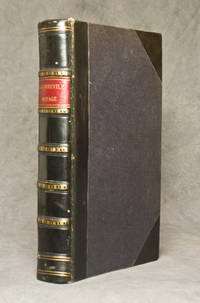
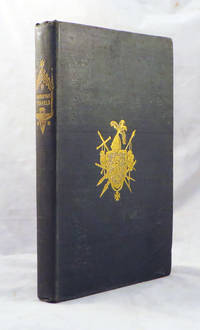
1839Best.-Nr. 26571London: Edward Lumley 1839. First edition with Halliwell's introduction and additions. Illustrated with an engraved frontispiece vignette title-page and many illustrations throughout the text in the style of medieval woodcuts. 8vo publisher's original green cloth the upper cover with large coat of arms in gilt and additional decoration in blind blind decoration on the lower cover and in gilt with gilt lettering on the spine. vxii xii 326 2 ads pp. An unusually handsome and well preserved copy as fine and highly unusual for a book of the period especially as this copy is preserved in its original early cloth binding. FIRST EDITION WITH HALLIWELL'S INTRODUCTION AND ADDITIONS AND A BEAUTIFULLY PRESERVED COPY. 'In his preface the compiler calls himself a knight and states that he was born and bred in England of the town of St Albans. Although the book is real it is widely believed that 'Sir John Mandeville' himself was not. Common theories point to a Frenchman by the name of Jehan a la Barbe or other possibilities discussed below. The most recent scholarly work suggests that The Travels of Sir John Mandeville was “the work of Jan de Langhe a Fleming who wrote in Latin under the name Johannes Longus and in French as Jean le Long." Jan de Langhe was born in Ypres early in the 1300s and by 1334 had become a Benedictine monk at the abbey of Saint-Bertin in Saint-Omer which was about 20 miles from Calais. After studying law at the University of Paris de Langhe returned to the abbey and was elected abbot in 1365. He was a prolific writer and avid collector of travelogues right up to his death in 1383. John de Mandeville crossed the sea on 1322; had traversed by way of Turkey Asia Minor Armenia the Little Cilicia and the Great Tartary Persia Syria Arabia Egypt upper and lower Libya great part of Ethiopia Chaldea Amazonia India the Less the Greater and the Middle and many countries about India; had often been to Jerusalem and had written in Romance as more generally understood than Latin. In the body of the work we hear that he had been at Paris and Constantinople; had served the Sultan of Egypt for a long time in his wars against the Bedouin and had been offered and declined a princely marriage and a great estate on condition of renouncing Christianity and had left Egypt under Sultan Melech Madabron al-Muzaffar Sayf-ad-Din Hajji I who reigned in 1346-1347; had been at Mount Sinai and had visited the Holy Land with letters under the great seal of the sultan which gave him extraordinary facilities; had been in Russia Livonia Kraków Lithuania "en roialme daresten" Dristra or Silistra in Bulgaria and many other parts near Tartary but not in Tartary itself; had drunk of the Well of Youth at Polombe Quilon on the Malabar coast and still seemed to feel the better for it; had taken astronomical observations on the way to Lamory Sumatra as well as in Brabant Germany Bohemia and still farther north; had been at an isle called Pathen in the Indian Ocean; had been at Cansay Hangchow-fu in China and had served the emperor of China for fifteen months.had been through a haunted valley which he places near "Milstorak" i.e. Malasgird in Armenia; had been driven home against his will in 1357 by arthritic gout; and had written his book as a consolation for his "wretched rest".' Copies of this work are scarce in the marketplace. Edward Lumley hardcover
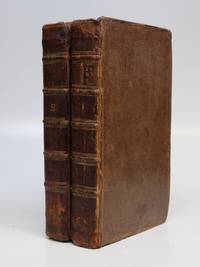
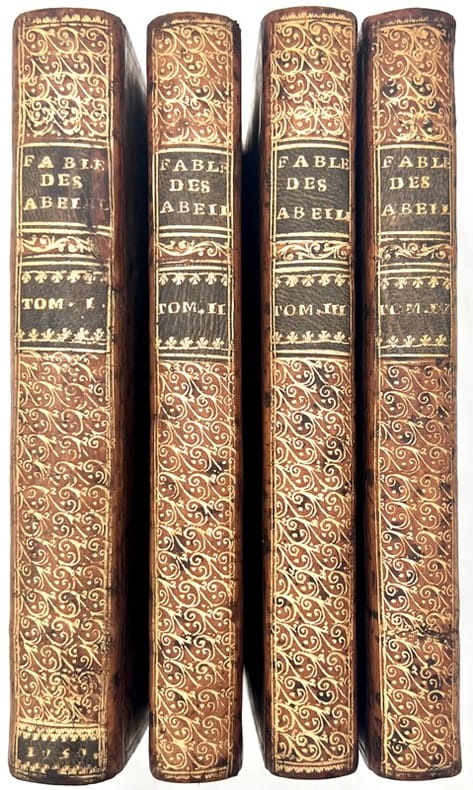
1740Best.-Nr. ZNC-112A Londres, Aux dépens de la compagnie, 1740, 4 volumes in-12°, XXII-333, 267, XLVIII-282 et 270 pages, cartonnage marron, dos lisses ornés de filets dorés.
Best.-Nr. elala3545London: Printed for J.Tonson 1732-33. Sixth Edition of Vol. I; Second Edition of Vol. II. Mandeville’s most famous and controversial work in which he advanced the view that virtue derives from the practice of selfish instincts and that the public prosperity is dependent upon private vices. His original intention was probably to satirize the political state of England in 1705 when the Tories were accusing Marlborough and the ministry of advocating the French war for personal reasons. The ironical nature of his commentary on the hypocrisies of artificial society was overlooked by his contemporaries and the Fable was widely attacked and condemned notably by Bishop Berkeley Francis Hutcheson and Archibald Campbell. NCBEL II 1096. cfKress 4024. cfRothschild I 1371. 2 Volumes. 8vo. pp. 8 p.l. 477; 1 p.l. xxx 432 24index. woodcut ornaments & initials. later calf rebacked rubbed front cover of Vol. I loose. armorial bookplate of George Goddard Knowles London: Printed for J.Tonson, 1732-33 unknown
1887Best.-Nr. 293400London: Pickering 1887. hardcover. near fine. Edited Annotated and Illustrated in Facsimile by John Ashton. 289 pages with untrimmed edges. 4to Original pale blue boards rubbed and somewhat discolored with vellum spine. London: Pickering 1887. Limited edition. Endpapers a bit foxed otherwise a beautiful pristine copy. Number 28 of 100 copies printed in Large Paper. Based on a reprint of the unique Pynson edition the oldest English printed version extant in the Grenville Library of the British Museum. ".Grenville and Dibdin believe the Pynson edition to be earlier than that of Wynken de Worde's" See Cox I p. 319. Pickering unknown books
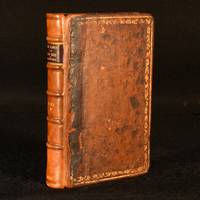
1728Best.-Nr. 211271London: J. Tonson 1728. hardcover. very good. With an Essay on Charity and Charity Schools and A Search into the Nature of Society. Also A Vindication of the Book from the Aspersions contained in a Presentment of the Grand Jury of Middlesex and an Abusive Letter to Lord C-. 2 volumes published 1 year apart and by different publishers 8vo original calf; rubbed spine labels partially present. London: J. Tonson 1728 Fifth Edition and James Roberts 1729. First Edition. Very Good. This is one of many editions of the famous and popular satire on the true causes of social welfare and riches Mandeville suggesting that base behavior produces positive economic effects. The conspiratorial theory of the origin of society so prominent in Part I was widely criticized after the publication of the 1723 edition. In the second volume probably in response to his critics Mandeville moved towards a more evolutionary account of society. This had an influence on the thinking of David Hume. Mandeville also adumbrated the division of labour theory subsequently developed by Adam Smith. J. Tonson unknown books
1887Best.-Nr. 293400London: Pickering 1887. hardcover. near fine. Edited Annotated and Illustrated in Facsimile by John Ashton. 289 pages with untrimmed edges. 4to Original pale blue boards rubbed and somewhat discolored with vellum spine. London: Pickering 1887. Limited edition. Endpapers a bit foxed otherwise a beautiful pristine copy. Number 28 of 100 copies printed in Large Paper. Based on a reprint of the unique Pynson edition the oldest English printed version extant in the Grenville Library of the British Museum. ".Grenville and Dibdin believe the Pynson edition to be earlier than that of Wynken de Worde's" See Cox I p. 319. Pickering unknown
1750Best.-Nr. 262982Londres: Jean Nourse 1750. hardcover. very good. 4 volumes 12mo 2 396 4 62lxv1 339 et 4 362 pages original mottled calf; rubbed rubricated edges. Londres: Jean Nourse 1750. Very good. Translated from the sixth English edition. This is one of many editions of the famous and popular satire on the true causes of social welfare and riches Mandeville suggesting that base behavior produces positive economic effects. Jean Nourse unknown books
1750Best.-Nr. 262982Londres: Jean Nourse 1750. hardcover. very good. 4 volumes 12mo 2 396 4 62lxv1 339 et 4 362 pages original mottled calf; rubbed rubricated edges. Londres: Jean Nourse 1750. Very good. Translated from the sixth English edition. This is one of many editions of the famous and popular satire on the true causes of social welfare and riches Mandeville suggesting that base behavior produces positive economic effects. Jean Nourse unknown
Best.-Nr. 1627802J. Tonson 1730. Used-Very Good. London : J. Tonson 1730. Recent full calf with contrasting spine label. 380 pp. Some edgewear to binding with a small split at the bottom rright of spine. Internally very sound with just a trace of foxing in some initial and final leaves. J. Tonson, 1730 unknown
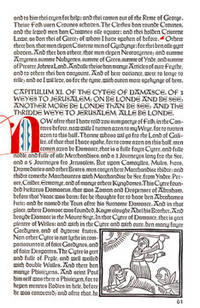
1928Best.-Nr. 527461928. MANDEVILLE John. Itinerarium English. The Voiage and Travaile of Sir John Maundevile Kt. Which treateth of the way to Hierusalem and of marvayles of Inde with other ilands and countryes. 4 156 1 pp. Illustrated throughout with woodcuts and illuminated initials by Valenti Angelo. Folio bound by William Wheeler in recent half morocco. New York: Printed by Edwin and Robert Grabhorn for Random House 1928. The superb Grabhorn edition of Mandeville's Travels originally written in Anglo-Norman French in 1356-7. "It claims to be a guide both geographical and ethical for pilgrims to the Holy Land but it carries the reader far off course to Turkey Tartary Persia Egypt and India. It was an important influence on subsequent English writers from Chaucer to Shakespeare and was the prototype in English of the popular genre of the fabulous travel book" Osborne Oxford Companion. The illustrations were drawn by Valenti Angelo from those in early editions and manuscripts. The type was designed by Rudolph Koch here used for the first time in America. The text of this Grabhorn edition is taken from that of the English edition of 1725. One of an edition of only 150 copies. Ransom p. 302 no. 12. unknown books
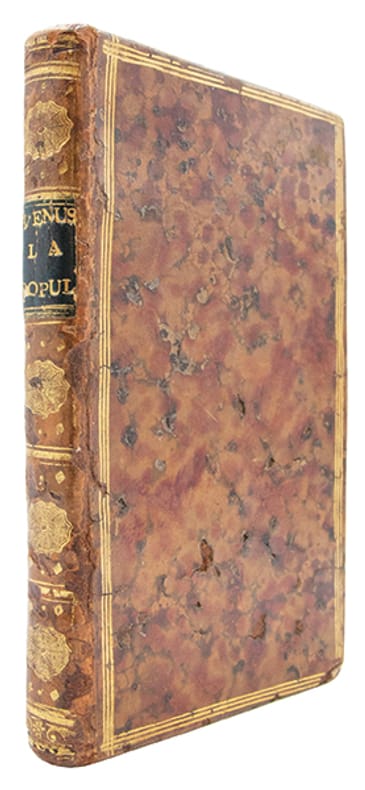
Best.-Nr. 39364In-16 (133 x 80 mm), veau porphyre de lépoque, dos lisse orné de compartiments garnis dun fer à la toile daraignée répété au centre, filets et palettes dorés, pièce de titre de veau vert bronze, (4), xij, [13]-136 pages et 4 pages de catalogue éditeur. Paris, Mercier, s.d. [1796].
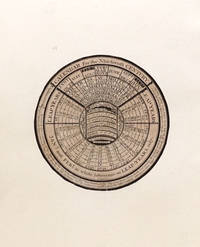
1801Best.-Nr. 319639Philadelphia 1801. Small circular engraved broadside engraved by Draper. Approx. 3 1/2 inches in diameter. Inlaid into a larger sheet at a later date. Small circular engraved broadside engraved by Draper. Approx. 3 1/2 inches in diameter. America Looks to the Future: An Unusual Early American Perpetual Calendar. The Explanation running arount the outer border of the lower portion of the Calendar details its use: "Intersect the Column of the Month by the circle in which the Year stands & the Day you there find look for under October which day of the week with those on the right hand will stand over such Days of the Month as falls on them." The Explanation continues with how to determine days of the month using the calendar in the previous century and into the 20th century. A January 14 1802 review in the Philadelphia Gazette extolls its virtues: ".I am induced to think that sufficient justice can hardly be done to the ingenuity of this little production: The Author has modestly called it a Calendar for the 19th Century while it is in fact a Calendar for twenty-one centuries . It will shew sic in what day of the week an event in history occurred . This Calendar is handsomely executed on copperplate . when framed its figure and beauty will entitle it to a station in the parlour as well as counting house." The review further reveals that the Calendar was being sold for $.25 and was also being marketed as a hat maker's label. Just a few days prior to that review Mandeville had taken the liberty of sending his Calendar to President Thomas Jefferson writing to him on January 9 1802: "Permit me the honor to present to you . a Calendar for the Nineteenth Century to which I have recently given publicity -- Should I learn that in your estimation I have combined usefulness with originality and comeliness I shall be highly gratified.". According to Philadelphia Directories from the period David Mandeville lived at North Sixth Street in Philadelphia in 1801 and 1802 and worked as an "accomptant" and clerk in the Bank of the United States. The broadside is engraved by John Draper; a former apprentice to Robert Scot he engraved for Dobson's Encyclopedia and was an early American banknote engraver. Very rare with only three examples recorded by Shaw and Shoemaker American Antiquarian Society New York Public Library and Massachusetts Historical Society. The AAS example with a variant spelling of the word Calendar "Calender" and with the engraver's name below the outer circle suggesting two issues. Shaw-Shoemaker 269 unknown books
1727Best.-Nr. 244219London: Woodman Lyon and C. Davis 1727. Reissue of the 1725 edition with cancel title-page. xvi 8 384 8 pp. 1 vols. 8vo. Half dark brown polished calf and cloth red leather spine label. Title and final leaf backed title page a little toned otherwise a clean crisp copy. Reissue of the 1725 edition with cancel title-page. xvi 8 384 8 pp. 1 vols. 8vo. Translation of a French manuscript of Mandeville's Itinerarium. and for centuries a standard book for travellers. "Mandeville is said to have set out on his travels in 1322 and after visiting Egypt Palestine Tartary India the Indian isles etc. returned home in 1355. His death is set at 1371." Cox I 319. This is the second issue of the "best English edition" Lowndes and "the completest edition up to date" Cox. Woodman, Lyon and C. Davis unknown books
Best.-Nr. 2314A Londres. Aux dépens de la Compagnie. 1740. 4 tomes en 3 volumes 100 x 165 mm. Reliure d'époque en plein veau blond, dos à cinq nerfs ornés de motifs dorés, pièces de titre en maroquin rouge, tranches rouges. XXII + 333 pp. & 267 pp. & XLVIII + 282 pp. & 270 pp. Les coins et dos des reliures sont un peu frottés, sans manque, sans gravité. Quelques inscriptions anciennes sur les gardes du premier volume. Bon exemplaire, très propre intérieurement.
1727Best.-Nr. 244219London: Woodman Lyon and C. Davis 1727. Reissue of the 1725 edition with cancel title-page. xvi 8 384 8 pp. 1 vols. 8vo. Half dark brown polished calf and cloth red leather spine label. Title and final leaf backed title page a little toned otherwise a clean crisp copy. Reissue of the 1725 edition with cancel title-page. xvi 8 384 8 pp. 1 vols. 8vo. Translation of a French manuscript of Mandeville's Itinerarium. and for centuries a standard book for travellers. "Mandeville is said to have set out on his travels in 1322 and after visiting Egypt Palestine Tartary India the Indian isles etc. returned home in 1355. His death is set at 1371." Cox I 319. This is the second issue of the "best English edition" Lowndes and "the completest edition up to date" Cox. Woodman, Lyon and C. Davis unknown
1750Best.-Nr. CLL-634Londres, Jean Nourse, 1750 "4 volumes n-12 de (1) f., XXXIII, 396 pp. ;(2) ff., 362 pp. ; (1) f., LXVI pp., 1 fb., 339 pp. ; (2) ff., 361, (1) pp., veau moucheté, filet à froid en encadrement sur les plats, dos à nerfs ornés de caissons de fleurons dorés, pièces de titre et de tomaison de maroquin rouge et vert, armes dorées en pied, filet doré sur les coupes, bordures dorées, tranches rouges (reliure de l'époque)."
1750Best.-Nr. 42931A Londres, chez Jean Nourse, 1750. 4 vol. in-12 de (2)-XXXIII-(1)-396 pp. ; (4)-362 pp. ; (2)-LXVI-(2)-339 pp. ; (4)-361-(1) pp., veau moucheté, dos lisse orné à la grotesque, double filet d'encadrement doré sur les plats, pièces de titre et de tomaison en maroquin vert, tranches dorées (reliure de l'époque).
1924Best.-Nr. 9022351Oxford: Clarendon Press 1924. Hardcover. Very good. One of 25 presentation copies printed on India paper and bound in the publisher's original green cloth over boards as two volumes in one spine and cover stamped in gilt. Spine is slightly faded but legible. Lightly rubbed at the edges and extremities. All edges gilt. Facsimile illustrations. With a commentary critical historical and explanatory by F. B. Kaye. From the library of R.S. Crane with a signed and dated presentation to him by the author on the ffep. Clarendon Press hardcover books
1924Best.-Nr. 9022351Oxford: Clarendon Press 1924. Hardcover. Very good. One of 25 presentation copies printed on India paper and bound in the publisher's original green cloth over boards as two volumes in one spine and cover stamped in gilt. Spine is slightly faded but legible. Lightly rubbed at the edges and extremities. All edges gilt. Facsimile illustrations. With a commentary critical historical and explanatory by F. B. Kaye. From the library of R.S. Crane with a signed and dated presentation to him by the author on the ffep. Clarendon Press hardcover
2001Best.-Nr. 12913Somerset New Jersey U.S.A.: Transaction Publishers. New. Hardcover. FREE UPGRADE to Courier/Priority Shipping Upon Request - IN STOCK AND IMMEDIATELY AVAILABLE FOR SHIPMENT - Flawless -- with a bonus offer--; 012913; POLITICAL SCIENCE THEOLOGY RELIGION CHRISTIANITY . 2001. 0765800292 . Transaction Publishers hardcover
Best.-Nr. 23496Indianapolis IN: Liberty Fund Inc. . As New. Two 2 Volume Set. Paperback. FREE UPGRADE to Courier/Priority Shipping Upon Request - IN STOCK AND IMMEDIATELY AVAILABLE FOR SHIPMENT - AS NEW THE TEXT BLOCK IS PRISTINE CLEAN UNMARKED AND IN EXCELLENT CONDITION - -- clean and crisp tight and bright pages with no writing or markings to the text. F. B. Kaye Edition -- with a bonus offer--; 010623-1 . Liberty Fund, Inc. paperback
1729Best.-Nr. r029F.023GB: J Roberts 1729. DISBOUND TEXT No covers. Text commences at title page and ends on last index page with FINIS at base. Last numbered page is 432. 2 and 32 and 432 and index. Library stamps on title page and last page. Title page deatched and slight damage at inner margin. Else a very good clean tight text most suitable to rebind. . 1st Edition. Hardback. Good/No DW. J Roberts Hardcover
1727Best.-Nr. 431G0236London: Woodman Lyon and C. Davis 1727. Book. Good. Hardcover. Reprint. 8vo - over 7¾" - 9¾" tall. xxiv 384 viii pp. Recased in leather. Raised bands and periphery of boards decorated with gilt. Title page printed in red and black. Bookplate inside front board. Several incidents of peeling and sticker remnant to decorated front endpaper. Small faint numeric ink stamp at bottom of title page. Call numbers on backstrip scarcely visible. Moderate wear. Binding firm. Woodman, Lyon and C. Davis Hardcover
1729Best.-Nr. 1028Y13London: Printed and Sold by J. Roberts 1729. First edition. Leather. Very Good. 7.5" by 5". None. Part II of Bernard Mandeville's 'Fable of the Bees' comprising six dialogues expanding on his controversial moral theory. First edition. Part II only. Rebacked with the contemporary gilt-decorated calf boards laid down. Renewed calf spine. ESTC No.T78343Page 4 misnumbered 2. Register: A4 a-c4 d1 B-Ff8 Gg4. With an index. Collated complete. Following the first part published in 1705 which famously contains The Grumbling Hive in which Mandeville describes the collapse of a bee community upon becoming honest and virtuous. Written primarily as a political satire on the state of England Mandeville argues that the actions of men cannot be divided into lower and higher. The present work comprises six philosophical conversations in which Cleomenes instructs Horatio as to the Fable's true meaning. With the bookplate of Joseph Henry Green to the front paste down. Rebacked with the contemporary gilt-decorated calf boards laid down. Renewed calf spine. Marbled endpapers. Externally smart with rubbing and discolouration to the contemporary calf. Hinges starting but firm. Bookplate of Joseph Henry Green to the front paste down. Internally firmly bound. Pages are generally bright and clean with toning to the title page and occasional spots. Very Good Printed and Sold by J. Roberts hardcover
1928Best.-Nr. 236765New York: Printed by Edwin and Robert Grabhorn for Random House 1928. No. 56 of 150 copies SIGNED by Angelo. With 34 decorative initials hand-illuminated in red gold and blue and 31 illustrations by Valenti Angelo redrawn from early editions and manuscripts. 1 vols. Folio 362 x 235 mm. Original Philippine mahogany boards brown morocco back spine tooled in blind by William Wheeler; very slight wear to spine ends else Fine. Angelo Valenti. No. 56 of 150 copies SIGNED by Angelo. With 34 decorative initials hand-illuminated in red gold and blue and 31 illustrations by Valenti Angelo redrawn from early editions and manuscripts. 1 vols. Folio 362 x 235 mm. A superb example of the Grabhorn expertise one of the Fifty Books of the Year; Rudolph Koch's Gothic type Bibel Gotisch is used here for the first time in America. The Grabhorns intended to offer the book for direct sale but after viewing proofs Bennett Cerf bought the entire edition for Random House. One can see why. Heller & Magee 107 Printed by Edwin and Robert Grabhorn for Random House unknown books