(Dore, Gustave) Dupont, PierreBiblio.com

3.377 Ergebnisse
1856Best.-Nr. 302070Paris: Michel Lévy frères 1856. First Edition. 12 plates on wood after the designs of Gustave Doré. 1 vols. Folio. Quarter publisher's black morocco and pebbled cloth small loss at bottom of spine. Doré Gustave. First Edition. 12 plates on wood after the designs of Gustave Doré. 1 vols. Folio. "Le chef-d'oeuvre de Doré dans le genre fantastique.et puis le format est formdable!" Beraldi. Renonciat p. 92; Leblanc 217 Michel Lévy frères unknown
1856Best.-Nr. 302070Paris: Michel Lévy frères 1856. First Edition. 12 plates on wood after the designs of Gustave Doré. 1 vols. Folio. Quarter publisher's black morocco and pebbled cloth small loss at bottom of spine. Doré Gustave. First Edition. 12 plates on wood after the designs of Gustave Doré. 1 vols. Folio. "Le chef-d'oeuvre de Doré dans le genre fantastique.et puis le format est formdable!" Beraldi. Renonciat p. 92; Leblanc 217 Michel Lévy frères unknown books
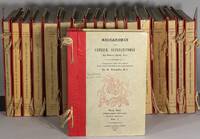
1914Best.-Nr. 67749Shanghai: Tusewei Printing Press 1914. 18 volumes mixed editions; 8vo extensively illustrated throughout with plates facsimiles halftones etc. much in color lithography after drawings by the author; original string-bound printed paper-covered boards; stamps from the library of St. Joseph's Priory on covers and title pages else generally a very good to fine set. Henry Doré was a French missionary and scholar of Asia. His 18-volume major work "Recherches sur les Superstitions en Chine" was one of the earliest 20th century European writings on Chinese culture and religion. Doré studied in Central China for more than two decades and was also an exceptionally talented illustrator who reproduced many pieces of Chinese art for his books. Originally published in French in a set of eighteen volumes from 1914-1938 these texts are notable for their colorful illustrations. Only volumes I through X and XIII were translated into English. The First Part in 5 volumes covers "Superstitious Practices" 1914-1918; the Second Part in 7 volumes covers "The Chinese Pantheon" 1918-1933 - the last two volumes in French; and the Third Part in 6 volumes covers Confucianism Buddhism and Taoism 1919-1938 all but volume XIII in French. Tusewei Printing Press unknown
1914Best.-Nr. 67749Shanghai: Tusewei Printing Press 1914. 18 volumes mixed editions; 8vo extensively illustrated throughout with plates facsimiles halftones etc. much in color lithography after drawings by the author; original string-bound printed paper-covered boards; stamps from the library of St. Joseph's Priory on covers and title pages else generally a very good to fine set. Henry Doré was a French missionary and scholar of Asia. His 18-volume major work "Recherches sur les Superstitions en Chine" was one of the earliest 20th century European writings on Chinese culture and religion. Doré studied in Central China for more than two decades and was also an exceptionally talented illustrator who reproduced many pieces of Chinese art for his books. Originally published in French in a set of eighteen volumes from 1914-1938 these texts are notable for their colorful illustrations. Only volumes I through X and XIII were translated into English. The First Part in 5 volumes covers "Superstitious Practices" 1914-1918; the Second Part in 7 volumes covers "The Chinese Pantheon" 1918-1933 - the last two volumes in French; and the Third Part in 6 volumes covers Confucianism Buddhism and Taoism 1919-1938 all but volume XIII in French. Tusewei Printing Press unknown books
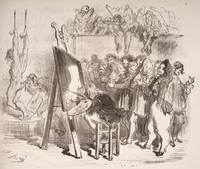
Best.-Nr. 03768Paris: Au Bureau du Journal Amusant 1854. A Superb Copy Of One of the Master's Earliest Successes DORÉ Gustave. Les Différents Publics de Paris. Paris: Au Bureau du Journal Amusant 1854. First edition. Oblong quarto 10 x 13 1/4 in; 254 x 335 mm. Lithograph title and twenty original lithograph plates. Publisher's lithographed green boards small piece 1 1/8 inch missing from top of spine. Ink signature on front free end-paper. Some light foxing heavier on preliminary leaves. A superb copy of the second 'collection' from the most popular and successful French book illustrator of the mid 19th century. "These twenty lithographs are studies of massed humanity ranging from the audiences at the great Parisian theatres to the crowds at a wrestling match or a Punch and Judy show. Without exception they are striking in conception and fertile in detail. To compare Doré's version of the reader's room at the library no. 14 and amongst Doré's celebrated with Daumier's in Les bas bleus is to ask one's self what word is left for the first if the second is called a caricature. Yet each of Doré's scenes is based on close observation and the album provides valuable testimony to the manners of the day" Ray. One of Doré's earliest efforts with which he made his debut at age twenty-two Les Différents Publics de Paris "scored an easy success.brilliant.masterly lithographed skits on Paris" Gosling p. 16 38. An important volume and a cornerstone to any collection of Doré. Beraldi Vl 30. Leblanc 90. Rahir 404. Ray 241. List of Plates: 1. Opéra Italien. 2. Comédie Francaise. 3. Opéra la fosse aux lions. 4. Jardin Des Plantes. 5. Odéon. 6. Folies Nouvelles. 7. Seraphin. 8. Funambules. 9. Soirées Fantastiques de Robert Houdin 10. Le Theatre Guignol. 11. Cirque et Hippodrome. 12. Les Lutteurs. 13. Les Abonnés Au Canon Du Palais Royal. 14. La Bibliotheque Salle de travail. 15. Les Joueurs De Boules. 16. Amphithéatre De L'Ecole De Médecine. 17. Cours D' Anatomie Comparée Au Jardin Des Plantes. 18. La Coulisse De La Bourse. 19. Justice De Paix Du 12me. Arrondissement. 20. Les Revues. Paris: Au Bureau du Journal Amusant, [1854] unknown
Best.-Nr. 03768Paris: Au Bureau du Journal Amusant 1854. A Superb Copy Of One of the Master's Earliest Successes DORÉ Gustave. Les Différents Publics de Paris. Paris: Au Bureau du Journal Amusant 1854. First edition. Oblong quarto 10 x 13 1/4 in; 254 x 335 mm. Lithograph title and twenty original lithograph plates. Publisher's lithographed green boards small piece 1 1/8 inch missing from top of spine. Ink signature on front free end-paper. Some light foxing heavier on preliminary leaves. A superb copy of the second 'collection' from the most popular and successful French book illustrator of the mid 19th century. "These twenty lithographs are studies of massed humanity ranging from the audiences at the great Parisian theatres to the crowds at a wrestling match or a Punch and Judy show. Without exception they are striking in conception and fertile in detail. To compare Doré's version of the reader's room at the library no. 14 and amongst Doré's celebrated with Daumier's in Les bas bleus is to ask one's self what word is left for the first if the second is called a caricature. Yet each of Doré's scenes is based on close observation and the album provides valuable testimony to the manners of the day" Ray. One of Doré's earliest efforts with which he made his debut at age twenty-two Les Différents Publics de Paris "scored an easy success.brilliant.masterly lithographed skits on Paris" Gosling p. 16 38. An important volume and a cornerstone to any collection of Doré. Beraldi Vl 30. Leblanc 90. Rahir 404. Ray 241. List of Plates: 1. Opéra Italien. 2. Comédie Francaise. 3. Opéra la fosse aux lions. 4. Jardin Des Plantes. 5. Odéon. 6. Folies Nouvelles. 7. Seraphin. 8. Funambules. 9. Soirées Fantastiques de Robert Houdin 10. Le Theatre Guignol. 11. Cirque et Hippodrome. 12. Les Lutteurs. 13. Les Abonnés Au Canon Du Palais Royal. 14. La Bibliotheque Salle de travail. 15. Les Joueurs De Boules. 16. Amphithéatre De L'Ecole De Médecine. 17. Cours D' Anatomie Comparée Au Jardin Des Plantes. 18. La Coulisse De La Bourse. 19. Justice De Paix Du 12me. Arrondissement. 20. Les Revues. Paris: Au Bureau du Journal Amusant, [1854] unknown books
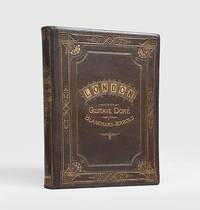
1872Best.-Nr. 189931London: Grant & Co. 1872. One of the great illustrated books of the world First edition in the publisher's deluxe morocco binding. Showcasing Doré and Jerrold's beautiful and influential "Pilgrimage" around the great metropolis of 19th-century London the ambitious project took four years to complete and was published with 180 engravings depicting various scenes around the city. Doré's striking chiaroscuro drawings faithfully rendered by a team of the finest French wood-engravers reflects the closeness and contrast of London's social classes. The book gained popularity and financial success in both Britain and America. Gordon Ray describes it as simply "one of the great illustrated books of the world". Folio. Wood-engraved frontispiece decorative title page 52 plates with captioned tissue guards illustrations in the text all after Doré. Title and letterpress printed within red double-rule border. Original green morocco over bevelled boards spine and covers lettered and elaborately decorated in gilt inner dentelles gilt loose French curl patterned endpapers edges gilt. Shallow chip to spine head foot of front joint just starting a few scratches and small dents to covers wear to corners large faint damp stains to some plates occasional light foxing. A very good copy. Beraldi VI 157; Ray 207 and listed as one of his "Outstanding Books". hardcover
1872Best.-Nr. 189822London: Grant & Co. 1872. One of the great illustrated books of the world First edition in the publisher's deluxe morocco binding. Showcasing Doré and Jerrold's beautiful and influential "Pilgrimage" around the great metropolis of 19th-century London the ambitious project took four years to complete and was published with 180 engravings depicting various scenes around the city. Doré's striking chiaroscuro drawings faithfully rendered by a team of the finest French wood-engravers reflects the closeness and contrast of London's social classes. The book gained popularity and financial success in both Britain and America. Gordon Ray describes it as simply "one of the great illustrated books of the world". Folio. Wood-engraved frontispiece decorative title page 52 plates with captioned tissue guards illustrations in the text all after Doré. Title and letterpress printed within red double-rule border. Original brown morocco over bevelled boards spine and covers lettered and elaborately decorated in gilt inner dentelles gilt loose French curl patterned endpapers edges gilt. A little rubbing inner hinges reinforced with cloth shallow chips to foot of front free endpaper repaired closed tear to upper margin of engraved title pale damp stains to a few plates contents a little foxed and cockled. A very good copy. Beraldi VI 157; Ray 207 and listed as one of his "Outstanding Books". hardcover
1854Best.-Nr. 1692561854. DORE Gustave. Histoire Dramatique Pittoresque et Caricaturale de la Sainte Russie D'après les Chroniquers et Historiens Nestor Nikan Sylvestre Karamsin Segur etc. 4 207 pp. printed on recto only illustrated with 500 engraved illustrations by Gustave Doré cut onto woodblocks by Sotain. 4to 290 x 195 mm. bound in contemporary brown quarter cloth over marbled boards with the original front and rear wrappers preserved. Paris: Lacour for J. Bry Ainé 1854. First edition early issue. Containing 500 surreal illustrations by Doré this volume presents a blistering criticism of the tyranny of the Russian Czars. In the first issue pages 89 and 97 have large blots of red ink depicting "le regné d'Ivan-le-Terrible." In this copy there is a red blot on page 97 but page 89 is blank. The collaboration between Gustave Doré and the woodcutter Sotain represents an important moment in both artist's development. "Sotain began engraving for the Magasin Pittoresque having executed for Philipon the plates to Beau Monde by Gustave Doré. The understanding that Sotain had for his art his methods and his ingenuity reassured the artist for this project. In the designs of this album Gustave Doré voluntarily multiplied the details of the images which are not usually found in such clarity" Valmy-Baysse Gustave Doré p. 150. Binding repaired and a few spots but overall a fine copy of an extremely rare work. Forberg Gustave Doré: Das graphische Werk II pp. 900-925. Leblanc Catalogue de l'Oeuvre Complet de Gustave Dore p. 135. hardcover books
Best.-Nr. 17297Paris, Au bureau du Journal pour rire, s.d. [1854] In-4, 24 pl., maroquin rouge de l'époque, caissons, filets et arabesques dorés en encadrement sur les plats, des fleurons mosaïqués de peau fauve, verte et brune dans les angles et au milieu des caissons, frise de palmettes à froid et filets dorés cantonnés de fleurons dorés en encadrement autour du fleuron doré central, dos lisse orné de filets dorés et de fleurons dorés et mosaïqués de peau fauve et verte (restaurations du papier, rousseurs, quelques petits frottements et épidermures).
2007Libro d’Ore di Bonaparte Ghislieri (Libro d’Ore del Perugino, Hours of Bonaparte Ghislieri). British Library, Yates Thompson MS 29, Londra. Franco Cosimo Panini Editore, 2007. Riproduzione in facsimile del manoscritto con miniature, a piena pagina, realizzate dal Perugino altri miniatori quali Lorenzo Costa, Amico Aspertini, Francesco Francia, Matteo da Milano. Legatura in marocchino con, sui piatti, due castoni di pietre dure e due medaglioni centrali raffiguranti l’Annunciazione. Formato 15x21 cm. Pagine 270. Commentario, in italiano, di Benevolo Giancarlo, Kidd, Peter e Medica Massimo. Cofanetto di custodia. Tiratura limitata e numerata di 980 copie. Condizioni ottime.
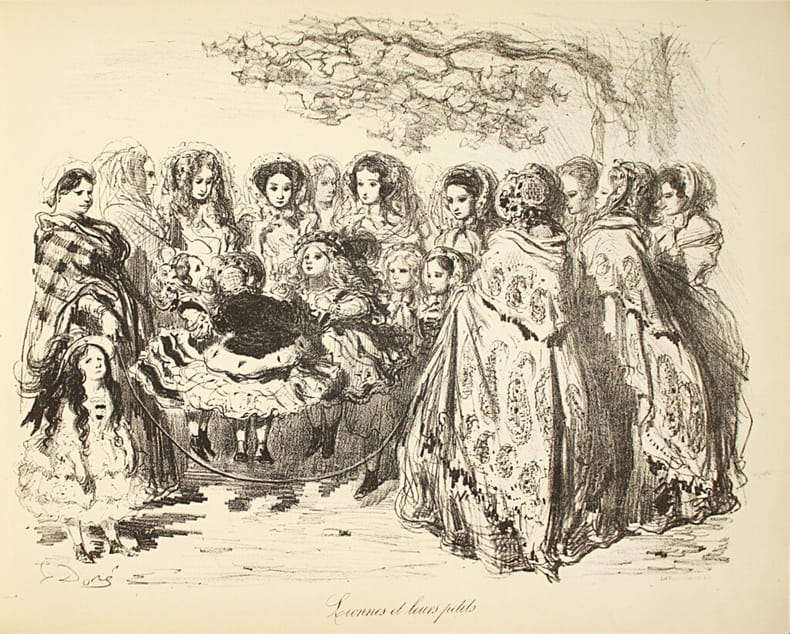
Best.-Nr. 06358Paris: Au Bureau du Journal Pour Rire 1854. From Lions to Sewer Rats: Doré's Merciless Pencil Spares No Class of Parisian Society" DORÉ Gustave. La Ménagerie Parisienne. Paris: Au Bureau du Journal Pour Rire n.d. 1854. First proof printing of this remarkable and extremely rare album comprising 24 original lithographs by Veyron after Gustave Doré. The work was advertised in the Bibliographie de la France on 28 October 1854 no. 3826. Oblong folio 10 1/4 x 13 1/2 inches; 259 x 343 mm. Original publisher's green paper wrappers title stamped in gilt. A minute chip to the lower edge of the front wrapper approximately 5/8 x 3/8 inch otherwise a superb fresh copy preserved in the publisher's original glassine and entirely free of foxing. Housed in a quarter red morocco chemise gilt-lettered over marbled boards within a matching red leather-edged slipcase. An exceptionally fine and unrecorded example printed on papier vélin fort. Not listed by standard bibliographers the leaves are 5/8 inch wider than usual examples. This suite appears never to have been commercially marketed. It was issued without a printed title-page the title instead stamped in gold on the green wrappers. In La Ménagerie Parisienne Doré delivers a scathing and brilliantly observed satire of Parisian society. Social types are transformed into a kind of urban "fauna" each class assigned an animal identity that mirrors its dress posture and moral character - yet without ever sacrificing humanity. Aristocrats of the Faubourg Saint-Germain appear as "lions" and "lionesses" adopting a term already current in 18th-century England while the social scale descends inexorably to the "rats" of the Parisian sewers. Doré's vision is unsparing and no stratum of urban life escapes his scrutiny. Michèle Lavallée Gustave Doré 1832-1883 p. 287. Produced during Doré's youth this album reveals the formative synthesis of his influences. While the titles and captions recall Grandville whose work deeply marked Doré's early career the drawings themselves resonate strongly with the graphic force and social acuity of Daumier. Among the most celebrated plates is the riotous assembly of washerwomen a scene that would become emblematic of Doré's early satirical power. Doré first visited Paris in 1847 with his parents and soon showed his drawings to Charles Philipon who immediately recognized his talent and engaged him for the Journal Pour Rire. Although Doré's earliest lithographic albums - beginning with Les Travaux d'Hercule published when he was just fifteen - are today among his most engaging works they remain conspicuously under-represented even in advanced collections due to their extreme scarcity. As Gordon Ray observed albums such as Les Différents publics de Paris Les Folies gauloises Les Agréments d'un voyage de désagrément 1851 and La Ménagerie Parisienne 1854 reveal Doré at his most inventive and humorous combining youthful exuberance with a remarkably sophisticated social vision. Gordon Ray. The Art of the Illustrated Book in France 1700-1914 p. 327. A rare and important early Doré album virtually unobtainable in this condition and state. The plates: 1. Lions 2. Petits Lions Lions adultes 3. Lionnes 4. Lionnes Sortie de la messe d'1 heure 5. Lionnes et leurs petits 6. Paons 7. Rats d'opéra 8. Rats d'égout 9. Rats peintres alias rapins 10. Rats de Jardin 11. Loups 12. Loups cerviers 13. Vautours 14. Les dindons et les oies 15. Serpents 16. Pies 17. Crapauds 18. Coq de barriere 19. Tigre / Serin 20. Pantheres 21. Chouettes 22. Vielles Pantheres 23. Buses 24. Oiseau de proie / Merlan. Paris: Au Bureau du Journal Pour Rire, [1854] unknown
Best.-Nr. 06358Paris: Au Bureau du Journal Pour Rire 1854. From Lions to Sewer Rats: Doré's Merciless Pencil Spares No Class of Parisian Society" DORÉ Gustave. La Ménagerie Parisienne. Paris: Au Bureau du Journal Pour Rire n.d. 1854. First proof printing of this remarkable and extremely rare album comprising 24 original lithographs by Veyron after Gustave Doré. The work was advertised in the Bibliographie de la France on 28 October 1854 no. 3826. Oblong folio 10 1/4 x 13 1/2 inches; 259 x 343 mm. Original publisher's green paper wrappers title stamped in gilt. A minute chip to the lower edge of the front wrapper approximately 5/8 x 3/8 inch otherwise a superb fresh copy preserved in the publisher's original glassine and entirely free of foxing. Housed in a quarter red morocco chemise gilt-lettered over marbled boards within a matching red leather-edged slipcase. An exceptionally fine and unrecorded example printed on papier vélin fort. Not listed by standard bibliographers the leaves are 5/8 inch wider than usual examples. This suite appears never to have been commercially marketed. It was issued without a printed title-page the title instead stamped in gold on the green wrappers. In La Ménagerie Parisienne Doré delivers a scathing and brilliantly observed satire of Parisian society. Social types are transformed into a kind of urban "fauna" each class assigned an animal identity that mirrors its dress posture and moral character - yet without ever sacrificing humanity. Aristocrats of the Faubourg Saint-Germain appear as "lions" and "lionesses" adopting a term already current in 18th-century England while the social scale descends inexorably to the "rats" of the Parisian sewers. Doré's vision is unsparing and no stratum of urban life escapes his scrutiny. Michèle Lavallée Gustave Doré 1832-1883 p. 287. Produced during Doré's youth this album reveals the formative synthesis of his influences. While the titles and captions recall Grandville whose work deeply marked Doré's early career the drawings themselves resonate strongly with the graphic force and social acuity of Daumier. Among the most celebrated plates is the riotous assembly of washerwomen a scene that would become emblematic of Doré's early satirical power. Doré first visited Paris in 1847 with his parents and soon showed his drawings to Charles Philipon who immediately recognized his talent and engaged him for the Journal Pour Rire. Although Doré's earliest lithographic albums - beginning with Les Travaux d'Hercule published when he was just fifteen - are today among his most engaging works they remain conspicuously under-represented even in advanced collections due to their extreme scarcity. As Gordon Ray observed albums such as Les Différents publics de Paris Les Folies gauloises Les Agréments d'un voyage de désagrément 1851 and La Ménagerie Parisienne 1854 reveal Doré at his most inventive and humorous combining youthful exuberance with a remarkably sophisticated social vision. Gordon Ray. The Art of the Illustrated Book in France 1700-1914 p. 327. A rare and important early Doré album virtually unobtainable in this condition and state. The plates: 1. Lions 2. Petits Lions Lions adultes 3. Lionnes 4. Lionnes Sortie de la messe d'1 heure 5. Lionnes et leurs petits 6. Paons 7. Rats d'opéra 8. Rats d'égout 9. Rats peintres alias rapins 10. Rats de Jardin 11. Loups 12. Loups cerviers 13. Vautours 14. Les dindons et les oies 15. Serpents 16. Pies 17. Crapauds 18. Coq de barriere 19. Tigre / Serin 20. Pantheres 21. Chouettes 22. Vielles Pantheres 23. Buses 24. Oiseau de proie / Merlan. Paris: Au Bureau du Journal Pour Rire, [1854] unknown books
1538Best.-Nr. 15510Paris, Pierre Vidoue, 1538. In-8 gothique (145 x 90 mm) de (111) ff. (sign. A-N8 O7), maroquin rouge, dos lisse orné, triple filet doré d'encadrement sur les plats, roulette intérieure, tranches dorées (reliure du XVIIIe siècle).
1855Best.-Nr. 1696331855. DORÉ Gustave. Les Contes Drolatiques. By Honore de Balzac. 8vo. 205 x 130 mm bound in nineteeenth century full crushed brown morocco in a slipcase. Paris: Garnier Freres 1873. A superb copy of this Doré masterpiece with fine impressions of the engraving printed on Chine and with "huitieme edition" on the title-page. Gordon Ray called Doré'ss illustrations for the Contes Drolatiques "Doré's early masterpiece." The first illustrated edition was issued with 425 original designs by Gustave Doré comprising 103 full-page engravings and 322 vignettes of varying sizes. It is well recorded that Balzac's widow granted permission for the illustrated edition only on the condition: "that no artist but Doré should be allowed to illustrate her husband's works" Anthony North-Peat Gossip from Paris 1864-69 p. 324. "Si de tous les ouvrages illustrés par Gustave Doré il ne devait en rester qu'un ce serait celui-là: l'illustration est à la hauteur du texte et ce n'est pas peu dire puisque Balzac considérait les "Contes drolatiques" comme son chef-d'oeuvre" Brivois Bibliographie des ouvrages illustrés du XIXe siècle 1883 p. 32. "Ce livre est considéré comme le chef-d'oeuvre d'illustration de Gustaf Doré il est apprécié pour son format agréable et la qualité de son illustration variée et abondante: 425 compositions vignettes et grands bois compris dans la pagination." Carteret III p. 50. Ray Art of the French Illustrated Book 244. See: Rahir 304. Beraldi VI 34 "Un des chef-d'oeuvres de Doré: cette illustration est étonnante d'invention de joyeuse humeur vraiment gauloise et rabelaisienne et pétillante d'esprit." Leblanc 39. Provenance: The library of William Ivins inscribed to him by his father. unknown
1872Best.-Nr. 302978London: Grant & Co 1872. First edition. Wood-engraved title page illustrated with numerous wood-engraved plates vignettes head- and tail-pieces after Doré. 13 parts in 12. 1 vols. Folio. Original printed wrappers spines repaired. Very good clean set. Cloth folding box. Doré Gustave. First edition. Wood-engraved title page illustrated with numerous wood-engraved plates vignettes head- and tail-pieces after Doré. 13 parts in 12. 1 vols. Folio. "Doré's devastating realization of the contrast of wealth and poverty in a modern metropolis makes LONDON one of the great illustrated books of the world.". Ray p. 134; Malan pp. 126-9; Grant & Co unknown
1872Best.-Nr. 302978London: Grant & Co 1872. First edition. Wood-engraved title page illustrated with numerous wood-engraved plates vignettes head- and tail-pieces after Doré. 13 parts in 12. 1 vols. Folio. Original printed wrappers spines repaired. Very good clean set. Cloth folding box. Doré Gustave. First edition. Wood-engraved title page illustrated with numerous wood-engraved plates vignettes head- and tail-pieces after Doré. 13 parts in 12. 1 vols. Folio. "Doré's devastating realization of the contrast of wealth and poverty in a modern metropolis makes LONDON one of the great illustrated books of the world.". Ray p. 134; Malan pp. 126-9; Grant & Co unknown books
1855Best.-Nr. 1696331855. DORÉ Gustave. Les Contes Drolatiques. By Honore de Balzac. 8vo. 205 x 130 mm bound in nineteeenth century full crushed brown morocco in a slipcase. Paris: Garnier Freres 1873. A superb copy of this Doré masterpiece with fine impressions of the engraving printed on Chine and with "huitieme edition" on the title-page. Gordon Ray called Doré'ss illustrations for the Contes Drolatiques "Doré's early masterpiece." The first illustrated edition was issued with 425 original designs by Gustave Doré comprising 103 full-page engravings and 322 vignettes of varying sizes. It is well recorded that Balzac's widow granted permission for the illustrated edition only on the condition: "that no artist but Doré should be allowed to illustrate her husband's works" Anthony North-Peat Gossip from Paris 1864-69 p. 324. "Si de tous les ouvrages illustrés par Gustave Doré il ne devait en rester qu'un ce serait celui-là: l'illustration est à la hauteur du texte et ce n'est pas peu dire puisque Balzac considérait les "Contes drolatiques" comme son chef-d'oeuvre" Brivois Bibliographie des ouvrages illustrés du XIXe siècle 1883 p. 32. "Ce livre est considéré comme le chef-d'oeuvre d'illustration de Gustaf Doré il est apprécié pour son format agréable et la qualité de son illustration variée et abondante: 425 compositions vignettes et grands bois compris dans la pagination." Carteret III p. 50. Ray Art of the French Illustrated Book 244. See: Rahir 304. Beraldi VI 34 "Un des chef-d'oeuvres de Doré: cette illustration est étonnante d'invention de joyeuse humeur vraiment gauloise et rabelaisienne et pétillante d'esprit." Leblanc 39. Provenance: The library of William Ivins inscribed to him by his father. unknown books
1861Best.-Nr. 51287Sous étui bordé. Reliure plein maroquin brun. Dos à 4 nerfs sautés orné de filets et d'un fleuron central à froid. Panneau orné d'un décor à répétition dessiné par des fleurons disposés sur un pavage de losanges, encadrement intérieur de deux doubles filets dorés. Tranches dorées sur témoins. Reliure signée CONIL-SEPTIER.
1573In-4°; pp. 492, (4), segue Hymni per totum annum... pp. 70, (2) con colophon Antverpiae excudebat Christophorus Plantinus Architypographus Regius anno MDLXXIII; frontespizio stampato in rosso e nero, entro bordura xilografica e al centro un grande tondo con l’Ascensione della Vergine (il monogramma di firma A.V.L, Antonius van Leest, l’incisore.). L’intero testo (tranne le ultime 70 pagine) è stampato con parti in rosso, ogni pagina entro ricca bordura xilografica a quattro legni. Nel testo illustrazioni di Pieter van der Brocht incise su legno da Antonius van Leest (i nomi dei due artisti fiamminghi si trovano espressi per intero nell’ultima illustrazione, quella dell’Apocalisse, con data 1572; nelle altre incisioni con i monogrammi). Rara edizione, e una delle prime, riccamente illustrata dell’Officium riformato di Pio V, libro d’ore di Plantin, qui nella versione (Variante C) con illustrazioni e bordure xilografiche. Le xilografie a piena pagina sono 19. Legatura in piena pelle con titolo in oro al dorso. Alcuni fori di tarlo passanti al margine interno bianco delle prime e ultime carte.
Best.-Nr. LCS-17558Premier tirage de cette suite de 24 lithographies réalisées d’après les dessins de Gustave Doré. Paris, Au Bureau du Journal pour Rire, s.d. [1854].Grand in-4 oblong de (1) f. de titre et 24 lithographies numérotées. Relié en demi-percaline ocre, dos lisse, pièce de titre en maroquin vert. Reliure du XIXe siècle.258 x 330 mm.
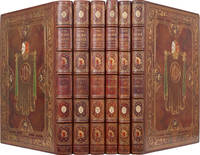
1904Best.-Nr. 1057London: Cassell and Company 1904. First Edition. Six volumes folio. Bindings by La Belle Sauvage in full morocco elaborate gilt spines covers and doublures with morocco onlaid masks of Comedy and Tragedy grape and floral inlays in an Art Nouveau style upper doublures of each volume with copper medallions of Dante with a verdigrised patina. The signed "Sir Henry Irving limited edition" number 14 of 55 sets each volume with a watercolor frontispiece by William Satterlee after the famous Gustave Doré designs. 136 full-page wood-engraved plates on Japan paper after Doré. Red moiré silk endpapers hand painted drop caps and decorations throughout. Five of the six volumes skillfully rebacked with the original spines laid down some other points of restoration to the extremities rubbing to the extremities some cracking and chipping to the silk endpapers else internally clean and beautiful. The Divine Comedy’s enduring relevance and universal themes have cemented its status as a cornerstone of Western literary tradition. The vivid imagery makes Dante’s poem particularly well suited to a multitude of illustrative interpretations from Sandro Botticelli’s in the Renaissance to the Romanticism of Doré to the late stage historical-Surrealism of Salvadore Dali. Cassell and Company unknown
1904Best.-Nr. 1057London: Cassell and Company 1904. First Edition. Six volumes folio. Bindings by La Belle Sauvage in full morocco elaborate gilt spines covers and doublures with morocco onlaid masks of Comedy and Tragedy grape and floral inlays in an Art Nouveau style upper doublures of each volume with copper medallions of Dante with a verdigrised patina. The signed "Sir Henry Irving limited edition" number 14 of 55 sets each volume with a watercolor frontispiece by William Satterlee after the famous Gustave Doré designs. 136 full-page wood-engraved plates on Japan paper after Doré. Red moiré silk endpapers hand painted drop caps and decorations throughout. Five of the six volumes skillfully rebacked with the original spines laid down some other points of restoration to the extremities rubbing to the extremities some cracking and chipping to the silk endpapers else internally clean and beautiful. The Divine Comedy’s enduring relevance and universal themes have cemented its status as a cornerstone of Western literary tradition. The vivid imagery makes Dante’s poem particularly well suited to a multitude of illustrative interpretations from Sandro Botticelli’s in the Renaissance to the Romanticism of Doré to the late stage historical-Surrealism of Salvadore Dali. Cassell and Company unknown books
1860Best.-Nr. 47799Paris & New York.: Turgis & Duane. c.1860. Oblong folio. 320 x 434 mm. Six original colour lithographs by Gustave Doré each heightened with gum arabic. Each plate with the running title 'Corrida de Toros' individual captions in Spanish and French and with 'G. Doré del.'. Four of the lithographs nos. 2 3 5 and 6 are signed in the plate. First edition of Gustave Doré's rare suite of bullfighting lithographs.Each of the plates has the title in both Spanish and French:1. Caida del Picador - Chute d'un Picador.2. Suerta de Banderillas - Banderillero piquant la Banderilla.3. Suerta de Capa - Banderillero excitant le taureau.4. Cogida de un Torero - Torero enlevé par le taureau.5. Suerta de Pica - Coup de Lance.6. Estocada - Coup d'épée.Leblanc pg. 521 unseen; Vindel Toros 1931; not in Sims Reed / Forgeot. Turgis & Duane. unknown
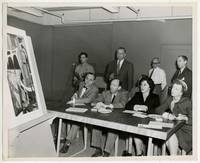
1940Best.-Nr. COL26-111940. Silver and chromogenic prints approx. 160; typed and manuscript poems letters and essays approx. 200 pages; ink watercolor and graphite sketches approx. 120 pages. A substantial and significant volume of material pertaining to the pioneering art critic and writer Dore Ashton an early champion of Abstract Expressionism and the New York School with scores of primary works related to both fine art and poetry. The archive can be divided into three major components: photographs artwork and written material. The centerpiece of the written material is a thick notebook of material compiled by Ashton over many years. Included are dozens of signed and dated typescript poems by Hilda Morley Jane Randall William Jay Smith Barbara Howes and Richard Wilbur. The Wilbur material is particularly fascinating and speaks to their close friendship and working relationship Wilbur was a contributor to Ashton's 1959 publication "Poets of the Past". Included is an unpublished hand-written poem by Wilbur. The poem titled "Two Pre-Columbian Cultural Cheers" is a jocular satire of the collegiate fight song. It was composed in 1957 on the occasion of the publication of Ashton's 1957 book "Abstract Art Before Columbus." There is also a printed copy of Wilbur's "Advice to a Prophet" inscribed with the following: "I have just written a one-line play about Prometheus. Prometheus is tied to the rock: the eagle of Zeus is tormenting him. ENTER a SHALLOW OPTIMIST. Shallow Optimist: "What's Eating You" Other notable material includes two working drafts of poems by the important Peruvian author Blanca Varela. One of these is an early draft of her beloved prose poem "Calle Catorce" "Fourteenth Street" which bears a number of notable differences from the published version. There is also a page of manuscript sheet music composed by Yehudi Wymer done so for a party of Yunkers'. Also present are many examples of Ashton's own writing much of which pertains to some of the key figures in American art in the late 1940s and early 1950s. "It has been nearly three months since I visited Rothko in his studio "begins one entry "and the residue of feeling is with me. It bothers me that I have been unable to find the language to speak of the experience. Let alone the language to speak of the works of art." There are also substantial entries pertaining to Phillip Guston Jackson Pollock and numerous others. The photographic portion of the collection is equally robust. There are many wonderful and captivating portraits of Ashton taken throughout the years. Along with candid snapshots there are many pictures of her shot by notable photographers including David Gahr Larry Fink David and Denise Hare Renate Motherwell and others. Also present are many photographs which were used to illustrate her 1973 book "The New York School: A Cultural Reckoning" such as a portrait of Milton Avery shot by Lee Sievan and a wonderful group portrait of the Forum 49 collective showing Weldon Kees Adolph Gottleib and others. Other portraits of art world luminaries found in the collection include those of Philip Guston Hannah Wilke Robert Motherwell Joseph Cornell Will Barnet Marisol Escobar and many more. Another interesting aspect of the photographic collection is a group of about forty candid photos of a Rothko opening showing him Guston and others. Ashton was for a time married to the Abstract Expressionist Adja Yunkers and the present collection contains and the present collection also includes dozens of examples of his own work mainly in the form of watercolor sketches some with text or inscriptions to Ashton. Also included are four sketchbooks of Ashton's own work done in the 1950s and 60s as well as a few of her woodblock prints. The aforementioned notebook also contains many fascinating pieces of original art crafted as unique Christmas cards and given to Ashton and her one-time husband the artist Adja Yunkers. These include works by the Abstract painter Perle Fine Italian painter Pietro Dorazio natalia dumitresco and her husband Alexandre Istrati and a few others. Overall a significant endlessly fascinating account of a singular New York figure. More images available upon request. Various sizes; photographs from 2 x 2 inches to 8 x 10 inches; most written material approximately 8 x 10 inches; sketches mostly 4 x 6 inches. unknown