Dore GustaveBiblio.com

3 942 résultats
1850réf. 70018Paris: Chez Aubert & Cie 1850-51. First Edition First Issue of one of the two earliest and most rare of all Doré's illustrated books. Only Les Travaux d'Hercule precedes this book and like the Trois Artistes Incompris et Mecontens is very rarely if ever seen in commerce. Illustrated with an engraved title-page as the upper cover illustration of the book and over 150 woodcut illustrations throughout. Folio publisher's original and earliest binding of pictorially illustrated yellow paper over boards the upper cover with all-over illustrations printed in red and black. 1 25 pp. A well preserved and handsome copy of this very rare and fragile book some expert and unobtrusive strengthening at the tips and edges a book seldom if ever encountered and even then nearly always with very considerable wear and breakage. FIRST EDITION OF ONE OF THE EARLIEST AND MOST RARE OF DORÉ'S ILLUSTRATED WORKS. 'At 15 years of age Doré had begun his career working as a caricaturist for the French paper Le journal pour rire. Wood-engraving was his primary method at this time. In the late 1840s and early 1850s he made several text comics like Les Travaux d'Hercule 1847 Trois artistes incompris et mécontents 1850-1 Les Dés-agréments d'un voyage d'agrément 1851 and L'Histoire de la Sainte Russie 1854 but subsequently went on to win commissions to depict scenes from books by Cervantes Rabelais Balzac Milton and Dante. He also illustrated "Gargantua et Pantagruel" in 1854. 'Trois Artists is a fascinating book.but dating the Trois Artistes original is a bibliographical challenge. The earliest Journal pour Rire advertisement was in November 29 1850 and the book itself has a Dec. 1850 date in the publisher's catalogue. The second larger Journal pour Rire advertisement was dated January 31 1851 and the book was listed by February 11 1851 in Bibliographie de la France. Whether December or January the book remains along with Les Travaux d'Hercule the most rare of Gustave Doré's illustrated books and one of the earliest "comic books" produced. Gustave Doré 1832-1883 was described by Saturday Review as “The most startling art phenomenon in Europe; his genius at each turn changes like the colors in a kaleidescope into something new and unexpected.” The Fine Arts Quarterly Review also wrote: “Doré is a great and marvelous genius a poet a nation produces once in a thousand years. He is the most imaginative the profoundest the most productive poet that ever sprang from the French race.” These are 1860s quotes from England about a French artist. What did Doré actually do He created a series of dozens of literary folios with thousands of full-page engravings that are still being borrowed today in hundreds of popular culture genres. The Doré phenomenon was all the more remarkable because he was being viciously attacked by British elitists like John Ruskin who asserted that Doré was the Devil come to destroy the morality of the British public who were unsophisticated peasants. But those “unsophisicated peasants” who admired Doré art included the Queen of England the Prince of Wales the Poet Laureate Charles Dickens plus Leo Tolstoy Mark Twain not to mention the Pope. Doré’s dramatic mystical otherworldly imagery transcended dimensions of the physical and the spiritual. While other illustrators showed people standing in a room talking Doré showed images of Spiral Nebula Flying Saucers the depths of Hell and the opening of Heaven in his folios for Dante Milton Tennyson The Bible Rabelais Shakespeare Fairy Tales Fables Don Quixote Baron Munchausen The Ancient Mariner Doré’s social commentary masterpiece London A Pilgrimage and Poe’s The Raven which Doré did not live to see published. Doré was a creative geniuses with unlimited imagination. Consider that Gustave Doré at the age of 15 years and a diminutive teenager walked into the office of Charles Philipon to show his drawings. It is said that he looked to be about 12. Philipon was mesmerized as Doré created new drawings with lightning-fast rapidity right before his eyes. Shortly thereafter a book appeared with a most curious introduction by the Aubert Publishing Company that read “The Labours of Hercules was written drawn and lithographed by a 15-year-old artist who has no teacher or art training.” Thus began the art career of the most prolific and popular illustrator of all time. He wrote and drew several “comic books” before he began the transition to Literary Folios Painting & Sculpture. But the only other edition of Doré’s Hercules in 145 years was a German edition in 1922. Charles Philipon’s company Aubert contracted with Doré'’s father to hire the boy to draw for his Journal pour Rire and Doré had over a thousand engravings published while still a teenager. In 1850 TROIS ARTISTES INCOMPRIS ET MÉCONTENS Three Misunderstood Malcontent Artists with 155 drawings was published. One of the two earliest and now most rare of the young genius's books. And one of the earliest of all "comic books". Considering his illustrations for Cervantes's Don Quixote his depictions of the knight and his squire Sancho Panza have become so famous that they have influenced subsequent readers artists and stage and film directors' ideas of the physical "look" of the two characters. Doré also illustrated an oversized edition of Edgar Allan Poe's "The Raven" an endeavor that earned him 30000 francs from publisher Harper & Brothers in 1883. Doré's illustrations for the Bible 1866 were a great success and in 1867 Doré had a major exhibition of his work in London. This exhibition led to the foundation of the Doré Gallery in Bond Street London. In 1869 Blanchard Jerrold the son of Douglas William Jerrold suggested that they work together to produce a comprehensive portrait of London. Jerrold had obtained the idea from The Microcosm of London produced by Rudolph Ackermann William Pyne and Thomas Rowlandson published in three volumes from 1808 to 1810. Doré signed a five-year contract with the publishers Grant & Co that involved his staying in London for three months a year and he received the vast sum of Å10000 a year for the project. Doré was mainly celebrated for his paintings in his day. His paintings remain world-renowned but his woodcuts and engravings like those he did for Jerrold are where he excelled as an artist with an individual vision. The completed book London: A Pilgrimage with 180 wood-engravings was published in 1872. It enjoyed commercial and popular success but the work was disliked by many contemporary critics. Some of these critics were concerned by the fact that Doré appeared to focus on the poverty that existed in parts of London. Doré was accused by The Art Journal of "inventing rather than copying". The Westminster Review claimed that "Doré gives us sketches in which the commonest the vulgarest external features are set down". The book was a financial success however and Doré received commissions from other British publishers. Doré's later work included illustrations for new editions of Coleridge's Rime of the Ancient Mariner Milton's Paradise Lost Tennyson's Idylls of the King The Works of Thomas Hood and The Divine Comedy. Doré's work also appeared in the weekly newspaper The Illustrated London News.' Wiki Chez Aubert & Cie hardcover
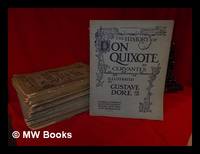
réf. 318340London Paris New York & Melbourne: Cassell & Company Limited. First English Language Edition. Softcover. Good set in original stiff card wrappers with some wear and tear as with age. Remains well-preserved overall; bright and clean.Volume 30 is missing its front cover. Physical description; 30 issues. Notes; No date given. First English Language edition succeeded by the first book form in Sept. 1906. The success of Doré's work this edition led largely to his success. Subjects; Don Quixote. Cervantes. Gustave Doré illustrator. London, Paris, New York & Melbourne: Cassell & Company, Limited paperback
1538réf. 15510Paris, Pierre Vidoue, 1538. In-8 gothique (145 x 90 mm) de (111) ff. (sign. A-N8 O7), maroquin rouge, dos lisse orné, triple filet doré d'encadrement sur les plats, roulette intérieure, tranches dorées (reliure du XVIIIe siècle).
1855réf. 1696331855. DORÉ Gustave. Les Contes Drolatiques. By Honore de Balzac. 8vo. 205 x 130 mm bound in nineteeenth century full crushed brown morocco in a slipcase. Paris: Garnier Freres 1873. A superb copy of this Doré masterpiece with fine impressions of the engraving printed on Chine and with "huitieme edition" on the title-page. Gordon Ray called Doré'ss illustrations for the Contes Drolatiques "Doré's early masterpiece." The first illustrated edition was issued with 425 original designs by Gustave Doré comprising 103 full-page engravings and 322 vignettes of varying sizes. It is well recorded that Balzac's widow granted permission for the illustrated edition only on the condition: "that no artist but Doré should be allowed to illustrate her husband's works" Anthony North-Peat Gossip from Paris 1864-69 p. 324. "Si de tous les ouvrages illustrés par Gustave Doré il ne devait en rester qu'un ce serait celui-là: l'illustration est à la hauteur du texte et ce n'est pas peu dire puisque Balzac considérait les "Contes drolatiques" comme son chef-d'oeuvre" Brivois Bibliographie des ouvrages illustrés du XIXe siècle 1883 p. 32. "Ce livre est considéré comme le chef-d'oeuvre d'illustration de Gustaf Doré il est apprécié pour son format agréable et la qualité de son illustration variée et abondante: 425 compositions vignettes et grands bois compris dans la pagination." Carteret III p. 50. Ray Art of the French Illustrated Book 244. See: Rahir 304. Beraldi VI 34 "Un des chef-d'oeuvres de Doré: cette illustration est étonnante d'invention de joyeuse humeur vraiment gauloise et rabelaisienne et pétillante d'esprit." Leblanc 39. Provenance: The library of William Ivins inscribed to him by his father. unknown
1872réf. 302978London: Grant & Co 1872. First edition. Wood-engraved title page illustrated with numerous wood-engraved plates vignettes head- and tail-pieces after Doré. 13 parts in 12. 1 vols. Folio. Original printed wrappers spines repaired. Very good clean set. Cloth folding box. Doré Gustave. First edition. Wood-engraved title page illustrated with numerous wood-engraved plates vignettes head- and tail-pieces after Doré. 13 parts in 12. 1 vols. Folio. "Doré's devastating realization of the contrast of wealth and poverty in a modern metropolis makes LONDON one of the great illustrated books of the world.". Ray p. 134; Malan pp. 126-9; Grant & Co unknown
1872réf. 302978London: Grant & Co 1872. First edition. Wood-engraved title page illustrated with numerous wood-engraved plates vignettes head- and tail-pieces after Doré. 13 parts in 12. 1 vols. Folio. Original printed wrappers spines repaired. Very good clean set. Cloth folding box. Doré Gustave. First edition. Wood-engraved title page illustrated with numerous wood-engraved plates vignettes head- and tail-pieces after Doré. 13 parts in 12. 1 vols. Folio. "Doré's devastating realization of the contrast of wealth and poverty in a modern metropolis makes LONDON one of the great illustrated books of the world.". Ray p. 134; Malan pp. 126-9; Grant & Co unknown books
1855réf. 1696331855. DORÉ Gustave. Les Contes Drolatiques. By Honore de Balzac. 8vo. 205 x 130 mm bound in nineteeenth century full crushed brown morocco in a slipcase. Paris: Garnier Freres 1873. A superb copy of this Doré masterpiece with fine impressions of the engraving printed on Chine and with "huitieme edition" on the title-page. Gordon Ray called Doré'ss illustrations for the Contes Drolatiques "Doré's early masterpiece." The first illustrated edition was issued with 425 original designs by Gustave Doré comprising 103 full-page engravings and 322 vignettes of varying sizes. It is well recorded that Balzac's widow granted permission for the illustrated edition only on the condition: "that no artist but Doré should be allowed to illustrate her husband's works" Anthony North-Peat Gossip from Paris 1864-69 p. 324. "Si de tous les ouvrages illustrés par Gustave Doré il ne devait en rester qu'un ce serait celui-là: l'illustration est à la hauteur du texte et ce n'est pas peu dire puisque Balzac considérait les "Contes drolatiques" comme son chef-d'oeuvre" Brivois Bibliographie des ouvrages illustrés du XIXe siècle 1883 p. 32. "Ce livre est considéré comme le chef-d'oeuvre d'illustration de Gustaf Doré il est apprécié pour son format agréable et la qualité de son illustration variée et abondante: 425 compositions vignettes et grands bois compris dans la pagination." Carteret III p. 50. Ray Art of the French Illustrated Book 244. See: Rahir 304. Beraldi VI 34 "Un des chef-d'oeuvres de Doré: cette illustration est étonnante d'invention de joyeuse humeur vraiment gauloise et rabelaisienne et pétillante d'esprit." Leblanc 39. Provenance: The library of William Ivins inscribed to him by his father. unknown books
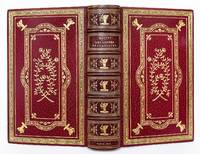
1861réf. 51287Sous étui bordé. Reliure plein maroquin brun. Dos à 4 nerfs sautés orné de filets et d'un fleuron central à froid. Panneau orné d'un décor à répétition dessiné par des fleurons disposés sur un pavage de losanges, encadrement intérieur de deux doubles filets dorés. Tranches dorées sur témoins. Reliure signée CONIL-SEPTIER.
1573In-4°; pp. 492, (4), segue Hymni per totum annum... pp. 70, (2) con colophon Antverpiae excudebat Christophorus Plantinus Architypographus Regius anno MDLXXIII; frontespizio stampato in rosso e nero, entro bordura xilografica e al centro un grande tondo con l’Ascensione della Vergine (il monogramma di firma A.V.L, Antonius van Leest, l’incisore.). L’intero testo (tranne le ultime 70 pagine) è stampato con parti in rosso, ogni pagina entro ricca bordura xilografica a quattro legni. Nel testo illustrazioni di Pieter van der Brocht incise su legno da Antonius van Leest (i nomi dei due artisti fiamminghi si trovano espressi per intero nell’ultima illustrazione, quella dell’Apocalisse, con data 1572; nelle altre incisioni con i monogrammi). Rara edizione, e una delle prime, riccamente illustrata dell’Officium riformato di Pio V, libro d’ore di Plantin, qui nella versione (Variante C) con illustrazioni e bordure xilografiche. Le xilografie a piena pagina sono 19. Legatura in piena pelle con titolo in oro al dorso. Alcuni fori di tarlo passanti al margine interno bianco delle prime e ultime carte.
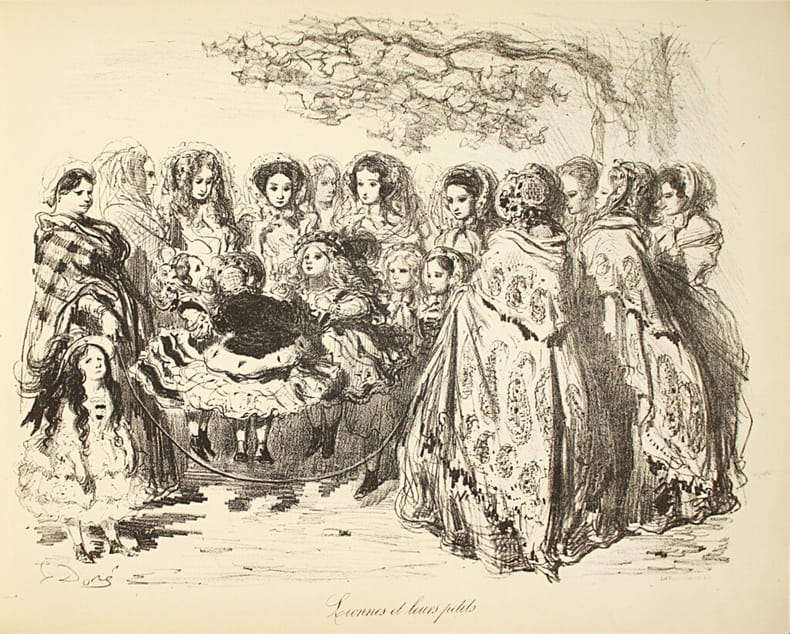
réf. LCS-17558Premier tirage de cette suite de 24 lithographies réalisées d’après les dessins de Gustave Doré. Paris, Au Bureau du Journal pour Rire, s.d. [1854].Grand in-4 oblong de (1) f. de titre et 24 lithographies numérotées. Relié en demi-percaline ocre, dos lisse, pièce de titre en maroquin vert. Reliure du XIXe siècle.258 x 330 mm.
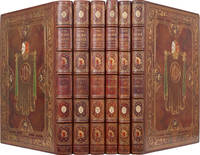
1904réf. 1057London: Cassell and Company 1904. First Edition. Six volumes folio. Bindings by La Belle Sauvage in full morocco elaborate gilt spines covers and doublures with morocco onlaid masks of Comedy and Tragedy grape and floral inlays in an Art Nouveau style upper doublures of each volume with copper medallions of Dante with a verdigrised patina. The signed "Sir Henry Irving limited edition" number 14 of 55 sets each volume with a watercolor frontispiece by William Satterlee after the famous Gustave Doré designs. 136 full-page wood-engraved plates on Japan paper after Doré. Red moiré silk endpapers hand painted drop caps and decorations throughout. Five of the six volumes skillfully rebacked with the original spines laid down some other points of restoration to the extremities rubbing to the extremities some cracking and chipping to the silk endpapers else internally clean and beautiful. The Divine Comedy’s enduring relevance and universal themes have cemented its status as a cornerstone of Western literary tradition. The vivid imagery makes Dante’s poem particularly well suited to a multitude of illustrative interpretations from Sandro Botticelli’s in the Renaissance to the Romanticism of Doré to the late stage historical-Surrealism of Salvadore Dali. Cassell and Company unknown
1904réf. 1057London: Cassell and Company 1904. First Edition. Six volumes folio. Bindings by La Belle Sauvage in full morocco elaborate gilt spines covers and doublures with morocco onlaid masks of Comedy and Tragedy grape and floral inlays in an Art Nouveau style upper doublures of each volume with copper medallions of Dante with a verdigrised patina. The signed "Sir Henry Irving limited edition" number 14 of 55 sets each volume with a watercolor frontispiece by William Satterlee after the famous Gustave Doré designs. 136 full-page wood-engraved plates on Japan paper after Doré. Red moiré silk endpapers hand painted drop caps and decorations throughout. Five of the six volumes skillfully rebacked with the original spines laid down some other points of restoration to the extremities rubbing to the extremities some cracking and chipping to the silk endpapers else internally clean and beautiful. The Divine Comedy’s enduring relevance and universal themes have cemented its status as a cornerstone of Western literary tradition. The vivid imagery makes Dante’s poem particularly well suited to a multitude of illustrative interpretations from Sandro Botticelli’s in the Renaissance to the Romanticism of Doré to the late stage historical-Surrealism of Salvadore Dali. Cassell and Company unknown books
réf. 58836Paris: Bureaux de la Société générale de librairie 1855. FIRST EDITION THUS. PRINTED ON PAPIER VÉLIN SATINÉ. 8vo. 20 x 12.5 cm. pp.xxxi16141. Contemporary full crushed red morocco signed by David sides richly tooled in gilt with inlaid green morocco border and flowers four gilt cherubs to corners reflecting "la victime de l'amour" vignette to covers and title-page spine with raised bands and gilt-decorated compartments green morocco doublures stamped with gilt cherubic motifs decorative silk endpapers and additional marbled endpapers all edges gilt some pages uncut with the original wrappers dated 1856 bound in. 425 illustrations by Gustave Doré engraved on wood by Lavieille Rouget Pisan Brévière and Piaud. An extremely fine copy printed on immaculate papier vélin satiné and with particularly fine impressions throughout. First illustrated edition of the Contes drolatiques with 425 illustrations by Gustave Dore praised by Ray "Doré's early masterpiece" Carteret "le chef-d'œuvre d'illustrations de Gustave Doré" and Beraldi who though it the most likely to endure of all Doré's books - "S'il n'en reste qu'un seul ce sera celui-là !" Béraldi. Although the title refers to this edition as the "cinquiesme édition" it is actually the fourth edition of Les contes drolatiques which was first published between 1832-1837. It is well recorded that Balzac's widow granted permission for the illustrated edition only on the condition: "that no artist but Doré should be allowed to illustrate her husband's works" Anthony North-Peat Gossip from Paris 1864-69 p. 324. According to Carteret there were probably 25 copies printed on chine of which he lists 7 copies to have appeared in commerce. It is likely that copies printed on vélin are equally rare with Carteret again citing just 7 copies. Carteret III pp. 48-53; Bulletin de la Librairie Morgand et Fatout II 6445; Berny Livres anciens romantiques et modernes III 92; Rahir VI 1875; Ray 244. Paris: Bureaux de la Société générale de librairie, 1855. hardcover
1860réf. 47799Paris & New York.: Turgis & Duane. c.1860. Oblong folio. 320 x 434 mm. Six original colour lithographs by Gustave Doré each heightened with gum arabic. Each plate with the running title 'Corrida de Toros' individual captions in Spanish and French and with 'G. Doré del.'. Four of the lithographs nos. 2 3 5 and 6 are signed in the plate. First edition of Gustave Doré's rare suite of bullfighting lithographs.Each of the plates has the title in both Spanish and French:1. Caida del Picador - Chute d'un Picador.2. Suerta de Banderillas - Banderillero piquant la Banderilla.3. Suerta de Capa - Banderillero excitant le taureau.4. Cogida de un Torero - Torero enlevé par le taureau.5. Suerta de Pica - Coup de Lance.6. Estocada - Coup d'épée.Leblanc pg. 521 unseen; Vindel Toros 1931; not in Sims Reed / Forgeot. Turgis & Duane. unknown
1940réf. COL26-111940. Silver and chromogenic prints approx. 160; typed and manuscript poems letters and essays approx. 200 pages; ink watercolor and graphite sketches approx. 120 pages. A substantial and significant volume of material pertaining to the pioneering art critic and writer Dore Ashton an early champion of Abstract Expressionism and the New York School with scores of primary works related to both fine art and poetry. The archive can be divided into three major components: photographs artwork and written material. The centerpiece of the written material is a thick notebook of material compiled by Ashton over many years. Included are dozens of signed and dated typescript poems by Hilda Morley Jane Randall William Jay Smith Barbara Howes and Richard Wilbur. The Wilbur material is particularly fascinating and speaks to their close friendship and working relationship Wilbur was a contributor to Ashton's 1959 publication "Poets of the Past". Included is an unpublished hand-written poem by Wilbur. The poem titled "Two Pre-Columbian Cultural Cheers" is a jocular satire of the collegiate fight song. It was composed in 1957 on the occasion of the publication of Ashton's 1957 book "Abstract Art Before Columbus." There is also a printed copy of Wilbur's "Advice to a Prophet" inscribed with the following: "I have just written a one-line play about Prometheus. Prometheus is tied to the rock: the eagle of Zeus is tormenting him. ENTER a SHALLOW OPTIMIST. Shallow Optimist: "What's Eating You" Other notable material includes two working drafts of poems by the important Peruvian author Blanca Varela. One of these is an early draft of her beloved prose poem "Calle Catorce" "Fourteenth Street" which bears a number of notable differences from the published version. There is also a page of manuscript sheet music composed by Yehudi Wymer done so for a party of Yunkers'. Also present are many examples of Ashton's own writing much of which pertains to some of the key figures in American art in the late 1940s and early 1950s. "It has been nearly three months since I visited Rothko in his studio "begins one entry "and the residue of feeling is with me. It bothers me that I have been unable to find the language to speak of the experience. Let alone the language to speak of the works of art." There are also substantial entries pertaining to Phillip Guston Jackson Pollock and numerous others. The photographic portion of the collection is equally robust. There are many wonderful and captivating portraits of Ashton taken throughout the years. Along with candid snapshots there are many pictures of her shot by notable photographers including David Gahr Larry Fink David and Denise Hare Renate Motherwell and others. Also present are many photographs which were used to illustrate her 1973 book "The New York School: A Cultural Reckoning" such as a portrait of Milton Avery shot by Lee Sievan and a wonderful group portrait of the Forum 49 collective showing Weldon Kees Adolph Gottleib and others. Other portraits of art world luminaries found in the collection include those of Philip Guston Hannah Wilke Robert Motherwell Joseph Cornell Will Barnet Marisol Escobar and many more. Another interesting aspect of the photographic collection is a group of about forty candid photos of a Rothko opening showing him Guston and others. Ashton was for a time married to the Abstract Expressionist Adja Yunkers and the present collection contains and the present collection also includes dozens of examples of his own work mainly in the form of watercolor sketches some with text or inscriptions to Ashton. Also included are four sketchbooks of Ashton's own work done in the 1950s and 60s as well as a few of her woodblock prints. The aforementioned notebook also contains many fascinating pieces of original art crafted as unique Christmas cards and given to Ashton and her one-time husband the artist Adja Yunkers. These include works by the Abstract painter Perle Fine Italian painter Pietro Dorazio natalia dumitresco and her husband Alexandre Istrati and a few others. Overall a significant endlessly fascinating account of a singular New York figure. More images available upon request. Various sizes; photographs from 2 x 2 inches to 8 x 10 inches; most written material approximately 8 x 10 inches; sketches mostly 4 x 6 inches. unknown
1876réf. 47354Paris.: Librairie Hachette et Cie. 1876. Contemporary burgundy half-morocco marbled boards and endpapers banded spine with gilt title in six compartments original publisher's blue printed wrappers and backstrip with titles in red and black retained t.e.g. Small folio. 385 x 296 mm. Half-title with printer's credit verso printed title in red and black and Enault's text illustrated with 174 wood-engraving after Doré of which 52 are full-page. A very scarce deluxe example of Louis Enault's 'Londres' illustrated by Gustave Doré printed on Chine and with a signed original drawing. This is the first French edition; the work was first published in English in 1872 with text by Blanchard Jerrold. No copies of the English edition were issued on Chine.The original drawing by Doré 420 x 350 mm framed separately is a preparatory sketch for one of the illustrations in the book 'Pauvresse à Londres'. The image shows a bare-footed young woman seen from behind carrying a small child on her left shoulder her head turned to the right another child very slightly older her face half-turned towards the viewer shelters within the skirts of the young woman the whole scene suggesting pathos and poverty.'La publication de cette édition française ne reçut que des éloges.' Leblanc.Ray 251 English edition & 252; SR / BF 59. Librairie Hachette et Cie. hardcover
1860réf. 24278Paris: L. Turgis ca. 1860. EXTREMELY RARE SUITE OF HAND-COLOURED LITHOGRAPHS ON BULLFIGHTING. A complete suite of six large hand-coloured original lithographs by Gustave Doré. 45.5 by 61.4 cm Each plate with the running title 'Corrida de Toros' individual captions in Spanish and French and with 'G. Doré del. A fine set with occasional evidence of age. FIRST ISSUE AND VERY RARE A SUITE OF IMAGES ON BULL FIGHTING AS SEEN AND CHRONICLED BY GUSTAVE DORÉ. In Corrida de Toros Doré captured the strength and movement of the bull the tension the danger in the ring - it almost seems as if the bull has a chance not just at survival but of actually conquering the men on foot and horseback who are supremely annoying it to rage. Doré appears to sympathize with the bull and the tragedy of bullfighting rather than the glory of the fighters. ‘The French artist Gustave Doré was born in Strassburg in 1832. In 1848 he moved to Paris where it was noted that “his facility as a draughtsman was extraordinary.” He was a prolific worker whose talents and creations are greatly valued to the present day. Doré’s first illustrated story was published when he was only fifteen years old. His talent was evident even earlier however. At age five he had been a prodigy troublemaker playing pranks that were mature beyond his years. Seven years later he began carving in cement. Subsequently as a young man he began work as a literary illustrator in Paris winning commissions to depict scenes from books by Rabelais Balzac Milton and Dante. In 1853 Doré was asked to illustrate the works of Lord Byron. This commission was followed by additional work for British publishers including a new illustrated English Bible. A decade later he illustrated a French edition of Cervantes's Don Quixote and his depictions of the knight and his squire Sancho Panza have become so famous that they have influenced subsequent readers artists and stage and film directors' ideas of the physical "look" of the two characters. Doré also illustrated an oversized edition of Edgar Allan Poe's "The Raven" an endeavor that earned him 30000 francs from publisher Harper & Brothers in 1883. Doré's English Bible 1866 was a great success and in 1867 Doré had a major exhibition of his work in London. This exhibition led to the foundation of the Doré Gallery in Covelant Bond Street. After an illness he died in January of 1883. L. Turgis unknown